

COMLEX-USA Level 3 has no single fixed date. The National Board of Osteopathic Medical Examiners runs several testing windows, each with its own registration deadline, so candidates need the current NBOME testing-windows calendar before choosing an examination date.
What does an open testing window secure if the local testing center has no suitable appointment? A window works like the period when tickets go on sale; the seat is the actual appointment. That difference guides residents arranging clinical coverage, leave approval, travel, and preparation.
Treat only confirmed windows, deadlines, and booked appointments as firm.
By Ace Med Boards Editorial Team
COMLEX Level 3 Test Windows and Deadlines
The National Board of Osteopathic Medical Examiners (NBOME) publishes three pieces of scheduling information for COMLEX-USA Level 3: the testing window, the registration deadline, and the target score-release date. Its testing-windows and score-release calendar supports the historical dates below and states that registration generally opens approximately six months before a window begins.
COMLEX Level 3 testing windows, deadlines and score-release targets
| Testing window | Registration deadline | Score release target | Status as of November 11, 2026 |
|---|---|---|---|
| January 14 to February 7, 2026 | December 5, 2025 | April 2, 2026 | Closed, 2026 cycle reference |
| March 2 to 21, 2026 | January 21, 2026 | May 14, 2026 | Closed, 2026 cycle reference |
| April 6 to May 2, 2026 | February 25, 2026 | June 11, 2026 | Closed, 2026 cycle reference |
These closed rows reveal the rhythm of a typical cycle. Each window runs roughly three to four weeks, the registration cutoff lands about six weeks before the window opens, and the score-release target falls about six to eight weeks after the window closes. The pattern shows a resident what to look for on the official calendar, though the next cycle's dates must be confirmed there rather than extrapolated from this table.
Read the calendar as separate decisions
The testing window identifies the period in which an examination may be administered. A window works like a month a concert venue announces for a tour: it tells you performances will happen, and it says nothing about whether a specific seat on a specific night is still available. The registration deadline answers a different question, marking the last day to register for that window. The appointment itself is a third decision entirely, secured separately at a testing center.
The score-release target answers yet another question: when a candidate can reasonably plan to look for a result. NBOME cautions that these targets can change because of candidate scheduling, testing-site closures, or other administration constraints. A resident whose program needs a score by a set date should count backward from the release target, then from the registration cutoff, and leave room for the target to slip.
A useful calendar entry therefore includes four separate lines: the window name, its registration deadline, the desired examination appointment, and the score-release target. Keeping them apart prevents a common mistake, which is remembering the examination month while missing the earlier registration cutoff.
Practical rule: A resident should select a workable window before committing to a particular test day, then confirm that an actual appointment fits the approved clinical schedule.
Candidates should also keep examination levels separate. The COMLEX Level 2-CE test-date guide covers a different examination with its own windows and deadlines, so its dates shouldn't be used to infer Level 3 deadlines.
Key Takeaways
- Check the official calendar before requesting final leave. COMLEX Level 3 test dates follow published windows, and historical patterns cannot confirm upcoming availability.
- Treat the window and the seat as two different decisions. A window tells you when registration is possible; an appointment confirmation tells you the plan is feasible.
- Book the appointment pair as one logistics problem. The first visit alone is only half the schedule, because the follow-up must also fit coverage, travel, and the permitted spacing.
- Plan backward from residency obligations. Start with the rotation schedule, leave approval, and any program reporting requirement, then choose the window that leaves room for score-release timing.
- Keep rescheduling practical and nonjudgmental. A change can be reasonable when duties, readiness, or circumstances shift. Confirm the replacement appointments, leave status, and current fees before moving.
A sound plan combines official calendar information, confirmed appointments, program approval, and an honest readiness assessment. Each one covers a different risk.
Why an Open Window Does Not Guarantee a Seat
A testing window is an administration period. A seat is a specific appointment at a particular testing center and time. An eligibility period is the candidate's authorized testing period, which must be checked against the applicable window and appointment rules.
These terms shouldn't be used interchangeably. Registration may open before the testing window begins, and a candidate still needs a suitable appointment after completing the required registration process.
NBOME's registration and scheduling guidance advises candidates to attempt scheduling at least 120 days before the desired examination date; under the two-day structure, Day 1 must precede Day 2, and both appointments must fall within a permitted 14-day interval.
A hypothetical scheduling conflict
Consider a resident who has approval to test during an outpatient rotation. The resident finds a suitable first appointment but discovers that the available follow-up appointment conflicts with an inpatient assignment.
The first appointment alone doesn't solve the problem. The resident needs an acceptable appointment pair that meets NBOME's scheduling requirements and the program's coverage expectations.
A better search starts with a small set of acceptable start dates rather than a single preferred day. The resident can compare complete appointment combinations, travel requirements, and coverage needs before finalizing the booking.
- Search for a complete arrangement. An attractive first appointment has limited value if the remaining required appointment can't be secured.
- Keep location flexible when feasible. Another testing center may offer a more workable combination, but travel and lodging should be assessed before payment.
- Use confirmations as evidence. An available date displayed during a search isn't the same as a completed reservation.
The decision rule is straightforward: an open window isn't a booked test day. For an examination requiring multiple appointments, scheduling isn't complete until every required appointment is confirmed.
Format Changes That Affect Your Test Date
The selected test date determines the applicable format, not merely the year in which preparation begins. NBOME's examination-format guide describes the existing examination as four computer-based sessions of 3.5 hours each, divided across two days, with approximately eight hours per day including the tutorial and designated breaks; it identifies January 13, 2027 as the effective date of the planned one-day format.
The NBOME Bulletin of Information describes the planned transition as a one-day, eight-hour examination, with fewer questions and the same overall blueprint. Exact session details and question totals should be checked in the bulletin applicable to the selected appointment rather than inferred from the older structure.
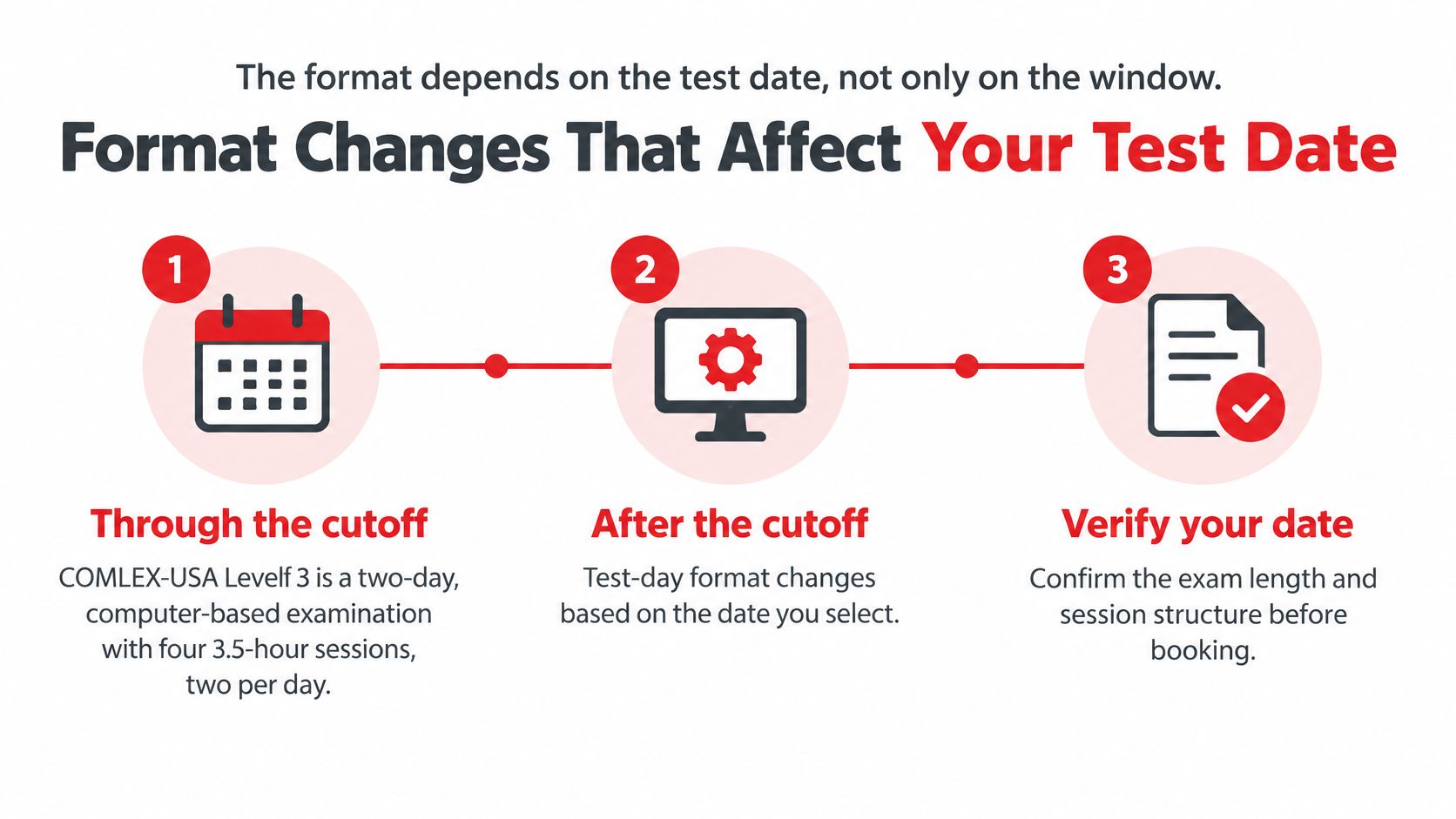
Two-day and one-day COMLEX Level 3 formats compared
| Feature | Two-day format before the transition | Planned one-day format from the published transition |
|---|---|---|
| Test days | Two days | One day |
| Sessions | Four computer-based sessions | Confirm the redesigned session structure in the applicable bulletin |
| Session length | 3.5 hours each | Confirm individual session lengths in the applicable bulletin |
| Approximate daily time | About eight hours per day, including tutorial and breaks | Eight-hour examination; confirm the detailed appointment schedule |
| Question count | Consult the applicable bulletin for the exact total | Fewer questions; confirm the exact total |
| Content blueprint | Existing blueprint | Same overall blueprint |
| Appointments to book | Two within the permitted interval | One |
How to handle transition boundaries
A final administration date for an outgoing format and an effective date for its replacement can describe separate milestones. They don't establish that testing is offered on the intervening dates.
A December final-administration reference should therefore never be interpreted as permission to schedule the older format throughout the remaining calendar period. Candidates near the transition need NBOME's current calendar and applicable bulletin to establish both whether testing is offered and which format applies.
For preparation details beyond booking logistics, the COMLEX Level 3 format guide provides a separate place to review examination structure. Calendar planning should remain focused on appointment requirements, approved absence, travel, and the format shown for the actual reservation.
Planning Backward From Your Residency Calendar
A useful plan begins with the residency schedule, not a preferred examination month. The candidate identifies feasible leave periods, checks which official windows overlap those periods, and then works backward through registration and appointment-search requirements.
The registration deadline and the recommended seat-search lead time serve different purposes. The registration cutoff isn't automatically earlier than the ideal search start, and candidates shouldn't force those milestones into a presumed order.
Backward planning milestones for COMLEX Level 3
| Milestone | Timing | Action |
|---|---|---|
| Residency timing | Follow the applicable bulletin's residency-timing guidance and confirm individual eligibility | Confirm that the program supports the planned window |
| Registration opens | At the opening published for the selected window | Monitor NBOME and confirm the relevant cycle |
| Start seat search | By NBOME's recommended advance-scheduling point | Search for the complete appointment arrangement |
| Registration deadline | Set by the assigned testing window | Complete registration and payment before the cutoff |
| Prep planning | Set from practice performance and available study time | Match preparation tasks to the resident's actual schedule |
| Score release target | Published for the selected window | Plan follow-up while allowing for a possible change |
A hypothetical late-spring plan
A resident hopes to test during a late-spring outpatient block. Before requesting final leave, the resident checks the official window, its registration cutoff, the advance-scheduling recommendation, and the appointments available.
The resident then asks the program whether the examination absence can be approved and whether adjacent duties create a conflict. A night shift before travel, a required clinic session, or an unpredictable handoff may make an otherwise available appointment a poor choice.
Preparation needs a separate readiness decision. The scheduling guidance isn't a personalized study prescription, and a lighter rotation doesn't automatically mean the candidate is ready to test.
A workable appointment fits both the clinical calendar and the candidate's preparation needs. Availability alone isn't a readiness assessment.
The resident can place the window deadline, appointment-search reminder, leave request, and score-release target in a shared calendar. Each entry should identify who owns the next action, such as the candidate, chief resident, or program coordinator.
The medical residency application timeline addresses broader application planning. Its milestones shouldn't be substituted for the resident's program-specific Level 3 scheduling requirements.
How to Book Both Level 3 Appointments
Booking a two-appointment format works like reserving two legs of the same trip: each segment has to be available, and the first one only counts if the second completes the journey inside the permitted interval. Candidates whose selected format requires a pair of appointments should treat the pair as a single scheduling task. Candidates assigned the redesigned format should follow its applicable appointment instructions instead.
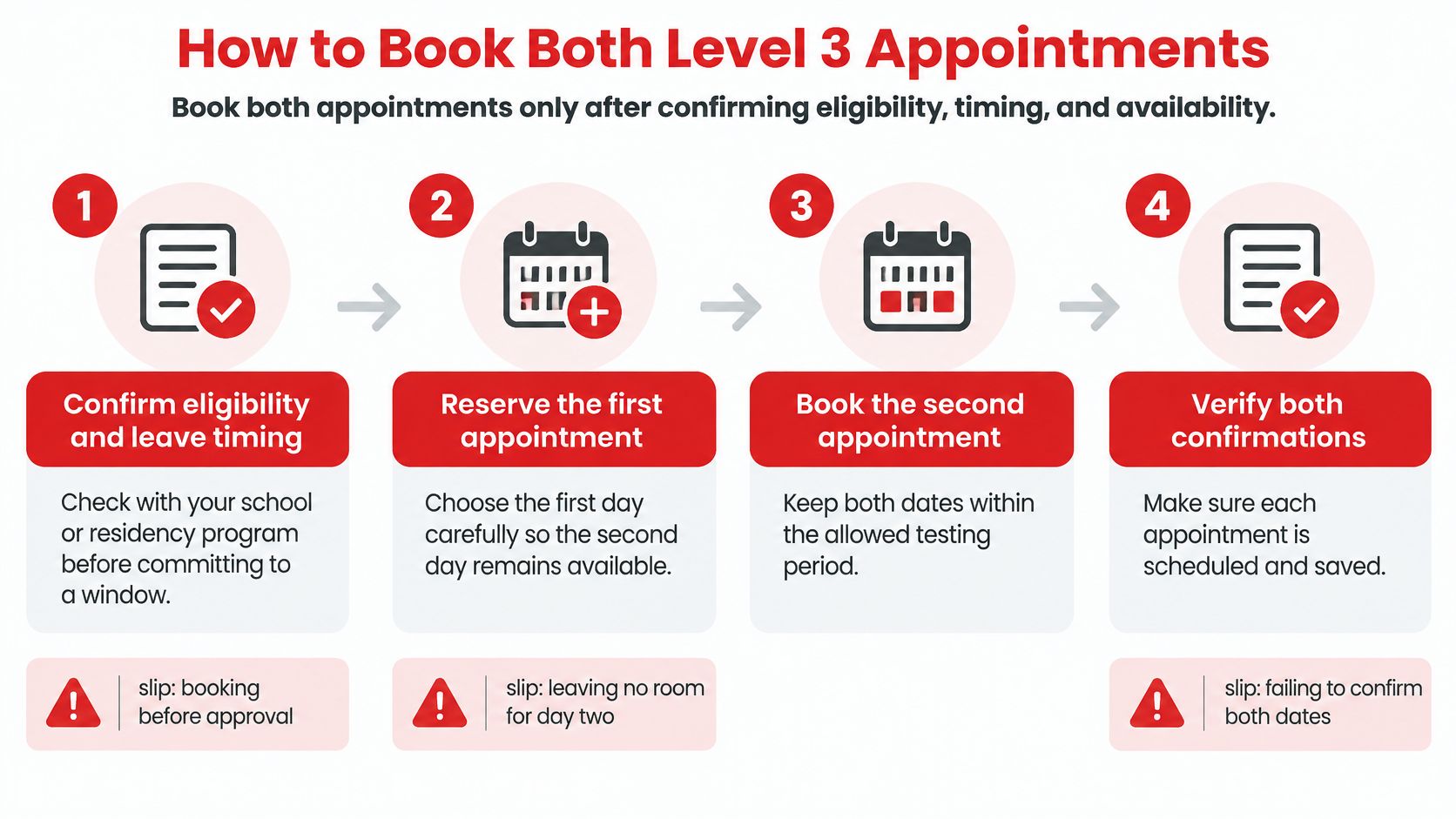
Confirm eligibility and leave timing. Review individual eligibility through NBOME and coordinate the clinical absence with the school or residency program. The common slip is treating a preferred rotation as approved leave before the program has agreed.
Identify the appropriate testing window. Read the registration deadline attached to that exact window rather than reusing a remembered deadline from another cycle. A window that fits the clinical calendar is still unusable once its cutoff has passed.
Complete registration through NBOME's current process. Follow the instructions shown in the official account and confirm that registration is complete. Portal labels and workflow details should come from the current system, not an older walkthrough.
Search for a workable first appointment. Evaluate the first appointment together with the remaining appointment requirement. The earliest available start is not always the best choice if it leaves no acceptable completion date.
Secure the remaining appointment within the permitted interval. Its order and timing must meet the rules attached to the selected examination format. The common slip is confirming a date that fits approved leave but falls outside the authorized scheduling arrangement.
Save and inspect every confirmation. Compare appointment details, testing-center addresses, and the registered name against current identification instructions. Record the score-release target separately from the appointment confirmations.
Delegate reminders, not account control
Administrative help can reduce calendar clutter. A coordinator can set deadline alerts, track leave paperwork, and flag confirmation emails, and general guidance on how to delegate scheduling and calendar coordination covers exactly that kind of reminder management.
Account control stays with the candidate. Eligibility decisions, payment authorization, and final appointment verification belong to the person sitting the exam, because only the registered candidate can confirm that the booking matches the format and the identification on file. A complete booking has the required confirmations saved, approved leave recorded, and the correct format identified for the selected date.
Rescheduling, Cancellation and Refund Rules
NBOME's frequently asked questions page lists a $950 Level 3 registration fee and change rules that tighten as the appointment approaches: no fee for a change made more than 30 days before the examination, a $170 forfeiture when the change falls six to 30 days out, and no rescheduling at all inside the final 24 hours. Where charges are assessed per examination day, a booking that spans two appointments can carry a separate consequence for each one.
COMLEX Level 3 change and cancellation timing
| Timing before the exam | Change allowed | Financial effect |
|---|---|---|
| More than 30 days | Reschedule or cancel through the scheduling portal | No change fee |
| Six to 30 days | Reschedule through the NBOME change process | $170 forfeiture deducted from the registration fee |
| Less than 24 hours | Rescheduling isn't permitted; the appointment stands | The paid fee stays attached to this appointment and can't be moved to a new date |
Because fee schedules can be updated, the candidate should confirm the current amounts on the NBOME FAQ page and in the portal transaction summary before submitting a change.
What each timing band means for planning
An early change costs nothing but time. A resident whose appointment is still more than 30 days away has the widest room to rearrange clinical coverage, reconsider travel, and secure a replacement seat inside an open testing window. A reschedule isn't finished until that new seat is confirmed; releasing the old appointment before a workable alternative exists can leave the candidate with neither.
Inside the 30-day boundary, every move carries a $170 cost per affected examination day. Inside the last 24 hours, the decision narrows to sitting the examination or walking away from the booking.
The candidate should also keep three outcomes distinct: rescheduling, which moves the seat to a new date; cancellation, which releases it; and nonattendance, which forfeits it. A prohibition on rescheduling under 24 hours doesn't, by itself, spell out what a cancellation or a missed appointment would cost, so the transaction summary needs a careful read.
- Read the transaction summary. Identify the charge or forfeiture displayed before submitting the change.
- Check each examination day. When charges apply per day, changing a multi-appointment booking means reviewing every affected reservation.
- Save the revised record. A cancellation confirmation and a replacement appointment confirmation serve different purposes, and both belong in the file.
The COMLEX rescheduling guide can help organize the decision, but NBOME's current policy controls the transaction. If the portal and the published policy appear inconsistent, the candidate should seek clarification from NBOME before proceeding.
A schedule change isn't a personal failure. The useful response is to confirm the applicable rule, protect clinical coverage, and choose a realistic next step.
A resident may need to move an examination because of illness, family responsibilities, clinical demands, or preparation concerns. The practical question is whether the replacement plan, including leave approval and an available seat in the right window, holds together on its own merits.
Pre-Booking Checklist and Final Decision
A candidate should book only after the window, date-specific format, and complete appointment arrangement have been verified. This checklist is complete only when each policy item has an official reference and a recorded checking date.
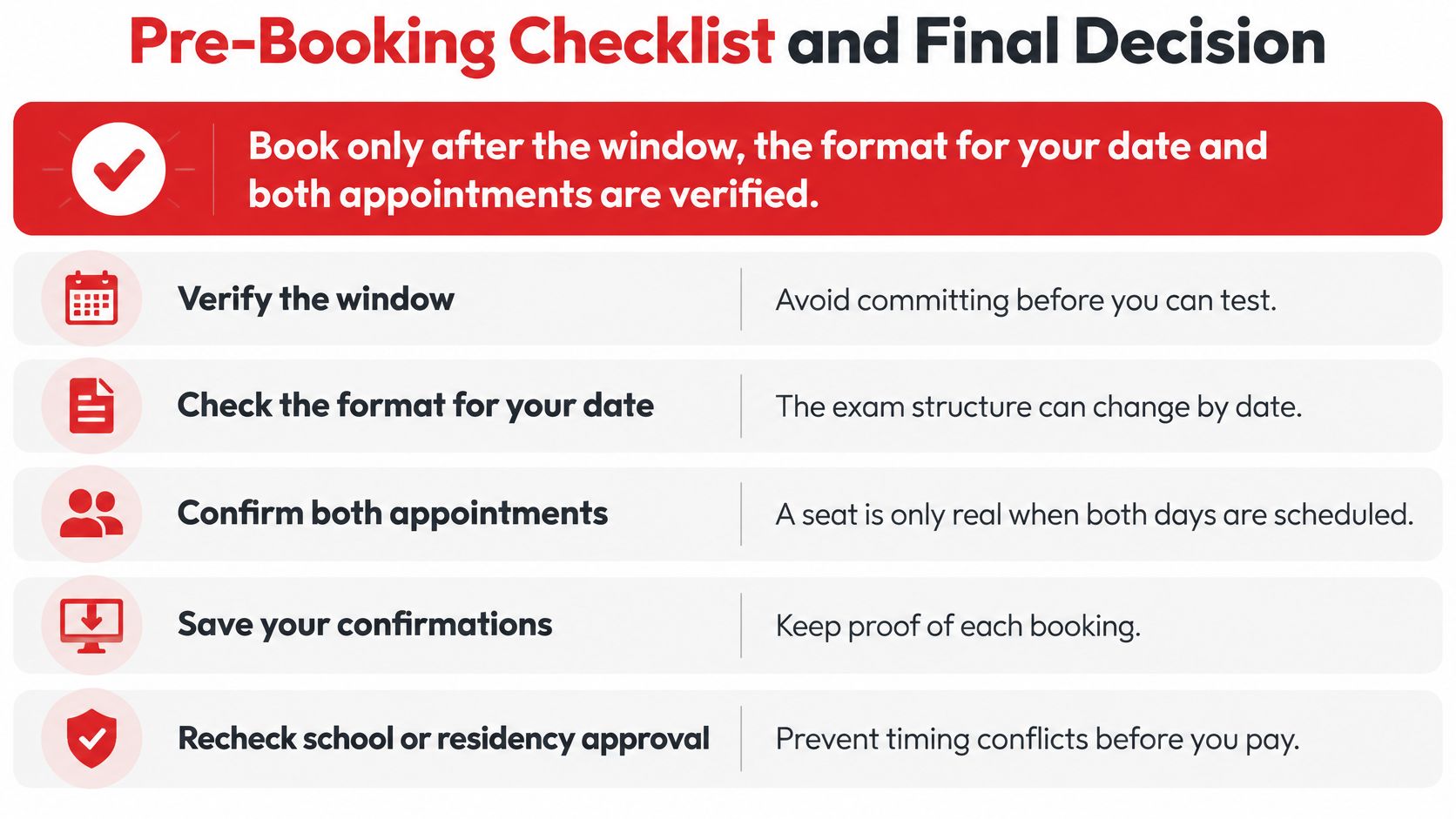
- Record the verification date. Calendar and fee information can change, so the candidate should retain the page title and checking date.
- Confirm the window and registration deadline. The selected appointment must belong to the correct administration period.
- Resolve transition references. The current bulletin and calendar should establish the last administration of the outgoing format and the first administration of its replacement.
- Confirm the required appointments. Every necessary reservation must be saved before scheduling is treated as complete.
- Record the score-release target. The candidate should distinguish an anticipated result date from a program's reporting requirement.
- Check current financial terms. The COMLEX cost guide can support budgeting, while NBOME determines examination charges and refunds.
- Obtain program approval. Leave, rotation coverage, travel, and return-to-duty expectations should be settled before committing.
- Create deadline reminders. Advance-search, registration, and change-policy reminders should be separate calendar entries.
For preparation support, the COMLEX tutoring information page describes an option for candidates preparing for Level 3, including those facing a plateau or returning after an unsuccessful attempt. Ace Med Boards doesn't set NBOME dates and doesn't claim NBOME affiliation, endorsement, or partnership; NBOME's current testing-windows page remains the authority for examination dates.
Sources
Which page should you trust when an open testing window and a reserved seat do not match? Start with the NBOME document that matches the decision you are making. Each source below supports the matching discussion above, and upcoming test windows and deadlines should be read from NBOME's current calendar before booking.
- NBOME, COMLEX-USA Testing Windows and Score Release Dates. Supports the historical window table, registration timing, and the qualification that score-release targets may change.
- NBOME, COMLEX-USA Bulletin of Information. Supports the published examination structure and planned redesign. Candidates should use the edition applicable to their examination date.
- NBOME, Registration and Scheduling. Supports advance-scheduling advice and the appointment-order and interval requirements for the existing format.
- NBOME, Examination Format. Supports the format comparison and published effective date of the planned transition.
- NBOME, Frequently Asked Questions. Supports the listed registration fee and cancellation or rescheduling information, subject to confirmation of current terms.
A testing window works like an open season: being inside it does not hold a specific day. The testing-windows page sets that season and the score-release target. The registration page then explains how the two Level 3 appointments are ordered and spaced. If a format change falls near your date, the bulletin and the examination-format page show which version applies to that administration. Read the fee and change rules on the FAQ before you pay or move a seat, because those terms can differ from an older bulletin.
Ace Med Boards offers COMLEX tutoring that covers content review, clinical reasoning, question approach, and pacing. That support can help you match study time to a residency calendar your program has already approved. A candidate can visit Ace Med Boards to schedule a free COMLEX consultation about the examination level and timeline.