
De Virgilio surgery is not one standardized operation or a disease-specific procedure. In the records behind the name, it points to Christian De Virgilio's surgical education, authorship, and clinical research, most often the case-based surgical review.
Most students type the phrase because it sounds like an operation. The search returns a textbook, a residency program director, and a scatter of operative papers. That gap is the whole problem. A clerkship grade depends on knowing which item you opened.
Key takeaways
- Name first: “De Virgilio surgery” is an author and a set of publications, not a protocol.
- Edition second: Title, year, publisher, and ISBN (International Standard Book Number) have to match before you study.
- Cases train decisions: Commit to an answer before you read the discussion.
- Guidelines win conflicts: Pair the review with current official outlines, not with memory of an older chapter.
- Two weeks is the test: Shrink the error log before you swap books.
What DeVirgilio Surgery Refers To in Practice
A student searches for a procedure and lands on a textbook. That result is the finding, not a broken search. De Virgilio surgery points to Christian De Virgilio's surgical teaching, writing, and research. The name works like a library shelf, not a single operation.
An LMU newsroom profile describes Christian de Virgilio, MD, FACS, as a surgeon and educator. He is a general and vascular surgeon, educator, and author. That profile helps explain why students meet his name in study material. It does not establish a "De Virgilio operation."
What the name actually covers
The confusion comes from mixing three kinds of records. A textbook teaches a clerkship student how to reason. A research paper reports what one surgical team did in a narrow clinical setting. A board review book prepares a resident for an exam. They can share an author and still serve different readers.
A peer-reviewed operative report describes a vastus lateralis muscle free flap for tongue reconstruction, with a fascia paddle extending more than 20% beyond the muscle flap in every direction. A consecutive series of 10 patients completed head-and-neck free-flap anastomoses with a 4K three-dimensional exoscope and reported 100% final free-flap survival during a mean follow-up of 4.3 months. A 2025 target-trial study in Annals of Surgery analyzed 113,994 carotid endarterectomy patients and 12,613 transcarotid artery revascularization patients, with an adjusted 90-day composite morbidity risk of 4.1% for both. Those papers are research records. They are not the clerkship text.
| Item | Type | Detail reported | Clerkship relevance |
|---|---|---|---|
| Surgery: A Case-Based Clinical Review | Case-based review book | First edition 2015; later editions listed by the publisher | Core clerkship reasoning resource |
| Review of Surgery for ABSITE and Boards | Board and ABSITE review book | Third edition November 2022, ISBN 9780323870542 | Residency exam preparation, not core clerkship reading |
| Vastus lateralis free flap for tongue reconstruction | Operative report | Fascia paddle more than 20% beyond the muscle flap in every direction | Procedure-specific, not a clerkship topic |
| 4K exoscope free-flap series | Case series of 10 patients | 100% reported final flap survival, mean follow-up 4.3 months | Technical research, not clerkship material |
| Carotid endarterectomy vs transcarotid revascularization | 2025 Annals of Surgery target-trial study | 113,994 and 12,613 patients; 4.1% adjusted 90-day composite morbidity for both | Outcomes research, not clerkship material |
ABSITE means the American Board of Surgery In-Training Examination. The two books are the items a student might read. The flap series and the carotid study do not set shelf answers. A 10-patient series can suggest a technical possibility. It cannot benchmark complications for a clerkship exam.
Practical rule: Name the specific procedure before you discuss indications, anatomy, or outcomes. No single De Virgilio protocol exists.
If the clerkship itself is still fuzzy, the medical student clerkships overview separates ward work from the subject exam so the book has a clear job.
Confirm the Edition and Publisher Before You Study
Which edition are you holding? The cover can say DeVirgilio and still belong to one of two different books. One is a case-based clerkship review. The other is an ABSITE and board review. Check the edition before you read the first case.
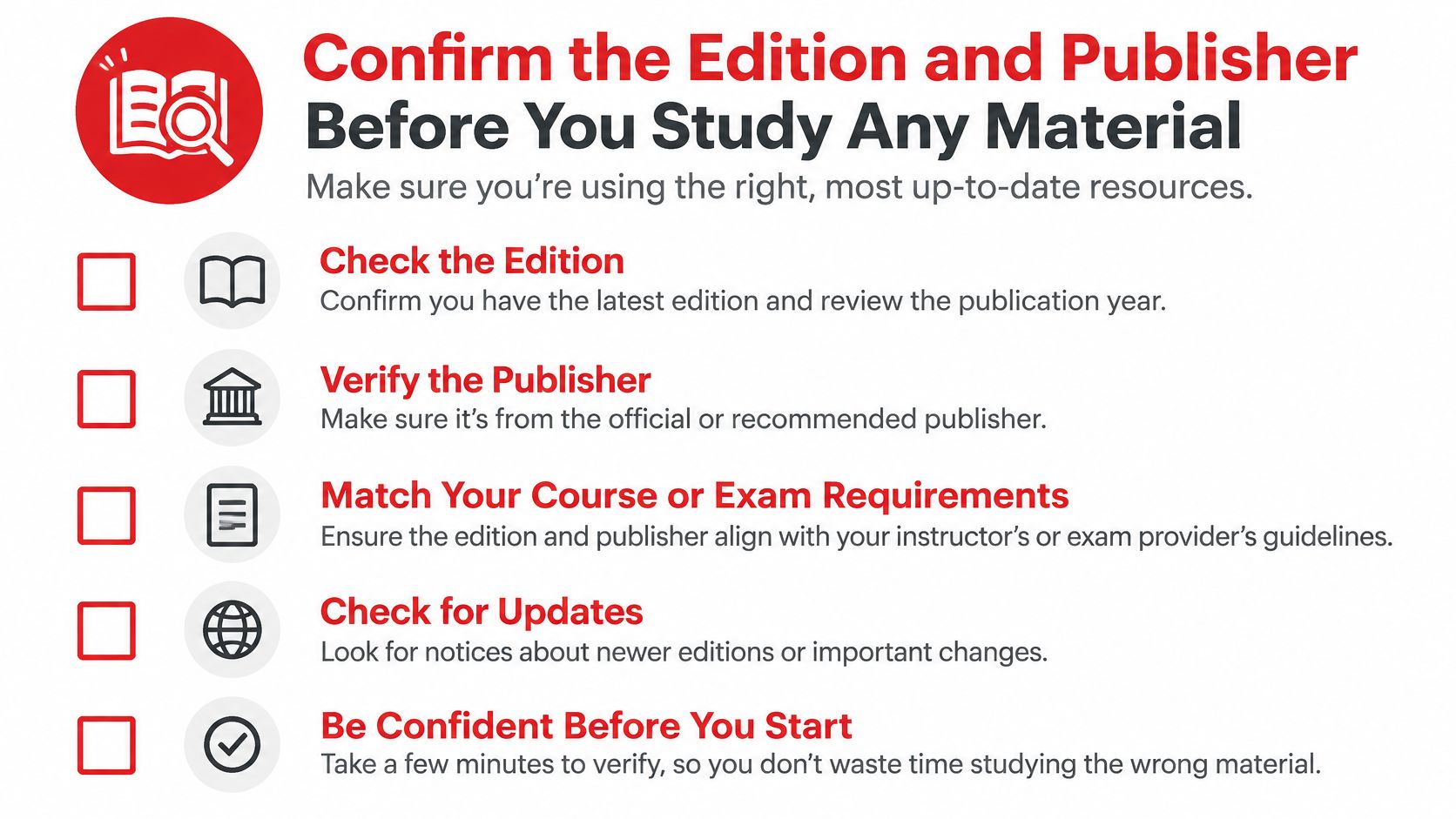
A Springer front-matter file for Surgery: A Case Based Clinical Review places the first edition in 2015 and the second edition in 2020, and the same file lists Review of Surgery for ABSITE and Boards, co-edited by Christian DeVirgilio and Areg Grigorian, in a third edition dated November 2022 with ISBN 9780323870542. Do not pick a winner from memory. Check the publisher's current listing.
Verification checklist
- Title and subtitle. Surgery: A Case Based Clinical Review is the clerkship case book. Review of Surgery for ABSITE and Boards is the residency exam book.
- Edition number and year. Write both down. “The new one” is not an edition.
- Publisher and ISBN. Match them to the publisher's current page, not to a reseller photo.
- Syllabus match. If the school names a text, that title wins over a popular alternative.
- Verification date. Editions and stock change. Note the day you checked.
| Title | Edition and year | Publisher or ISBN | Clerkship fit |
|---|---|---|---|
| Surgery: A Case Based Clinical Review | First edition 2015; second edition 2020 | Springer (2020 second edition) | Clerkship case review; match to the syllabus |
| Review of Surgery for ABSITE and Boards | Third edition, November 2022 | ISBN 9780323870542 | Residency and ABSITE review, not the core clerkship text |
The case book supports clerkship reasoning. The ABSITE book prepares for a residency exam. Use each title for the exam it was written for.
If the school names no edition, ask the clerkship coordinator which text the course expects. A short list of books for the medical student can sit beside that answer. It does not replace it.
Build a Weekly Clerkship Reading and Question Workflow
Call weeks eat long reading plans. This sample is a framework, not an official schedule. Shorten a block when you are post-call. Finish and review every question you start.
| Day | Review text focus | Question work | Output to keep |
|---|---|---|---|
| Monday | One case-based topic: presentation and differential | None (reading day) | Written differential of three to five options |
| Tuesday | Same topic, after the question set | Short set from an official or school-assigned source, every answer reviewed | Error log entries with the reason for each miss |
| Wednesday | Management section of the same case | No new questions; rewrite the decision | One-paragraph management plan in your own words |
| Thursday | Mixed topics from earlier in the week | Second question block | Updated error log |
| Friday | Review of the week's error log | None | Two rules to remember next week |
| Weekend | One case rebuilt from memory | None | Comparison with the text and any gaps listed |
How the days fit together
Monday is intake. Spend 30 to 45 minutes on one case's presentation and differential. Stop with three to five written options. Do not collect five topics.
Tuesday is retrieval. Use a short set from an official form or the school's assigned bank. Review every item, including the ones you got right for the wrong reason. Each miss becomes one error-log line.
Wednesday is translation. No new questions. Rewrite the management choice in your own words so the paragraph still makes sense away from the page.
Thursday mixes earlier topics so Tuesday's case does not stay isolated. Friday turns the log into two rules you can say on rounds. The weekend rebuild is one case from memory, then a gap list against the text.
Classify each miss with the three labels in the reasoning routine: knowledge gap, misread finding, or priority error. One log runs the week.
Two signs the workflow is working: the error log shrinks from week to week, and review time does not grow faster than question time.
A fuller surgery shelf exam study schedule can stretch this skeleton across a whole rotation. Keep this week's outputs even if you change the daily counts.
Turn Each Case into a Reasoning Routine
The case format teaches reasoning when you commit before the discussion. Reading the answer first feels efficient and hides the miss.
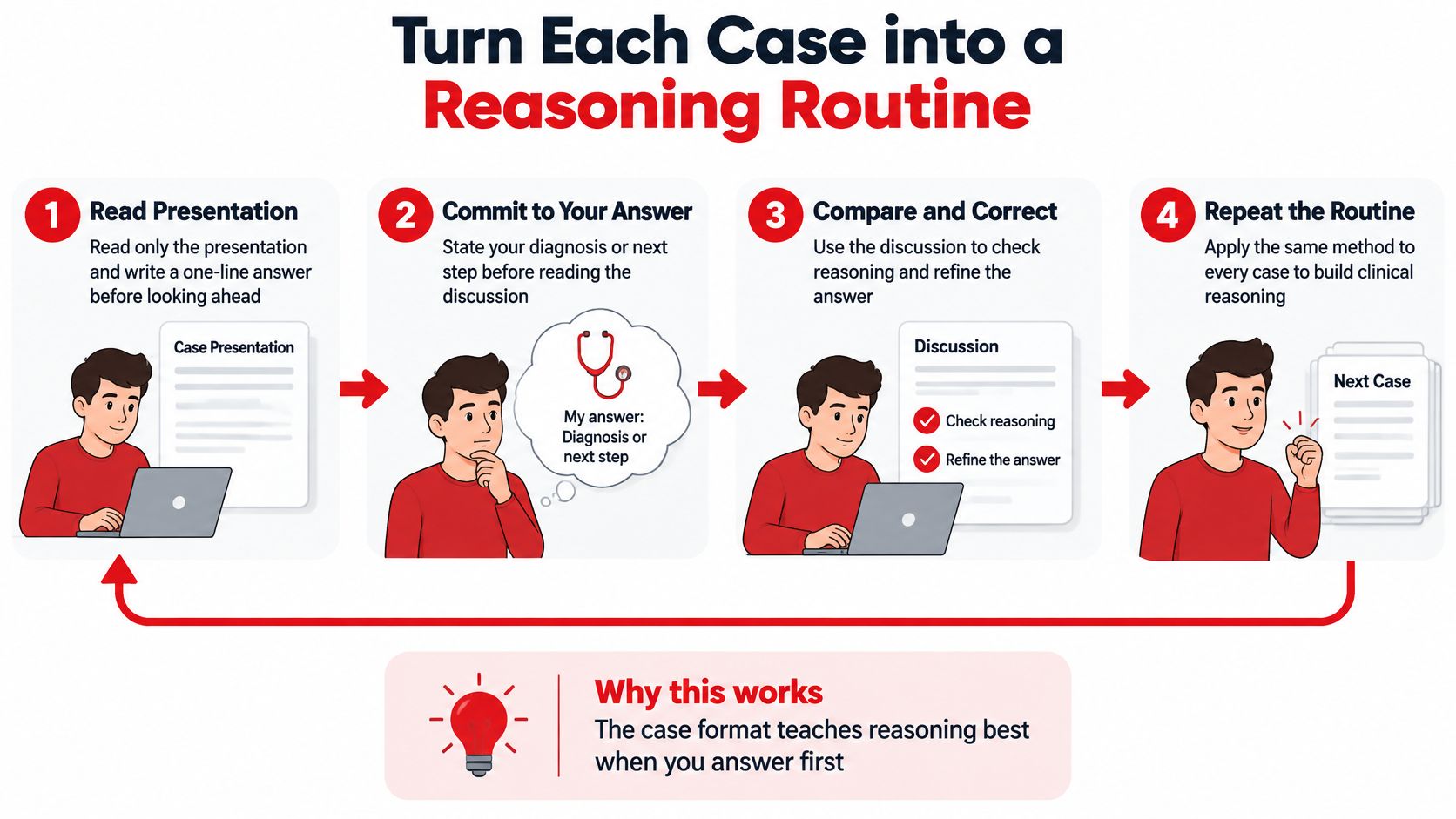
The picture compresses the habit. The pass below is what you write.
- Read only the presentation and write a one-line working diagnosis. That first impression is the claim you will test.
- Write a differential of three to five options before you turn the page, so you can see what you already know.
- Mark the finding that separates the top two options. Most surgical questions turn on one detail.
- Compare operative and nonoperative choices and write the reason. The reason is what transfers.
- Read the postoperative course and note expected complications and how they are recognized.
- Log the miss as a knowledge gap, a misread finding, or a priority error. Each type needs a different fix.
A short educational case
Say a 46-year-old with mid-abdominal pain, one episode of vomiting, and a history of an open appendectomy. Your first three options might be adhesive small-bowel obstruction, gastroenteritis, and early appendicitis in a patient with an atypical history. Distended bowel loops with air-fluid levels on plain film, plus high-pitched rushes, separate obstruction from the other two. The next decision is whether that patient needs an operation tonight or a trial of decompression. Write the reason, not just the verb.
This is an educational simplification. Real decisions depend on the patient, the exam, and the attending's judgment. Nothing here is advice for a patient.
The case is done when you can explain the decision without looking at the text. If you want the habit named in plain language, what clinical reasoning is is the companion piece. Use it as a definition, then come back and write the one-line diagnosis.
Pair the Review with Official Practice Materials
The review is strong on case structure. It is not the source for a current threshold, an exam blueprint, or a score report. Editions age. A number that was fair when the chapter was written can be the wrong exam answer later.
National Board of Medical Examiners (NBME) subject-exam outlines and self-assessments, listed on nbme.org, show the surgery subject exam's blueprint and timed style. School objectives say what your course grades. A current society guideline is the check for any drug, cutoff, or operative standard you might quote. Osteopathic students should confirm whether the clerkship exam is an NBME product or a National Board of Osteopathic Medical Examiners (NBOME) product. Those exams and their materials differ. Verify on each organization's site.
| Source | Job in your study | Where to verify |
|---|---|---|
| NBME subject-exam content outline and self-assessment | Blueprint and timed practice for the surgery subject exam | nbme.org, current listing |
| School clerkship objectives and assigned question source | Defines what the course tests | Clerkship coordinator |
| Current society or guideline document | Thresholds, drug and operative standards | Issuing organization's current publication |
| De Virgilio review | Case structure and reasoning routine | Edition confirmed in the edition checklist |
A question bank trains retrieval and timing. The review trains why an answer wins. Use them together. For a neutral look at how banks differ in layout, medical question bank formats compared is a useful side read. It does not replace the school's assigned set or an official form.
One-on-one tutoring can complement official materials, question banks, and independent study. It does not replace them.
If a chapter and a current guideline disagree:
- The exam answer follows the current guideline and the official outline.
- The ward decision follows the supervising attending, not a study note.
- Log the conflict so you do not memorize the older line.
NBME practice shelf exams are the place to rehearse that official style once the case routine is steady.
Choose Your Edition and Start the First Week
Three moves are enough to begin.
Confirm the book with the edition checklist: title, year, publisher, ISBN, and the date you checked. Set Monday as one topic plus an empty error log, not a stack of resources. Read the log after two weeks. The first two weeks test the routine. If misses are not shrinking, change the question source or the block length before you change books.
Students who want an outside structure can read the Ace Med Boards tutoring services page for what is listed now. Listings change, so confirm that surgery or shelf support is offered before you plan around it. Sessions are conducted by secure online video meeting. Tutoring complements official practice materials and independent study. It does not replace them, and no score, pass, or grade outcome is guaranteed.
If the workflow needs outside support, that page is where you check current options.
Ace Med Boards offers one-on-one online tutoring that can sit beside a surgery clerkship plan, including case-based review and question analysis, without replacing official outlines or your assigned bank. If the Monday block and the error log need a second set of eyes, visit Ace Med Boards to see current options and whether a free consultation fits your rotation.