A useful COMLEX Level 3 practice test must cover both multiple-choice items and clinical decision-making cases for the current two-day exam; the passing standard is 350. What does a strong question-bank percentage establish if the candidate hasn't practiced deciding which clinical action comes next?
For a busy resident, assessment should produce a decision: continue the current plan, change the review method, or seek targeted support. The most useful resource isn't necessarily the largest bank. It's the one that matches the scheduled exam version and reveals weaknesses that a total percentage can hide.
Ace Med Boards Editorial Team
What Counts as a COMLEX Level 3 Practice Test
Does a practice resource train you to make the next clinical decision, or only to choose an answer? A useful COMLEX Level 3 assessment should reflect both single-best-answer questions and clinical decision-making (CDM), where decisions are linked and responses may include extended multiple choice or short answers.
The NBOME examination-format page describes the two-day format as four separately timed sessions, with a 14-day testing window. It includes 420 single-best-answer questions and approximately 26 CDM cases. The page also describes a one-day format, so check that a resource matches the version scheduled for your exam. A bank can still help with content review while falling short as a full exam rehearsal.
Key Takeaways
- Check the decision-making sequence. CDM practice should connect assessment, testing, treatment, and follow-up.
- Match the exam version. Confirm that the materials reflect the format you will take.
- Separate question practice from simulation. A flexible question bank can support learning without reproducing the exam's timed structure.
- Read scores in context. A practice percentage is an indicator, not a guaranteed exam result.
- Look beyond item count. More questions do not necessarily mean better practice for clinical decisions.
COMLEX Level 3 Practice Formats Compared
| Practice format | What it trains | Timing to copy | Main limit |
|---|---|---|---|
| NBOME samples and CDM tutorial | Item style, extended multiple response, short answers | Tutorial pace, not a full examination | Not a full-length score predictor |
| Timed multiple-choice blocks | Single-best-answer knowledge and pacing | Separate sessions matching the scheduled format | Omits CDM sequencing |
| CDM case sets | Prioritization, testing, treatment, and follow-up | A dedicated CDM block within the applicable limit | May cover fewer question types than the full exam |
| Two-day dress rehearsal | Stamina across both modes | The complete session structure for the scheduled format | Difficult to schedule during residency |
| Official self-assessment such as COMSAE | A trend-style readiness indicator | The applicable timed NBOME form | Percent correct isn't a guaranteed passing score |
COMSAE means Osteopathic Medical Self-Assessment Examination. The name alone does not establish whether a currently available form matches Level 3 or the format you are scheduled to take. Confirm the form's level, availability, timing, and score interpretation before purchase. A self-assessment should not automatically be treated as a complete CDM simulation.
A Comparison Checklist Before Buying
Mark each criterion confirmed, missing, or unclear:
- Version label: Identifies the applicable exam format.
- Response types: Includes single-best-answer, extended multiple-response, and short constructed answers.
- Case structure: Uses linked CDM questions rather than isolated management facts.
- Timers: Reproduces the applicable session limits.
- Results: Reports domain-level weaknesses, not only percent correct.
- Explanations: Teaches reasoning without claiming access to live examination wording.
- Update date: States when the content and format information were last revised.
NBOME samples and tutorials help illustrate item style. For commercial-bank evaluation, the COMBANK and TrueLearn resource guide offers another point of comparison. Check whether a product's current questions and case structure match the exam version you plan to take.
A practical starting combination is one primary scored tool and dedicated CDM practice. Choose based on whether the materials build clinical decisions in sequence and match your scheduled exam version, rather than on the number of multiple-choice items.
How to Simulate the Two-Day Exam
A dress rehearsal should reveal what happens under realistic constraints, not what happens with unlimited pauses. It should distinguish a knowledge problem from pacing, fatigue, or unfamiliar response entry.
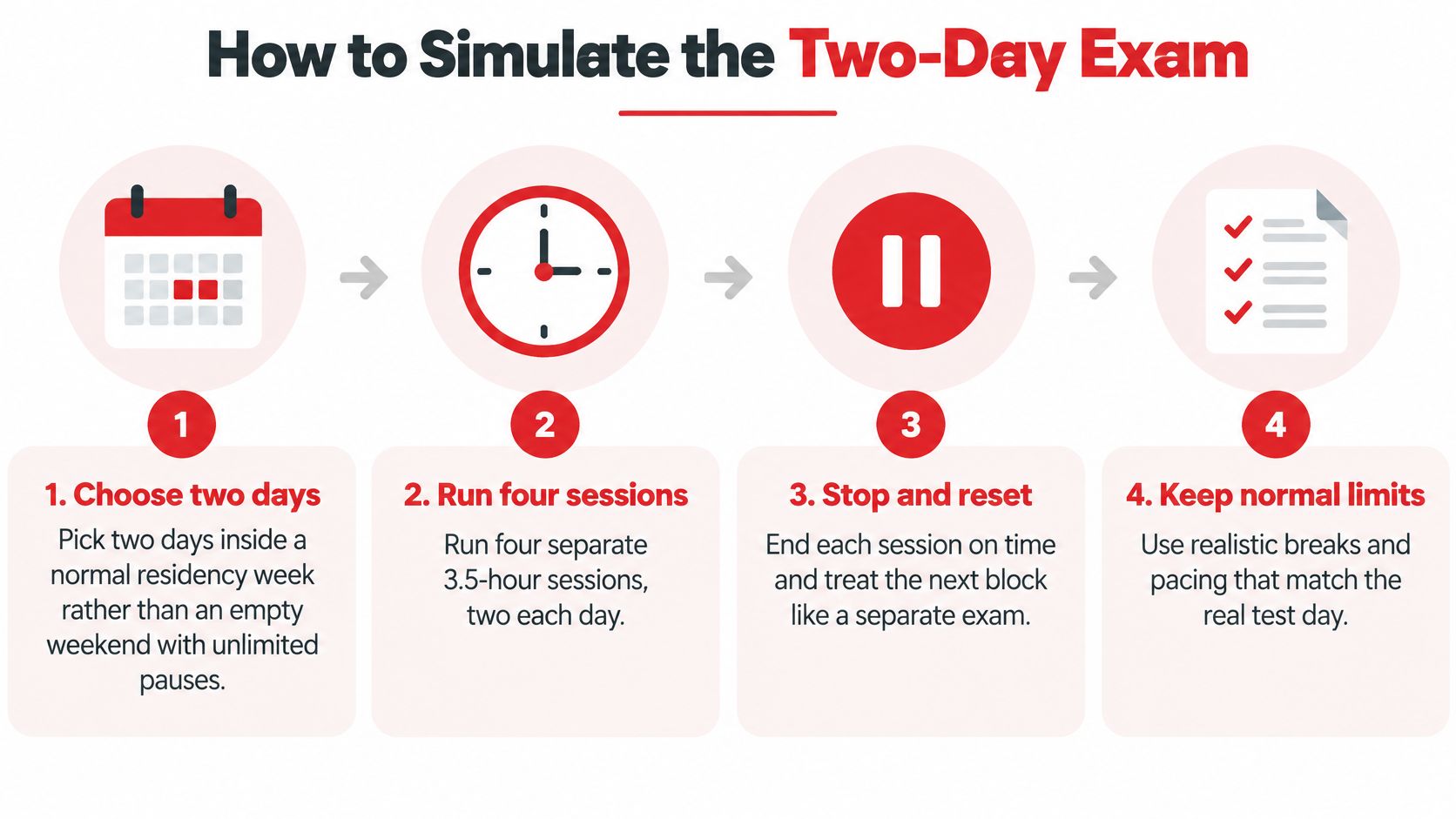
For the two-day format, the NBOME bulletin eligibility page describes two separately timed 3.5-hour sessions per day, with unused Session A time unavailable for transfer to Session B, within a 14-day testing window. Those constraints should determine the rehearsal rather than the question bank's most convenient default.
A Realistic Rehearsal Sequence
Choose representative days. Protected time within an ordinary residency week is preferable to an arrangement with unlimited interruptions or recovery time. The candidate shouldn't sacrifice necessary sleep or clinical responsibilities to manufacture a simulation.
Complete the tutorial beforehand. Response selection and short-answer entry should already feel familiar when the assessment begins. Otherwise, the result blends clinical reasoning with interface learning.
Run separately timed sessions. Each session ends when its timer ends. Finishing early doesn't create extra time for the next session, and unfinished items remain recorded as unfinished.
Keep CDM together. A dedicated case block exposes cumulative pacing problems that disappear when cases are scattered through tutor mode. Explanations and lookups remain closed until the timed work ends.
Standardize the environment. A quiet room, planned breaks, a consistent screen setup, and a realistic food and hydration plan reduce avoidable differences between practice attempts. A phone stays outside the work area.
Record performance conditions. The candidate notes fatigue, unseen items, interrupted concentration, and rushed cases before reviewing answers. These observations help explain a score without dismissing it.
When a Full Rehearsal Isn't Feasible
During a demanding rotation, a candidate can complete an uninterrupted session and a separate short CDM set. That is a partial assessment, not evidence of full-exam stamina, and the log should label it accordingly.
Simulation rule: A completed session under honest conditions is more informative than a nominal full-length test assembled from interrupted fragments.
The examination's scheduling window is an administration rule, not a recommendation to distribute a practice assessment across weeks. Excessive spacing changes what the rehearsal measures.
Candidates preparing for the announced one-day examination should rebuild the rehearsal around NBOME's published structure for that version. They shouldn't retain an obsolete endurance plan just because older materials use it.
The USMLE Step 3 computer-based case simulation guide addresses a different examination format. It shouldn't be used as a substitute for COMLEX-specific CDM instructions or interface practice.
How to Log and Review Every Miss
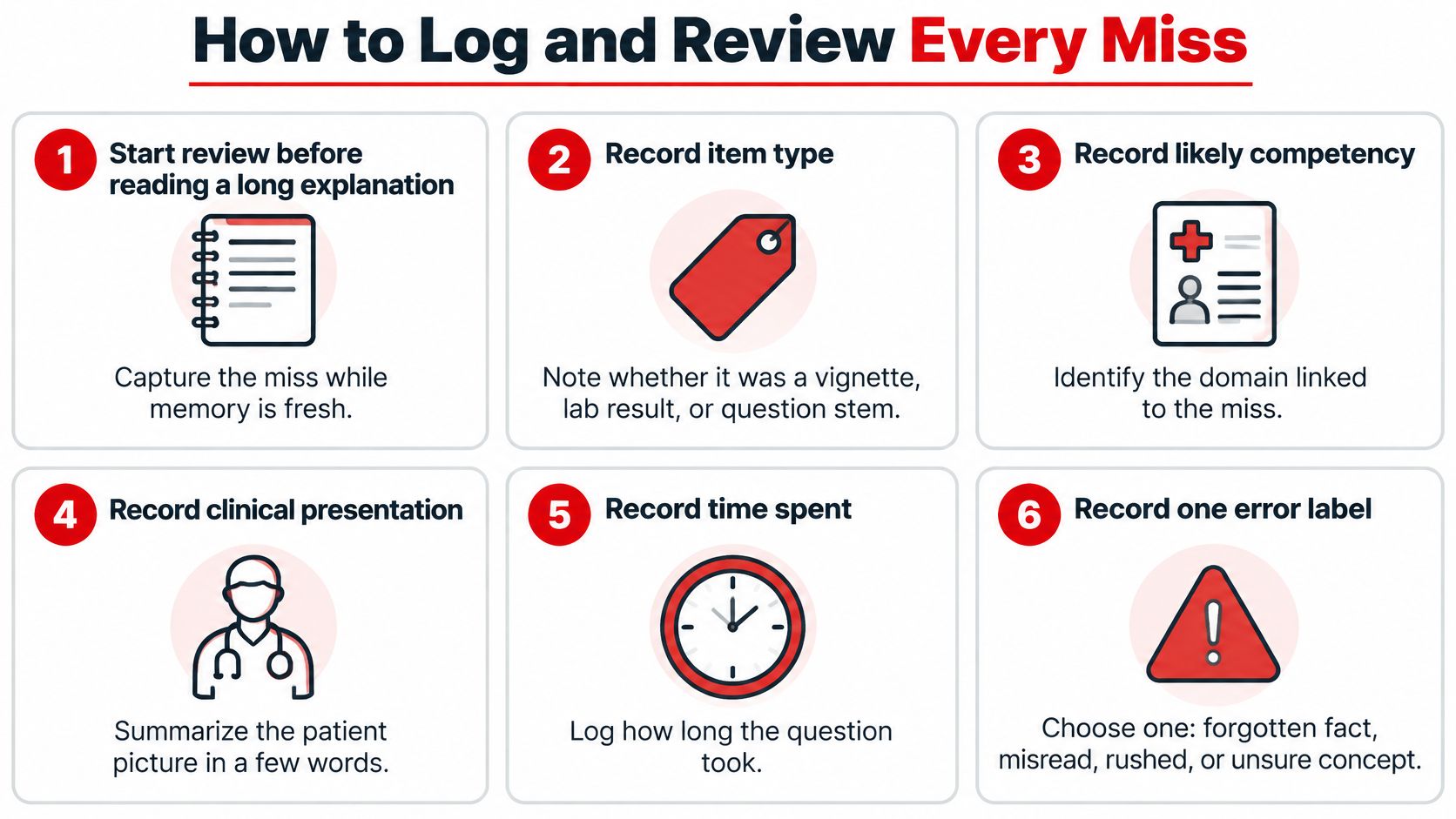
Review begins before the explanation opens. The candidate first records what seemed most likely, which action was chosen, and why the alternative was rejected.
That brief reconstruction separates a forgotten fact from a decision error. Reading a polished explanation first can make the correct reasoning feel obvious and obscure what happened during the attempt.
The NBOME practice-resources page identifies CDM as a distinct component and provides separate practice materials. A review system should therefore examine clinical actions and linked decisions, rather than treating every miss as a flashcard problem.
A Reusable Error Log
| Field | What to record |
|---|---|
| Item type | Single-best-answer, extended multiple-response, or constructed answer |
| Likely competency | Patient care, osteopathic principles, communication, or another relevant domain |
| Clinical presentation | A brief description of the presenting problem |
| Time spent | Recorded time, with a note about rushing or prolonged uncertainty |
| Primary error | Forgotten fact, misread stem, unsafe prioritization, over-ordering, omitted action, wrong sequence, or incorrect multi-select |
| Corrective task | The specific exercise needed before reassessment |
Broad labels such as rushed or unsure concept can start the review, but they shouldn't end it. The candidate needs a more actionable explanation: an omitted action, a misunderstood mechanism, or a decision made before the necessary assessment.
For CDM, the log should outline the intended pathway: assess urgency, stabilize when indicated, investigate, treat, consult, and arrange follow-up. Not every case follows an identical order; the useful step is identifying the first divergence between the candidate's reasoning and the explanation.
A Fact Gap Versus an Action Gap
Consider a wholly original educational scenario, not an official or recalled item: a clinic vignette describes worsening shortness of breath. The examinee chooses a low-yield scan before assessing oxygenation and recognizing the need for urgent management.
The learning point is sequence, not a specific treatment recommendation. Additional clinical details would be necessary for actual care, but the examination-review task is to recognize that immediate assessment was bypassed.
A new flashcard about possible diagnoses wouldn't directly correct that error. A sequencing drill would: the candidate explains which information establishes urgency and which decisions can reasonably wait.
A useful log entry names the decision that failed, not merely the topic that appeared.
The distractor-analysis guide complements this process by examining why an attractive answer was wrong for that particular question.
For an illustrative spaced-review plan, safety-related misses return the following day, repeated patient-care or osteopathic-treatment patterns return after several days, and mixed review follows later in the week. These are editorial scheduling suggestions, not NBOME requirements.
Results can then be grouped into recall, prioritization, safety-netting, and CDM decision paths. Learning points should be paraphrased in the candidate's own words, without copying restricted question-bank or examination content.
How to Interpret a Practice Score
As of 2026, the NBOME Level 3 page identifies 350 or higher as the passing standard and describes comparison with the mean of first-time examinees who passed and the mean of all examinees. The standard is criterion-referenced, not a requirement that a predetermined percentage of candidates fail.
The NBOME description of examinations explains that the result reflects performance across the examination rather than separate pass decisions for individual content areas, with unscored pretest questions excluded. Consequently, a commercial raw percentage can't be converted into a guaranteed standard score.
Level 3 Domain Minimums and What Weakness Suggests
The following minimum shares are reported in NBOME's Level 3 blueprint; the interpretation column is an editorial review aid, not an official diagnostic classification.
| Competency domain | Minimum share | What repeated misses suggest |
|---|---|---|
| Osteopathic patient care and procedural skills | At least 40% | Weak test, treatment, or procedure sequencing |
| Application of knowledge for osteopathic medical practice | At least 15% | Facts are known but not applied to the vignette |
| Foundational biomedical sciences | At least 10% | The mechanism behind the decision is unclear |
| Osteopathic principles, practice, and manipulative treatment | At least 10% | Osteopathic diagnosis or treatment choice needs work |
| Practice-based learning and improvement | At least 8% | Guidelines or feedback aren't being used |
| Professionalism | At least 6% | Ethics or responsibility cues are being missed |
| Systems-based practice | At least 6% | Coordination, setting, or resource use is off |
| Interpersonal and communication skills | At least 5% | The response doesn't address what to say or document |
For a clinical-presentation cross-check, the NBOME examination-scores bulletin identifies musculoskeletal systems at 13%, community health and wellness at 12%, and nervous system and mental health at 10%. Presentation categories offer another way to sort misses; they aren't additional percentages to add to the competency table.
Read the Pattern, Not Just the Total
A candidate should track the overall indicator, CDM or multi-response performance, and recurring domain weaknesses. Only an assessment that explicitly provides an appropriate standard-score estimate should be compared numerically with the official passing threshold.
- Rising results with fewer safety errors: Continuing the current approach may be reasonable, provided testing conditions remain comparable.
- Flat results with repeated sequencing errors: The method needs adjustment, not more questions.
- A decline after poor sleep or interruptions: A comparable, uninterrupted reassessment is more informative than an immediate scheduling decision.
- Strong totals with recurring omitted actions: Overall accuracy doesn't resolve the specific CDM concern.
The COMLEX score and percentile guide provides related score-report context. Percentile comparisons, however, shouldn't replace an assessment of the candidate's actual reasoning gaps.
A low result is information, not a judgment of professional worth. That remains true after an unsuccessful attempt; the useful question is which errors persist and what different practice would address them.
Turn Practice Results into a Study Plan
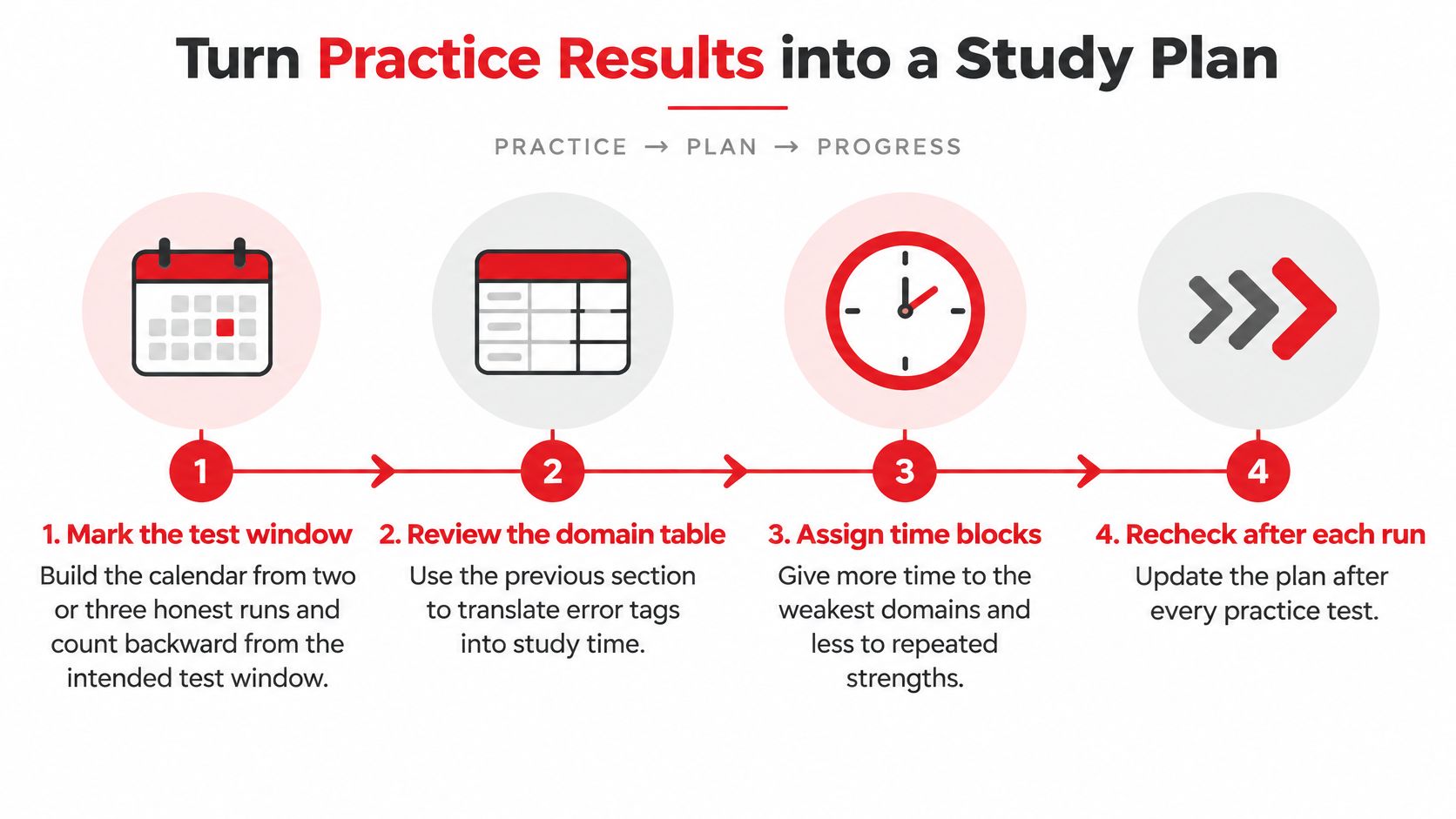
A study calendar should reflect the error log, available energy, and scheduled exam version. It shouldn't assign equal time to every topic just because equal blocks look organized.
An illustrative planning approach uses a baseline rehearsal, a midpoint check, and a later reassessment if clinical duties permit. These are suggested checkpoints, not an official preparation schedule.
Let Error Tags Determine the Work
The candidate starts with the intended test window and counts backward, protecting a final taper period without a new full-length assessment. The last substantial rehearsal should leave enough time for meaningful correction rather than merely generating a score immediately before testing.
Between rehearsals, study tasks follow the dominant error tags. Frequent patient-care sequencing errors justify linked-case drills; repeated osteopathic-treatment errors justify focused review followed by application questions.
Post-shift work should have a finishable endpoint. A timed block or a CDM set, followed by review of the previous log, is easier to evaluate than an open-ended instruction to study all evening.
Sample Resident Week
This is an illustrative editorial schedule, not a schedule supplied by NBOME or Ace Med Boards.
| Day | Session | Log follow-up |
|---|---|---|
| Monday evening | Timed multiple-choice question block, single-best-answer | Tag each miss the same night |
| Tuesday morning | Log review of Monday block | Update error counts |
| Wednesday evening | Timed multiple-choice block | Compare tags with the prior week |
| Friday | Protected half-day off | None |
| Saturday morning | Timed CDM set, one hour | Mark the first divergence per case |
| Sunday | Log review and next-week plan | Pick the top two error tags |
A week dominated by omitted actions should produce a different following week from one dominated by forgotten mechanisms. In the former, the candidate rehearses decision paths; in the latter, focused content review precedes fresh application questions.
Progress check: The plan is working when repeated error patterns diminish, not merely when study hours increase.
The Level 3 advanced clinical practice preparation guide addresses the broader content plan. This assessment-driven calendar can sit alongside it without duplicating every subject assignment.
For residents who struggle with task initiation or breaking large assignments into manageable steps, Uptown Psychology's executive functioning strategies for college success offers general organizational ideas. That resource isn't an authority on examination rules or a substitute for individualized clinical assessment.
A duplicate question bank is a reasonable item to remove when review time becomes scarce. The candidate gains more useful information from correcting a recurring error than from accumulating another unrevised set of answers.
Pitfalls to Avoid and When to Get Help
A long question count can create the impression of progress without showing whether you can make the right decision at each step. Choose practice by how well it rehearses clinical decision-making sequences and whether it matches the 2026 or 2027 exam version you plan to take.
Common Pitfalls and Their Corrections
- Treating tutor mode as an assessment. Immediate feedback changes the task from recall under exam conditions to learning with support. Use a separate timed attempt without explanations or lookups when you want to assess readiness.
- Buying overlapping question banks without reviewing errors. More questions add little if the same mistakes go unexamined. Keep one shared error log and pair a main assessment resource with focused case practice.
- Using the wrong version for rehearsal. A version mismatch makes conclusions about pacing and stamina less useful. Check the product's version label and update date before purchase and before a major simulation.
An older timer may still help with learning medicine. Use it to study content, not to judge how well you can manage the scheduled exam format.
When Targeted Support Is Reasonable
Consider structured support if sequencing or safety errors persist across timed practice, or if scores remain flat and the error pattern is unclear. A previous unsuccessful attempt can also be a reason to review which parts of preparation helped and which need a different approach.
Ace Med Boards tutors students preparing for COMLEX Level 1, Level 2-CE, and Level 3, including those facing a plateau or returning after an unsuccessful attempt. Tutoring covers content review, clinical reasoning, question approach, and pacing. The COMLEX tutoring page describes the service, and the pricing page lists available hours, package prices, and eligible guarantees.
Tutoring can complement official practice materials, independent study, and question review. The ACE Progress Increase Guarantee applies to eligible 20-hour and 40-hour USMLE and COMLEX packages, with a target of 10 points on NBME or 50 points on COMSAE practice assessments. To qualify, students take an NBME or COMSAE self-assessment before the first session and another by the end of tutoring and before the official exam. Shelf and COMAT examinations are excluded.
Before booking the exam or buying practice materials, confirm the current two-day or one-day format and scheduling details on NBOME's official website, since these can change.
Ace Med Boards also offers a free COMLEX consultation to discuss your exam level and timeline. Bring recent assessment reports, recurring error tags, and your intended testing window to help focus the conversation.