

To improve Psych/Soc on the MCAT, students should stop adding more flashcards and start auditing why passage questions go wrong, then retest those exact weaknesses on unfamiliar material under time pressure. The Medical College Admission Test (MCAT) Psychological, Social, and Biological Foundations of Behavior section rewards applied reasoning, not vocabulary in isolation. A blueprint-weighted diagnostic, an error taxonomy, and spaced retrieval tied to passage transfer provide a clearer route forward than another week of rereading.
Where You Stand and Where the Section Is Going
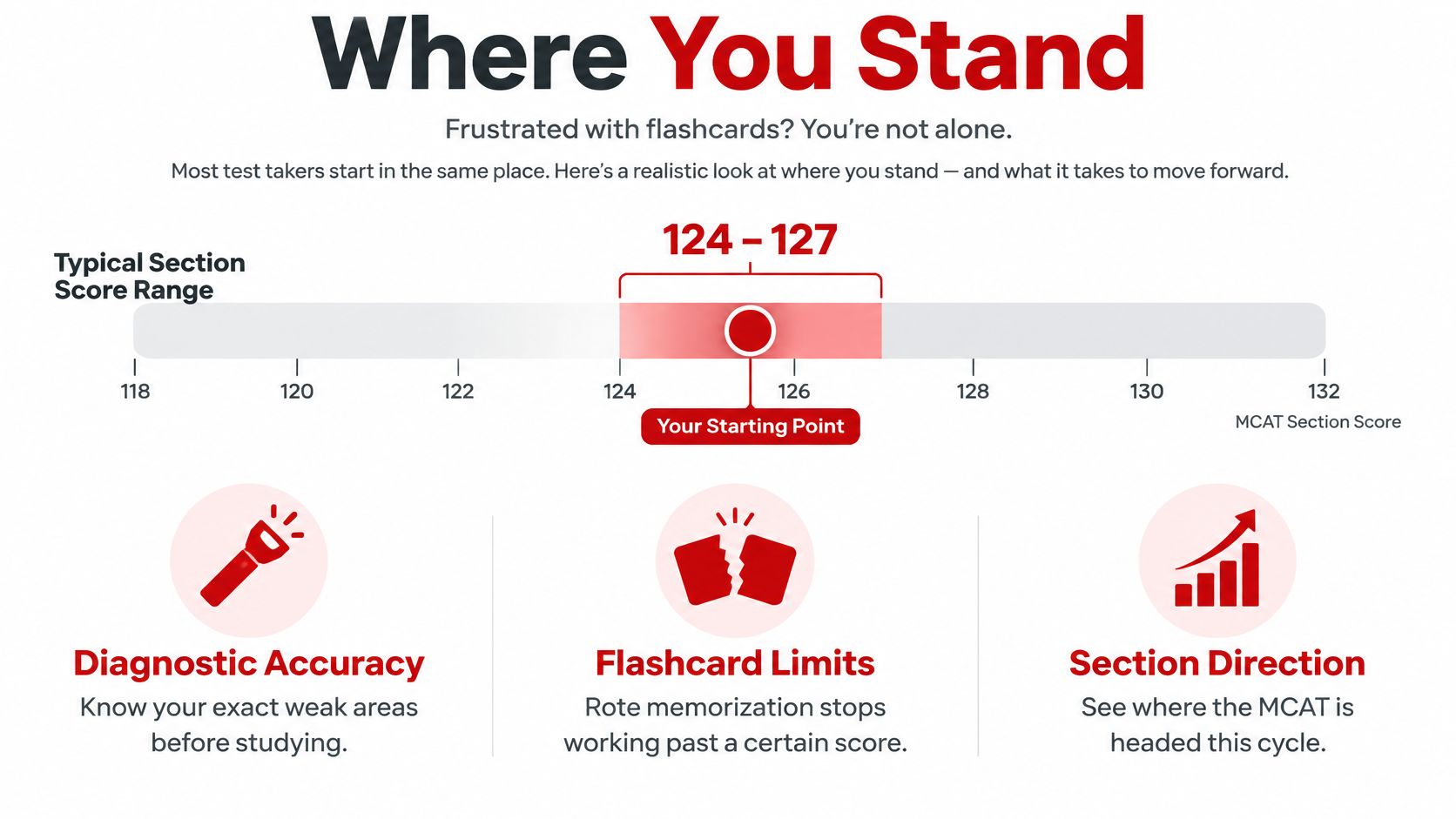
A common plateau looks like this. A premed has worked through Khan Academy notes, matured a large Anki deck, and can define most terms on sight. Practice scores still sit in the same band. Passage sets feel harder than discrete questions, and wrong answers usually come down to two choices that both sound plausible. When I see that pattern in a student, the diagnosis is almost always the same: the studying stayed at the level of recognition while the section kept demanding application.
The AAMC describes the section as assessing how psychological, social, and biological factors influence behavior and health across five foundational concepts and a set of scientific reasoning skills. A definition earns points only when a student can attach it to a mechanism, a study result, or a health-related example inside a passage. Treat Psych/Soc like a vocabulary course and the score stalls. Treat it like applied reasoning and it moves.
Key Takeaways
- Diagnose before adding volume: A timed baseline shows whether misses come from content gaps, construct confusion, or passage reasoning.
- Weight study by blueprint: Psychology carries more of the section than sociology or biology, so equal time for every topic wastes hours.
- Retest on new material: Improvement counts only when a previously missed construct gets answered correctly in an unfamiliar passage.
- Track scaled trends: Error categories and repeat performance reveal more than one raw percentage.
For score context, AAMC percentile rankings for 2023 to 2025 based on 305,494 examinees placed a section score of 123 at the 25th percentile, 129 at the 85th percentile, and 132 at the 100th percentile. Use those markers to set incremental targets. A lower starting score is a scheduling input; it says nothing about your ceiling.
The blueprint reports two different breakdowns, and students routinely conflate them. Keep them separate when you plan.
Discipline Share of Section
| Discipline | Share of Section |
|---|---|
| Introductory psychology | Approximately 65% |
| Introductory sociology | Approximately 30% |
| Introductory biology | Approximately 5% |
Foundational Concept Share of Section
| Foundational Concept | Share of Section |
|---|---|
| Foundational Concept 7 | 35% |
| Foundational Concept 6 | 25% |
| Foundational Concept 8 | 20% |
| Foundational Concept 9 | 15% |
| Foundational Concept 10 | 5% |
The first table tells you the content mix. The second tells you which reasoning themes the AAMC weights most heavily across that content, and they are independent cuts of the same section. The practical answer to how to improve Psych Soc MCAT performance starts there: your study time follows blueprint weight and your own error frequency, not whichever topic felt worst last week.
The Blueprint That Drives Every Study Decision
The section contains 59 questions in 95 minutes, with approximately 65% introductory psychology, 30% introductory sociology, and 5% introductory biology, according to the AAMC Psychological, Social, and Biological Foundations of Behavior section overview. That split should shape a weekly plan from day one. A student weak in sociology still shouldn't spend half of every week on sociology if psychology errors account for more lost points.
Structure matters as much as content mix. The 59 questions combine 10 passage-based sets of four to six questions with 15 independent discrete questions, as described in the AAMC guide to what's on the MCAT exam. Discrete questions reward clean recall. Passage sets reward something different, namely reading a study, identifying variables, and mapping results onto a construct. Preparation that only trains the first skill leaves most of the section undertrained.
Weighting Inside the Blueprint
Foundational concepts aren't weighted equally either. Concept 7 represents 35% of the section, Concept 6 represents 25%, Concept 8 represents 20%, Concept 9 represents 15%, and Concept 10 represents 5%, per the UWorld summary of MCAT Psychology and Sociology blueprint weightings. Students should log every miss by concept so review can start where frequency and personal weakness overlap. A rare topic missed once deserves a note. A high-weight concept missed repeatedly deserves a study block.
Pacing follows from the same numbers. At 59 questions in 95 minutes, the overall target is approximately 1.6 minutes per question, with passage reading time built into that average. Students who read every passage word for word before looking at any question often run short at the end. A better habit is to read for the research question, variables, and results first, then return to details only when a question demands them.
Practical rule: Allocate time by blueprint weight multiplied by personal error rate. Perceived difficulty alone is a poor scheduling tool.
Biology needs targeted attention, not neglect and not overinvestment. At roughly 5% of the section, a small number of mechanism gaps can still cost points, especially on discrete questions. Short, focused review of the biology that appears inside behavioral contexts handles that risk efficiently. Students building a topic list can cross-check priorities against MCAT high-yield topics guidance and then adjust based on personal diagnostic data rather than a generic list.
Scoring adds one more reason to track trends carefully. Section scores run from 118 to 132, and correct answers convert to a scaled score that can vary by exam form, as explained in AAMC MCAT exam scoring guidance. Small raw changes shouldn't trigger a plan overhaul. Patterns across timed sets should.
Run a Diagnostic and Build Your Error Taxonomy
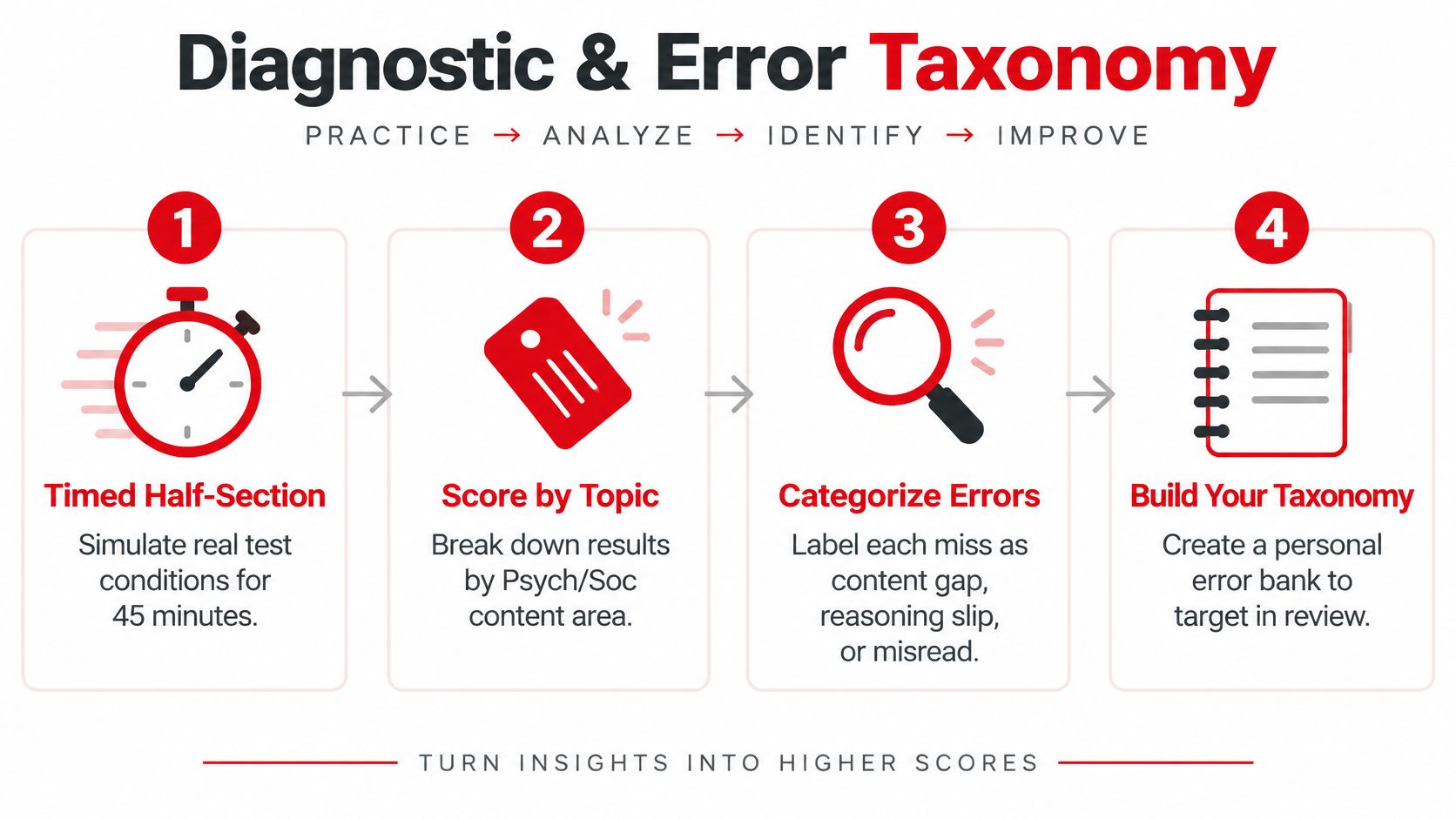
Start with one timed set completed under realistic conditions, no pausing, no checking answers mid-set, and no notes. A half-section is enough for an initial baseline if time is tight. What matters is honest data. Students can use an MCAT practice test for timed diagnostic work and then review every miss and every lucky guess before doing any new content review.
Review is where the diagnostic earns its value. Each missed question becomes one row in an error log with the discipline, foundational concept, tested construct, passage evidence, tempting distractor, and corrected reasoning. A row that only says "missed attribution theory" teaches nothing. A row that says the student chose a dispositional explanation when the passage manipulated a situational variable points directly to the repair.
The Six-Category Error Taxonomy
| Category | What It Looks Like | Sample Tag |
|---|---|---|
| Content omission | The term or theory was never learned | CONTENT |
| Definition discrimination | Two similar constructs were confused | DISCRIM |
| Passage-variable mapping | Variables in the study were matched to the wrong construct | MAP |
| Research-method reasoning | Design, bias, or validity was misjudged | METHODS |
| Graph or table interpretation | Data trends were read incorrectly | DATA |
| Timing or careless error | Rushing or misreading drove the miss | TIMING |
Turning Tags Into Decisions
After tagging, students should count categories before choosing resources. A log dominated by content omission calls for targeted content learning. A log dominated by mapping and methods errors calls for passage drills, not a bigger deck. That distinction is the core diagnostic move, because two students with identical scores can need completely different plans.
One further step separates a log from a diary. Each tagged construct gets retested after a delay using an unfamiliar passage or a newly written scenario. Correct recognition of the original question proves little, since the wording may be remembered. Correct transfer to new material is the evidence that the underlying skill changed. Students should mark retest results in the same row so persistent categories stay visible week after week.
Confidence notes add useful signal at low cost. Marking each answer as confident or guessing during the diagnostic exposes a specific problem, namely confident errors. Those deserve priority because the student won't slow down or double-check a construct that feels solid. Guessed-correct answers belong in the log too. They represent fragile knowledge that timed pressure will eventually expose.
Spaced Retrieval and Anki the Way the Evidence Supports
Retention work should serve the diagnostic, not run on autopilot. Evidence from medical education supports retrieval practice as the core architecture. A 2026 systematic review identified 542 records, included 14 studies, and meta-analyzed 13 studies involving 21,415 learners, finding spaced repetition produced a standardized mean difference of 0.78 with a 95% confidence interval of 0.56 to 0.99 (p < 0.0001) over standard study methods, according to the systematic review and meta-analysis in PubMed Central. That's a strong basis for structure, provided cards demand real recall.
A second data point simplifies scheduling. A meta-analysis of 29 studies found spaced retrieval beat massed retrieval with Hedges' g = 0.74, while progressively expanding intervals showed no meaningful advantage over uniform spacing at g = 0.034, per the Educational Psychology Review meta-analysis on spaced retrieval practice. Students don't need a complicated expanding schedule. A steady cycle works.
A Schedule Students Can Actually Run
- Day 1 retrieval: Produce the definition and mechanism the day after first learning, without looking at notes.
- Day 3 retrieval: Distinguish the concept from its closest near-neighbor in one spoken or written sentence each.
- Day 7 retrieval: Apply the concept to a new short scenario before checking any answer.
- Day 14 retrieval: Mix the concept into a timed passage set so retrieval happens under test-like conditions.
Card quality decides whether this schedule helps. Every missed or guessed question should generate a prompt with four parts. Define the concept. Distinguish it from a closely related concept. Explain the mechanism. Apply it to a fresh behavioral or social scenario. A card that asks only for a one-line definition trains recognition, and recognition is exactly what already failed on the passage.
Flipping a card and thinking "that's familiar" is not retrieval. Producing the answer unaided, then checking, is retrieval.
The most common Anki failure is volume without discrimination. Decks grow while confusing pairs stay confused because they're never tested side by side. Students should build contrast prompts for pairs the error log flags repeatedly, and suspend cards that test wording rather than understanding. Guidance on spaced repetition and Anki setup can help with deck mechanics, but the error log should decide what enters the deck.
One caution keeps expectations honest. The cited evidence concerns retention, not a guaranteed score increase. Flashcards hold knowledge in place. Timed passages prove whether that knowledge transfers. Pairing both, every week, is essential for a section built around passage sets.
Reading Passages and Killing Distractors With Reasoning
Passage work follows a repeatable sequence. First, identify the research question in the opening sentences. Second, name the independent variable and dependent variable in plain words. Third, note what the results showed before reading any answer choices. Fourth, test each choice against the passage evidence and reject distractors by stating which construct would have to be true for that choice to work. Students wanting structured drills can work through MCAT psychology practice questions with passage-based sets using this sequence rather than answer-checking after every item.
Consider an original practice scenario written for study purposes. Researchers randomly assign patients recovering from surgery to either a peer support group that meets weekly or usual care, then measure days until return to normal activity. The support group returns sooner. A question asks which concept best explains the result.

Working the Distractors
- Social support: Fits directly. The manipulated variable is group-based emotional and practical assistance, and the outcome is recovery behavior.
- Self-efficacy: Tempting but unsupported unless the passage measured patients' beliefs about their own capability. No belief measure appears, so this choice imports a psychological construct the study didn't test.
- Social stratification: Describes unequal access to resources across groups. Nothing in the design compares income, status, or resource tiers, so the sociological frame is wrong at the level of the variables.
- Placebo effect: Requires an inactive treatment perceived as real. Usual care isn't a placebo condition, and expectancy wasn't measured.
Notice what decided that question. The answer came from matching variables to constructs, not from knowing definitions harder. Each wrong choice was a real term that belonged to a different study. That's the standard Psych/Soc distractor pattern, and it explains why vocabulary-strong students plateau. General MCAT test-taking strategies for passage reasoning reinforce the same evidence-first habit across sections.
Distractor rule: A choice isn't wrong because it sounds unfamiliar. It's wrong because the passage variables don't instantiate that construct.
Review of passage sets should end with one written sentence per miss naming the exact evidence that separates the correct answer from the chosen distractor. That sentence goes into the error log. A week later, the same construct gets tested in a different passage. Students whose logs show mostly mapping and methods tags should expect passage drills, not additional flashcards, to produce movement. Extra cards have diminishing returns when recall was never the bottleneck.
A Six-Week Schedule, Daily Blocks, and a Mid-Cycle Checkpoint
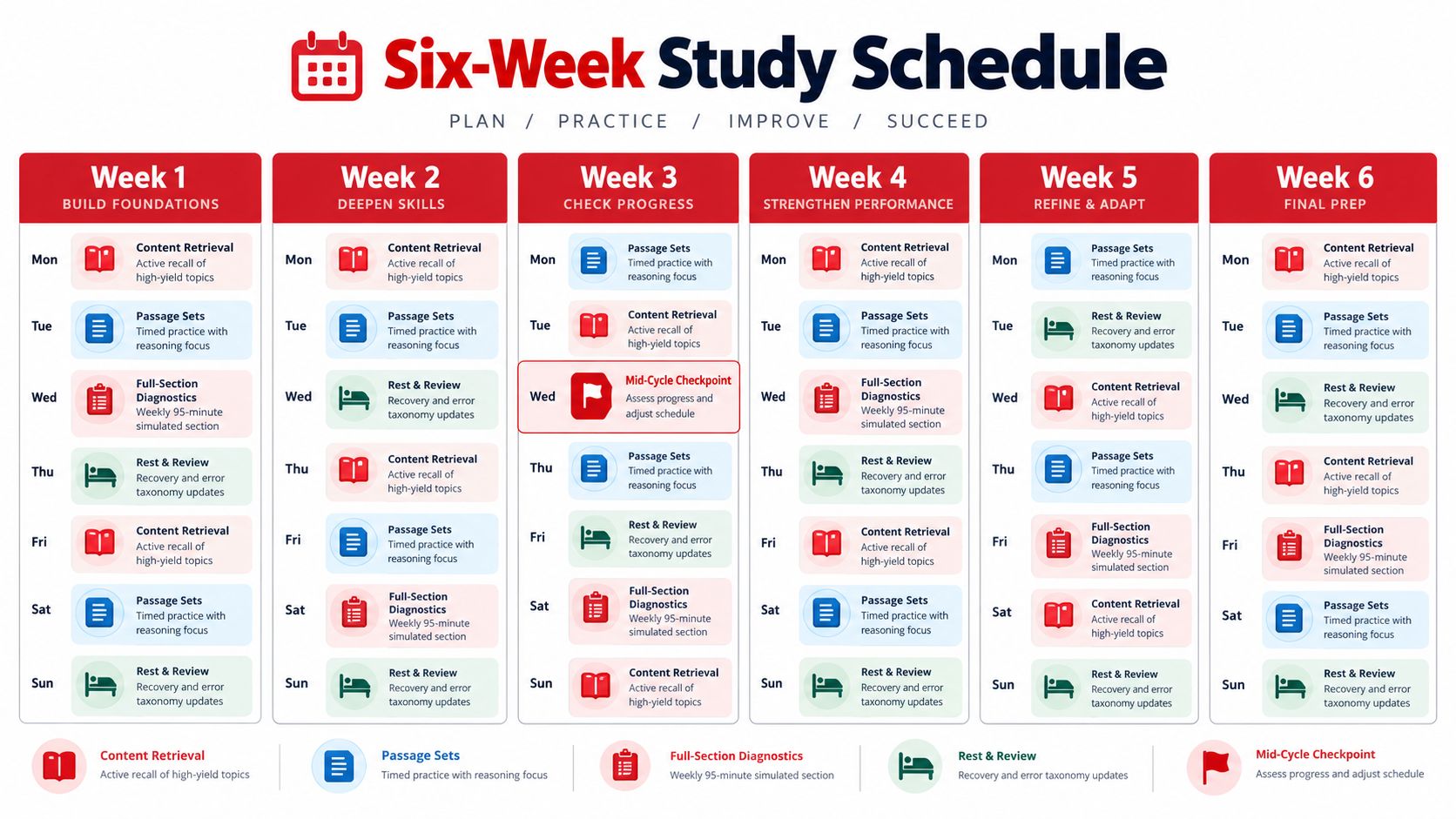
Six weeks is enough time to run the full cycle of diagnosis, retrieval, passage transfer, and retesting at least twice. The schedule below assumes daily Psych/Soc blocks alongside other MCAT sections, with load adjusted to a student's overall plan. Early weeks weight blueprint-heavy psychology and fresh error-log repairs. Later weeks shift toward timed full-section work.
Sample Six-Week Psych/Soc Schedule
| Week | Mon to Wed | Thu to Fri | Sat | Sun |
|---|---|---|---|---|
| 1 | Timed diagnostic, error log setup | Retrieval for top error categories | Two passage sets, untimed review | Rest, log cleanup |
| 2 | Psychology retrieval blocks | Sociology retrieval, contrast cards | Timed half-section | Retest Week 1 constructs |
| 3 | Passage drills on dominant tag | Methods and data drills | Full-section diagnostic, mid-cycle checkpoint | Rest |
| 4 | Repairs from checkpoint data | Mixed timed passage sets | Timed half-section | Retest persistent tags |
| 5 | Biology mechanism review, discretes | Full passage sets under time | Full-section diagnostic | Light retrieval only |
| 6 | Confidence calibration drills | Mixed review of stubborn pairs | Final full-section set | Rest before test week |
Trigger Conditions for Changing the Plan
The Week 3 checkpoint isn't ceremonial. Two triggers should force a change. First, a scaled score that stalls across consecutive full-section sets while the same error category dominates means the current repair method isn't working, so passage drills replace content review or the reverse. Second, any single tag that keeps appearing after two retest cycles gets its own dedicated block rather than more mixed review.
Daily blocks stay simple. One block handles due retrieval from the error log. One block handles new passage work or targeted content. Mixing both into every session blurs the feedback, because a student can't tell whether fatigue or a genuine gap caused late-session errors. Shorter, separated blocks keep the data clean.
Rest belongs in the table for a reason. Sleep supports the retention the retrieval schedule is built to create, and a student reviewing error tags while exhausted generates noisy data. A light Sunday protects the quality of every other day. The schedule serves the diagnostic cycle, and the cycle only works when performance data reflects skill rather than depletion.
Measuring Progress and When Tutoring Makes a Difference
Three metrics predict whether a score will move. The first is scaled-score trend across at least three full-section diagnostics, since single-set swings reflect form difficulty as much as skill. The second is shrinkage of the dominant error category, because a student whose mapping errors halve while content errors hold steady is improving in a way a raw percentage hides. The third is confidence calibration, meaning confident answers are usually right and guesses are flagged.
Retrieval gains also need time to show. Benefits were most consistent when retrieval was structured, repeated, and sustained across weeks to months rather than used as a one-time activity, as concluded in the systematic review cited earlier in this article. Students shouldn't judge a repaired construct after one correct retest. Two correct transfers to unfamiliar passages, spaced apart, is a sturdier standard.
Signals That Outside Help Earns Its Cost
Self-study handles content gaps well. It handles blind spots poorly. Persistent construct confusion, recurring research-method errors, confident mistakes the student can't explain after review, and a plateau holding across multiple full-section sets all point to problems that are hard to see from inside the log. One-on-one review through online MCAT tutoring with individualized session plans is one option for that situation, and students comparing formats can review current MCAT pricing and program information before deciding. Ace Med Boards offers MCAT preparation support that can be structured around a student's error log and diagnostic history.
Tutoring complements official AAMC materials rather than replacing them. The strongest use of a tutor's time is live distractor analysis on passages the student already attempted, where reasoning errors surface in real time. Spending sessions re-lecturing definitions the student can retrieve alone wastes the resource. A plateau is information about method, not ability, and it responds to better diagnosis.
This guidance covers exam preparation only. It isn't admissions counseling, clinical advice, or a prediction of any individual outcome, and exam details should be confirmed against current AAMC publications before test day.
Students whose Psych/Soc scores have stalled despite solid content knowledge can bring a recent diagnostic and error log to a free consultation, where an advisor can help map the pattern behind the misses and outline a targeted study plan. Visit Ace Med Boards to schedule that conversation and decide whether one-on-one MCAT support fits the next stage of preparation.