The second year often feels like a scheduling trap. Lectures, laboratories, integrated cases, and block exams consume the day, while Step 1 preparation sits in the background as a problem that seems too large to start. The most sustainable answer is to study for Step 1 during second year as a parallel curriculum, not as a second full-time course.
Coursework should remain the priority, but each organ-system block can leave behind a durable board-review footprint: a small set of high-yield recall prompts, carefully reviewed questions, and a record of weak concepts. By the time dedicated study begins, the student should be sharpening knowledge and test-taking habits, not rebuilding the entire foundation.
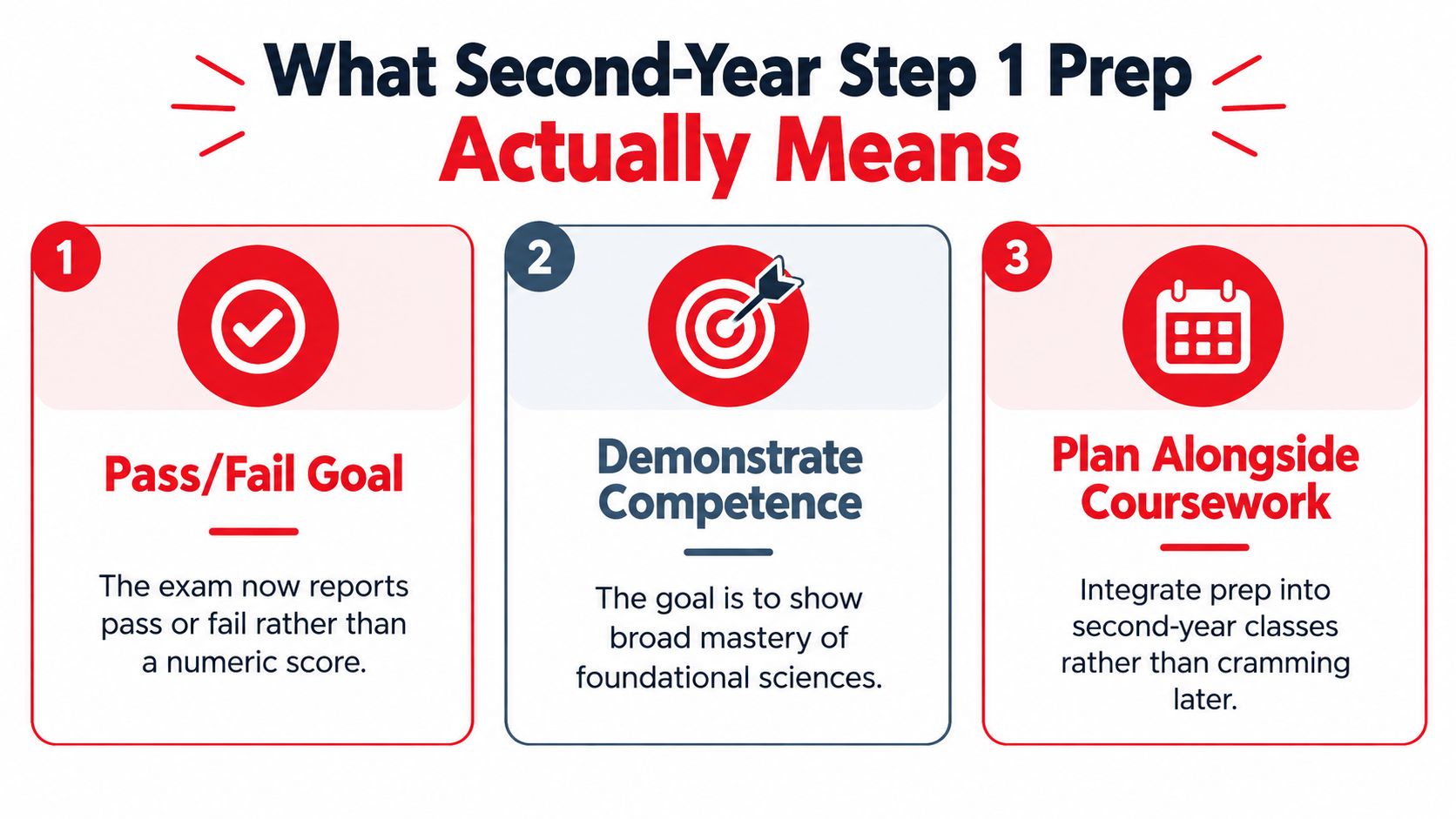
What Second-Year Step 1 Prep Actually Means
Step 1 preparation during second year doesn't mean completing every resource or studying as though dedicated time has already begun. It means using current coursework to build three assets: reliable recall, comfort with board-style reasoning, and evidence about readiness.
The exam's strategic purpose changed when Step 1 began reporting pass/fail outcomes for examinations administered on or after January 26, 2022. The former three-digit minimum passing standard increased from 194 to 196, but the reported result shifted from a numerical score to pass/fail, as explained by the official USMLE examination results and scoring information. That makes durable mastery and dependable performance more useful targets than chasing marginal score gains.
The three outcomes that matter
Second year should produce a working system, not just a pile of completed lectures.
- A selective spaced-repetition system: Cards should preserve mechanisms, associations, and distinctions that are easy to forget. They should come from coursework, missed questions, and important facts.
- A growing question-analysis habit: Questions should teach the student how to identify the tested mechanism, eliminate distractors, and explain why the correct answer fits.
- A calibrated baseline: At least one National Board of Medical Examiners Comprehensive Basic Science Self-Assessment, or CBSSA, can show which disciplines need repair before dedicated study.
The academic year usually moves through organ-system blocks, integrated cases, and increasingly direct exposure to pathology and pharmacology. Each block offers a natural board connection. Cardiovascular physiology can become a framework for hemodynamic vignettes. Renal pathology can connect structure, mechanism, laboratory findings, and treatment logic.
The USMLE Step 1 overview can help students keep the exam's scope in view without turning every class assignment into a separate board study project.
Practical rule: Coursework comes first, but no block should end without a small, durable Step 1 footprint.
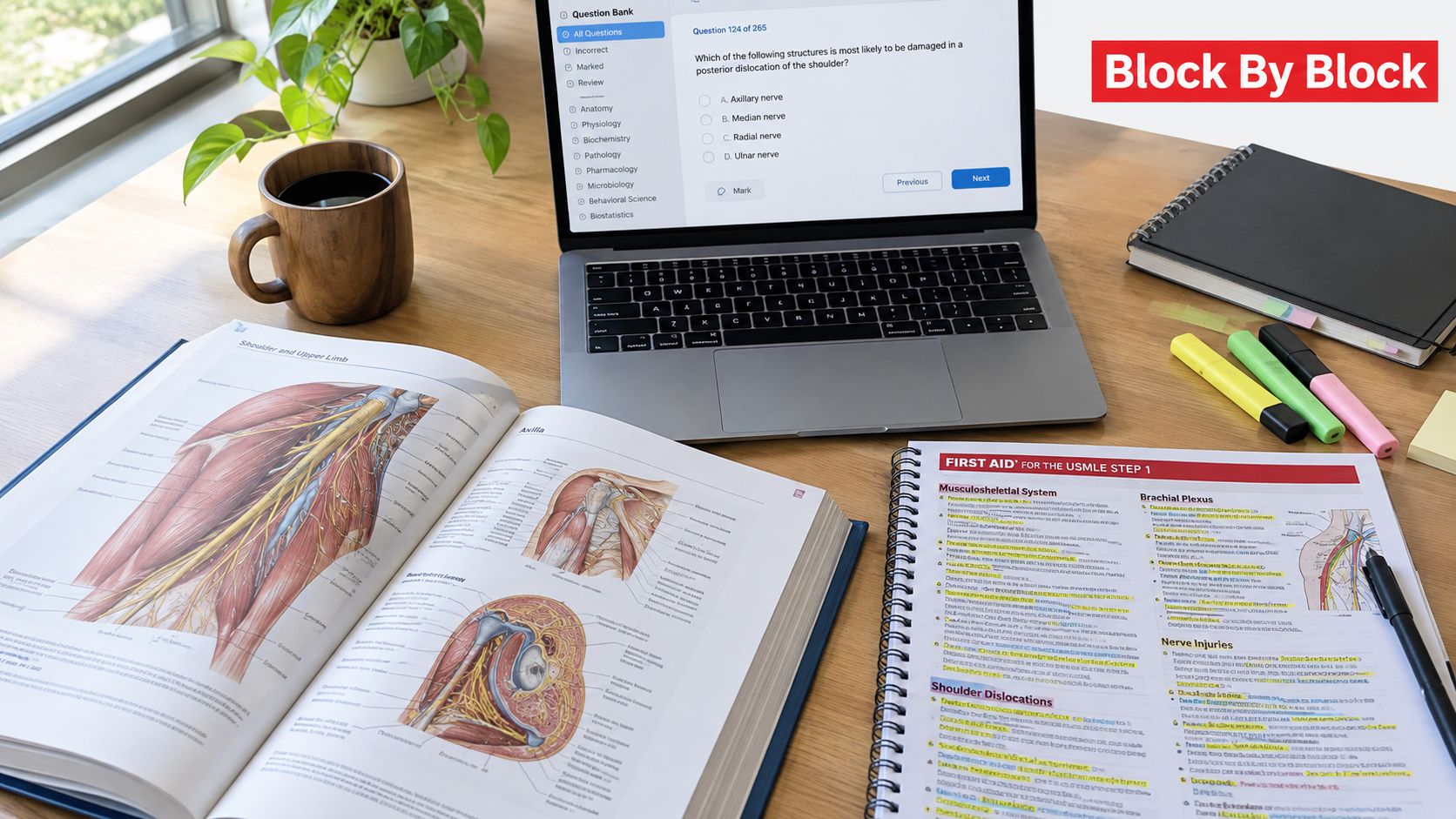
Aligning Coursework With Board Review Block by Block
A block-by-block method prevents two common mistakes. The first is studying class material and board material as unrelated subjects. The second is trying to learn an entire premade deck before the class has supplied enough context to make those facts meaningful.
Start each block with orientation, not memorization. Use First Aid as a map of recurring board concepts, then use lectures, required readings, laboratory sessions, and faculty explanations to understand the physiology and pathology underneath those headings. First Aid works best here as an annotated scaffold, not as a textbook to read from beginning to end.
A repeatable block sequence
A practical sequence looks like this:
- Map the block. Identify the relevant First Aid pages and the disciplines involved. A renal block may require physiology, pathology, pharmacology, and microbiology rather than one isolated subject.
- Learn the mechanism in class. Class notes should answer the question, "Why does this finding occur?" Board review becomes much easier when the student can connect a mechanism to a presentation.
- Add only essential cards. Create or unsuspend a manageable set of cards for high-yield facts from the block's tested material. Avoid adding hundreds of cards just because they are available.
- Apply the material. Complete a focused set of board-style questions after the relevant concepts have been taught. Review the explanation, not just the answer.
- Consolidate the system. At the end of the block, complete a mixed set covering the system and annotate First Aid with concise corrections.
Blocks won't all require equal time. A familiar topic can receive maintenance review, while a difficult transition into integrated cases may require more explanation review and fewer new cards. Reweighting the week is more sustainable than abandoning a difficult subject or allowing it to consume every other academic responsibility.
A simple focus-block planner can help students protect short study periods around lectures, laboratories, and exams. The focus planner for telepsychiatry is one example of a time-blocking resource that can be adapted for this purpose.
A student who needs a broader handoff from block study into dedicated preparation can also use this schedule for USMLE Step 1 preparation as a planning reference. The key is to preserve the block-first sequence rather than layering every resource onto every day.
Building a Question Habit Without Burning Out
It is Tuesday night, lab ran late, and you have 40 minutes before you need to sleep. That is the actual setting for second-year Step 1 prep. A sustainable question habit has to fit around lectures, practicals, and block exams, because the goal is to reach dedicated study already able to retrieve facts, work through stems, and notice your common errors.
Question practice should build in layers. Early in second year, questions are mainly for exposure. Later, they become a way to test integration, pacing, and concentration. A peer-reviewed study found an association between each additional 445 board-style practice questions and approximately a 1-point higher Step 1 score after adjustment for academic and psychological factors, and a similar association for an additional 1,700 unique spaced-repetition flashcards, as described in the medical-education study on practice questions and spaced repetition. These are observational benchmarks, so treat them as context rather than targets.
| Phase | Questions per Session | Review Depth | Primary Goal |
|---|---|---|---|
| Early block learning | 10 to 20 untimed | Review every option and explanation | Learn board-style reasoning |
| Mid-year consolidation | 20 to 40 timed weekly | Record the error and corrective rule | Build pacing and application |
| Late second year | Mixed timed sets | Review patterns across systems | Prepare for sustained concentration |
The pattern matters more than the raw count. Thirty questions reviewed carefully can teach more than 120 skimmed explanations. Questions help only when they produce a correction you will remember the next time a similar stem appears.
A good weekly rhythm is simple. On lighter class days, do a short set tied to your current block. On one weekend session, do a slightly longer timed set to feel what pressure does to your reading. Keep one day lighter or off. Students often stay more consistent when the routine depends on cues and setup, not daily motivation, which is the same idea behind workout consistency without willpower.
Make every miss diagnostic
Every missed or guessed question should go into an error log under one of four categories:
- Knowledge gap: You did not know the fact or mechanism. Add a concise recall prompt for spaced review.
- Misread stem: You missed a qualifier, timeline, or key finding. Rewrite the clue you overlooked in one sentence.
- Reasoning error: You knew the facts but did not connect them correctly. Write the rule that should have led you to the answer, and note why the distractors fail.
- Timing problem: You knew enough but spent too long. Practice paced sets instead of adding more untimed questions.
If you want a clearer picture of how to use a bank during pre-dedicated study, this USMLE UWorld questions guide is a useful reference. Judge each session by what it improved: knowledge, reasoning, or pacing.
Choosing and Using Your Core Resources
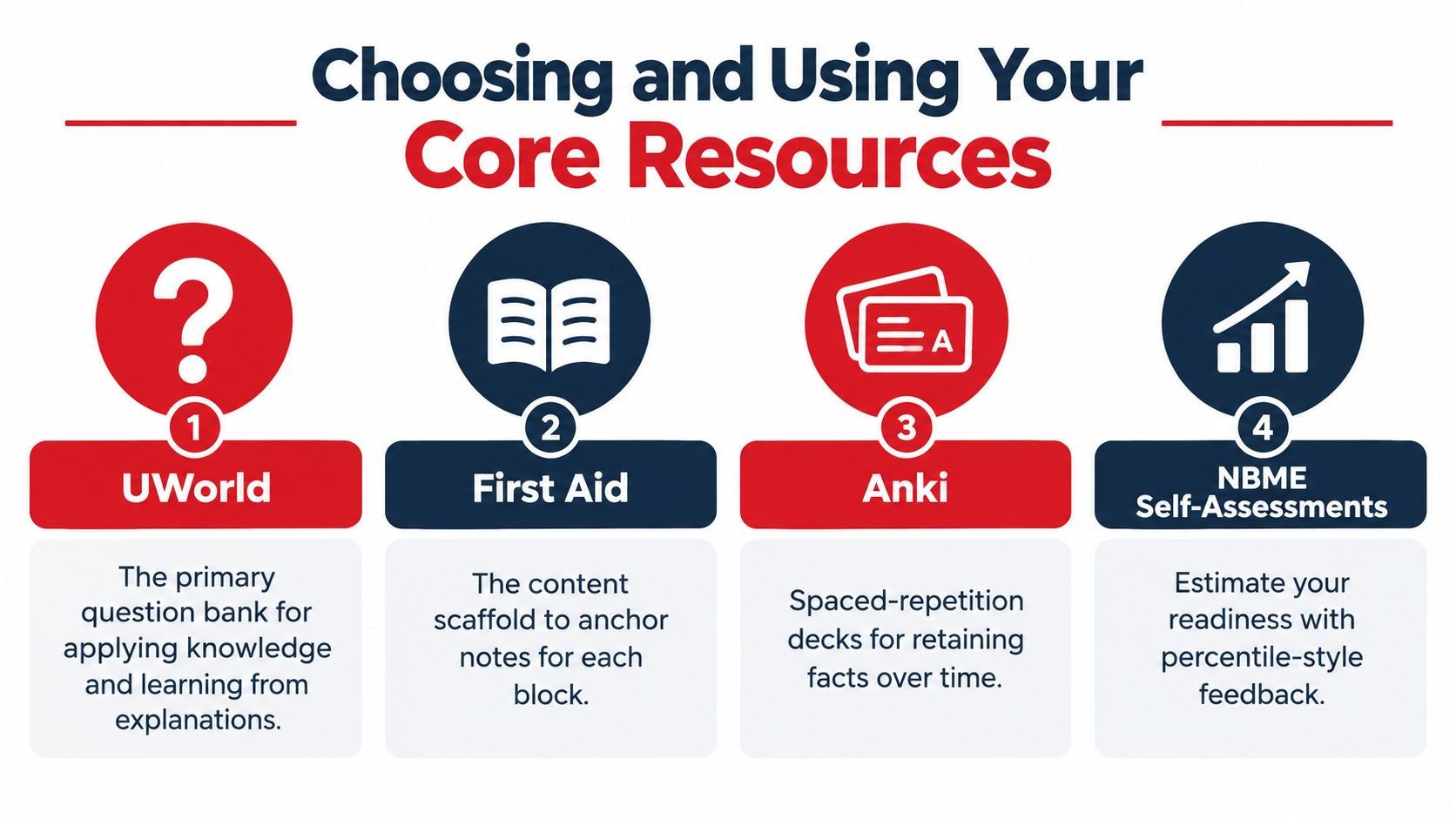
Second year isn't the right time to use every resource at maximum intensity. Each tool should have one primary job, and a new resource should replace something rather than stack on top of an already crowded schedule.
| Resource | Best second-year role | Common misuse |
|---|---|---|
| UWorld | System-based application and explanation learning | Treating early percentages as a final readiness verdict |
| First Aid | A content scaffold and annotation surface | Reading it passively from cover to cover |
| Anki | Retention of selected facts over time | Unsuspending a massive deck without reviewing the cards |
| NBME CBSSA | Defined readiness checkpoints | Taking assessments so frequently that results become noise |
Give every tool a boundary
UWorld functions well as a learning bank during second year. System-based questions can follow the current organ block, and explanations should receive more attention than the percentage correct. A student may miss questions because a mechanism is new, not because the overall foundation is weak.
First Aid connects systems and exposes gaps in coverage. The most useful annotations are short: a correction from a missed question, a confusing distinction, or a mechanism that class clarified. Long lecture transcripts make the book harder to review later.
Anki provides a retention layer. The strongest cards test one meaningful relationship, such as a mechanism, finding, diagnosis, treatment, or next step. A card that requires recognizing a long paragraph usually tests recognition rather than recall.
CBSSA offers standardized feedback at selected checkpoints. The NBME self-assessment information identifies CBSSA as an assessment for students planning to take Step 1 and describes its use in identifying relative strengths and weaknesses.
Sketchy, Pathoma, and Boards and Beyond can supplement difficult subjects, but each should have a defined purpose. A video that clarifies a confusing mechanism may replace rereading, while watching several explanations without question practice usually adds time without adding feedback.
One-on-one tutoring can complement these resources by helping a student diagnose recurring errors, organize a realistic workload, or connect foundational science to vignette reasoning. It doesn't replace official assessment materials or independent question review. The Step 1 study resources guide can help students compare resource roles before adding another tool.
A Flexible Sample Week That Actually Fits
A second-year schedule has to survive block exams, mandatory sessions, fatigue, and unexpected assignments. The following template assumes roughly 15 to 20 hours of board-adjacent study per week, layered on top of class responsibilities. It isn't a requirement or a promise that every student can use the same allocation.
Monday and Tuesday
Class and laboratory work remain central during the day. In the evening, a focused review session should pair the current block with the relevant First Aid pages, followed by a small batch of high-yield cards.
The student shouldn't attempt to finish every associated resource. The useful question is whether the session clarified the day's mechanisms and preserved the most forgettable facts for later retrieval.
Wednesday
Wednesday can serve as the first feedback point. A timed set of 20 to 40 questions should draw from systems already covered, followed by an error-log review. The review should identify whether the week is producing knowledge gaps, reasoning errors, stem-reading problems, or pacing concerns.
Thursday and Friday
Thursday is a maintenance day. Review prior cards, but avoid adding new content if the backlog is growing. This protects retention from being overwhelmed by acquisition.
Friday should be lighter. A class review session and a short mixed question set may be enough, especially when the block has an examination approaching. A lighter day isn't wasted time. It helps prevent the weekend from becoming a recovery period.
Saturday and Sunday
Saturday can hold the deepest work: a mixed timed block across several systems, followed by focused repair in the weakest tested discipline. The student should review the explanations while the reasoning is still fresh.
Sunday functions as a buffer for rest, light card review, and a CBSSA checkpoint when one is scheduled. It can also absorb a missed weekday session without forcing the next week into an unrealistic workload.
Sustainability rule: Drop a resource before dropping sleep, and protect at least one genuine recovery period each week.
The schedule should have guardrails: a cap on daily board study, a day away from intensive preparation, and permission to reduce question volume during major course examinations. The plan is working when it remains usable during difficult weeks, not only during ideal ones.
Using NBME Self-Assessments as Year-End Checkpoints
Late in second year, a CBSSA stops being an abstract milestone and starts acting like a practical check on whether your weekly routine is building readiness. NBME says to take the self-assessment under exam-like conditions, in one sitting and without outside resources, in its official self-assessment guidance. The point is not to chase reassurance after a good week or panic after a bad one. The point is to test the system you have been using while classes were still going.
Timing matters. A first assessment usually becomes interpretable after you have seen the major organ systems once. If you take it too early, a weak result may mostly reflect content you have not learned yet. If you take it after that first pass, the report can answer a more useful question: are you missing because one subject area is weak, because recall is thin across many systems, or because the vignette is asking more than you are used to doing under time pressure?
When you open the first report, read it like a mechanic reading a dashboard, not like a verdict on your potential. For a walkthrough of how these reports are structured, see this NBME self-assessment guide.
Turn the report into a repair plan
Match each pattern to a concrete response:
- Foundational science weakness: Relearn the mechanism with class material and one concise review source, then test it with a few focused questions.
- Poor transfer to vignettes: Do targeted question sets and say out loud why each clue points toward or away from the diagnosis.
- Broad but shallow recall: Keep using selective cards and spaced review, but trim card creation if review volume is crowding out questions.
- Unstable performance: Repeat timed mixed blocks and sort errors by type, not just by subject.
A later checkpoint near the end of the year should show whether the fix held up. One strong form does not prove readiness, and one disappointing form does not erase months of good work. What matters is a stable trend and a pattern of misses you can explain. If the same problem keeps recurring, a tutor or study partner can often spot a recurring error category, such as misread stems, within a single reviewed block of questions.
Transitioning Into Dedicated Study Without Burning Out
Late spring of second year often feels strange. You are still going to class, still keeping up with block exams, and suddenly everyone starts talking about dedicated as if a switch is about to flip. The smoother transition is usually much less dramatic. Dedicated works best as a narrowing of focus, not a last-minute attempt to rebuild everything from scratch.
A practical runway is the last two to three weeks of second year. Use that period to take stock, identify the weak spots that keep recurring, and sketch a dedicated schedule that protects sleep, exercise, and at least one full day each week with lower cognitive load. If dedicated begins with exhaustion, the first week is often spent recovering rather than studying.
Before dedicated starts, this checklist should be mostly true:
- Personalized content scaffold: First Aid contains brief annotations linked to your actual coursework and question misses.
- Usable retention system: Anki contains selective cards drawn from real errors and hard-to-hold concepts, with review volume still manageable.
- Meaningful question exposure: The first UWorld pass is complete or near complete.
- Assessment evidence: At least one CBSSA provides a baseline, and later results can be interpreted against that earlier performance.
- A sustainable calendar: The plan includes recovery time instead of assuming every day can run at maximum intensity.
If one of these pieces is weak, do not panic. Treat it like a handoff problem. A runner does not fix a shaky baton pass by sprinting harder. In the same way, a student who enters dedicated with scattered notes, uncontrolled reviews, and little question experience usually needs a cleaner system before adding more hours.
A score below expectations needs diagnosis before any big decision. Ask what happened. Was content coverage incomplete? Did the reasoning fall apart in vignettes? Was pacing poor? Did anxiety spike under timed conditions? Was the form taken during an unusually disrupted week? The decision to move the exam date should follow readiness evidence and school or licensing requirements, not shame. Official policies and score reporting details are outlined by USMLE in the 2026 USMLE Bulletin of Information and its USMLE performance data.
The people around you matter here. Family and friends are often more helpful when they understand that dedicated is scheduled work with limits, not open-ended availability. Clear expectations around study blocks, meals, sleep, and recovery protect attention and reduce friction.
Ace Med Boards offers one-on-one USMLE tutoring that can complement a student's existing question bank and review system. A free consultation or Board Score Audit can help examine second-year workflow, recurring error patterns, and the transition into dedicated study before that period begins.