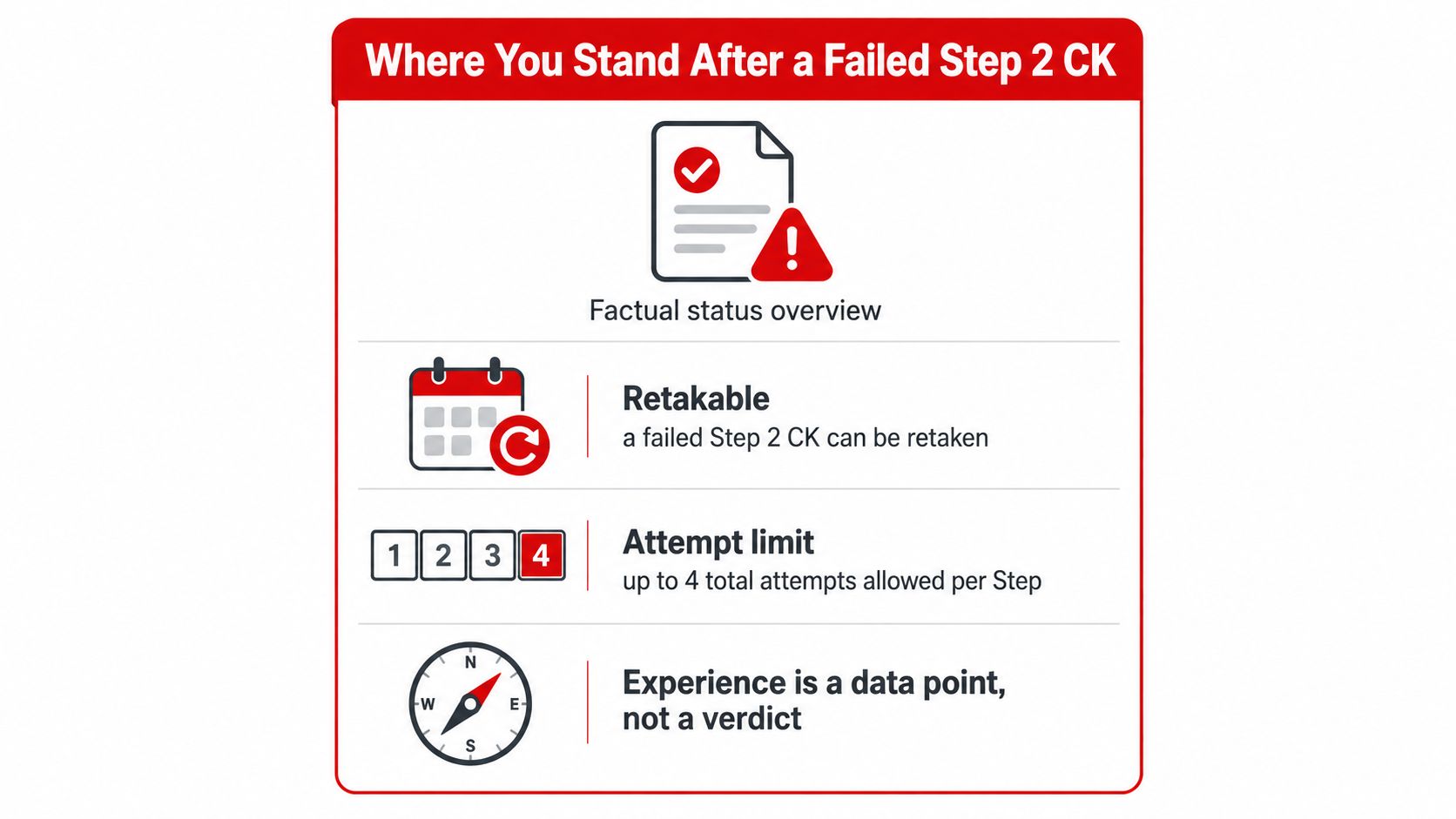
A failed Step 2 CK attempt is retakable, and the USMLE allows up to four total attempts per Step. One failure does not end a medical career.
It does, however, change the clock, the paperwork, and the strategy. A failed attempt now needs a calm, structured response, not panic or denial.
Where You Stand After a Failed Step 2 CK
A failed Step 2 CK usually brings shock, shame, and uncertainty. That reaction is normal. The practical answer is straightforward. The exam can be retaken, the USMLE limits each Step to four attempts, and one failure is a setback, not a verdict.
The failure matters because Step 2 CK now carries more visible weight in residency review than it did when Step 1 had a numeric score. Step 1 moved to pass/fail reporting in 2022, so Step 2 CK performance sits more prominently in application review. Official USMLE performance data also show a clear split between first-time pass rates and outcomes for repeat examinees, which is why a failed attempt calls for a targeted response rather than generic studying. USMLE performance data
Practical rule: treat the failure as a performance signal. Identify what broke down, then rebuild around that problem instead of trying to study harder in the abstract.
Your response should be concrete. Preserve the score report, check the passing standard that applied on your test date, separate content gaps from reasoning or timing problems, and decide whether a retake fits your application timeline. If you are comparing outcomes and planning a retake, use the Step 2 CK percentile guide to calibrate where the score sits in context.
Your first three days should be spent confirming the result and protecting your calendar, not booking a retake.
First 72 Hours After an Unsuccessful Result
The first 72 hours are for containment, not heroics. Confirm the result on the official USMLE record, not through screenshots, rumors, or half-read messages. Step 2 CK results are usually released within two to four weeks, though rare delays can last at least eight weeks, and score reports stay accessible for about 365 days after notification. Use ECFMG's official results timeline to check what timing applies to your situation.
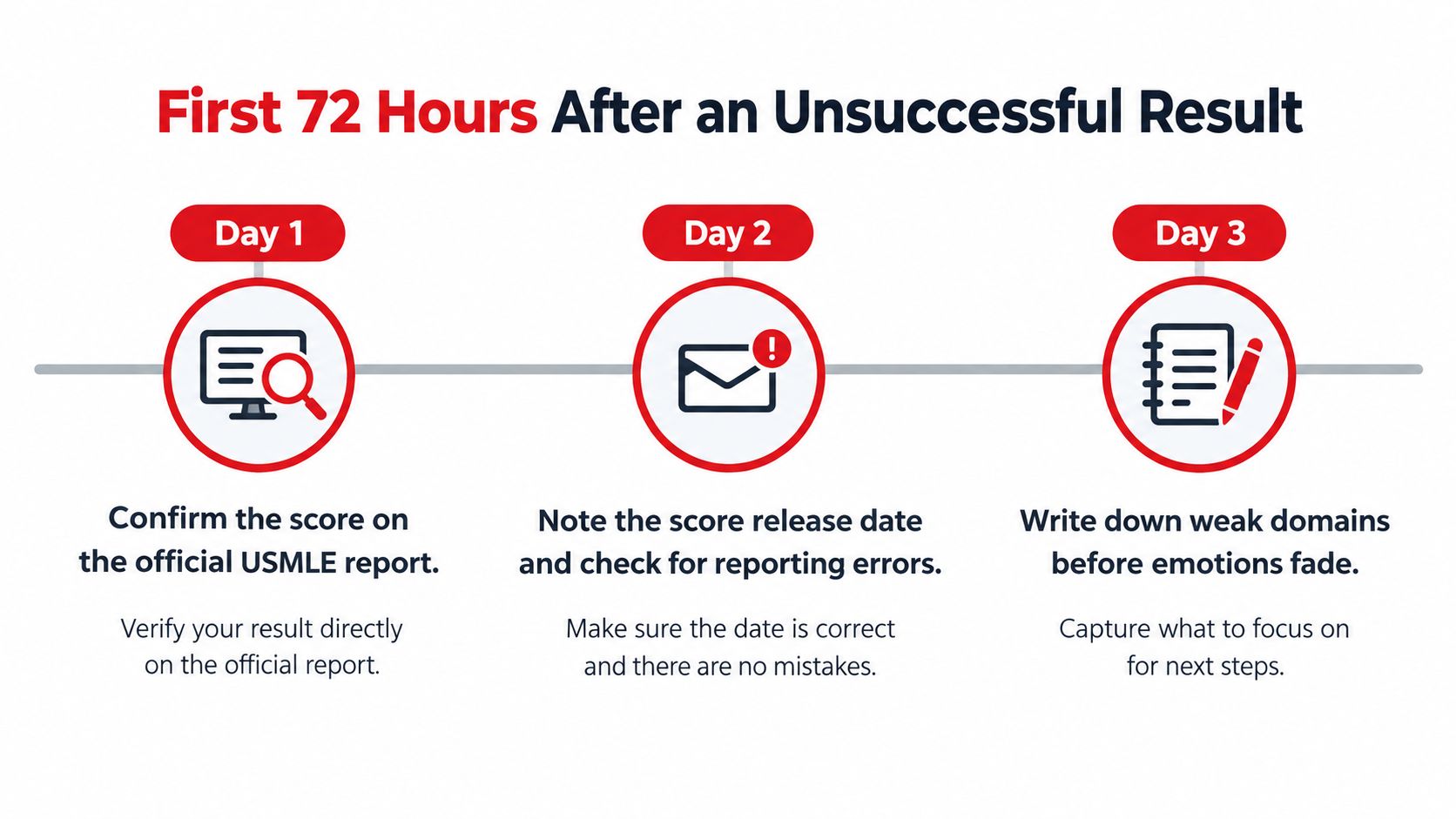
Day 1 is for confirmation
Download the full score report, save it, and write down the test date. That date matters because the passing standard changed over time, so interpret the result in the context of when you sat for the exam, not today's cutoff. Do not make irreversible moves on day one while the reaction is still raw.
Day 2 is for disclosure to one trusted person
Tell a trusted advisor, dean, or family member. Handling a failure alone usually makes the next decision worse. The immediate problem is usually not the study plan, it is avoiding impulsive choices about rotations, applications, or travel.
Day 3 is for first-pass planning
List the weak domains while the exam is still fresh. Note whether the breakdown came from content gaps, pacing, fatigue, or anxiety. If test anxiety is part of the picture, use a focused resource like test anxiety support instead of trying to brute-force your way through it.
Don't withdraw from a rotation, cancel an application plan, or book a retake out of fear before the evidence is clear.
A useful next step for some learners is a Board Score Audit, a structured review of the report, performance profile, and application calendar. That review shows whether this was a narrow miss or a broader readiness failure. Save NBME practice exams for Step 2 for the audit, where practice data belong.
Auditing Your Score Report and Identifying Weaknesses
A failed score report is a diagnostic tool, not a verdict. Read it to separate what you missed from how you missed it. Step 2 CK is integrative, and USMLE expects you to review all content areas when you retake, even if one system looks like the obvious weak spot. The official report also notes a standard error of estimate of about 8 points, so a close miss should not be interpreted too strictly. Sample Step 2 CK passing score report
Classify every miss the right way
Tag each missed or guessed question by three filters:
- Clinical domain. Medicine, surgery, OB-GYN, pediatrics, psychiatry, or preventive care.
- Task type. Diagnosis, next best step, management, prognosis, ethics, or interpretation.
- Error mechanism. Knowledge gap, rushed reading, second-guessing, timing collapse, or fatigue.
That log gives the retake plan structure. Without it, students usually study what feels worst, which is often not what caused the failure.
Narrow miss versus broad readiness failure
| Pattern | Typical Signal | First Remediation Move |
|---|---|---|
| Narrow miss | Practice exams and timed blocks sit close to the cutoff, but one or two domains or pacing errors pulled the score down | Tighten weak domains, drill timed blocks, and retest only after repeat evidence of stability |
| Broad readiness failure | Multiple practice scores were unstable, timing fell apart, and review shows recurring reasoning errors across systems | Rebuild fundamentals, slow the pace, and delay retake booking until the plan shows stable results across two consecutive assessments |
A narrow miss and a broad readiness failure are different problems. The first often improves with focused remediation. The second usually needs a deeper reset.
Do not blame the result on “just cardiology” or “just test anxiety” without checking the evidence. The score report, missed-question log, and practice performance should line up. When they do not, trust the safer interpretation.
Use prior NBME trends, not one lucky form, to judge readiness. The NBME practice exams Step 2 guide helps anchor that review in repeatable data, and the same logic applies when you use how to interpret NBME practice exams for Step 2 during your audit.
Building a Realistic Retake Study Plan
A retake plan should be long enough to fix the problem and short enough to protect the application calendar. For many learners, 8 to 12 weeks is a workable frame, but the calendar matters less than the readiness gate. A rushed retake after a weak failure often compounds the original problem.
Three phases, one purpose
Phase 1, content refresh. Rebuild the weakest systems and shore up the core algorithms. At this point, a learner stops pretending the problem was only stamina and re-engages the material directly.
Phase 2, question-bank heavy practice. Timed mixed blocks should become the default. The goal is to improve decision-making under pressure, not just recognize information in review mode.
Phase 3, assessment taper. Use multiple independent checks before booking the retake. The score trend matters more than a single good day.
A practical weekly structure can look like this:
- Monday to Wednesday: content review in the morning, timed question blocks in the afternoon, error log at night.
- Thursday: mixed timed blocks plus deep review of wrong answers.
- Friday: systems review tied to recurring misses.
- Saturday: one longer assessment block or self-test.
- Sunday: recovery, light recall, and schedule adjustment.
Bottom line: if timed blocks still collapse under fatigue, the retake is too early.
A useful resource for study method selection is proven study approaches from Documind. The value there is not branding, it is choosing a method that fits active recall and question-driven learning rather than passive rereading.
Readiness checkpoint before booking
- Stable or improving practice scores
- Consistent timing across mixed blocks
- Multiple timed blocks completed under exam-like conditions
- Error log showing fewer repeat reasoning mistakes
- A schedule that fits rotations, visa timing, or work constraints
The checkpoint matters more than the calendar. A learner who books too early can walk into the second attempt with the same pattern that caused the first failure. That is avoidable.
For a more detailed framework, the USMLE Step 2 CK study plan page is the closest internal match.
Retake Rules, Fees, and Eligibility Windows
A failed Step 2 CK does not come with an automatic do-over. The examinee must submit a new application and pay the applicable fee before retesting. USMLE also limits each Step to four total attempts, counting incomplete attempts, and no one can take the same Step more than three times in a 12-month period. ECFMG reexamination and reapplication
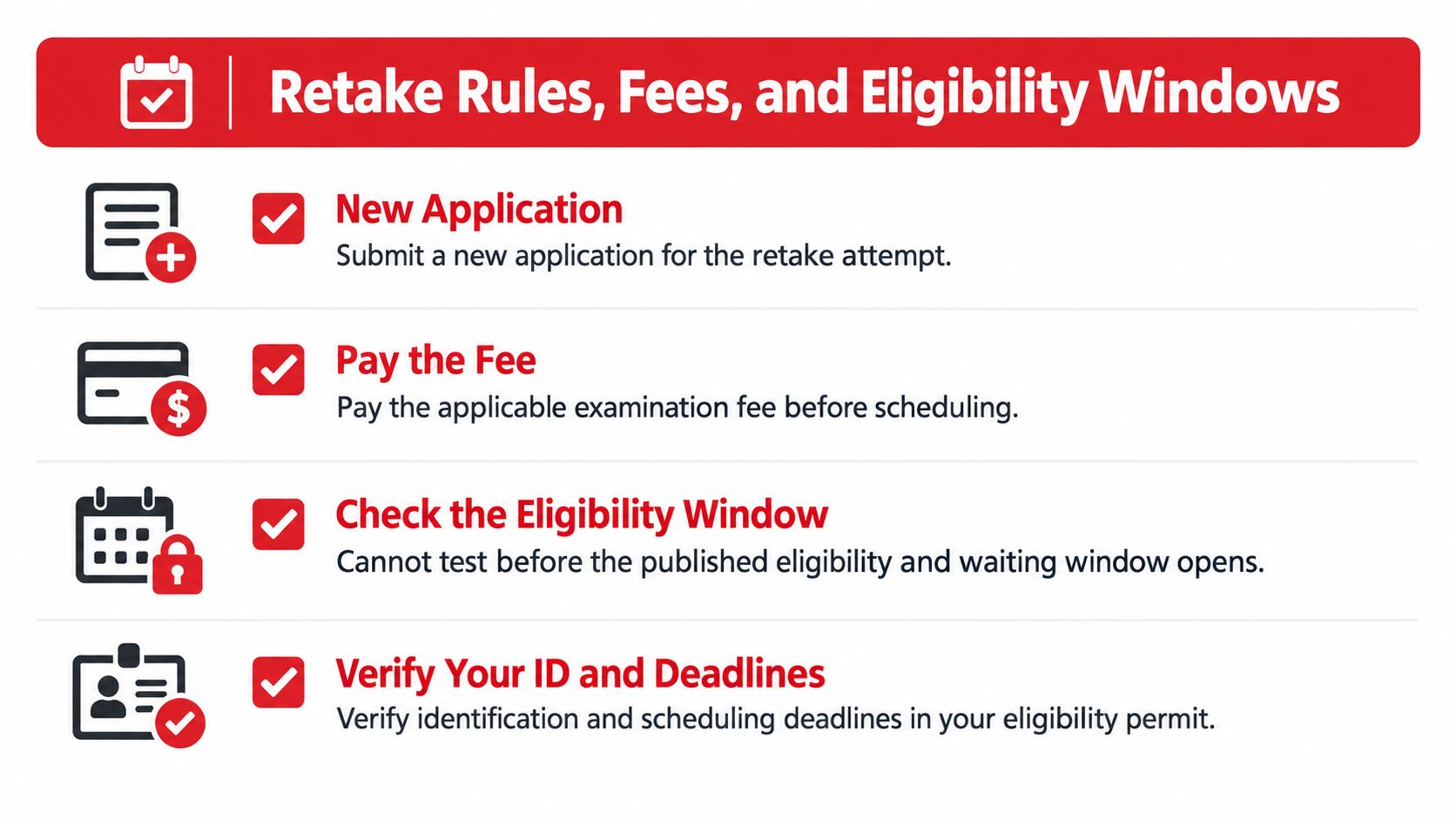
Check jurisdiction and school rules before booking
The eligibility period still controls when the retake can happen. The exam has to fall inside the assigned window, and if that window expires, ECFMG allows a one-time contiguous eligibility-period extension for Step 1 or Step 2 CK. That extension is administrative only. It does not create another attempt. If a fourth attempt ever becomes necessary, it must be at least 12 months after the first attempt and at least 6 months after the most recent attempt.
Protect the licensing sequence
Read the pass-fail rules before you schedule anything. USMLE generally does not let an applicant retake a Step that has already been passed, except in narrow licensing situations tied to time limits. If someone retakes a previously passed Step 1 or Step 2 CK to satisfy that rule and then fails, Step 3 eligibility can be affected. 2027 Bulletin
Budget and timing with the actual rules
State medical licensing authorities can be stricter than USMLE on attempt limits. That is why the first question should be whether a retake protects the rest of the application path, not whether it can be squeezed in quickly. A rushed retake after a failure can create avoidable problems with eligibility windows, school policy, and jurisdiction rules.
Use the USMLE Step 2 CK retake strategy guide as a reference point for sequencing the next attempt, and verify the deadline details with the registrar, the school, and the relevant board before paying for a new registration.
Residency Application Implications and Communication Strategy
A failed Step 2 CK does not end a residency path. It does enter the file, and programs may use any failed USMLE attempt as a screen. Treat it that way. The question is not whether the failure matters. It is how cleanly you explain it and whether your retake plan looks credible. NRMP PD survey report
How to talk about it without making it worse
Keep the message short, direct, and accountable. Say what happened, show what changed in the retake plan, and point to evidence that the problem is being fixed. Skip excuses. Skip blame-shifting. Skip a long emotional story.
For ERAS, the MSPE, or an interview, use this structure:
- State the result plainly.
- Name the audit or remediation work.
- Show what is different now.
- Return to current readiness.
Applicant group matters
U.S. MD, U.S. DO, and international medical graduates do not face the same downstream pressure. IMG applicants need to be especially careful, since as ECFMG notes in its 2025 information bulletin, schools may receive pass or fail status and the numerical score when results are reported. That makes transparency and timeline control especially important for students training outside the U.S. or Canada.
A failed Step 2 CK should not be hidden, and it should not dominate every conversation.
The strongest response sounds measured, specific, and current. Here is a clean interview answer: “I failed Step 2 CK in March, spent eight weeks auditing my error log and fixing my weak areas, and my last three NBMEs are 235-plus. Here is what changed in my study process, and here is why I am ready now.”
Support, Mental Health, and Tutoring Options
A Step 2 CK failure can hit harder than expected because it touches identity, finances, and future plans at once. Test anxiety, embarrassment, and the urge to isolate are common reactions. They're common, but they shouldn't be handled alone if they're starting to interfere with sleep, concentration, or daily function.
Use support that matches the problem
Most medical schools and teaching hospitals have confidential mental-health resources, and those should be used early when anxiety is starting to distort the retake plan. For learners who want an outside option, therapy options for anxiety online may be a practical starting point when local access is limited.
Where tutoring fits
One-on-one USMLE tutoring is not a replacement for official practice materials, NBME-style assessment, or question-bank work. Its value is narrower and more useful than that. A good tutor or advisor helps spot reasoning errors, reorganize study time, and keep the retake plan accountable.
Ace Med Boards offers USMLE Step 2 CK tutoring and a broader USMLE tutoring page, which can be relevant for learners who want structured feedback after a failure. A Board Score Audit typically looks at the score report, recurring content gaps, pacing problems, and a realistic weekly schedule.
What to ask for in help
- Score-report interpretation
- Error-pattern mapping
- Calendar design
- Readiness checkpoint review
- Accountability between practice tests
The right support should make the next decision clearer, not more dramatic. A learner who needs help with structure can get it without turning the setback into a crisis.
Ace Med Boards helps medical learners build a retake plan around the real problem, not just the emotional impact of a failed attempt. For students rebuilding after failed Step 2 CK, that means score audit, study structure, and accountability that fit the actual timeline. If a clearer next step would help, visit Ace Med Boards and start with a free consultation.