The strongest practical formats are answering a short prompt before seeing the explanation, reconstructing a diagram from memory, and explaining why a plausible alternative is wrong. Active recall has a substantial evidence base, including 118 articles and 159 independent comparisons, with an overall effect size of Hedges' g = 0.61 for practice testing versus control conditions.
Retrieve First, Then Check
Popular study advice often encourages another pass through lecture slides, annotated notes, or a textbook chapter. That approach can create familiarity, but familiarity isn't the same as being able to produce an answer when a board-style vignette presents an unfamiliar combination of findings. Active recall studying methods reverse the sequence. The learner attempts retrieval first, then checks the explanation and repairs the reasoning.
The approach applies to the United States Medical Licensing Examination (USMLE), the Comprehensive Osteopathic Medical Licensing Examination of the United States (COMLEX-USA), and relevant Shelf examinations. It doesn't justify ranking one exercise as universally superior, and it doesn't establish a particular Ace Med Boards score gain. Retrieval-practice evidence supports delayed retention in studied learning tasks, not a guaranteed board outcome.
Roediger and Karpicke's foundational experimental work, published in 2006, helped clarify why recalling information can produce better later retention than restudying it. A later synthesis reported a moderate overall testing effect, with Hedges' g = 0.61 across the cited comparisons in the meta-analytic review. The practical lesson is simple: a study session should contain an attempt, feedback, and a correction, not only exposure.
This workbook emphasizes prompt construction and error checking, rather than app-specific intervals. Scheduling matters, but a poorly written prompt can rehearse recognition instead of retrieval. Each exercise below asks the learner to produce something before checking an authoritative explanation.
Key takeaways
- A useful prompt requires an answer, explanation, comparison, or prediction before feedback.
- Medical prompts should test mechanisms and decisions, not only isolated definitions.
- Errors should be categorized and converted into revised prompts.
- The format should match the exam objective, not a fixed visual or auditory learning-style label.
- Delayed accuracy and explanation quality matter more than how comfortable an exercise feels.
1. Immediate Question-and-Answer Prompts
A focused question turns reading into a retrieval exercise when the learner must answer before seeing the explanation. The process works like a diagnostic test: the response exposes what is available from memory, while feedback shows which links in the explanation remain weak.
Use this sequence:
- Read the prompt and pause.
- State the answer from memory, including your reasoning.
- Compare it with a reliable explanation.
- Mark the response as correct, incomplete, or incorrect.
- Convert the error into a revised prompt.
The 2006 Roediger and Karpicke experiments cited in the introduction support retrieval as a stronger test of later retention than another restudy episode. Question quality still determines what the exercise measures. A mechanism prompt reveals the structure of the learner's understanding; a yes-or-no prompt mainly permits guessing.
How to write the prompt
A useful prompt requires why, how, or what changes next. It should make the learner produce a mechanism, decision, comparison, or prediction.
- Mechanism prompt: “A 62-year-old man begins lisinopril and develops a dry cough. What mechanism best explains the symptom?” Retrieve the relationship between angiotensin-converting enzyme inhibition and bradykinin before checking the explanation.
- Safety prompt: “Why can metformin become unsafe during acute kidney injury?” Connect impaired clearance with lactic acidosis risk. Keep the exercise educational, without turning it into individualized treatment advice.
- Adverse-effect prompt: “Name three common adverse effects of angiotensin-converting enzyme inhibitors and identify the reversible one.” Explain the relevant mechanism alongside the list.
A 5 to 10 second pause creates space for a genuine attempt. After checking, record the error using a simple template: prompt, answer given, missing mechanism, corrected explanation, follow-up prompt. For example, a learner who names cough but cannot explain bradykinin might revise the question to, “How does ACE inhibition alter bradykinin breakdown?”
A missed prompt can return after a delay, such as 3 to 7 days. Treat that interval as a review option, not a universal prescription. The correction and the quality of the second explanation matter more than fast recognition.
Daily practice can use Ace Med Boards' Step 2 question of the day as a question-based context. Learners examining how prompts are built may also consult the ParakeetAI interview prep resource. Both resources still require an attempted answer and careful review of the explanation.
2. Blank-Diagram Reconstruction and Spatial Explanation
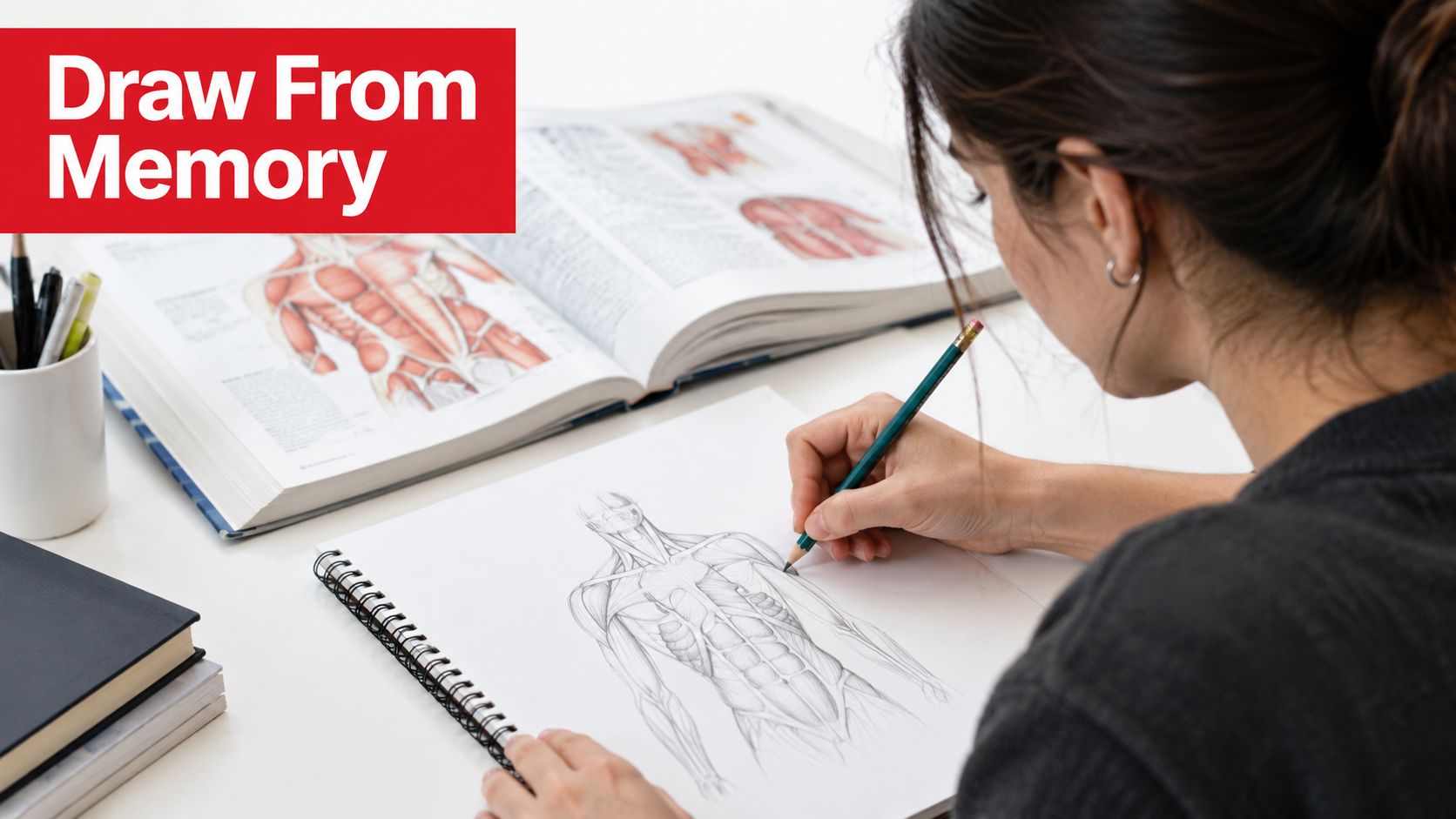
A labeled diagram rewards recognition. A blank page tests whether the learner can reconstruct the structures and relationships without visual support. The exercise therefore works best when the learner draws first, labels second, and checks the reference only after completing the reconstruction.
Neuroanatomy provides a clear application. A learner can draw a spinal cord cross-section at C5, label the gray-matter horns and major white-matter regions, and then explain why an anterior cord lesion affects motor pathways more directly than vibration pathways. The value lies in connecting location, tract function, and clinical consequence, not in producing an attractive drawing.
Build the explanation into the drawing
The same format can be adapted to cardiovascular anatomy. A learner redraws the aortic arch and its major branches, identifies their order, and explains why a dissection involving the proximal aorta can compromise branch-vessel flow. The explanation should distinguish the anatomic relationship from a real-world management decision.
Inguinal anatomy offers another useful prompt. After reconstructing the inguinal ligament, canal, and contents, the learner explains the relationship of the femoral nerve to the femoral artery and why that relationship matters in an examination question about regional procedures. Clinical examples here are for examination education, not individualized patient care.
Practical rule: A diagram isn't complete until every important location has a functional or clinical explanation attached to it.
A blank template from a textbook or legitimate practice material can reduce drawing demands, but the labeled version shouldn't be copied first. The learner should mark specific errors after checking:
- Missing structure: A relevant vessel, tract, or compartment was omitted.
- Incorrect relationship: Two structures were placed in the wrong spatial position.
- Mislabeled structure: The placement was reasonable, but the name was wrong.
- Unexplained consequence: The anatomy was recalled, but its clinical significance wasn't.
The same diagram can be reconstructed after 1 week and 3 weeks as a durability check. The goal isn't artistic precision. It is accurate retrieval of spatial relationships and the ability to explain why those relationships matter.
3. Error Analysis and Wrong-Answer Explanation
Correct-answer review can stop too early. A learner may recognize the correct option and move on without understanding why a plausible alternative failed. Error analysis adds a second retrieval task: the learner explains the wrong answer, identifies the clue that defeats it, and states why the correct option fits better.
Consider an original educational vignette involving a patient with chronic kidney disease who develops a creatinine increase and hyperkalemia after starting an angiotensin-converting enzyme inhibitor. Rather than memorizing a single management response, the learner should identify the relevant medication effects, assess the significance of the laboratory changes, and verify the appropriate educational explanation against a current clinical reference. The example illustrates reasoning practice, not patient-specific medical advice.
A second example involves acute myocardial infarction followed by a new systolic murmur and pulmonary edema. Papillary-muscle rupture is the intended answer in the educational scenario. Ventricular septal rupture remains a plausible distractor because it can also cause a new murmur and hemodynamic deterioration, so the learner must distinguish the associated findings rather than just memorize the answer.
Use a wrong-answer sentence frame
After each question, the learner can complete this frame:
“Choice ___ is tempting because ___. It is less appropriate because ___. The correct answer is stronger because ___.”
Pharmacology makes the method particularly useful. If a learner explains that phenytoin inhibits warfarin metabolism when the educational point is enzyme induction, the error isn't just a missed fact. It is a mechanism reversal. The revised note should state the actual direction of the interaction and identify the clinical variable that may change.
The learner should categorize each error as a factual mistake, reasoning gap, timing error, missed clinical detail, or mechanism misunderstanding. Repeated categories reveal which prompt type deserves more attention. Ace Med Boards' distractor-analysis resource is relevant to this style of review.
A concise error note should include the original prompt, attempted answer, correct distinction, and a revised question. Explanation checking matters. A confident but incorrect explanation can strengthen the wrong association if it isn't compared with a reliable reference.
4. Reverse-Prompt Variation
A reverse prompt changes one clinical clue after the learner has solved an original vignette. The learner then predicts whether the diagnosis, confidence, or management priority changes. This method exposes which findings are essential and which are merely supportive.
The exercise is an illustrative editorial variation, not a tested Ace Med Boards intervention or a report of a student outcome. It works best with an original question that the learner solved through reasoning rather than guessing. Only one clue should change at a time.
Change one variable
An original vignette might describe an older adult with fever, a left lower-lobe infiltrate, and respiratory symptoms. A reverse version changes fever to chills and a mild cough without fever. The diagnosis may remain plausible, but the absence of fever in an older adult can alter confidence because older patients may present atypically. The learner should explain what changed and what didn't.
An endocrine example changes the thyroid-stimulating hormone result in a vignette involving amenorrhea and weight loss. A high value supports one diagnostic direction, while a low value shifts the differential toward causes of hyperthyroidism. The important retrieval target is not a memorized disease label. It is the relationship between the clue and the mechanism.
A third prompt changes hypokalemia to normal potassium in a vignette involving new hypertension and metabolic alkalosis. Normal potassium doesn't automatically exclude primary hyperaldosteronism, but it changes the strength of the clue and may broaden the differential.
The learner can classify each clue as pathognomonic, highly suggestive, supportive, or a red herring. The final explanation should answer three questions:
- Diagnosis: Does the leading diagnosis change?
- Confidence: Does the clue make the diagnosis more or less likely?
- Action: Would the next examination-relevant step change?
A reliable reference should be checked before the revised explanation is saved. This prevents the reverse prompt from turning a speculative association into a study fact.
5. Mechanism Retrieval and Application Chain
A mechanism chain begins with a process and ends with a prediction. The learner retrieves the mechanism in one sentence, applies it to a new scenario, and predicts the resulting finding or complication. This separates fact recall from transfer.
For an angiotensin-converting enzyme inhibitor, the chain can be written as: inhibit angiotensin-converting enzyme, reduce angiotensin II, reduce aldosterone activity. The learner then applies the chain to cough, potassium changes, or blood-pressure effects and explains which part of the pathway accounts for each outcome. The explanation should be checked against an authoritative pharmacology reference.
Match the chain to the knowledge task
For hyperthyroidism, the starting mechanism is excess thyroid hormone, increased metabolic activity, and greater catecholamine sensitivity. The learner can apply that mechanism to atrial fibrillation risk and explain why a beta blocker may address adrenergic symptoms without correcting the underlying hormone excess. This is an examination simplification, not a treatment plan for a patient.
For anatomy or physiology, the chain might begin with a narrowed valve, altered pressure gradient, and downstream chamber response. The learner should then apply the relationship to a new hemodynamic vignette. The prompt format changes because the knowledge task is causal physiology rather than medication recall.
A mechanism-application record can use three columns:
The learner should apply each mechanism to at least two different scenarios before checking references. If the mechanism works only in the wording used during the lecture, the prompt needs more variation. A difficult application is often more informative than another definition card.
6. Timed Retrieval Under Exam Conditions
Timed retrieval tests whether knowledge can be accessed while the learner is managing pace, attention, and uncertainty. It shouldn't replace untimed review. A timed miss may represent a knowledge gap, a missed clue, a reasoning delay, or a pacing problem, and those causes require different corrections.
Official exam formats and timing rules can change. Students preparing for USMLE, COMLEX-USA, or a Shelf examination should verify current requirements through the responsible examination organization and use practice materials whose structure has been checked. A fixed seconds-per-question rule shouldn't be treated as universal.
Separate speed from accuracy
A learner can begin with individual questions, progress to timed blocks, and later use longer practice sessions when the verified exam plan supports them. The review record should separate time spent from answer quality:
- Knowledge miss: The learner didn't know the relevant mechanism or fact.
- Retrieval lag: The learner knew the concept but couldn't produce it efficiently.
- Pacing error: Too much time went to one question.
- Reading error: A decisive clinical detail was overlooked.
- Overthinking: A supported answer was changed without a sound reason.
A hard stop can reveal whether an answer was completed through retrieval or through extended rereading of the vignette. After the timer ends, the learner should revisit every item without the clock and compare the two performances. If untimed accuracy improves substantially, pacing or retrieval fluency may deserve attention. If both versions are wrong, the issue is more likely conceptual.
The final 4 to 6 weeks before an exam can include more timed work when that schedule fits the verified exam date and the learner's readiness. This isn't a universal prescription. Timed practice should preserve enough review time for error correction.
Ace Med Boards' performance-under-pressure resource can complement a timing review, but independent analysis of missed questions remains necessary.
7. Teach-Back and Verbal Explanation
Teach-back turns silent knowledge into an observable explanation. The learner closes the notes and explains a diagnosis, mechanism, or relationship aloud as though teaching a peer. Speaking forces the learner to organize the sequence, identify assumptions, and notice where the explanation becomes vague.
A pharmacology teach-back might explain how angiotensin-converting enzyme inhibitors work and why they can contribute to hyperkalemia. A thyroid example might require an explanation of why thyroid antibodies support an autoimmune process and how excess or deficient hormone states produce different symptoms. These are examination-focused simplifications, not individualized medical guidance.
Make the listener part of the retrieval task
A peer can ask, “Why?” after each step. If the learner says that a medication causes a finding, the peer can ask which pathway connects the two. If the learner claims that a diagnosis is likely, the peer can ask which clue would make the diagnosis less likely.
A 5 to 10 minute explanation can be recorded and replayed. The learner should listen for:
- Missing sequence: The explanation jumps from cause to outcome.
- Unclear terminology: A key term is used without a definition.
- Mechanism reversal: The direction of a pathway is incorrect.
- Unsupported certainty: The explanation treats a suggestive clue as definitive.
- Clinical overreach: An exam simplification is presented as a universal patient-care rule.
Teach-back can also use a patient-friendly version, but the educational purpose remains retrieval and clarity. The learner should check the recording against a reliable textbook or reference and convert each gap into a new prompt.
Ace Med Boards' communication-skills resource may be useful when verbal organization is part of a broader examination-preparation plan. The core exercise doesn't require a partner. A blank room, voice recorder, or written transcript can expose many of the same gaps.

8. Spaced Retrieval with Progressive Difficulty Escalation
Spaced retrieval works best when each return asks for a slightly different performance. The learner first attempts an answer, checks reliable feedback, records the error, and then meets a prompt that demands more application. Scheduling supports this workbook process, but prompt design determines what the learner retrieves.
For heart failure, begin with a closed-book definition of systolic and diastolic dysfunction. Next, ask the learner to interpret a patient with preserved ejection fraction. Follow with a mechanism-based medication decision, then an integrated vignette involving complications. The topic stays related, while the task progresses from naming to interpreting, explaining, and deciding.
Escalate the prompt, not just the date
Construct each prompt with four parts: the target concept, a retrieval task, the expected evidence, and a feedback check. A metformin sequence could ask for its mechanism, then present acute kidney injury and ask about safety, then change renal function in a new scenario. A hyponatremia sequence could move from causes to classification of a simple case, analysis of a complex presentation, and an examination-style question.
The learner should attempt every prompt before opening notes or an answer key. A useful review record contains:
| Field | Example |
|---|---|
| Prompt | Why might metformin require review during acute kidney injury? |
| Attempt | The learner's answer, written before checking |
| Gap | Confused renal clearance with the medication's mechanism |
| Repair | Correct the relationship in one sentence |
| Next prompt | Apply the rule to changing renal function |
A planning record may use Day 1, Day 3, Day 7, Day 14, and Day 28. These dates are examples, not universal prescriptions. If a session is missed, complete it on the next available day and record whether the longer gap changed accuracy or explanation quality. Tools such as Ace Med Boards' spaced-repetition resource can provide planning context, while information retention strategies offer another perspective on retaining material.
Let the error choose the next exercise:
- Definition failure: Return to a concise fact prompt.
- Application failure: Add a short clinical scenario.
- Integration failure: Retrieve each mechanism separately before combining them.
- Explanation failure: Write a causal chain with arrows and missing steps.
- Repeated failure: Check the source, correct the wording, and create a narrower prompt.
The expanding-retrieval study summarized in Sources supports increasing delays between retrieval attempts. The retrieval-practice meta-analysis cited in Sources likewise supports retrieval followed by feedback and later testing. These findings justify a planned review loop, not a guaranteed examination result. Prompt quality is the central decision; scheduling tools remain secondary.
Active Recall Methods, 8-Point Comparison
| Method | Implementation complexity | Resource requirements | Expected outcomes | Ideal use cases | Key advantages |
|---|---|---|---|---|---|
| Immediate Question-and-Answer Prompts | Low | Short prompts, answer key/reference | Faster retrieval, improved long-term recall | Rapid review, low-time study sessions, question banks | Strengthens memory via active retrieval; easy to integrate |
| Blank-Diagram Reconstruction and Spatial Explanation | Medium–High | Blank templates or paper, reference diagrams | Improved spatial accuracy and anatomy retention | Anatomy, neuroanatomy, radiology, surgery prep | Engages visual+verbal memory; reveals spatial errors |
| Error-Analysis and Wrong-Answer Explanation | Medium | Question bank, reliable references, note-taking | Better discrimination between similar options, deeper reasoning | Multiple-choice vignettes, board prep, common distractors | Exposes reasoning traps; strengthens conceptual distinctions |
| Reverse-Prompt Variation (Clinical Clue Substitution) | Medium–High | Vignettes, references for verification | Greater causal reasoning and sensitivity to key features | Diagnostic reasoning, variable presentations, advanced prep | Identifies essential vs incidental clues; tests robustness |
| Mechanism Retrieval and Application Chain | Medium | Mechanistic references, varied clinical scenarios | Transferable understanding and predictive ability | Pharmacology, pathophysiology, applied problem solving | Promotes causal understanding and transfer to new cases |
| Timed Retrieval Under Exam Conditions | Medium | Timer, exam-format questions, enforced conditions | Improved speed, exam readiness, time-management skills | Final exam simulations, timed blocks, test-day prep | Trains automaticity and decision speed under pressure |
| Teach-Back and Verbal Explanation | Medium | Peer or recording device, references for feedback | Clearer organization of knowledge, identification of gaps | Deep learning, peer teaching, oral exams, patient communication | Strengthens encoding through generative explanation and communication |
| Spaced Retrieval with Progressive Difficulty Escalation | High (planning) | Scheduling tool or tracker, varied prompts | Durable long-term retention and improved transfer | Long-term study plans, high-yield board topics, curriculum design | Combines spacing and increasing complexity for durable mastery |
Turn Retrieval Into a Review Loop
Active recall becomes practical when every attempt produces a usable record. A missed question shouldn't disappear into a score report, and a correct answer shouldn't automatically be treated as mastered. The learner needs to know whether the answer was produced independently, whether the explanation was accurate, and whether the same concept survives a later test.
The following template keeps review specific:
- Topic: Name the disease, mechanism, anatomy, or decision.
- Original prompt: Copy or summarize the original question without reproducing protected examination content.
- Attempted answer: Record the answer before checking.
- Correct answer: State the answer in original words.
- Missing or incorrect reasoning: Identify the broken step.
- Error category: Choose factual mistake, reasoning gap, timing error, missed detail, or mechanism misunderstanding.
- Reliable reference checked: Record the textbook, official educational source, or peer-reviewed reference.
- Revised prompt: Write a new question that tests the repaired distinction.
- Next retrieval date: Choose a later review point that fits the study plan.
A useful selection framework starts with the exam objective. Pharmacology usually benefits from retrieving mechanism, indication, and a key adverse effect before applying the information to an original vignette. Anatomy often benefits from reconstructing a blank diagram, labeling relationships, and explaining the functional consequence. Neither choice depends on a fixed “visual learner” or “auditory learner” identity. Preference may improve adherence, but it doesn't establish that matching instruction to a learning-style label improves outcomes.
The learner can evaluate each method using four practical criteria: accuracy after a delay, quality of explanation, time cost, and relevance to the exam objective. A comfortable exercise that produces weak delayed recall deserves revision. An uncomfortable exercise that reveals a recurring reasoning gap may be worth keeping, provided feedback follows every attempt.
Sample routines for different exams
A USMLE routine can combine a short prompt set, one mechanism chain, and wrong-answer analysis from practice questions. A COMLEX-USA routine can add anatomy reconstruction and a reverse prompt when a vignette depends on structure, physiology, or an integrated clinical relationship. A Shelf routine can center on the current rotation's common presentations, with teach-back used to connect diagnosis, mechanism, and distinguishing findings.
Current examination formats, timing, registration rules, and eligibility requirements should be checked through the responsible official organization because those details can change. Practice materials should be original or properly licensed, and learners shouldn't reproduce recalled questions or live examination content.
Ace Med Boards' study-skills reference can sit alongside the workbook as a broader reference. Ace Med Boards offers online tutoring and test preparation for the USMLE, COMLEX-USA, and selected Shelf examinations, but tutoring complements rather than replaces official guidance, independent study, and legitimate practice materials.
The clinical examples in this article are for examination education, not individualized patient care. Medical students should use current authoritative references for clinical decisions, and learners with persistent low scores, failed attempts, academic gaps, or test anxiety deserve a respectful review of the underlying problem rather than a judgment about their potential.
Sources
- Roediger and Karpicke, 2006, experimental evidence on test-enhanced learning
- Meta-analytic review of retrieval practice and the testing effect
- Medical-school study of expanding retrieval intervals
- Medical-education summary of retrieval practice and delayed recall
Ace Med Boards offers online tutoring for USMLE, COMLEX-USA, and selected Shelf preparation, including question analysis, mechanism-based review, and individualized study planning. Students who want help turning an error-review template into a focused plan can visit Ace Med Boards and request a free Board Score Audit consultation, without treating the consultation as a guaranteed outcome.