A synthesis of 184 studies found that spaced study sessions outperform cramming, with an average recall gain of around 15%. The strongest study skill strategies here are retrieval practice, spacing and interleaving, deliberate feedback through error analysis, and transfer-focused practice with metacognitive monitoring, used as one integrated cycle rather than isolated tips.
Passive review can feel productive because familiar notes look easy to understand. Yet rereading and highlighting don't reliably create the durable recall and flexible reasoning that high-stakes medical exams demand, while active recall asks you to produce an answer before you look at one. Evidence-based medical education guidance formalizes six validated methods, including spaced practice, interleaving, retrieval practice, elaboration, dual coding, and concrete examples.
Retrieval practice means pulling information from memory through questions, flashcards, or explanation. Spacing distributes those attempts over time. Interleaving mixes topics so you must identify which concept applies. Feedback explains why an answer worked or failed. Transfer means applying a principle to an unfamiliar question. Metacognition is the process of comparing your confidence with your actual performance and changing your plan accordingly.
Use USMLE examples for USMLE preparation, COMLEX-USA examples for osteopathic learners, Shelf examples for rotation exams, and MCAT examples only for pre-medical preparation. This article includes a reusable weekly retrieval calendar, an error log, a practical decision framework, Key Takeaways, and a Sources section. Clinical examples are for examination education, not patient treatment or individualized medical advice.
1. Retrieval Practice and Active Recall
Retrieval practice should be the first diagnostic in a study session. Before reviewing notes, try to produce the mechanism, diagnosis, definition, or next reasoning step. Then check the answer, identify the missing element, and record what needs another attempt. Rereading may create recognition, but retrieval shows whether you can generate an answer without those prompts.
This process is often called the testing effect. Its value does not depend on waiting until you feel prepared. A difficult attempt exposes a specific gap, giving the next session a defined target. A medical education review places retrieval practice among validated methods such as spacing, interleaving, elaboration, dual coding, and concrete examples. Read the peer-reviewed overview of validated study methods.
Use the diagnostic goal to determine what you record. For a USMLE learner, a UWorld question can become an error record rather than a right-or-wrong event: note your choice, the reasoning required by the correct answer, and the point at which your reasoning failed. A COMLEX-USA learner can apply the same process while keeping osteopathic principles aligned with the official exam outline. Shelf preparation should use rotation-relevant questions. MCAT preparation should target that exam's distinct science and reasoning demands, not a board-preparation workflow transferred unchanged.
Turn questions into scheduled retrievals
Start with one attempt during learning, then use short recalls at 5 minutes, 30 minutes, and 2 hours, a sequence described in medical education literature on expanding retrieval intervals. Review the medical education source describing this recall sequence. Place difficult concepts on a weekly calendar so the next retrieval is planned rather than left to memory.
Practical rule: Spend less time making notes look complete and more time proving that you can produce the answer without looking.
A weekly review should measure performance, not hours studied. Track whether the answer was correct, whether the reasoning was complete, and whether the same error recurred. Use untimed review to explain why an answer is correct. Use timed blocks to test pacing and attention under exam-like pressure. Alternating these modes separates knowledge gaps from speed problems.
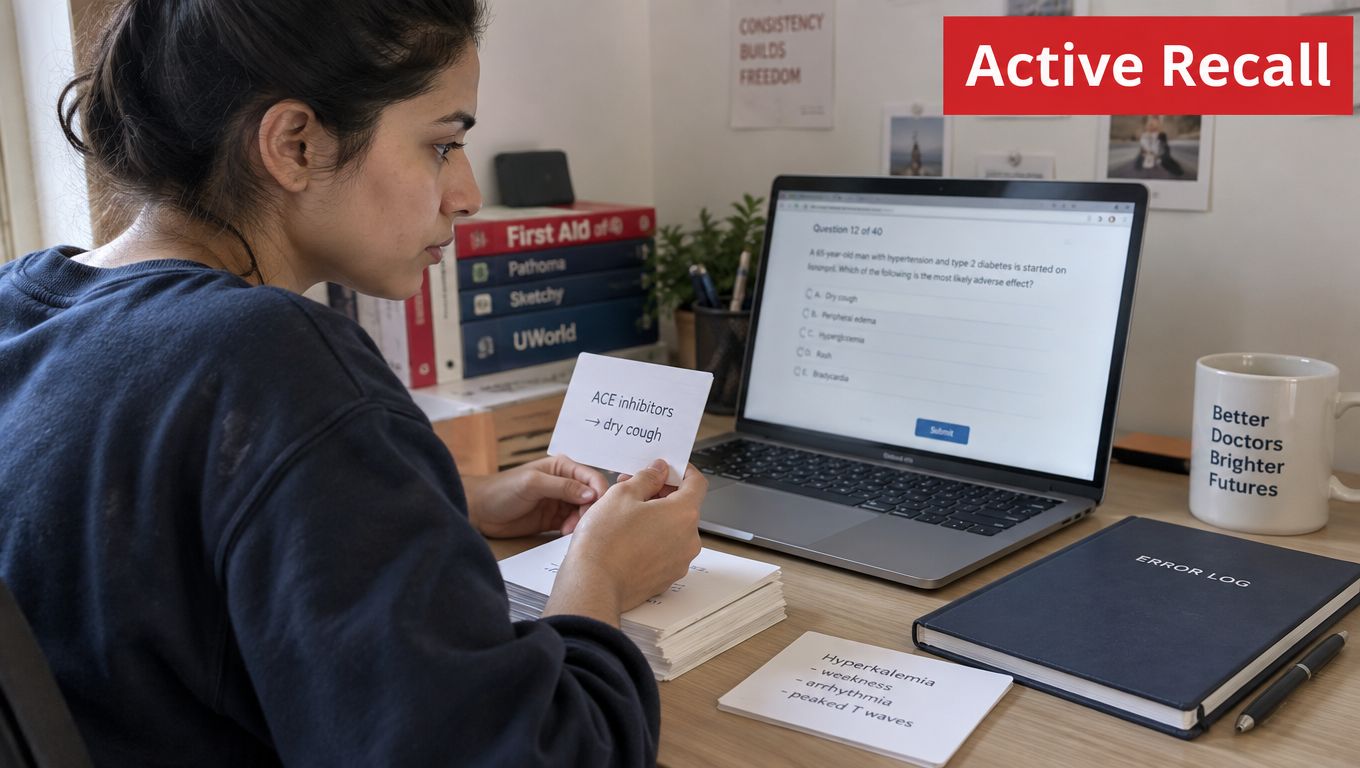
For a concise explanation of building active recall into a medical study routine, see this active recall guide from Ace Med Boards. How retrieval practice boosts GCSE scores offers a related educational example. Medical learners should still align question selection, scoring review, and recalibration with the relevant official exam outline and learner population.
2. Spacing and Interleaving
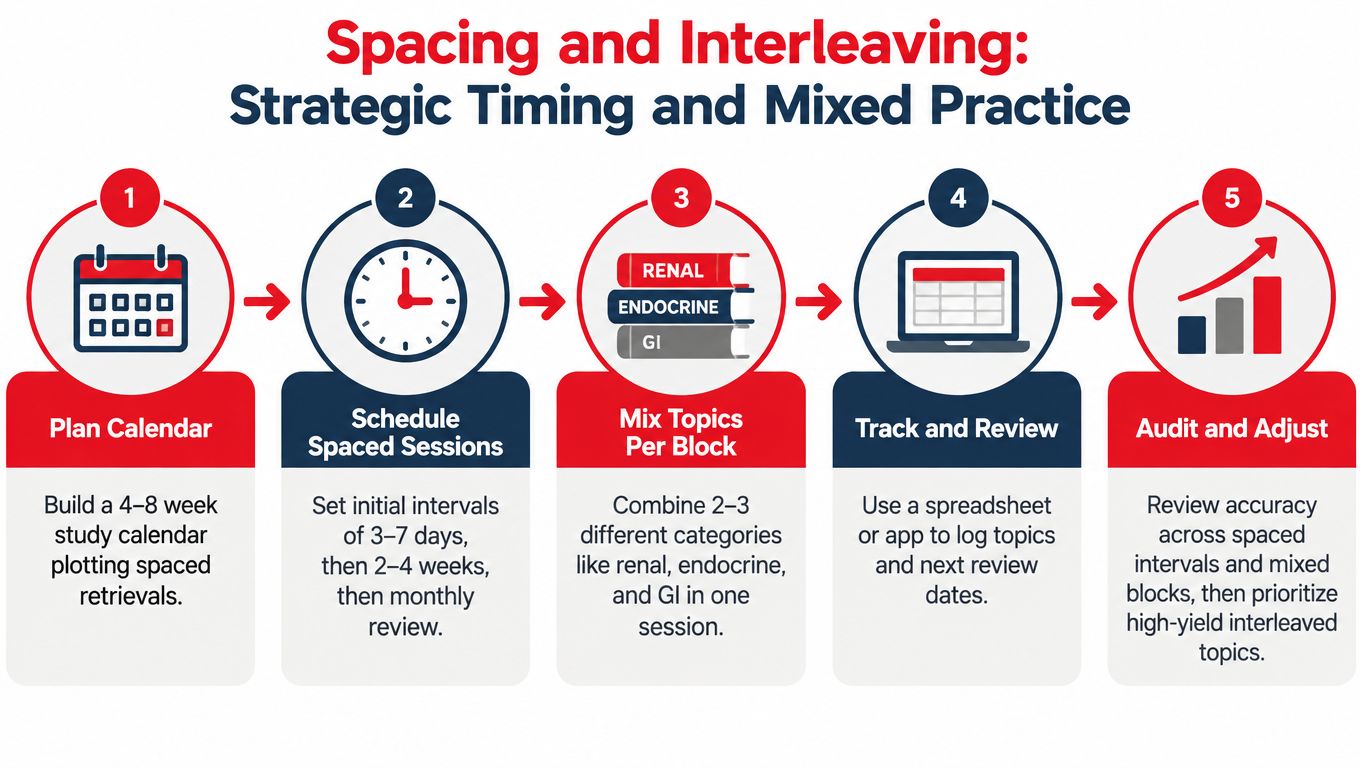
Spacing determines when a concept returns to your schedule. Interleaving determines which concept follows it. Together, they replace predictable chapter-by-chapter practice with delayed, mixed retrieval that requires you to identify the relevant mechanism before answering. A systematic review of medical education methods reports that longitudinal spaced retrieval generally improves exam performance or knowledge retention in controlled studies. Read the review of spaced retrieval for medical learners.
Start with a diagnostic goal for the exam you are preparing to take. A Shelf learner might track whether obstetrics concepts remain accurate after a delay, then mix obstetrics with gynecology and other rotation topics. A COMLEX-USA learner can distribute OMM across the calendar and combine it with system-based questions, so the material is retrieved within broader clinical reasoning contexts. USMLE preparation benefits from mixing mechanisms and presentations across systems. MCAT preparation calls for deliberate alternation among biology, chemistry, physics, psychology, and passage-based reasoning rather than treating each subject as a separate block.
Design the calendar around forgetting
Begin a topic with a retrieval attempt, then schedule the next attempt after a meaningful delay. One medical-student guide describes an inter-study gap of 20% to 40% of the time until a test for material needed in one week, and 5% to 10% for material needed in one year. See the guide's distributed-practice scheduling examples. Use these ranges as planning guidance, not as a fixed prescription for every learner or topic.
A workable calendar can include a short review soon after learning, another within the next day or two, a later retrieval at one to two weeks, and a final check before the exam. Record the date, topic, question result, and next interval. If performance remains accurate across separate sessions, extend the interval. If accuracy falls, shorten it and change the question type or explanation before testing again.
Mix with a reason
Interleaving should create a decision problem, not random noise. Combine related categories that require discrimination, such as renal, endocrine, gastrointestinal, and metabolic questions, while keeping enough focus to repair a confirmed gap. A spreadsheet or app can show which topics are due, which results are unstable, and whether the weekly plan is improving performance.
Review the calendar each week and adjust it from results rather than hours studied. Ace Med Boards' spaced repetition guide offers additional guidance on returning to material at meaningful intervals. The objective is a visible cycle: set the diagnostic target, retrieve on schedule, mix unseen combinations, and recalibrate before exam day reveals what has faded.
3. Deliberate Practice and Error Analysis
A wrong answer becomes useful only after you identify the failed decision. Two learners can miss the same question for different reasons. One may lack the relevant physiology, another may misread a qualifier, and a third may know the concept but lose the reasoning sequence under time pressure.
Deliberate practice separates these causes, assigns a corrective action, and schedules a later test of that correction. Evidence from medical education favors active retrieval, spaced repetition, interleaving, and self-monitoring over passive review. A recent synthesis reported stronger effects for active-learning interventions, including retrieval practice and self-testing, with a pooled effect around g ≈ 0.91. Time-management interventions showed smaller but meaningful effects around g ≈ 0.39 to 0.59. Review the evidence summary on study methods in medical education.
Classify the failed step
An error log should identify the cause rather than label every miss as “weak knowledge.” Use categories such as:
- Knowledge gap: You cannot explain the relevant mechanism or fact.
- Misreading: You missed a qualifier, comparison, or requested exception.
- Reasoning error: You knew the facts but connected them incorrectly.
- Pacing error: Time pressure altered your reading or decision process.
- Careless error: You recognized the answer but selected or recorded the wrong option.
A practice vignette may ask you to explain metabolic decompensation. If the miss reflects an unexplained physiologic mechanism, record a knowledge gap, review the mechanism, retrieve it later without notes, and solve a new vignette with a changed context. Repeating the original item mainly tests memory for its wording.
The corrective action should match the exam and the error. A Shelf learner who repeatedly misses qualifying words needs controlled reading practice. A COMLEX-USA learner who struggles with neurologic localization needs to rebuild the anatomy and reasoning chain. A USMLE learner may need to connect a mechanism to a different clinical presentation. For the MCAT, the same log can track failures to interpret an experiment, graph, or passage, rather than clinical localization.
Make feedback actionable
For each miss, record the question task, topic, error type, correction, next review date, and transfer test. Write the correction in your own words and answer, What will I do differently next time? Set a diagnostic goal for the week, then judge the plan by error patterns and later performance rather than hours studied.
Distractor review can clarify whether a miss reflects missing knowledge or an answer-choice trap. Use this distractor analysis resource alongside your own log, official exam materials, and independent practice.
Audit the log weekly. If pacing errors dominate, add controlled timed reading. If mechanism errors dominate, repair the concept before adding more questions. Then test the correction with unseen material and adjust the next week from the results.
4. Transfer and Metacognitive Monitoring
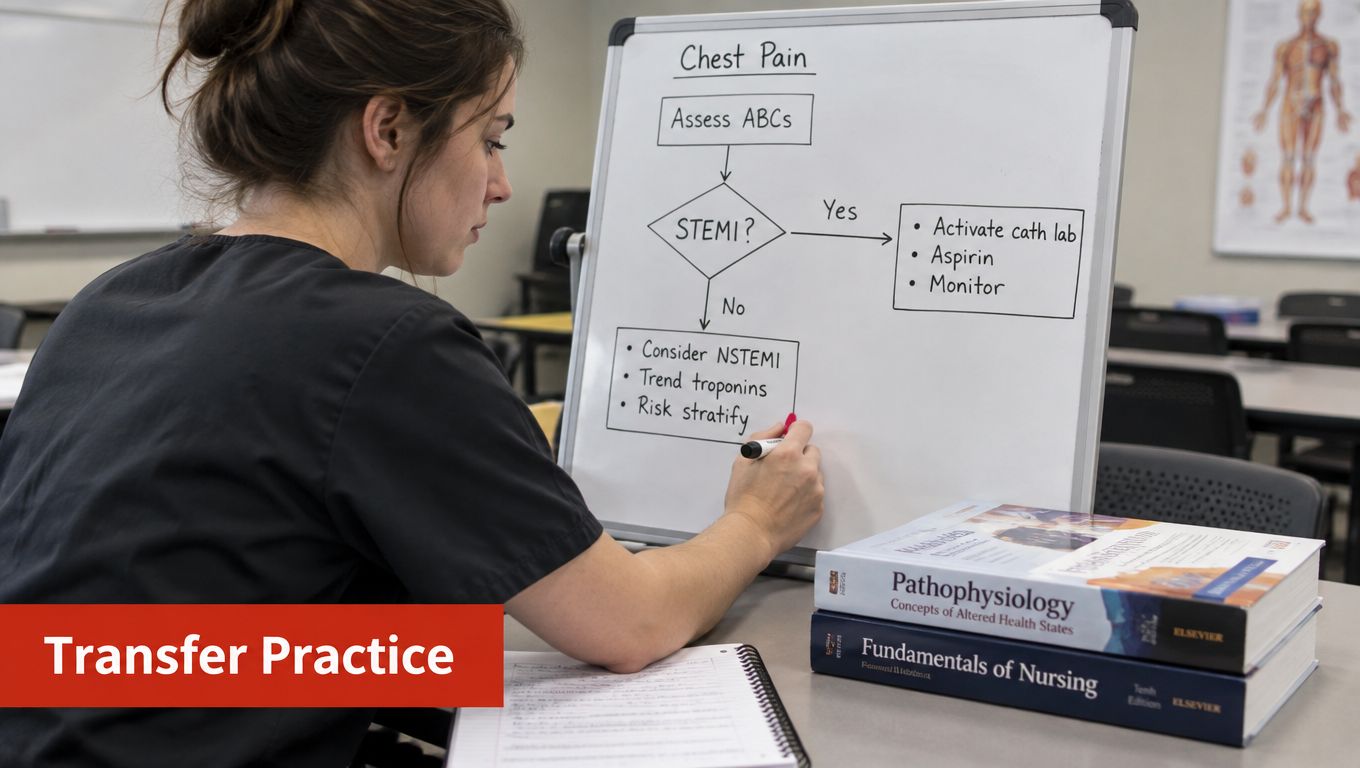
Correctly answering a familiar question can create false confidence. Transfer-focused practice tests whether you can apply a principle after the wording, patient context, or combination of findings changes. That shift matters because exam questions rarely present every concept in the same form used during review.
For USMLE Step 1, study the mechanisms of heart failure, then apply them to unfamiliar scenarios involving different causes or physiologic stressors. A Shelf learner studying acid-base physiology should reason through a new mixed disorder instead of matching a memorized pattern. COMLEX-USA preparation can test whether drug mechanisms remain usable across patient contexts while preserving the exam's distinct osteopathic and biomedical expectations. These examples concern exam preparation, not treatment of real patients.
Test the mechanism, not the surface pattern
During review, ask:
- What changed between the familiar and unfamiliar question?
- Which mechanism stayed constant?
- What finding would disconfirm my first interpretation?
- Can I explain the answer without repeating the source's wording?
- Can I solve an original question that combines this concept with another system?
Use official exam outlines to set the study target, then choose practice material that changes the surface features while preserving the underlying principle. For the MCAT, transfer may require applying a scientific idea to an unfamiliar passage, graph, or experimental setup. That task differs from a USMLE, COMLEX-USA, or Shelf clinical vignette, so the method should match the exam's reasoning demands rather than treat all question formats alike.
Metacognitive monitoring adds a measurable control point. Before answering, record confidence and the reason for that estimate. After answering, compare confidence with correctness and classify the result. High confidence with an incorrect answer signals a calibration or reasoning problem. Low confidence with a correct answer suggests that retrieval may be working while confidence remains poorly calibrated. Review metacognitive awareness for medical studying to support this type of monitoring.
Turn each result into a scheduling decision. Revisit a concept when confidence is high but accuracy is low, and use an unfamiliar question when accuracy is high only on repeated formats. If performance varies by exam task, change the material, timing, or question type rather than just adding study hours.
Learning-style labels do not justify matching instruction to a preferred sensory mode. Choose a representation that fits the material, combining words with a diagram when it clarifies a pathway, comparison, or sequence. A flow chart can show a mechanism, but retrieval and transfer testing must establish whether you can use it independently.
4-Strategy Study Skills Comparison
| Method | Implementation Complexity 🔄 | Resource Requirements ⚡ | Expected Outcomes ⭐📊 | Ideal Use Cases | Key Advantages ⭐💡 |
|---|---|---|---|---|---|
| Retrieval Practice: Testing Effect and Active Recall | 🔄 Moderate, needs schedule and disciplined self-testing | ⚡ High time + Q-bank access; efficient per-hour learning when focused | ⭐⭐⭐⭐⭐ / 📊 Strong long-term retention and measurable exam gains | High‑stakes board prep (USMLE/COMLEX/Shelf); routine question-based study | ⭐ Identifies gaps, builds exam confidence, transferable across formats. 💡 Prioritize Q‑bank over passive review |
| Spacing and Interleaving: Strategic Timing and Mixed Practice | 🔄 Moderate–High, requires multi‑week planning and adherence | ⚡ Moderate resources (planning tools, large question pool); very efficient for durable retention | ⭐⭐⭐⭐ / 📊 Produces durable retention and better transfer to novel problems | Long-term study plans; multi-system exams; preventing last‑minute cramming | ⭐ Reduces fluency illusions and burnout; improves transfer. 💡 Build a 4–8 week calendar with spaced intervals |
| Deliberate Practice with Error Analysis & Metacognitive Feedback | 🔄 High, structured error logs, feedback loops, honest reflection | ⚡ High per‑item time; needs detailed explanations/mentor support; slower throughput but high ROI | ⭐⭐⭐⭐⭐ / 📊 Rapid reduction of repeated errors; targeted score gains | Students with recurring error patterns or needing targeted remediation | ⭐ Diagnoses root causes and improves reasoning; prevents repeat mistakes. 💡 Log error type + action plan for each miss |
| Transfer-Focused Practice & Metacognition | 🔄 High, depth learning and ongoing calibration required | ⚡ High resources (diverse banks, full‑length exams); time‑intensive but prepares for novelty | ⭐⭐⭐⭐ / 📊 Better performance on unseen vignettes and improved self‑calibration | Preparing for novel clinical reasoning on boards and clinical exams | ⭐ Builds ability to apply principles to new problems; data‑driven study adjustments. 💡 Emphasize mechanisms and regular full‑length tests |
Build the Cycle, Then Audit It Weekly
The four methods become more useful when they operate as a loop:
- Retrieve instead of reread. Start with a question, blank-page explanation, or flashcard response before reviewing notes.
- Space and mix review. Return to material after delays, then combine topics that require different decisions.
- Classify errors. Record whether the miss came from knowledge, reading, reasoning, pacing, or carelessness.
- Test transfer. Use unseen, original practice to check whether the mechanism works outside the familiar wording.
- Monitor and recalibrate. Compare accuracy, retention, confidence, pacing, and workload, not hours alone.
A reusable weekly retrieval calendar
The short recall sequence comes from medical education literature, while the later calendar is a reusable planning framework. The evidence synthesis covering distributed practice and practice testing supports the broader principle that repeated retrieval and distributed practice are stronger foundations than restudy alone.
Error-tracking checklist
For every missed or uncertain question, record:
- Question task: What did you need to identify, calculate, compare, or explain?
- Error type: Was it a knowledge gap, misreading, reasoning error, pacing error, or careless mistake?
- Correction: What concept or reasoning step fixes the error?
- Next review dates: When will you retrieve it again, including a short review and a later spaced review?
- Transfer test: What new, unseen prompt will show that the correction works?
Use the framework differently by exam. USMLE learners should align content and practice with the relevant USMLE outline. Osteopathic students should keep COMLEX-USA planning distinct and include the competencies represented by the NBOME outline. Shelf learners should prioritize the current rotation and its exam expectations. MCAT learners should use passage-based and experimental transfer appropriate to that test, rather than assuming a clinical board workflow applies.
Choose the next action based on the error. Remediate a knowledge gap with a focused explanation and retrieval. Slow down when reading or reasoning errors recur. Adjust timing when pacing causes avoidable misses. Reduce or redesign the workload when the schedule can't be sustained. A consistent schedule, clear goals, distraction control, and time management also belong in an effective study system, as described in the medical education literature.
No study skill strategy guarantees a score, pass, admission, or residency match. These methods support preparation by making learning and readiness more observable. Clinical examples in this article are for examination education only, not medical advice or patient-care decisions.
Ace Med Boards publishes study guidance that connects an official exam outline, a primary question bank, review tools, an error log, and a weekly calendar. If you want outside structure, compare that approach with your current plan and keep your own performance data at the center.
Sources
- Peer-reviewed overview of validated study strategies in medical education
- Systematic review of spaced retrieval for medical learners
- Medical education study methods evidence summary
- Medical education source on expanding retrieval intervals
- Evidence summary on active recall and spaced repetition
Ace Med Boards offers online tutoring and test preparation for USMLE Steps 1, 2, and 3, COMLEX-USA Levels 1, 2, and 3, and selected Shelf exams, with study planning that can incorporate retrieval calendars, error analysis, and transfer practice. Visit Ace Med Boards to learn more or request a free consultation, without treating tutoring as a guarantee of any exam or career outcome.