
You can spend an entire day studying and still struggle to retrieve the material tomorrow. For medical students, the problem usually isn't a lack of discipline. It's a study system that measures time and pages instead of recall, error patterns, retention, and transfer to unfamiliar questions.
The most reliable study skills and study strategies form one connected loop: set a measurable goal, diagnose the starting point, retrieve information from memory, space reviews, mix related topics, analyze errors, and adjust the plan each week. That system can support USMLE and COMLEX-USA preparation, but the exact exam blueprint and official materials should determine what you study.
Why Most Medical Study Plans Quietly Stall
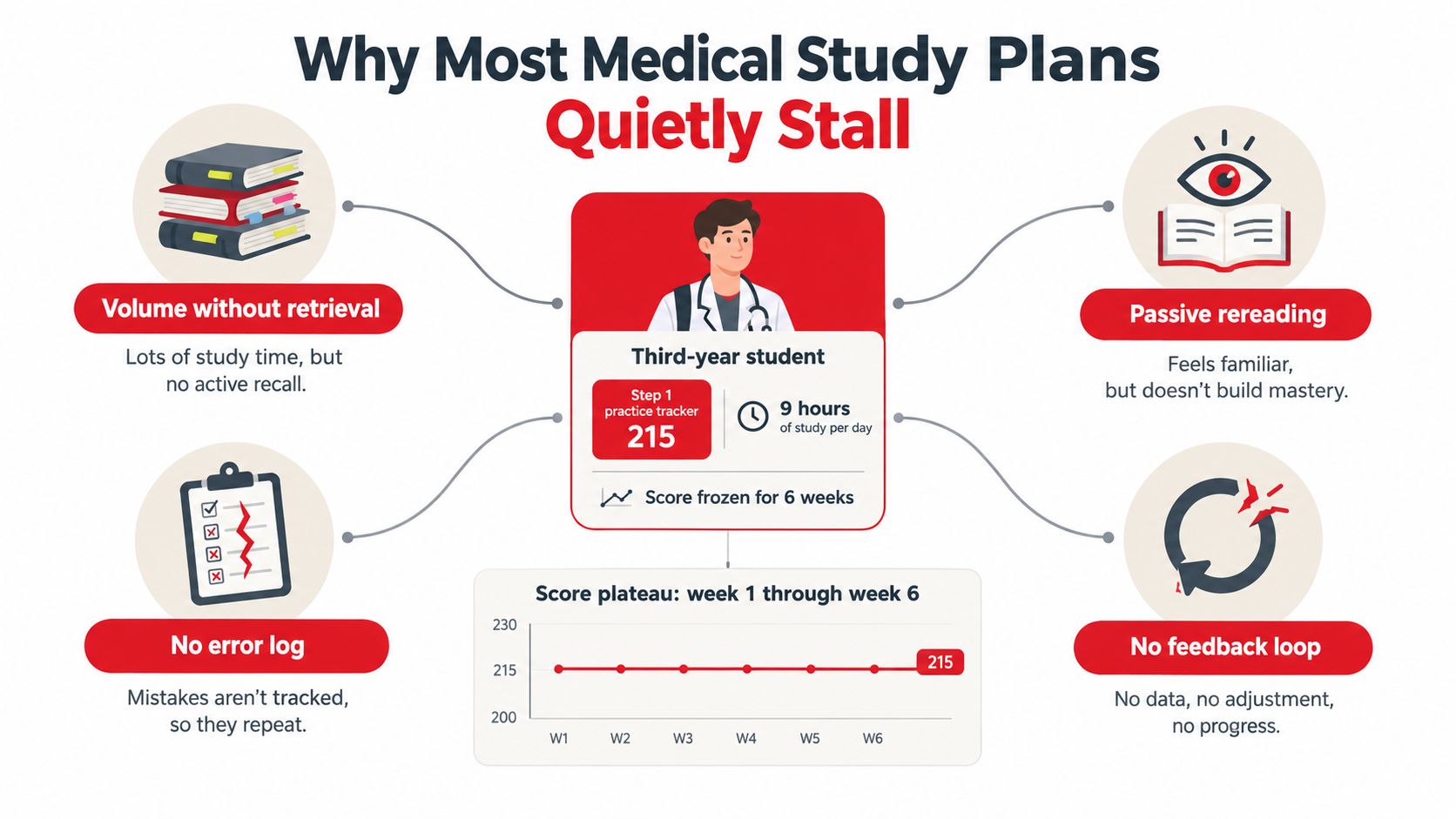
Composite scenario: A third-year student has a 215 on a USMLE Step 1 practice tracker, studies nine hours a day, and watches the score remain unchanged for six straight weeks. The student isn't careless or unmotivated. The schedule is full, the videos are complete, and the notes are heavily highlighted. Yet the plan produces familiarity more reliably than it produces usable recall.
That plateau often begins with volume without retrieval. Reading a chapter again can make the material look easy because the answer is already in front of you. Watching another video can clarify a concept, but it doesn't prove that you can reconstruct the mechanism when the prompt is unfamiliar. Active learning reviews consistently favor approaches that make learners generate answers, while passive review tends to provide weaker evidence of mastery (medical-student learning strategy review).
The four missing habits
- Retrieval makes you answer before you look. A blank page, oral explanation, flashcard prompt, or original practice question exposes what you can produce.
- Spacing brings the same material back across expanding intervals. A 2024 meta-analytic review of spaced retrieval practice included 29 studies and 54 aggregated effect sizes, and one analysis found a strong benefit for spaced retrieval over massed retrieval, g = 0.74 (retrieval-practice review).
- Interleaving mixes related subjects or problem types so you must identify the relevant rule instead of responding to a predictable sequence.
- Feedback explains why an answer worked or failed, then turns that explanation into the next action.
A stalled plan usually skips at least one of these. It may contain retrieval without spacing, a question bank without careful review, or spaced flashcards without transfer to unseen cases. The result is exhausting effort with little diagnostic information.
Practical rule: Your study plan should make a measurable change in what you can retrieve, explain, discriminate, and apply. Hours alone can't show that.
High-stakes preparation also needs room for recovery. If anxiety or overload is making every study block feel like a crisis, guidance on balance and calm while studying can complement, but not replace, an evidence-based learning system. The aim isn't to study harder indefinitely. It's to assemble retrieval, spacing, interleaving, and feedback so each session informs the next one.
Set a Goal and Run a Real Diagnostic
Start with a goal that can direct decisions. “Study more” isn't measurable enough to tell you whether the plan is working. Write down the exam, the target date, the performance goal, the number of weekly study blocks you can protect, and the review volume you won't negotiate away.
A useful planning statement might read:
“I'm preparing for this exam by this date. Each week, I'll complete my planned mixed-question blocks, review every explanation, revisit weak material on schedule, and track accuracy, retention, pacing, and workload.”
Don't treat the target as a promise. It's a planning reference. Exam alignment matters, so use the current official blueprint or content outline for the specific examination rather than letting a commercial resource define the whole curriculum. USMLE, COMLEX-USA, Shelf, MCAT, and admissions preparation require different content maps and shouldn't be blended into one generic target.
Run the diagnostic before rebuilding everything
Take one full timed block under conditions that resemble your intended examination environment. Don't pause to research, change answers after looking something up, or turn the block into a tutorial. Record the overall result, subject-level performance, pacing, and every question that felt uncertain, including questions you answered correctly for the wrong reason.
Tag each miss by cause:
- Knowledge gap: You didn't know the relevant fact or mechanism.
- Reasoning error: You knew the facts but failed to connect them to the answer.
- Careless misread: You overlooked a qualifier, timeframe, or negation.
- Stamina slip: Your attention or pacing deteriorated late in the block.
| Diagnostic Error Tagging Template | What It Means | Example | Fix the Plan Should Add |
|---|---|---|---|
| Knowledge gap | The needed information wasn't retrievable | You can't explain why a lab pattern occurs | Atomic retrieval prompts and spaced review |
| Reasoning error | Facts were available but the decision rule failed | You identified the diagnosis but chose the wrong next step | Worked reasoning, comparison prompts, and transfer questions |
| Careless misread | The stem was interpreted inaccurately | You missed “most likely” or a key time course | Slow first read, underline mentally, and review misread patterns |
| Stamina slip | Performance changed with fatigue or time pressure | Later questions show rushed reading | Timed practice, pacing checkpoints, and recovery planning |
This baseline gives you an error mix, not just a score. If most misses are knowledge gaps, build the retrieval and spacing engine. If reasoning errors dominate, review explanations and practice transfer. If the same errors recur despite review, your feedback loop isn't changing behavior.
For a framework that turns broad ambitions into observable behaviors, use measurable performance goals. A diagnostic isn't a judgment about your potential. It's a map of where the next study decision should come from.
Build a Retrieval and Spacing Engine
Retrieval and spacing work best as one workflow. First, try to produce the answer without looking. Then schedule another attempt after a delay. If you miss it, correct the explanation and bring it back sooner. If you retrieve it accurately, widen the interval.
Take one page of notes on a topic and convert it into atomic questions, not a compressed paragraph. Useful prompts include:
- What is the definition?
- What mechanism produces this finding?
- What feature distinguishes it from a close alternative?
- How would the concept apply in an original clinical scenario?
For instance, instead of copying a paragraph about a renal transport process, write separate prompts for its location, transporter function, expected laboratory pattern, and a distinguishing comparison. The question should be narrow enough that a wrong answer tells you what to repair.
Use an expanding review schedule
A practical starting sequence is same day, +1 day, +3 days, +7 days, and +21 days. These intervals aren't sacred. They create a repeatable structure that prevents newly learned material from disappearing into a completed-notes folder. A 2026 medical-education systematic review and meta-analysis of 14 studies involving 21,415 learners found a significant advantage for spaced repetition over standard studying, with a standardized mean difference of 0.78, a 95% confidence interval of 0.56 to 0.99, and p < 0.0001 (systematic review of spaced repetition in medical education).
During each review, hide the answer. Use free recall through a blank page, a short oral explanation, or a written comparison. Recognition, such as thinking “that looks familiar,” isn't the same as reconstructing the answer. When recall fails, look briefly, close the source, and try again.
A weekly low-stakes self-test checks whether the system is working outside the exact wording of your cards. Include unseen prompts and questions that require choosing between related concepts. Research on self-testing found that practice-question completion was positively associated with course performance, including a reported 1.1% increase in final course score for every 10% increase in completion and performance about 11% higher for completing all available self-testing opportunities compared with not self-testing (self-testing and follow-through study).
A flashcard application such as Anki can automate scheduling, but paper cards, a spreadsheet, or a calendar can perform the same essential function. The engine supplies retrievable knowledge. A question bank then trains the reasoning and transfer needed to use that knowledge under pressure. Guidance on Anki and spaced repetition can help you choose a tool without confusing the tool with the learning process.
Use Question Banks Like a Reasoning Workout
A question bank shouldn't function as a scoreboard you check and abandon. Use it as a reasoning workout. Open each session with at least one item due from your spacing schedule, then move into questions that match the day's purpose.
| Block Type | When to Use | Pacing | Explanation Rule |
|---|---|---|---|
| Untimed learning block | First pass through a system or a new reasoning pattern | Read carefully and pause when needed | Explain the correct answer and why each alternative fails |
| Timed mixed block | Transfer practice and exam conditioning | Keep moving and flag uncertainty | Review after the block, not during it |
| Targeted weak-area block | Repeated errors with a defined cause | Use enough time to reason accurately | Add one correction and one unseen transfer prompt |
In an untimed block, read every explanation actively. Identify the stem cue, the discriminating feature, the rule being tested, and the reason your answer diverged. Then write one original transfer question, such as changing the timing, population, or key finding. Don't reproduce commercial wording or recalled examination content. Your transfer prompt should test the rule in a new form.
Timed blocks serve a different purpose. A common format is 40 mixed questions, completed without pausing, with uncertain items flagged for later review. The point isn't to create panic. It's to practice switching between organ systems and deciding what matters when the topic isn't announced in advance.
A gradual progression
- Early phase: Use untimed blocks to learn how explanations expose reasoning errors.
- Next phase: Mix subjects while preserving enough review time to correct each miss.
- Later phase: Use timed mixed blocks and review the full error set, including correct guesses.
- Reset condition: If a familiar system remains weak, use a batch that is 70% new questions, then review all flagged items within 48 hours.
Mixing subjects reduces the illusion of mastery that appears when every question tests the same recently reviewed rule. It also teaches you to recognize which framework applies before you start solving. For a resource-ordering discussion focused on USMLE question analysis, see USMLE and UWorld question strategy. UWorld is a third-party resource, and no affiliation should be assumed.
Weekly Retrieval Calendar and Error Log You Can Reuse
A good calendar protects retrieval before the week becomes crowded. It also assigns a purpose to each day, so you aren't deciding from scratch while tired.
| Day | Main task | Retrieval behavior |
|---|---|---|
| Monday | Spaced review of last week's cards | Free recall before checking answers |
| Tuesday | New content plus interleaved recall | Mix the new topic with older prompts |
| Wednesday | Timed mixed question-bank block | Flag uncertainty and review afterward |
| Thursday | Error-log triage and card updates | Repair causes, not just memorize answers |
| Friday | Transfer questions and a mini self-test | Use unseen prompts and delayed recall |
| Saturday | Weak-system deep dive | Consolidate one recurring failure pattern |
| Sunday | Rest or light review | Review the data and reset the calendar |
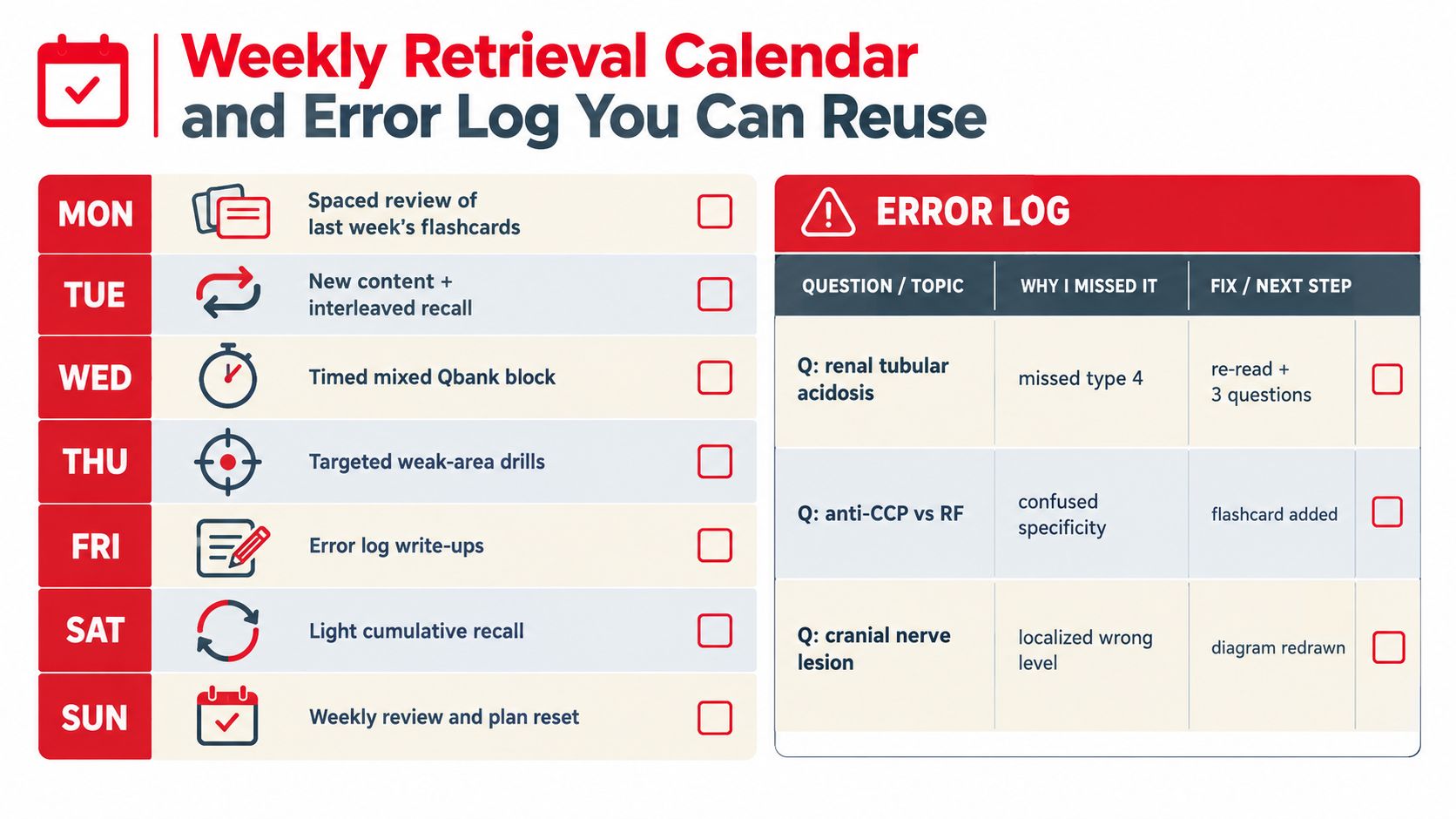
The error log should be a diagnostic instrument, not a diary of everything you did. Record the date, question task, error type, correction, next review date, and transfer test prompt. Use consistent tags, such as knowledge gap, misread stem, careless slip, second-order reasoning, and time pressure.
| Date and question task | Error type | Correction | Next review date | Transfer test |
|---|---|---|---|---|
| Monday, original cardio question on interpreting an ST-segment finding | Misread stem | Re-read the tracing description and distinguish the stated timing from the distractor pattern | Two weeks later | Write an original question changing the timing and identify which finding should change |
The correction must explain the rule in your own words. “Review cardio” is too broad to guide action. “When the finding occurs in this context, compare timing and distribution before selecting the mechanism” gives you a behavior to test.
A repeatable monthly rhythm
At the end of each week, count repeated error types rather than total entries. If knowledge gaps cluster in one system, add atomic prompts. If misreads recur across systems, practice deliberate first reads. If transfer questions fail after accurate card recall, reduce recognition-based review and add more unseen mixed blocks.
Use progress tracking tools only if they help you see these decisions clearly. A dashboard that records many activities but doesn't change the next review date is decoration. The useful record connects each error to a correction, a delayed retrieval attempt, and a new application.
Breaking a Score Plateau Without Burning Out
A plateau deserves investigation before it deserves a new resource. For planning purposes, define it as three consecutive weeks with under one percent variation on a calibrated NBME, then inspect the conditions around the result rather than treating the score as a verdict.
Check four things first:
- Recovery: Is sleep deteriorating, or are study blocks extending while attention weakens?
- Question exposure: Are you completing enough questions to reveal transfer problems, or repeatedly reviewing familiar items?
- Error distribution: Does the log show one system, one reasoning task, or one recurring careless habit?
- Review adherence: Are scheduled reviews happening, or are they being postponed until the material feels urgent?
Match the adjustment to the pattern
If errors remain concentrated in one system, add interleaving. Place that system beside related systems and require yourself to identify the relevant framework before answering. If known-item recall is strong but unseen mixed questions remain weak, shift toward fully unseen blocks. The problem may be transfer, not storage.
If new content keeps expanding while old material decays, temporarily reduce the intake and consolidate. More cards won't repair a review schedule that already exceeds your capacity. A smaller set of accurately retrieved concepts is more useful than a large collection you recognize but can't produce.
Learning-style labels don't solve this problem. Visual, auditory, and kinesthetic preferences don't justify matching instruction to a declared sensory mode. Choose the representation that fits the material, and combine words with a useful diagram when the relationship is spatial or mechanistic. The 2026 STEM learning-strategy review identifies retrieval, spacing, interleaving, elaboration, concrete examples, and dual coding as evidence-based approaches while also describing gaps in longitudinal evidence. Use strategies because they create the needed learning behavior, not because a label says they match your personality.
A predictable morning routine can reduce decision fatigue, especially for learners managing attention challenges. A calmer ADHD morning strategy may offer useful routine ideas, but it shouldn't replace individualized academic or clinical support. If stress, low mood, or exhaustion is interfering with basic functioning, review medical student mental health support and contact the appropriate professional or school resource.
Track Progress, Adjust Weekly, and Know When to Ask for Help
Reserve 30 minutes on Sunday for a review that looks at behavior and retention, not just effort. Pull up the error log, score trend, and delayed-recall results. Choose one focus behavior for the coming week, then decide whether to repeat the current plan, raise the difficulty, or lighten the load.
Track the measures that can change your next decision:
- Retrieval accuracy: Can you produce the answer before seeing it?
- Repeated error rate: Which causes keep appearing?
- Retention: What remains available after a delay?
- Pacing: Do errors increase late in timed blocks?
- Sleep and energy: Can you sustain the planned work without escalating exhaustion?
Drop vanity measures such as total cards reviewed or pages highlighted when they aren't connected to performance. A large review count can hide shallow recognition. A smaller count with accurate delayed recall and successful transfer gives you better evidence.
Use these adjustment rules:
- If accuracy stays above 85% across two reviews, widen the interval or increase the question difficulty.
- If you plateau on a familiar batch, reset with a clean set of unseen questions.
- If energy drops for two weeks in a row, protect a half-day off and reassess the workload.
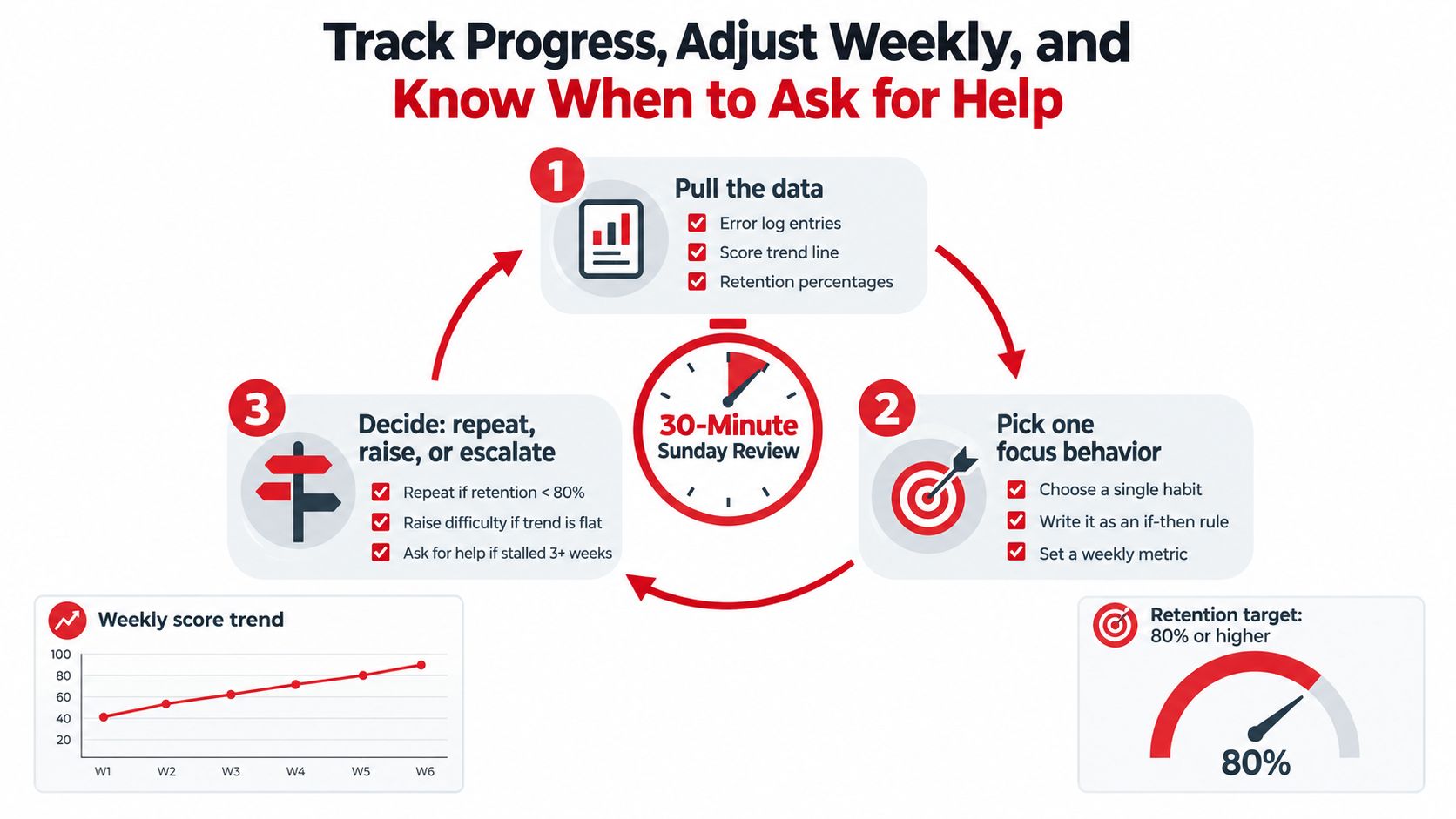
Ask for outside input when practice scores fall without an understandable cause, you keep avoiding questions in one weak subject, sleep collapses, or low mood persists. Tutoring, counseling, faculty advising, and peer support are routine maintenance. They don't mean you lack ability, and one difficult score or failed attempt doesn't determine your medical career.
Ace Med Boards offers individualized online preparation for USMLE, COMLEX-USA, selected Shelf exams, MCAT preparation, admissions consulting, and residency-match planning, with study-plan and question-analysis support built around the relevant goal. If you want a second pair of eyes on your retrieval calendar, error log, or plateau pattern, visit Ace Med Boards to learn about a free consultation without treating tutoring as a promise of a particular score, pass, admission, or match.