For exams on or after May 7, 2026, USMLE Step 2 CK is a one-day, nine-hour exam with 16 thirty-minute blocks and up to 318 items. For exams on or after July 1, 2025, the minimum passing score is 218.
That answer matters because older Step 2 advice can be misleading. The exam has changed in its structure, its passing standard has been recalibrated, and its role in residency applications became more prominent after Step 2 Clinical Skills was discontinued. If you're studying now, your plan should match your test date, your registration pathway, and the way modern clinical vignettes demand decisions under time pressure.
What USMLE Step 2 CK Tests in 2026
Step 2 Clinical Knowledge, or Step 2 CK, remains a numerically scored clinical licensing examination. The current minimum passing score is 218 for exams administered on or after July 1, 2025, as reported by USMLE examination results and scoring guidance. That passing standard is tied to the date you test, so don't rely on an old score report or a preparation guide that treats the threshold as permanent.
The format changes on May 7, 2026. Before that date, USMLE guidance describes eight 60-minute blocks with no more than 40 questions per block, within a single nine-hour testing session. On or after that date, the session keeps the same one-day, nine-hour structure but moves to 16 thirty-minute blocks, with up to 20 items per block, at least 55 minutes of break time, and an optional five-minute tutorial, according to the official Step 2 CK content outline and specifications and USMLE exam resources.
| Feature | Exams before May 7, 2026 | Exams on or after May 7, 2026 |
|---|---|---|
| Testing session | One day, nine hours | One day, nine hours |
| Block structure | Eight 60-minute blocks | 16 30-minute blocks |
| Item limit | No more than 40 questions per block | Up to 20 items per block, up to 318 items overall |
| Break structure | Within the nine-hour session | At least 55 minutes of break time |
| Scoring | Three-digit numerical score | Three-digit numerical score |
Why the dates change your preparation
Shorter blocks may reduce the number of questions you must hold in working memory at one time, but they also create more frequent pacing decisions. Practice should include timed blocks that resemble your actual format, rather than assuming that experience with an older block structure will transfer automatically.
The passing-standard change also alters the risk calculation for borderline examinees. A result that might have met the prior threshold could fail under the newer standard, so students near the passing range should treat readiness as a formal decision based on current practice evidence, not on reassurance from old forums.
Step 2 CK became more consequential after Step 2 Clinical Skills was suspended in May 2020 and permanently discontinued in January 2021. CK became the sole Step 2 examination, and programs lost the separate clinical-skills pass/fail component, increasing the importance of the CK result in residency selection. The USMLE performance data also show how competitive interpretation can become when scores cluster near national means. For U.S. and Canadian school examinees, the reported first-time mean is 251 in 2025–2026, while the 2024 aggregate data list 30,690 total first-time examinees and an 88% overall pass rate for that broad group.
Eligibility and Registration After the 2026 Transition
Eligibility starts with your school and your status on both the application date and test day. You must be enrolled in or graduated from an LCME-accredited U.S. MD program, a COCA-accredited U.S. DO program, or a non-U.S. medical school listed in the World Directory of Medical Schools that meets ECFMG eligibility requirements, according to the 2026 USMLE Bulletin and Addendum.
The registration pathway also changed with the January 2026 service transition. U.S. MD and DO students and graduates register through NBME, while eligible international medical graduates, or IMGs, use FSMB. This distinction matters because the organization handling your application affects document submission, identity verification, and the appropriate customer-service channel.
Build the checklist around your pathway
Before choosing a date, confirm:
- School eligibility: Verify that your school and degree category meet the current requirements.
- Registration authority: Determine whether NBME or FSMB handles your application.
- Identity documentation: Prepare the required identity verification materials.
- Photograph submission: Follow the current specifications rather than relying on a prior application.
- Enrollment or diploma verification: Confirm whether your school must verify current enrollment or graduation.
- Test-date feasibility: Leave enough time for authorization, scheduling, and any unresolved credentialing issue.
International graduates should review the current ECFMG pathway directly and avoid assuming that a legacy application route still applies. The ECFMG certification requirements can help organize that review, but current USMLE and ECFMG instructions control your eligibility.
Building a Realistic Study Timeline
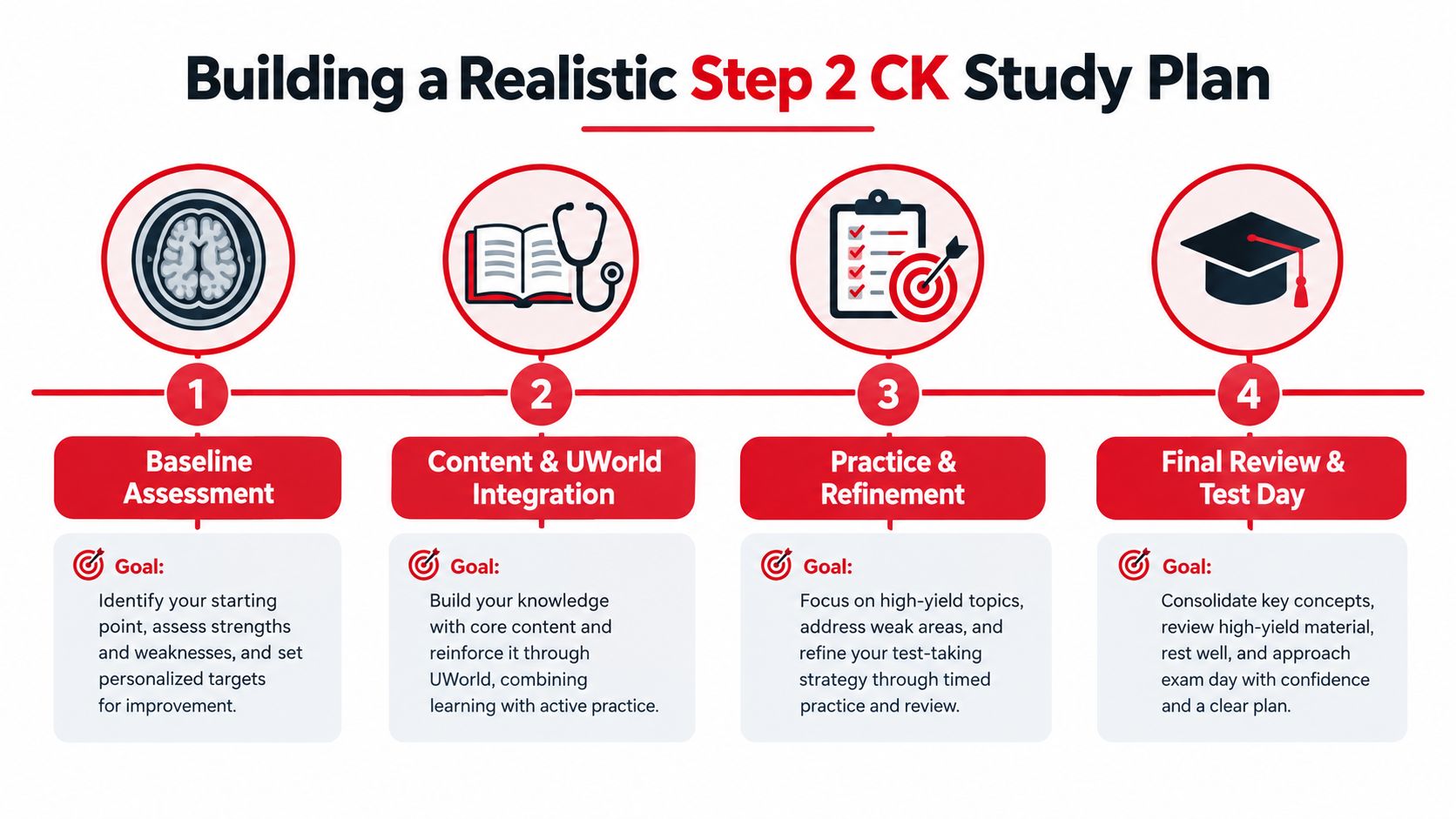
A strong Step 2 CK plan is built around decision points, not a calendar that assumes every student begins from the same place. Start by identifying your baseline, then use practice performance to decide whether to continue, narrow the plan, or move the exam date.
Use this sequence:
- Baseline assessment: Complete an NBME self-assessment roughly 16 to 20 weeks before your intended date when that timeline is available to you. Record not only the score, but also the systems and reasoning failures behind missed items.
- Content consolidation: Use the first phase to repair core clinical knowledge. UWorld explanations, a focused organ-system review, and clerkship or shelf-exam weaknesses can form the backbone.
- Intensive practice: Shift toward timed, mixed blocks. Review errors carefully, then target the specific cause with focused questions or a concise reference.
- Midpoint reassessment: Around eight weeks out, complete another calibration point using an appropriate official assessment or practice resource. Look for repeatable performance, not one encouraging session.
- Final simulation and taper: Use the last phase for full-session stamina, pacing, chart-style interpretation, and targeted review. Reduce novelty near test day so your attention is available for execution.
The amount of time should reflect the baseline. A learner already performing above 230 may use a 12-week plan, while someone in the 200 to 220 range may need 16 to 20 weeks, according to the planning framework used for this guide. Those figures aren't guarantees or universal rules. IMGs and repeat examinees may need longer if they are rebuilding clinical fluency, test stamina, or confidence after a prior attempt.
Practical rule: Every phase should answer one question. What weakness am I repairing, and what new evidence will show that the repair worked?
A weekly plan should gradually resemble the exam. Early study can include subject-focused learning, but dedicated preparation needs mixed content, timed decisions, planned breaks, and sustained concentration. The Step 2 CK study schedule resource can help you convert these milestones into a personal calendar.
How to Reason Through a Step 2 CK Vignette
A long vignette becomes more manageable when you stop treating every sentence as equally important. The following worksheet is designed for original practice cases, not recalled exam content, and it forces you to identify the task before you chase a diagnosis.
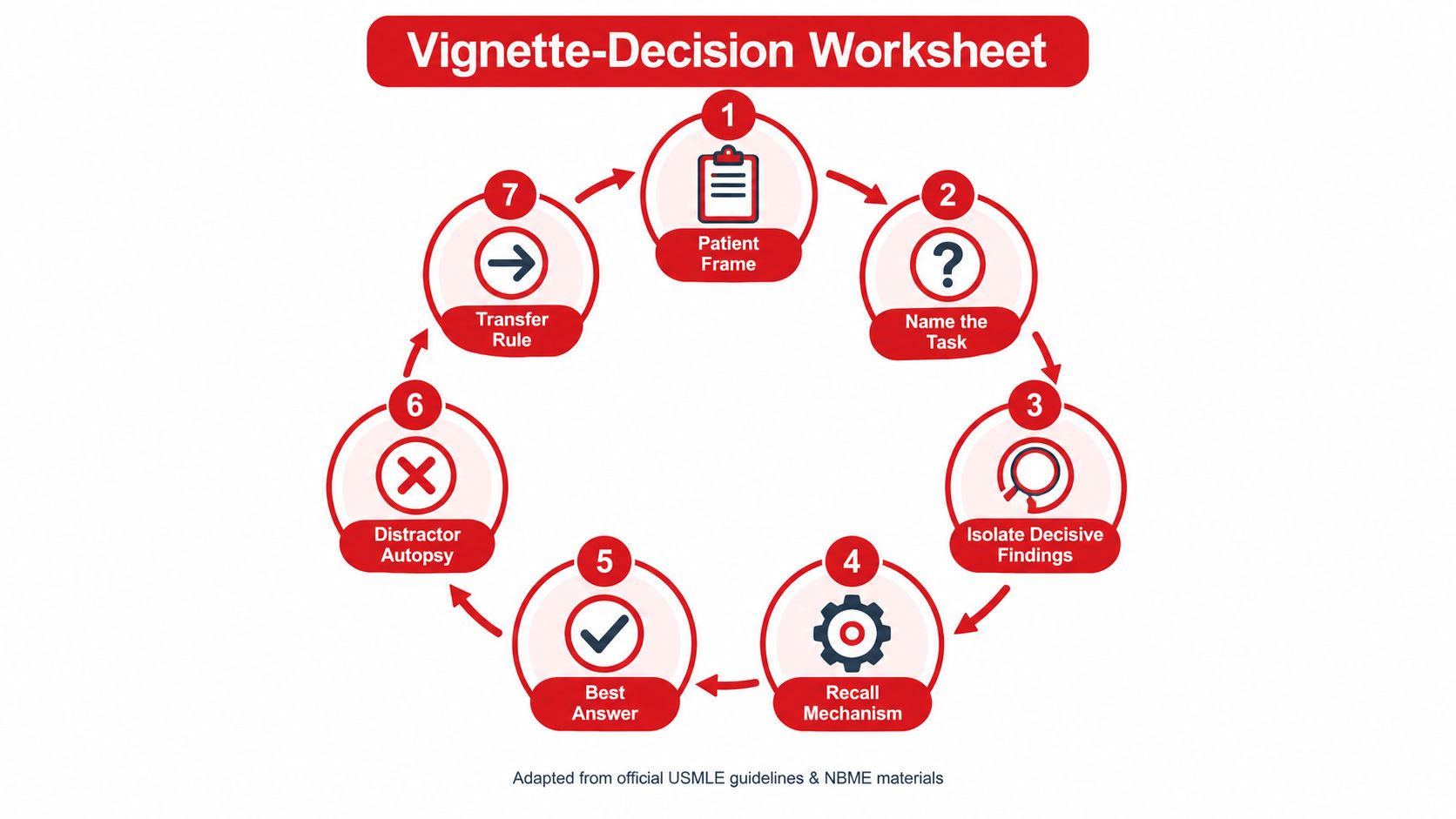
The vignette-decision worksheet
Hypothetical composite learner: Maya is a fourth-year student ten weeks from Step 2 CK. She reads an original chest-pain case involving a patient with exertional discomfort, a normal resting examination, a family history of premature vascular disease, and a finding that changes the immediate risk assessment. The question asks for the most appropriate next step, not only the diagnosis.
Maya works through the case this way:
- Patient frame: Adult with exertional chest discomfort and concerning risk features.
- Task: Choose the next best diagnostic or management step.
- Decisive positives and negatives: She identifies the exertional pattern and the risk-changing finding, while recognizing that a normal resting examination doesn't erase the concern.
- Mechanism or illness script: She recalls the clinical pattern of inducible myocardial ischemia and the need to select testing based on immediate risk and stability.
- Best answer: She chooses the option that addresses the question's task and fits the patient's risk profile.
- Distractor autopsy: She rejects an answer aimed at long-term prevention because the item asks what should happen next, and rejects an invasive option because the case doesn't establish the indication.
- Transfer rule: “When a stable patient has exertional symptoms plus a decisive risk feature, define the next diagnostic step before jumping to definitive treatment.”
This process prevents a common error. Students often recognize the disease but miss the question because the stem asks for a test, an intervention, prognosis, or ethical response rather than a label.
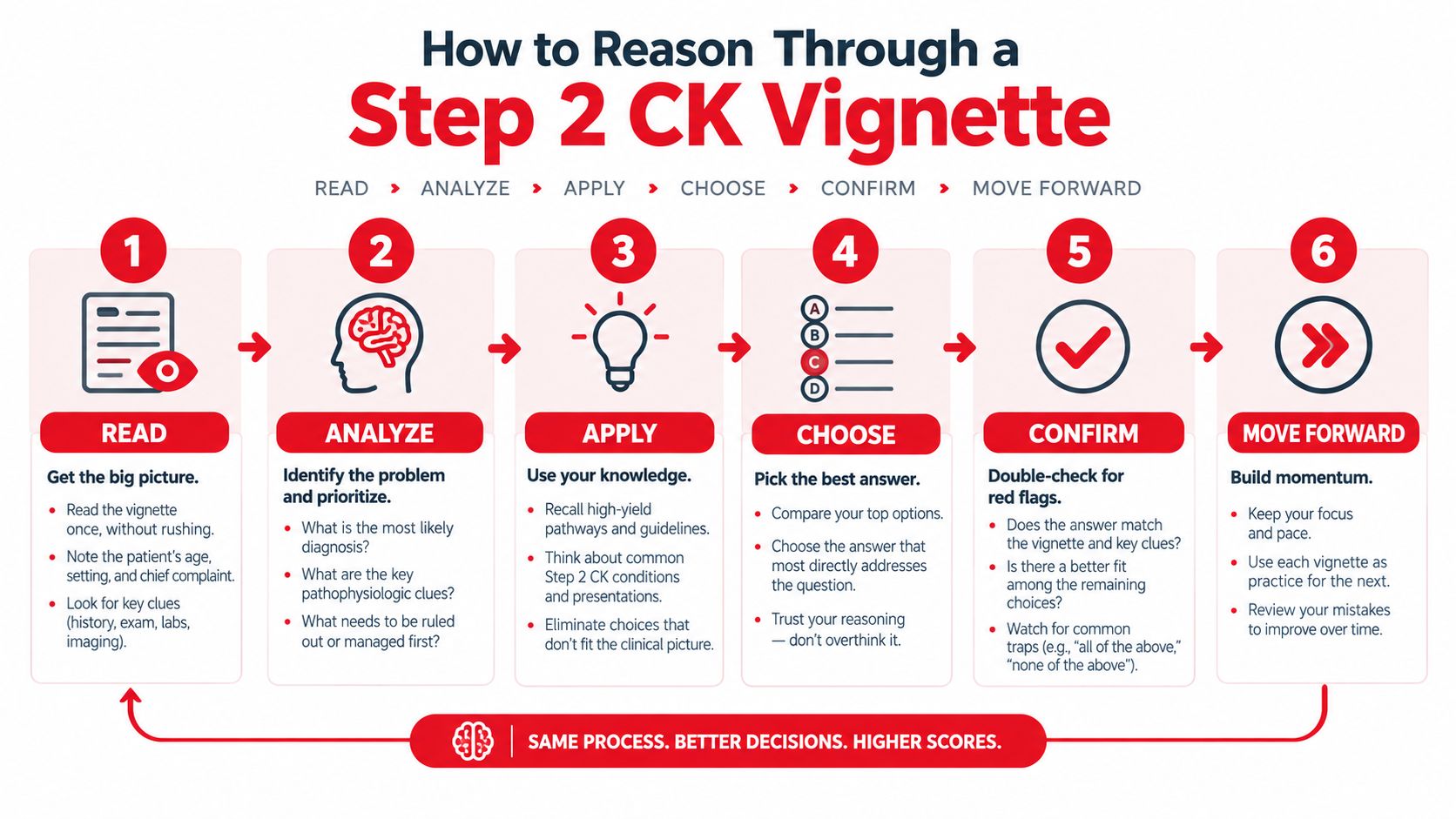
Maya also uses a checkpoint rule: if she can't state the decisive finding in one sentence, the item enters her error log. That prevents repeated exposure from creating false familiarity. For more background on applying this reasoning style, see clinical reasoning for Step 2 CK.
Diagnosing Weak Areas With an Error Log
A percentage correct tells you what happened. An error log should tell you why it happened and what you'll do differently next time. Without that distinction, students often respond to every missed question by rereading broad content, even when the actual problem is task recognition or evidence weighting.
| Error tag | Definition | Remediation action |
|---|---|---|
| Knowledge | You didn't know the relevant fact or algorithm | Review the narrow concept, then answer new questions on it |
| Illness-script | You knew facts but couldn't organize the presentation | Write the patient pattern, mechanism, and discriminating findings |
| Question-task | You misread what the item asked | Restate the task before reviewing answer choices |
| Evidence | You noticed findings but weighted them incorrectly | Rank decisive positives and negatives before choosing |
| Pacing or test-taking | Timing, fatigue, or answer-changing disrupted execution | Use timed mixed blocks and track when the error occurs |
Consider a hypothetical biostatistics miss involving negative predictive value. If the learner understood the definition but applied it to the wrong population, the entry belongs under evidence, not knowledge. The remediation would focus on how prevalence affects predictive values, followed by new questions that require interpretation rather than recognition.
Don't retest with the same item and call the result improvement. Memory can make a familiar question feel easy while hiding the original reasoning failure. Use unseen mixed blocks or official NBME forms when appropriate, then record whether the same error tag returns.
A useful entry has five lines:
- What was the question task?
- Which two findings mattered most?
- What answer did I choose and why?
- Why was the correct answer better?
- What transfer rule will I use next time?
The distractor analysis framework can supplement this process, especially when two answer choices appear clinically reasonable.
Practice Resources and Where Tutoring Fits
No single resource should carry your entire preparation. Official materials establish the examination's structure and sample interface, while question banks and references provide volume, explanation, and repetition. Use each resource for a defined purpose instead of collecting materials that compete for your attention.
| Resource | Best use | Study phase |
|---|---|---|
| USMLE sample questions and interactive tools | Learn item formats and interface expectations | Early orientation and final format check |
| NBME self-assessments | Calibrate readiness and identify broad weaknesses | Baseline, midpoint, and readiness review |
| UWorld | Detailed question-based learning and explanation review | Clerkships and dedicated practice |
| AMBOSS | Targeted reference and additional question exposure | Gap repair and focused reinforcement |
| First Aid for the USMLE Step 2 CK | Reference spine for concise review | Content consolidation and final review |
| Divine Intervention podcasts | High-yield reinforcement during appropriate study windows | Targeted review and commuting or low-intensity periods |
Third-party resources are proprietary. Don't reproduce UWorld or another question bank's wording, screenshots, or recalled content. Write your own reasoning notes and use official Step 2 CK test-question formats alongside the official sample question materials.
Where one-on-one support helps
Tutoring doesn't replace questions, official assessments, or independent review. It can help when you can't identify why your performance is inconsistent, when the same error tags recur, or when you need an external structure for a demanding study period.
Tutoring is usually more useful after a baseline assessment, when the learner can define a problem more specifically than “I need to review everything.” For students seeking structured one-on-one guidance, Ace Med Boards Step 2 CK tutoring is one available option. No tutoring service can promise a particular score, pass, admission result, or residency outcome.
Common Pitfalls and How to Recover
Step 2 CK preparation often fails through avoidable mismatches between the student's method and the exam's demands. The correction isn't always “study more.” It may be changing what you measure.
- Treating Step 2 as pure content review: Memorizing lists doesn't train next-best-step decisions. Add timed mixed questions and explain why each alternative is wrong.
- Collecting too many resources: Every new platform can fragment your review. Keep a primary question bank, an official assessment plan, and a short reference list.
- Ignoring ethics and biostatistics: These topics can feel manageable until wording changes the task. Schedule them repeatedly instead of leaving them for the final review.
- Chasing a question-bank percentage: One overall percentage can hide a weak organ system or a recurring task error. Track trends by system and error tag.
- Mistaking familiarity for mastery: A second pass through remembered questions may inflate confidence. Test transfer with unseen items.
- Assuming one setback ends a career: A low or failed result creates a planning problem, not an automatic verdict on your future. Review the cause before choosing a new date.
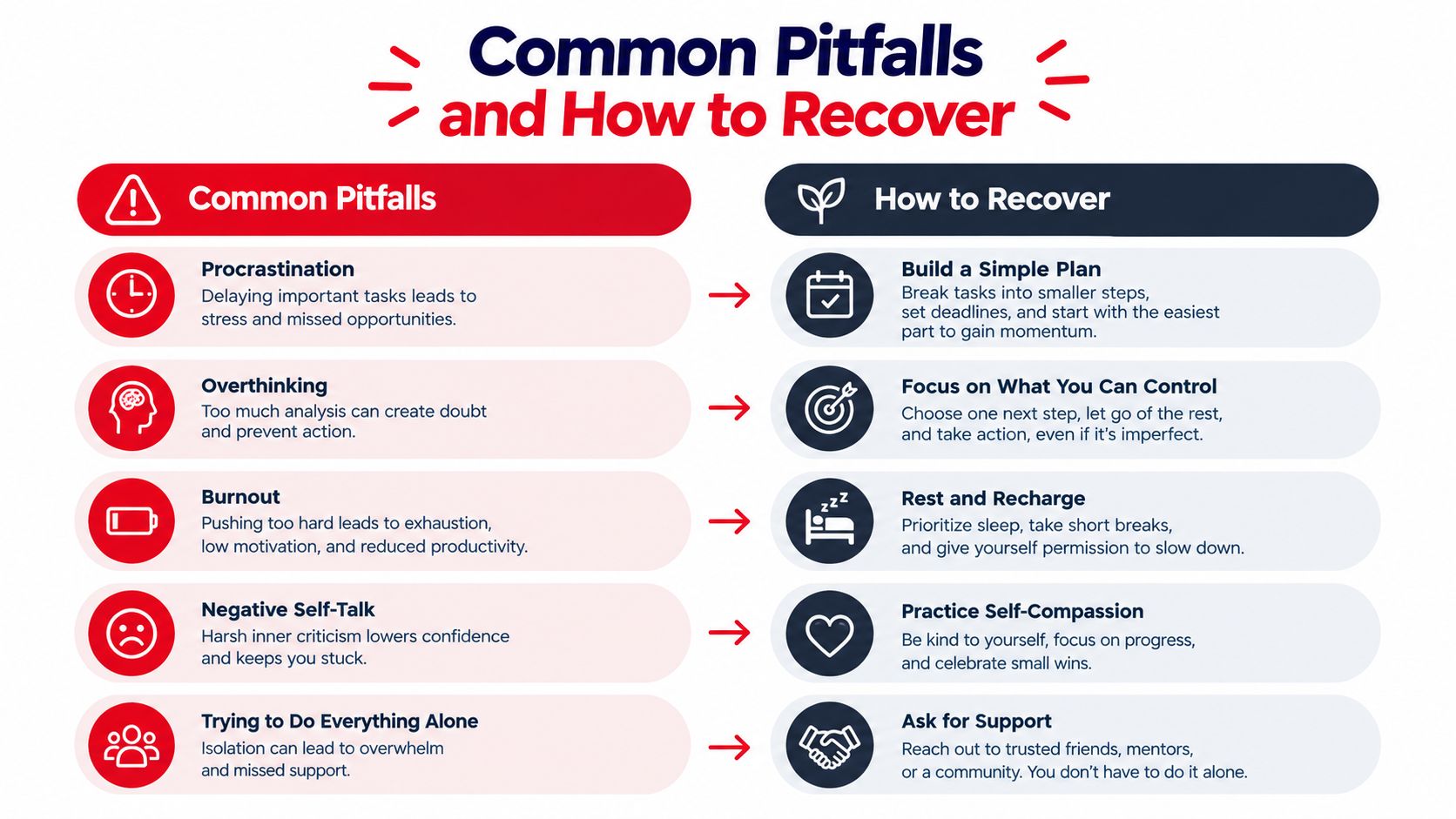
If your result is below target, separate three possibilities: knowledge, test strategy, and test conditions. A student who knew the material but rushed may need pacing practice, while a student who lacked core illness scripts needs targeted remediation. Anxiety, health concerns, accessibility needs, and outside stressors also deserve a formal review rather than blame.
Delay a retake when the evidence doesn't support readiness. Rebuild with new assessments, an error log, and a different plan. A faculty advisor, disability-access professional, or qualified tutor may help you decide what needs to change before you spend another testing attempt.
Key Takeaways and Frequently Asked Questions
Key takeaways
Use this checklist before you commit to a date:
- Confirm eligibility: Identify your MD, DO, or IMG pathway and the organization handling registration.
- Check the test date: Match your preparation to the format in force on your exam date.
- Set milestones: Schedule a baseline, content phase, mixed timed practice, and final readiness review.
- Run a diagnostic: Use an appropriate NBME assessment or other structured baseline before heavy studying.
- Practice full blocks: Build the concentration and pacing required by a nine-hour session.
- Maintain an error log: Tag each miss as knowledge, illness-script, task, evidence, or pacing.
- Retest on unseen material: Measure transfer rather than memory.
- Reassess before testing: If your evidence is weak, revisit the date and plan.
When should I take Step 2 CK relative to Step 1 and ERAS submission?
Plan around your clinical preparation and the score-reporting timeline for your application year. Many applicants want the score available before residency programs review applications, but the correct date depends on your school schedule, readiness, and the current ERAS calendar. Verify both timelines through official sources rather than relying on an old application cycle.
How long are Step 2 CK scores valid?
Validity rules can depend on the purpose, jurisdiction, and organization evaluating the result. Check the current USMLE, FSMB, ECFMG, and state licensing requirements that apply to your situation before assuming a score remains usable indefinitely.
What is a competitive score for my specialty?
There isn't one universal competitive score. Programs consider the full application, including clinical evaluations, recommendation letters, experiences, school context, attempts, and timing. Use published program guidance and advice from your school rather than treating a single number as a guarantee of an interview or match.
Can I retake a passing Step 2 CK?
Don't assume that a passing result can be retaken just to seek a higher score. Retake eligibility and reporting implications are policy-sensitive, so review the current USMLE bulletin and ask your school or the responsible registration organization before scheduling.
How do IMGs navigate the FSMB and NBME split?
Eligible international medical graduates use the FSMB pathway under the January 2026 transition, while U.S. MD and DO candidates use NBME. Confirm your category, school eligibility, documentation requirements, and current process in the 2026 Bulletin and Addendum before submitting an application.
Is the 318-item format harder?
The item count alone doesn't establish difficulty. The 2026 format changes block length while preserving the one-day, nine-hour structure, so preparation should focus on short-block pacing, break management, and sustained reasoning rather than assuming the new format is automatically easier or harder.
When should I consider a tutor instead of self-study?
Self-study may be sufficient when you can diagnose errors accurately, follow a schedule, and show stable improvement on unseen timed blocks. Consider structured tutoring when you keep repeating the same errors, can't interpret assessment results, or need accountability and individualized review. Tutoring should complement, not replace, official materials and independent question practice.
USMLE Step 2 CK is demanding, but a difficult result or a delayed date doesn't define your medical career. Build your plan from verified rules, current-format practice, honest error analysis, and readiness evidence.
If you want structured accountability for your Step 2 CK timeline or need help turning assessment results into a focused study plan, visit Ace Med Boards to learn about one-on-one USMLE tutoring and request a consultation. Use the conversation to clarify your weaknesses and next steps, not to commit to an exam date before you're ready.