

You're probably looking at MCAT resources right now and feeling a familiar kind of overload. There's the official AAMC material, third-party books, question banks, videos, flashcards, full-length exams, and a dozen competing opinions about whether MCAT prep should take three months, six months, or much longer.
The short answer is this. Strong MCAT prep starts with the four official AAMC sections, uses a real diagnostic to find your score gap, and then shifts quickly from passive review into passage-based practice, retrieval practice, timed work, and full-length simulation. The exam rewards stamina, reasoning, and disciplined review much more than rereading notes.
By Ace Med Boards Editorial Team
What MCAT Prep Actually Requires in 2026
A student starts studying in January with color-coded notes, three prep books, and a plan to “cover everything.” By March, the books are half-finished, passage scores are flat, and timing still feels rushed. The problem is rarely effort. It is usually a mismatch between how the MCAT is built and how the student is training.
A stable prep plan starts with the AAMC's structure. That matters because the MCAT has changed over time, but its current design is deliberate. The Association of American Medical Colleges traces the exam's modern lineage to the 1920s, notes a revision from eight sections to four in 1946, a renaming in 1948, and a major redesign launched in spring 2015 after a review process that began in 2008, according to the AAMC history page.
The four sections you're training for
The current exam reports four section scores and one total score. The AAMC explains the reporting structure, including the 118 to 132 section scale, the 472 to 528 total scale, and the fact that there is no penalty for guessing, in the AAMC MCAT scoring guide.
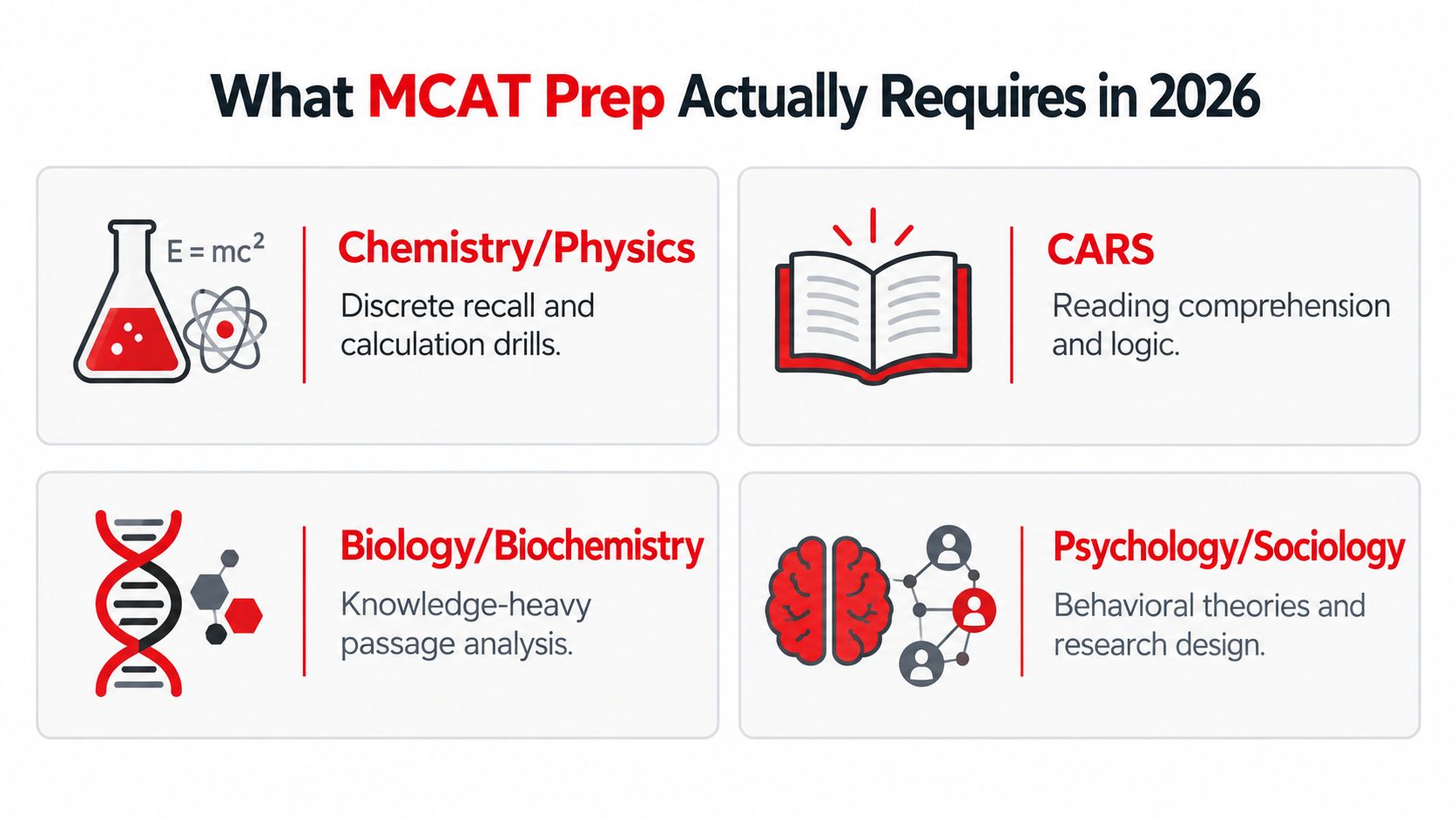
Those four sections are:
Chemical and Physical Foundations of Biological Systems
This section asks you to use chemistry and physics in biological settings. Students who treat it like a formula dump usually stall. The stronger approach is to practice translating equations, graphs, units, and lab setups into quick decisions.Critical Analysis and Reasoning Skills
CARS is closer to argument reading under pressure than to memorization. Your review has to focus on why a wrong answer looked tempting, how the author built the passage, and where your inference drifted beyond the text.Biological and Biochemical Foundations of Living Systems
This section blends core science knowledge with experiment interpretation. A student may know glycolysis cold and still miss questions if they cannot read figures, isolate variables, or connect a pathway to the passage's research goal.Psychological, Social, and Biological Foundations of Behavior
Psych/Soc rewards term mastery, but term mastery alone is not enough. You also need pattern recognition for study design, variable relationships, and the way the AAMC turns a familiar definition into a passage-based judgment call.
What prep demands in practice
Good MCAT prep is less like finishing a textbook and more like training for a long race with four different terrains. Each section uses a different mix of knowledge, reasoning, and pacing. That is why a generic “study 300 hours” rule fails so many students. Hours only matter when they are tied to your starting score, target score, and section-level weaknesses.
A peer-reviewed review of MCAT preparation describes the exam as a long performance that depends on more than recall. The authors discuss sustained attention, pacing, and decision quality across a test day that runs about 7 hour 33 minute, and they note that the research does not support a simple linear relationship between total study hours and final score in the peer-reviewed review article on MCAT preparation.
That is the planning shift many students need. Instead of asking, “How many chapters did I finish this week?” ask three narrower questions. How big is my score gap. Which section is costing me the most points. What review method fits that section's demands.
For students building a plan around those questions, the MCAT prep hub with section-specific planning resources can help organize the next steps.
How the MCAT Is Scored and Reported
You finish a full-length practice test, see a raw percent that feels uneven, and then wonder what it means for your real exam score. That confusion is common because the MCAT is reported on a scaled score, not as a simple classroom-style percentage.
The scale that matters
The MCAT reports four section scores from 118 to 132 and a total score from 472 to 528. Your total is the sum of those four section scores. If you want a plain-language breakdown of the ranges students usually reference, see what the MCAT is scored out of.
Raw performance is converted into a scaled score so scores from different test dates can be compared fairly. In practical terms, two students can miss a different number of questions on different forms and still earn the same scaled score if their overall performance is judged equivalent after equating.
A classroom test works like a tally sheet. The MCAT works more like a calibrated ruler. The point is consistency across administrations, not a direct one-to-one conversion from percent correct to final score.
MCAT scoring at a glance
| Metric | Range | What it means |
|---|---|---|
| Section score | 118 to 132 | One score for each of the four AAMC sections |
| Total score | 472 to 528 | Sum of all four section scores |
| Guessing penalty | None | Wrong answers and unanswered questions are not penalized differently |
| Reporting model | Scaled | Reported scores are adjusted for fairness across exam forms |
That has an important planning consequence. Students should not build an MCAT prep plan around chasing a specific raw percentage in every resource. A better question is whether your passage accuracy, timing, and review process are strong enough to keep producing scaled-score gains across all four sections.
What score reporting tells you
Your score report gives more than a single total. It separates performance by section, which is exactly how your prep should be organized.
AAMC also publishes examinee score data, including national score distributions and recent testing volume, in the MCAT examinee data report. Use those numbers as background, not as a study target. Admissions committees review applicants in context, and your planning decisions should start with your baseline, your school list, and your section-by-section spread.
A 500 with balanced section scores can call for a very different study plan than a 500 built from one strong section and three weaker ones. Same total. Different repair job.
When your score arrives
Official MCAT scores are typically released about a month after test day. That delay exists because forms are processed before final scores are posted. You also choose on test day whether to have the exam scored or voided, as noted earlier in the article.
For prep purposes, the big lesson is simple. Treat every full-length as four separate signals inside one total score. That is how the AAMC reports the exam, and it is the clearest way to decide whether your next study block should focus on content repair, passage strategy, or timing.
How Many Study Hours You Actually Need
A student takes a diagnostic in January, sees a 498, and immediately hears the same advice from three directions: "Just put in 300 hours." That answer sounds precise, but it skips the part that matters. A 498 to 505 plan is a different job from a 498 to 515 plan, and a student with rusty prerequisite science needs a different calendar from one who mainly loses points on timing and passage review.
Start with the score gap, then build the hour target around it.
Start with a score-gap calculation
Use this four-step framework:
- Take a true baseline diagnostic under official-style conditions.
- Set a target based on the schools you are seriously considering.
- Measure the gap between your baseline and target.
- Convert that gap into weeks using the number of focused hours you can realistically sustain.
The common public estimate of 300 to 400 hours is a useful starting range, as noted earlier in the article. It is not a rule. It is closer to a packing list. Helpful, but incomplete until you know the trip length and what you need to carry.
AAMC-style prep works the same way. Your total hours should reflect two separate questions: how far the score must move, and what kind of repair the exam is asking for.
Hours depend on the kind of score gain you need
Students with a small gap often do not need a long content rebuild. They usually need cleaner execution: better passage pacing, fewer avoidable misses, and a review system that turns each practice set into the next score increase.
Students with a moderate gap often need both. Some content repair. Some strategy repair. Some timing repair.
Students with a large gap usually need the longest runway because the work is layered. First, rebuild weak foundations. Then learn how each of the four AAMC sections asks you to use that knowledge under time pressure. Then prove it on full-lengths.
Score-Gap to Study-Hour Mapping
| Score Gap | Focused Study Hours | Typical Timeline | Practice-Test Count |
|---|---|---|---|
| Small gap | Closer to the lower end of the usual prep range if content is mostly intact | Shorter plan with steady timed practice | Multiple official-style full-lengths with deep review |
| Moderate gap | Middle of the usual prep range for mixed content and execution issues | Standard multi-month plan | Repeated timed sections plus full-lengths |
| Larger gap | Upper end of the usual prep range or more if fundamentals are weak | Longer plan with room for content rebuild and retesting weak areas | Heavy review load plus repeated simulation |
A focused hour has a job. It might be active recall for amino acids, a timed CARS set, a physics passage review, or a full-length postmortem. It is not passive highlighting, and it is not videos playing while you answer texts.
A simple analogy helps here. Study hours work like training miles for a race. Ten careful miles with feedback change performance more than ten distracted miles logged for the spreadsheet.
Use section patterns to refine the total
This is the step many hour-count articles skip.
If Chem/Phys and Bio/Biochem are low because content is patchy, more of your hours should go to retrieval practice and passage application. If CARS is lagging while science sections are stable, adding more biochemistry flashcards will not fix the actual bottleneck. If Psych/Soc errors come from answer-choice traps rather than forgotten terms, your next block should emphasize passage review and reasoning, not another full reread of notes.
That is why total hours should be tied to section-level diagnosis, not a generic benchmark. The same 60-hour block can produce very different results depending on where it goes.
If you want a way to estimate hours based on your baseline, target, and weekly capacity, this MCAT prep time guide gives a practical planning framework.
Subject-by-Subject Study Strategies That Work
A common MCAT prep mistake is treating all four sections like they reward the same kind of studying. They do not. The AAMC groups the exam into four sections for a reason. Each section asks you to process information in a different way, so each one needs its own review method.
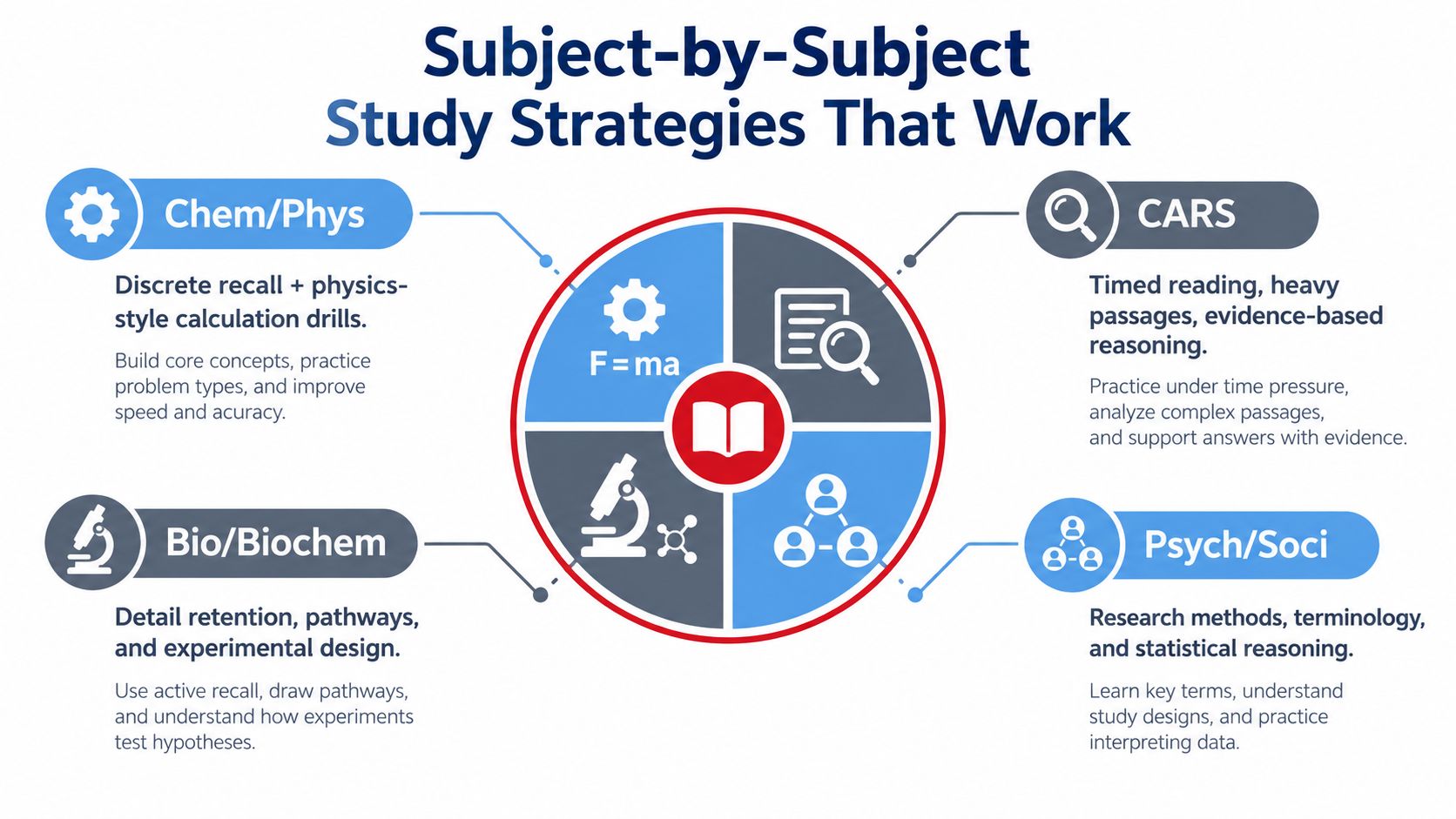
If your score gap is section-specific, your study plan should be section-specific too. A student stuck at the same total score often is not missing effort. The student is using the wrong tool for the section in front of them.
Chem and Phys needs compact setup habits
For Chemical and Physical Foundations, missed questions often start before the math. The problem is usually setup. Students read a dense passage, grab an equation, and start manipulating symbols before they have identified what the question is asking.
A better approach is to shrink the problem first. Chem/Phys works like translating a word problem into a small blueprint. Your job is to strip away extra wording until you can see the variables, the relationship, and the target.
Use a repeatable setup:
- Recall the equation from memory first. That checks whether the relationship is available under pressure.
- Label the knowns and unknowns. A short variable list prevents careless substitutions.
- Track units on purpose. Many questions become easier once the units point to the right operation.
- Turn long descriptions into a sketch or trend. A tube, circuit, graph trend, or force diagram is often clearer than the paragraph.
During review, do not stop at "I forgot the formula." Ask a sharper question. Did you miss the concept, the setup, the units, or the passage detail? Those are different problems, and they need different fixes.
CARS improves through evidence-based reading
For Critical Analysis and Reasoning Skills, stronger scores come from better reading decisions, not from memorizing outside content. CARS is a reading-and-reasoning section. The passage is the source material, and the credited answer has to match what is on the page.
Many students over-mark the passage and under-identify structure. They highlight lines that feel important but never decide what each paragraph is doing. That is like underlining every sentence in a textbook and calling it a map.
A cleaner method works better:
- Write a one-line function for each paragraph.
- State the author's main claim or attitude before opening the questions.
- For every answer you choose, point to the text evidence that supports it.
- During review, name the trap. Was the wrong choice too extreme, partly true, or based on your own assumption?
If you cannot support a CARS answer with the passage, the reasoning is probably too loose.
Later in your prep, this video can help reinforce section-specific planning:
Bio and Biochem rewards experimental reading
For Biological and Biochemical Foundations, content knowledge matters, but passage interpretation usually decides the question. Students who know the chapter well still miss points because they read the experiment like a story instead of a study design.
Treat each passage like a lab meeting summary. What was the researchers' question? What changed? What was measured? What did the figure show?
A simple sequence helps:
- Identify the experiment's purpose or hypothesis.
- Mark the independent and dependent variables.
- Translate each figure or table into a one-sentence result.
- Connect that result back to the pathway, mechanism, or prediction being tested.
This keeps you from drowning in details. It also helps with questions that look content-heavy but are really asking whether you understood the experiment.
Psych and Soc responds well to definition plus application
For Psychological, Social, and Biological Foundations of Behavior, straight memorization helps only if the memory is usable. A term you can recite but cannot recognize in a vignette is not exam-ready.
Build flashcards and notes around application, not just definitions. Each term should connect to a concrete example and a passage clue. That way, recall becomes faster and more flexible when the wording changes.
A stronger card format looks like this:
| Term | Definition | Example | Passage trigger |
|---|---|---|---|
| Hypothetical concept | Your own concise wording | A simple real-world example | What clue would signal it in a vignette |
Across all four sections, the goal is the same. Match the review method to the section's task. Chem/Phys needs setup discipline. CARS needs text-based reasoning. Bio/Biochem needs experimental reading. Psych/Soc needs term-to-example transfer.
That is the part many MCAT guides skip. They give one big hour target, then act as if all study blocks are interchangeable. In practice, section gains come from using the right review loop for the right kind of mistake, then carrying that loop into real passages until it holds under timed conditions.
Choosing Your 3, 6, or 9 Month Study Timeline
The right timeline depends less on motivation and more on fit. Three inputs matter most: how recently you completed prerequisite coursework, how large your score gap is, and how many hours per week you can sustain without burning out.
When a shorter timeline works
A 3-month plan fits students whose science foundation is still fresh, whose diagnostic is already close to target, and who can study at a high weekly volume. This isn't the right setup for major content repair. It works best when the main job is converting knowledge into timed performance.
A 6-month plan is the most broadly workable option for many applicants. It gives enough time to review content, build question volume, and complete multiple official-style full-lengths without turning every week into a crisis.
When a longer timeline is the smarter choice
A 9-month plan makes sense when prerequisites are older, life obligations are heavy, or your baseline shows deeper rebuilding needs. It's also a better fit for retakers who already know that rushing creates sloppy review.
Decision cue: If you need to relearn the foundations while also working or carrying classes, stretch the timeline before you compress your sleep.
3 vs 6 vs 9 Month MCAT Prep Timelines
| Timeline | Best For | Weekly Hours | Content vs Practice Split | Expected AAMC FL Delta |
|---|---|---|---|---|
| 3 months | Strong baseline, fresh prerequisites, high availability | Higher weekly load | Faster move into practice-heavy prep | Individual and unpredictable |
| 6 months | Typical applicant with completed prerequisites | Moderate weekly load | Balanced content and practice | Individual and unpredictable |
| 9 months | Retakers, older prerequisites, busy schedules, major rebuild | Lower to moderate weekly load | Longer content rebuild before full practice emphasis | Individual and unpredictable |
The more compressed the plan, the less room you have for inconsistency. If you need a calendar you can adapt to your schedule, this MCAT study schedule guide can help you map the phases.
Diagnostic, Review, and Passage Workflow
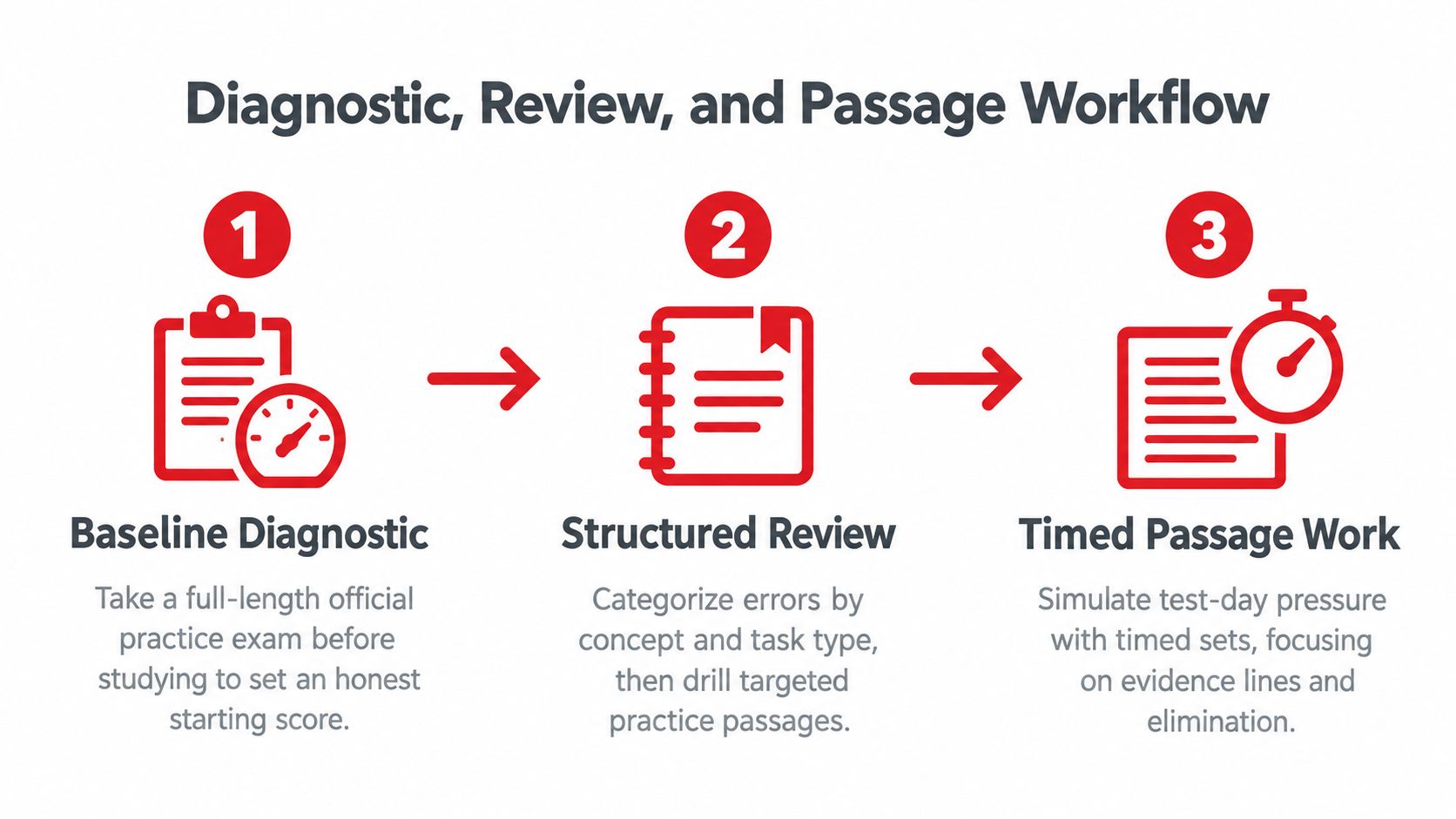
A lot of MCAT plans fail because they confuse activity with progress. Doing questions isn't the same as learning from them.
Stage one starts before content review
Take an official-style diagnostic before serious studying. Not after a week of brushing up. Not after watching summary videos. Before.
That score isn't a judgment. It's a planning tool. It helps you separate four common error types:
- Content gap
- Reasoning error
- Misread or overread
- Timing problem
Stage two is where most score movement happens
Once you know why you're missing questions, move from untimed to timed work gradually. Start by reviewing passages slowly enough to understand the logic, then reduce support as your pattern recognition improves.
Use a passage-review sheet like this after every meaningful practice set:
Passage Review Sheet
| Tested concept | Task | Evidence line | Why the credited answer wins | Why each distractor fails | Timing | One transfer rule |
|---|---|---|---|---|---|---|
| What content or reasoning idea was tested | What the question asked you to do | What sentence, figure, or data point supports the answer | The specific logic connecting evidence to answer | Why the wrong choices were tempting but incorrect | Fast, steady, or rushed | One lesson to apply on the next similar question |
That sheet works because it converts vague frustration into repeatable correction. It also keeps your review grounded in official content categories and official-style reasoning rather than memory of isolated items. Use the AAMC's MCAT Essentials, Official Prep Hub, and official sample and practice materials as your reference frame for format and content coverage.
Review every option, not just the credited answer. The wrong choices show you your habits.
Stage three is full timing under realistic conditions
Don't rush into full-speed conditions just because the calendar says you should. Shift to timed sections once your untimed review shows stable reasoning and your misses are becoming more specific.
A practical weekly cadence looks like this:
- One full timed section per subject across the week
- One review block that rewrites recurring misses into action items
- One full-length exam every two to three weeks in the final phase
- One weekly planning hour to revise the next week based on review-sheet patterns
Where Tutoring Fits in an MCAT Prep Plan
Some students can self-study all the way through. Others hit a plateau that isn't about effort. It's about calibration.
Four support models
Tutoring is most useful when it solves a specific problem that your current system isn't fixing. That problem might be unstable CARS reasoning, repeated timing collapse, or a science section where every review session turns into random content chasing.
MCAT Support Models Compared
| Model | Best For | Weekly Cost Profile | When to Upgrade |
|---|---|---|---|
| Fully self-study | Strong planners with steady review habits | Lowest direct cost | Upgrade if errors repeat without a clear fix |
| Course-only | Students who want structure and deadlines | Moderate to higher | Upgrade if feedback stays generic |
| Hybrid | Students mixing self-study with targeted outside help | Variable | Upgrade if one section remains stuck |
| 1:1 tutoring | Students needing individualized diagnosis and accountability | Highest direct cost | Use when targeted intervention would save time |
Signs that one-on-one help may add value
You may benefit from targeted tutoring if any of these are happening:
- Your full-length trend has stalled: You've taken multiple full-lengths with no meaningful change in the same weak areas.
- CARS is volatile: Your passage performance swings because your method changes from day to day.
- Content review never closes the loop: You relearn topics repeatedly but still miss passage application.
One-on-one tutoring shouldn't replace official AAMC practice. It should help you use it better. For example, a service like Ace Med Boards offers individualized MCAT tutoring and diagnostic review that can fit into an AAMC-first plan rather than compete with it. If you're comparing support models, this guide to one-on-one tutoring benefits can help you decide whether you need accountability, section-specific coaching, or neither.
Common Pitfalls and a Final Readiness Checklist
Two weeks before test day, a student's calendar can look full and still hide a real problem. The hours are there, but the work is misallocated. They did extra biology flashcards, skimmed missed questions, and saved CARS for “later,” yet their score stayed flat because the prep no longer matched the exam.
That pattern is common. The MCAT punishes vague studying. It rewards specific adjustment, section by section, based on the score gap you are still trying to close.
The patterns that derail otherwise solid prep
The biggest mistakes usually come from using one study style for all four sections. The AAMC exam is built in four parts, so your review has to work the same way.
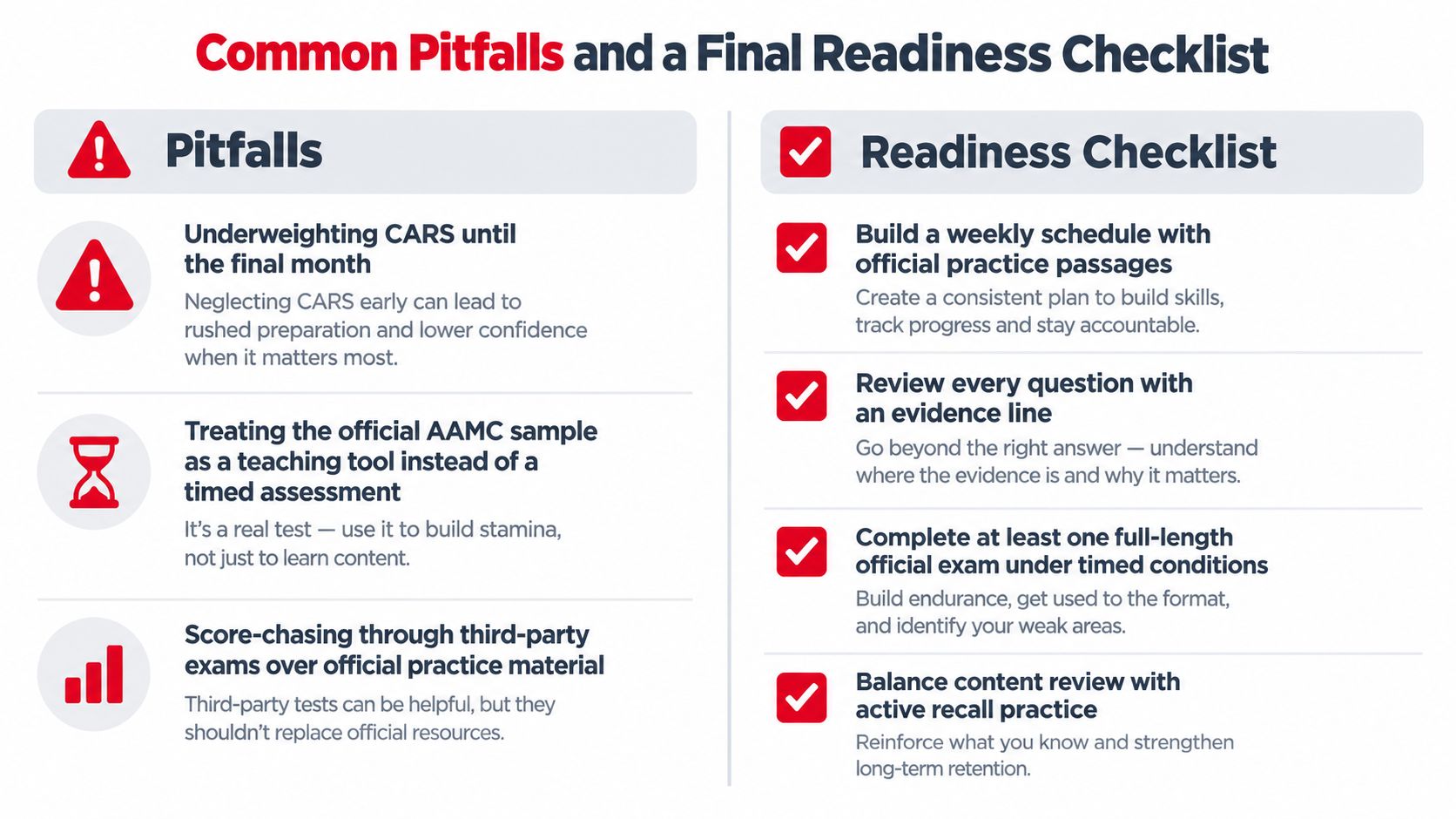
- Underweighting CARS: Students often delay daily CARS practice because improvement feels less visible than memorizing science facts. CARS works more like learning an instrument than cramming vocabulary. Short, regular reps matter more than occasional long sessions.
- Using official material too casually: Official passages are your best calibration tool. If you rush through them just to get a score, you lose the chance to study how the exam frames evidence, distractors, and reasoning.
- Score-chasing instead of error analysis: A new full-length can show you where you stand. It cannot, by itself, fix why you missed electrochemistry graphs, research design questions, or CARS inference items.
- Building a burnout schedule: A plan that looks impressive on paper can still fail in practice. If your weekly target is so high that review gets shallow, retention drops and stamina training becomes inconsistent.
A practical readiness checklist
Use this near the end of your prep, when the question is no longer “Have I studied a lot?” but “Am I ready to turn this level of work into a stable score?”
Skill and content readiness
- You know your error patterns: Your review sheet shows repeat categories, such as content gaps, passage misreads, weak data interpretation, timing errors, or second-guessing. You have already changed your study plan in response.
- You can support answers with evidence: In CARS, that means pointing to the line or paragraph that justifies the choice. In the science sections, it means using the figure, trend, variable, or experiment details instead of answering from memory alone.
- You've completed realistic timed work: Quiet, closed-door sections feel familiar. The clock no longer changes your method.
- Your official-style performance trend is stable: You are seeing a consistent range across recent practice, not one unusually high result surrounded by lower scores.
Test-day readiness
- Your stamina is trained: Full-lengths and long section blocks no longer feel like a shock to your focus.
- Your guessing strategy is settled: As noted earlier, unanswered questions only cost opportunity. You should be prepared to eliminate choices, make a reasoned selection, and keep moving instead of freezing on one hard item.
- You've planned logistics: You know your date, your route, what you'll bring, and how you would handle a test day that clearly goes off track.
- You're no longer adding random resources: Late-stage prep should get narrower. The final phase is for tightening execution, not collecting new books, decks, or question banks.
Key takeaways
A strong final phase comes from alignment. Your remaining study hours should match your remaining score gap, your review should match the section in front of you, and your passage notes should produce clear repeatable fixes.
- Build around the four official sections, because each section rewards a different review method.
- Use a score-gap framework, not a generic hour target, to decide how long your prep should be.
- Review drives improvement, especially when you track the tested concept, the evidence line, distractors, timing, and a transfer rule for next time.
- Official AAMC-style work matters most for calibration, pacing, and realism.
FAQs
Should I start with content review or a diagnostic?
Start with a diagnostic. A rough baseline is more useful than guessing what you need.
Is it bad if my first score is low?
No. A low baseline is information. It helps you choose a realistic timeline, set a score-gap target, and decide where your hours should go first.
How should I review a missed passage?
Record the tested concept, the task, the evidence line, why the credited answer was right, why each distractor was tempting but wrong, your timing, and one transfer rule for next time.
Can I improve without buying every resource?
Yes. Students usually improve more from using a small set of materials thoroughly than from switching tools every week.
When should I consider tutoring?
Consider it when your review stops producing change, especially if the same section, question type, or reasoning error keeps repeating.
Sources
- AAMC history of the MCAT and exam redesign
- AAMC MCAT examinee data report with aggregate 2023 to 2025 administration and mean score data
- Peer-reviewed review on MCAT preparation, study hours, and endurance training
- AAMC MCAT scoring guide with section and total score ranges and no guessing penalty
- AAMC MCAT scores page on scaled scoring, equating, and no curve
- AAMC explanation of score release timing and void option
If you want help turning a diagnostic, score goal, and weekly schedule into a structured MCAT prep plan, Ace Med Boards offers one-on-one MCAT tutoring built around official-style review, section-specific strategy, and individualized study planning. You can learn more or set up a free consultation at Ace Med Boards.