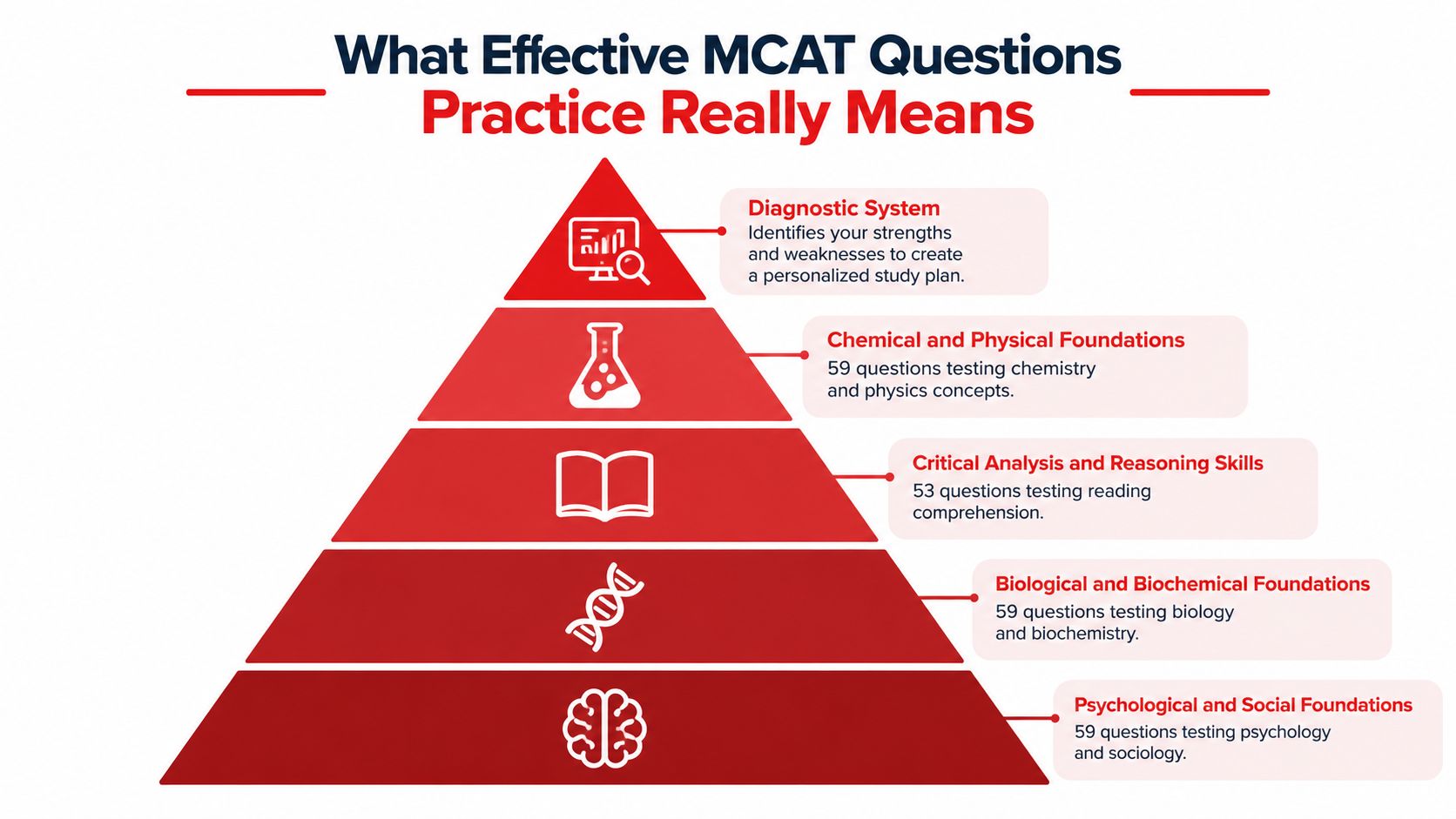
Effective MCAT questions practice mirrors the four official AAMC sections and uses timed, passage-based work plus deep review of every miss to drive the next study block. The exam contains 230 total questions, with 59 questions in each science section and 53 in CARS, so your practice should reflect the structure rather than rely on generic mixed sets.
You may be sitting with a question bank open, watching the correct-answer percentage fall, and wondering whether every miss means you aren't ready. It doesn't. A missed question is useful when you can identify whether the problem was missing content, weak application, or a reasoning and strategy error. It becomes much less useful when you record only the topic and move on.
The process below treats MCAT questions practice as a diagnostic system. You'll establish a baseline, use section-specific materials, alternate untimed learning with timed execution, review every incorrect or flagged item, and track patterns that tell you what to study next. A low starting score or a difficult prior attempt is information about your current preparation, not a verdict on your ability to become a physician.
What Effective MCAT Questions Practice Really Means
You finish a practice set and see several missed questions, including one you thought you understood. That result is not a verdict on your ability. Effective MCAT questions practice shows you what failed, then turns each miss into a rule you can apply to a new passage.
The MCAT has four separately timed sections: Chemical and Physical Foundations of Biological Systems, Critical Analysis and Reasoning Skills (CARS), Biological and Biochemical Foundations of Living Systems, and Psychological, Social, and Biological Foundations of Behavior. The official format includes 59 questions in each science section and 53 CARS questions. Each science section lasts 95 minutes, while CARS lasts 90 minutes, creating a 6 hour 15 minute content test before breaks and other test-day procedures. The AAMC exam overview explains the structure and timing.
Practice tests more than recognition
Retrieval practice asks you to produce an answer before checking notes, flashcards, or a solution. That effort reveals what you can access independently. Recognition is weaker evidence. You may recognize an enzyme definition in a review book yet struggle to identify which result from an unfamiliar experiment supports an enzyme-related conclusion. Active recall study methods can support this habit between question sets.
Passage reasoning connects the passage's setup, data, and question task to the principle being tested. In a science passage, identify what changed between experimental groups before choosing an explanation. In CARS, follow the author's argument and the passage's evidence instead of importing outside opinions.
CARS needs section-specific practice because all 53 questions are passage-based and organized into 9 passage sets, with 5 to 7 questions per set, according to the AAMC CARS overview. More psychology or biology memorization cannot replace reading, evaluating, and supporting an answer with passage evidence.
Use a closed loop
Use a review sheet that classifies every miss as content, application, or reasoning:
- Content: You did not know or could not recall the relevant concept.
- Application: You knew the concept but could not connect it to the passage, graph, equation, or experiment.
- Reasoning: You misread the task, ignored evidence, made an unsupported inference, or used poor timing.
For each error, write one transfer rule, such as “compare the control and experimental groups before interpreting the result.” Then follow this cycle:
- Establish a baseline with a sample test.
- Choose questions that match the skill needing work.
- Add timed practice as your method becomes reliable.
- Review every incorrect and flagged question, including lucky correct answers.
- Study the identified gap and test the transfer rule on new material.
The AAMC sample-question guidance supports baseline testing, full-length work under test-day conditions, and review of incorrect or flagged questions. Let the sheet determine the next study block. If graph interpretation causes repeated misses, another hour of passive reading may not solve the problem. A low starting score is information about current preparation, not a judgment about your future.
How to Source High Quality Practice Questions Without Wasting Time
A large question bank isn't automatically a good question bank. Before committing study hours, check whether its format, explanations, and difficulty serve the skill you're trying to develop.
Start with official AAMC materials for the clearest match to the exam's structure and question style. The AAMC Official Prep Hub and official sample and practice materials are useful for learning how passages are written, how questions are framed, and how a complete section feels. Their limitation is finite availability, so using every official item casually can reduce its value later when you need realistic readiness checks.
Third-party resources can provide additional repetition and topic filtering. Their value depends on the quality of the passages, the accuracy of explanations, and how well they distinguish a content question from a reasoning task. Treat them as supplements, not replacements for official materials.
| Resource Type | Format and Strengths | Limitations | Best Use Case |
|---|---|---|---|
| Official AAMC materials | Closest available match to official section structure, passage style, and question presentation | Limited supply makes careless use costly | Baseline work, late-stage calibration, and final readiness review |
| Third-party question banks | Broad repetition, topic filters, and opportunities to practice specific content areas | Style and difficulty can vary; some explanations may be too brief | Early and middle preparation, targeted content repair, and extra passage work |
| Original tutor-created sets | Can target a learner's exact error pattern and provide customized prompts | Quality depends on the author; they don't establish official exam equivalence | Focused remediation and transfer practice |
| Recalled or copied items | May appear familiar, but they raise copyright and test-integrity concerns | They may be inaccurate, outdated, or improperly obtained | Avoid. Use original or officially provided questions instead |
| Full-length practice exams | Build section pacing, stamina, sequencing awareness, and review habits | A score without error analysis gives limited guidance | Timed simulation and plan calibration |
Match the source to the phase
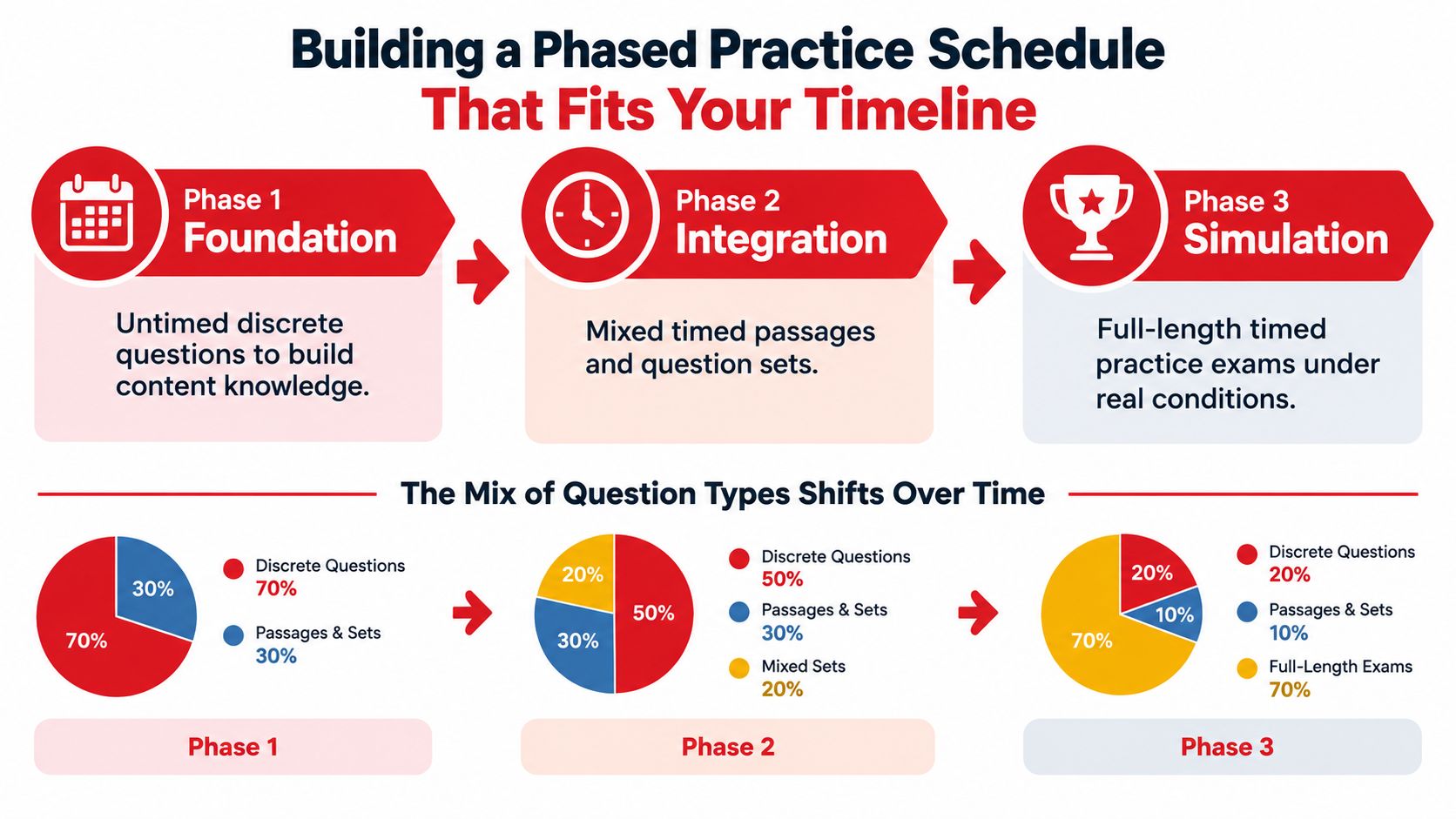
Early in preparation, discrete questions can help you retrieve foundational facts and expose obvious gaps. They shouldn't become a permanent comfort zone. Once you know the basic idea, passage-based sets force you to apply it in an unfamiliar context.
Middle-stage work should blend content-focused questions with passages. In the final phase, place more weight on timed passage sets, section banks, and full-length simulations. The AAMC MCAT content outline can help you check whether a question source covers the tested competencies without encouraging you to memorize isolated facts.
Use transparent criteria when comparing resources:
- Alignment: Does the material map to the AAMC content outline and four-section structure?
- Reasoning demand: Does it require data interpretation, experimental logic, or evidence use?
- Explanation quality: Does the solution explain why the credited answer wins and why distractors fail?
- Timing support: Can you practice in manageable timed blocks and recreate section conditions?
- Reviewability: Can you tag errors by section, topic, and error type?
- Integrity: Are the items original, authorized, or officially supplied?
For a broader side-by-side discussion of practice-test selection, see MCAT practice test options. Choose fewer, better-understood resources rather than collecting materials you won't review.
Building a Phased Practice Schedule That Fits Your Timeline
Your question mix should change as your test date approaches. A learner who is still building foundational knowledge needs retrieval and targeted content work. A learner close to test day needs to prove that knowledge remains accessible while moving through timed passages and full sections.
A useful progression is:
- More than 8 weeks out: Use content-style and discrete questions alongside early passage work. Untimed review is acceptable when you're learning how to reason through a new topic.
- 8 to 5 weeks out: Blend content questions with passage sets. Begin recording timing and error type consistently.
- Within 4 weeks: Prioritize passage-based work, section banks, timed blocks, and full-length practice under realistic conditions.
These stages aren't rigid rules. A baseline result, course schedule, work obligations, and anxiety level may require adjustment. The AAMC recommends taking a baseline sample test and using full-length practice plus detailed review to identify what needs attention, so your calendar should respond to evidence rather than a fixed formula.
A reusable weekly structure
Use this as a framework, not a promise of a particular result:
| Study block | Primary work | Review output |
|---|---|---|
| Early week | One science topic with retrieval questions and a short passage set | Content gaps and application errors |
| Next block | CARS passage practice with written evidence for each answer | Main idea, inference, tone, and timing patterns |
| Middle week | A different science section, using mixed questions | Error categories and formulas or concepts requiring retrieval |
| Later week | Psychology, sociology, or integrated science passages | Connections between terms, data, and question tasks |
| End of week | Timed mixed block or full section, depending on readiness | A short list of behavioral corrections for the next week |
| Review period | Revisit flagged questions and complete transfer questions | Evidence that a correction works on new material |
Protect review time in the schedule. A question set that takes an hour to complete may need substantial additional time for careful analysis, especially when you examine correct answers chosen for weak reasons.
Interleave instead of isolating
Interleaving means practicing different sections or related skills across the week instead of completing one subject in isolation until it feels finished. It makes retrieval less dependent on a predictable topic cue and helps you decide which principle applies when the passage doesn't announce it.
Keep CARS in the schedule throughout preparation because its central work is passage interpretation and reasoning. For science sections, move from topic-focused questions toward mixed passages as your familiarity grows. Use full-length simulations to test not only knowledge, but also attention and pacing across the complete sequence.
A detailed six-month MCAT study schedule can help you adapt the phases to a longer preparation window. If your timeline is shorter, preserve the order of skills, but combine blocks carefully rather than eliminating review.
Timed Versus Untimed Strategies for Each MCAT Section
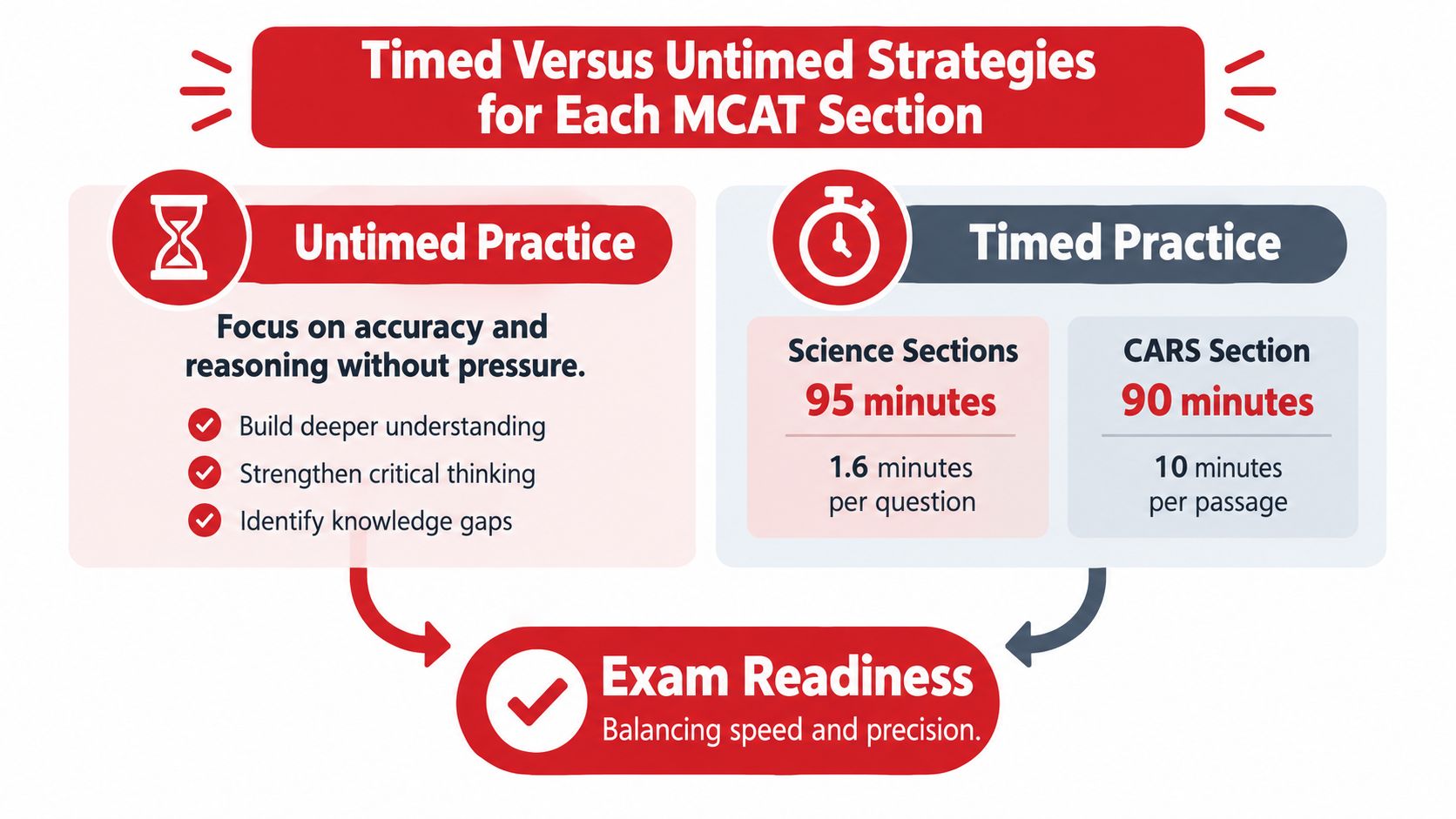
A student may understand a passage untimed, then lose accuracy once the clock starts. That result does not automatically mean the content is missing. Untimed practice tests whether you can build a sound reasoning path. Timed practice tests whether you can repeat that path while making decisions under section constraints.
The science sections contain 59 questions in 95 minutes, or roughly 1.6 minutes per question as a broad pacing reference. Treat that average as a checkpoint, not a rule for every item. A long passage, complex data, or a straightforward question can reasonably require different amounts of time.
CARS contains 53 questions in 90 minutes across 9 passage sets, which averages about 10 minutes per passage set. Practice full sections with the same kind of timing structure described in the official MCAT format guidance, rather than relying only on short, untimed question blocks.
Use two passes through difficult material
Early practice should remove the clock long enough for you to identify the reasoning sequence:
- Read the passage or prompt to determine the task, not to memorize every detail.
- Name the relevant concept, relationship, or argument.
- Find the sentence, result, or data pattern that supports your answer.
- Eliminate choices that contradict the passage or answer a different question.
- Explain why your choice works before checking the explanation.
Record that process on a reusable passage-review sheet. For each miss, label the problem as a content gap, application error, or reasoning or strategy error, then write one transfer rule. For example, “Before choosing an inference, identify the passage evidence that limits it.” This turns timing practice into a behavior you can test on unfamiliar material.
Repeat similar sets with a clock after the untimed process becomes reliable. Poor untimed accuracy points toward content or reasoning repair. Strong untimed accuracy followed by a timed collapse points toward reading speed, delayed decisions, rereading, or changing answers without new evidence.
CARS benefits from a narrow routine. Highlight only information you can use, write a one-sentence function for each paragraph, and require a specific evidence line for every answer. A choice that sounds reasonable in ordinary life still fails if the passage does not support it.
A labeled composite example
Composite learner, not a verified Ace Med Boards case: A student repeatedly rereads CARS passages and misses inference questions. The student limits highlighting, records each paragraph's function, and identifies textual evidence before selecting an answer.
The student then tests the routine on new AAMC-style passages, not memorized questions. The goal is to see whether the behavior transfers when the topic, passage, and choices change.
For section-specific pacing ideas, review this MCAT test time breakdown guidance. Timing is a skill to record and adjust. When the clock exposes a problem, write down the exact behavior that caused the delay.
Turning Misses Into Mastery With a Proven Review Workflow
The most valuable part of a practice set often begins after you submit the answers. A correct percentage tells you what happened. A structured review explains why it happened and what you need to change.
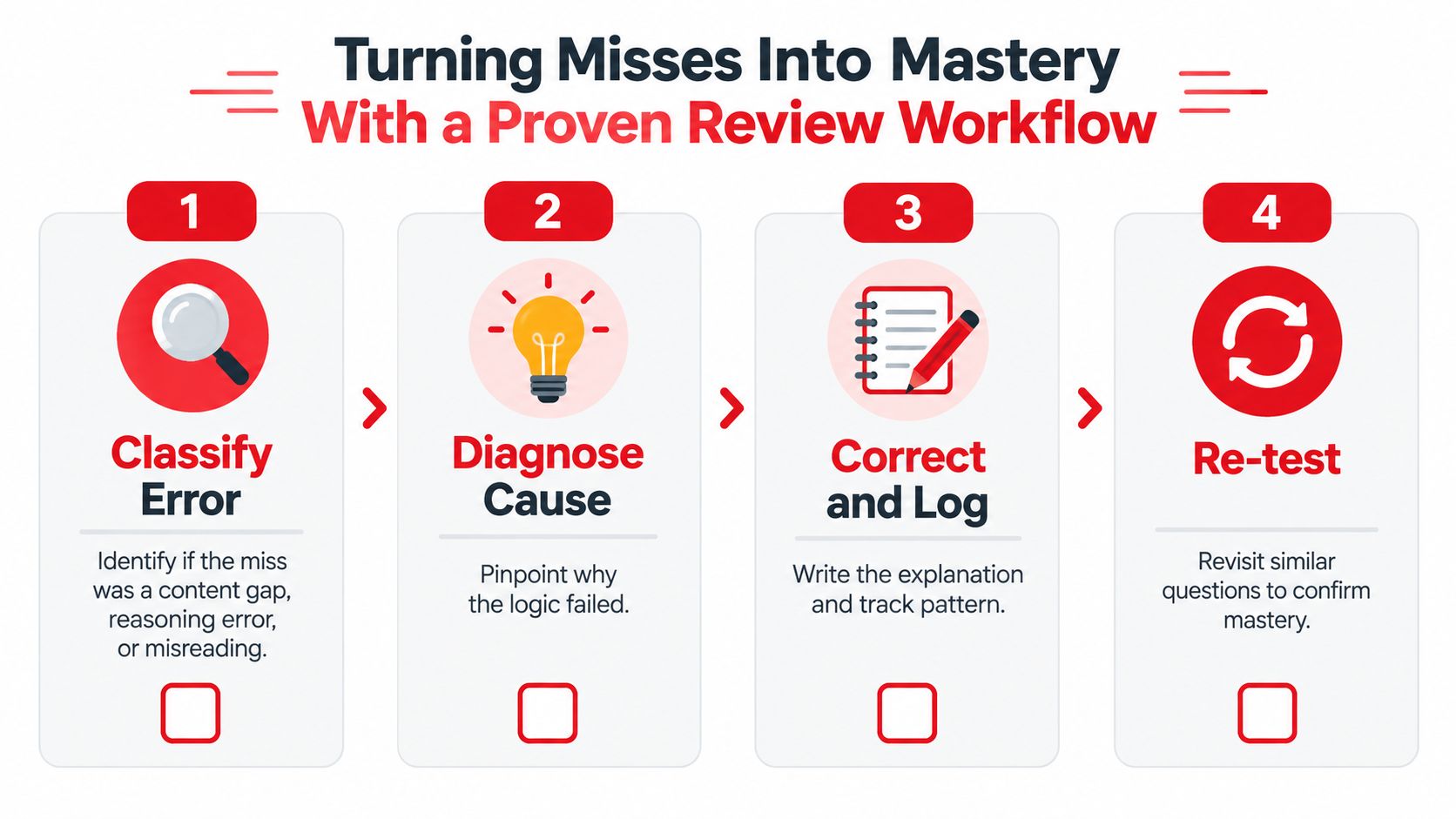
Classify each incorrect or flagged question by error type, not only by subject:
- Content gap: You didn't know or couldn't retrieve the relevant principle.
- Application error: You knew the principle but couldn't connect it to the passage, experiment, graph, or scenario.
- Reasoning or strategy error: You misread the task, ignored evidence, over-weighted outside knowledge, rushed, or selected a distractor for a predictable reason.
A topic label such as “acid-base” is still useful, but it isn't enough. Two learners can miss the same acid-base question for entirely different reasons. One needs retrieval practice. The other needs to slow down at the graph and identify what the question is asking.
The passage-review sheet
Use this sheet after every meaningful passage set:
| Review field | What to write |
|---|---|
| Tested concept | The scientific principle, behavioral concept, or CARS argument feature |
| Task | What the question required, such as inference, comparison, calculation, or evidence selection |
| Evidence line | The sentence, table, graph feature, or passage idea that supports the answer |
| Why the credited answer wins | The connection between the task, evidence, and answer |
| Why each distractor fails | The specific contradiction, scope problem, reversal, or unsupported assumption |
| Timing | Whether time pressure affected reading, reasoning, or choice |
| Error type | Content, application, or reasoning and strategy |
| One transfer rule | A concise behavior you'll apply to a new question |
The sheet prevents vague notes such as “review metabolism.” A stronger entry might say, “When a passage changes one variable between groups, identify that variable before interpreting the result.” That sentence is a transfer rule, because it can guide your next unfamiliar experiment.
Here is an original educational example. A fictional passage describes two cell cultures exposed to the same nutrient, with one group receiving an inhibitor of a transport protein. The inhibited group shows lower intracellular nutrient concentration, while the surrounding solution remains similar. A question asks what conclusion is best supported.
A useful review might read:
- Tested concept: Membrane transport and experimental comparison.
- Task: Interpret a result relative to the control group.
- Evidence line: The inhibitor group has lower intracellular concentration while external conditions are held similar.
- Why the credited answer wins: The result supports a role for the inhibited transport protein in moving the nutrient into the cell.
- Why distractors fail: One claims the inhibitor increased extracellular nutrient production, which the design doesn't measure. Another reverses the direction of transport. A third treats association as proof of an unrelated metabolic pathway.
- Timing: Note whether you spent too long rereading the setup or evaluating choices.
- One transfer rule: Compare the manipulated variable and measured outcome before selecting a mechanism.
This is original practice material, not a recalled or copyrighted MCAT item. It teaches the review process without pretending to reproduce official content.
A short demonstration of distractor review can reinforce the habit:
Track behaviors, not just totals
Record accuracy by section and topic, time per question or passage set, and the frequency of each error type. Also mark flagged questions you got right, because a correct answer based on guessing or fragile logic isn't stable evidence of mastery.
The published validity analysis found that practice-question volume was a significant positive predictor of Step 1 performance in two cohorts, with reported coefficients of β=0.141 and β=0.133 and raw correlations of r=0.176 and r=0.143. That study concerns Step 1, not the MCAT, so it shouldn't be treated as an MCAT score forecast. Its practical relevance is narrower: completing questions can matter, but the learning value depends on correction and feedback.
Use your log to choose the next block. A repeated content-gap pattern calls for focused retrieval and concise review. A repeated application pattern calls for more passage interpretation. A repeated reasoning error calls for a behavioral rule, such as writing the question task before evaluating the answer choices. The distractor-analysis approach can help you make that last step more precise.
Tracking Progress Avoiding Pitfalls and Knowing When Tutoring Helps
Progress isn't only a rising percentage. Look for stronger evidence of readiness: fewer repeated error types, more consistent timing, better explanations of credited answers, and successful transfer to unfamiliar passages.
Avoid three common traps:
- Question volume without review: Finishing another set won't repair an error you haven't diagnosed.
- Recognition mistaken for retrieval: Familiar notes or explanations can feel like mastery until you must produce the reasoning independently.
- Repeated errors disguised as productivity: More questions can reinforce the same rushed reading, unsupported inference, or distractor pattern.
When reviewing scores, keep the scale in perspective. Each MCAT section receives a scaled score from 118 to 132, with 125 as the midpoint, and the total score is the sum of the four sections. The total ranges from 472 to 528, with 500 as the midpoint, according to the AAMC score scale. These numbers describe performance on the scoring scale, but they don't create a universal admissions threshold. Applicants should interpret results alongside their school list, academic record, experiences, and broader application context.
Key takeaways
- Mirror the official four-section structure, including the different CARS format.
- Start with a baseline and use timed practice to expose pacing and stamina issues.
- Review every incorrect or flagged question with a passage-review sheet.
- Classify misses as content, application, or reasoning and strategy errors.
- Convert each recurring error into one transfer rule, then test that rule on new material.
One-on-one tutoring can complement official AAMC materials when you can't determine why your practice results are uneven, when timing problems persist despite self-review, or when your error log has become too broad to guide the next step. Ace Med Boards offers MCAT preparation guidance, including structured question analysis and planning support. It doesn't replace official practice materials or independent work, and no tutoring format can guarantee a score, admission, pass, or match.
As of September 2026, review current AAMC materials and policies before relying on exam details, because official resources can change.
If your MCAT questions practice feels busy but directionless, visit Ace Med Boards to discuss your section-specific workflow, passage-review sheet, and error patterns in a free consultation. Bring a recent practice review log if you have one, so the conversation can focus on practical next steps rather than promises.