Medical school requirements are school-specific and must be verified through each school's current admissions page or MSAR entry, with AAMC premed competencies as a foundation and AACOM resources for DO programs. Nationally, the average MD matriculant had a 3.81 GPA and 512.1 MCAT, compared with 3.67 GPA and 506.3 MCAT for applicants, but those figures are context, not a universal cutoff.
That distinction changes how you should plan. Coursework, GPA, MCAT policy, clinical exposure, service, research, letters, residency rules, and application deadlines can vary by institution. A strong application begins with a verified school list, not a copied checklist.
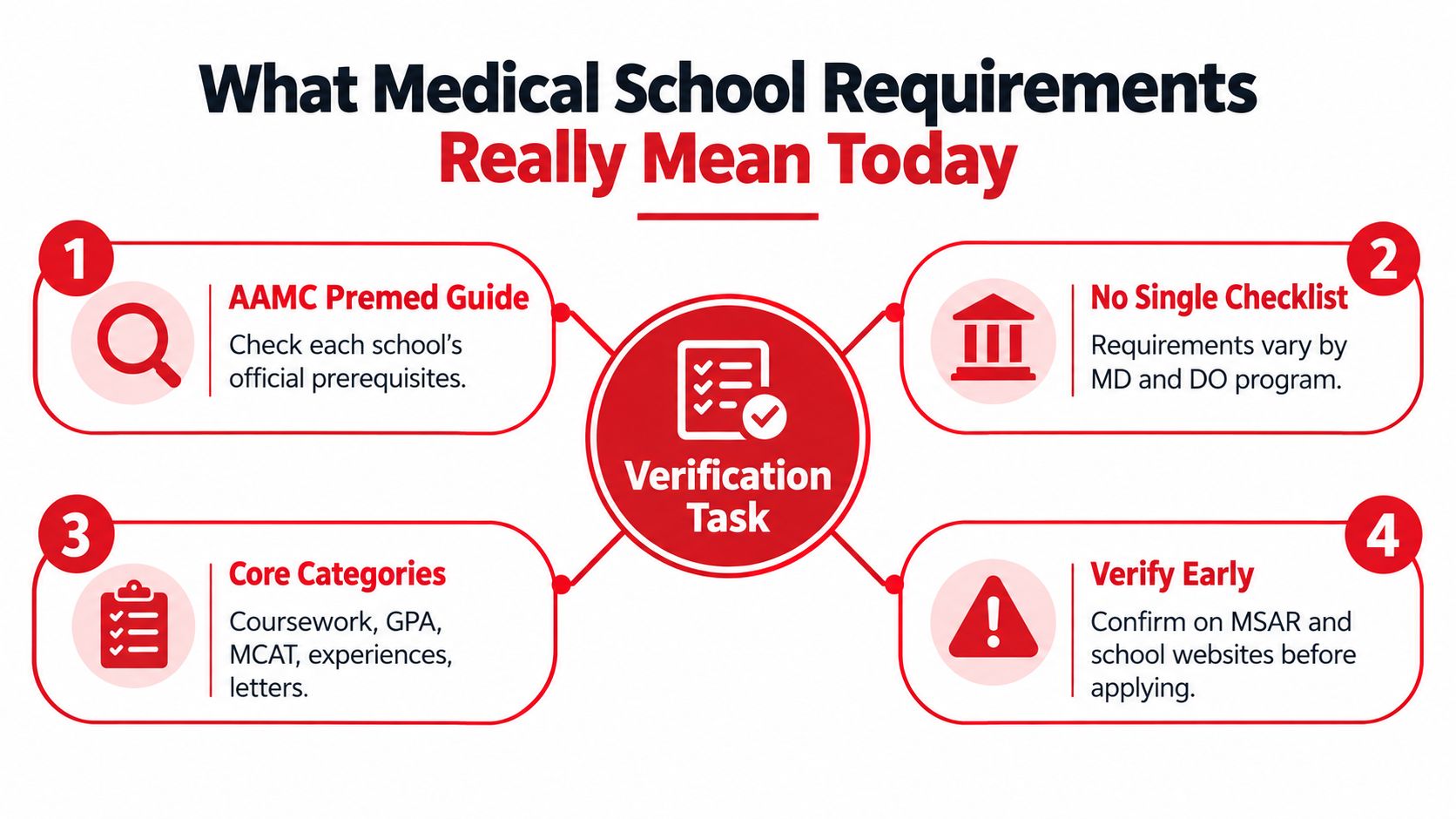
What Medical School Requirements Really Mean Today
Medical school requirements have a long history of formal academic screening. In 1911, the Association of American Medical Colleges (AAMC) revised admission requirements to require certification that applicants had completed premedical coursework. That framework also specified a baccalaureate degree from an accredited college or university and a high school background that included mathematics, physics, history, English, and Latin, with French or German accepted in some cases. The historical framework is documented in the LCME history of medical education.
Modern admissions still reflect that emphasis on preparation, but schools now evaluate more than course completion. The AAMC's Medical School Admission Requirements, or MSAR, resources provide school-by-school information about required and recommended coursework, acceptance of Advanced Placement (AP), community college, and online courses, and other institutional policies. The AAMC's medical school admission requirements reports should be checked alongside each school's official admissions page.
A selective filter, not a simple minimum
The national AAMC figures show why meeting a published minimum doesn't necessarily make an applicant competitive. In the cited cycle data, matriculant averages were higher than applicant averages, illustrating how academic metrics can operate as an initial filter before a school reviews the rest of the file. A lower GPA or MCAT score doesn't end your path, but it does make school fit, academic explanation, recent performance, and evidence of readiness more important.
For applicants, the practical task is verification:
- Start with competencies: Use the AAMC's premed competencies framework to understand the academic and personal capabilities schools look for.
- Check the institution: Confirm prerequisites, labs, test policies, letters, experiences, and deadlines on the current admissions page or MSAR entry.
- Separate MD and DO pathways: MD applicants generally use the American Medical College Application Service (AMCAS), while DO applicants use the American Association of Colleges of Osteopathic Medicine Application Service (AACOMAS), with AACOM resources guiding osteopathic applications.
- Record the source date: Save the page date or the date you verified the rule, because requirements can change.
Students comparing international medical education systems may also find Access to HE Medicine Cardiff useful for understanding how another admissions environment describes entry expectations. It shouldn't replace U.S. school-specific research, but it can clarify why requirements can't be transferred between countries without checking equivalency.
Prerequisite Coursework and How Schools Verify It
Most schools share broad prerequisite patterns, but the exact wording matters. AAMC materials identify common coursework that appears across many programs, including one year of biology, one year of English, and two years of chemistry through organic chemistry. Some schools add biology laboratory requirements or specify particular course content, so applicants should never assume that a course title alone proves eligibility.
The AAMC's admission requirements guidance is a useful starting point. It explains common coursework patterns while emphasizing that requirements vary by institution.
Read the rule, then verify the course
Use this sequence for every school:
- Copy the exact requirement. Record the subject, number of courses, laboratory expectation, acceptable course level, and completion deadline.
- Compare your transcript. Match course descriptions, not just titles. “Biology” may not establish that a school's required laboratory component was completed.
- Check equivalency policies. MSAR and official school pages may address AP credit, community college coursework, online classes, postbaccalaureate work, and courses taken outside the United States.
- Document uncertainty. If a course isn't clearly accepted, email the admissions office and retain the written response.
| Course Area | Common Pattern | Verification Check |
|---|---|---|
| Biology | One year commonly appears in AAMC coursework patterns | Confirm whether labs are required and whether specialized biology courses are accepted |
| English | One year commonly appears | Check whether writing-intensive or communication courses meet the policy |
| Chemistry | Two years through organic chemistry commonly appears | Confirm general chemistry, organic chemistry, and laboratory expectations |
| Physics | Frequently included in school prerequisites and relevant to MCAT preparation | Verify course sequence, labs, and whether advanced or algebra-based courses are accepted |
| Biochemistry | Often recommended or required by individual schools | Check whether a dedicated course is required and whether it must be completed before enrollment |
| AP, community college, and online work | Acceptance varies by institution | Review the school's current policy and request written clarification when needed |
Prerequisites also connect to the Medical College Admission Test (MCAT). The AAMC MCAT FAQ states that the exam draws from introductory biology, general chemistry, organic chemistry, physics, first-semester psychology, sociology, and biochemistry. That doesn't mean every school requires an identical course list, but it explains why prerequisite planning can support both eligibility and test preparation.
Applicants seeking international experience should keep it separate from prerequisite verification. General guidance such as UK student medical elective tips may help with planning an elective, but an elective abroad doesn't automatically satisfy a U.S. school's prerequisite or clinical-exposure policy.
For a consolidated planning reference, review this guide to required classes for medical school. Treat any secondary resource as a planning aid, then confirm the current rule with the school.
GPA and MCAT Expectations Without the Myths
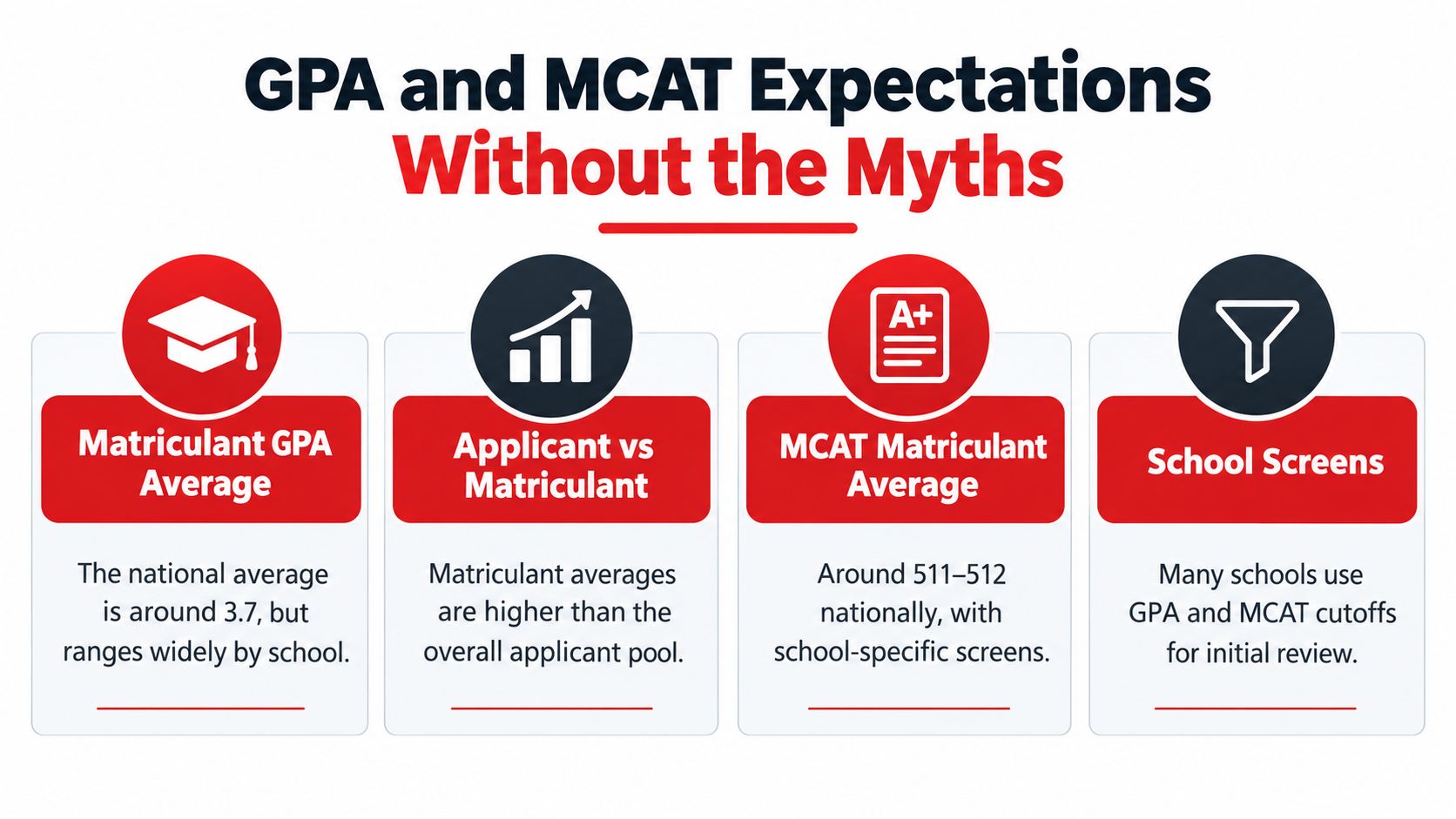
GPA and MCAT scores matter because medical schools often use academic metrics to assess readiness and manage an extremely large applicant pool. They don't function as a single national pass line. A school may publish a minimum, use an indexed screen, consider trends, or evaluate the full academic record differently from another institution.
The AAMC's reported averages provide useful context. In the cited 2024-2025 and 2025-2026 cycle data, mean total GPA was approximately 3.67 for applicants and 3.81 for matriculants, while mean MCAT scores were approximately 506.3 for applicants and 512.1 for matriculants. These figures come from the AAMC facts on applicants and matriculants. They describe national groups, not the profile required by every school.
Read averages as context
The difference between applicant and matriculant averages shows why a modest improvement can matter during initial review. The verified AAMC summary describes an approximate 6-point MCAT difference and 0.14 GPA difference between those groups, but that association isn't a promise that raising a score by a specific amount will produce an interview or admission. Academic improvement works best when it reflects a broader plan that includes school selection and application quality.
The AAMC score and GPA data also show that acceptance probability rises at higher academic levels, with ranges above approximately 510 MCAT and 3.7 GPA clustering among successful applicants. Applicants should use those ranges for planning, not as guarantees or universal thresholds.
Check hard screens before applying
Some schools impose rules that can remove an application from consideration even when the overall file appears strong. The AAMC MSAR materials include examples of schools requiring MCAT scores no more than 3 years old, minimums such as a 498 total MCAT or a 3.0 cumulative or science GPA, and indexed policies pairing GPA bands with MCAT percentile thresholds. One example pairs a 3.8 to 4.0 GPA band with at least the 27th MCAT percentile, while a 2.6 to 3.39 GPA band may require the 61st percentile. These examples are school-specific, not national standards, and should be verified in the AAMC MSAR requirements materials.
If your academic record includes a setback, begin with an audit. Separate cumulative GPA, science GPA, recent coursework, prerequisite completion, MCAT validity, and each school's screen. A clear academic plan is more useful than comparing yourself with a national average.
For a focused review of the academic side of an application, see medical school GPA and MCAT requirements.
Experiences Letters and Mission Fit That Matter
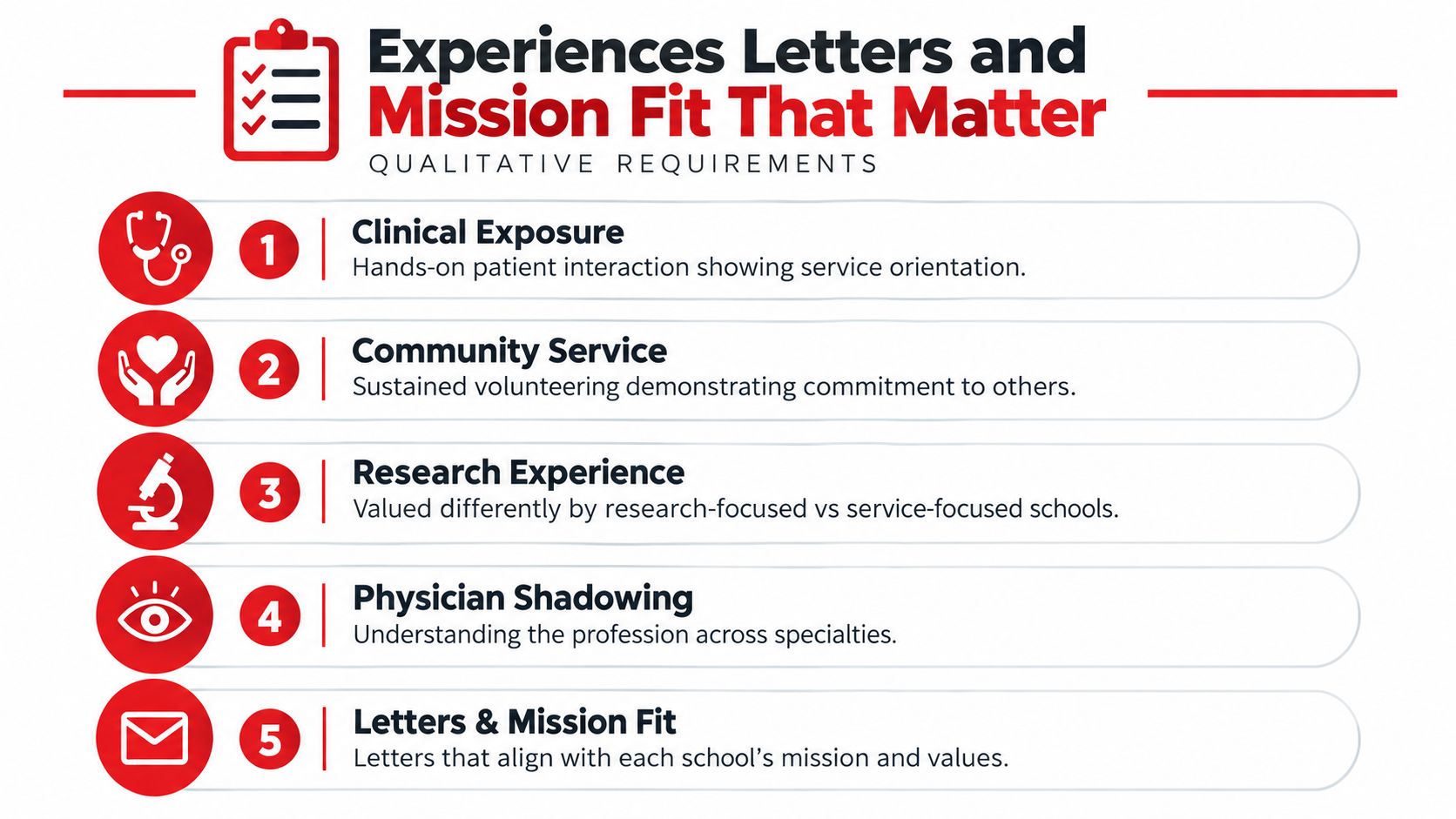
Scores answer one question, whether your academic preparation appears ready for medical training. Experiences and letters help schools understand how you serve, communicate, reflect, and respond to responsibility. The weight assigned to clinical exposure, community service, research, shadowing, and leadership depends on the school's mission and the story your application can support.
A research-intensive school may value sustained investigation and scholarly curiosity. A program focused on community health may look closely at service continuity, local engagement, and understanding of underserved populations. Neither emphasis is automatically better. The relevant question is whether your activities demonstrate authentic preparation for the institution you selected.
Build meaning, not an activity inventory
For each substantial experience, write four short notes:
- Role: What did you do?
- People served: Who benefited from your work?
- Observation: What did you learn about healthcare, access, teamwork, or responsibility?
- Change: How did the experience influence your next decision?
This reflection framework helps distinguish direct patient exposure from observation, and service from résumé accumulation. Shadowing can help you understand the profession, while clinical roles may provide closer contact with patients. Research can demonstrate inquiry, but it won't replace clinical understanding when a school expects applicants to have engaged with patient care.
Letters also require school-by-school verification. Schools can differ in the number of letters, acceptable authors, committee-letter policies, science faculty expectations, and submission procedures. Use MSAR, AMCAS guidance, and the institution's official page rather than relying on a general “standard” package.
Practical rule: Choose recommenders who can describe your work with specific, credible detail, then confirm that their letter format satisfies each school.
A labeled composite illustrates the principle without claiming a real outcome. Composite applicant: strong research experience, limited patient-facing exposure. The plan doesn't add random activities. Instead, the applicant chooses a sustained role aligned with service goals, documents reflection, and revises the school list according to mission fit and current requirements. This strategy doesn't promise acceptance. It creates a more coherent, verifiable application.
For planning patient-facing preparation, review clinical experience for pre-med students.
How the Application and Interview Process Works
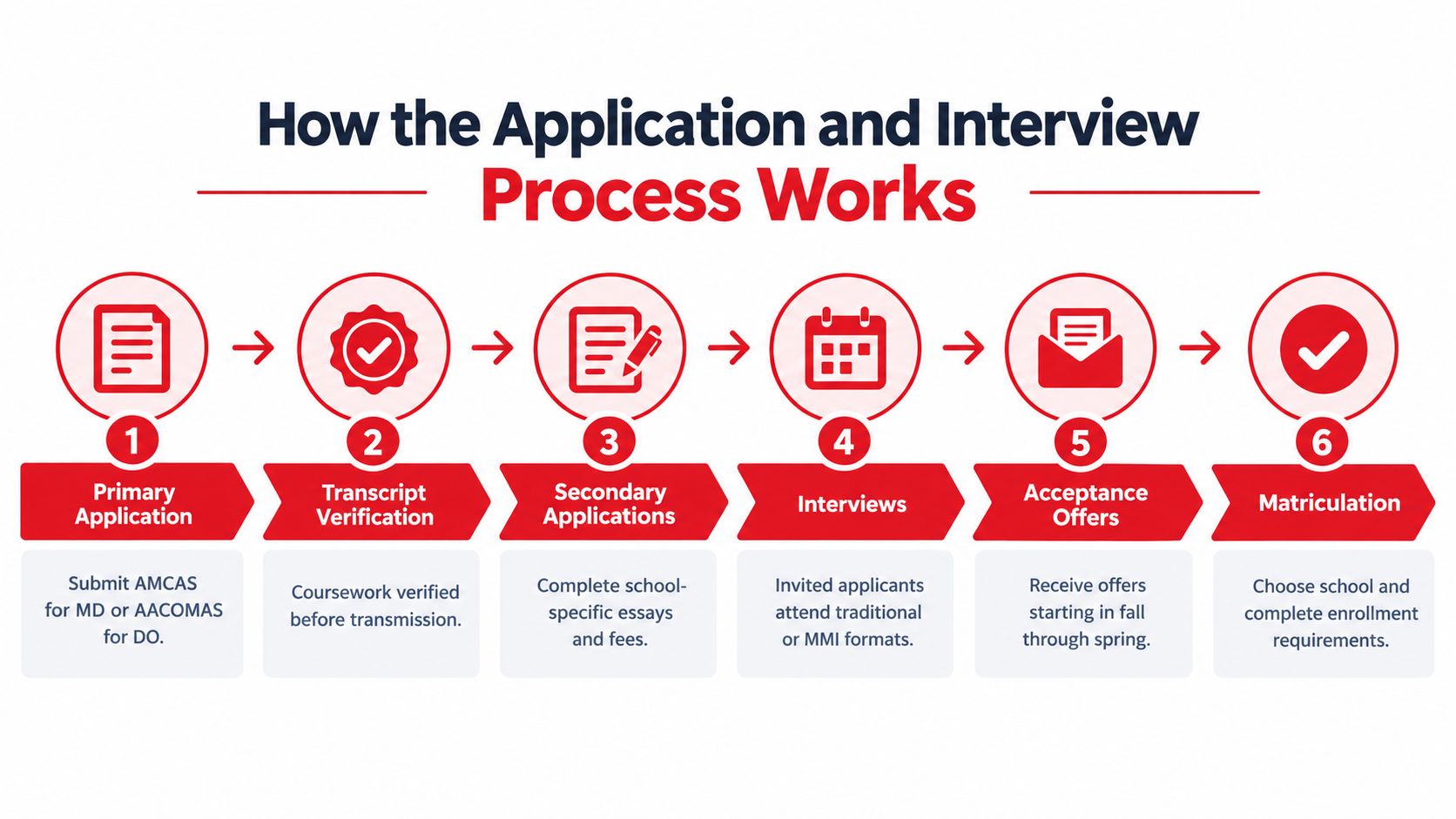
The application process is a sequence of separate decisions, and each stage has its own requirements. MD applicants generally submit through the American Medical College Application Service (AMCAS). DO applicants use the American Association of Colleges of Osteopathic Medicine Application Service (AACOMAS). Both pathways require careful transcript entry, supporting documents, school selection, and deadline tracking.
Follow the operational sequence
- Primary application: Enter coursework, activities, personal information, and school selections accurately through AMCAS or AACOMAS.
- Transcript verification: The application service verifies coursework before transmitting the primary application to schools. Resolve transcript discrepancies early.
- Secondary applications: Complete institution-specific essays, forms, and fees according to each school's instructions.
- Review and interview invitation: Schools assess academic preparation, experiences, mission fit, and other file components before inviting selected applicants.
- Interview: Formats may include traditional interviews, Multiple Mini Interviews (MMIs), or hybrid approaches. Prepare to explain your decisions and experiences.
- Decision and matriculation: Applicants may receive offers, remain on waitlists, or receive other decisions. Accepted students then complete enrollment and background-check requirements before matriculation.
Manage details before they become emergencies
Create one tracker with school name, application service, primary deadline, secondary deadline, letters received, prerequisite questions, interview format, and submission status. Save the current source URL and verification date beside every requirement. This simple record can prevent an avoidable omission when policies differ.
Interview preparation should focus on reasoning and communication, not memorizing polished scripts. Practice explaining a course setback, a gap year, a change in career direction, or a service commitment in a way that shows accountability and reflection. General resources on AI-powered interview preparation can provide ideas for practicing communication, but applicants should keep answers personal and verify that preparation doesn't encourage artificial responses.
See this medical school application guide for additional application-planning context. Don't reproduce recalled questions or copyrighted prompts. Use original practice scenarios and the school's own interview guidance.
Guidance for DO International Nontraditional and Gap Year Applicants
The same verification method applies across applicant pathways, but the questions change. DO applicants should use AACOM and AACOMAS resources alongside each osteopathic school's official admissions page. International applicants need to investigate eligibility before investing heavily in an application. Nontraditional and gap-year applicants need a transcript and timeline review that explains what has changed since earlier academic work.
Compare pathways by evidence
| Applicant path | First verification questions | Planning emphasis |
|---|---|---|
| DO applicant | Does the school accept your coursework, MCAT history, letters, and application format through AACOMAS? | Review osteopathic mission language, prerequisite details, academic screens, and school-specific requirements |
| International applicant | Does the school accept international applicants, and does it require U.S. coursework, proof of funding, or English testing? | Confirm eligibility, transcript evaluation, visa readiness, financial documentation, and accepted coursework |
| Nontraditional applicant | Are older prerequisites still valid, and how will the school read postbaccalaureate or recent coursework? | Explain academic history, show current readiness, and verify prerequisite timing |
| Gap-year applicant | Which requirements will be complete before submission and which must be complete before enrollment? | Use the year deliberately for coursework, MCAT planning, sustained service, clinical exposure, or application improvement |
The international route has additional bottlenecks. A neutral U.S. admissions guide notes that only a small number of U.S. medical schools accept international students, and some expect 1 to 2 years of U.S. undergraduate coursework, proof of funding, and visa readiness. Johns Hopkins explains that foreign university preparation may be supplemented by a year or more at an accredited U.S. university, and that TOEFL may be required when prior instruction wasn't primarily in English. Review those details in the international applicant guidance and confirm every point with the target school.
Use one school-fit matrix
The matrix below is reusable. Cite the AAMC premed competencies, MSAR, and AMCAS guidance for MD planning, then add AACOM, AACOMAS, and each DO school's official admissions page where relevant.
| School | Mission | Prerequisites | GPA and MCAT context | In-state policy | Experiences | Letters | Cost | Deadlines | Verified source date |
|---|---|---|---|---|---|---|---|---|---|
| Target school | Record exact mission language | Required, recommended, labs, equivalencies | Average context and hard screens | Preference or restriction | Clinical, service, research, shadowing | Type and format | Confirm directly | Primary and secondary | Add date checked |
Don't treat a lower metric, older prerequisite, or international transcript as a character judgment. It is a planning variable. Clarify the rule, identify what can be strengthened, and build a list where your preparation and the school's mission align.
For additional planning support, see nontraditional medical school applicants.
Your Timeline Checklist and Next Steps
A practical application plan often spans 12 to 18 months, beginning with verification rather than submission. Use the timeline as a framework, then replace general steps with the dates published by each school and application service.
A 12 to 18 month application timeline
- 12 to 18 months before submission: Build the school-fit matrix. Review prerequisites, labs, AP and online-course policies, GPA and MCAT screens, residency rules, letters, experiences, and deadlines.
- 9 to 12 months before submission: Complete or schedule remaining coursework, plan MCAT preparation, identify recommenders, and address gaps in clinical exposure or service.
- 6 to 9 months before submission: Take or schedule the MCAT according to each school's score-recency policy. Draft your primary materials and arrange transcript procedures.
- Application opening through primary submission: Enter coursework carefully in AMCAS or AACOMAS, submit transcripts, select schools intentionally, and verify every deadline.
- After secondary invitations: Complete school-specific essays promptly, preserve a copy of each response, and tailor answers to verified mission language.
- Interview through matriculation: Prepare original responses, track interviews and decisions, respond to administrative requests, and complete enrollment requirements.
Final readiness checklist
Before submitting, confirm:
- Coursework: Every prerequisite and lab is complete or scheduled according to the school's policy.
- Academic context: You understand your cumulative GPA, science GPA, recent trend, and MCAT validity.
- Experiences: Your clinical exposure, service, research, and shadowing show reflection rather than unexplained accumulation.
- Letters: Each recommender and format meets the school's requirements.
- School fit: Your list reflects mission, residency policy, academic context, and realistic eligibility.
- Documentation: Your transcript, identity information, immigration materials, and equivalency records are accurate.
- Dates: Every source has a verified date, and you've checked for updates before submission.
Key takeaways:
- There isn't one universal list of medical school requirements.
- AAMC resources and each school's current admissions page or MSAR entry should guide MD planning.
- DO applicants should add AACOM and AACOMAS resources.
- GPA and MCAT averages describe selectivity, not guaranteed outcomes.
- A verified school-fit matrix turns a confusing process into manageable decisions.
This article is educational admissions guidance, not medical advice. For a personal application review, use current official policies and consult the admissions office when a requirement remains unclear.
Ace Med Boards offers MCAT preparation and medical school admissions consulting that can help you organize academic metrics, review school-fit decisions, and plan application materials without replacing official AAMC, AACOM, or school guidance. Visit Ace Med Boards to learn about the available support and request a free consultation for your requirements review.