The doctor of medicine vs doctor of osteopathic medicine decision is no longer a choice between a mainstream path and a marginal alternative. The United States now has 48 accredited colleges of osteopathic medicine in 75 teaching locations across 36 states, educating more than 38,000 future physicians, while living DOs number 167,216 and DOs represent roughly 11% of the U.S. physician workforce, according to AACOM's current osteopathic medical school overview.
Both MDs and DOs are fully licensed physicians. The practical differences that should drive your decision are more specific: osteopathic manipulative medicine, licensing exams, exam-order strategy, accreditation, school-level support, and specialty-level residency competitiveness. Don't choose from stereotypes. Choose the pathway whose curriculum, testing obligations, geography, and residency goals you can support for years.
What Sets an MD and a DO Apart
MDs and DOs can diagnose illness, prescribe medication, perform procedures and surgery within their training, and practice in every medical specialty and U.S. state. The degree itself doesn't create a different license to practice medicine. The more consequential differences appear during medical school, board preparation, and the residency application process.
MD schools receive accreditation through the Liaison Committee on Medical Education (LCME). DO schools receive accreditation through the Commission on Osteopathic College Accreditation (COCA). Both systems teach the core biomedical sciences and clinical disciplines required for physician training, but DO programs add an osteopathic framework that emphasizes the relationship between structure and function, the body as an integrated unit, and its capacity for self-regulation and healing.
Osteopathic medicine began in 1874, when Andrew Taylor Still developed its founding philosophy. The first osteopathic medical school opened in 1892 with 21 students, including six women, as documented in AACOM's history of osteopathic medical education. Those origins still matter academically because they explain why DO students study osteopathic manipulative medicine (OMM) as a defined competency rather than treating the philosophy as an optional perspective.
The curricular difference that affects board preparation
DO students complete the same core medical sciences and clinical clerkships as MD students, then add approximately 200 to 500 hours of OMM and manual therapy instruction, according to this osteopathic and allopathic curriculum comparison. That workload creates a separate content domain involving anatomy, biomechanics, physical examination, and manipulative techniques.
The result is straightforward. A DO student must build a study plan that protects time for both general medical knowledge and osteopathic content. An MD student usually has a more concentrated licensing-exam pathway, while a DO student must decide whether residency goals justify preparing for an additional examination series.
Advisor's rule: Don't ask whether MD or DO is “better.” Ask which program's required curriculum and exam pathway fit your intended specialty, learning preferences, and available support.
The decision becomes clearer through four practical lenses:
- Curriculum load: Can you engage seriously with OMM, including its hands-on and examination components?
- Exam strategy: Will you take USMLE, COMLEX-USA, or both?
- Residency access: How does your target specialty view applicants from each pathway?
- Specialty opportunity: Are you pursuing a field where historical bias, score reporting, or limited audition access still affects applicants?
If you want a deeper explanation of osteopathic education before comparing schools, review osteopathic medicine and its training model.
MD vs DO at a Glance
The table below separates structural facts from assumptions. Both degrees lead to physician practice, but the route through school, licensing, and residency preparation isn't identical.
MD vs DO Side-by-Side Comparison
| Dimension | MD, Doctor of Medicine | DO, Doctor of Osteopathic Medicine |
|---|---|---|
| Accrediting body | Medical schools are accredited by the LCME, the Liaison Committee on Medical Education. | Osteopathic medical schools are accredited by COCA, the Commission on Osteopathic College Accreditation. |
| Degree route | Students complete the standard medical school curriculum leading to the MD degree. | Students complete the standard medical curriculum plus osteopathic principles and OMM. |
| Medical school length | The usual program structure is four years. | The usual program structure is four years, with an additional OMM curriculum. |
| OMM instruction | OMM isn't a required MD degree competency. | DO students receive approximately 200 to 500 hours of OMM and manual therapy instruction, according to ICOM's curriculum comparison. |
| Primary licensing exams | MD students follow the United States Medical Licensing Examination (USMLE) sequence. | DO students must complete COMLEX-USA, the Comprehensive Osteopathic Medical Licensing Examination of the United States. |
| Additional exam option | MD students generally don't take COMLEX-USA. | DO students may also take USMLE exams, particularly when applying to programs or specialties where USMLE scores are commonly reviewed. |
| Residency accreditation | MD graduates enter the single Accreditation Council for Graduate Medical Education (ACGME) system. | DO graduates also enter the single ACGME system. The two graduate medical education systems fully integrated in 2020, as described by AACOM's osteopathic medical education history. |
| Practice rights | MDs are fully licensed physicians with practice rights across the United States, subject to state licensing requirements. | DOs are fully licensed physicians with the same broad practice rights, subject to state licensing requirements. |
| Workforce scale | MDs remain the larger physician group in the United States. | A 2025 profession report cited 167,216 living DOs, with DOs comprising roughly 11% of the U.S. physician workforce, according to AACOM's profession data. |
| Best fit question | Does the school's research environment, curriculum, clinical network, and residency record support your goals? | Can you fully support the school's osteopathic mission, OMM requirements, exam pathway, clinical network, and residency record? |
The most common mistake is treating the curriculum row as a philosophical footnote. It isn't. OMM adds required studying, practical learning, and examination preparation. That doesn't make DO training less rigorous. It makes the preparation task broader.
The second mistake is assuming the 2020 residency merger erased every difference. It removed separate accreditation barriers and allowed DOs and MDs to train in the same ACGME residency programs. It didn't eliminate specialty-specific selection practices, differences in school resources, or the need to translate COMLEX performance for programs that primarily understand USMLE reporting.
School-level evaluation matters more than the initials after the degree. Compare clinical rotation locations, faculty advising, research access, residency placement, academic support, and regional relationships before deciding.
USMLE vs COMLEX and What Each Pathway Requires
The USMLE, or United States Medical Licensing Examination, is the standard licensing examination sequence for graduates of U.S. MD-granting schools and international medical graduates. The COMLEX-USA sequence is the licensing pathway required for osteopathic physician licensure in every U.S. jurisdiction, according to the peer-reviewed comparison of USMLE and COMLEX-USA.
For MD students, the practical planning question centers on USMLE Step 1 and Step 2 Clinical Knowledge, commonly called Step 2 CK, followed by the later licensing requirements. Step 1 transitioned to pass/fail reporting in 2022, so students and residency applicants increasingly focus on clinical performance, Step 2 CK, letters, research, and specialty fit rather than treating Step 1 as a numerical differentiator.
DO students must complete COMLEX-USA requirements. AACOM states that COMLEX-USA Level 1 and Level 2-CE are required for graduation from an osteopathic medical college, while osteopathic licensure generally requires graduation from an accredited osteopathic medical school and completion of an accepted licensing examination sequence, as summarized in AACOM's osteopathic licensure guidance.
The dual-exam decision
A DO student can take USMLE in addition to COMLEX-USA. That option may help when applying to programs whose screening systems, faculty, or specialty norms rely heavily on USMLE scores. But taking both exams isn't a free signal. It requires another preparation cycle, another registration expense, and enough recovery time to avoid weakening the required COMLEX performance.
Recent evidence found that osteopathic students who took USMLE first scored higher on paired exams than those who took COMLEX first. Reported median paired results were 227 versus 567 for Step 1 and COMLEX Level 1, and 246 versus 606 for Step 2 and COMLEX Level 2, as reported in this peer-reviewed analysis of exam order. The results don't prove that every student should take USMLE first. They do show that exam order deserves deliberate planning rather than a last-minute decision.
Board-prep implications
Use this sequence:
- Define the residency target. USMLE may be more strategically useful for a DO applicant pursuing a specialty or program that expects it.
- Protect the required exam. COMLEX-USA remains the necessary osteopathic licensing route, so dual preparation can't compromise COMLEX readiness.
- Choose the shared foundation. General pathology, physiology, pharmacology, microbiology, and clinical reasoning overlap substantially, but COMLEX preparation adds osteopathic content and style-specific practice.
- Schedule the exams intentionally. Build the order around readiness, school requirements, testing dates, and recovery capacity, not around internet folklore.
For a focused comparison of content and planning choices, use this USMLE versus COMLEX comparison for medical students. The right sequence differs for USMLE-only, COMLEX-only, and dual-exam candidates.
Residency Match Outcomes and Specialty Access
The aggregate match gap is now small, but applicants shouldn't confuse “small overall” with “irrelevant everywhere.” In the 2026 Main Residency Match, 93.5% of U.S. MD seniors and 93.2% of U.S. DO seniors matched to first-year positions, a difference of less than one percentage point, according to AACOM's report of the 2026 DO match.
The 2026 DO result included 8,503 U.S. DO senior participants and 7,928 matches, which AACOM described as the highest DO match rate in the single-match era. That benchmark should correct the outdated assumption that a DO degree prevents broad residency access.
Why specialty choice changes the analysis
Overall match rates hide specialty-level variation. Applicants to highly competitive surgical and procedural fields may encounter stronger preferences for USMLE reporting, established research networks, audition rotations, and school-affiliated clinical relationships. Some DO applicants also self-select away from these specialties, which makes raw specialty comparisons harder to interpret.
The practical issue isn't whether a DO can legally or academically enter a specialty. DOs can pursue every specialty. The issue is whether a particular specialty and program combination creates additional application work or greater screening risk.
| Applicant question | What to investigate |
|---|---|
| Does the specialty screen by exam type? | Determine whether programs request USMLE, accept COMLEX directly, or expect applicants to provide a conversion or explanation. |
| Can your school support the specialty? | Review research mentors, home departments, specialty advising, and access to relevant clinical electives. |
| Are audition rotations realistic? | Check geographic reach, scheduling flexibility, and the school's established relationships. |
| Does the program evaluate the whole file? | Look at letters, research, clerkship performance, leadership, and personal fit rather than focusing on degree initials alone. |
Residency training now sits within the unified ACGME system, but integration doesn't create identical applicant experiences. Before choosing a degree, build a specialty list and compare actual program requirements. Residency match statistics by specialty can help organize the questions, but applicants should still verify current program policies directly.
Practical rule: If you're committed to a highly competitive specialty, choose the school that gives you the strongest combination of specialty mentorship, research access, clinical exposure, and exam support. Don't choose based on degree label alone.
Choosing Between MD and DO as an Applicant
Start with mission fit, not perceived prestige. An applicant who wants a research-heavy academic career may find an MD school's institutional environment more aligned with that goal. An applicant drawn to primary care, community medicine, prevention, and whole-person frameworks may find a DO school's mission more natural. These are tendencies, not restrictions. Strong MD schools support community care, and DO graduates pursue academic and highly specialized careers.
Use the following decision sequence before submitting applications:
- Mission fit: Read the school's curriculum, service commitments, and faculty priorities. Look for evidence in the program itself, not assumptions about the degree.
- OMM tolerance: Decide whether you're willing to learn osteopathic principles and approximately 200 to 500 hours of OMM instruction, rather than hoping the requirement will be easy to ignore.
- School outcomes: Review published match lists, specialty placements, clinical affiliates, academic support, and residency advising.
- Exam pathway: MD students plan around USMLE. DO students plan around COMLEX-USA and decide whether USMLE adds value for their residency goals.
- Specialty target: Identify whether your intended field has meaningful program-level preferences or requires extra application work.
- Cost and geography: Compare tuition, living expenses, clinical rotation travel, family support, and the locations where you can realistically train.
- Learning preferences: Consider whether you prefer a curriculum with a distinct hands-on osteopathic component, a more conventional allopathic structure, or either format.
The school, not the acronym, determines much of your daily experience. Ask current students how rotations are assigned, how OMM is taught, how remediation works, and how advisors help students develop specialty-specific application plans. Also compare whether clinical training is centralized or distributed across many sites, because that affects housing, transportation, continuity, and access to mentors.
A DO school isn't a fallback if its mission and curriculum suit you. An MD school isn't automatically the right choice if its location, culture, cost, or advising structure works against your goals. Use medical school admissions requirements and planning guidance to organize your application work, then verify each school's current requirements through its official admissions office.
Tailoring Exam Preparation to Your Pathway
Board preparation should follow the credential you need and the residency audience you're trying to reach. Don't copy an MD student's schedule for COMLEX, and don't assume a DO student needs every USMLE resource because a competitive specialty appears on the horizon.
USMLE-focused preparation
MD students generally build preparation around the USMLE sequence. The core workflow should connect foundational review, question-based learning, and self-assessment. Resources such as UWorld, First Aid, and NBME self-assessments are third-party or official study tools that students may evaluate for fit. They aren't substitutes for a plan that identifies why questions are missed.
Because Step 1 is pass/fail, readiness means more than chasing a numerical target. Confirm that you can recognize common presentations, reason through mechanisms, manage timing, and sustain performance across mixed blocks. Step 2 CK deserves early attention because clinical knowledge, clerkship performance, letters, and specialty-specific evidence carry greater weight in many residency applications.
COMLEX-focused preparation
DO students must cover general medical content plus osteopathic principles and manipulative medicine. A COMLEX plan should include dedicated OMM review, practice that reflects COMLEX-style reasoning, and an audit of weak clinical systems. COMBANK, TrueLearn, and Savarese OMM review are examples of named resources students may compare, but no resource replaces checking current exam policies and your school's requirements.
Protect time for OMM rather than adding it at the end. The content is not decorative, and a student who understands general medicine but neglects osteopathic material has left a required competency underprepared.
Dual-exam preparation
A DO student targeting a competitive ACGME specialty may consider taking both exams. The choice should follow a written review of specialty expectations, program screening practices, baseline performance, available study time, and financial capacity. The exam-order evidence cited earlier supports planning, but it doesn't justify dual testing for every DO student.
Use a three-column plan:
- Shared medicine: Build one strong foundation in physiology, pathology, pharmacology, microbiology, and clinical reasoning.
- USMLE-specific work: Add question interpretation and reporting considerations relevant to programs that use USMLE results.
- COMLEX-specific work: Schedule OMM, osteopathic principles, and COMLEX-oriented practice without treating them as last-minute additions.
A targeted tutor can complement official practice materials and question banks by reviewing errors, clarifying concepts, and helping sequence the workload. Ace Med Boards offers pathway-specific tutoring for USMLE and COMLEX preparation, including planning aligned to the student's exam route. For students building a COMLEX schedule, this COMLEX Level 1 study schedule provides a starting framework that should be adapted to school deadlines and individual readiness.
Decision Checklist and a Composite Applicant Example
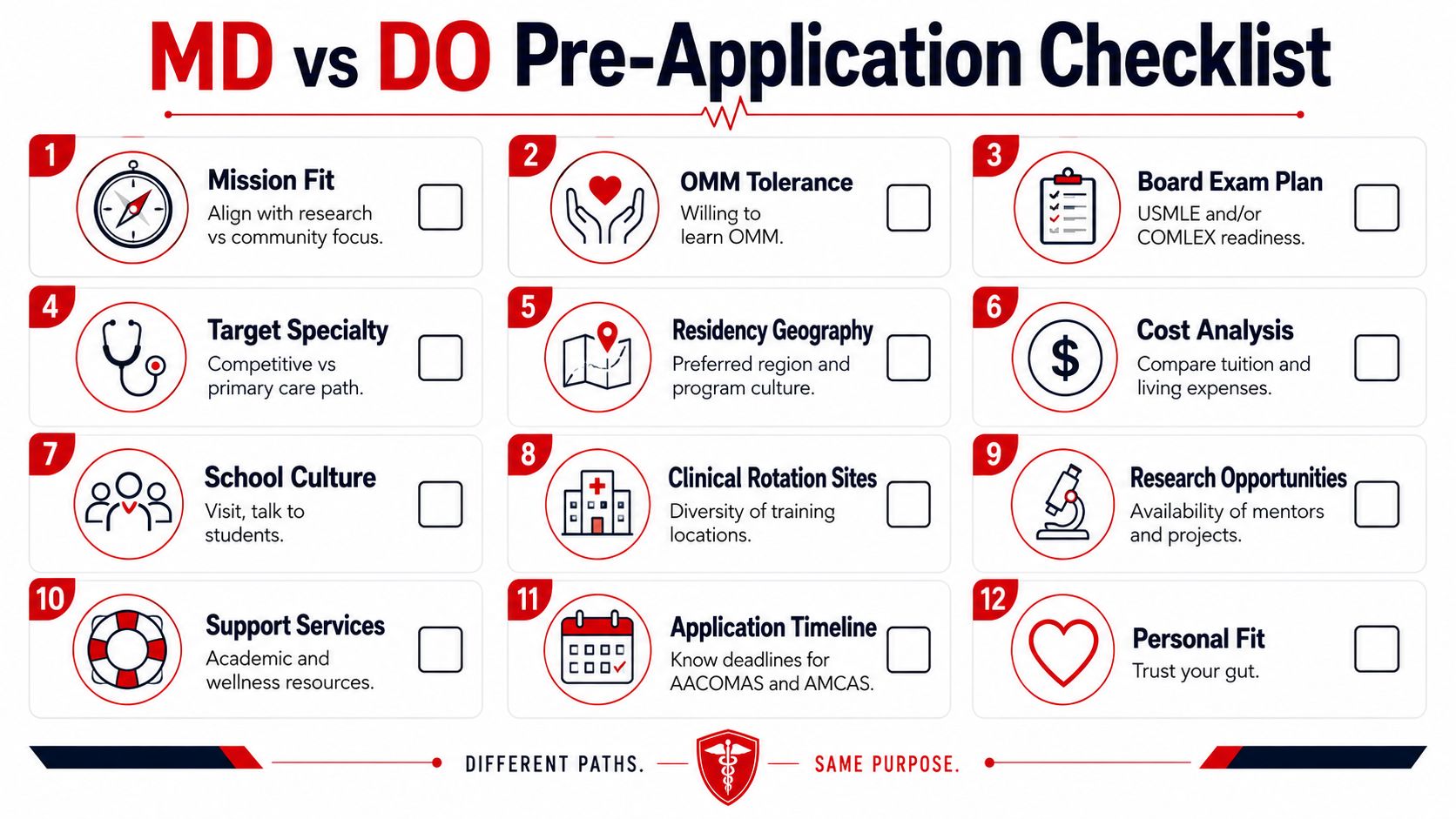
Use this checklist before finalizing an MD, DO, or combined application strategy. Treat unanswered items as research tasks, not as reasons to panic.
Pre-application checklist
- Mission fit: Can you explain why the school's educational and service mission fits your goals?
- OMM tolerance: Are you willing to study and practice OMM as a required part of DO education?
- Board exam plan: Have you identified whether USMLE, COMLEX-USA, or both fit your intended residency path?
- Specialty target: Have you checked how competitive your intended specialty is at the program level?
- Residency geography: Can you train in the regions where the school's clinical and residency relationships are strongest?
- Cost analysis: Have you compared tuition, living expenses, travel, and financial support?
- School culture: Have you spoken with students or reviewed the learning environment directly?
- Clinical rotations: Are rotation sites diverse, reliable, and relevant to your intended specialty?
- Research access: Can you identify mentors and projects that support your academic goals?
- Support services: What academic, wellness, and remediation resources are available?
- Application timeline: Have you checked current AMCAS and AACOMAS requirements and deadlines?
- Personal fit: Can you picture yourself engaging with the curriculum during difficult academic periods?
A labeled composite applicant
Composite example, not a real student story: A state-school graduate has primary-care leanings, moderate academic metrics, and genuine interest in whole-person care but isn't sure about OMM. The applicant shouldn't assume that a DO program will be easier or that an MD program will provide stronger training automatically.
They would first compare specific schools by mission, cost, clinical rotation structure, published match outcomes, specialty advising, and access to mentors. Next, they would attend an OMM lab or speak with current DO students to understand the hands-on curriculum. Finally, they would decide whether primary-care goals make COMLEX-only preparation reasonable, or whether a future specialty target makes dual-exam planning worth the added burden.
The decision could favor either pathway. The sound process is the result.
Frequently Asked Questions
Can MDs and DOs enter the same specialties?
Yes. Both are fully licensed physicians and can pursue every medical specialty. The practical challenge is specialty-level competitiveness, not a formal restriction on DO practice. Applicants should review program requirements, exam expectations, clinical exposure, research access, and advising support before building a rank list.
Can a DO student take the USMLE, and does it matter?
Yes. DO students can take USMLE in addition to the required COMLEX-USA pathway. It may matter for specialties or programs that rely heavily on USMLE reporting, but the extra preparation can strain time and finances. Decide from your specialty list and target programs, not from a blanket rule.
What changed after the single GME accreditation system?
Since 2020, DO and MD graduates have been able to train in the same ACGME-accredited residency system, a milestone described by AACOM's history of osteopathic graduate medical education. The merger expanded structural access, but it didn't erase specialty-specific preferences or differences in school resources.
Is DO training less expensive than MD training?
There's no universal cost difference you can safely assume. Tuition, living expenses, required travel, clinical rotation geography, and financial aid vary by school. Compare actual institutional cost information and the location of required rotations instead of using the degree title as a price proxy.
Should DO students still plan for COMLEX Level 1?
Yes. AACOM identifies COMLEX-USA Level 1 and Level 2-CE as graduation requirements for osteopathic medical colleges. Even if you also plan to take USMLE, COMLEX remains central to osteopathic licensure and must have a protected place in your preparation schedule.
If you're weighing MD and DO options or need to choose between USMLE-only, COMLEX-only, and dual-exam preparation, visit Ace Med Boards to review tutoring and exam-planning support. A free consultation can help you turn your specialty goals, curriculum demands, and current readiness into a practical study plan without promising a particular score or outcome.