You're staring at a practice question with two diseases that look almost identical at first glance. One label feels familiar, the other sounds close enough to fool you, and the answer choices all seem to blur together.
That's the part of pathology that trips up a lot of students. The fix is to stop memorizing disease names in isolation and start tracing the chain from cause to cellular response to gross or microscopic finding to clinical consequence. Once you do that, pathology questions become less about recognition and more about reasoning.
Why Pathology Feels Overwhelming and How to Fix It
A student can know the vocabulary and still miss the question. That usually happens when the brain stores diseases as loose labels instead of causal sequences, so similar answer choices all feel plausible. In pathology, that gap shows up fast, because exam writers rarely ask, “What is this called?” They ask, “What happened first, what changed in the tissue, and what should you expect clinically?”
The most reliable fix is a four-column habit. For any disease process, write or say: cause, cellular response, morphology, and manifestation. If you can move through those four steps without getting stuck, you're not just recalling facts, you're building the logic that links them.
Practical rule: if you can explain why two answer choices differ, you usually understand the disease better than if you can only name the right one.
A simple example makes this clearer. “Chronic irritation” is not enough by itself. You need to ask what the cells did in response, whether the tissue architecture changed, and how that change would show up in a symptom, lab pattern, or operative finding. That same habit will help with inflammation, neoplasia, renal syndromes, and hematologic disease, because the mechanism always leaves a trace.
Use that mindset while studying and while doing questions. If a miss feels random, force yourself to identify which link in the chain broke, not just which fact you forgot. For a broader study structure that pairs well with this approach, see this medical-student study framework.
Understanding the Branches and Core Concepts of Pathology
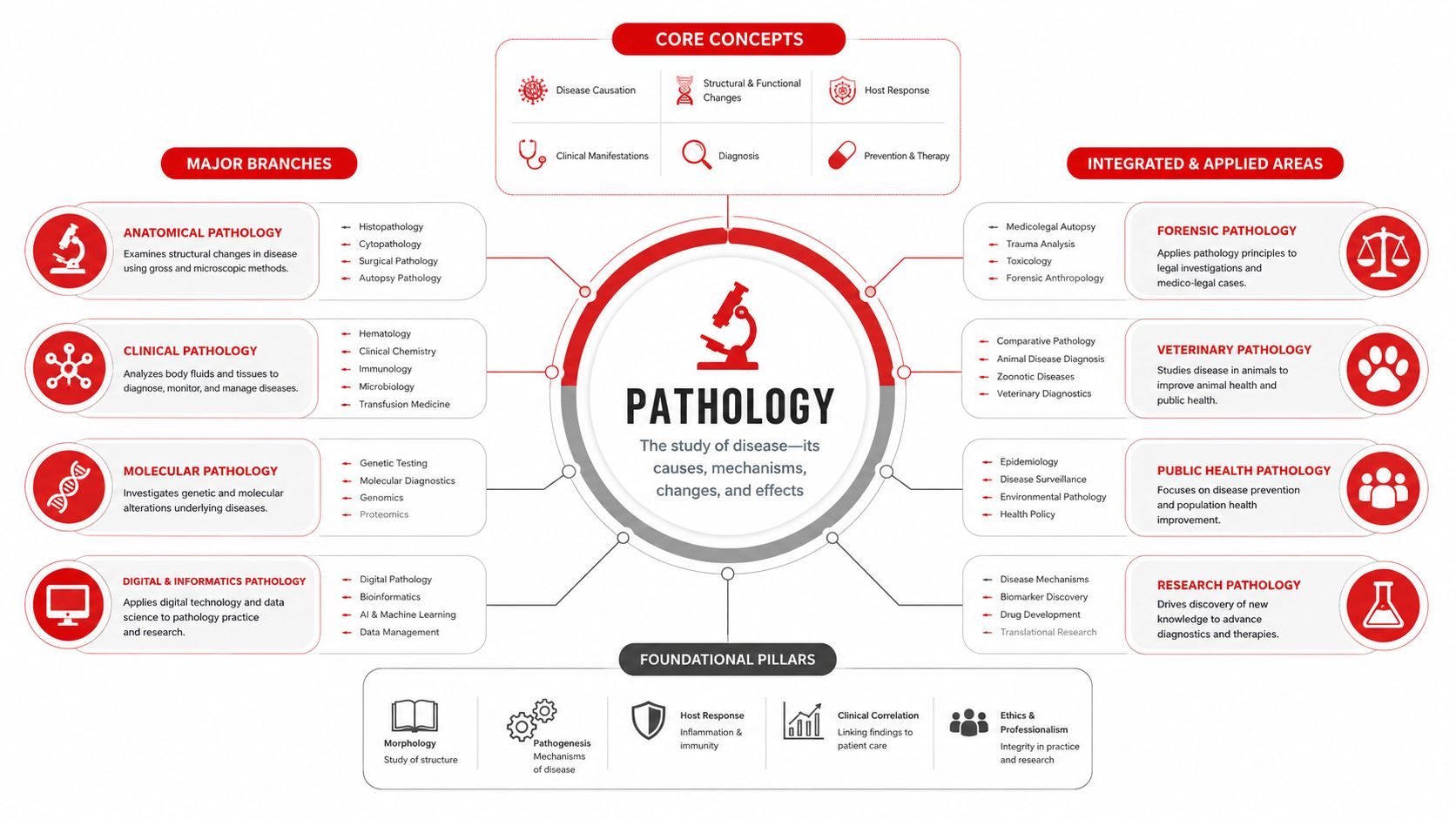
Pathology is the medical specialty concerned with the cause, development, structural and functional changes, and natural history of disease, which makes it more than microscopic diagnosis and gives it a core role in understanding how illness progresses. That definition matters because pathology is not one thing. It has branches, and each branch asks a slightly different question about disease.
Anatomic pathology focuses on tissues and organs, usually from biopsies or surgery, while clinical pathology centers on laboratory analysis of fluids such as blood, urine, and cerebrospinal fluid. A pathologist may be reading a colon biopsy one moment and interpreting a blood count or coagulation study the next. For a clean comparison of these two domains, this overview on anatomic versus clinical pathology is a useful vocabulary check.
General pathology and systemic pathology
General pathology covers the universal rules of disease, things like cell injury, inflammation, repair, and neoplasia. Systemic pathology applies those rules to organs and organ systems. The point of learning both is simple. You need the mechanism first, then the organ-specific expression of that mechanism.
A concept map helps. Think of the field as a ladder. At the top is the disease process itself. Below that are the shared mechanisms. Below that are the organ patterns, for example glomerular injury in kidney disease or dysplasia in epithelial neoplasia. At the bottom are the findings that matter on exam day, such as lab abnormalities, histology, gross appearance, and clinical presentation.
For attorneys and other nonmedical readers who need to interpret pathology language in plain terms, a resource like translating autopsy terminology for attorneys can be helpful. For students, the takeaway is different, medical language is shorthand for a chain of events, not just a label.
If you're reviewing physiology and pathology side by side, the closest internal companion is this pathophysiology guide. The two subjects overlap, but pathology is where those mechanisms become visible in tissue and in reports.
Mastering High-Yield Disease Mechanisms with the Four-Column Framework
The easiest way to learn pathology is to stop studying isolated disorders and start studying repeating mechanisms. Cell injury, inflammation, hemodynamic disorders, genetic disorders, and neoplasia show up across many organ systems, but they keep the same logic structure. If you know the mechanism, you can often predict the finding before the answer choices appear.
Use the mechanism to predict the finding
A healthy cell exposed to ischemia behaves differently from a cell exposed to a toxin, but both can end in injury or death. Inflammation may be acute or chronic, but each form leaves a different tissue pattern and a different clinical course. Neoplasia is especially testable because the exam often gives you a tissue pattern and asks whether it behaves benignly or malignantly, or whether a specific genetic change is likely to be involved.
Study move: before reading the answer choices, say the expected sequence out loud, cause first, then cell response, then morphology, then clinical consequence.
| Cause or Etiology | Cellular Response | Gross or Microscopic Finding | Clinical Manifestation |
|---|---|---|---|
| Ischemia or toxin exposure | Reversible injury, then cell death if severe or prolonged | Swelling, membrane damage, later tissue necrosis | Organ dysfunction, pain, or failure depending on the tissue involved |
| Infection or tissue damage | Acute inflammatory response | Neutrophils and edema early, then more organized healing if the trigger clears | Fever, tenderness, purulent exudate, or improving symptoms after the insult resolves |
| Chronic inflammatory stimulus | Ongoing inflammatory and repair response | Fibrosis, architectural distortion, and chronic infiltrates | Stiffness, reduced function, or progressive organ compromise |
| Genetic alteration affecting growth control | Dysregulated proliferation | Disordered tissue architecture, atypia, or invasive behavior in malignant disease | Mass effect, bleeding, obstruction, or systemic effects depending on site |
| Endothelial or clotting disturbance | Abnormal blood flow or thrombosis | Infarction, congestion, or edema in affected tissue | Sudden pain, organ ischemia, or acute functional loss |
A table like this works best when you use it actively, not passively. Cover the rightmost column, say the manifestation from memory, then uncover it and check your reasoning. If you get the answer right but can't explain why, the knowledge still isn't stable.
The same framework also helps with frozen sections and intraoperative decisions. Frozen section pathology is a rapid service, and the literature reports real-world concordant diagnostic frequencies around 92% to 98%, with one study of 140 cases reporting 97.85% concordance and an average turnaround time of 15 minutes, and another reporting 97.08% concordance with an average turnaround time of 23 minutes (source). The teaching point is not the exact number, it's that speed and accuracy are both part of pathology logic.
Applying Pathology Concepts Across Organ Systems
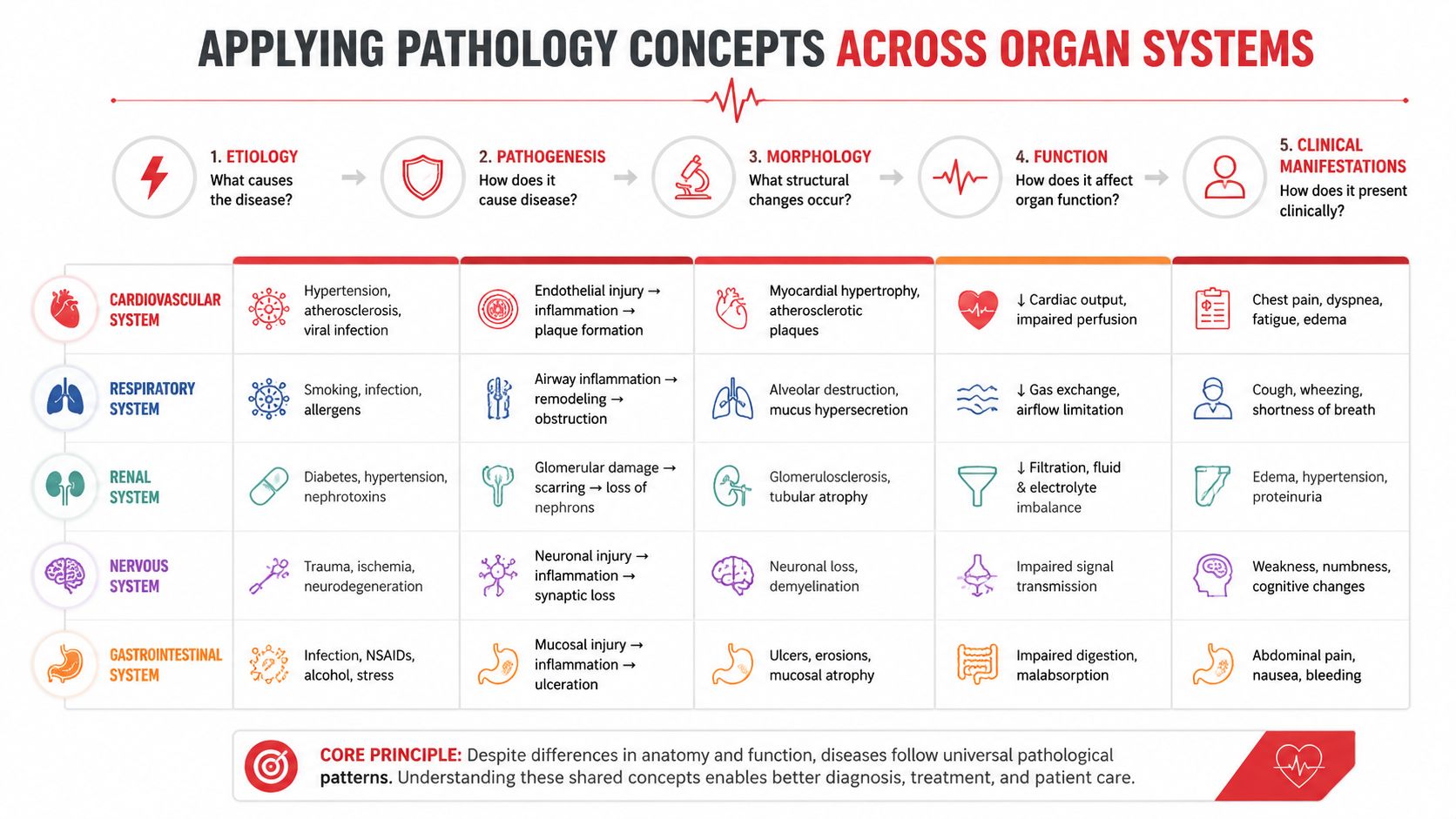
The same mechanism can look very different once it lands in a specific organ. That's why students who memorize buzzwords often feel confident until a question changes the tissue site, the time course, or the lab pattern. Atherosclerosis, pneumonia, ulcer disease, glomerular injury, cirrhosis, anemia, and leukemia all become easier when you ask what the organ does with the damage.
Organ patterns that repeat on exams
Cardiovascular pathology often turns on blood flow. In atherosclerosis and myocardial infarction, the key reasoning step is whether the problem is chronic narrowing with plaque-related risk or sudden ischemic injury with tissue death. Respiratory disease often asks whether the pattern is infectious consolidation or long-term airway damage and remodeling, which changes both morphology and symptoms.
Gastrointestinal questions often separate mucosal injury from chronic inflammatory change. Peptic ulcer disease and inflammatory bowel disease can both produce pain and bleeding, but the tissue pattern and distribution are not the same. In the kidney, the high-yield distinction is whether the process is nephrotic or nephritic, because the dominant mechanism determines whether protein loss, hematuria, or inflammatory injury stands out. Hepatic disease often rewards attention to chronic injury and fibrosis, since cirrhosis reflects structural remodeling rather than a single acute insult. Hematologic disease asks you to link marrow or blood-cell abnormalities to the lab pattern and to the downstream consequence, whether that is anemia, leukocytosis, or malignant proliferation.
A useful way to study these organ systems is to compare what changes and what stays the same. The mechanism may repeat, but the tissue response differs by organ architecture, blood supply, and function. That is why the same broad process can produce chest pain in one organ, jaundice in another, and cytopenias in a third.
For a clinical setting where pathology language intersects with the physical environment of the lab, the discussion of pathology lab furniture is a reminder that specimen handling and workflow matter too. On the student side, the more relevant question is how the organ-specific pattern leads you to the right diagnosis under timed conditions.
The most helpful comparison test is not “What disease is this?” but “What decisive variable changes the answer?” If the lesion is diffuse instead of focal, chronic instead of acute, or infiltrative instead of localized, the diagnosis often changes with it.
For more on integrating organ-based reasoning into clerkship study, this internal medicine shelf review can help you connect pathology to real clinical presentation.
Common Pathology Misconceptions That Cost Points on Exams
The biggest pathology mistake is treating similar-looking diseases as interchangeable. They're not. Exam questions often present surface similarities on purpose, then hinge the correct answer on a single causal difference that changes the pathology underneath.
Why buzzwords fail
Buzzwords help only when they point you toward the mechanism. If you memorize “painful ulcer,” “inflammation,” or “mass lesion” without asking what drove the tissue change, you'll miss questions that swap in a close cousin. Acute and chronic inflammation can both involve swelling, but they don't have the same dominant cells, the same tissue remodeling, or the same clinical trajectory. Benign and malignant neoplasms may both form masses, but invasion, atypia, and spread separate them in clinically meaningful ways.
The answer choice that sounds most familiar is not always the right one. The better clue is the one that fits the cause-to-consequence chain.
A looks-similar but differs because comparison
A student may see two renal syndromes and focus only on the word “proteinuria.” That's a trap. If the question includes hematuria, red cell casts, and an inflammatory picture, the mechanism points one way. If the question emphasizes heavy protein loss and edema without active urinary sediment, the mechanism points another way. The surface symptom is the same, but the decisive variable changes the diagnosis.
The same logic applies to tumor questions. A benign lesion may compress nearby tissue, while a malignant one infiltrates, destroys boundaries, and creates broader clinical consequences. If you skip the mechanism, you may still guess correctly on easy items, but transfer questions will expose the gap immediately.
For more complex answer sets, the fastest correction is to ask, “What would this tissue look like if the alternative were true?” That question forces you to compare mechanisms instead of memorizing names. It also makes distractors easier to eliminate because the wrong options usually violate the expected biology.
Diagnostic Reasoning Walkthrough Using a Composite Case Example

Here's a composite hypothetical. A patient develops sudden chest discomfort after a period of poor perfusion, and the question stem mentions tissue injury with abnormal laboratory markers. The student's job is not to guess the label first. The job is to identify the mechanism, then use that mechanism to test the answer choices.
Step by step reasoning
Start with the cause. If perfusion drops, the immediate cellular problem is oxygen deprivation, which pushes the tissue toward injury. Next, ask what cells do under stress. They may show reversible damage first, then progress to death if the insult continues. Then ask what the tissue would show. The morphology should reflect injury severity and timing, not just the organ name.
Now use the answer choices as a filter. Any distractor that requires an inflammatory mechanism, a growth-control defect, or an isolated fluid abnormality doesn't fit the chain. The right answer has to match the sequence from cause to consequence. That is the part students often skip when they jump too quickly to a memorized diagnosis.
Helpful habit: predict the next most likely finding before you read the options. That one step makes plausible distractors much easier to reject.
For transfer practice, change one variable. In the first case, the issue is reduced blood supply. In the contrast case, replace that with chronic irritation and tissue remodeling. The clinical picture should change. If you still want the same diagnosis in both cases, you're probably recognizing words instead of tracing biology.
The best use of a composite case is not to “get it right” once. It's to see whether you can explain why a similar-looking stem should lead somewhere else when one key variable changes. For a broader way to structure those differential comparisons, this differential-diagnosis guide fits well with pathology reasoning.
Actionable Study Strategies and Resources for Pathology Success
Pathology gets easier when you study it in cycles, not as one long reread. Start by checking whether you can explain the mechanism of a disease without looking at notes. If you can't, the problem is usually not memory alone, it's that the mechanism wasn't tied to a visible pattern or a clinical clue.
A simple weekly structure
- Mechanism day: review one shared process, such as cell injury or neoplasia, and write the cause-to-consequence chain from memory.
- Organ day: study one system, then list how the mechanism appears in tissue, labs, and symptoms.
- Question day: do mixed questions, then tag every miss as a knowledge gap, reasoning error, misread, or pacing issue.
- Repair day: revisit only the tagged misses and redo them without looking at the old explanation first.
A review workflow like that works better than redoing questions blindly. It forces you to diagnose your own errors the same way pathology diagnoses disease, by finding the step where the chain broke.
For learners who want a structured repetition system, this spaced-repetition guide is a practical companion. If you prefer a culture-of-growth model for long-term retention, the framework at Tutorial AI's learning and development strategy offers a useful mindset, even if you adapt it to medical study rather than workplace training.
Ace Med Boards also offers one-on-one support for pathology reasoning, including diagnostic tutoring and personalized study-plan help, which can be useful if you keep missing the same disease patterns across systems. A tutor should complement your question bank and textbooks, not replace them, because the independent work is where retrieval strength gets built.
For the broader context of the field, the ASCP 2024 Vacancy Survey reported 1,027 management-level and HR responses representing more than 18,626 employees, and found that anatomic pathology had the highest overall vacancy rate at 28.5%. It also showed 27.5% for supervisory roles and 28.6% for non-supervisory staff, with the survey conducted every two years since 1988 (source). That workforce pressure is one reason clear, efficient pathology teaching matters so much.
If you want a focused review of your own pathology weak spots, schedule a free consultation with Ace Med Boards and use it to build a plan around your missed mechanisms, not just your missed questions.
Ace Med Boards can help you turn pathology from memorization into reasoning with one-on-one tutoring and a personalized study plan built around your weak mechanisms, your question patterns, and your exam timeline. If you want targeted support that fits this subject, visit Ace Med Boards and see whether a diagnostic tutoring session is a good next step.