Residency programs are ACGME-accredited graduate medical education positions that bridge medical school and independent practice, and most applicants enter them through the NRMP Main Residency Match using ERAS applications. In the most recent national data, the U.S. training pipeline included 163,189 active residents, the 2026 Main Residency Match offered 44,344 training positions across 6,809 certified program tracks, and 41,482 positions were filled.
That scale matters because residency is where specialty, geography, and career direction start to narrow fast. If you're weighing programs now, the core task isn't just “How do I apply?” It's learning how programs screen, how interviews are offered, and how to build a rank list that reflects your actual goals.
What Residency Programs Are and Why They Matter
A residency program is the place where medical school turns into supervised practice. On the first day, you are still a learner, but the role is no longer simulated. You are caring for patients under attending physician supervision, building judgment one decision at a time.
Residency sits inside graduate medical education (GME), and the Match ties the whole process together. The National Resident Matching Program (NRMP) runs the Main Residency Match, while ERAS, the Electronic Residency Application Service, is the application system that sends your materials to programs. If you want a plain-English walk-through of that structure, this guide to how residency works is a helpful place to start.
The scale of the system matters because every program has limited review time. In the AAMC 2025 resident report, the U.S. training pipeline included 163,189 active residents. The NRMP's 2026 Main Residency Match reported 48,050 active applicants, 44,344 positions offered, and a 93.5% overall fill rate. Those figures show why applicants are not just competing for positions, they are competing for a small number of screening slots at each program. (AAMC 2025 resident report)
What a residency actually does
A residency program has three jobs. It gives you supervised clinical training so you can safely take on more responsibility. It keeps you on a path toward board certification in your specialty. It also shapes access to fellowship, licensure, and the next stage of your career.
That is why medical school, residency, and fellowship should not be blended together. Medical school builds the base. Residency is where specialty choice becomes real, and geography often becomes part of the decision too. Fellowship comes later, after the residency path is in place.
The Match works like one continuous filter. You submit ERAS materials, programs decide whom to interview, interview slots are rationed, and the rank list reflects who reached the final stage of review. For applicants preparing their materials, a professional guide to medical headshots with AiHeadshots can help make the application packet look polished and consistent.
A practical way to think about residency is simple. You are choosing the next several years of supervised work, and the program you join will shape how quickly you gain autonomy, which mentors you meet, and what opportunities stay open later.
How Residency Training Is Structured by Specialty
Residency structure depends on specialty, but the basic unit is the postgraduate year, or PGY. PGY-1 is the intern year, when supervision is tight and the shift from student to physician is most visible. Later years usually bring more responsibility, more independent decision-making, and more room for electives or niche interests.
Some specialties are straightforward to plan for because the length is well established. Others require preliminary or advanced training before you begin the core residency. That distinction matters when you're building your list, especially if you're trying to compare a shorter categorical program with a longer path that leads to fellowship.
A few common examples help anchor the structure.
| Specialty | Typical length | Common track type |
|---|---|---|
| Internal Medicine | 3 years | Categorical |
| Family Medicine | 3 years | Categorical |
| Pediatrics | 3 years | Categorical |
| Emergency Medicine | 3 to 4 years | Categorical or advanced depending on program design |
| General Surgery | 5 years | Categorical |
| Anesthesiology | 4 years | Advanced, often with a PGY-1 preliminary or transitional year |
| Psychiatry | 4 years | Categorical |
| Obstetrics-Gynecology | 4 years | Categorical |
Track types that confuse applicants
Categorical programs begin and finish the full residency path within one application. Preliminary positions usually cover a single year of training and can support another specialty's pathway. Transitional years are broader and often function as a bridge before an advanced specialty begins. Advanced programs start after PGY-1, so you may need to match into both the advanced spot and the first-year training year.
Combined programs add another layer. Internal Medicine-Pediatrics and Med-Psych paths blend training structures and can lengthen or reshape your planning. Some specialties also expect fellowship later, so the residency choice becomes part of a longer sequence rather than a closed endpoint.
If the structure feels complicated, start with one question, “What year do I enter, and what year do I finish?” That usually clarifies whether you're looking at categorical, preliminary, transitional, or advanced training.
Ace Med Boards also has a clear guide on how long residency is, which is helpful when you're comparing specialties side by side and trying to see how the years fit together.
The ERAS and NRMP Match Timeline From Start to Finish
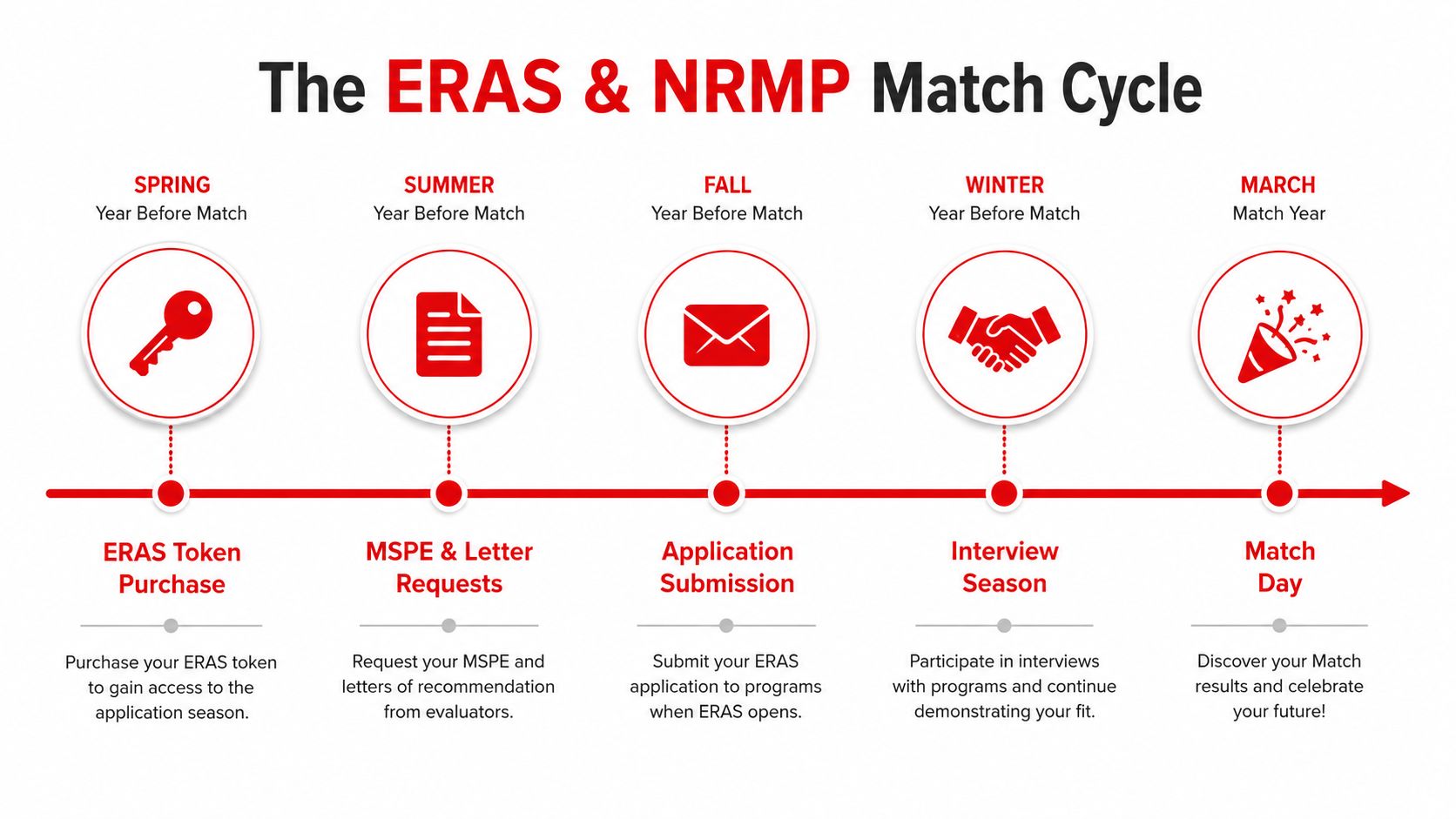
The Match works best when you think of it as one timeline, not a series of disconnected deadlines. Spring is for preparation, summer is for building the file, fall is for submission and review, winter is for interviews and ranking, and March is for outcomes. Missing one stage often creates problems in the next, so timing matters as much as content.
Spring and summer preparation
In the spring before the Match, students usually focus on ERAS token purchase, personal statement drafting, letters of recommendation, and scheduling exams such as USMLE or COMLEX. By summer, the application itself is being assembled, including transcripts, the Medical Student Performance Evaluation, or MSPE, and supporting documents.
Programs start seeing fuller files once the MSPE is released in the fall. That's when application quality and completeness matter more than last-minute volume. If your letters are late or your application is incomplete, you can lose momentum before review even begins.
Fall through Match Week
The fall interview season is where signaling, program screening, and applicant communication intersect. Some specialties use program signaling to help programs identify genuine interest, and the interview season often peaks after applications are released and files are reviewed. Rank lists then open later, and applicants certify them before the late-January deadline.
March brings Match Week, which ends in Match Day. If you go unmatched or partially matched, the Supplemental Offer and Acceptance Program (SOAP) begins on Monday of Match Week. The NRMP's 2026 results report shows 2,851 positions were available through SOAP, and 2,632 were filled for a 99.3% fill rate across the Match and SOAP combined. (NRMP 2026 results)
Timing rule: every missing document, delayed recommendation, or late rank-list decision can spill into the next phase, so treat the calendar as a chain, not a checklist.
For a practical year-at-a-glance version, Ace Med Boards also keeps a concise ERAS residency timeline guide, which can help you map your own month-by-month plan.
Competitiveness by Specialty and Applicant Type
Competitiveness is better understood as a capacity equation than as a vague label like “hard” or “easy.” Each specialty has a certain number of positions, a certain number of applicants who rank it, and a screening process that varies by applicant type. A specialty can feel realistic for one student and very tight for another, even when they're aiming at the same program.
A recent analysis showed how program size and applicant volume shape access. Internal medicine had 10,680 positions across 707 programs, with average program size of 15, while pediatrics had 3,078 positions across 251 programs, with average size 12. The same source noted that average applications per U.S. MD or DO applicant reached 31/58 in internal medicine and 41/50 in emergency medicine, which shows how broadly applicants often apply when they know screening capacity is limited. (Specialty capacity analysis)
Why the same specialty isn't equally easy for everyone
Applicant type changes the picture. U.S. MD seniors, U.S. DO seniors, and international medical graduates, or IMGs, are not evaluated from the same starting point, even when they apply to the same discipline. USMLE or COMLEX performance, research, clinical fit, visa sponsorship, and prior U.S. experience all influence whether an application rises to the interview pile.
IMGs also matter in workforce distribution. ECFMG has noted that IMGs remain important for U.S. workforce shortages, especially in underserved communities and essential specialties, and in 2025 they filled 44.6% of Internal Medicine PGY-1 positions. For applicants who are weighing geography and specialty together, that means receptivity can differ sharply by program type and community need. (ECFMG IMG success in the 2025 Match)
The useful move is to benchmark yourself against the applicants who matched in your target category, not against the entire applicant pool. If you're a DO student, an IMG, or someone with a less conventional academic path, that comparison is much more honest and much more useful.
Ace Med Boards has a residency match statistics and specialty analysis that can help you think in those terms, but the core habit is simple, study the specialty, then study your applicant category inside that specialty.
Program Signaling and How Interviews Are Offered
Program signaling is a limited-token system that lets applicants tell programs where they're interested. The reason it matters is simple, programs receive far more applications than they can review, so a signal can move an application into a more visible pile. In emergency medicine, published evidence showed interview yield at signaled programs was 76.3% in 2023 and 78.9% in 2024, compared with 51.3% and 43.5% across programs overall, and signaling increased the odds of receiving an interview offer and matching after interviewing. (Emergency medicine signaling study)
How to use signals without wasting them
Token counts vary by specialty, so your strategy should start with the rules for your field. In many specialties, internal medicine applicants may have around 25 to 30 tokens, while highly competitive fields may have far fewer. Some pathways also use special token types, and some specialties reserve gold signals for particular applicants or program structures.
The practical guidance is straightforward.
- Signal true targets: use tokens on programs you'd seriously attend if offered a spot.
- Read each program's policy: some programs use signals to prioritize interviews, others use them for a full review.
- Don't assume your home program is automatic: policies differ, so check before you spend a token there.
- Treat a signal as a tool, not a promise: it can improve visibility, but it doesn't guarantee an interview.
A simple way to think about signaling is as triage for a crowded inbox. It helps programs decide where to look first, but it doesn't replace your scores, clinical background, or letters. If your file is weak in one area, a signal may help you get seen, but it won't rewrite the whole application.
You can see signaling as a pressure test for program interest, not a badge of worth. When used well, it helps a program understand that your application is intentional rather than scattershot.
Researching Programs and Building a Smart Rank List
Good program research starts before interview invites arrive. Use FREIDA and the ACGME program database to build your first long list, then narrow by location, program size, visa sponsorship, setting, and whether the program seems more community-based or academic. From there, read each program website for curriculum structure, call expectations, away-rotation requirements, and any published applicant criteria.
That broad filter matters because not every “good” program is good for you. A student who wants fellowship support will look at different signals than a student who wants a community-based job pipeline. An IMG may care more about visa sponsorship and track record, while a couples Match applicant may care more about geography and scheduling flexibility.
Build a spreadsheet that tells the truth
A spreadsheet keeps the process from becoming emotional guesswork. Track interview date, signal status, thank-you follow-up, geographic fit, and any special notes from the program. If you send updates, send them only when something has changed, such as a publication, award, or strong new rotation evaluation.
Practical rule: if you wouldn't want a program to think the update was fluff, don't send it.
Rank-list strategy should follow the NRMP algorithm's basic logic, which favors the applicant's order of preference. Rank every program where you would train, then sort by your true preference rather than by your guess about where you “have a shot.” Leaving off interviews or burying a reach behind a safer-feeling option can cost you the chance to match where you'd be happiest.
Ace Med Boards offers rank residency programs guidance that fits this exact problem, although the core principle is already enough on its own, honest preference beats nervous second-guessing.
What Happens if You Do Not Match and How to Reapply
If you don't match, the next move is to understand SOAP before making any emotional decisions. SOAP is only for applicants who are registered for the Main Residency Match, verified as eligible to enter graduate medical education on July 1 by their medical school or ECFMG, and unmatched or partially matched on Monday of Match Week. It is a rule-based process, and only unfilled program slots are available through it. (NRMP SOAP guide)
The compressed timeline can feel disorienting, but it's orderly. Monday brings unmatched notification, and eligibility verification must be completed by noon Eastern Time. Thursday and Friday then include the SOAP offer rounds, and communication happens through the AAMC portal, not by informal outreach to programs outside the process.
Reapplication works best as an audit, not a reaction
After the cycle ends, write down what happened. Which interviews came through, which programs never responded, which parts of the file got questions, and where your specialty list may have been too narrow. That post-mortem becomes the basis for your next cycle, and it's usually more helpful than trying to “start over” emotionally.
If you reapply, strengthen the specific parts of the application that were weakest. That might mean improving exam performance, adding stronger letters, clarifying specialty choice, or gaining more recent clinical exposure. Some applicants also consider preliminary or research years when they need a more structured bridge into the next Match.
Not matching is painful, but it isn't a verdict on your entire future. It's a signal that your current application package needs a more targeted plan.
Key Takeaways and Your Action Plan
Residency programs are the bottleneck between medical school and independent practice, and the whole process works like one decision system. You apply through ERAS, programs screen with limited capacity, signals help programs prioritize, interviews narrow the field, and rank lists determine the final order of outcomes. The applicants who do best usually aren't the ones who treat each step separately, they're the ones who connect the steps.
A practical monthly plan helps you stay grounded.
- Start with fit: decide which specialties match your goals, energy, and long-term plans.
- Audit your applicant category: MD, DO, IMG, or reapplicant status changes how you should benchmark yourself.
- Build the target list early: use program databases, not rumor, to decide where to apply.
- Use signals deliberately: spend them on programs you want, not on guesses.
- Rank: order programs by preference, then certify on time.
If you're worried about setbacks, keep the mindset simple. A weak round of interviews, a narrow list, or even an unmatched cycle can be revisited with a cleaner plan and better documentation. What matters most is that you learn from the cycle instead of drifting into the next one with the same assumptions.
For applicants who want help pressure-testing signal strategy, interview answers, or rank-list logic, one-on-one support can be useful. Ace Med Boards offers diagnostic tutoring and personalized study-plan support for medical students and residency applicants who want a structured outside review of their application strategy.
If you'd like a calm, practical review of your residency plan, visit Ace Med Boards to explore diagnostic tutoring and personalized support for your application strategy, interviews, and study planning. It's a low-pressure way to get a second set of eyes on your timeline and your decisions before the next deadline hits.