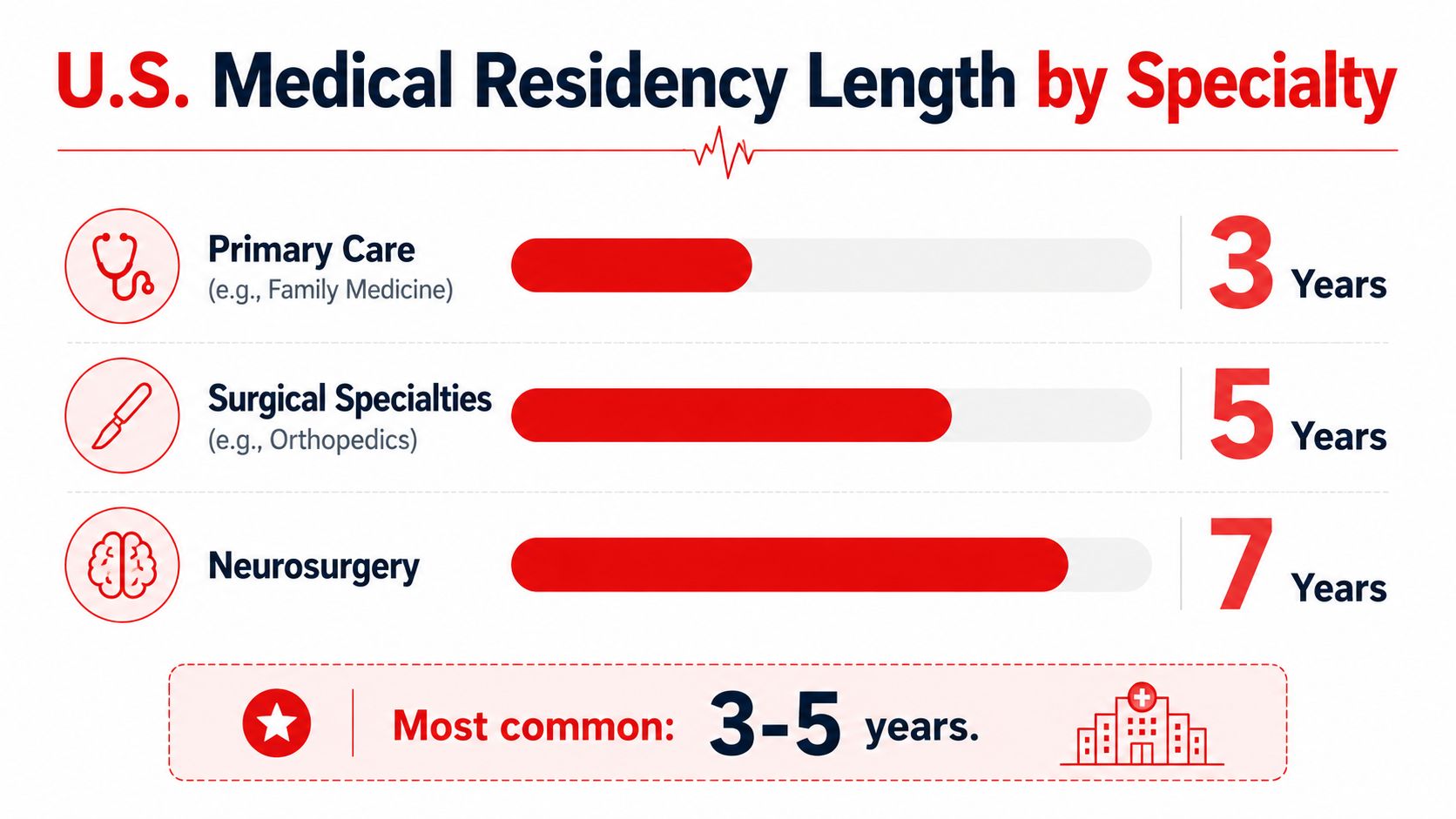
Medical residency typically lasts 3 to 7 years in the U.S. The most common primary-care pathways are 3 years, while the longest core programs, including neurosurgery at 7 years and plastic surgery at about 6 years, take longer, and the total time to independent practice is often longer once preliminary years and fellowship training are counted.
If you're trying to plan your career, that headline number is only the starting point. Answer depends on specialty, training pathway, and sometimes on what you want to do after residency.
The Short Answer to How Long Medical Residency Is
If you are trying to answer the question quickly, residency in the U.S. is usually 3 to 7 years depending on specialty, with family medicine, internal medicine, and pediatrics usually near the shorter end and more technically demanding surgical fields near the longer end (Washington University residency length reference). That range appears across major academic and clinical sources because residency is organized around the demands of each specialty, not around one universal timeline.
Residency is the postgraduate training stage after medical school, and medical residency works through a structured progression of supervised clinical responsibility. The setting is closer to an apprenticeship than to classroom study, because you are applying what you learned in medical school while a senior team is still overseeing your decisions. The pace changes over time, and that gradual shift from close supervision to more independent judgment is part of what residency is designed to do.
In U.S. training, residency sits between graduation from medical school and independent practice, and it is closely tied to licensure and board eligibility (Residency overview)). That is why the question “how long is medical residency” is really asking two different things. One is the official length of the residency program itself. The other is how long it takes a doctor to reach the point of practicing independently, which can be longer once preliminary years, fellowship training, research gaps, remediation, or visa and licensing delays are part of the path.
Practical rule: the specialty label gives you the core residency length, but it does not always tell you the full path to the job you want.
That difference matters because the rest of the answer depends on whether you are looking at a straight categorical residency, a program with a preliminary year, or a residency that is often followed by fellowship training.
PGY Years and What Internship and Preliminary Years Mean
Medical training uses shorthand that can confuse even strong applicants at first. PGY means postgraduate year, so PGY-1 is the first year after medical school, PGY-2 is the second, and the numbering continues from there.
A categorical position is a full residency track in one specialty. A preliminary position is usually a one-year, and sometimes two-year, training block before specialty training, and a transitional year is a flexible PGY-1 year with rotations across several departments. Some specialties are listed as three years, but that number refers to the specialty portion, not always the whole route.
A preliminary year works like a prerequisite course. You complete it before the specialty curriculum starts.
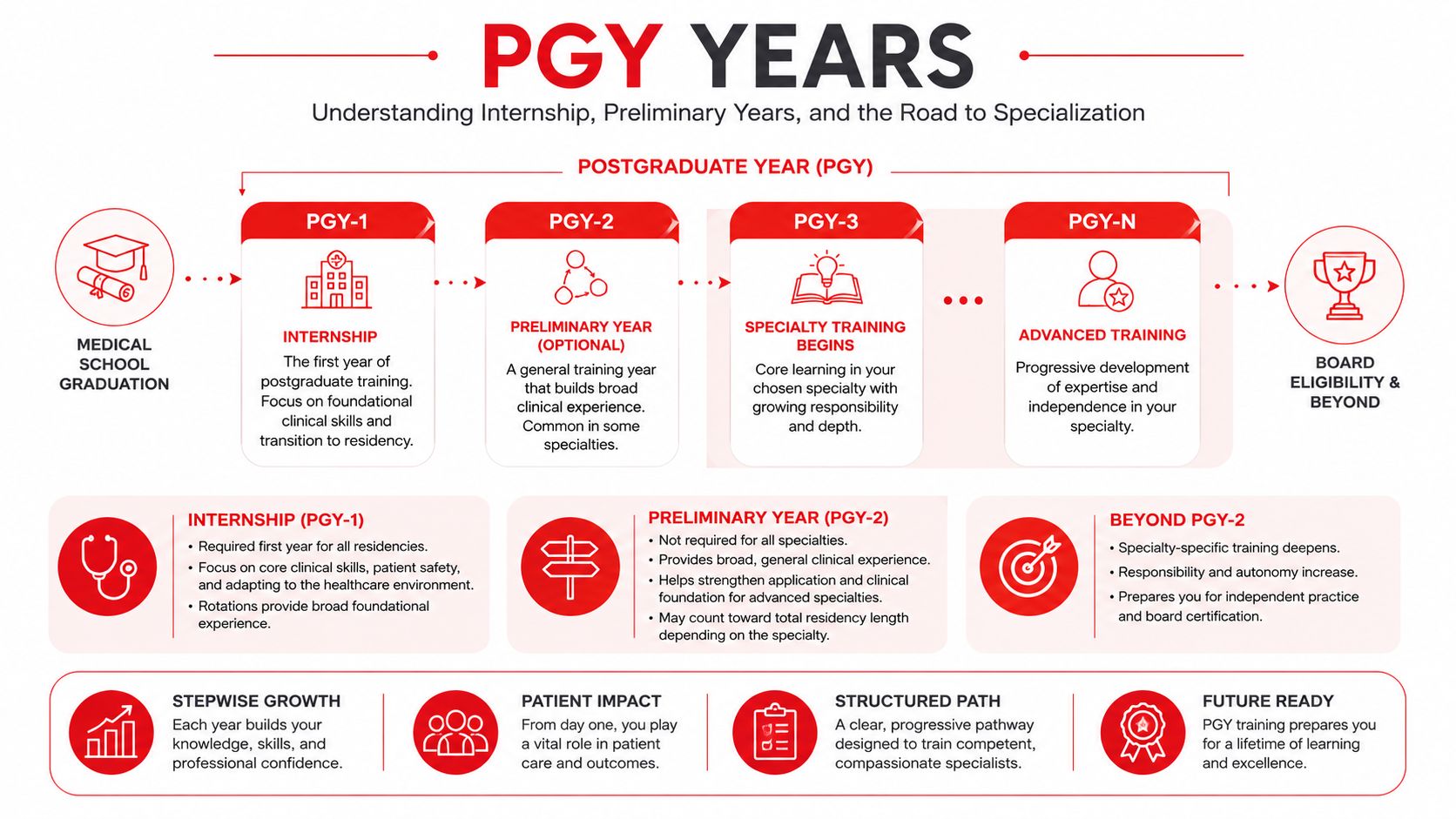
That is why a field like dermatology can look short on paper but still take more time overall if it requires a preliminary internship first. The same pattern applies to anesthesiology, radiology, neurology, ophthalmology, and physical medicine and rehabilitation when a PGY-1 preliminary or transitional year is built into the path (MedEdits PGY-1 timeline). For a clearer explanation of the first training year, this PGY-1 guide is a helpful companion if you are still learning the terminology.
The phrase “how long is medical residency” often gets used as a shortcut for something broader. Applicants usually want the full timeline from graduation to independent practice, and that timeline can stretch because of preliminary years, fellowship training, research gaps, remediation, or visa and licensing delays. If you are comparing training paths outside medicine too, CE courses for counselors from Be Your Best Self & Thrive Counseling, PLLC shows how other licensed professions also organize continuing education in structured stages.
Once you understand how PGY numbering works, the residency labels on specialty tables make much more sense.
Residency Length by Specialty at a Glance
The table below is a date-stamped reference, not a substitute for checking current program requirements. Specialty length can vary by institution, combined pathway, or added fellowship, so it's smart to verify the exact path on current specialty-board and program pages. For a specialty-specific example, urology residency length is a useful reminder that even a single field can have its own training structure.
| Specialty | Typical Core Residency (years) | Preliminary PGY-1 Required? | Example Fellowship (additional years) |
|---|---|---|---|
| Family medicine | 3 | Usually no | Sports medicine, geriatrics, or faculty development can add time |
| Internal medicine | 3 | Usually no | Cardiology 3 years, gastroenterology 3 years, nephrology 2 to 3 years, critical care often 2 years (fellowship examples) |
| Pediatrics | 3 | Usually no | Pediatric subspecialty fellowships vary by field |
| Medicine-pediatrics | 4 | Usually no | Fellowship depends on the chosen subspecialty |
| Emergency medicine | 3 to 4 | Usually no | Ultrasound, toxicology, or critical care may add training |
| Psychiatry | 4 | Usually no | Child and adolescent psychiatry adds fellowship training |
| Anesthesiology | 3 plus PGY-1 | Yes, commonly | Critical care, pain medicine, or pediatric anesthesiology may add training |
| Pathology | 3 to 4 | Sometimes, depending on track | Subspecialty fellowship often follows |
| Diagnostic radiology | 3 plus PGY-1 | Yes, commonly | Interventional radiology or subspecialty fellowship may add years |
| Obstetrics and gynecology | 4 | Usually no | Maternal-fetal medicine, gynecologic oncology, or reproductive endocrinology adds training |
| General surgery | 5 | Sometimes, depending on pathway | Surgical oncology, colorectal surgery, or trauma and critical care may add fellowship time |
| Orthopedic surgery | 5 | Typically no | Sports medicine, hand surgery, or spine-related fellowship can add time |
| Otolaryngology | 5 | Typically no | Facial plastic and reconstructive surgery or head and neck fellowship may add time |
| Urology | 5 | Sometimes, depending on pathway | Pediatric urology, oncology, or reconstruction may add time |
| Ophthalmology | 3 plus PGY-1 | Yes, commonly | Retina, cornea, or glaucoma fellowships are common add-ons |
| Plastic surgery | about 6 | Sometimes, depending on integrated route | Craniofacial or microsurgery fellowships can follow |
| Neurosurgery | 7 | Usually no | Spine, vascular, or pediatric neurosurgery may add fellowship time |
| Thoracic surgery | varies by pathway | Often after general surgery or integrated route | Advanced thoracic or congenital work may add fellowship time |
| Vascular surgery | varies by pathway | May be integrated or after general surgery | Additional vascular-focused training may follow |
The most useful way to read the table is to separate core residency from extra fellowship training. A field can be a three-year residency on paper and still take much longer if your career goal is a subspecialty practice.
Good habit: check the specialty board and the residency program page together, because the core label alone doesn't always show the full training route.
Combined Programs and Fellowship Timelines That Extend Training
Some applicants focus on the headline number and only later realize that the path they want includes extra training beyond the core residency label. Combined programs and fellowships can change the full timeline even when the accredited residency requirement itself stays the same.
Combined routes that change the math
A combined internal medicine-pediatrics program is typically 4 years, which can be shorter than completing two separate full residencies. Other combined or integrated pathways can also reduce duplication, including some emergency medicine combinations and integrated radiology tracks, while still leading to specialty-specific training that fits the field (Cleveland Clinic residency overview).
For readers interested in cardiology, the total path is easier to see with the residency and fellowship separated. Internal medicine is usually 3 years, and then cardiology commonly adds 3 more years of fellowship, so the route to that subspecialty is much longer than the core residency alone (cardiologist training guide).
Why fellowship changes the real total
Many subspecialties follow the same pattern. Internal medicine followed by gastroenterology, nephrology, or critical care can add years beyond residency because the fellowship is where deeper subspecialty skills are built. A resident may finish the core program and still have another formal training stage before practicing independently in the desired subspecialty.
A simple timeline helps make the difference clear:
- Medical school graduation
- Residency
- Optional or required fellowship
- Independent practice in the desired subspecialty
That sequence explains why a student can say they matched into a 3-year residency and still have several more years of training ahead if the goal is a subspecialty role.
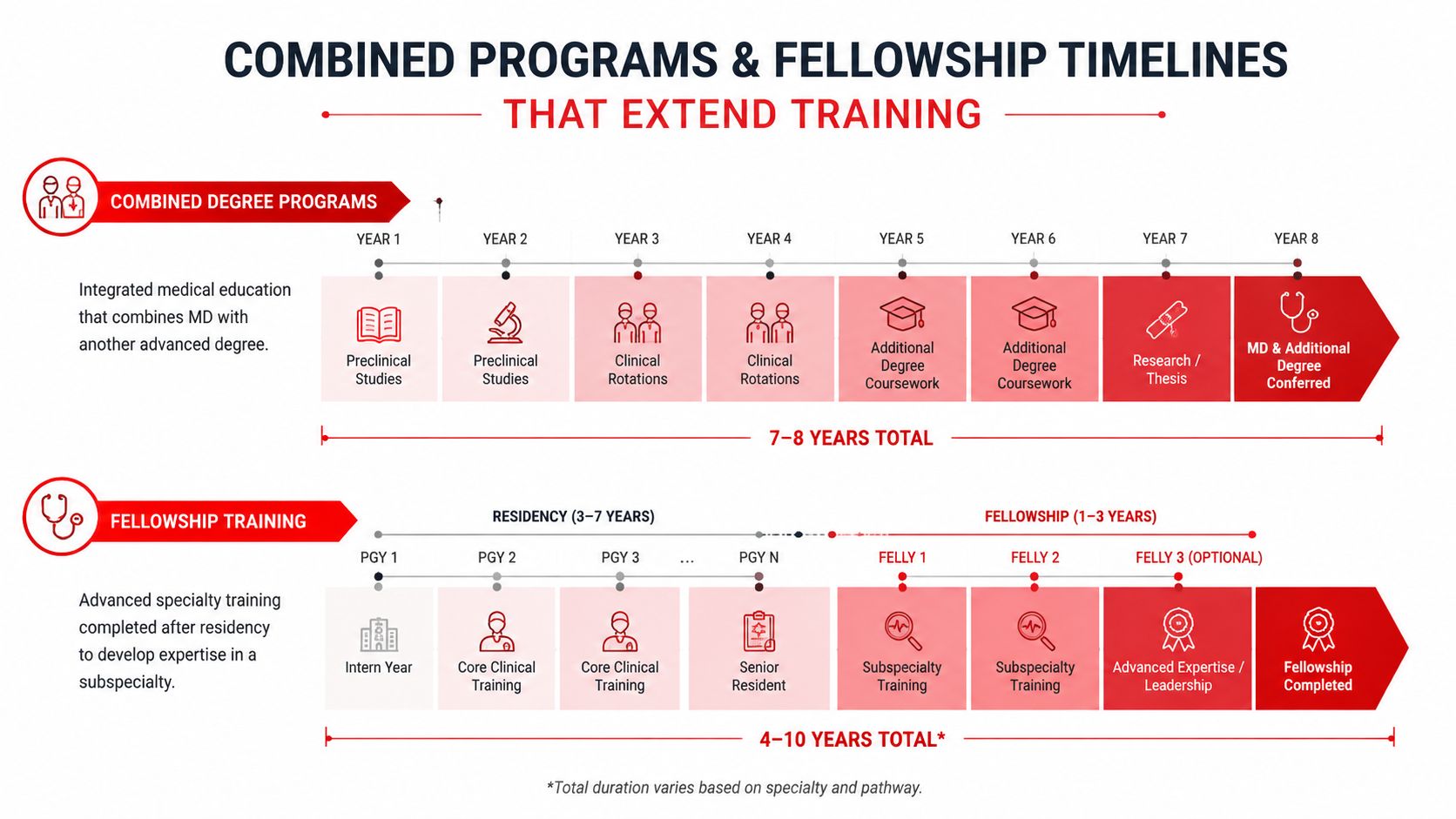
The main takeaway is that the core residency length and the full training arc are not the same thing. If you are choosing a field because you want a particular kind of practice, the fellowship layer matters just as much as the residency label.
What Can Extend Residency Beyond the Standard Length
Residency can take longer than the standard program length for reasons that have nothing to do with failure. Approved leave for health, parental, or family needs can pause training, and many programs allow that under their own rules.
Remediation is another common extension point. If a resident needs more time to meet competency expectations, repeat a rotation, or finish required cases, the program may extend training so the physician can safely complete the requirements.
Common reasons the timeline expands
- Approved leave: health, parental, or family leave can interrupt the schedule.
- Remediation or repeat rotations: some residents need extra time to meet milestones.
- Research years: physician-scientist or research tracks can add 1 to 3 years when built into the training plan.
- Transfers: moving to a different program often means repeating some time at the new institution.
- Licensing or visa issues: IMGs can face delays from ECFMG certification steps or visa processing before training starts.
- Part-time arrangements or competency delays: these can extend the calendar length without changing the specialty itself.
Those extensions are policy-driven, not moral judgments. A resident who takes leave, changes programs, or spends dedicated time in research is still following a legitimate training path, just not the fastest one.
Important distinction: an extension usually changes the calendar, not the specialty's accredited core requirement.
For surgeons in particular, this residency-length guide is a useful example of how training can stretch beyond the headline number once the full route is counted. The same logic applies across medicine, because the exact time depends on program rules, specialty requirements, and the resident's circumstances.
If you're an IMG, foreign medical graduate, or anyone with a nontraditional path, the practical question is not whether the timeline is “normal.” It's whether the training plan is clear, documented, and acceptable to the program and licensing bodies involved.
International Differences and the IMG Perspective
U.S. residency length is determined by specialty and program, not by whether a physician earned an MD or DO degree or took USMLE versus COMLEX. The accredited duration for a given specialty doesn't become longer just because someone is osteopathic, and individual application or licensing requirements are separate from program length.
Other countries organize training differently. In the UK, a foundation programme is usually followed by core and specialty training, and the total can vary widely by specialty. In Canada, the structure is broadly similar to the U.S. in spirit, but the training pathway follows Canadian accreditation and Royal College designations. Australia and New Zealand also use intern and resident stages before specialty training, while the European Union varies by country.
For IMGs matching into the U.S., the residency length usually follows the U.S. accredited program once they enter that system, even if prior training influences placement or credit. That means prior experience can sometimes help, but it doesn't automatically rewrite the program's requirement.
A few useful guardrails for international readers:
- Check ECFMG requirements early: certification and documentation can affect your start date.
- Verify NRMP and program rules: match eligibility and rank-list processes can differ by pathway.
- Assume specialty rules still apply: a field that takes 3 years in the U.S. doesn't become shorter because the applicant is international.
The most important point is that a non-U.S. background doesn't make your path less legitimate. It just means the paperwork and timing may need closer attention.
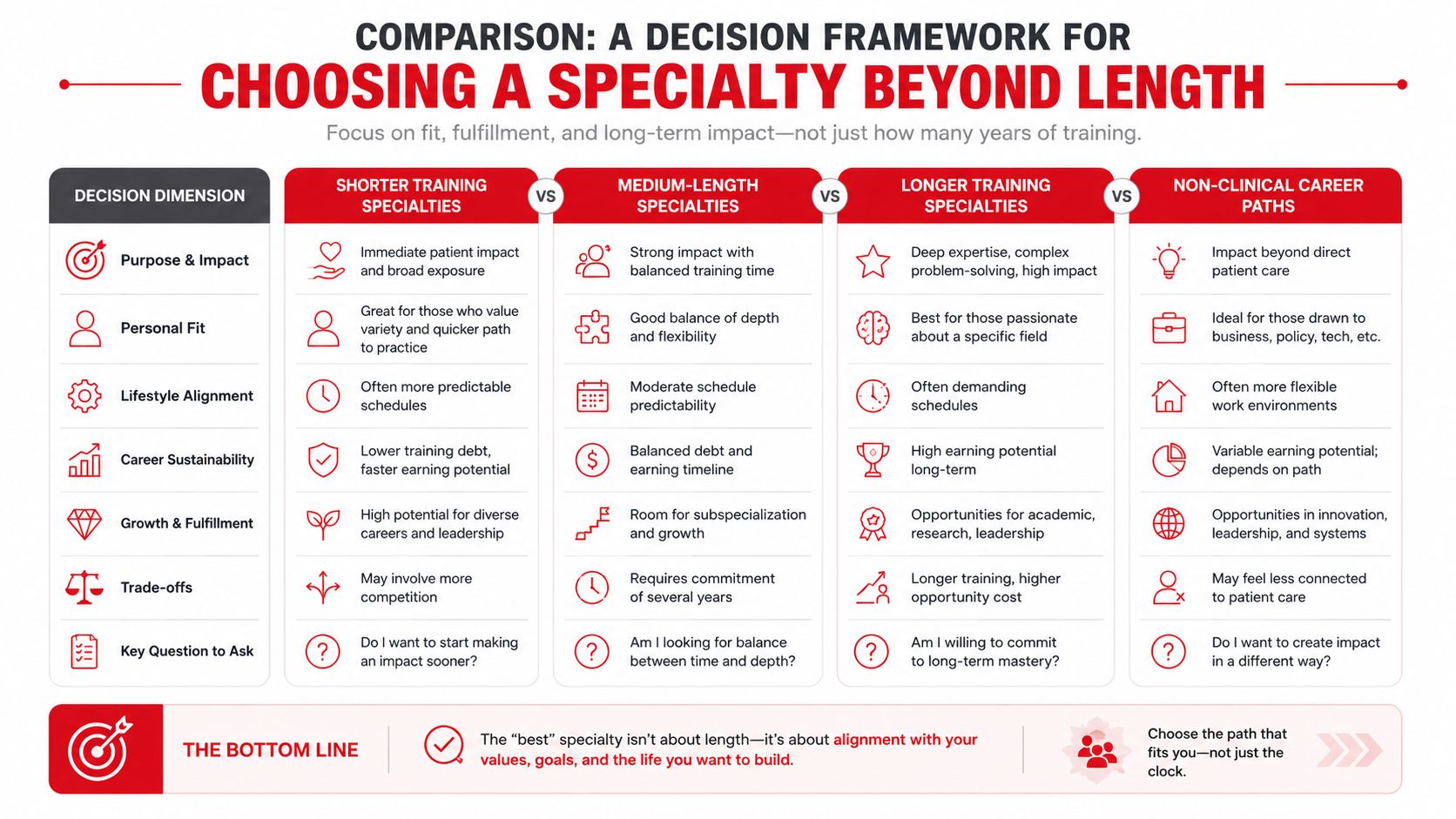
A Decision Framework for Choosing a Specialty Beyond Length
Residency length matters, but it shouldn't be the only thing guiding your choice. A specialty is a long-term work pattern, not just a training calendar, so the better question is how the path fits the life and practice you want.
Compare specialties with the right criteria
Use these questions side by side:
- Total postgraduate years to the job you want. A 3-year residency can become a much longer arc if a fellowship is the norm.
- Competitiveness. Look at current NRMP data and specialty-specific match reports before assuming a field is realistic for your application profile.
- Lifestyle and call structure. Surgical, inpatient, and procedural fields often feel different from outpatient-heavy primary care.
- Procedural versus cognitive work. Some students want hands-on interventions, while others prefer longitudinal diagnosis and management.
- Financial planning. Debt, delayed earning, and fellowship time all matter, even though they don't tell the whole story.
- Daily satisfaction. The day-to-day work has to fit your interests, not just your resume.
A useful example is internal medicine versus family medicine. Internal medicine can lead to primary care practice, but it also opens the door to fellowship training, while family medicine usually leads more directly into broad outpatient care. Both are legitimate, and neither is “better” in the abstract.
Decision rule: pick the specialty whose daily work you can picture doing for years, then check whether the training length still makes sense for that goal.
If you want a structured place to think through competitiveness, match strategy, or whether a specialty choice fits your application profile, Ace Med Boards offers residency-match consulting as one planning option among many. The right choice isn't always the shortest path, it's the one that matches your strengths, interests, and long-term goals.
Practical Planning Tips and Next Steps for Applicants
A clear plan turns “how long is medical residency” into a decision tool you can use. Start with your target specialty, then verify the core residency length on the specialty board or ACGME program page. A quick search often gives the headline answer, but it does not always show the full path from medical school graduation to independent practice.
A simple checklist for this week
- Confirm the core length: check your specialty's standard residency years and whether it usually includes a PGY-1 preliminary or transitional year.
- Identify the position type: decide whether you need a categorical, preliminary, or transitional spot.
- Map the full arc: add any likely fellowship, research year, or subspecialty step to estimate the total time before you practice on your own.
- Review match competitiveness: use NRMP Charting Outcomes in the Match and specialty resources to see how your application fits the field.
- Account for your background: if you're an IMG, plan for ECFMG timing, visa steps, and program-specific rules early.
- Get help if you're uncertain: a residency-match consultation or Board Score Audit can help if you are comparing competitive specialties, recovering from a difficult cycle, or trying to understand where your application stands.
A student aiming for primary care may be looking at a shorter residency track, while someone drawn to a surgical subspecialty may need to plan for more training after residency ends. Both paths are legitimate. The useful question is not only how many years the specialty requires on paper, but what the full route will look like for your own application, training, and career goals.
The broad picture is still the same. 3 to 7 years is the usual residency range, primary care is shortest, surgical subspecialties are longest, and preliminary years and fellowships often extend the timeline. Extra time can happen for normal reasons, including research gaps, remediation, licensing steps, or visa delays, so a longer path does not mean the plan has failed.
If you want a low-pressure place to sort through those questions, you can schedule a free consultation through Ace Med Boards. It is a practical way to talk through residency-match planning, specialty fit, and the difference between the core years you will train and the full path you may follow.