You're staring at the application portal, the deadline is close, and the letter section is still half empty. One attending likes you, one faculty member knows your work, and the chair has a big name but barely remembers your face. That's where most medical applicants lose control of the process.
How to write letters of support is not mainly about asking nicely. It's about choosing the right people, giving them the right facts, and making it easy for them to write something specific enough that a reviewer trusts it. Program directors are not looking for warmth alone, they're looking for credibility signals, concrete observation, and a clear reason to believe you'll perform well in the next setting, which is why readers often care about things like how long the writer has known you, what role they had, and what they saw you do, not just that they “support you” (program review factors).
A weak letter strategy usually creates the same problem every time. The writer is polite, but the letter sounds interchangeable, and the committee learns almost nothing new. A stronger strategy treats the letter as part of your application architecture, the same way you'd organize a clean personal statement or a polished CV, and if you want a reality check on tone, tools that focus on turning AI drafts into authentic letters are useful only if you still supply the genuine observations and details yourself.
Why Your Letter Strategy Matters More Than You Think
The applicant who panics most is usually the one who waited too long and asked the easiest person, not the best person. I've seen students reach for a famous name first, then end up with a vague endorsement that sounds pleasant but says almost nothing. A junior faculty member who worked with you every day can write a far more persuasive letter than a department chair who knows your name but not your habits, your clinical judgment, or your work ethic.
What reviewers notice first
Committees skim fast. They look for whether the letter shows direct observation, whether the writer can compare you to peers fairly, and whether the endorsement comes from someone who knows your role. That's the basic logic behind the professional format described in university and research guidance, which emphasizes a concise opening, evidence-rich middle, and a decisive closing rather than a long, emotional narrative (UCF guidance on letter structure).
Practical rule: If the writer can't name a specific rotation, project, or encounter, the letter is probably too thin.
A good request changes the final product before the first sentence is written. You are not asking for a favor in the abstract. You are managing who speaks for you, what they say, and how much weight their words carry in a file that may be read in minutes.
Choosing the Right Recommenders for Your Application
Start with the people who have seen your work closely, then sort them by fit. The best recommender is not automatically the most senior person in the room. The best recommender is the one who can say, from firsthand observation, that you handled real responsibilities well and can anchor that praise in examples a reviewer will recognize as meaningful.
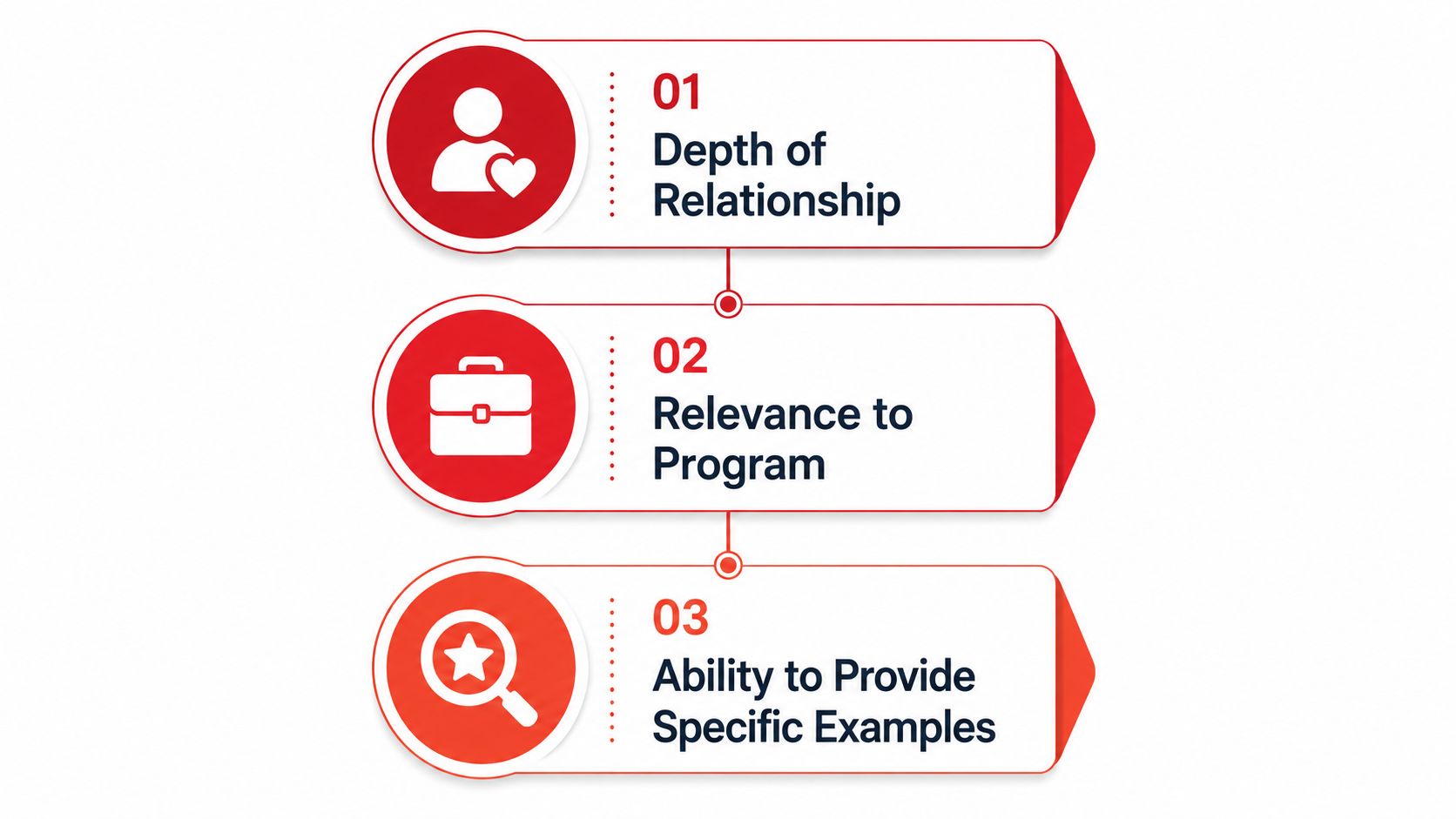
Use a simple ranking system
Rank potential writers by three questions.
- Depth of relationship. Did they observe you work, or did they just meet you at a formal event?
- Relevance to your goal. Do they practice in the field you're targeting, or at least understand the setting you're applying to?
- Specificity. Can they describe a patient interaction, research contribution, leadership moment, or clinical decision you made without guessing?
That ranking approach is the same one I use when students ask whether to choose the big-name attending or the less famous clinician who worked shoulder to shoulder with them. The second person usually wins, because specificity beats prestige when the letter is supposed to prove competence. If you need help making that ask cleanly, the mechanics described in how to ask for a letter of recommendation are worth following closely.
Build a portfolio, not a pile of names
For residency, you want balance. One letter should usually come from someone who knows your clinical work directly, another from someone aligned with your specialty interest, and any additional letters should add a different angle, not repeat the same praise in new words. For research roles, the strongest letters usually come from people who can speak to your reliability, project follow-through, and how you handled uncertainty. For clerkship-based applications, choose the people who supervised your day-to-day work, not the ones who only saw you in passing.
Bottom line: A letter only helps if the reader learns something distinct about you from that writer.
If you're unsure whether someone is a good candidate, ask yourself one blunt question. Could this person write a letter that sounds impossible to swap with someone else's? If not, keep looking.
The Anatomy of a High-Impact Support Letter
A strong letter is a professional document, not a tribute. Reviewers want enough evidence to trust the recommendation, and they expect the writer to sound like someone who observed your work. Formal guidance from the University of Calgary shows how standardized this format has become, with expectations for letterhead, date, salutation, and signature line, which tells you these letters are handled as formal documentation, not casual notes (University of Calgary guidance).
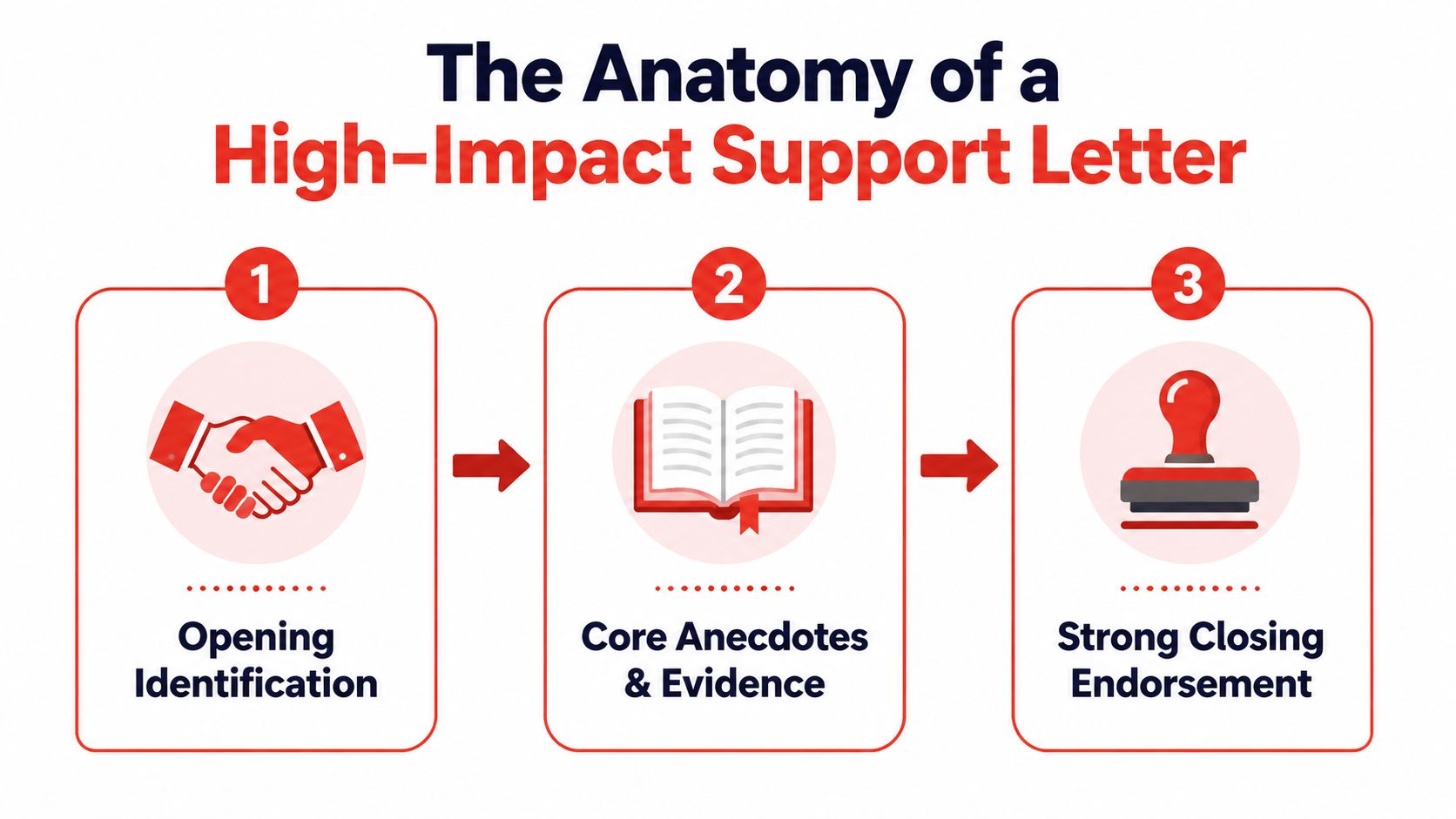
The three-part structure reviewers expect
Strong letters usually follow a simple pattern. They identify the person and project, describe the relationship and evidence, then close with direct support and follow-up availability. That matches multiple university and research guides that describe roughly three parts or three to five focused paragraphs, not sprawling stories, as outlined in the UCF structure guide.
The opening should say who the writer is and how they know you. The middle should do the heavy lifting with concrete examples, like a patient interaction, a research responsibility, or a decision-making moment. The closing should stop hedging and clearly endorse you. In practice, the best letters read like someone is willing to stand behind the student or applicant after real observation, not after a polite conversation in the hallway.
What to tell your recommender to include
Tell them to include facts that help a reviewer judge performance, not just personality. That means your role on the team, the context of the observation, and any meaningful comparison to peers when that comparison is justified. Guidance also notes that strong letters may include ranked comparisons, such as placing a candidate in the top tier of peers when that assessment is earned and defensible.
For grant or institutional settings, the bar rises. The Canadian Institutes of Health Research expects letters to cover the relationship, the project's relevance, impact, and any in-kind or monetary support, while Tufts stresses alignment with funding instructions, letterhead, an authorized signature, and page limits or other agency rules (CIHR letter requirements, Tufts letter guidance). If you want a model for tone and structure, the same discipline used in brief drafting advice for junior lawyers applies here, state the claim, support it with facts, and close decisively.
The best letters don't sound effusive. They sound documented.
If you want to see what polished language looks like, compare your draft expectations against residency recommendation samples, but do not copy the wording blindly. The point is to understand the level of specificity, not to mimic a template.
Tailoring Letters for Different Medical Contexts
A letter that works for residency can miss the mark for a grant, and a letter for a clerkship can be too thin for institutional review. The setting controls the content, the tone, and the level of commitment the writer should make. If you ask every recommender for the same kind of letter, you get mismatched documents that fail the purpose.
| Context | Key Focus | Required Details | Typical Length |
|---|---|---|---|
| Residency match | Clinical judgment, teamwork, reliability, specialty fit | Specific patient care examples, comparison to peers when justified, clear support | Usually concise and focused |
| Clerkship rotation | Day-to-day performance, responsiveness, professionalism | Observed behavior, work habits, case participation | Short and practical |
| Research fellowship or grant | Contribution, feasibility, institutional backing | Project relevance, commitments, support details, agency-specific identifiers when required | More formal and detailed |
| Visa or advocacy support | Credibility, standing, purpose of support | Relationship, reason for support, factual context | Variable, but direct |
Residency and clerkship are not the same letter
Residency letters should speak to readiness for training. The writer needs to explain what kind of clinician you are becoming, based on direct observation, not vague confidence. Clerkship letters are narrower. They should emphasize how you showed up every day, how you handled feedback, and whether you were reliable under supervision.
The material you give your recommender should match that difference. A letter for residency benefits from a writer who can speak to clinical judgment and specialty fit. A clerkship letter should come from someone who saw your work habits closely and can describe them plainly.
Research and formal support letters carry compliance weight
Grant-related letters need more than praise. The Canadian Institutes of Health Research expects details about the relationship, the project's relevance, the impact, and any in-kind or monetary support, while Tufts stresses that the letter must follow the funder's instructions, use letterhead, carry an authorized signature, and respect page limits or other agency rules (CIHR, Tufts). National Wildlife Federation guidance also asks for the Easygrants five-digit proposal number, the project title, and the applicant organization name (NWF guidance).
That changes how you brief the writer. For residency, ask for clinical competence and readiness for training. For research, ask for feasibility, commitment, and institutional backing. For formal support letters, give every required identifier up front, because missing metadata can sink the letter before the reader gets to your actual qualifications.
If you need a practical model for how these letters are usually built, how to create a letter of recommendation is a useful reference point for structure, but the substance still has to fit the setting.
Making the Request and Guiding Your Recommender
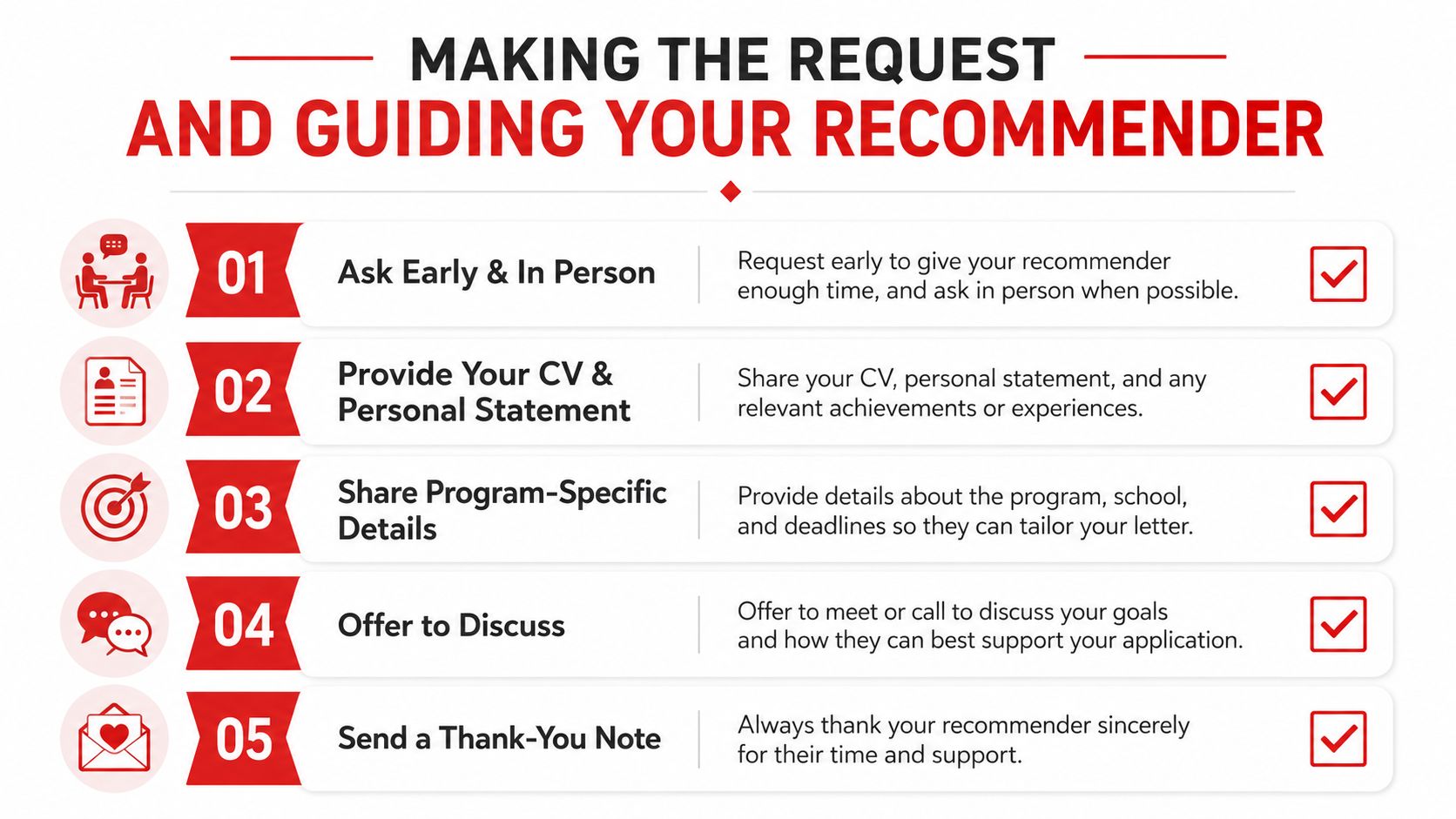
The request itself should be direct, respectful, and easy to answer. Don't bury the ask in a long message, and don't make the writer hunt for your materials. The easier you make the process, the more likely you are to get a letter that sounds informed instead of rushed.
The email should be short and specific
If you're contacting someone new, use a direct ask. If you're following up with a mentor, remind them where you worked together. If you're on a tight deadline, say that plainly and give them the date. The structure is similar to how to write a cold email, keep it clear, useful, and easy to respond to.
A clean version looks like this:
Dear Dr. Patel,
I'm applying for residency and would be grateful if you'd consider writing a letter of support based on our work together on the wards. I valued your teaching and think you saw my clinical growth clearly. If you're able to write one, I can send my CV, personal statement, and submission details right away.
A follow-up version is even simpler:
Dear Dr. Lopez,
Thank you again for supervising me on rotation. I'm reaching out to ask whether you'd be willing to write a letter of support for my application. I can send everything you'd need, including deadlines and the exact submission instructions.
What to put in the briefing packet
Send the writer a packet that removes guesswork. Include your CV, personal statement, the program or opportunity details, submission instructions, and a short note about which experiences you'd like highlighted. If the platform uses a letter request form, include that too. Ace Med Boards' residency material specifically discusses the ERAS Letter of Recommendation Request Form and Letter ID, which is the kind of detail that prevents submission errors in a crowded application season (ERAS letter request guidance).
Use this checklist:
- CV: So the writer can see your full timeline and avoid factual errors.
- Personal statement: So the tone of the letter matches your application theme.
- Program details: So the letter can be customized for the right specialty or institution.
- Submission instructions: So the writer knows where, when, and how to upload.
- Highlighted experiences: So they know which examples matter most.
If they ask you to draft the letter yourself, treat it as a drafting exercise, not a free pass to write your own praise. Give them a factual outline, then let them edit it into their own voice. That's the only way the final letter stays credible.
Common Mistakes and Your Final Revision Checklist
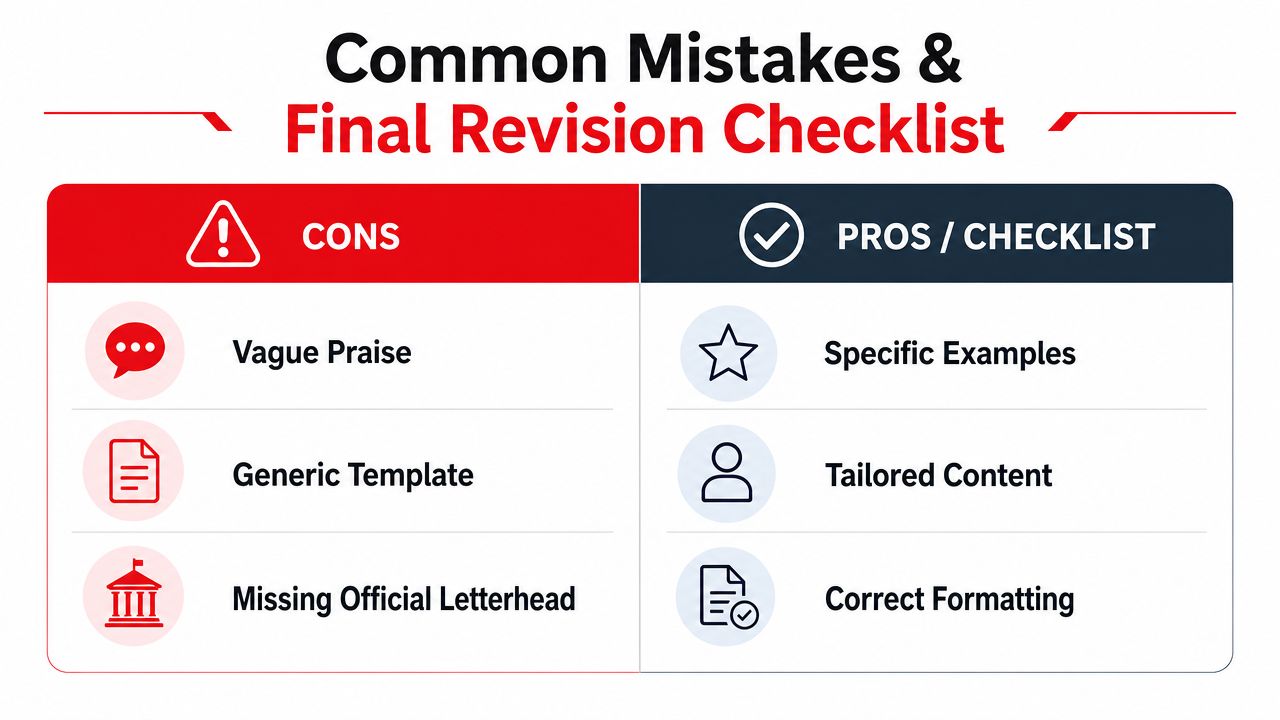
The worst letters are often the ones that sound nice and say almost nothing. Committees do not need flattery. They need a letter that helps them judge credibility, commitment, and fit, because that is the job of a support letter.
The mistakes that sink otherwise strong applications
Vague praise is the biggest offender. A generic template that could be sent to any applicant in any field is just as bad. Missing letterhead, missing signature, or missing required identifiers also weakens the document, especially in formal grant and institutional settings where compliance matters (Tufts guidance, CIHR requirements).
Overpromising causes another kind of damage. If a support letter implies material backing, access, or effort that the writer cannot provide, the letter becomes a liability. Keep the commitment concrete and documented, and leave the exaggerated enthusiasm out of it.
What to check before submission
Review the letter, if the writer shares it, for these items:
- Correct name and role: Make sure your name, title, and program are right.
- Official formatting: Letterhead, date, salutation, and signature line should be present when required.
- Specific examples: Look for actual observations, not generic praise.
- Relevant focus: The letter should match the purpose, residency, research, or formal support.
- Required identifiers: Proposal numbers, project titles, organization names, or request IDs should be included when the system asks for them.
- Accurate tone: The letter should sound like the writer, not like a committee memo.
If the letter reads like it could have been written for ten other people, it probably won't help you.
If something is missing, ask for a revision respectfully and quickly. Tell the writer exactly what needs to change, why it matters, and which detail or example would strengthen the letter. Faculty usually fix the problem when you make the correction easy.
You do not need another generic template. You need the right people, the right instructions, and the right materials in front of them before they write. Ace Med Boards helps medical students prepare stronger applications across exams, residency planning, and admissions support, and its application resources can help you organize your materials before you ask for letters. Visit Ace Med Boards if you want a more disciplined way to manage your recommenders, your timelines, and the documents that shape how programs see you.