What makes one board question about infertility feel obvious and another feel impossible, even when both mention the same hormones? The difference is usually not more memorization. It's whether you can see the feedback loop underneath the vignette.
That mental model is the core of reproductive endocrinology basics. The hypothalamus, pituitary, ovaries, and cycle timing work like a control system, and once you learn where the loop is broken, the labs and treatments start making sense. Use that model here, and you'll be able to interpret hormone panels, localize disorders, and answer the kind of questions that reward reasoning instead of rote recall.
Why Reproductive Endocrinology Trips Up Even Strong Students
Students often get stuck because they study reproductive endocrinology like a list of isolated facts. They memorize GnRH, LH, FSH, estradiol, progesterone, then freeze when an exam vignette mixes irregular menses, infertility, and a few borderline labs. The problem isn't effort, it's organization.
The better approach is to treat the entire topic as one feedback-loop system. Every cycle, disorder, and treatment choice fits somewhere in that loop, whether the issue is central suppression, ovarian failure, or a structurally correctable problem. That's why strong test-takers don't just name hormones, they localize the failure.
A helpful way to study this topic is to ask three questions every time:
- Where is the signal starting? Look at the hypothalamus and pituitary.
- What is the ovary doing with that signal? Check steroid production and ovulation.
- What pattern does the lab panel create? Match the pattern to the disorder.
Practical rule: If you can tell whether the problem is central or ovarian, half the vignette is already solved.
This guide keeps that structure front and center, rather than burying it under jargon. It also fits cleanly with broader endocrine review, so if you want a companion map for related systems, the endocrine study guide pairs well with this framework. By the end, you should be able to read a hormone panel, identify the broken loop, and connect it to first-line management without guessing.
The Hypothalamic Pituitary Gonadal Axis Explained Step by Step
Start at the top of the relay
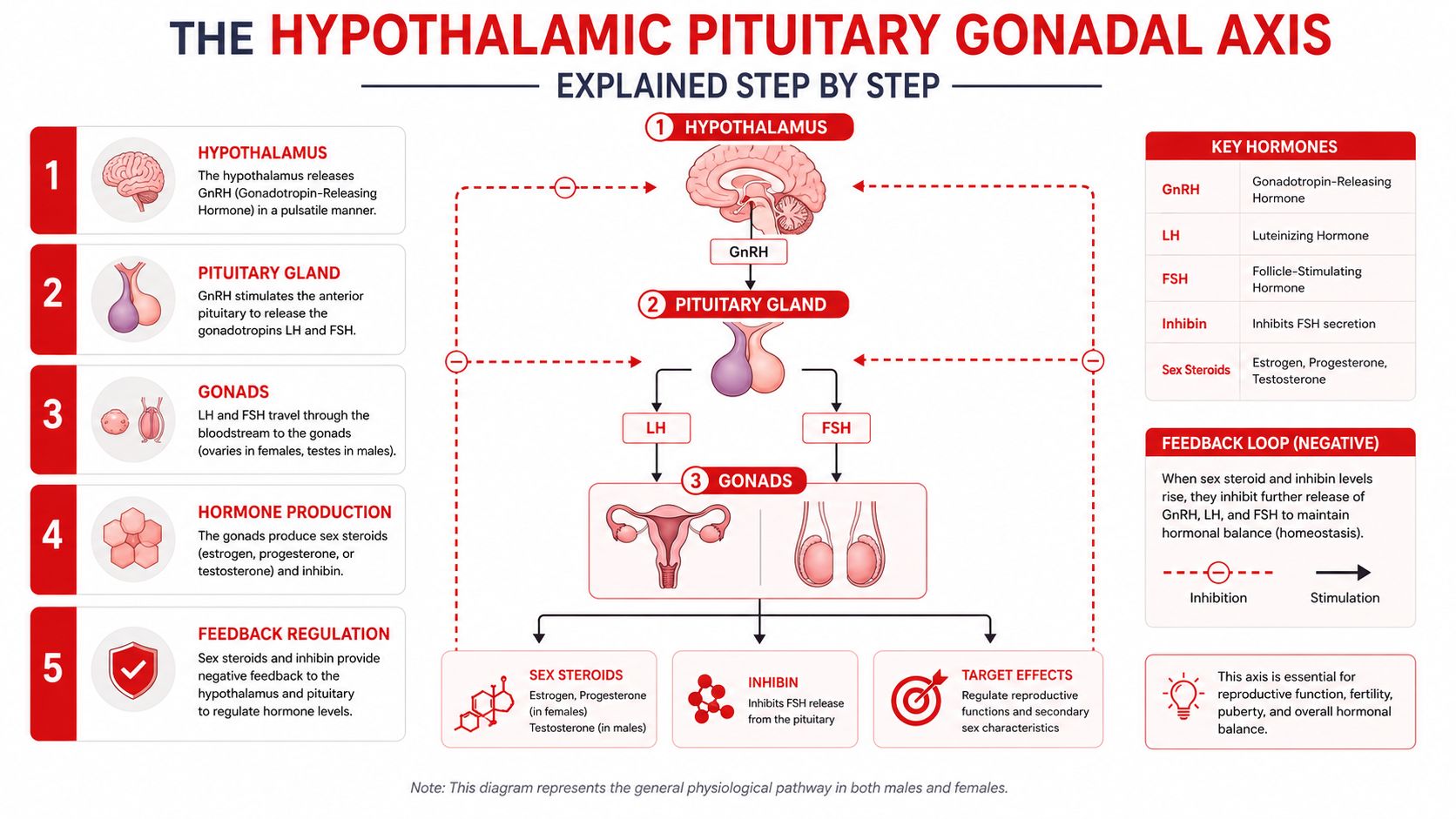
The hypothalamus starts the sequence by releasing gonadotropin-releasing hormone, or GnRH, which tells the anterior pituitary to release luteinizing hormone, LH, and follicle-stimulating hormone, FSH (Merck Manual). In board-style questions, a central problem often appears as low or inappropriately normal gonadotropins, because the signal never reaches the next station.
GnRH is a pulse signal, not a constant stream. The gonadotropins are released in pulses every 1 to 4 hours to regulate ovulation and ovarian estradiol and progesterone production (Merck Manual). That rhythm matters because reproductive function depends on timing and feedback, the same way a relay race fails if the baton is passed too early or too late.
What LH and FSH actually do
FSH supports follicular development, while LH is the main signal for ovulation and luteal function. The ovary then produces estradiol and progesterone, which feed back to the hypothalamus and pituitary to shape the next round of signaling. The system stays balanced unless disease interrupts one of those links.
A clean way to remember the direction is simple.
GnRH drives LH and FSH, LH and FSH drive the ovary, and ovarian steroids feed back to the brain.
That back-and-forth is why a hormone panel has to be read in context. A low ovarian output can make the pituitary push harder, while central suppression can leave both the pituitary and ovary underactive. The signaling behavior also depends on hormone class, so a quick review of peptide hormones versus steroid hormones helps the mechanism stick, especially the difference between surface receptor signaling and gene transcription effects.
Why the pulse pattern matters clinically
Pulsatile release is not trivia, it is the mechanism behind normal cycling. If the pulse generator is disrupted, ovulation becomes unreliable or stops altogether. That is why a board vignette about stress, undernutrition, pituitary disease, or hypothalamic suppression often points upstream rather than at the ovary itself.
A useful exam habit is to ask whether the disorder is signal failure, ovarian failure, or feedback mismatch. If you know which tier failed, the hormone pattern usually follows logically. That is the core logic of the axis.
Reading the Menstrual Cycle as a Hormone Curve
The menstrual cycle makes more sense when you stop seeing it as a calendar and start seeing it as a curve. The median menstrual cycle length is 28 days, most cycles fall between 25 and 30 days, the follicular phase is the most variable at about 10 to 14 days, and the luteal phase stays relatively stable at about 14 days (Oncohema Key). That timing explains why the same patient can have very different cycle lengths month to month and still have a normal luteal phase.
A simple pattern to memorize
At the beginning of the cycle, FSH rises enough to recruit follicles. As the dominant follicle matures, estradiol climbs and gradually changes feedback at the hypothalamus and pituitary. Once estrogen reaches the right level, the system flips from restraint to stimulation, and the LH surge appears.
Ovulation happens roughly 36 hours after LH surge onset (Oncohema Key). That single timing pearl is high yield for ovulation prediction, fertility planning, and answering questions about when the egg is released. After ovulation, progesterone rises from the corpus luteum and stabilizes the endometrium.
Hormone Levels Across the Menstrual Cycle
| Cycle Phase | FSH | LH | Estradiol | Progesterone |
|---|---|---|---|---|
| Early follicular | Moderate, rising | Low to moderate | Low, then rising | Low |
| Late follicular | Falls slightly as dominance emerges | Rises toward surge | High | Low |
| Ovulatory window | Variable | Surge | High, then shifts | Low, begins to rise after ovulation |
| Luteal | Low | Low | Moderate | High |
What the graph means in plain language
The follicular phase is variable because follicle recruitment and selection can take different amounts of time. The luteal phase is steadier because the corpus luteum follows a more predictable endocrine pattern once ovulation has happened. That is why luteal length is less useful for explaining irregular cycles than follicular variability.
Exam pearl: If progesterone is absent when it should be present, think anovulation first, not just “bad periods.”
If you're reviewing cycle timing alongside sexual health counseling, the sexual health education resource can help connect physiology to patient conversations without losing the hormonal logic. The point for boards is simple, though. If the question gives you cycle day, hormone peaks, and a missed ovulation event, you should be able to reconstruct the whole curve.
High-Yield Disorders and Where the Feedback Loop Breaks
Central suppression versus ovarian failure
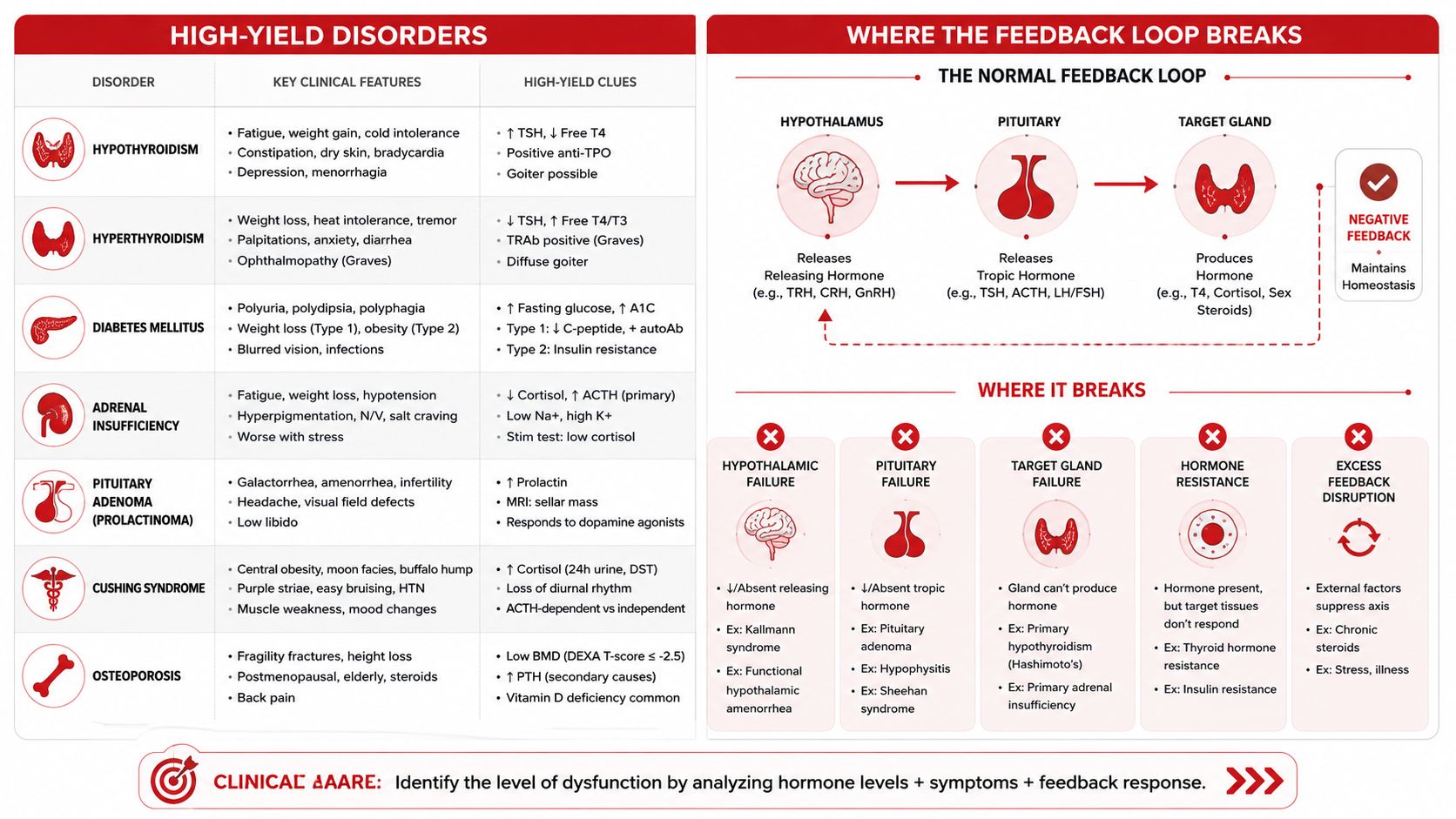
The easiest way to sort reproductive disorders is by locating the break in the feedback loop. If the hypothalamus is quiet, the pituitary receives too little drive and FSH and LH stay low or inappropriately normal. If the ovary cannot answer the signal, the pituitary reacts by raising FSH, as if it is pressing harder on a stuck pedal.
Functional hypothalamic amenorrhea belongs on the central side of that map. The hypothalamus under-signals the pituitary, so LH and FSH remain low, and the ovary never gets the message to ovulate. On a vignette, that pattern usually appears with amenorrhea plus stress, low energy availability, or heavy exercise.
Primary ovarian insufficiency is the opposite pattern. The ovary fails early, estrogen falls, and the pituitary answers by increasing gonadotropins, especially FSH. High FSH with low estradiol should push ovarian failure to the front of the differential.
PCOS and the mismatch problem
PCOS is a mismatch disorder rather than a complete shutdown. The axis is still talking, but the conversation is distorted enough to interrupt ovulation. Patients often have irregular cycles, androgen excess, and anovulatory infertility, so the key is recognizing that the pituitary-ovarian loop is out of sync instead of fully absent.
Board questions like to blur that distinction. A patient can have irregular menses for endocrine reasons, yet not every abnormal cycle is purely hormonal. REI specialists are trained to integrate endocrine, genetic, anatomic, and structural causes because a careful evaluation has to ask whether the problem is central, ovarian, or surgically correctable, as described by the ASRM.
Menopause and the final loop shift
Menopause is the end-stage form of ovarian failure. Ovarian reserve declines over time, and by menopause it drops to less than 1,000 oocytes after starting with about 500,000 at puberty and only about 400 ovulations across the reproductive lifespan (UC Davis). Age is therefore a biologic variable, not just a demographic one, and that is why fertility counseling changes as patients get older.
Practical rule: Low gonadotropins point central. High gonadotropins point ovarian. Normal gonadotropins with irregular cycles often means you need to think more carefully about an ovulatory disorder.
A national survey of REI practices tied to OB/GYN residency programs found that only 56% reported at least one access-to-care initiative, with discounted treatment, low-cost IVF, or resident and fellow staffed clinics among the most common efforts (PMC). That matters because even when the diagnosis is clear, access can still decide whether a patient gets evaluated and treated.
For a deeper review of endocrine pattern recognition, use the comprehensive endocrine board review once you are ready to drill the same logic in different vignette formats. The main point is simple. Every disorder is just a different place where the loop loses control. If you also want a patient-facing explanation of hormone balance, manage your hormone health can help connect the physiology to real-world counseling.
Labs and Imaging You Need to Interpret on Exam Day
Hormone tests only help if you know what question each one answers. FSH and LH localize the problem to the brain versus the ovary, estradiol tells you whether the ovary is producing meaningful steroid output, and progesterone helps confirm whether ovulation happened. Prolactin, TSH, testosterone, DHEA-S, and hCG are the add-on tests that keep you from missing a pituitary, thyroid, androgen, adrenal, or pregnancy explanation.
How to think through the panel
If FSH is high and estradiol is low, the ovary is underperforming. If gonadotropins are low or inappropriately normal with amenorrhea, the issue is more likely hypothalamic or pituitary. If androgens are high, think about ovarian or adrenal androgen excess, with PCOS often at the top of the differential.
Mid-luteal progesterone is used as a practical check for ovulation because progesterone should rise after the LH-triggered ovulatory event. A progesterone challenge test, in contrast, is useful in amenorrhea workup because it helps you infer whether the endometrium has been exposed to estrogen and whether the outflow tract can respond normally. The key is not memorizing the test names separately, but knowing what part of the loop they probe.
Imaging clues that matter
Transvaginal ultrasound is the imaging workhorse because it can show ovarian structure, endometrial appearance, and follicular development. Antral follicle counts help with ovarian reserve assessment, but the exam usually wants the concept more than the number. A scan that shows many small follicles can fit PCOS, while a thin endometrium in the right clinical setting may support low estrogen states.
For a concise hormone reference while you manage your hormone health, keep the logic tied to the axis rather than to isolated lab values. The same principle applies on boards. Test the question, not just the number.
| Finding | Most likely implication |
|---|---|
| High FSH, low estradiol | Ovarian failure pattern |
| Low or normal LH and FSH with amenorrhea | Central suppression pattern |
| Elevated androgens with irregular cycles | Androgen excess pattern |
| Positive hCG | Pregnancy until proven otherwise |
A bedside shortcut
If the hormone panel feels messy, start with pregnancy, then localize with gonadotropins.
That order prevents wasted reasoning and keeps you from overcalling endocrine disease when the answer is physiologic or structural. The best labs are the ones that tell you where the feedback loop is broken, not just that something is abnormal.
First Line Treatments and Management Pearls
Treatment follows the same map as diagnosis. You don't pick therapy by symptom alone, you pick it by the part of the axis that's failing. That's why board questions reward matching the mechanism to the intervention.
PCOS and ovulatory dysfunction
For PCOS, first-line management usually starts with lifestyle modification and combined oral contraceptives when the goal is symptom control and cycle regulation. If the goal is fertility, letrozole is the preferred ovulation induction agent in many board-style scenarios because the problem is absent or unreliable ovulation, not a lack of estrogen alone. The treatment choice makes sense once you remember the loop is present but misaligned.
Central causes and prolactin excess
For functional hypothalamic amenorrhea, the treatment is to restore the signal source. That can mean weight gain, reducing excess exercise, or addressing stress and energy deficiency; in fertility-focused cases, pulsatile GnRH is a key concept to know. For prolactinoma, cabergoline or bromocriptine lowers prolactin and helps release the brake on the reproductive axis.
Primary ovarian insufficiency and menopause
For primary ovarian insufficiency, hormone replacement therapy addresses the hypoestrogenic state, but it doesn't restore fertility. That distinction matters on exams because symptom control and reproductive potential are not the same goal. Menopause management follows similar replacement principles, with treatment framed around symptoms, bone health, and patient-specific risk.
If you're wondering when to see a fertility expert, the board answer is usually when infertility has crossed the standard clinical threshold or when the history already points to a complex endocrine, ovarian, or structural issue. Infertility is commonly defined as inability to conceive after 1 year of regular sexual intercourse (UC Davis), and that threshold is the signal to evaluate, not wait indefinitely.
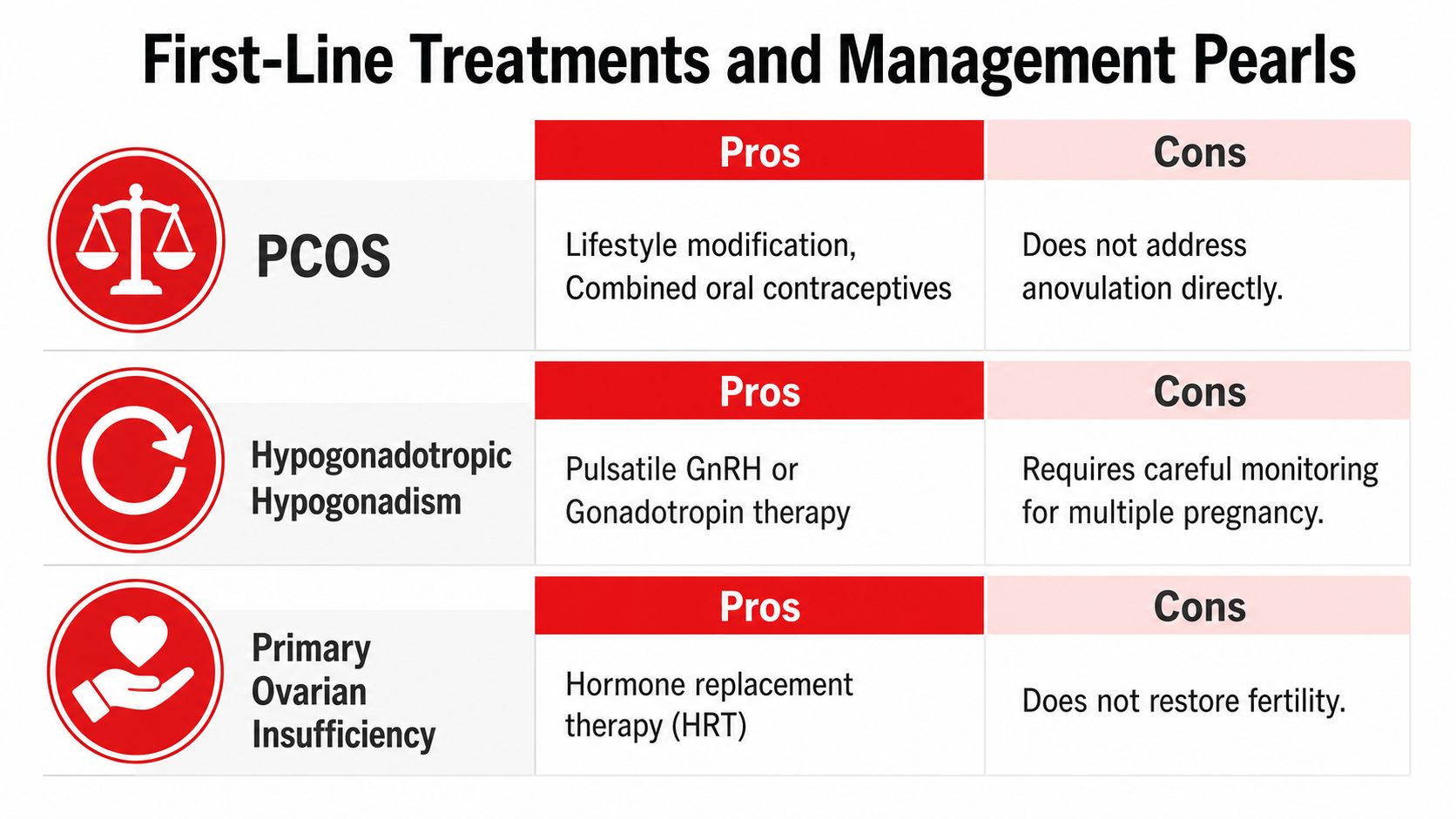
Management pearl: Treat the mechanism. If the ovary isn't receiving the right signal, fix the signal. If the ovary has failed, replace what's missing and set expectations honestly.
For students who want a quick comparison guide while studying treatment patterns, the nurse cheat sheet for lab values can be a useful cross-check for interpreting patterns fast. The test question, though, is always whether your treatment choice matches the broken loop.
Exam Day Toolkit, Mnemonics, and Practice Questions
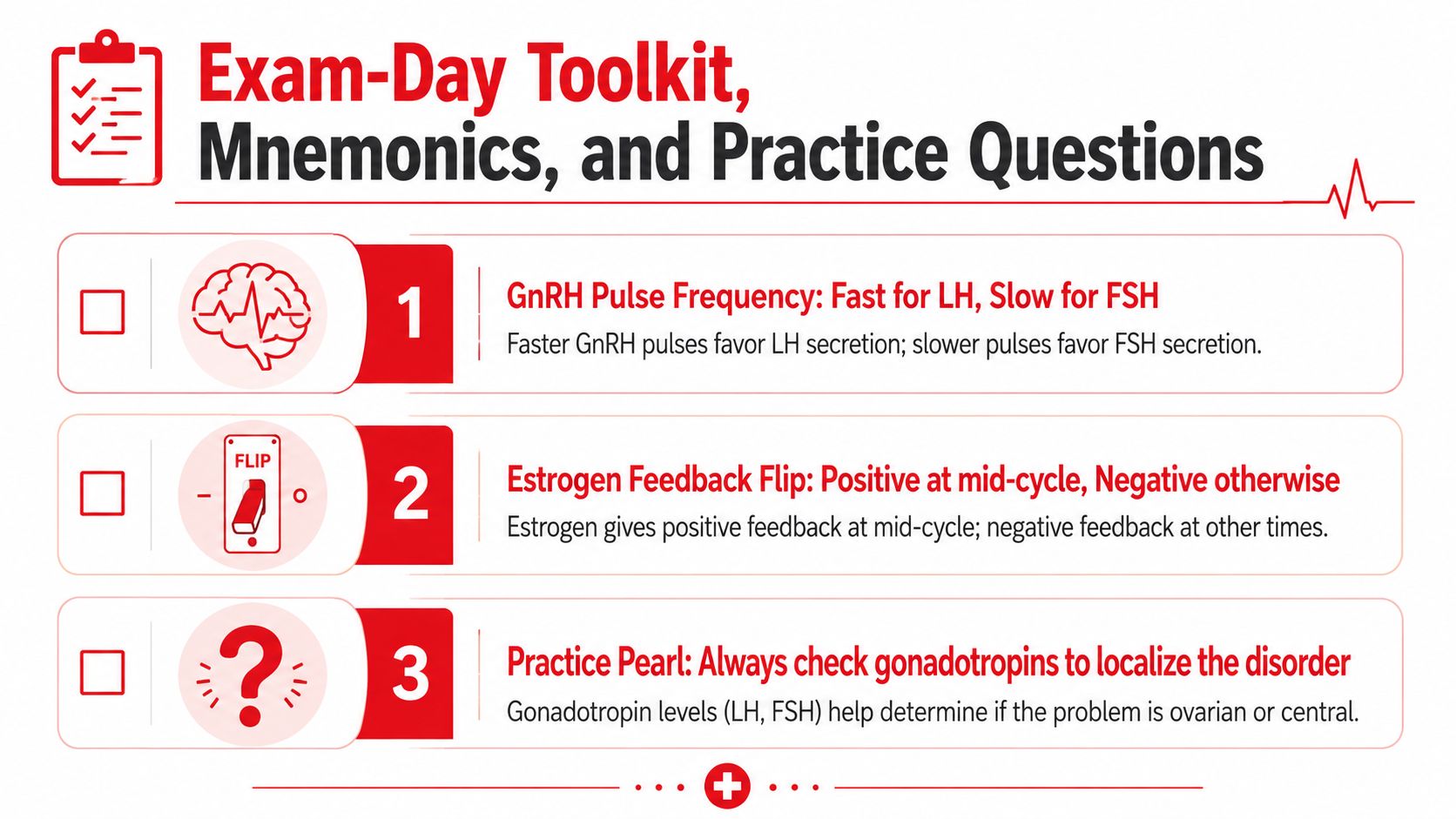
A few mnemonics carry a lot of weight here. GnRH pulse frequency is the reason LH and FSH change dynamically, and the estrogen feedback flip explains why the cycle behaves differently at mid-cycle than it does earlier in the month. Keep one more rule in mind, always check gonadotropins to localize the disorder.
For a broader lifestyle lens that some students like to pair with endocrine study, Momotaro Apotheca's wellness insights can sit alongside standard medical review, but for exams the physiology still comes first. The questions below are the kind that reward the feedback-loop model.
A patient has amenorrhea, low LH and low FSH, and a history of intense exercise. What is the most likely level of dysfunction?
Answer: Hypothalamic suppression. Low gonadotropins localize the problem centrally.A patient has irregular menses, signs of androgen excess, and anovulatory infertility. What disorder best fits?
Answer: PCOS. The loop is active but dysregulated, so ovulation is unreliable.A patient has hot flashes, amenorrhea, high FSH, and low estradiol. What is the best explanation?
Answer: Primary ovarian insufficiency or menopause pattern. The ovary is failing, so the pituitary raises FSH in response.
If you can solve those three, you're already thinking the way board questions are built. The question stem gives you the clue, the hormone panel localizes the defect, and the treatment follows the defect rather than the symptom.
Ace Med Boards helps students turn topics like reproductive endocrinology basics into a repeatable test-day strategy, not a pile of disconnected facts. If you want guided tutoring, board-style practice, and a framework that makes vignettes easier to decode, visit Ace Med Boards and see how focused prep can sharpen your reasoning.