You're a third-year resident on your third back-to-back late shift, answering messages between sign-outs, and someone casually mentions a telemedicine job that could cut the commute, the parking hunt, and half the friction of clinic days. That sounds appealing because it is appealing, but the question is sharper than that. Is a telemedicine career a legitimate long-term path, or just a polished side door out of the hospital?
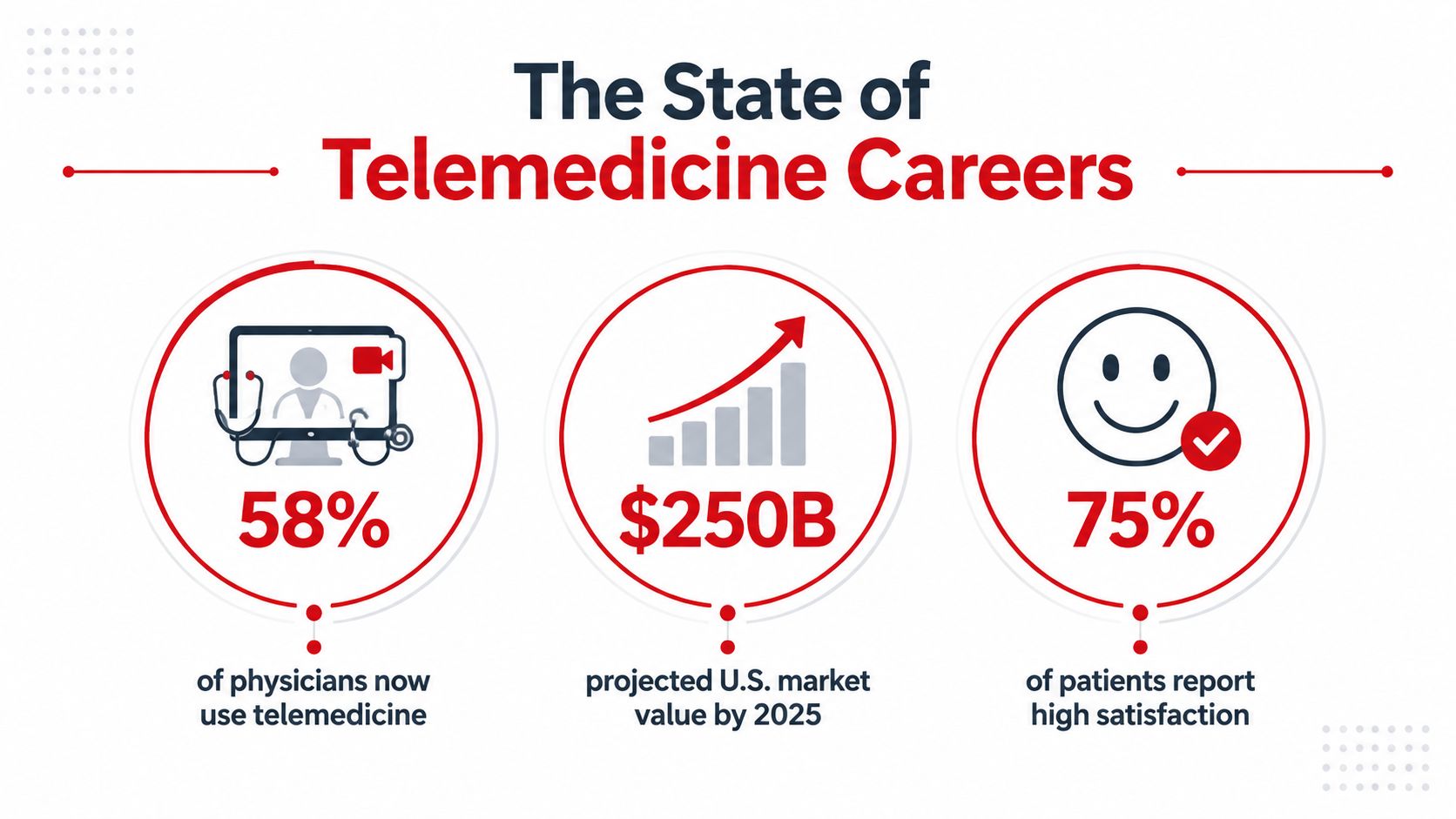
The honest answer is that telemedicine is no longer a novelty. The CDC reported that 16.0% of office-based physicians used telemedicine in 2019, and that rose to 80.5% in 2021 (CDC/NCHS). By 2024, the AMA found 71.4% of physicians reported using telehealth weekly, compared with 25.1% in 2018 (CDC/NCHS). That is not a temporary detour. That is medicine changing its delivery model.
If you've ever asked yourself whether telehealth is “real medicine,” stop asking that. The better question is which version of it fits your specialty, your tolerance for screen time, and your appetite for workflow discipline. A useful companion resource while you think about documentation-heavy digital work is what is a medical scribe, because telemedicine rewards physicians who understand how clinical information gets captured cleanly and quickly.
What a Telemedicine Career Actually Looks Like Today
A tired resident often imagines telemedicine as a few video visits from a couch. That picture is too small. In practice, a telemedicine career is a blend of direct care, digital workflow, and rapid judgment, and the job often has more moving parts than a standard clinic day.
The job is clinical, not cosmetic
The role still includes diagnosis, treatment, follow-up, ordering tests, prescribing when appropriate, and knowing when to escalate in person. It is built around synchronous video visits, asynchronous messaging, and remote patient monitoring, so you need to be comfortable moving between those modes without losing clinical rigor. A telemedicine physician is not just “the doctor on screen,” it is a clinician who can manage care across formats and still keep the chart, the patient, and the next step aligned.
Practical rule: if a job description sounds like “answer video calls from anywhere,” it's incomplete. Real telemedicine work depends on documentation, triage judgment, and a reliable escalation pathway.
Why the shift matters for trainees
The big career mistake is treating telemedicine like a side hustle instead of a structural change in where care happens. The Doximity telemedicine report shows the work is embedded in practice patterns now, and specialty distribution matters a lot, especially in primary care and psychiatry (Doximity 2024 report). That means you should think about telemedicine the same way you'd think about outpatient procedures or hospitalist work, as a legitimate lane with its own rules.
The upside is real flexibility. The trade-off is that the job asks for more self-management than many new physicians expect. You are not stepping out of medicine, you're stepping into a tighter operational environment where every gap in communication, setup, or documentation shows up immediately.
Understanding the Three Modes of Virtual Care
Virtual care runs through three distinct modes: live encounters, delayed messaging, and continuous monitoring. If you do not know which mode a role uses, you will misread the workload, the pace, and the kind of clinician it rewards.
Synchronous visits are the closest to traditional clinic
Synchronous video visits are real-time encounters. You speak with the patient, gather what you can visually, make decisions, and close the loop in the same sitting. That format suits physicians who still want the cadence of a visit without room turnover or waiting-room choreography.
Primary care and urgent care often sit here, especially when the patient needs immediate guidance and the clinician can make a safe decision from a live conversation. Behavioral health also fits well because the therapeutic relationship holds up when the clinician is disciplined about structure, attention, and presence.
Asynchronous care rewards precision, not charm
Asynchronous messaging is store-and-forward medicine. A patient uploads a photo, sends symptoms, or shares records, and you review the material, make a decision, and respond later. Dermatology and triage-heavy services fit here because the work depends on careful review, tight language, and sound judgment rather than real-time bedside manner.
A strong asynchronous clinician writes like every sentence matters, because it does. A vague answer creates a second message, then a third, then a mess.
Remote monitoring is the most operationally demanding
Remote patient monitoring uses continuous or repeated data from devices and wearables to guide care. Chronic disease management is the obvious home for it, and it works best when the practice has a clear protocol for abnormal readings. This mode is less about seeing the patient and more about interpreting data without getting buried in alerts.
A lot of physicians now work in a hybrid pattern, part virtual, part in person, part administrative. That is often the smarter model because it keeps skills broad and lowers the chance of getting trapped in a narrow, repetitive workflow. If you want a durable telemedicine career, learn all three modes, then choose the one that fits your temperament instead of chasing the easiest-looking schedule.
A newer route is also opening for physicians who want to shape care behind the scenes. Roles in medical education specialist work can sit close to virtual training, platform design, and clinician support, which makes them relevant for doctors who want telemedicine exposure without full-time direct visits. On the operations side, some clinicians also move into managing medical claims analysis, where the work is less patient-facing but still tied to how virtual care gets paid and processed.
Clinical and Non-Clinical Roles Worth Considering
Don't start with job titles. Start with the kind of work you want to do. The most common mistake I see is a trainee saying they want telemedicine, when what they really want is less commuting, more control, or a path out of nights.
If you want direct patient care, specialty concentration matters
Primary care fields carry a large share of telehealth visits, with family medicine, internal medicine, and pediatrics accounting for roughly 35 to 45% of telehealth visits in the Doximity report (Doximity 2024 report). Psychiatry stands out even more strongly, with 60 to 100% remote roles appearing in meaningful numbers in the same specialty data (Doximity 2024 report). That is the most durable signal in the market, and I would pay attention to it.
For clinical work, the best-supported lanes are psychiatry, primary care, dermatology, endocrinology, and neurology, because the work often translates well to screen-based evaluation and follow-up. That doesn't mean every physician in those fields should go fully remote, but it does mean the market already understands how to use them virtually.
Hybrid roles can be smarter than pure remote roles
If you're early in training, a hybrid model can protect you from the isolation and monotony that sometimes show up in pure telehealth. You still get some bedside exposure, but you also build fluency in secure messaging, digital documentation, and virtual patient flow. That combination makes you more hireable later.
Non-clinical roles are real, and often more durable
Telemedicine also creates room for physicians who want to move into medical director work, clinical informatics, platform quality and safety, product design, AI validation for clinical models, and education. Those jobs favor doctors who can think clearly about workflows, user behavior, and failure modes, not just diagnosis. If you like systems, telemedicine becomes especially interesting.
A smart adjacent track is managing medical claims analysis, because virtual care lives or dies on clean billing logic, documentation discipline, and operational precision. If you prefer teaching, an internal option worth exploring is medical education specialist, since telehealth teams need clinicians who can train others in digital workflow and patient communication.
If you hate ambiguity, avoid roles that promise “flexibility” but won't define patient volume, call burden, or escalation rules. Those jobs usually punish the physician fastest.
Licensure, Infrastructure, and Core Prerequisites
Licensure comes first. Everything else comes after. If you cannot legally see the patient where the patient is located, the rest of the job description does not matter.
Start with jurisdiction, not convenience
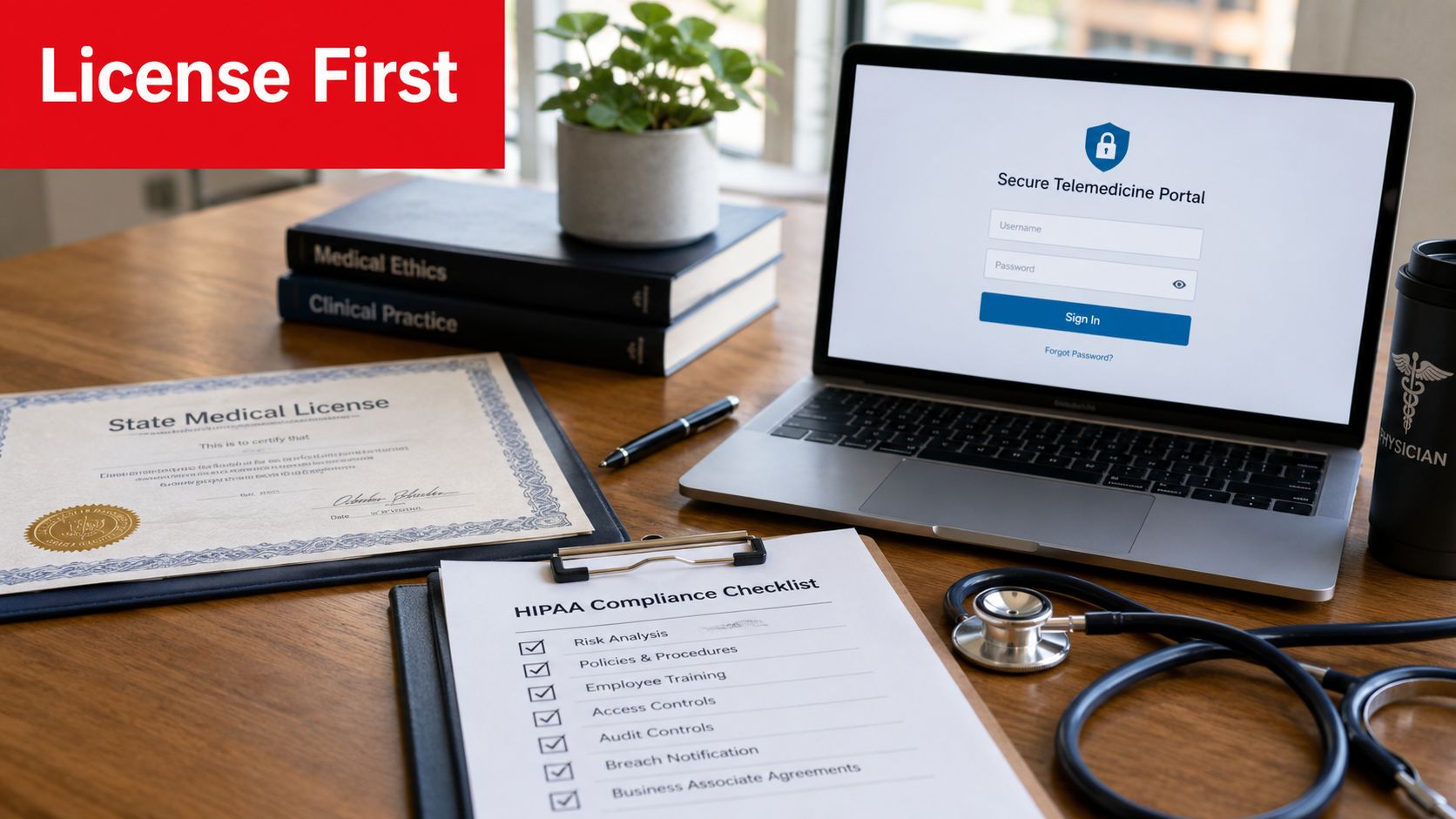
Physicians must be licensed in the jurisdictions where the patient is located, and that rule determines how broad your telemedicine options really are (LinkedIn career guide). The Interstate Medical Licensure Compact now covers 42 states, and the cited career guidance notes it reportedly issues over half of new licenses within a week (Sermo resource). That is why multi-state licensure is the main scaling bottleneck.
If you want to understand how credential checks fit into the broader process, use credential verification as a lens for how employers think. Telemedicine hiring is not just about clinical skill, it is about whether your paperwork and verification profile let a platform onboard you quickly.
Your setup has to be boringly reliable
Employers commonly expect a private workspace, stable broadband, a quality webcam and headset, secure EHR access, and an escalation plan for cases that need in-person care. In practical guidance, stable broadband is often discussed as 50+ Mbps, though the main point is reliability, not speed. A polished desk means nothing if your audio cuts out during triage.
Communication skills are a hiring filter
Written communication matters more than most new physicians expect, especially in asynchronous work. Virtual bedside manner is different from being pleasant. You need to create trust quickly, explain limits clearly, and document in a way that supports safe follow-up.
The NEJM Career Center notes that physicians should verify patient volume, schedule, call burden, compensation model, platform integration, and regulatory compliance before accepting a role (NEJM Career Center). That advice is correct because telemedicine jobs vary widely in how they feel, even when the titles look similar. One platform may be clean and sustainable, another may be a message flood disguised as flexibility.
Training Pathways for Medical Students and Residents
Medical school and residency are the best time to build a strong foundation for a future telemedicine career. If you wait until after training, you'll still be able to move into virtual care, but you'll have fewer ways to signal readiness.
Medical students should collect proof of comfort, not just interest
Seek out telehealth electives, sit in on virtual follow-up visits, and learn how asynchronous case write-ups are structured. The goal is not to become “the telemedicine student,” it's to show that you understand remote communication, digital workflow, and safe escalation. Small habits matter here, especially when you're building a CV that has to prove more than enthusiasm.
Residents should use their training years aggressively
Residency is the time to find telehealth moonlighting, document virtual encounters whenever your program allows it, and build a niche that translates well remotely. Addiction medicine, sleep, and behavioral health all tend to travel better than highly procedural fields, because the clinical value often comes from history, follow-up, and longitudinal management. If your program offers any virtual exposure, take it.
The best guide for early trainees is docs in training, because telemedicine readiness is partly about how you present yourself as a learner who can function independently in a digital environment. Employers want evidence that you can work with less physical support and still communicate well.
Early-career physicians should position for durability
A first attending job can still be used to move toward telemedicine if you choose the right environment. Look for exposure to platform workflows, documentation standards, and cross-state compliance, not just a shiny remote title. If you can get some experience with digital care delivery early, you'll be much more competitive later.
The physician who learns virtual workflow early doesn't just get more options. They look safer to hire, because they've already shown they can work without constant hand-holding.
Salary Models and How Compensation Actually Works
A common pitfall can mislead many physicians. A telemedicine role can sound generous on paper and still feel exhausting in practice if the compensation model is mismatched to the workload.
Compare the models before you compare the numbers
| Telemedicine Compensation Models Compared | Predictable Income | Workload Ceiling | Best For |
|---|---|---|---|
| Hourly | High | Moderate | Physicians who value stable scheduling |
| Salaried | High | Moderate | Clinicians who want consistency and benefits |
| Per-consult | Lower | High | High-efficiency clinicians comfortable with volume |
| Productivity-based | Variable | High | Physicians who can control throughput and documentation speed |
Hourly and salaried roles usually feel safer, but they can hide a heavy call burden or packed schedules. Per-consult arrangements reward speed and judgment, yet they can punish you if the cases are messy or the platform sends too much low-value volume. Productivity-based pay can work well for efficient clinicians, but it gets ugly fast if the visit mix is mostly acute and the panel doesn't support continuity.
The hidden drivers are the real story
Schedule density matters because a “flexible” job can still crush you if the platform stacks encounters back to back. Call burden matters because overnight urgent-care coverage changes the character of the work completely. No-show patterns matter because they make volume unpredictable, and patient panel composition matters because chronic care, urgent care, and behavioral health do not drain you in the same way.
If you want a practical benchmark for this part of the search, use locum tenens opportunities as a way to think about how temporary coverage and schedule flexibility are packaged. The logic carries over well to telemedicine, because the work is only good if the actual workload matches the way you're paid.
Telemedicine burnout usually doesn't come from the video camera itself. It comes from a mismatch between acuity, volume, message load, and compensation. If a role buries you in chat volume or overnight escalations, the “work from home” label stops mattering very quickly.
Regulatory, Liability, and Platform Realities
A telemedicine career is only durable if the legal and operational structure is sound. A great job with weak coverage or sloppy escalation rules is not a great job. It's a risk waiting to surface.
Liability and prescribing rules shape the day
Malpractice coverage for virtual care may be platform-provided or personal, and you need to know exactly which one you're relying on before you sign anything. Cross-state prescribing rules also matter in day-to-day practice because a telemedicine physician cannot assume that digital access equals legal access. The patient's location still governs a lot of what you can do.
If a platform also leans heavily on decision support tools, read AI in clinical decision support with a skeptical eye. Technology can help, but it does not transfer responsibility away from the physician.
Platform type changes the job quality
Direct-to-consumer urgent care is fast and often chaotic. Employer-sponsored virtual primary care tends to be more structured. Payer-led chronic disease management can be steadier, tele-ICU is more intensive, and telepsychiatry often rewards consistency and good communication.
The career trap is accepting a role that looks flexible but locks you into low-acuity volume work with limited growth. The better move is to ask whether the platform gives you realistic expectations, clean escalation, and a skill set you can reuse later. If the answer is vague, keep looking.
Ask these questions before you accept an offer
- Who covers malpractice: Find out whether the platform's policy covers virtual care and in which jurisdictions.
- How escalation works: Ask what happens when remote management is not enough and how fast in-person backup responds.
- What patient mix looks like: Acute-only volume and longitudinal care feel very different in practice.
- How documentation is handled: Weak templates create hidden labor, and hidden labor becomes burnout.
- What the schedule is: “Flexible” means nothing until you see call burden, message volume, and expected response times.
If the employer can't answer these questions clearly, the role is probably designed around throughput, not physician sustainability.
Your 90-Day Action Plan and What Comes Next
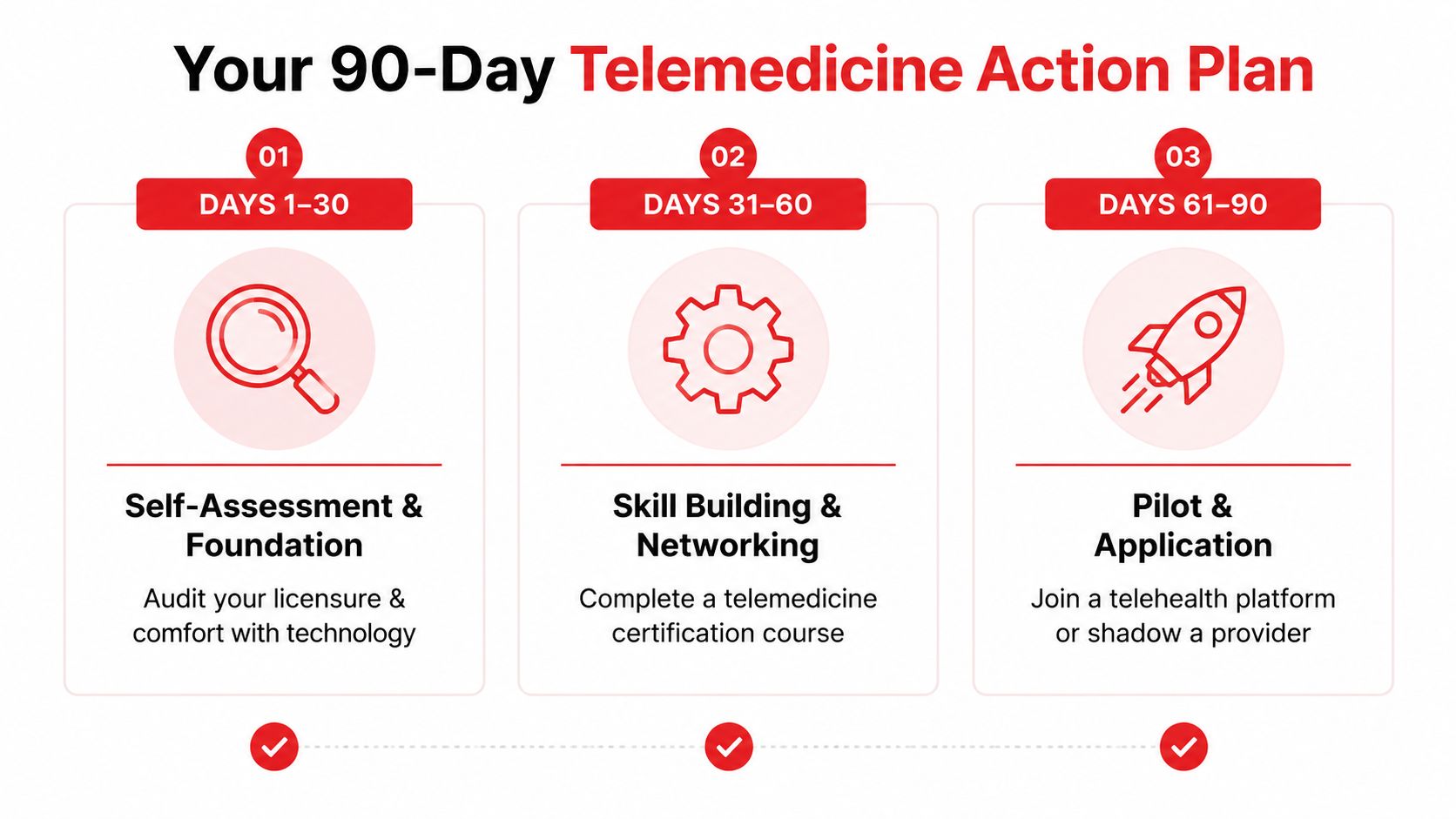
A serious telemedicine move is built in phases. Don't browse jobs randomly. Build a profile that makes one kind of role clearly better than the others, then apply with intent.
Days 1 to 30 focus on fit
Audit your licensure status, your comfort with technology, and the specialty lanes that match your training. Make a short list of one or two telemedicine roles that fit your current stage, then write down what you'd need to be competitive for each. If you don't know which niche you want, you're not ready to apply yet.
Days 31 to 60 focus on readiness
Tighten your CV, build any telehealth exposure you can document, and get serious about licensure groundwork if you plan to work across state lines. Practice concise written communication, because that skill shows up everywhere in virtual care. If you still fumble asynchronous follow-up notes, the platform will notice.
Days 61 to 90 focus on applications and testing
Apply to roles that match your niche, request shadowing when possible, and prepare for interviews that ask about escalation, documentation, and patient communication. When you review an offer, don't just ask whether it's remote. Ask whether the workload, coverage, and patient mix would still make sense after six months.
A telemedicine career is worth pursuing when it gives you more control without stripping away clinical seriousness. The best roles are the ones that fit your specialty, your life stage, and your tolerance for operational pressure. If you want structured help building the academic and career foundation that makes these transitions easier, visit Ace Med Boards for focused support that can help you stay competitive while you move toward the right virtual-care path.