You can sit through orientation, hold a color-coded schedule, and still feel like everyone else got a handbook you never saw. The first-generation medical student often finds out fast that the hard part isn't just learning anatomy or memorizing pathways, it's learning when to email faculty, how to ask for a letter without sounding awkward, when to start board prep, and which support office helps. That gap is real, and it's not a sign that you don't belong. It means the system assumed somebody already taught you the rules.
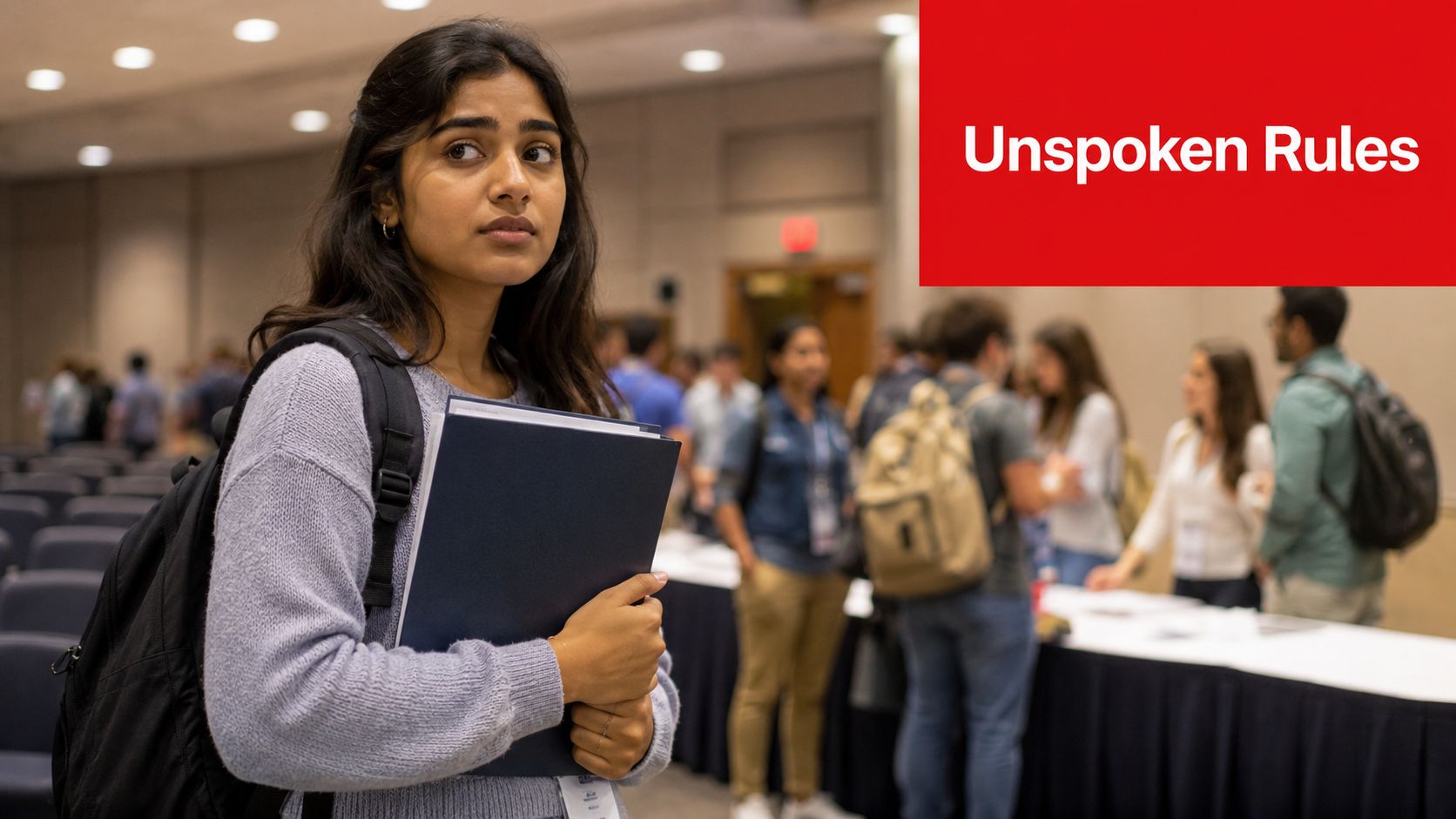
The First Day No One Warned You About
On the first week of medical school, the lecture hall fills before sunrise. One student already knows which professor writes strong recommendation letters, which class group chats matter, and how early to start asking about research. Another student, often the first in the family to go this far, is trying to decode every sentence in real time.
That second student is usually doing more than studying. They're translating hidden norms, managing family expectations, and worrying about money, all while trying to look calm. The result is a very specific kind of exhaustion, because the academic load is only one part of the job.
The four pressures that show up early
The first pressure is academic, which looks like not knowing what matters most, or whether you're studying the right thing. The second is financial, which shows up when rent, food, transportation, and books compete with tuition and exam fees.
The third is social, especially isolation when classmates seem to share a vocabulary you never inherited. The fourth is structural, which includes weak advising, unclear remediation pathways, and a hidden curriculum that rewards people who already know how the place works.
Practical rule: if a task feels confusing, don't assume you're behind. Assume the process was never made explicit.
That's the lens for this guide. It's built to help you see the system clearly, then use that clarity to study better, budget smarter, and ask for help earlier.
What a First Generation Medical Student Actually Is
A first generation medical student usually means a student who is the first in their family to complete college, or at least the first in the line that matters for the medical-school pipeline. The key point is that the label is about educational lineage, not intelligence, and not whether someone is a hard worker. It also isn't the same thing as being a first-generation immigrant or a first-generation professional, because those are different experiences with different pressures.
The AAMC's data show that this group is not small or marginal. It estimated that 12.4% of 2021 to 2022 MD matriculants were first-generation college students, up from 10.8% in 2018 to 2019, and that by 2022 to 2023 first-generation students made up 15% of the U.S. medical-school matriculant pool, with 53% women, 43% having attended community college, 71% of known U.S. first-generation students being Pell Grant recipients, 64% coming from families earning below $50,000 per year, and 41% underrepresented in medicine. AAMC data on first-generation medical school matriculants
A working definition you can actually use
If you need a simple line for an advisor, scholarship form, or mentor conversation, use this: “I'm a first-generation medical student, meaning I'm the first in my family to work through college and the medical-school pipeline, so I'm building a lot of the process knowledge from scratch.” That sentence is clear, accurate, and doesn't apologize for your background.
It also helps to separate identity from performance. The AAMC reports that four-year graduation rates nearly mirror those of nonfirst-generation students, which matters because it shows persistence improves once students are admitted and supported. If you've been talking yourself out of asking for help because you think the label means weakness, that assumption doesn't hold up.
For students writing about this identity in admissions or support contexts, a useful companion resource is this guide on how to write a diversity statement, because first-generation status often belongs in a broader story about perspective, resilience, and service. The point isn't to make yourself smaller. It's to describe the path accurately.
The Four Hidden Barriers You Will Hit Early
The most useful way to think about first-generation disadvantage is as a navigation problem. A student can be talented and hardworking, yet still lose time and confidence to rules that were never explained out loud. UCLA interview-based research identified four recurring pressure points, isolation and exclusion, limited access to resources, lack of institutional support, and heavy reliance on self-reliance and resilience. The burden is not just academic effort, it is also the work of figuring out the system while everyone else seems to already know it. UCLA first-gen medical student findings
What those barriers look like in a real semester
Isolation shows up when classmates trade advice about a professor, a tutor, or a research connection, and you do not know the names or the backstory. It can feel like everyone else got a family briefing on medical school, while you are piecing together the basics from office hours, group chats, and whatever you can find on your own.
Limited access to resources shows up in smaller ways that add up. Another student may have a parent, sibling, or family friend who can explain rotations, loans, board timing, or how to ask for a letter. You may have to build that map one conversation at a time.
Lack of institutional support often feels polite on the surface and vague underneath. You are told to “reach out,” but no one tells you who answers, what to say first, or which office handles which problem. Heavy self-reliance can look admirable from the outside, yet it becomes a trap when a student keeps carrying stress alone until the issue is bigger and harder to fix.
The downstream outcomes are not imaginary. In a national study of 256,513 U.S. medical-school students matriculating from 2002 to 2015, first-generation college graduates were less likely to apply to medical school, with aOR 0.84, and less likely to be accepted, with aOR 0.86, than continuing-generation peers. Once accepted, they were as likely to matriculate, but they had 56% higher adjusted odds of not graduating, and students who were first-generation, low-income, and underrepresented in medicine faced a 2.51x higher likelihood of leaving medical school. JAMA Network Open study on first-generation medical education outcomes
The hidden curriculum does not announce itself. You learn it by getting burned once, unless someone shows you the pattern early.
That is why naming the barrier helps. Hidden expectations need explicit guidance, clearer escalation paths, and fewer assumptions about inherited knowledge. For a practical starting point on the day-to-day side of that work, see how to study as a medical student.
Building a Study System That Actually Works
A first-generation student doesn't need a prettier notebook. They need a repeatable system that cuts uncertainty. A strong starting point is to treat each syllabus like a contract, because the syllabus usually tells you what counts, what gets tested, and what deadlines matter. Pair that with a simple priority filter, high-yield material first, low-yield material last.

A seven-day setup that cuts noise
Start by sorting your week into three buckets. Must do includes lectures, required labs, and the highest-yield question sets. Should do includes review of weak topics. Could do is everything else, including extra videos and extra note systems you don't need.
Next, build around active recall. Use Anki for spaced repetition, UWorld for question-based learning, and NBME self-assessments for calibration when exam timing gets close. The value isn't in collecting resources, it's in using a small set well and reviewing mistakes with discipline.
JAMA Network Open recommends combining free tutoring, academic support specialists, mentorship, and flexible remediation policies, alongside explicit unwritten norms and funded affinity groups, because first-generation learners often face compounding academic, financial, and identity stress. JAMA Network Open support model for first-generation learners
A simple weekly layout might look like this:
- Monday and Tuesday: class content, then 20 to 40 practice questions on the same topics.
- Wednesday: error review, then flashcards tied to the missed concepts.
- Thursday: targeted weak-area cleanup.
- Friday: mixed question block and deep review of why you missed each item.
- Weekend: one longer exam-style set plus reset time.
For a cleaner, med-school-specific structure, this how to study as a medical student guide can help you compare study methods without drowning in options. The goal is boring consistency, because boring consistency wins more often than ambitious chaos.
Money, Scholarships, and Surviving Basic-Needs Stress
Financial strain isn't a side issue. It's part of performance. When a student is worrying about groceries, rent, transportation, or textbooks, study time gets shorter and focus gets thinner, and qualitative research on first-generation medical students found exactly those basic-needs pressures alongside isolation and weak institutional support. More recent data also link first-generation and low-income status with worse educational outcomes overall, including lower standardized and clinical exam scores and higher leave-of-absence, attrition, and withdrawal rates. UChicago Medicine discussion of first-generation med student basic-needs stress
The money checklist that prevents avoidable damage
Start with financial aid before the deadline gets close. Then check for institutional need-based aid, emergency grants, and any program-specific support tied to service or specialty commitments. If your school has a hardship office, learn its name now, not after your account is already on hold.
One useful way to think about budgeting is to separate fixed costs from variable ones. For a student-friendly comparison of monthly planning styles, Velzee's comparison of student budgets gives a clean overview of how different budgeting methods work without turning the process into financial jargon.
Practical rule: if a cost is likely to disrupt sleep, meals, or attendance, treat it like an academic risk, not a personal inconvenience.
Scholarship searches should include diversity awards, specialty society funding, school-specific endowments, and service-commitment programs. If you need a focused starting point, this medical school scholarship resource can help you organize the search without missing obvious categories.
When you speak to a financial-aid office, keep it direct. Say, “I'm trying to avoid a disruption in enrollment and exam preparation. Can you tell me which emergency funds, payment adjustments, or hardship resources are available to me this term?” That phrasing is honest, professional, and specific. Money management isn't separate from medical training. It's one of the survival skills of medical training.
How Targeted Board Tutoring Fits Into the Plan
A tutor should do more than restate facts. They should clear away the hidden assumptions that trip students up, especially when you are learning how to move through USMLE Steps 1, 2, and 3, COMLEX Levels 1, 2, and 3, and third-year Shelf exams with a system that changes how you answer under pressure. For a first-generation medical student, that matters because board prep is not only content review. It is also learning the unwritten rules of timing, pacing, and error correction.
What to ask before you commit
A strong tutoring relationship should do three things. It should tighten content understanding, improve question-analysis technique, and help you build an exam workflow you can repeat when the room gets tense. That means looking closely at how you read stems, how you eliminate distractors, and how you learn from missed questions without turning every error into a crisis.
The right tutor also fills in the kinds of details some families pass along naturally, like when to begin dedicated study, how to set up NBME-style self-checks, and how to respond when an early score falls short of your goal. If distance is a problem, online sessions remove a real barrier, and a free consultation gives you room to define goals before you commit money. For students comparing support across life stages and finances, mature student funding explained is a useful parallel read, because the same problem shows up in different settings, unclear funding and unclear pathways.
A useful tutoring relationship should also fit the rest of your training plan, not sit apart from it. The best sessions connect with your class schedule, your weak systems, your question bank habits, and the reality of whether you need remediation support after an assessment. One-on-one tutoring benefits are clearest when the tutor adjusts the work to the student instead of forcing every learner through the same script.
Ace Med Boards is one option that offers one-on-one online tutoring across USMLE, COMLEX, Shelf exams, MCAT prep, admissions consulting, and residency match planning. Before you choose any service, ask three things, who teaches your exact exam, how sessions are customized, and what happens if you need remediation help after an assessment. If the answers stay general, keep looking. If they are specific, you are closer to a system that fits your life instead of fighting it.
Mental Health, Identity, and Sustainable Resilience
A rough week in medical school often starts before the exam. You miss a family call because of lab, spend half an hour decoding an email that everyone else seems to understand, then wonder why the day felt harder than it should have. For a first generation medical student, that strain is often not about weak motivation. It is about carrying two worlds at once, while learning the hidden rules of medicine in public and the rules of home in private.
Resilience grows better when you treat it like part of your training plan. That starts with naming the load correctly. Earlier research on first-gen medical students showed patterns of isolation and exclusion, limited access to resources, lack of institutional support, and the pressure to rely on self-reliance and resilience. Those findings matter because they point to a practical truth, the stress is often in the system around you, not in your ability to learn. UCLA first-gen medical student findings

Make recovery part of the plan
Recovery works like study time. If you do not schedule it, it gets eaten by everything louder and more urgent. Protect one block each week for sleep, movement, or quiet, and treat that block as a real appointment. A tired brain may still sit in lecture, but it will not hold onto information the same way.
Therapy can help when the pressure starts to blur together. Student health is a reasonable first stop, and it is fair to ask for a culturally competent provider rather than accepting the first open name on a list. If you want a place to start reading before you book anything, medical student mental health support is a useful companion resource because it frames stress, burnout, and help-seeking in the language of training, not failure.
Peer groups matter for the same reason good study groups matter. SNMA, LMSA, and similar affinity organizations can give you belonging, mentorship, and practical advice in one place. They also reduce the energy cost of translating yourself every time you enter a room, which leaves more attention for the work that affects performance.
Imposter thoughts can still show up even when your scores improve. A therapy approach such as CBT for imposter syndrome therapy can be useful because it targets the thought loops that turn one mistake into a story about who you are. That matters for a first-gen student, because medicine already asks you to evaluate yourself constantly. You need habits that separate a bad quiz from a bad identity.
The goal is steady function, not perfect toughness. Build routines that help you sleep, ask for help early, and stay connected to people who understand the path. When those pieces are in place, resilience stops being a slogan and starts working like a system you can rely on.
Your Year by Year Roadmap and Final Checklist
Pre-med is about fit, not just ambition. Make your school list by mission, gather clinical exposure, and time the MCAT so it supports, not crowds, the rest of your application. In M1, build board-relevant habits early, find one mentor, and join at least one affinity group that gives practical advice.
M2 is for dedicated board prep and baseline self-assessment, because guessing at your level wastes time. M3 is where Shelf strategy and Step 2 CK or Level 2 timing matter, along with letters of recommendation and rotation performance. M4 is the residency season, ERAS, your personal statement, MSPE review, interviews, and, if needed, SOAP or reapplication planning. International and foreign medical graduates should use the same principle, clear timelines, targeted support, and early document review.
Screenshot checklist
- This week: identify one tutor, one mentor, and one financial-aid contact.
- This month: build a study calendar with question blocks and review time.
- This term: join one affinity group and ask one direct question about hidden norms.
- This year: track exams, deadlines, letters, and funds in one place.
- Always: ask for help before the problem gets big.
The first-generation label is not a liability to hide. It's a set of strengths to organize. Use it with intention, and the path gets more workable.
If you want a structured partner for boards, Shelf exams, admissions support, or match planning, start with a free consultation at Ace Med Boards and decide whether one-on-one tutoring fits the part of training you're in right now.