You've seen it happen in real time. You're midway through a USMLE block, the question looks familiar, and then your mind goes blank. The stem is still on the screen, the clock is still moving, and there's nothing to grab onto except the feeling that you know this. That moment is unsettling, but it's not rare, and it doesn't mean you're unprepared.
In research, mind blanking is treated as a distinct waking mental state, not just ordinary distraction. A 2022 PNAS paper defined it as “a waking state during which we do not report any mental content,” and a 2025 synthesis reported that people experience it about 5%–20% of the time on average, with wide variation between individuals and more frequent reports near the end of long attention-demanding tasks like exams (PNAS study on mind blanking). That matters in board-style testing because the problem is often triggered by sleep deprivation, anxiety, and other pressure-heavy conditions, not by lack of intelligence.
If you want a broader overview of exam panic itself, see Ace Med Boards' guide on overcoming test anxiety. For practical support on focus lapses outside the testing center, strategies to prevent zoning out are worth a look too, because the mechanics of attention loss overlap more than is commonly understood.
Why Your Mind Goes Blank During High-Stakes Exams
A student sits down for a COMLEX block, reads a question about a topic she reviewed the night before, and feels the answer vanish before she can reach it. That board-exam blank is a real cognitive event, and it is not the same as laziness, poor preparation, or being “bad at tests.” Research now treats mind blanking as a measurable waking state with identifiable triggers, not just a dramatic way of saying “I spaced out” (PNAS study on mind blanking).
USMLE, COMLEX, and Shelf exams create the exact conditions that make it more likely. They demand sustained attention, rapid retrieval, and constant self-monitoring, while every second of hesitation carries a cost. For medical trainees, the pressure is usually highest when sleep is short, anxiety is already running hot, and the question set has worn down attention over a long block. If you have ever thought, “I studied this, why is it gone now,” you are dealing with a state that many students run into under exam pressure, not a sign that your preparation disappeared.
What the blank state actually means
Mind blanking refers to a waking moment with no accessible mental content, meaning no words, images, or thoughts are available to report right then (Paris Brain Institute glossary). That is different from weak recall, where the material is still partly there but hard to pull up, and different again from ordinary daydreaming, where the mind still has content even if it has drifted off task.
Practical rule: if the blank feels sudden and total, treat it like a load problem first, not a character flaw.
For test takers, that distinction matters. A retrieval problem often responds to a cue, a reworded stem, or a brief pause. A true blank usually needs the pressure lowered before memory can come back online.
That is why the rest of this guide is built around three levels of response. You need an immediate reset for the testing station, a test-day strategy that keeps one blank from spreading into the next question, and a long-term prep approach that makes recall less fragile before exam day. If you want a broader overview of exam panic itself, see Ace Med Boards' guide on overcoming test anxiety. For practical support on focus lapses outside the testing center, strategies to prevent zoning out are worth a look too, because the mechanics of attention loss overlap more than people usually expect.
Immediate Recovery Techniques for the Exam Room
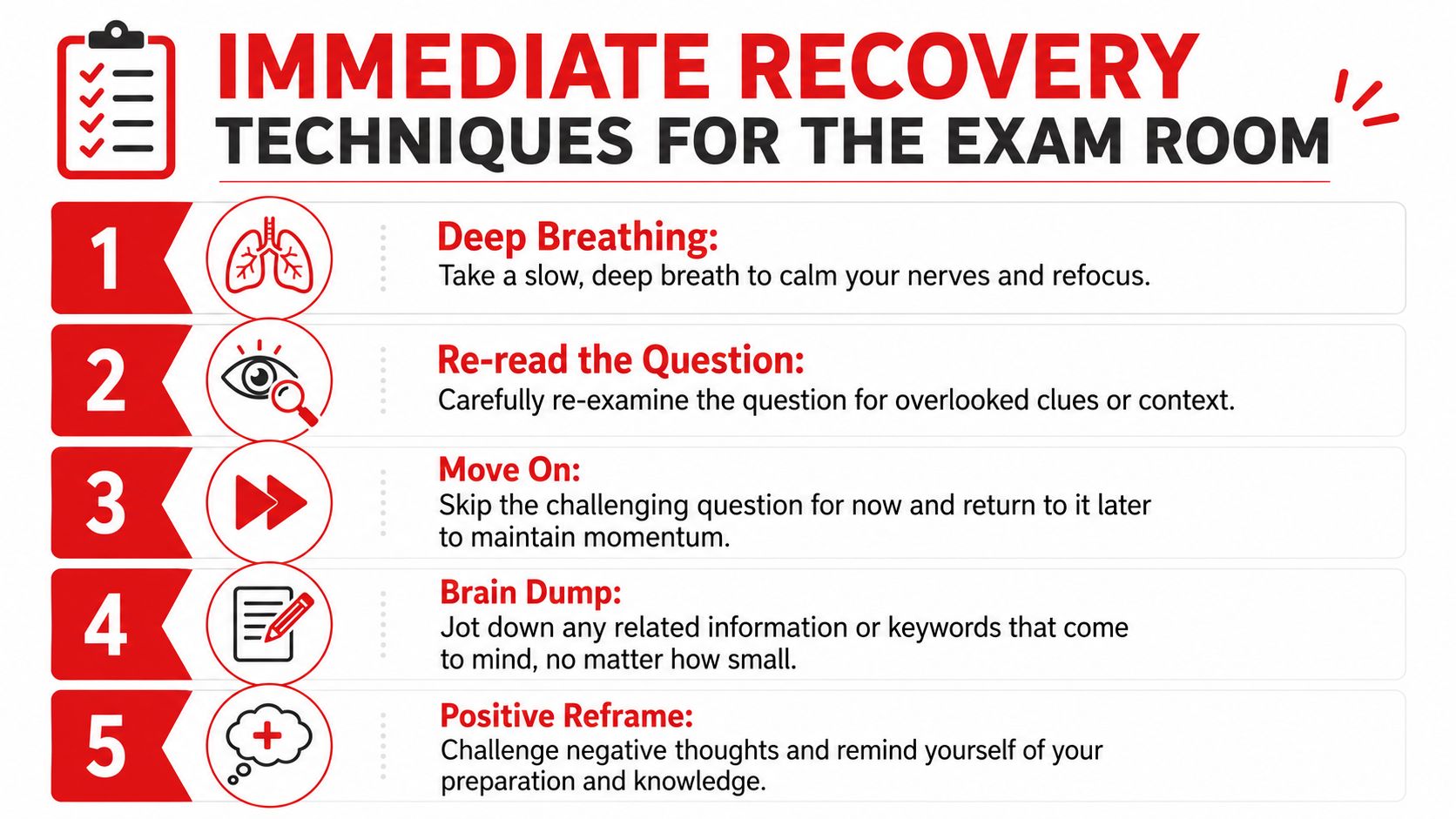
A blank in the exam room can feel like the floor dropped out under you. The first minute matters most because forcing the answer usually keeps working memory jammed and gives the panic loop more room to grow. The faster move is to lower cognitive load right away, then give your brain a simpler way back into the item.
Regulate your body first
Start with one slow inhale and a longer exhale. In a USMLE, COMLEX, or Shelf setting, that matters because a stress spike can shut down retrieval for a few seconds or longer, and thinking harder rarely helps until your body settles. Do not try to reason your way out before your physiology cools down.
A simple inner script helps: “Pause, breathe, then restart.” You are not trying to solve the item yet. You are stopping the freeze from taking over the whole question.
Engage with a lower-demand cue
Rephrase the stem in your own words or pull out one core idea from the prompt. The RESET sequence fits that moment well, regulate breathing, use a bridging phrase, summarize the question, state one core idea, then tie it back to the task (RESET technique). It was built for speaking pressure, but the logic works in exam rooms because it gives your mind one manageable job instead of several at once.
If the question is clinical, anchor on the patient's age, symptom pattern, or the one lab value that stands out. If it is a Shelf item, anchor on the rotation context and the most likely next step. Those small cues are often enough to reopen retrieval without forcing a full answer immediately.
Do not hunt for the polished answer
Many students get stuck waiting for certainty that never arrives. That costs time and usually deepens the blank. A better move is to name one fact, one mechanism, or one clue, then use that as a foothold.
Mantra: get the machine moving again before you ask it to sprint.
For a related practical framework, Ace Med Boards' performance-under-pressure resource aligns with this approach. The value of rehearsal shows up here, because under stress you can only execute what you have already practiced calmly.
A silent in-the-moment sequence
- Stop clicking. Hold still for a second so panic does not drive random changes.
- Exhale slowly. One controlled breath can interrupt the spiral.
- Re-read the last line. Board stems often hide the clue in the final sentence.
- Name one anchor. A diagnosis, a lab trend, a risk factor, anything concrete.
- Restart with a simpler cue. Ask yourself what the question is really testing.
That sequence stays short on purpose. In a testing center, the goal is not to feel perfectly calm. The goal is to get back to answering questions without giving one freeze the whole block.
Strategic Exam-Day Tactics to Mitigate Blanking
Pressure changes retrieval. In exam settings, stress-related noradrenaline release can disrupt executive attention and memory encoding, which is why a fact you know well can feel unavailable for a few seconds or longer (The Conversation). That mechanism is the reason exam-day tactics matter, because the problem isn't only what you know, it's how you keep access to it under load.
The most useful mindset is to treat blank-prone questions as momentum threats. If a stem is taking too long, flag it and move. If you're unsure, make the most educated guess available and protect time for later questions that you can still answer cleanly. On USMLE and COMLEX, momentum often preserves more points than stubbornness.
How to decide when to skip
Skip early when the question is causing a full freeze, not just normal uncertainty. You're looking for the item that makes you reread the same line three times, lose track of time, or start second-guessing every option. That's the item most likely to eat the next two minutes with no return.
Practical rule: if the question is becoming a panic trigger, it's no longer a test of knowledge alone. It's a test of your willingness to move on.
Use educated guessing instead of empty staring
Blanking often makes students wait for certainty that isn't coming. A better approach is to eliminate obviously wrong choices, identify the best remaining option, and commit. Even a modestly informed guess is better than leaving a question to consume your attention while the rest of the block keeps moving.
For Shelf exams, that discipline matters even more because clinical vignettes often reward pattern recognition, not perfect recall. Once you've identified the testable clue, lock in an answer and trust the process.
Oral exams need a different response
When a preceptor or examiner asks a direct question, silence can look worse than it is. A short bridge phrase buys time without sounding lost. The key is to speak early, even if the content is still forming.
| Scenario | Scripted Phrase to Use |
|---|---|
| You need a second on rounds | “That's a good question. Let me organize my thoughts.” |
| You need to clarify the stem | “Just to make sure I'm answering the right point, you're asking about the main next step.” |
| You know the topic but not the exact wording | “I can give the core idea first, then fill in the detail.” |
| You need to recover from a blank | “Let me restate the question and start with the most relevant finding.” |
| You want to avoid dead air | “I'm thinking through the differential, and the first thing that stands out is…” |
Those phrases work because they externalize the problem. Instead of struggling, you show structure. That is often enough to keep an attending, examiner, or standardized patient from reading the pause as total loss.
Long-Term Prevention Through Effective Study Methods
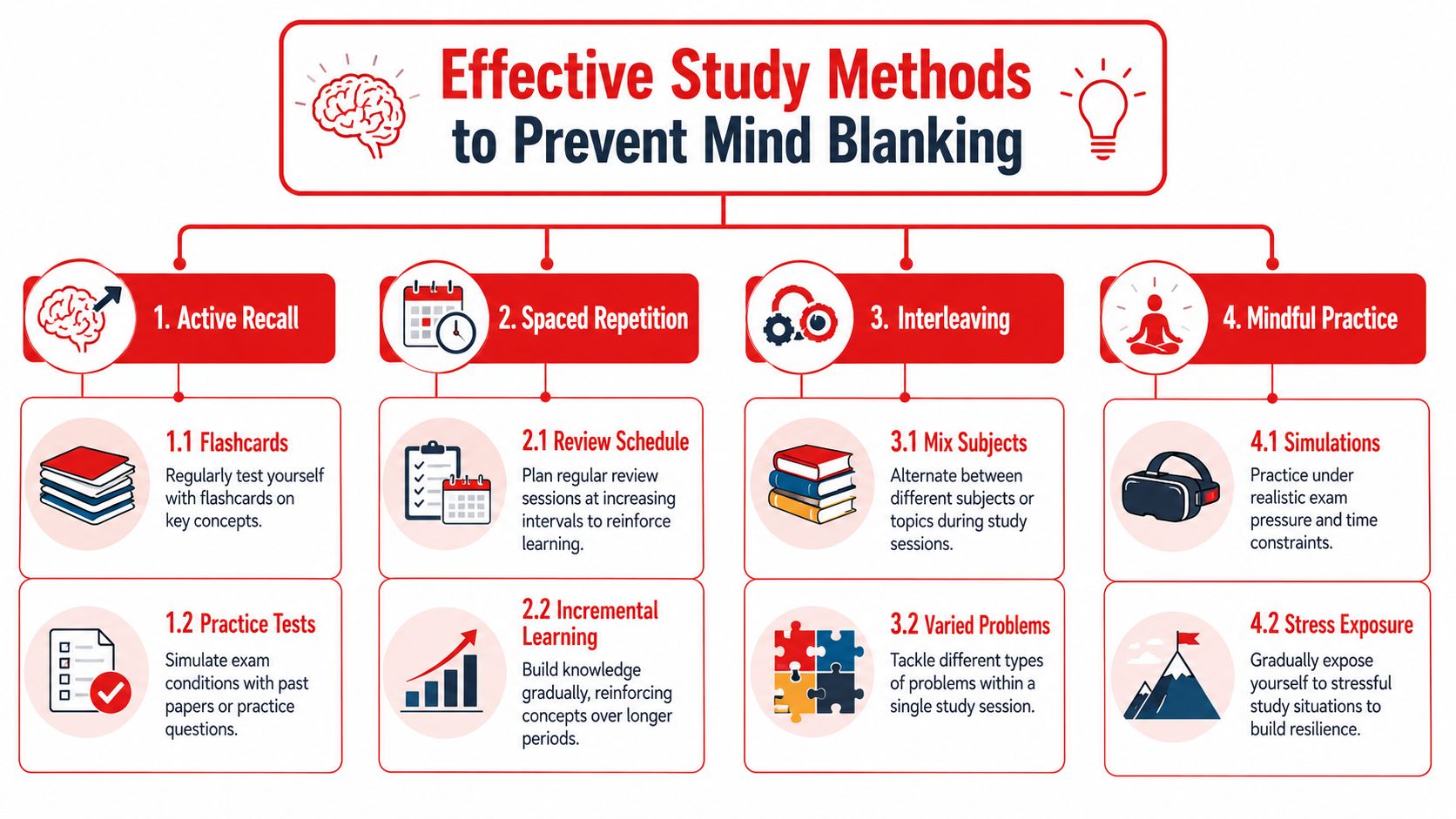
The strongest defense against exam blanking is making retrieval easier before test day. Passive rereading feels productive, but it doesn't train you to pull information out under pressure. Active recall does, because it forces the brain to produce the answer rather than recognize it after the fact.
Build retrieval, not recognition
Flashcards and practice questions matter because they simulate the moment you'll face in the exam room, a prompt, a gap, then a forced answer. That is the kind of repetition that makes knowledge easier to retrieve when the room gets quiet and the clock gets loud. For learners who want a more structured memory framework, Ace Med Boards' guide to memory retention aligns well with this principle.
The point isn't to memorize more pages. It's to make key facts available on demand.
Space the work and vary the context
Spaced repetition helps because it stops you from cramming everything into a single session, where it only feels familiar. Interleaving helps because switching between subjects makes your brain work harder to choose the right rule, which is closer to actual examination conditions. Both methods make retrieval less brittle.
You also want realistic exam simulations. Timed blocks, quiet environments, and hard transitions between topics all matter because stress exposure can be trained. A student who only studies in a comfortable, predictable setting often discovers too late that the testing center itself is part of the challenge.
Use stress exposure on purpose
Practice under conditions that are slightly uncomfortable but controlled. That can mean doing questions after a long study day, sitting through a timed set without pausing, or explaining an answer out loud as if an attending is waiting. The goal is to normalize the sensations that would otherwise trigger a freeze.
A service like Ace Med Boards can fit naturally for students who want one-on-one help with board prep, question analysis, and exam strategy. It's one option among many, but the principle stays the same, deliberate retrieval practice beats passive review when success is critical.
Bottom line: if your study method never makes you retrieve under pressure, it's leaving a major part of exam performance untrained.
Optimizing Your Biology to Beat Exam Stress
A blank mind shows up more often when the body is running on fumes. Sleep loss is one of the triggers linked to mind blanking in the research literature, and that matters because no amount of grit fully compensates for a tired brain. If you walk into a long block after a poor night of sleep, you are not just less focused. Your memory systems are being asked to work in a state they do not handle well.
Nutrition and hydration matter on test day too. Long exams punish small mistakes, and skipped meals or low fluid intake can make an already taxed brain feel even flatter. Keep intake boring and reliable. Do not try anything new the night before or the morning of the test.
Treat recovery as part of studying
Exercise and stress regulation belong in the same conversation. Physical activity helps your nervous system clear some of the tension that builds during long prep stretches, and it gives your brain a break from constant retrieval work. For a practical perspective on that connection, Ace Med Boards' exercise and cognitive performance resource fits the board-prep context well.
Mindfulness can help some students catch spiraling before it turns into a full freeze, but it works best as a regular habit, not as a rescue tool in the testing room. If you wait until question 38 of a Shelf exam to start breathing like a meditation app, you are already behind.
Keep your gut and energy steady
Food choices do not need to be perfect. They need to be predictable. If stress makes your stomach sensitive, planning meals that sit well can remove one more source of distraction. For students who want help organizing that part of the routine, AI-powered plans for gut health can be useful as a planning tool rather than a treatment.
The broader point is straightforward. Your brain is part of a body, and the body brings its own exam-day advantages or liabilities. If you want fewer blank moments, do not only study harder. Sleep better, move regularly, eat in a way your system tolerates, and keep baseline stress from running too hot.
When a Blank Mind Signals Something More
Occasional blanking during a hard exam is common, but frequent blanking outside pressure deserves a closer look. Clinical discussion notes that recurring blank episodes can show up with anxiety, sleep deprivation, depression, or certain seizure types, and the key distinction is whether the problem is context-specific or more global (PMC review). That distinction is useful because it separates a stress response from a possible health issue.
If your mind goes blank only during board-style questions, oral questioning, or other high-stakes situations, test anxiety is a likely contributor. If it happens while talking with friends, reading casually, or doing routine tasks, the pattern is less likely to be just exam pressure. That's the point where a physician or mental health professional can help sort out what's going on.
What to watch for
- Blanking in low-stress settings: If it shows up during everyday conversations or simple tasks, take it seriously.
- Worsening sleep or mood: Poor sleep, low mood, or persistent worry can make retrieval problems harder to ignore.
- Repeated episodes with other symptoms: Headache, confusion, unusual spells, or lapses in awareness need medical attention.
- A strong anxiety pattern: If your blanking is tightly tied to fear, panic, or avoidance, a mental health evaluation can help.
For medical students who want a more focused mental health perspective, Ace Med Boards' medical student mental health resource is a relevant place to start. You don't need to wait until things become severe before asking for help.
If the pattern is mostly exam-linked, the practical response is better preparation, better sleep, and a rehearsed rescue plan. If the pattern is broad, frequent, or paired with other symptoms, get evaluated. Both paths are valid, and both are compatible with being a serious future physician.
If your mind goes blank during USMLE, COMLEX, or Shelf prep, don't guess your way through it alone. Use these tactics on the next practice block, then get a structured review of where you froze and why. If you want guided help turning blank moments into recoverable pauses, visit Ace Med Boards and set up support that matches your exam level and timeline.