You're probably at the point where telemedicine looks attractive for a simple reason, it feels like a way to keep practicing medicine without losing your whole day to waiting rooms, parking lots, and clinic bottlenecks. That instinct is understandable, but a strong telemedicine career is built on more than convenience. The clinicians who do well in this field know how to assess patients through a screen, document safely, work inside EHR-driven systems, and make quick decisions about when virtual care has reached its limit.
Telemedicine also isn't a side trend anymore. U.S. office-based physicians used telemedicine in 15.4% of visits in 2019, then 86.5% in 2021, and 80.0% in 2024, which shows a durable shift in how care gets delivered CDC data brief. For students, residents, and working clinicians, that means the question isn't whether telemedicine will matter. It's which kind of telemedicine work fits your skills, your risk tolerance, and your long-term goals.
Understanding Telemedicine and Industry Growth
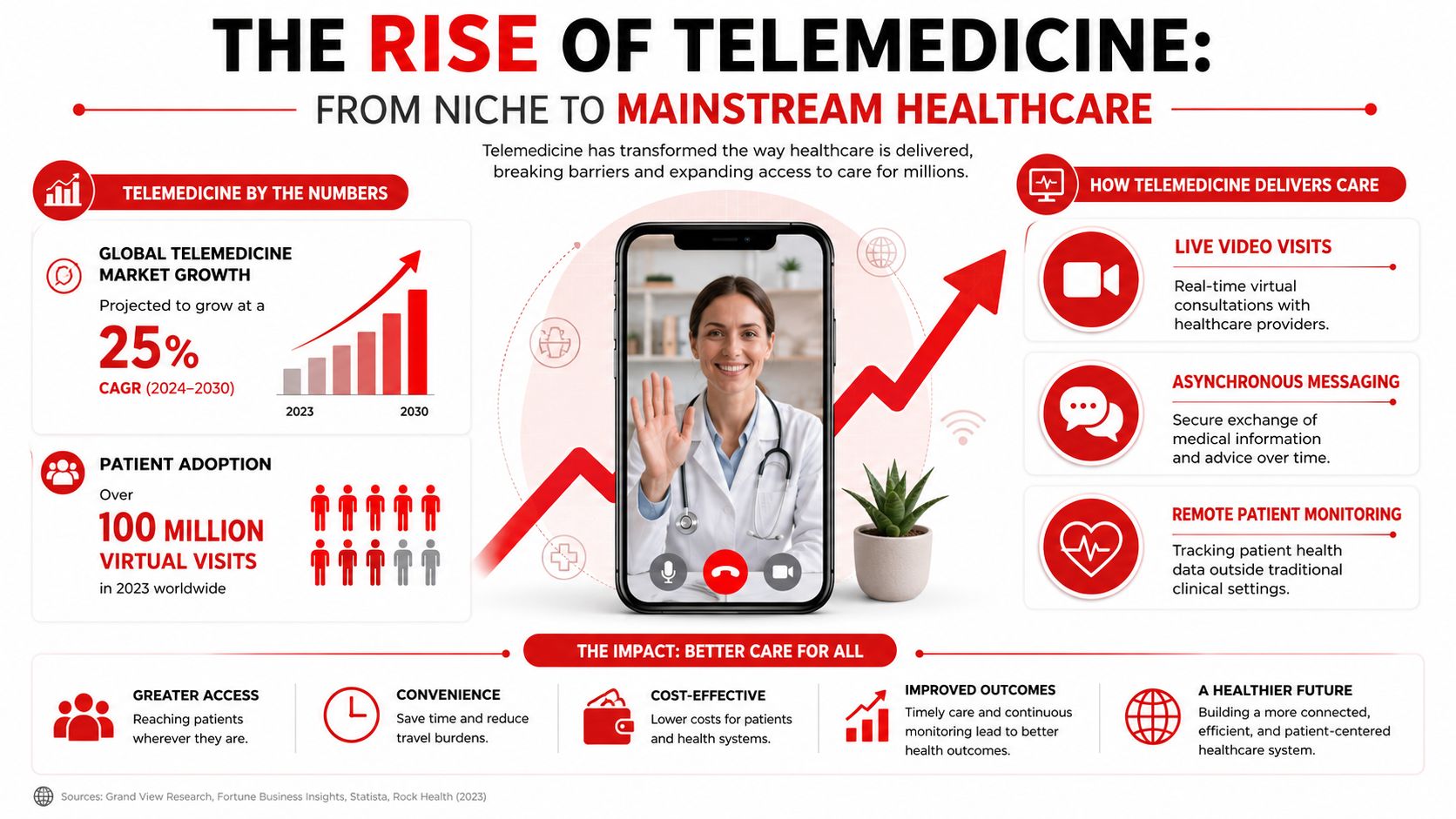
A telemedicine career starts to make sense once you treat it as a care delivery system, not just a video call. A patient may be seen face to face on a screen, send symptoms through secure messaging, share remote monitoring data between visits, or receive support in higher-acuity settings such as tele-ICU. Each format changes the clinician's workflow, the kind of judgment required, and the safeguards that need to be in place before care is considered safe.
A useful analogy is a clinic that has been stretched across distance. The exam room is no longer one physical space, it is a set of tools, platforms, and handoffs that all have to work together. If one piece fails, whether the connection drops, the history is incomplete, or the follow-up plan is unclear, the clinician has less margin for error than in a traditional visit.
The rapid growth of virtual care was accelerated by the pandemic, but it did not begin there. Office-based physician telemedicine use rose from 15.4% of visits in 2019 to 86.5% in 2021, then settled at 80.0% in 2024, which shows that virtual care became part of ordinary clinical operations rather than a short-term experiment. That shift matters for anyone considering a telemedicine career because staffing, supervision, scheduling, and training now have to assume that remote care is a normal part of practice.
How telemedicine actually shows up in daily practice
A clinician working remotely may start with live video visits, then review portal messages between appointments, then follow a patient's home blood pressure or glucose readings. In another setting, a specialist may use asynchronous messaging to review images or symptom updates, while a critical care physician supports bedside teams through tele-ICU oversight. These formats look different on paper, but they all ask the same question, can the clinician make a safe decision with less direct contact than a traditional exam room provides?
That is why telemedicine works best as a network of workflows rather than as a single technology. The clinical task still begins with history, triage, and judgment. The technology changes the route from the patient's concern to the clinician's decision, and that route has to be designed carefully if safety is the priority.
A specialty can adapt to virtual work in different ways. For a patient-centered example, understanding psychiatric telemedicine for Floridians shows how behavioral health often fits telemedicine well, especially when conversation, observation, and follow-up matter more than a hands-on exam.
Practical rule: If the visit depends on a hands-on exam, telemedicine may support follow-up but not replace the first assessment.
Telemedicine also connects to broader health-care efficiency. For a clear overview of how virtual care can fit into a larger access and throughput strategy, this guide on reducing healthcare costs is useful because remote care works best when clinicians choose the right site of care, reduce avoidable friction, and keep the plan aligned with the patient's actual needs.
Exploring Clinical and Non Clinical Telemedicine Roles
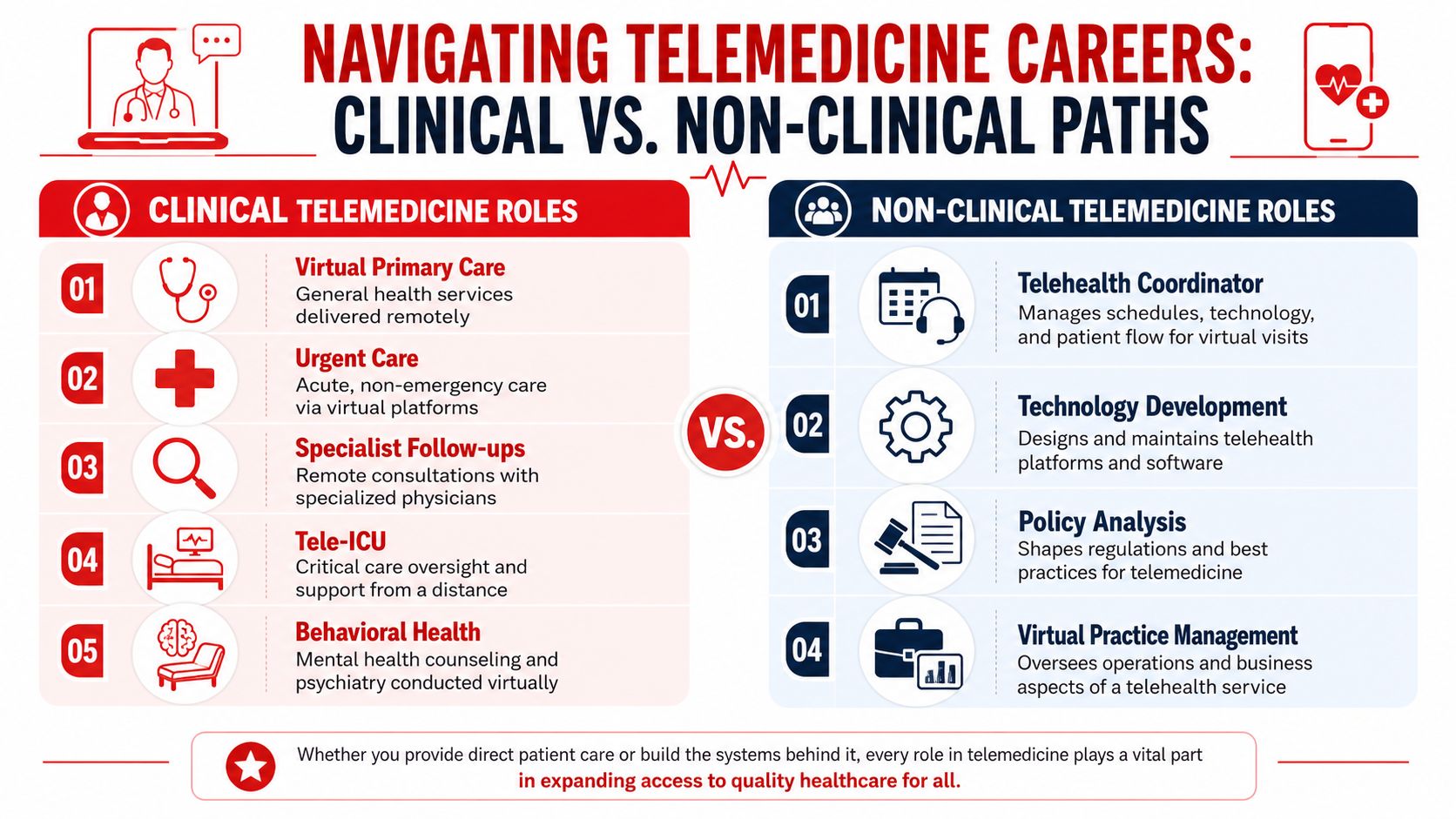
Telemedicine careers split into two broad lanes, direct patient care and the support roles that keep virtual care running. The clinical side includes virtual primary care, urgent care, specialist follow-up, tele-ICU, and behavioral health. The non-clinical side includes telehealth coordination, quality improvement, informatics, policy work, medical-legal consulting, and product design.
That split matters because the day-to-day work looks very different. A virtual urgent care clinician is making quick decisions about what can safely stay online and what needs escalation. A telehealth program manager is handling staffing patterns, platform issues, and patient flow. Both are part of the telemedicine career ecosystem, but they reward different strengths.
Clinical paths and what they demand
A virtual primary care clinician often manages chronic disease follow-up, preventive counseling, and medication review. An urgent care telemedicine physician is more like a remote gatekeeper, sorting viral syndromes, rashes, minor injuries, and symptoms that need hands-on care. A specialist follow-up role can be narrower and more efficient, because the clinician already knows the patient's diagnosis and is reviewing progress, side effects, or new test results.
Tele-ICU and behavioral health sit at opposite ends of the acuity spectrum, but both require strong judgment. Tele-ICU clinicians support bedside teams and need to stay oriented to clinical deterioration. Behavioral health clinicians often have more room for conversation and longitudinal care, but they still need to notice risk, safety concerns, and when a virtual setting isn't enough.
Non-clinical paths and why they matter
Non-clinical roles are easy to overlook, but they're central to a functioning virtual service. A telehealth coordinator manages schedules, test calls, and patient handoffs. A technology development role turns clinical frustrations into software fixes, while policy analysis shapes what services get reimbursed, regulated, and scaled. In virtual practice management, the work is closer to operations leadership than bedside medicine.
If you're deciding between these tracks, ask one simple question, do you want to treat patients, improve the system, or do both? That answer usually clarifies whether you belong in a clinical lane, an operations lane, or a hybrid role. For readers looking at physician-facing virtual job examples, American Cardiology Group's expert guide is a useful way to see how specialty telehealth jobs are described in the market.
The telehealth market also gives a clue about role diversity. The global telehealth industry reached $194.1 billion by 2023, up from $17.8 billion in 2014 with an 18.4% CAGR through 2020 industry summary. That growth doesn't just create more visits, it creates more staffing layers, more support functions, and more room for clinicians who want to move into leadership or product-facing work.
Essential Skills Certifications and Technical Fluency
The biggest mistake people make about telemedicine is assuming the video platform is the hard part. It usually isn't. The hard part is moving smoothly through a visit when you can't touch the patient, can't rely on a full in-person exam, and still have to produce a safe plan inside a digital workflow. That's why telemedicine hiring increasingly favors clinicians who can combine medical judgment with technical discipline.
The skills employers notice first
The most important clinical skill is advanced assessment through video. A good telemedicine clinician knows how to ask better questions, inspect visual clues carefully, and recognize when a symptom needs a different setting. Close behind that is remote triage judgment, because virtual care depends on deciding who can stay online, who needs same-day in-person care, and who needs emergency escalation.
Technical fluency matters just as much. Clinicians need comfort with EHR-integrated workflows, secure messaging, and ePrescribing, not just a polished webcam setup telehealth competency guidance. The clinician who can document cleanly, send orders correctly, and route follow-up safely is far more valuable than the clinician who only knows how to click “start meeting.”
A strong virtual visit is usually decided before the video starts, because the chart review, medication reconciliation, and escalation plan shape everything that happens in the room.
How to show readiness on paper
If you're applying for telemedicine work, show the employer how you think, not just where you've worked. List platforms you've used, such as Epic, Cerner, or Zoom for Healthcare, and pair them with the tasks you performed. A statement like “managed portal follow-up, ePrescribing, and result review in EHR-integrated workflows” tells a clearer story than “comfortable with telehealth.”
Training also helps, especially when it covers workflow rather than generic video etiquette. AAMC telehealth modules, CMS telemedicine education, and state-specific telehealth credentials can help fill knowledge gaps, but the value comes from how you apply them in practice. If you're trying to connect telemedicine skills to your broader charting habits, these EHR system resources can help you think about documentation and workflow in a more structured way.
Use your application to prove you understand the operational side too. Employers like to see data literacy, because telemedicine teams often track visit volume, patient satisfaction signals, follow-up completion, and technology-related friction. A clinician who can read a dashboard and notice where care is stalling often becomes a better teammate than one who treats the software as invisible.
Training Pathways for Medical Students and Residents
Medical training already gives you many of the habits telemedicine needs, but those habits have to be adapted. A strong history, a tidy assessment, and clear documentation still matter, yet virtual care asks you to gather information faster and in a narrower setting. That's why the most useful training experiences are the ones that combine communication, triage, and systems thinking.
Where students can build telemedicine habits early
Telehealth electives are the most obvious entry point, but clerkship-based virtual clinics can be just as valuable because they attach remote care to real patient follow-up. If your school offers virtual primary care observation, remote specialist follow-up, or supervised portal messaging, take it seriously. These settings teach a different rhythm, especially how to close loops when the patient isn't physically in front of you.
A medical student clerkships resource can help you think about how to use core rotations as a launchpad rather than a fixed path. For example, a student on internal medicine can learn how telemonitoring fits chronic disease care, while a psychiatry rotation can show how much of the visit depends on rapport, safety screening, and follow-up structure.
Building a telemedicine portfolio during residency
Residents should look for projects that demonstrate remote-care judgment, not just interest. Good examples include remote monitoring quality projects, tele-ICU shadowing, or workflow improvements for virtual follow-up visits. A letter from a mentor who has supervised virtual care carries more weight than a generic statement that you “like telehealth.”
The point is to develop a portfolio that shows you can work inside the constraints of remote care. That means examples of virtual patient communication, safe escalation, and documentation that supports continuity. You don't need every rotation to be telemedicine-heavy, but you do need evidence that you can think clinically when the encounter happens through a screen.
Transitioning into a Telemedicine Career
A telemedicine transition works best when you treat it like any other job search, except the employer is also checking whether you can function inside a distributed clinical system. Your CV should show more than credentials. It should show that you can run a digital visit safely, keep pace with documentation, and handle the communication load that comes with remote care.
A useful way to build that story is to translate your past experience into the language of telemedicine. A weak bullet says, “Participated in telemedicine visits.” A stronger one says, “Completed supervised virtual follow-up visits, managed portal messaging, and documented assessments in EHR-based workflows.” If you have tracked outcomes in training, include them carefully and accurately, because operational fluency matters in this field telehealth career guidance.
A portfolio can help too, especially for candidates shifting from inpatient or outpatient work. Include sample artifacts such as de-identified note templates, tele-triage algorithms you helped build, or a description of how you handled tech failures during clinic. Employers want evidence that you know what to do when the camera freezes and the patient is still waiting for care.
How to handle interviews and contracts
Telemedicine interviews often test judgment with practical scenarios. Be ready to answer questions like, “What would make you stop a video visit and send the patient in?” or “How do you manage patients across multiple time zones?” You do not need perfect answers, but you do need a safe framework. A good response sounds like a clinical handoff: what you can assess remotely, what you cannot confirm through the screen, and when escalation protects the patient.
Contract type matters too. W-2 employment usually offers more stability and clearer benefits. 1099 independent contractor work can offer flexibility, but it often shifts more administrative and financial risk onto the clinician. Per-visit stipends can look attractive, but they reward speed, which only works if quality and escalation are built into the workflow.
Interview filter: If a telemedicine role will not explain who handles malpractice, technology support, and after-hours escalation, the job is not fully defined yet.
Short-term roles can also help you compare how different systems operate. A locum assignment may show you how scheduling, handoffs, and remote documentation change from one employer to another, which is why some clinicians review locum tenens opportunities before committing to a telemedicine contract.
Compensation Platforms and Employers
Pay in telemedicine depends on specialty, volume, contract structure, and how much responsibility the clinician carries for triage or escalation. That's why two jobs with the same title can feel very different in practice. A physician doing narrow specialist follow-up on a stable schedule may have a different income pattern than someone covering high-volume urgent care nights across multiple states.
The market is broad enough that platform choice matters as much as title. A staff-employed role with a mature health system may trade some upside for benefits, predictable hours, and stronger malpractice support. A contractor role on a digital platform may offer more flexibility, but it can also mean more variability in schedule, billing, and compliance burden. For many clinicians, the core question is not “What pays the most?” but “What risk am I willing to carry for the schedule I want?”
Compensation models by platform
| Platform | Employment Model | Average Compensation |
|---|---|---|
| TeleHealthCorp | Staff-employed | Varies by specialty and workload |
| MDLive | Contractor and staff models | Varies by assignment type |
| Amwell | Mixed employment structures | Varies by service line |
| Specialty telehealth platforms | Contractor or hybrid | Varies by volume and niche |
Because verified numeric compensation benchmarks were not provided, the safest way to evaluate offers is to compare the structure, not just the headline rate. Ask whether the schedule includes admin time, whether no-show time is paid, whether message follow-up is included, and who carries malpractice coverage. Those details often matter more than the hourly figure.
A good offer also makes room for the work that happens outside the visit itself. Triage review, portal replies, handoffs, and documentation can all eat into apparent pay if they're not explicitly included. If you want a broader framework for short-term and flexible work models, these locum tenens opportunities offer a useful lens for understanding how autonomy and compensation usually trade off in modern clinical staffing.
Day in the Life of a Telemedicine Clinician
Dr. Lee starts the day by checking the schedule before the first patient logs on. A few visits are routine follow-ups, one patient has a new rash, and another needs medication review after a recent change. The morning already looks different from a traditional clinic because the day begins with planning for technical friction, not just clinical decisions.
Before the first visit, Dr. Lee reviews charts, confirms which patients may need interpreter support, and checks whether any test results are waiting. That prep time matters because a telemedicine visit can feel rushed if the clinician is looking up information mid-call. Good virtual care starts with a clean chart and a clear mental map.
What the workflow actually looks like
During the visit, Dr. Lee keeps one eye on symptoms and another on the limits of the medium. If the patient's story suggests a condition that can't be safely managed online, the plan shifts immediately toward in-person evaluation. If the patient can stay virtual, Dr. Lee documents carefully, sends orders through the EHR, and uses secure messaging for follow-up instructions.
Later in the day, Dr. Lee joins a brief huddle with an on-site team member to review patients who need tighter follow-up. That collaboration keeps telemedicine from becoming isolated care. The best virtual clinicians know when to slow down, ask for backup, or move the patient into another setting.
Workflow lesson: A telemedicine day gets easier when you protect time for chart review, documentation, and escalation follow-up instead of treating them as afterthoughts.
No-show management also looks different in this setting. A short technical check, a backup phone plan, and clear instructions on how to join the platform can prevent a lot of wasted time. When the setup is reliable, the clinician can spend more energy on clinical reasoning and less on recovering from avoidable disruptions.
Regulatory Liability and Future Outlook
Telemedicine is expanding, but the rules around it still shape what's possible. Licensure, reimbursement, and malpractice coverage all influence whether a clinician can practice across state lines, how much admin work is involved, and how safe a virtual-only role really is. A smart career plan has to account for those realities, not just the convenience of working from home.
One of the biggest hidden issues is cognitive load. Telemedicine can increase cognitive burden because clinicians must make faster safety decisions with fewer exam cues, while also managing documentation, technology issues, and malpractice coverage for virtual-only practice liability guidance. That's why telemedicine is not automatically a lower-stress career. Sometimes it's a different kind of stress, with tighter decision loops and fewer physical clues.
What to watch in practice
The safest clinicians build a lower threshold for escalation when the picture is unclear. They know which symptoms need immediate in-person care, which problems can be handled virtually with close follow-up, and which patients need a better setting for an exam. They also confirm that malpractice coverage explicitly includes virtual care, because a generic policy may not be enough.
Regulatory complexity is also why licensure and reimbursement should be part of every job search. If you're evaluating a role, ask how the employer handles cross-state practice, documentation standards, and emergency escalation. Those are career questions, but they're also patient-safety questions.
What the future is likely to reward
AI-assisted visits, remote diagnostics, and smarter triage tools will probably make telemedicine more capable, but they won't remove the need for judgment. In fact, the clinician who understands where technology helps and where it can't replace judgment will be the one employers trust most. For a deeper look at how digital tools may affect clinical work, machine learning in medicine is a useful place to think about the next layer of change.
The long-term pros are clear, broader access, flexible work, and a growing range of roles across clinical and non-clinical tracks. The cons are just as real, more cognitive load, more liability planning, and more dependence on reimbursement and licensure rules. If you want the most sustainable path, choose a role that gives you solid supervision, clear escalation policies, and malpractice coverage written for the work you perform.
If you're ready to turn this into a real plan, use Ace Med Boards to sharpen the clinical reasoning, test-taking discipline, and career strategy that make telemedicine work easier to enter and safer to practice. Visit Ace Med Boards to get started.