You're three blocks deep into a question bank, and the pattern feels uncomfortably familiar. You miss the same kind of answer again and again, not because you never learned the topic, but because one wrong option keeps looking “close enough” under pressure. That's exactly where distractor analysis earns its keep. It turns the wrong answers in a multiple-choice exam into a map of what you know, what you half-know, and what you're still guessing at.
In medical exam prep, that matters because good distractors aren't random filler. They're the wrong answers that separate a memorized fact from a usable concept, and the classic item-analysis framework treats a distractor as functional only when it draws more than 5% of examinees and has a negative relationship with total test score ED293851. A practical workflow for item review also looks at option-frequency proportion, option point-biserial, and a quantile plot of option endorsement across ability bands Assess.com. If you've ever wondered why one answer choice felt irresistible, the data often tells you.
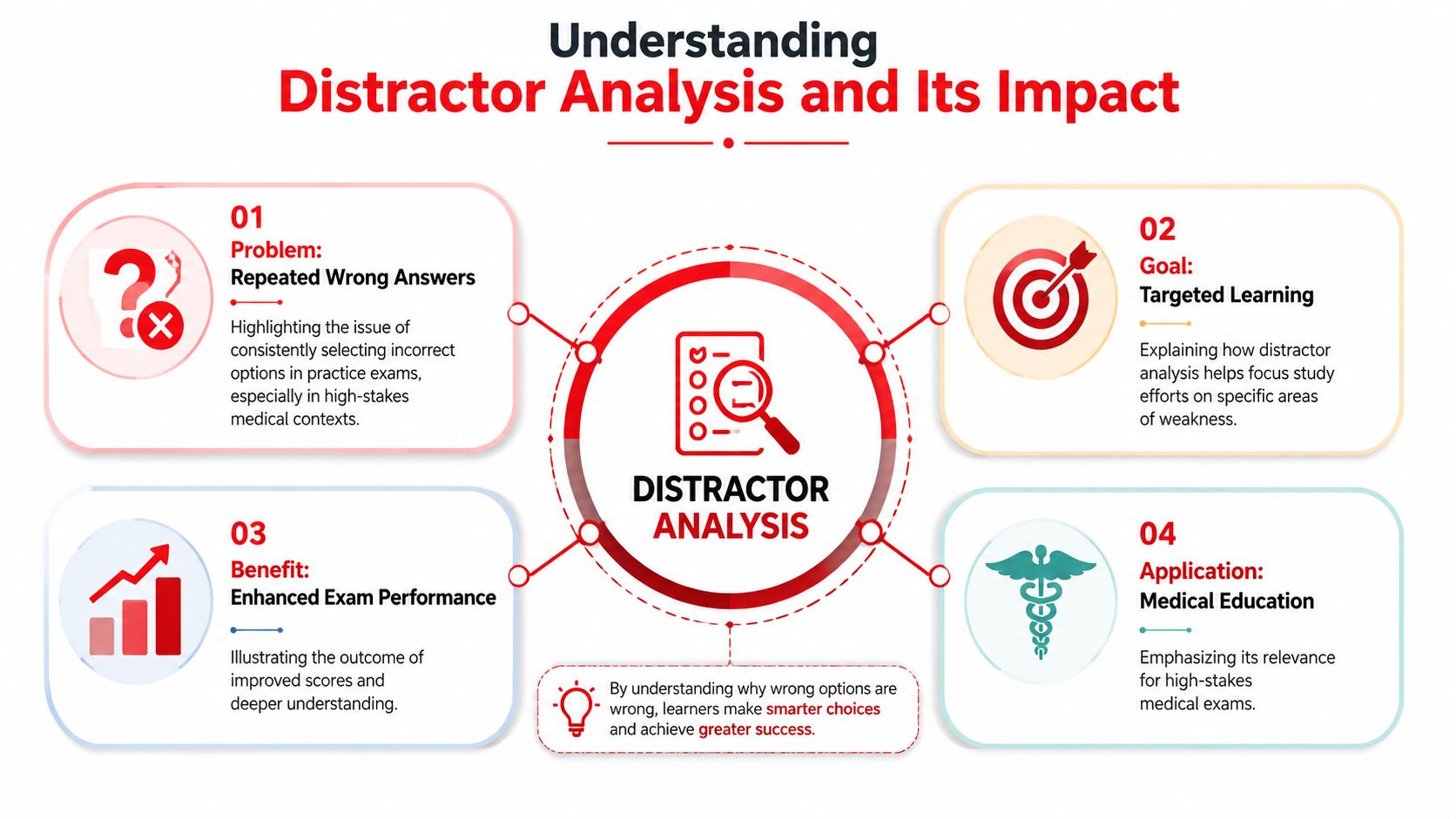
Understanding Distractor Analysis and Its Impact
A student can finish a full practice block and still miss the same concept in three different disguises. The score report says “incorrect,” but the answer choices often reveal something more useful. Distractor analysis is the habit of studying those wrong options to see whether they are pulling you in because of a content gap, a reading slip, or a misconception that has become automatic.
What a distractor is really doing
In a strong medical MCQ, the wrong answers are not supposed to be silly. They are supposed to be plausible enough that a student who has not fully mastered the topic might choose them. That is why item writers care whether a distractor is chosen by lower-performing examinees more often than higher-performing ones, and why classic item review looks at whether the wrong option separates strong test takers from weak ones.
If a wrong option never attracts anyone, it is decorative, not diagnostic. If it attracts thoughtful but uncertain students, it is useful. That distinction matters for USMLE and COMLEX prep because the exam rewards precise knowledge, not pattern recognition alone.
Practical rule: When a wrong answer keeps tempting you, ask whether it is conceptually close to the right answer or just linguistically familiar. Those are very different problems.
A useful way to think about distractor analysis is that it turns a missed question into a diagnosis. You can often tell whether the issue is recall, interpretation, or elimination strategy just by looking at which option won your attention. For students who review every missed item, this becomes a high-yield feedback loop instead of a passive “I got it wrong” note. It also fits into broader test-taking skills, because the same habits that improve option elimination also improve timing, reading discipline, and confidence under pressure.
That makes the review useful in real time, not just after the exam. You are not only checking the key. You are identifying the trap that worked, then deciding whether the fix belongs in content review, question interpretation, or your elimination strategy.
Setting Up Your Distractor Analysis Workflow
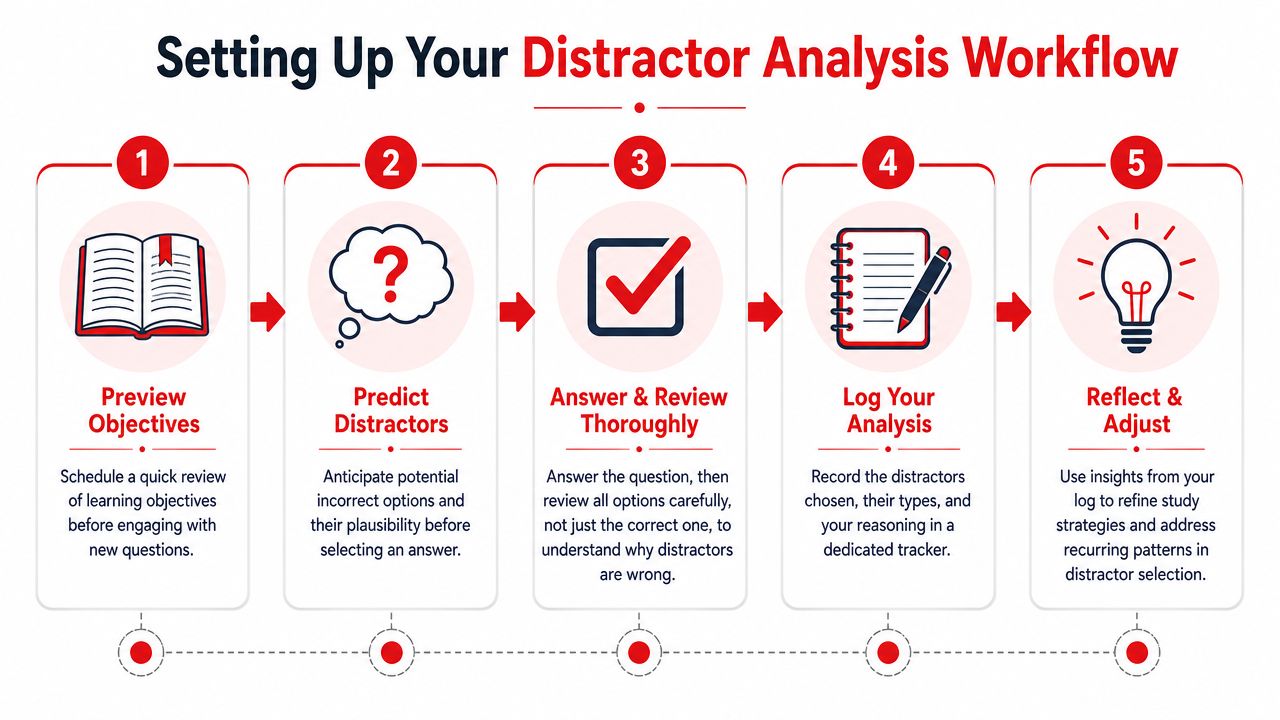
A good workflow starts before you answer the question. Read the learning objective first, look for likely traps in the stem, and predict what kind of wrong answer the writer might use. That pre-reading step is simple, but it changes how you approach the options because you are comparing each choice against a mental model instead of reacting one by one.
The pre-question routine
Start with the objective, not the answer choices. If the item is about acute chest pain, your brain should be ready for differential diagnosis, contraindications, and time-sensitive clues before you ever look at the options. That makes the distractors easier to classify later because you already have a sense of the trap the writer may have built.
After you answer, review every option, not just the key. A practical distractor analysis workflow looks at which wrong options are chosen, how often they appear across different ability levels, and whether they behave consistently across the score distribution. Those checks show whether a distractor is functioning, whether it is pulling lower performers more than higher performers, and whether it is behaving oddly in a way that deserves closer review.
The post-question routine
Log three things immediately. Which wrong option did you choose, why did it look right, and what clue should have eliminated it. That short note is often more useful than a longer summary because it captures the exact decision error while it is still fresh.
If you use a dashboard, make it measurable rather than decorative. A simple tracker helps you sort items by recurring distractor type, topic, and error mode, and the progress-tracking dashboard fits naturally into that kind of review habit.
Your log should answer one question, did you miss the content, or did the distractor exploit a predictable thinking error?
Study time becomes sharper. Instead of redoing random blocks, you start spending time where the wrong answer pattern shows up. That is an important distinction, as progress often looks like fewer repeated mistakes, not dramatic leaps.
Annotating MCQs with Real Examples
A good annotation system changes the way you read a missed item. The point isn't to memorize why the correct answer was correct. It's to understand why the tempting wrong answers were tempting in the first place.
On a Step 1 style pharmacology question, a student might correctly recognize the disease process but still pick the option that names the nearest-looking mechanism. That distractor is often built to catch partial knowledge, especially when the stem contains familiar buzzwords. In a Shelf-style clinical vignette, the wrong answer may be a real diagnosis that doesn't fit the timeline, severity, or exam finding.
How to annotate the wrong choices
Use the same three labels each time: trap type, missed clue, and fix. For example, a distractor might be a half-right drug class that fails because the mechanism doesn't match the mechanism in the stem. Another might be a plausible condition that's wrong because the patient's age, vitals, or lab pattern points elsewhere.
This kind of annotation keeps you from writing vague notes like “need to know this better.” It forces you to identify whether the issue was content, differentiation, or stem reading. Over time, that makes your review notes searchable by pattern instead of by topic alone.
A top performer often uses a short margin note system. One symbol can mark an outright content gap, another can mark a wording trap, and another can flag a distractor that looked right because it echoed an older misconception. If you want a question bank that already encourages this style of review, the structure of USMLE-style practice questions is only useful if you annotate the wrong options, not just the correct one.
A missed question becomes useful the moment you can say, “I chose this because of X, and X was the wrong cue.”
That's the core value of annotation. It makes your review concrete enough to study later and specific enough to change future choices.
Using Templates and Tracking for Continuous Improvement
A tracker turns scattered insights into a pattern you can act on. Without one, you remember the most recent bad choice and forget the rest. With one, you can see whether the same distractor style keeps winning your attention across different subjects.
| Distractor Analysis Tracking Template | ||||
|---|---|---|---|---|
| Date | Question ID | Distractor Chosen | Diagnostic Metric | Action |
| Date of review | Item identifier | Wrong option selected | Frequency, point-biserial, or note | Targeted fix for next session |
What to record
Keep the sheet lean. Record the date, the question ID, the wrong option you chose, the metric or note that explains why it was attractive, and a concrete action. That action should be something you can test later, such as “re-read mechanism,” “slow down on negations,” or “separate similar diagnoses before review.”
If you work in a group, the same template helps everyone speak the same language. If you work solo, it creates a paper trail that shows whether your weak distractors are changing or repeating unchanged. That matters because progress often looks like fewer repeated mistakes, not dramatic leaps.
For teams that already use structured content workflows, building an enterprise AI prompt library at Prompt Builder is a useful analogy. The value comes from organized reuse, not from a pile of disconnected notes.
How to make the sheet useful
Add a simple rule for action items. Every row should end with a decision about what you'll do differently next time. That might mean a flashcard rewrite, a targeted reading pass, or a new elimination cue.
If you're pairing this with tutor support, a measurable framework helps keep the conversation focused. Ace Med Boards' measurable performance goals page fits that mindset because distractor review works best when the next step is concrete.
Identifying Common Distractor Types and Counter Strategies
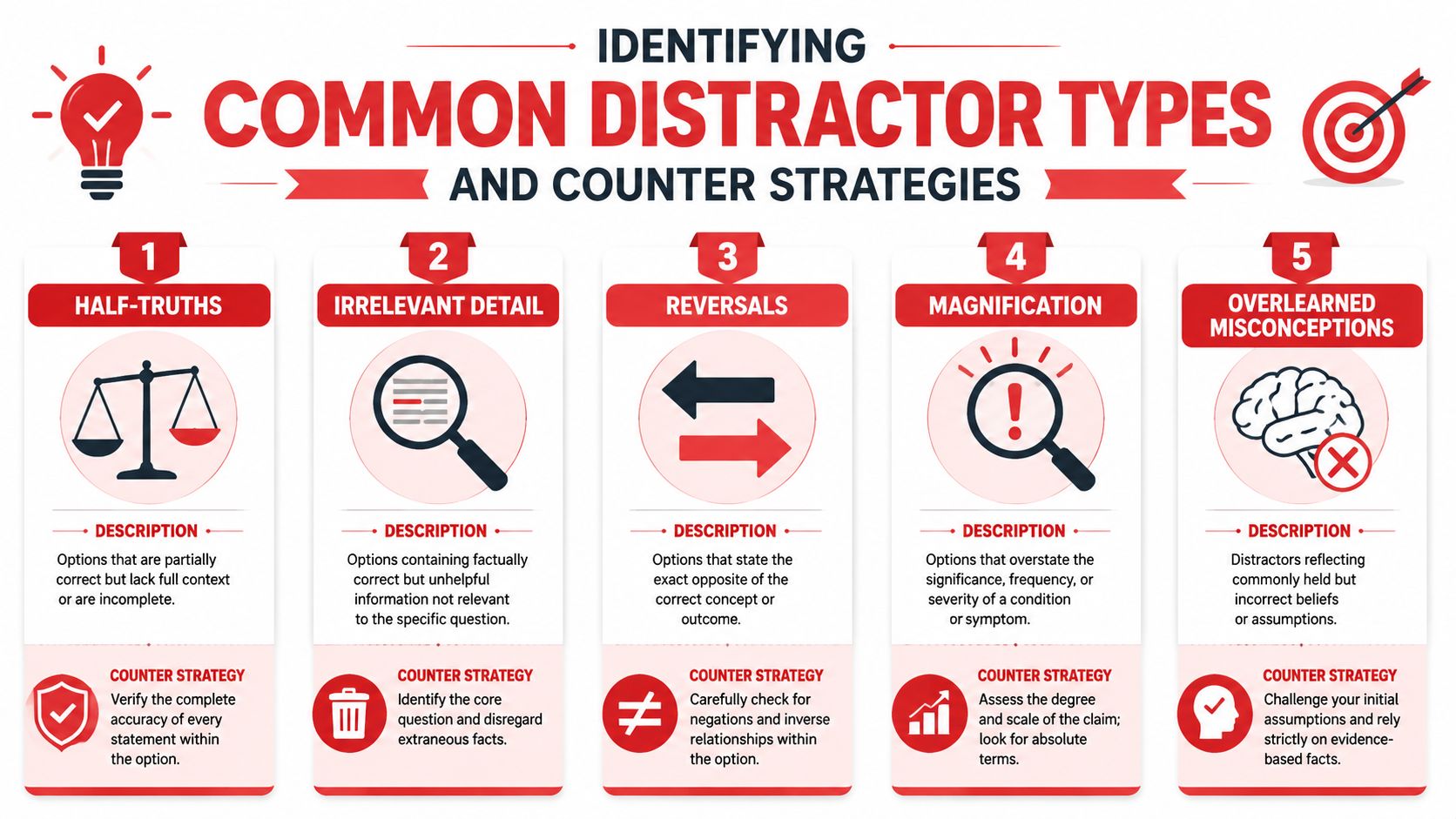
A weak distractor often looks plausible because it borrows part of the correct idea. In a review session, that is usually the first clue that the option is trying to sound right rather than answer the stem. The practical goal is not to doubt every wrong answer. It is to recognize which wrong answer is borrowing credibility from the right one, then move past it fast enough to keep your timing and your reasoning intact.
Five patterns that show up often
Half-truths are the classic trap. They include one correct idea and one missing piece, so they feel comfortable until you check the full statement against the stem. In classroom practice, students miss these when they recognize the topic but stop short of testing every clause. The counter move is simple, verify the whole option, not just the part that sounds familiar.
Irrelevant detail is different. The option may be factually correct, but it does not answer the question asked. I see this often when a student knows the material but locks onto a true statement that fits a different prompt. The fix is to restate the lead-in in your own words before choosing, so the question stays in focus.
Reversals try to flip the concept. They are dangerous in physiology, pathology, and pharmacology because a single negation can change the meaning completely. Scan for words like increase, decrease, inhibit, stimulate, improve, or worsen, then ask whether the option matches the actual direction of effect. That small habit catches a lot of avoidable misses.
Magnification exaggerates importance, frequency, or severity. It often sounds convincing because it is forceful and specific, not because it is accurate. A quick check of the scale in the stem usually exposes it. If the wording feels stronger than the case supports, slow down and test whether the option is stretching the facts.
Overlearned misconceptions are the hardest because they feel like common sense. These are the distractors that survive repeated exposure to bad mnemonics or oversimplified classroom rules. Students keep choosing them because the answer feels familiar, not because it fits the vignette. The only reliable defense is evidence-based recall, not intuition, and that is where a careful review process matters as much as content mastery.
A useful psychometric rule is that a distractor earns attention when it pulls in a meaningful share of examinees and does so more often among lower-performing test takers. That is why a strong wrong answer is not the one that sounds clever, it is the one that helps separate stronger reasoning from weaker reasoning. The same logic shows up in applied test interpretation, and the Orange Neurosciences blog on diagnostic tests is a helpful companion read because it reinforces the habit of checking whether a choice distinguishes the right cases from the wrong ones.
Integrating Distractor Analysis into Study Sessions
Distractor analysis works best when it's part of the session, not an afterthought. If you only review wrong answers at the end of the week, you lose the emotional and cognitive context that made the trap effective. The fix is to build a short review loop into every study block.
A strong routine is to pause after each question set and sort the misses by type. One peer can quiz the other on the eliminated options, forcing a verbal explanation of why each wrong choice failed. That kind of conversation exposes shaky reasoning fast, because it's harder to hide behind recognition than recall.
Flashcards can also carry distractor cues. Instead of writing only the fact you got wrong, add the misleading clue that pulled you toward the bad option. That turns the card into a reminder about decision-making, not just content.
If a distractor fooled you once, it deserves a line in your study materials.
Tutoring sessions can reinforce this approach by treating the wrong answer as the teaching point. A tutor can ask why the student rejected the correct answer, then trace the path that led to the distractor. That is often more efficient than reteaching the whole topic from scratch.
A short post-quiz slot helps too. Fifteen focused minutes on flagged items is usually enough to make the error visible and assign a fix. The key is consistency, because the benefit comes from repeated exposure to your own error patterns, not from one long review marathon.
Measuring Progress and Adjusting Strategies
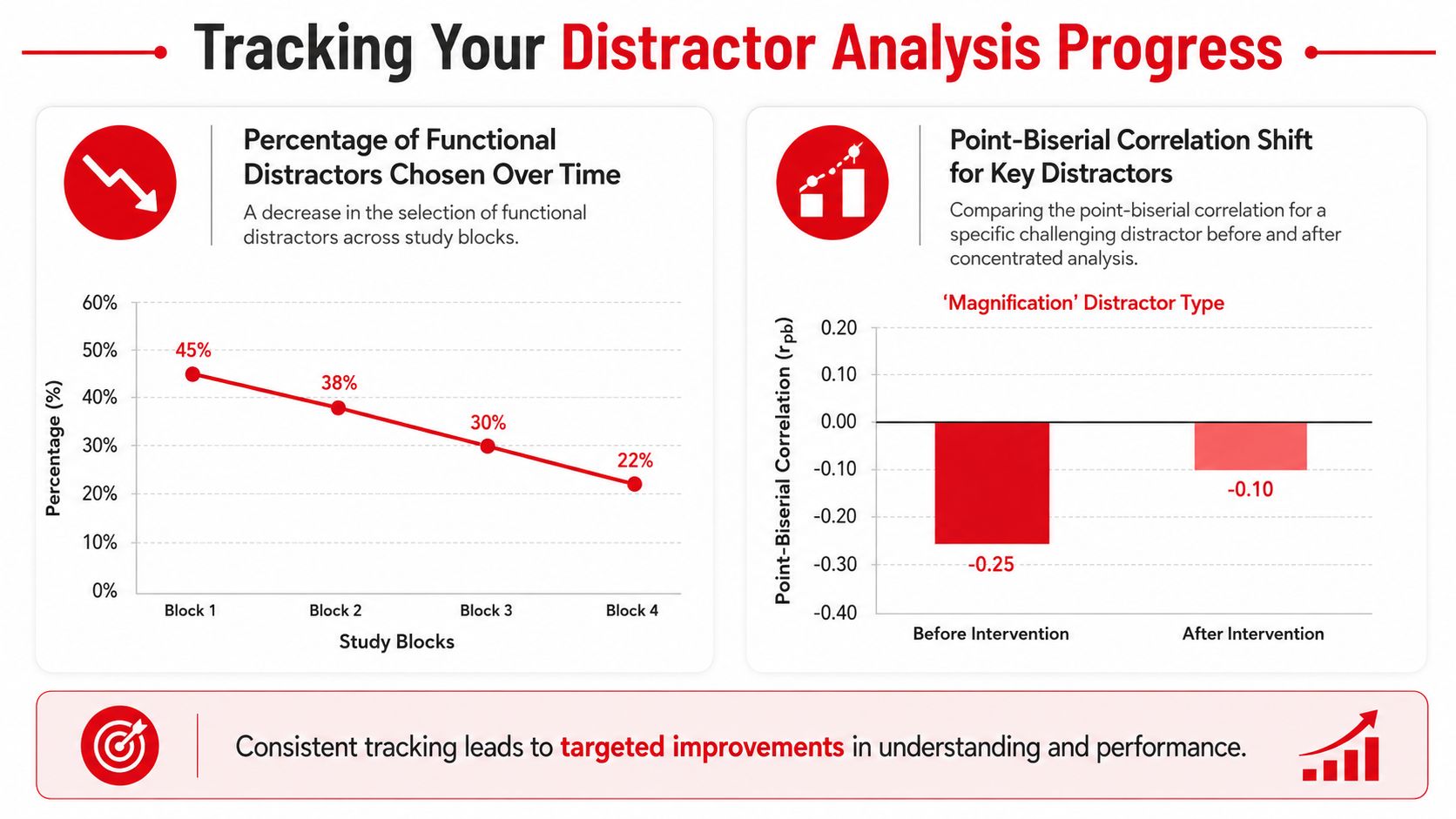
Progress shows up when the same distractor stops working on you. That can mean you're reading more carefully, eliminating more cleanly, or recognizing the content faster. A tracker gives you a way to see that improvement without guessing.
What to watch in the data
Look at the wrong answers you still choose repeatedly and ask whether they're still functional for you. If the same type keeps appearing, that's a sign your elimination strategy hasn't fully changed yet. If your notes show that a once-powerful trap is fading, your study routine is doing its job.
The 2024 study in Pedagogical Medicine found that reducing distractors from three to two did not compromise item difficulty or discriminative power, while lowering item-writing flaws Pedagogical Medicine. That's a useful reminder that better distractors beat more distractors. For practice exams, it means you should care less about how many wrong answers are on the page and more about whether the ones you're seeing are helping you learn.
A cleaner approach to review is often better than a busier one. If a distractor keeps appearing in your notes, simplify your focus around that pattern instead of trying to chase every possible wrong answer. That keeps your energy on the few traps that matter most.
USMLE practice exams work best when you use them as data, not as a score chase. The right adjustment is usually smaller and more specific than students expect.
A CTA for Ace Med Boards.