
The USMLE Step 3 Computer-based Case Simulations (CCS) section is often the most daunting part of the exam. Unlike multiple-choice questions, it requires a unique blend of clinical knowledge, rapid decision-making, and strategic workflow management. Simply knowing the medicine isn't enough; you must demonstrate your competence under pressure, navigating a simulated clinical environment where every order and every minute counts.
Many highly capable residents and medical students struggle not from a lack of knowledge, but from a lack of a systematic approach. This is where targeted preparation makes all the difference. Failing to develop a repeatable, efficient method for tackling each case can lead to missed points, poor time management, and unnecessary stress. The goal is to move beyond just surviving the cases to actively controlling them, demonstrating clinical proficiency from the initial encounter to the final disposition.
This guide cuts through the noise, providing a battle-tested framework of actionable usmle step 3 ccs tips designed to transform your preparation and exam performance. We will move beyond generic advice and focus on specific, repeatable strategies that you can implement immediately. From mastering the quirky interface and building a rapid assessment strategy to making confident disposition decisions, these eight core strategies will equip you with the skills and confidence needed to turn this challenging section into your greatest strength on exam day. You will learn precisely how to manage the clock, what orders to place and when, and how to document your plan effectively, ensuring you capture every possible point.
1. Master the CCS Interface and Navigation
The USMLE Step 3 Computer-based Case Simulations (CCS) are as much a test of your computer proficiency as they are of your clinical judgment. The interface is where you will spend every second of these crucial encounters, and your ability to navigate it swiftly and accurately directly translates into points. Wasting time fumbling through tabs or searching for order sets can mean the difference between stabilizing a patient and letting their condition deteriorate. Mastering this environment is a non-negotiable prerequisite for success.
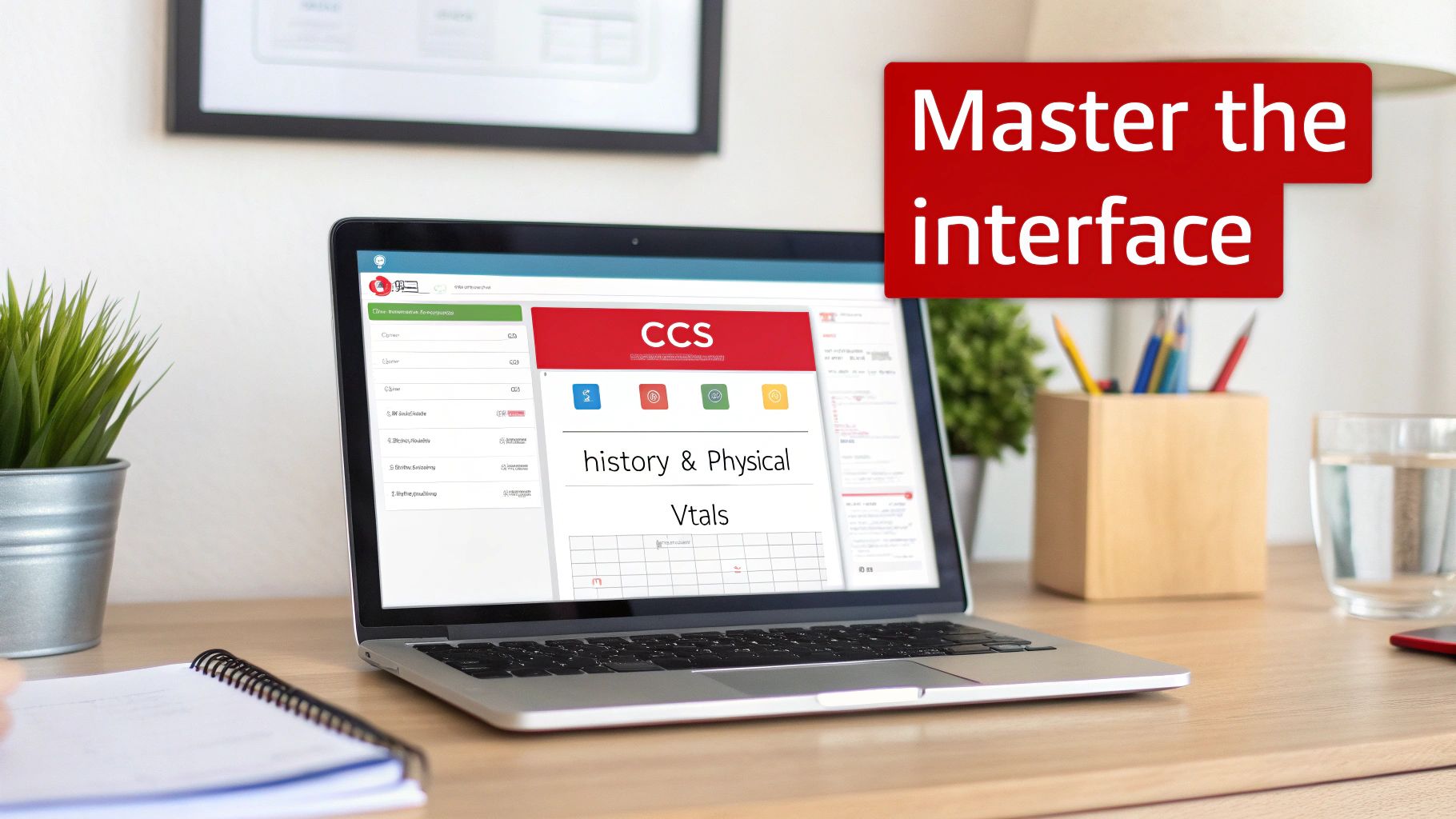
This foundational skill involves more than just knowing where buttons are. It’s about building muscle memory for a systematic workflow: obtaining the initial history and physical, ordering initial diagnostics, advancing the clock, re-evaluating, and documenting your plan. Students who report high comfort with the software, often after completing 20 or more practice cases, consistently perform better.
Why It’s a Top Priority
The CCS portion of the exam is designed to simulate the time pressure of a real clinical setting. Each case has a 10 or 20-minute time limit, and every moment spent searching for a lab test or trying to find a patient’s vital signs is a moment not spent on clinical decision-making.
Key Insight: Your interface speed sets the ceiling for your clinical performance. No matter how brilliant your differential diagnosis is, you cannot execute it effectively if you are fighting against the software. A smooth, practiced workflow frees up critical mental bandwidth to focus on the patient.
Actionable Tips for Interface Mastery
Follow these steps to turn the CCS interface into an advantage rather than a hindrance. This is one of the most high-yield USMLE Step 3 CCS tips you can implement.
- Systematic Tab Review: Develop a consistent pattern for checking information. For example, always review Vital Signs, then History & Physical, then check for any existing Labs or Imaging. Repetition builds speed.
- Practice with Official Software: Use the official USMLE CCS practice software available on their website. This is the only way to guarantee you are practicing on a platform identical to the real exam.
- Time Every Case: From your very first practice case, use a timer. This forces you to develop an efficient rhythm and highlights where you are losing precious seconds.
- Learn Order Set Keywords: Instead of typing out full test names, learn the shorthand. For example, typing "CBC" is much faster than "Complete Blood Count." Create a list of common abbreviations you will use.
- Develop a Routine: Create a personal workflow you follow for every case (e.g., initial orders, move patient, advance clock, check results, repeat). This structured approach minimizes cognitive load and prevents you from missing crucial steps under pressure.
2. Build a Rapid Clinical Assessment Strategy
In the USMLE Step 3 CCS, the first 2-3 minutes of each case are the most critical. This is your window to synthesize the initial patient presentation, identify life threats, and establish a focused differential diagnosis. Instead of creating an exhaustive list of possibilities, top performers develop a rapid clinical assessment strategy that prioritizes the most likely and most dangerous conditions based on the limited information available. This allows for efficient, targeted initial orders that save time and demonstrate superior clinical judgment.
This approach is about moving with purpose from the very start. For a 45-year-old man with crushing chest pain and diaphoresis, your immediate thought process should lock onto Acute Coronary Syndrome (ACS), Pulmonary Embolism (PE), and Aortic Dissection. Conversely, for a 28-year-old pregnant woman with acute abdominal pain, your mind should instantly pivot to placental abruption, preeclampsia with severe features, or appendicitis. This mental agility prevents you from ordering an unfocused, overly broad panel of tests.
Why It’s a Top Priority
The CCS scoring algorithm rewards efficiency and patient safety. A "shotgun" approach where you order every conceivable test not only wastes precious time but can also be interpreted as poor clinical reasoning. By narrowing your focus early, you demonstrate the ability to triage and prioritize, a core competency tested on Step 3. A rapid, targeted strategy ensures you stabilize the patient and move toward the correct diagnosis faster.
Key Insight: The goal isn't to be right on the first try; it's to be safe and logical. Your initial differential should cover the most likely and the most life-threatening possibilities, guiding your first wave of orders to quickly rule in or rule out these critical conditions.
Actionable Tips for Rapid Assessment
Use these techniques to sharpen your initial diagnostic skills. Honing this ability is one of the most effective USMLE Step 3 CCS tips for boosting your score and confidence. This process is a key component of effective clinical reasoning. You can learn more about clinical reasoning on acemedboards.com.
- Develop 'Rapid Fire' Differentials: For common chief complaints (e.g., chest pain, shortness of breath, altered mental status), create and memorize a short list of 3-5 top diagnoses you will always consider.
- Use the '3-5 Diagnosis' Rule: In the note or order section, discipline yourself to focus only on the top 3 to 5 most probable diagnoses. This forces you to prioritize and prevents you from getting lost in a sea of low-probability conditions.
- Create Mental Shortcuts: Develop simple, memorable associations for classic presentations. For example: "Young patient + sudden SOB = think PE, asthma, or pneumothorax first." These shortcuts accelerate your initial thought process.
- Practice High-Yield Patterns: Use practice cases to drill pattern recognition for high-yield presentations. The more you see classic cases of MI, sepsis, or DKA, the faster you will recognize them on exam day.
- Review Age-Specific Differentials: Before the exam, quickly review common diagnoses grouped by age (pediatric, adult, geriatric) and organ system. This helps tailor your differential to the specific patient in front of you.
3. Order Tests Strategically and Interpret Progressively
One of the most common mistakes on the CCS is ordering a massive, shotgun-style battery of tests right at the start. Successful examinees treat each case like a real clinical puzzle, ordering diagnostics in strategic phases. You should allow initial results to guide subsequent orders, demonstrating a logical and cost-effective approach to patient workup. This progressive method not only mirrors best practices but also prevents information overload and keeps your case management focused.
This skill is about showing the graders your clinical reasoning process. Instead of throwing everything at the wall to see what sticks, you're making deliberate choices based on the evolving clinical picture. This demonstrates competence and an ability to prioritize, which are key competencies being assessed in the USMLE Step 3 CCS.
Why It’s a Top Priority
The CCS algorithm rewards a thoughtful, stepwise diagnostic process. Ordering unnecessary or premature advanced imaging can actually penalize your score. The simulation is designed to see if you can formulate a differential diagnosis and then use high-yield, low-risk tests to narrow it down before proceeding to more invasive or expensive options. A phased approach saves precious time on the clock and showcases superior clinical judgment.
Key Insight: Your goal is not to order every possible test, but to order the right test at the right time. Each order set should be a direct answer to a clinical question raised by the patient's presentation and the results you've already received.
Actionable Tips for Strategic Ordering
Follow these steps to develop a phased and effective diagnostic strategy. This is one of the most critical USMLE Step 3 CCS tips for demonstrating your clinical acumen.
- Phase 1 Orders: Your initial order set should be focused and high-yield. Always start with basics like a CBC and CMP. Then, add tests directly relevant to the chief complaint. For chest pain, this means an EKG and troponins; for fever and cough, a chest X-ray and blood cultures. A crucial part of test interpretation in CCS cases involves understanding common diagnostic tools; for instance, you may need to learn how to read heart rate from an ECG to properly evaluate the initial data.
- Re-evaluate Before Re-ordering: After advancing the clock and receiving initial results, always review the patient’s vital signs and clinical status before ordering more tests. Has the patient stabilized or decompensated? This information is critical for guiding your next steps.
- Use Results to Guide Phase 2: Let the initial findings refine your differential diagnosis. An abnormal chest X-ray might prompt a CT chest, while elevated troponins and EKG changes would lead to a cardiology consult, not a D-dimer.
- Document Your Rationale: In your patient notes, briefly explain why you are ordering specific tests. For example, "Ordering CT angiography to rule out pulmonary embolism given patient's tachycardia and hypoxia." This explicitly states your thought process for the graders.
4. Develop a Standardized Assessment and Plan Template
In a real clinical setting, a well-structured Assessment and Plan (A&P) note communicates clear, organized thinking. On the CCS exam, it does the same thing for the scoring algorithm. Creating a personal, standardized template for your A&P section is a game-changing strategy that saves precious time, prevents critical omissions, and showcases your systematic approach to patient care. Instead of reinventing the wheel for every case, you apply a consistent framework.
This method involves pre-determining the structure of your final note before you even start a case. Your template acts as a mental checklist, ensuring you address differential diagnoses, diagnostics, therapeutics, patient education, and disposition every single time. This structured approach allows you to quickly populate the required fields under pressure, focusing your mental energy on the clinical data rather than on how to format your note.
Why It’s a Top Priority
The A&P note is your final opportunity to demonstrate your clinical reasoning to the grading software. A disorganized or incomplete plan can cost you points, even if your orders were correct. A template transforms this documentation task from a creative writing exercise into a simple fill-in-the-blank process. This frees up cognitive load and ensures you hit all the key scoring domains consistently.
Key Insight: The CCS software rewards organized, logical, and complete management plans. A standardized template is the most efficient way to ensure your documentation consistently meets these criteria, turning your final note into a point-scoring asset rather than a time-consuming chore.
Actionable Tips for Template Mastery
Use these steps to build and perfect a template that becomes second nature. This is one of the most effective USMLE Step 3 CCS tips for improving both your score and your speed.
- Create Your Core Structure: Design a simple, repeatable framework. A highly effective model includes:
- Assessment: List your differential diagnoses (DDx), ordered from most to least likely.
- Diagnostic Plan: Outline the workup for each primary diagnosis (e.g., Labs, Imaging, Special Tests).
- Therapeutic Plan: Detail your treatments, including medications, procedures, and supportive care.
- Patient Education/Counseling: Always include this section.
- Disposition & Follow-up: State the patient's destination (e.g., admit to floor, discharge home) and follow-up instructions.
- Use Bullet Points and Shorthand: The software grades content, not prose. Use bullet points, abbreviations, and concise phrases for rapid entry. For example, under your top DDx of ACS, your plan might be "- EKG, Troponin, CXR" and "- MONA-B."
- Practice Until It's Automatic: Integrate your template into every practice case you do. The goal is to make its structure an automatic part of your workflow, so you don't even have to think about it on test day.
- Pre-plan for Common Scenarios: Have mini-templates ready for common presentations like chest pain or shortness of breath. For chest pain, your DDx will almost always start with ACS, PE, and Aortic Dissection, with a pre-set initial workup for each.
5. Practice Time Management and Pacing Strategies
The USMLE Step 3 CCS cases are not a marathon; they are a sprint against a strict 10 or 20-minute clock. Exceptional clinical knowledge can be nullified by poor time management, a common pitfall that leads to incomplete cases and lost points. Success requires developing an internal clock and a deliberate pacing strategy that ensures you complete every critical action before time expires. This skill is built, not inherited, through rigorous, timed practice.

This involves breaking down each case into distinct phases and allocating a specific budget of time to each. For example, a successful strategy might involve spending the first 2-3 minutes on the initial assessment, the next 4-5 minutes on ordering tests and implementing initial management, and the final block of time on reassessment and plan refinement. Candidates who consistently finish cases with a 1-2 minute buffer for final review demonstrate mastery of this essential skill.
Why It’s a Top Priority
Time pressure is designed to test your ability to prioritize and act decisively, just like in a real emergency. Without a conscious pacing strategy, it's easy to get bogged down in the history-taking phase or spend too long deliberating over a complex differential. Every second wasted is a second you can't use to stabilize the patient, which is the ultimate goal of the simulation.
Key Insight: Time is the most critical resource in a CCS case. Managing it effectively is not just about moving quickly; it's about allocating your attention and actions to the highest-yield tasks at the right moments. Your pacing strategy is as important as your medical knowledge.
Actionable Tips for Time Management Mastery
Implement these steps to turn the clock into an ally. Honing your timing is one of the most impactful USMLE Step 3 CCS tips for boosting your score. You can find excellent resources to help you practice time management and pacing strategies to master a variety of Step 3 CCS cases.
- Time Every Single Case: From your first practice case to your last, use a timer. There are no exceptions. This is the only way to build an intuitive sense of how long each action should take.
- Set Internal Deadlines: Create mental checkpoints. For a 10-minute case, aim to have all initial orders placed by the 5-minute mark. This forces you to stay on track and prevents you from falling behind.
- Allocate Time Strategically: Use a consistent framework for every case. For example: 2-3 minutes for initial H&P and assessment, 4-5 minutes for initial orders and management, and the final 2-3 minutes for re-evaluation and final orders.
- Identify Your Bottlenecks: After each timed case, review where you spent the most time. If you consistently spend 4 minutes on the initial history, focus on streamlining your questioning to get the same information in 2 minutes.
- Build Your Speed: Practice rapid typing and mouse navigation. Learn keyboard shortcuts for advancing the clock and confirming orders to shave precious seconds off every interaction.
6. Recognize and Manage Red Flag Presentations and Urgency
The USMLE Step 3 CCS portion is designed to test your ability to act decisively in high-stakes scenarios, not just your diagnostic acumen. Many cases will present with "red flags" indicating a life-threatening condition that requires immediate intervention. Your primary task in these situations is to stabilize the patient first and foremost, often before a definitive diagnosis is even clear. Failing to recognize and act on this urgency is a critical error that can quickly end a case negatively.
This skill is about shifting your mindset from a methodical diagnostician to an acute care provider. When faced with severe respiratory distress, hemodynamic instability, or acute neurological changes, your initial orders must reflect these priorities. For example, a patient with chest pain and EKG changes needs immediate cardiac monitoring and potential acute coronary syndrome treatment, not a lengthy differential workup. This approach demonstrates clinical competence and patient safety awareness.
Why It’s a Top Priority
In the CCS environment, time is a clinical tool. An unstable patient's condition can deteriorate rapidly with each tick of the clock. The simulation rewards physicians who can triage effectively, implementing life-saving measures like providing supplemental oxygen, establishing IV access, and administering fluids or urgent medications. Delaying these actions to order routine labs or detailed imaging is a common pitfall that the exam is designed to penalize.
Key Insight: On the CCS, patient stability always supersedes diagnostic purity. An incomplete workup on a stabilized patient is scored far better than a comprehensive diagnostic evaluation on a patient who has decompensated. Your first job is to prevent harm.
Actionable Tips for Managing Urgency
Integrating this "safety-first" mindset is one of the most critical USMLE Step 3 CCS tips for passing the exam. Use these strategies to ensure you respond appropriately when the pressure is on.
- Trust the Vitals: Unstable vital signs (hypotension, tachycardia, hypoxia, high fever) are your biggest clue. Address these abnormalities immediately with orders like "IV access," "Normal saline bolus," "Oxygen via nasal cannula," and "Continuous cardiac monitoring."
- Memorize Acute Protocols: Before your exam, review the core principles of ACLS, acute stroke management (tPA criteria), and the Surviving Sepsis Campaign guidelines. These frameworks provide a ready-made checklist for urgent situations.
- Think "MONA" and Beyond: For chest pain, think beyond the mnemonic. Immediately order an EKG, troponin, and cardiac monitor. If the presentation is classic for an MI, consider aspirin and nitroglycerin while awaiting results. For suspected sepsis, order IV fluids and broad-spectrum antibiotics after drawing blood cultures.
- Choose the Right Location: Recognizing urgency also means placing the patient in the appropriate setting. A patient with septic shock or respiratory failure requires an "ICU" admission order, not "Admit to Ward." This decision itself is a key management step.
7. Master Disposition Decision-Making and Follow-up Planning
A common pitfall on the USMLE Step 3 CCS is focusing so intensely on the acute diagnosis and treatment that you neglect the final, crucial step: disposition. Deciding whether to admit, discharge, or transfer a patient is not an afterthought; it is a key demonstration of your clinical judgment and patient safety awareness. Your ability to make a sound disposition decision and arrange appropriate follow-up care is heavily weighted in your final score.
This skill involves integrating all the data you’ve gathered, from the initial presentation to lab results and response to treatment, to stratify patient risk. A low-risk patient with chest pain and a negative workup can be safely discharged with clear follow-up instructions, while a diabetic patient with a new infection and rising creatinine requires admission. Getting this decision right shows the graders you can think beyond the immediate problem and manage the entire episode of care.
Why It’s a Top Priority
The CCS scoring algorithm evaluates your ability to ensure continuity of care and prevent adverse outcomes. Discharging an unstable patient is a critical error, but so is unnecessarily admitting a stable one, which demonstrates poor resource management. A well-justified disposition, supported by appropriate follow-up, proves you can manage patients safely and effectively within a healthcare system.
Key Insight: Your disposition decision is the final, summative judgment on the case. It reflects your understanding of the patient's acuity, social context, and disease trajectory. A strong plan for follow-up is your insurance policy, ensuring the patient remains safe after leaving your direct care.
Actionable Tips for Disposition Mastery
Use these steps to make your disposition decisions a strength. This is one of the most vital USMLE Step 3 CCS tips for showcasing comprehensive clinical management.
- Utilize Risk Stratification Tools: Actively use and mention scoring systems in your final note to justify your decision. For example, use TIMI for chest pain, CHA₂DS₂-VASc for atrial fibrillation, or qSOFA for suspected sepsis to guide your admit-versus-discharge choice.
- Consider the Whole Patient: Always factor in social determinants of health. Ask yourself: Can this patient afford their medications? Do they have a safe place to go home? Do they understand the instructions? If not, an admission or social work consult may be necessary even for a medically stable condition.
- Be Highly Specific with Follow-up: Vague instructions like "follow up with PCP" are insufficient. A strong plan includes when (e.g., "in 2-3 days"), where (e.g., "with their primary care physician, Dr. Smith"), and what for (e.g., "for a wound recheck and to review lab results").
- Create a Disposition Checklist: For common presentations like chest pain or asthma exacerbation, develop a mental checklist of criteria that would necessitate admission. This prevents you from overlooking red flags when under pressure.
- Document Your Rationale: In your final patient note, briefly explain why you chose a particular disposition. For example: "Patient will be discharged home given resolution of symptoms, reassuring workup, and stable vital signs. They have good home support and understand the return precautions."
8. Perform Multiple Full-Length Practice Tests Under Exam Conditions
While individual case practice is useful, nothing prepares you for the rigor and mental fatigue of the real exam like completing full-length CCS practice tests under strict, simulated conditions. This means tackling a complete set of 13 cases back-to-back, within the allotted time, without any interruptions or external aids. This method goes beyond knowledge recall; it builds the critical stamina and pacing required to maintain peak performance through the final case.
The core principle here is to replicate test-day pressure as closely as possible. By doing so, you expose weaknesses in time management, highlight knowledge gaps that only appear under fatigue, and solidify your clinical workflow until it becomes second nature. Students who commit to this level of preparation, often completing 25 or more full cases, develop the confidence and resilience to handle whatever the actual exam throws at them.
Why It’s a Top Priority
The CCS portion is a marathon, not a sprint. Your ability to make sound clinical judgments on the last case is just as important as on the first. Simulating full-length exams is the only way to train your brain and body for this sustained effort, turning a potentially overwhelming experience into a manageable and predictable one.
Key Insight: Full-length practice transforms the exam from an unknown threat into a familiar challenge. It’s not just about knowing the medicine; it's about being able to apply it consistently and efficiently for hours under significant pressure.
Actionable Tips for Effective Practice Tests
Use these steps to maximize the value of your full-length simulations. Implementing these USMLE Step 3 CCS tips is crucial for building exam-day readiness.
- Schedule and Simulate: Block out a 4-hour window for your practice test. Go to a quiet location like a library, turn off your phone, and allow no interruptions, just like the real exam.
- Use Official Software: Stick to the official USMLE CCS practice software and cases from reputable sources like UWorld. This ensures the interface, timing, and case logic mirror the actual test.
- Aim for High Volume: The goal should be to complete at least 25 to 30 full-length practice cases before your exam date. This volume is strongly correlated with passing scores.
- Comprehensive Review: After each full test, review every single case, both right and wrong. Analyze your differential, the efficiency of your orders, your time management, and whether you missed any critical patient updates.
- Track Your Progress: Keep a log of your scores and note which case types (e.g., gynecology, pediatrics, emergency medicine) consistently give you trouble. This allows you to target your studying effectively. You can discover more strategies with high-quality USMLE Step 3 practice questions on acemedboards.com.
USMLE Step 3 CCS — 8-Point Tip Comparison
| Strategy | Implementation Complexity 🔄 | Resource Requirements ⚡ | Expected Outcomes 📊 | Ideal Use Cases 💡 | Key Advantages ⭐ |
|---|---|---|---|---|---|
| Master the CCS Interface and Navigation | Moderate → steep initial learning; becomes automatic with practice 🔄 | CCS practice software, tutorials, repeated hands-on cases ⚡ | Faster navigation, fewer missed items, reduced test anxiety 📊 | Early prep and ongoing timed practice to build fluency 💡 | ⭐ Efficiency gains; focus shifts to clinical reasoning |
| Build a Rapid Clinical Assessment Strategy | High → requires quick clinical synthesis and pattern recognition 🔄 | Clinical knowledge, focused differential lists, case exposure ⚡ | Faster targeted decisions, fewer unnecessary orders, improved prioritization 📊 | Initial 2–3 minutes of each case; acute presentations (chest pain, SOB) 💡 | ⭐ Time-saving; mirrors real-world triage and reasoning |
| Order Tests Strategically and Interpret Progressively | Moderate → needs iterative judgment for phased testing 🔄 | Guidelines for high-yield tests, practice interpreting results, tutor feedback ⚡ | Reduced unnecessary testing, dynamic reassessment, clearer plans 📊 | Cases where initial results inform next steps; complex differentials 💡 | ⭐ Mimics clinical workflow; prevents information overload |
| Develop a Standardized Assessment and Plan Template | Low–Moderate → template design then routine use 🔄 | Time to create template, practice cases, examples from tutors ⚡ | Faster, more complete documentation; consistent assessment & plan 📊 | Documentation-heavy cases and finalizing plans under time pressure 💡 | ⭐ Consistency and completeness; speeds documentation entry |
| Practice Time Management and Pacing Strategies | Moderate → requires discipline and repeated timed practice 🔄 | Timer, many timed practice cases, performance feedback ⚡ | Higher completion rates, improved pacing, reduced exam anxiety 📊 | Every practice session and final exam preparation for stamina building 💡 | ⭐ Ensures case completion; identifies workflow bottlenecks |
| Recognize and Manage Red Flag Presentations and Urgency | High → requires mastery of acute care protocols 🔄 | ACLS/sepsis/stroke protocols, simulation, supervised practice ⚡ | Appropriate urgent interventions, prevents catastrophic errors, better scoring in emergencies 📊 | Unstable or life‑threatening presentations (shock, MI, severe dyspnea) 💡 | ⭐ Direct patient-safety impact; demonstrates clinical judgment |
| Master Disposition Decision‑Making and Follow‑up Planning | High → needs risk stratification and contextual judgment 🔄 | Risk tools (TIMI, qSOFA, CHA2DS2‑VASc), disposition checklists, social history assessment ⚡ | Appropriate admit/discharge choices, better continuity of care, higher disposition scores 📊 | Cases where admission vs. discharge and follow-up drive scoring 💡 | ⭐ Differentiates top performers; ensures safe transitions of care |
| Perform Multiple Full‑Length Practice Tests Under Exam Conditions | Moderate → logistically intensive but straightforward process 🔄 | Major time investment (25+ exams), official CCS software, quiet test conditions, analytics ⚡ | Best predictor of exam performance, improved stamina, targeted gap ID, higher pass rates 📊 | Final prep stage for exam readiness, pacing and endurance testing 💡 | ⭐ Most accurate readiness signal; comprehensive feedback for improvement |
Integrating These Strategies for Peak CCS Performance
Navigating the USMLE Step 3 CCS portion of the exam is less about memorizing isolated facts and more about orchestrating a symphony of clinical skills under pressure. The eight core strategies we've detailed provide the foundational notes, but true mastery lies in their seamless integration. Viewing these tips not as a checklist but as interconnected components of a single, fluid workflow is the key to transforming your preparation from fragmented practice into confident, high-scoring performance. Success on test day is a direct reflection of your ability to synthesize these skills into an intuitive, repeatable process that holds up under the stress of the clock and the complexity of diverse clinical presentations.
From Individual Skills to an Integrated Workflow
The journey to CCS excellence begins by internalizing each strategy individually, then weaving them together. Think of it as building a house. First, you lay the foundation by mastering the CCS interface and navigation. Then, you erect the frame with a rapid, systematic clinical assessment strategy. From there, you add the internal systems: strategic test ordering, progressive interpretation, and meticulous medication management. Finally, you furnish the structure with robust documentation using a standardized A&P template and ensure its stability with disciplined time management and pacing.
This integrated approach means that when a case begins, your actions are not a series of disconnected decisions but a pre-planned cascade:
- Initial Encounter: Your rapid assessment strategy kicks in, identifying the chief complaint and vital signs to immediately gauge urgency.
- Order Entry: You leverage your interface mastery to quickly place initial orders, pulling from pre-built mental order sets for common presentations like "chest pain" or "shortness of breath."
- Time Advancement: You don't just advance time; you do so strategically, moving the clock just enough to get back crucial initial results. This is where your time management practice becomes critical.
- Documentation & Reassessment: As results return, you update your A&P template, refining your differential diagnosis. This structured documentation forces you to rethink your plan and prevents you from missing key diagnostic clues or management steps.
- Disposition: Your deep understanding of disposition criteria and follow-up planning allows you to confidently end the case, ensuring all patient safety and health maintenance tasks are addressed.
This fluid process, honed through dozens of practice cases, is what separates a passing score from an exceptional one.
The True Value of Deliberate Practice
Simply reading about these usmle step 3 ccs tips is insufficient. The real learning occurs during deliberate practice where you actively try to implement them. During your next set of practice cases, don't just aim to "get the right answer." Instead, set specific process-oriented goals.
- For one set of cases, focus exclusively on your timing. Can you complete the initial assessment and orders within the first two virtual minutes?
- For the next set, concentrate on documentation. Pause after each major decision point and ensure your A&P note is comprehensive and reflects your current thinking.
- Later, simulate exam conditions by running a full-length block of cases. This is where you test your ability to maintain focus, manage cognitive fatigue, and apply your integrated workflow consistently.
Key Takeaway: The goal of practice is not just to learn medicine but to perfect your process. Your clinical knowledge is the "what," but a refined CCS workflow is the "how." The USMLE grades you on both.
Ultimately, mastering the CCS cases is about building unshakable clinical confidence. It's the assurance that no matter what presentation walks through the virtual door, you have a system in place to assess, manage, and disposition the patient safely and efficiently. By methodically integrating these strategies, you are not just preparing to pass an exam; you are solidifying the clinical instincts and systematic approach that will define your future as a competent, caring physician. You are building a framework for clinical excellence that will serve you long after you receive your Step 3 score.
Feeling overwhelmed or stuck on a plateau with your CCS preparation? The expert tutors at Ace Med Boards specialize in providing personalized, one-on-one coaching to help you master these exact strategies. We can identify weaknesses in your workflow and provide targeted feedback to elevate your performance, ensuring you walk into your exam with maximum confidence. Visit Ace Med Boards to learn how we can help you conquer the Step 3 CCS cases.

