The best USMLE Step 1 study material isn't just one thing—it’s a carefully selected toolkit. The most successful students today aren’t just memorizing textbooks; they're building an integrated digital system where every resource plays a specific, powerful role.
Crafting Your Modern USMLE Study Toolkit
Let's get one thing straight: the old days of just grinding through a huge textbook are over. The classic "UFAPS" model (UWorld, First Aid, Pathoma, Sketchy) was a great starting point, but relying on it blindly today is a recipe for falling behind.
The real goal is to create a lean, synergistic study stack. Each resource should have a distinct job, with no pointless overlap. This approach prevents redundancy, slashes burnout, and gets you into a rhythm of active, integrated learning from day one.
The entire landscape of Step 1 prep has shifted. Between 2010 and 2023, we saw a massive move away from passive reading toward active problem-solving. A decade ago, a dedicated student might have tackled 1,500–2,000 practice questions. Now, even with the exam being pass/fail, it's common for top performers to crush 4,000–6,000+ questions. That’s not just busy work; it's a testament to the power of active learning.
The Foundational Trio of Resources
Your entire study plan should rest on a core set of three complementary resources. Think of it like a three-legged stool—remove any one leg, and the whole thing becomes unstable.
Your Framework (First Aid): First Aid for the USMLE Step 1 isn't a book you read cover-to-cover. Treat it like a syllabus or a high-yield checklist. It’s the skeleton you'll build upon. As you learn concepts from other resources, you should be annotating your copy of First Aid, turning it into your own personalized, ultra-consolidated review guide.
Your Concept Solidifier (Pathoma): Dr. Sattar’s Pathoma is legendary for a reason. It is absolutely unmatched for building a rock-solid understanding of pathology. The first three chapters are non-negotiable—they lay down the fundamental principles that pop up in every single organ system. Pathoma’s real magic is in explaining the "why" behind diseases, which is exactly what you need to tackle modern Step 1 questions.
Your Visual Learning Tool (SketchyMedical): For the brute-force memorization subjects like microbiology and pharmacology, visual mnemonics are a lifesaver. SketchyMedical uses unforgettable stories and images to lock in bug names, drug side effects, and complex biochemical pathways. It turns what would be a miserable grind into something engaging and, dare I say, almost fun.
The best study plans are lean. Fight the urge to pile on more and more resources. True mastery of a few high-quality materials will always beat a superficial skim of a dozen.
To help you visualize how these resources fit together, here's a quick breakdown of their roles:
Comparison of Core Step 1 Resource Types
| Resource Type | Primary Function | Best Used For | Example |
|---|---|---|---|
| Framework Resource | High-yield fact consolidation and organization. Acts as a central "syllabus." | Creating a single, personalized reference guide by annotating with notes from other resources. | First Aid for the USMLE Step 1 |
| Concept Solidifier | Building a deep, intuitive understanding of core pathophysiological principles. | Explaining the "why" behind disease processes, especially in general and systemic pathology. | Pathoma |
| Visual Learning Tool | Aiding long-term retention of memorization-heavy topics through visual mnemonics. | Mastering microbiology, pharmacology, and complex biochemical pathways. | SketchyMedical |
| Question Bank (Qbank) | Active learning, knowledge application, and test-taking skill development. | The primary engine for daily study, identifying weak areas, and simulating exam conditions. | UWorld or AMBOSS |
This table shows that each tool has a specific job, preventing the kind of redundant, inefficient studying that leads to burnout.
Integrating Your Digital Ecosystem
Your core resources lay the foundation, but your question bank is the engine that drives your progress. Qbanks like UWorld and AMBOSS are where you'll spend most of your time, actively applying concepts and sharpening your test-taking instincts. This active-recall method is scientifically proven to be far more effective than just passively rereading your notes.
To really get the most out of these platforms, you need to understand what makes each one unique. For a deeper dive, check out our guide on choosing the best USMLE Step 1 question banks to figure out the right fit for your learning style.
As you pull your digital toolkit together, it helps to think about the principles behind the best practices for engaging online courses. The goal isn't just to have a collection of apps and books; it's to create a dynamic learning environment where each resource reinforces the others, turning your prep into a powerful, interconnected system.
Turning Practice Questions Into Deep Learning
Question banks, or Qbanks, are the absolute heart and soul of your Step 1 prep. But here’s a common trap I see students fall into: they treat their Qbank like a final exam, obsessing over their percentage correct from day one.
That’s the wrong mindset.
Your primary Qbank, which for most people is UWorld, isn't just a test—it’s your most powerful, interactive textbook. Its main job is to teach you, not just spit out a score. The real learning doesn't happen when you click an answer; it happens in the messy, detailed review that follows. This is where you convert a simple question into a deep, lasting lesson.
The goal isn't just to get the question right. It's to understand it so completely that you could teach the concept to someone else.
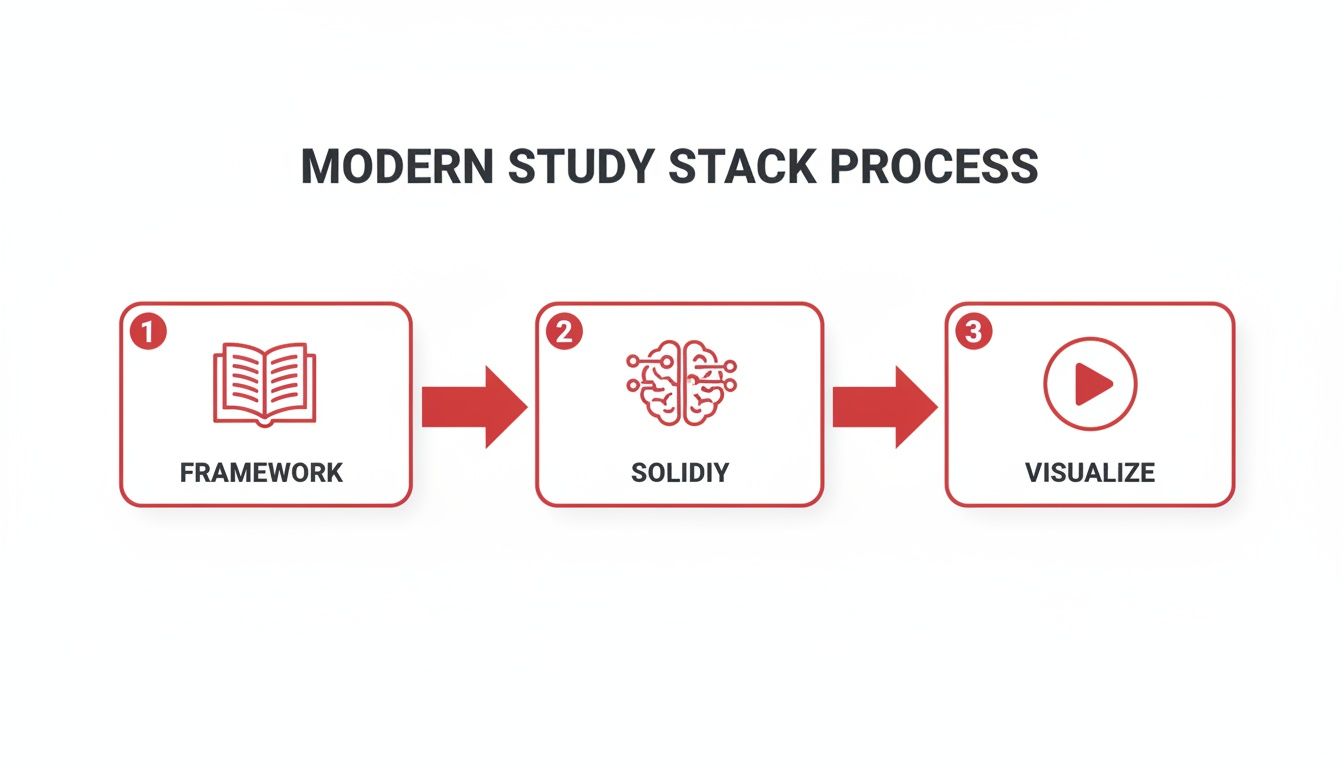
As you can see, Qbanks are the critical bridge between building your foundational knowledge and actually making it stick for the long haul.
Mastering Your Qbank Workflow
To get the most out of every single question, you need a structured workflow. Early in your study period, do your question blocks in tutor mode. This gives you immediate feedback, letting you connect the dots while the question is still fresh in your mind.
As you get closer to your exam date, it's time to switch gears. Transition to doing timed, random blocks. This shift is crucial for two reasons. First, it simulates the real exam environment, building your pacing and stamina. Second, it forces you to rapidly switch between subjects—a key skill for crushing Step 1.
But no matter which mode you're in, the review is where the magic happens. For every single question—correct and incorrect—you need to be able to explain:
- Why the correct answer is 100% right.
- Why every other answer choice is 100% wrong.
- The core concept the question was actually testing.
If you can’t clearly articulate all three, you haven't milked that question for all its worth. This detailed breakdown is a form of active recall, a powerhouse learning strategy that blows passive reading out of the water. To really dig into this, check out our guide on how active recall for medical students works.
Creating a Powerful Error Log
Your error log will become your secret weapon. Seriously. It’s just a simple spreadsheet or document where you track the questions you get wrong and, more importantly, why you got them wrong. This isn't about shaming yourself; it’s about collecting data to find your blind spots.
I recommend categorizing your mistakes into two main buckets:
- Knowledge Gaps: You flat-out didn't know the information. For example, not knowing that a "fixed, split S2" is the classic sign of an Atrial Septal Defect (ASD). The fix here is straightforward: targeted content review.
- Test-Taking Errors: You actually knew the material but still missed the question. Maybe you misread the vignette, second-guessed your gut instinct, or got lost in a long question stem.
Over time, this log will reveal undeniable patterns. You might realize you consistently miss microbiology questions or have a bad habit of overthinking straightforward ethics scenarios. This data lets you fix your weaknesses with surgical precision instead of just randomly re-reading chapters.
Every mistake is a learning opportunity in disguise. Your error log is the tool that helps you decode those opportunities and turn them into tangible score improvements.
The Smart Way to Use Spaced Repetition
Spaced repetition software (SRS) like Anki is non-negotiable for retaining the sheer volume of facts needed for Step 1. But mindlessly flipping through thousands of cards a day is a recipe for burnout, not a high score.
Many students get great results with high-quality, pre-made decks like AnKing, which is a massive deck built from First Aid, UWorld, and other key USMLE Step 1 study material. The biggest advantage is the time you save—the cards are already made for you.
However, the most effective Anki cards are often the ones you make yourself. When you review a UWorld question and identify a key fact you missed, turn it into a simple, targeted Anki card.
For instance:
- Front: What is the classic heart sound associated with an ASD?
- Back: Fixed, split S2.
This personalizes your review, focusing your precious Anki time on your specific weaknesses. A hybrid approach often works best: use a pre-made deck for broad coverage, and supplement it with custom cards you create from your Qbank incorrects. This strategy ensures you're building a comprehensive knowledge base while actively patching your own unique gaps.
Building a Study Schedule That Prevents Burnout
Having the perfect set of USMLE Step 1 study material is like owning a high-performance race car—it’s completely useless without a skilled driver and a clear map. Your study schedule is that map. A well-designed plan is the single most important factor separating focused, efficient preparation from the aimless, burnout-inducing chaos so many students fall into.
A common mistake is thinking that studying harder means studying longer. This marathon mentality almost always leads to diminishing returns, where the last few hours of a grueling 12-hour day yield practically zero real learning. The goal isn't to maximize hours clocked; it's to maximize the quality and retention of every single study session.

A sustainable schedule has to respect your brain's cognitive limits. It must build in non-negotiable time for rest, recovery, and life outside of medicine.
Adopting the Block Method
Instead of bouncing randomly between subjects, the most effective approach is the "block" method. This simply means you focus on one organ system at a time (like Cardiology) and tackle it across all your primary resources before moving on.
This creates a powerful synergistic effect. You'll read about myocardial infarctions in First Aid, get the pathophysiology down with Pathoma, watch a Sketchy video on beta-blockers, and then solidify everything by doing Cardiology questions in UWorld. This integrated approach builds far deeper, more interconnected knowledge than a scattered plan ever could.
A typical system block might last anywhere from four to seven days, depending on its complexity.
A Sample Weekly Schedule Framework
Your schedule should be a living document, not a rigid prison. That said, starting with a solid framework is key. Here’s a balanced template you can adapt for a typical week during your dedicated study period.
Morning (8 AM – 12 PM): This is usually peak focus time. Use it for your most demanding cognitive task: new practice questions.
- Complete two 40-question UWorld blocks (timed, random).
- Take a real 15-minute break between blocks. Get up, walk around.
Afternoon (1 PM – 5 PM): Shift gears from testing to deep learning and review.
- Meticulously review the 80 questions from the morning, creating Anki cards for incorrects and tricky concepts.
- Spend 1-2 hours on targeted content review for that day's system block (e.g., watching Pathoma or Sketchy videos for Cardiology).
Evening (7 PM – 9 PM): Wind down with consolidation and long-term retention.
- Crush your daily Anki reviews.
- Briefly skim notes from the previous day's weak topics.
Your schedule must serve you, not the other way around. If you're a night owl, flip the schedule. The key is to match your most difficult tasks (like Qbanks) with your personal peak energy levels.
This structure dedicates about eight hours to focused studying, a sustainable and highly productive target for most students. For a more detailed breakdown and other templates, check out our in-depth guide to building a comprehensive study schedule for medical students.
Scheduling Your Sanity
This might be the most overlooked—and most critical—part of your entire plan. Step 1 prep is a marathon, not a sprint. Without intentional rest, you are guaranteed to burn out.
You have to schedule your breaks with the same seriousness you schedule your study blocks.
- Daily Unplug Time: Carve out at least one hour every single evening to do something completely unrelated to medicine. Watch a dumb show, call a friend, go for a walk—anything that lets your brain switch off.
- Protected Sleep: Aim for 7-8 hours of quality sleep per night. Sacrificing sleep for more study time is scientifically proven to destroy memory consolidation and critical thinking. It is the single worst trade-off you can possibly make.
- Weekly Full Day Off: Take one full day off every week. No Anki, no questions, no videos. This day is absolutely essential for psychological recovery and prevents the cumulative fatigue that crushes performance.
As your exam date gets closer, your schedule will naturally evolve. The focus will shift away from learning new content and move towards building test-day endurance. In the final two to three weeks, you'll start replacing some content review time with full-length practice exams (like NBMEs or UWSAs) to simulate the 7-hour experience. This final phase is all about refining your pacing, managing test-day nerves, and walking into the center feeling prepared, confident, and rested.
How to Prepare in the Pass/Fail Era
When the USMLE Step 1 went pass/fail, a lot of students breathed a sigh of relief. The common thinking was, "Great, now I just have to pass." But this mindset is a dangerous trap.
The reality is that this exam has become a different kind of beast—one with subtle but serious consequences for your medical career if you underestimate it.
Let's look at the numbers. When the switch to pass/fail happened on January 26, 2022, the USMLE didn't just hide the score; they also raised the passing threshold from 194 to 196. That tiny two-point bump had a massive impact.
Official data shows that overall pass rates plummeted from 88% in 2021 to just 82% in 2022. For first-time International Medical Graduates (IMGs), the drop was even steeper, falling from 82% to 74% in a single year. The message is clear: treating Step 1 lightly is a recipe for disaster.
A Strong Foundation is More Important Than Ever
Without a three-digit score to lean on, residency program directors have shifted their focus, placing far more weight on other parts of your application. Your Step 1 performance is the foundation for all of them.
Here's what they're looking at now:
- Your Step 2 CK Score: This is now the undisputed king of standardized exam metrics. A shaky Step 1 foundation makes a high Step 2 CK score nearly impossible to achieve, as the clinical questions on the second exam assume you have absolute mastery of the basic sciences.
- Clinical Grades and Evaluations: Your performance during third-year clerkships is now under a microscope. Program directors want to see you consistently excelling in real-world clinical environments.
- Research and Extracurriculars: Meaningful involvement in research, publications, and leadership roles helps paint a complete picture of who you are as a candidate.
To excel in this new landscape, it's critical to adapt your study habits. Understanding the latest best practices for online learning can help you get the most out of your digital resources and truly thrive.
Common Pitfalls in the Pass/Fail Era
The "just need to pass" mentality leads students down a path of inefficient and risky study habits. Recognizing these traps is the first step to avoiding them.
One of the biggest culprits is resource overload. Students, terrified of missing a key detail, start piling on every resource they can find. This shotgun approach leads to a superficial understanding of a lot of topics instead of the deep mastery of high-yield concepts you actually need.
Another huge problem is passive learning. Re-watching lecture videos or re-reading First Aid for the fifth time feels productive, but it's a false sense of security. If you aren't actively doing practice questions and forcing your brain to retrieve information every single day, that knowledge simply won't stick when the pressure is on.
Reframe your goal. Step 1 isn't just a hurdle to jump over; it's the fundamental language of medicine. Your goal should be to achieve fluency. A confident pass—and a stellar Step 2 CK score—will naturally follow.
Finally, a surprisingly common mistake is avoiding official practice exams. Many students put off taking NBME self-assessments because they're afraid of seeing a low score. But these exams are your single best diagnostic tool. They pinpoint your weaknesses before they become critical failures on test day.
You have to face the data head-on. It's the only way to build a targeted plan for improvement. For a deeper dive, check out our guide on what USMLE Step 1 pass/fail means for students.
Using Practice Exams to Find and Fix Your Weaknesses
If your Qbank is your daily sparring partner, then practice exams are your diagnostic MRI scans. They are, without a doubt, the single most objective tool you have to measure your progress, uncover those sneaky hidden weaknesses, and build the sheer mental endurance needed for the real seven-hour exam day.
But just doing the exams isn't enough. Not even close. The real magic happens when you have a systematic approach to scheduling, taking, and—most importantly—reviewing each one.

The gold standard sources are the NBME Comprehensive Basic Science Self-Assessments (CBSSAs) and the UWorld Self-Assessments (UWSAs). Both are absolutely essential pieces of your USMLE Step 1 study material because they're written by the very same people who create the actual exam. This gives you the most authentic feel for question style, length, and difficulty.
Creating a Strategic Exam Timeline
Randomly taking practice exams whenever you feel like it is a huge waste of a precious resource. You need a clear timeline where each test informs the next phase of your study plan. Think of it as a series of crucial data points.
A highly effective strategy is scheduling your exams to track your progress and spot trends over time.
- Your Baseline Exam: Take an NBME exam before you even start your dedicated study period. Seriously. The score doesn't matter one bit. Its sole purpose is to give you a raw, unbiased starting point and shine a bright light on your initial weak areas.
- Midpoint Check-ins: From there, schedule subsequent NBME exams every one to two weeks throughout your dedicated period. This regular rhythm lets you see if your study strategies are actually moving the needle and helps you pivot your focus when needed.
- The Final Predictors: In the last two weeks before your test date, it's time for UWSA 1 and UWSA 2. These are widely considered to be highly predictive of your final score and serve as that crucial final check-in.
This structured approach transforms your practice exams from scary, high-stakes events into a powerful, data-driven feedback loop that guides your entire prep.
The Art of the Practice Exam Review
Finishing a practice exam is only half the battle. The review is where you extract the real value, turning a simple score into a concrete plan for improvement. Plan to dedicate at least four to six hours the day after your exam to a meticulous, question-by-question review.
Your goal is to categorize every single incorrect question into one of two buckets:
- A True Knowledge Gap: You flat-out did not know the fact, pathway, or mechanism being tested. An example would be not recognizing the classic triad for Wernicke-Korsakoff syndrome.
- A Test-Taking Error: You actually understood the underlying concept but totally misread the question, missed a critical word like "except" or "not," or second-guessed your gut instinct.
A rookie mistake is to only review the questions you got wrong. You must also review every question you marked or felt even a little unsure about, even if you got it right. This is how you separate true mastery from a lucky guess.
Once you've categorized your errors, consolidate them in your error log. After a few exams, clear patterns will start jumping out at you. You might discover you consistently get tripped up by renal physiology or that you tend to rush through long clinical vignettes. This is the specific, high-yield data you need to fine-tune your remaining study time for the biggest possible impact. You can learn more about structuring these assessments by exploring resources on USMLE practice exams.
Interpreting Your Scores and Making the Call
As you track your scores, what you're really looking for is a clear upward trend. A single score is just a snapshot in time, but a series of scores tells a story.
While the official passing score for Step 1 is 196, you shouldn't be aiming to just barely scrape by.
A widely accepted "safe" margin is to be consistently scoring above 210 on your final two or three practice exams. This buffer accounts for test-day nerves and the normal variability between practice tests and the real deal. Hitting this mark consistently is a strong sign that you’ve built a solid enough foundation to walk into that testing center with confidence, knowing you're ready to pass.
When You Might Need More Than a DIY Study Plan
Look, a solid self-study plan is the backbone of Step 1 prep for a reason—it works for a lot of students. But it's not a magic bullet. For some people, especially International Medical Graduates (IMGs) or those staring down a retake, targeted expert support can be the one thing that flips the script from a potential fail to a confident pass.
Just trying the same thing again—re-reading the same USMLE Step 1 study material and hoping for a different result—is a recipe for disappointment. It rarely works.
The data tells a pretty stark story here. In 2023, while 90% of US and Canadian MD grads passed Step 1 on their first go, that number plummeted to just 72% for students from non-US/Canadian schools. The gap gets even wider for repeat test-takers; the pass rate for IMGs retaking the exam dropped to a shocking 47%.
These numbers aren't meant to scare you, but they highlight a critical reality: certain groups face unique hurdles that demand a smarter, more personalized strategy. You can dig into these numbers yourself by checking out the official USMLE performance data.
Red Flags: Is It Time to Call for Backup?
Recognizing you need help isn't a sign of weakness—it's a sign you're serious about passing. A tutor isn’t just for students who are failing. They’re for anyone who wants to sharpen their prep and build the strongest possible foundation for clinicals and Step 2 CK.
It might be time to bring in an expert if any of this sounds familiar:
- You've failed the exam before. This is the biggest one. A previous fail is a clear signal that your original approach had some serious flaws. An expert provides that crucial outside perspective to figure out what went wrong and build a completely new game plan.
- Your practice exam scores are flatlining. If your NBME scores have been stuck in the same range for weeks, you're not just spinning your wheels—you're burning valuable time. This usually points to deep-rooted issues in how you break down questions or specific content gaps you're just not seeing.
- You're completely overwhelmed and have no structure. The sheer volume of material is paralyzing. A tutor brings accountability and a clear roadmap, cutting through the noise and focusing your energy on what actually moves the needle.
How a Great Tutor Changes the Game
A good tutor does way more than just re-teach you glycolysis. Their real value is in overhauling your entire approach to the exam. Think of them as a strategist, coach, and accountability partner all in one.
A tutor’s job isn't to give you the answers. It's to teach you how to find the answers yourself. They help you master the process of thinking through a question, a skill you’ll need for Step 1, Step 2, and the rest of your career.
Here’s a real-world example: an IMG might know the basic science inside and out but gets tripped up by the tricky phrasing and clinical twists in NBME-style questions. A tutor can sit down with them, work through UWorld blocks side-by-side, and literally teach them the pattern recognition skills to figure out what a question is really asking.
For someone who previously failed, a tutor can dissect their old score report, pinpoint the exact weak spots, and build a targeted plan to fix them. It ensures you're not just making the same mistakes again. This isn't just about spending money; it's a strategic investment in your confidence and your future.
If you’re stuck at a score plateau, recovering from a failed attempt, or just want to make sure your study plan is as sharp as it can be, personalized guidance can be a total game-changer. The expert tutors at Ace Med Boards specialize in creating customized strategies that zero in on your unique challenges and help you pass with confidence.
Schedule a free consultation with Ace Med Boards to build your personalized Step 1 success plan.

