
The NBME Step 2 CK practice exam is, without a doubt, the single most predictive tool you have for estimating your final score. These exams, officially called the Comprehensive Clinical Science Self-Assessments (CCSSA), come directly from the test makers. They are designed to perfectly mirror the real deal—format, timing, question style, everything—making them an absolutely essential part of your prep.
Your Blueprint for Mastering the NBME Practice Exam
Let’s be blunt: if you’re treating your NBME practice exams as just another box to check, you're making a huge mistake. These aren't just hurdles to clear; they are incredibly powerful diagnostic tools. When you use them correctly, they can completely reshape your entire study approach.
So, forget obsessing over a single score. Instead, think of each nbme step 2 ck practice exam as a deep-dive analysis that shows you exactly what you know and—more importantly—precisely where you’re weak.
Here’s a look at the NBME's Self-Assessment Services portal, which will become your command center for these exams.
This is where you'll schedule your assessments and, afterward, dig into the detailed performance feedback that will guide your entire study plan.
A Proven Four-Pillar Methodology
I’ve seen countless students prepare for Step 2, and the ones who succeed don't just wing it. They follow a proven methodology built on four essential pillars. Success isn't just about cramming facts; it's about having a system that builds endurance, sharpens your clinical reasoning, and guarantees you peak right on test day.
Here are the pillars:
- Strategic Selection: Picking the right CCSSA forms at the right times in your study schedule.
- Realistic Simulation: Replicating test-day conditions down to the last detail to build stamina and kill surprises.
- Granular Analysis: Going way beyond right vs. wrong to figure out why you're making certain mistakes.
- Smart Integration: Tying your performance data directly back to your Qbank sessions and content review.
Adopting this structured approach is often the key differentiator between simply passing and achieving a score that opens doors to competitive residency programs. It’s about working smarter, not just harder.
The stakes for Step 2 CK are incredibly high, and your preparation needs to reflect that. As you map out your study plan, it’s also critical to optimize how you learn. This means implementing effective techniques for maintaining focus during intense study sessions to get the most out of every hour.
Understanding the Stakes
Let me be clear: your first attempt at Step 2 CK is the one that matters most. According to performance data published by the National Board of Medical Examiners, first-time test-takers from U.S. medical schools had an 88% passing rate between July 2023 and June 2024.
Now, look at the contrast. For those repeating the exam, the passing rate plummeted to just 60-61%. That massive drop shows just how critical it is to get your preparation right from the very beginning. Your first shot is your best shot.
Ultimately, mastering the NBME practice exam is a non-negotiable part of any winning Step 2 CK strategy. For a complete roadmap on how to fit these principles into a bigger plan, check out our comprehensive USMLE Step 2 CK study guide.
Choosing and Scheduling Your Practice Exams
Figuring out when to take your NBME practice exams is a game-changer for your Step 2 CK prep. This isn't about cramming in as many tests as you can. It's about strategic placement—giving yourself enough time for deep review, targeted improvements, and building stamina without hitting a wall.
A smart schedule transforms each practice test from a dreaded checkpoint into an incredibly powerful learning tool. Think of your dedicated study period like a training montage. You need a baseline to see where you start, mid-point check-ins to adjust your game plan, and a final assessment to make sure you’re peaking at the right time.
Mapping Your Exam Timeline
For most students knee-deep in a dedicated study block, taking an NBME practice exam every 10-14 days is the sweet spot. This rhythm gives you enough breathing room to meticulously review your performance, build a solid error log, and actually implement changes before you sit down for the next one. Testing too often, like every single week, can cause score fluctuations that have more to do with random chance than real knowledge growth.
Here’s a practical way to map out your exams over a typical 6-8 week dedicated period:
- The Baseline Exam (6-8 Weeks Out): Kick things off with one of the older but still very useful CCSSA forms (think Forms 9, 10, or 11). The goal here isn’t a stellar score. It's about getting an honest, unfiltered look at your starting point, pinpointing your most glaring weaknesses, and setting a benchmark to track your progress.
- The Mid-Prep Check-In (3-5 Weeks Out): Time for a more recent form, like Form 12 or 13. This one is a crucial reality check. By this point, you should be seeing real improvement in those weaker areas. If your score has stalled, now is the moment to dig deep, figure out why, and make some serious adjustments to your study methods.
- The Final Predictors (1-2 Weeks Out): In the final stretch, you’ll want to take the newest CCSSA forms available (like Form 14) and, of course, the Free 120. These are widely considered the most predictive of your final score because their style and content mix are the closest you'll get to the real deal.
This tiered approach helps you build momentum and confidence as you get closer to exam day. For a deeper dive into how this fits into your overall timeline, our guide on when to take USMLE Step 2 has more detailed schedules.
To help you visualize this, here’s a sample schedule you can adapt for a 6-week dedicated study period.
Sample NBME Step 2 CK Practice Exam Timeline
| Study Week | Recommended Action | Goal and Rationale |
|---|---|---|
| Week 1 | Take a baseline exam (e.g., Form 9). | Establish your starting point. This isn't about the score; it's about identifying your weakest subjects to guide your initial study focus. |
| Week 2 | No exam. Focus on targeted content review. | Deeply review your baseline exam errors. Spend the week shoring up foundational knowledge in your 2-3 weakest areas. |
| Week 3 | Take a mid-prep exam (e.g., Form 11). | Check your progress. Are your study methods working? This is your chance to pivot your strategy if you're not seeing improvement. |
| Week 4 | No exam. Integrate Qbank blocks and review. | Analyze your mid-prep exam performance and hit weak areas hard with targeted UWorld blocks. Focus on application and reasoning. |
| Week 5 | Take a predictive exam (e.g., Form 14). | Assess your readiness and get a more accurate prediction of your score. Use this to fine-tune your final week of study. |
| Week 6 | Take the Free 120 (3-4 days before exam). | This is your final dress rehearsal. Get comfortable with the question style and interface of the real exam. Review it thoroughly. |
This schedule is a template, not a rigid rule. The key is the cycle of testing, reviewing, and applying what you've learned before you test again.
Simulating Test Day Conditions
When you take the exam is only half the battle; how you take it is just as important. Treat every single NBME as a full-blown dress rehearsal for test day. This is how you build the mental and physical endurance you’ll need for a grueling nine-hour exam.
Simply taking the practice test isn't enough. You must replicate the environment to expose and address weaknesses in focus, timing, and break management before they can sabotage you on your actual exam day.
Start by taking it seriously. Wake up at the same time you will on test day. Eat the same breakfast. Wear comfortable clothes.
Follow these non-negotiable rules for every practice test:
- Strict Timing: Use the official time limits for every block. No pausing, no looking things up, and no giving yourself a few extra minutes. The entire point is to get comfortable with the pressure of the clock.
- Eliminate Distractions: Your phone goes in another room, and it stays off. Tell your roommates or family that you are completely unavailable. Find a quiet spot where you can lock in and focus for the full duration.
- Manage Your Breaks: The real exam has 60 minutes of total break time. Practice how you’ll use it. Will you have a snack? Do a few stretches? Just close your eyes for a minute? Learning to use your breaks effectively is a skill in itself, so don’t skip them during your practice runs.
By consistently simulating the real testing environment, you remove the element of surprise. When your official test day rolls around, the structure, the timing, and the pressure will all feel familiar, letting you focus all your mental energy on answering the questions in front of you.
The Art of the Post-Exam Review
Getting your score back from an NBME Step 2 CK practice exam is just the starting gun. The real work—and where the real score jumps happen—begins with a deep, systematic review of your performance.
So many students just glance at the three-digit number, scroll through their incorrects, and call it a day. That's a massive missed opportunity.
The goal isn't just to see what you got wrong, but to understand why you got it wrong. This is how you turn raw data into a concrete plan for improvement. To get there, I push my students to use a structured approach I call the '4-Pass Review Method.' It forces you to look at every mistake from multiple angles, making sure no learning point gets left behind.
This whole process fits into a larger strategy. Practice exams aren't just random events; they are key checkpoints in your study timeline.
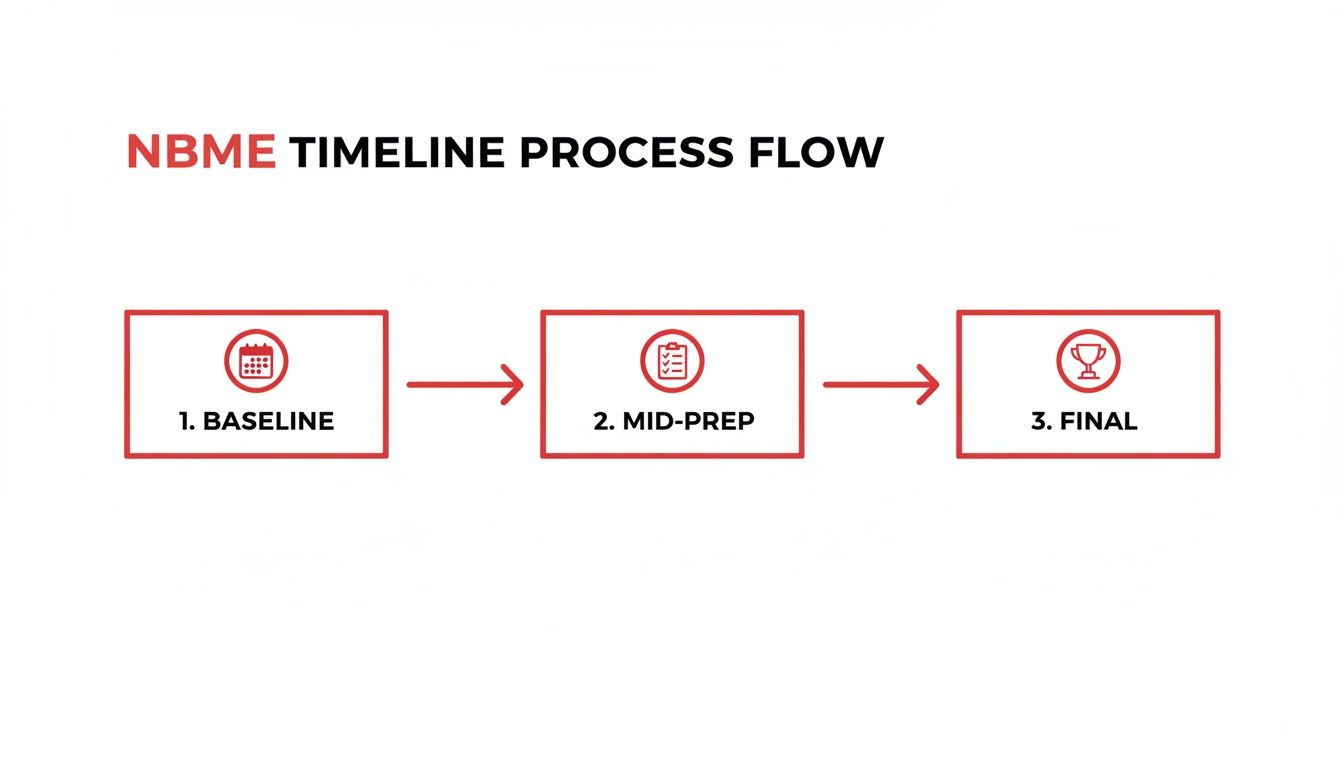
Each of these stages—Baseline, Mid-Prep, and Final—serves a totally different purpose. The review you do after each one is what actually drives your score up.
The First Pass: Incorrect Questions
This is the obvious first step, but it demands more than a quick look. For every single question you answered incorrectly, you need to play detective and pinpoint the exact point of failure. Don't just read the explanation and move on.
You have to ask yourself some tough, honest questions:
- Was it a pure knowledge gap? Did you just flat-out not know the material? If so, that’s your signal to hit the books or your Qbank for that specific topic.
- Did you misread the question stem? This is one of the most common and frustrating errors. Did you blow past a key detail like "except," "not," or a subtle clinical finding that changed everything?
- Did you misunderstand the answer choices? Sometimes you know the concept cold but just couldn't differentiate between two very similar-sounding options.
- Was it a timing issue? Did you panic and make a careless mistake because the clock was ticking down?
Answering these honestly is the foundation for building a truly useful error log.
The Second Pass: Marked Questions
Next up are the questions you marked but ultimately got right. These are your "lucky guesses" and moments of hesitation—they represent fragile knowledge. Ignoring them is a huge mistake. On test day, that same uncertainty could easily flip to a wrong answer.
Going back through these questions helps solidify shaky concepts. You might have reasoned your way to the correct answer, but if you weren't 100% confident, there’s still a crucial learning opportunity. This pass is all about turning that 50/50 guess into rock-solid knowledge you can bank on under pressure.
The difference between a 240 and a 260 isn't just about knowing more facts; it's about the confidence and speed with which you apply them. Eliminating uncertainty by reviewing marked questions is a high-yield way to build that exam-day armor.
The Third Pass: A Systems-Based Review
Okay, now it’s time to zoom out. Instead of looking at individual questions, you need to analyze your performance by clinical subject or organ system. Your score report will break this down for you.
Did you consistently tank Cardiology questions? Were Neurology questions your Achilles' heel?
This systems-based pass helps you spot recurring themes and larger-scale weaknesses. Seeing that you missed 70% of your renal questions is a much louder alarm bell than just noting a few random errors. It tells you that you need to dedicate a full study block to that system, not just review a few isolated concepts. This is how you stop plugging tiny holes while a massive leak goes unnoticed.
If you want a more structured way to think about different exam types and timelines, you can find more information about various USMLE practice tests and how to best slot them into your prep plan.
The Fourth Pass: The Error Log
The final pass is all about consolidation. This is where you pull everything you've learned from the first three passes into a powerful, personalized study tool: your error log. A simple spreadsheet is perfect for this.
Your log should categorize every single mistake you've analyzed. Here's a simple but incredibly effective structure:
| Question # | Subject/System | Error Type | Key Learning Point | Action Item |
|---|---|---|---|---|
| Block 2, Q14 | Cardiology | Misread Question | Missed "history of asthma" making beta-blocker incorrect. | Review contraindications for ACS meds. |
| Block 3, Q28 | Renal/GU | Knowledge Gap | Confused nephritic vs. nephrotic syndrome presentation. | Do a 20-question UWorld block on glomerulonephritis. |
| Block 1, Q35 | Biostats | Calculation Error | Mixed up sensitivity and specificity formulas under time pressure. | Create 5 Anki cards for biostats formulas. |
This log does way more than just track mistakes; it creates a direct feedback loop. It connects your nbme step 2 ck practice exam performance directly to your daily study tasks in UWorld, Amboss, or Anki.
Let's walk through a real-world example. Say you get a question about a patient with chest pain, ST-segment elevations, and a history of asthma. You correctly diagnose an acute coronary syndrome (ACS) but choose a beta-blocker as the next best step, which gets marked wrong.
A superficial review just says, "Okay, beta-blockers were wrong." A deep review using the 4-Pass method uncovers so much more:
- Incorrect Pass: The answer was wrong.
- Marked Pass: You weren't totally sure, but you knew beta-blockers were standard for ACS.
- Systems Pass: You notice this is your third missed Cardiology question related to pharmacology.
- Error Log Pass: You log the error as "Misread Question" because you overlooked the asthma history. The action item becomes "Review absolute and relative contraindications for all standard ACS medications."
Suddenly, one wrong answer doesn't just teach you one fact. It triggers a focused review of an entire class of high-yield information, preventing dozens of similar mistakes down the road. This granular, multi-pass review is the art that turns a simple practice test into one of your most powerful study assets.
What Your NBME Practice Score Really Means
Getting that three-digit number on your score report can feel like a final verdict. A high score brings a wave of relief, while a lower-than-expected result can send you into a full-blown panic. Before you do either, take a deep breath. The most important thing to remember is this: your nbme step 2 ck practice exam score is just a piece of data, not a judgment on your potential.
Think of it as a snapshot in time. It shows how you performed on one specific set of questions, on one particular day. It's less of a final grade and more like a detailed diagnostic report from a specialist. The true value isn’t in the number itself, but in what it reveals about your current strengths and—more importantly—your specific opportunities for improvement.
Decoding the Numbers
Your score report is more than just a single number. You’ll see a scaled score and often a confidence interval. The scaled score is designed to be comparable across different versions of the exam, which is helpful. The confidence interval, however, gives you a range where your "true" score likely falls.
For instance, a score of 245 with a confidence interval of +/- 8 suggests your actual knowledge level is probably somewhere between 237 and 253. Understanding this built-in variability is critical. It helps you realize that small fluctuations between exams are totally normal and not a sign that you’re suddenly backsliding.
A single score drop can happen for dozens of reasons:
- You were exhausted or hitting a wall of burnout.
- The exam happened to test a cluster of your weakest topics.
- You were distracted by something going on in your life.
- You experimented with a new timing strategy that didn't pan out.
Instead of obsessing over one disappointing result, zoom out and look at the overall trend across multiple exams. Consistent growth over time is a much more reliable indicator of readiness than any single performance.
When Your Score Plateaus or Drops
It’s one of the most frustrating parts of the process: you're putting in the hours, but your score hits a wall or even dips. This is your cue to shift from being a student to being a detective.
A score plateau is often a sign that your current study method has run its course. It might be time to switch from passive content review to more active problem-solving or refining your question-answering strategy.
A sudden drop, on the other hand, frequently points to burnout or a specific knowledge gap that the exam just ruthlessly exposed. This isn't a failure; it’s a gift. The test just handed you a personalized roadmap showing exactly where to focus your energy next. Use that intel to adjust your plan, get some rest if you need it, and come back stronger. To get a better handle on how scores are calculated, you can explore our complete guide to Step 2 CK scores and percentiles.
The Bigger Picture: Your Score in Context
While it’s crucial not to overreact to one score, it’s also important to understand why these exams carry so much weight. Step 2 CK scores have become a major predictor of success in residency and beyond.
In fact, research shows a strong correlation between exam performance and long-term career outcomes. One analysis found that physicians scoring 200 or above were about 7 times more likely to achieve board certification than those scoring below 200. This predictive power is a key reason residency programs weigh these scores so heavily—they see it as a signal of a solid foundation of clinical competence. Discover more insights from this study on residency success predictors.
Ultimately, your NBME practice score is a tool. Use it to guide your studying, not your stress levels. Track your trends, analyze your weaknesses honestly, and make targeted adjustments. By reframing the score as diagnostic feedback, you can transform it from a source of anxiety into your most powerful asset for hitting your goal.
Turn Your Practice Exam Insights Into a Qbank Weapon
Your NBME review is a treasure map showing you exactly where the gold is buried. After you've done the hard work of analyzing your performance and building that error log, the next move is crucial: you have to connect those insights to your daily Qbank routine. Just knowing your weak spots isn't enough—you need to attack them with relentless, focused practice.
This is the moment where data becomes action. Your error log stops being a list of what you did wrong and transforms into a blueprint for creating surgical strikes in UWorld or Amboss. We're talking about building highly targeted question blocks designed to systematically wipe out your weaknesses.
From Error Log to Targeted Qbank Blocks
The way you create these custom blocks should be methodical. Forget about doing random, timed 40-question blocks covering everything under the sun. Instead, you’ll build smaller, laser-focused sets based on the weak patterns you found in your nbme step 2 ck practice exam review.
Let's say your error log screams "Nephrology," specifically glomerulonephritis and electrolyte imbalances. Your next step isn't to just passively "study more nephro." A much better approach is to actively build specific Qbank sessions to fix this.
Here’s a practical workflow you can use right away:
- Isolate the System: First, create a question block using only the "Renal/GU" system.
- Drill Down on Topics: Inside that system, hand-pick the subtopics that gave you nightmares, like "Glomerular Disorders" and "Fluid & Electrolytes."
- Use Tutor Mode: For these targeted sessions, always use tutor mode, not a timed test. The goal here isn't to simulate the exam; it’s to learn deeply. This lets you read every explanation immediately, hammering home the concepts in real-time.
- Vary the Block Size: Forget the standard 40 questions. A focused set of 15-20 questions on a very narrow topic is often far more powerful for deep learning than a longer, more scattered set.
This strategy turns your Qbank from a simple testing tool into an active learning machine. You're directly confronting your weaknesses with targeted repetition until the clinical reasoning becomes second nature. There are plenty of great tools out there, so it's worth checking out the best Step 2 CK question banks and practice resources to see which one clicks with your style.
When to Bring Your Data to a Tutor
Working on your own is powerful, but sometimes you hit a wall that you just can't break through alone. This is where a tutor can be a game-changer, but the session is only as good as the data you bring to it. Showing up and saying, "I'm weak in Cardiology," is vague and a waste of your time and money.
Instead, your NBME performance data and detailed error log should be the agenda for your tutoring session. This creates a hyper-focused meeting where every minute is spent solving your specific problems.
Don't treat tutoring like a passive lecture. Use it as a strategic intervention. When you bring your performance trends and error log to the table, you transform a generic review into a focused problem-solving session that gets right to your sticking points.
Before you meet with a tutor, get your story straight. Prepare a quick summary of your findings:
- Present Your Trends: Show them your scores from several practice exams. Are you stuck on a plateau? Did your score suddenly drop?
- Share Your Error Log: Point out the most common "Error Types" you've logged. For instance, "I consistently misinterpret question stems that have a ton of lab values," or "I always get stuck between similar-sounding answer choices in endocrine questions."
- Bring Specific Examples: Have 2-3 specific questions from your last NBME ready to go. Walk the tutor through your exact thought process so they can diagnose where your reasoning went off the rails.
This proactive approach makes your tutoring sessions exponentially more valuable. A great tutor can look at this data and give you targeted strategies—maybe a new way to approach certain question types, a killer mnemonic for a tough pathway, or a resource for a knowledge gap you didn't even realize you had. It’s the best way to get unstuck and push your score into the next tier.
Common Questions About NBME Practice Exams
As you get deeper into your dedicated study period for the NBME Step 2 CK, it's totally normal for specific questions and anxieties to pop up. Let's cut through the noise and get you some direct, no-nonsense answers to the questions we hear most often.
Which NBME Practice Exam Is Most Predictive?
Everyone's looking for that one magic bullet—the single exam that will tell them exactly what score they'll get on test day. But the truth? It’s much more about the trend of your scores than any single test result.
While the newest CCSSA forms (like Forms 13 and 14) and the Free 120 are generally seen as the most accurate snapshots, your most reliable prediction comes from the average of your last two or three exams taken close to your real test date. A consistent performance across different forms is a far stronger signal of readiness than one standout score. So, focus on your overall trajectory in those final few weeks.
What Should I Do If My NBME Score Drops?
First thing's first: don't panic. A sudden score drop happens to almost everyone, and it rarely means you've actually lost knowledge. More often than not, it’s a red flag for external factors you can fix.
Think about these common culprits:
- Burnout and Fatigue: Are you running on fumes? A tired brain just doesn't perform well, period. Sometimes, the absolute best thing you can do after a score drop is take a full day off to completely reset.
- A Specific Weakness: The exam may have just happened to hit a cluster of your weak topics. This is actually a gift. The test just handed you a personalized, high-yield list of exactly what you need to work on.
A score drop isn't a sign of failure; it's a signal to adjust your study plan. Dive deep into the review for that specific exam. It’s likely to reveal a key knowledge gap you now have the opportunity to fix for good.
How Many NBME Practice Exams Should I Take?
It’s tempting to cram in as many tests as you can, but the goal should always be quality over quantity.
For most students, taking four to six exams during a dedicated study period hits the sweet spot. This allows you to get a baseline, check in on your progress a few times, and take a final predictive exam without completely sacrificing your review time—which is where the real learning happens.
Rushing through multiple tests is far less valuable than taking one exam and then spending one or two full days reviewing it meticulously. A good rhythm is a baseline test at the start of your dedicated period, followed by one exam every one to two weeks, and a final assessment about a week before the real deal. This schedule gives you enough breathing room to learn from your mistakes and actually implement changes before your next practice test.
At Ace Med Boards, we specialize in turning practice exam data into actionable strategies that lead to real score improvements. If you're hitting a plateau or want to maximize your study efficiency, a personalized tutoring session can make all the difference. Schedule your free consultation today!

