
Before you drop a single dollar on practice exams, it's critical to understand what NBME practice shelf exams really are. They aren't just shorter versions of the real thing; they're powerful diagnostic tools designed to sharpen your clerkship studying. Their whole purpose is to simulate the pressure of the clock and pinpoint your specific knowledge gaps, setting you up for a much smarter, more targeted study period.
Understanding the Purpose of NBME Practice Exams
So many students fall into the trap of treating their practice exam scores like a final grade, which just leads to a ton of unnecessary stress or a false sense of security.
Instead, you need to see these exams as a strategic starting point. Their primary job isn't just to predict your final score, but to hand you a detailed map of your strengths and weaknesses under realistic time constraints.
The NBME intentionally creates two different types of assessments for clerkship prep. First, you have the official, full-length NBME Subject Examinations (the "shelf exams") that medical schools use to grade you. Then, you have the shorter, 50-item practice forms made for students to self-assess.
Here's a quick look at how they stack up.
Practice Form vs Official Shelf Exam At a Glance
| Feature | NBME Practice (Self-Assessment) | Official Shelf Exam |
|---|---|---|
| Question Count | ~50 questions | ~100-110 questions |
| Time Limit | ~75 minutes | ~2.5 hours |
| Pacing | ~90 seconds per question | ~90 seconds per question |
| Purpose | Diagnostic & self-assessment | Official evaluation |
| Score Report | Detailed performance feedback | Graded score for your rotation |
| Environment | Self-administered | Proctored exam setting |
The key takeaway? While the length and stakes are different, the pacing is identical. This is by design, forcing you to practice the exact same time management skills you'll need on test day. You can learn more about the structure of these predictive forms and other key insights to help you prepare.
Diagnostic Tools, Not Final Judgments
Think of a practice exam like a blood draw for your medical knowledge. The results show you what’s high, what’s low, and what’s in the normal range, allowing you to create a precise treatment plan—in this case, your study plan.
It will tell you if you're consistently bombing pharmacology questions on your pediatrics rotation or totally misinterpreting imaging on surgery questions. That level of detail is just invaluable.
The goal isn’t to nail a perfect score on your first try. The real win is using the detailed performance feedback to transform a generic study approach into a targeted, high-yield strategy that hammers your specific weak points.
This shift in perspective is everything. It moves the focus from a single, scary number to a process of continuous improvement. The score itself is just data; the real value is in how you analyze and act on that data.
Ultimately, these assessments are built to help you answer a few key questions:
- Pacing: Can you actually answer questions consistently within that tight ~1.5-minute window?
- Knowledge Gaps: Which specific subjects or systems are dragging your score down?
- Test Stamina: Are you mentally ready for the grind of a multi-hour standardized exam?
By using NBME practice shelf exams as the diagnostic tools they are, you move beyond simple memorization and start the real work of strategic, focused learning. This approach doesn't just get you ready for the shelf exam—it builds a much stronger foundation for USMLE Step 2 down the road.
How to Time Your Practice Exams for Peak Performance
Just winging it with practice exams is a fast track to burnout and stagnant scores. To get the most out of your NBME practice shelf exams, you need a real strategy. Think of them less as stressful hurdles and more as invaluable checkpoints that tell you exactly what to study and when.
The goal is to create a rhythm. Taking your first practice exam a week before the shelf is too late—it gives you no time to fix what's broken. On the flip side, taking one too early, before you've even hit the wards, can be a huge morale-killer and won't give you much useful data.
This flowchart breaks down a proven workflow that turns practice tests into a cycle of continuous improvement.
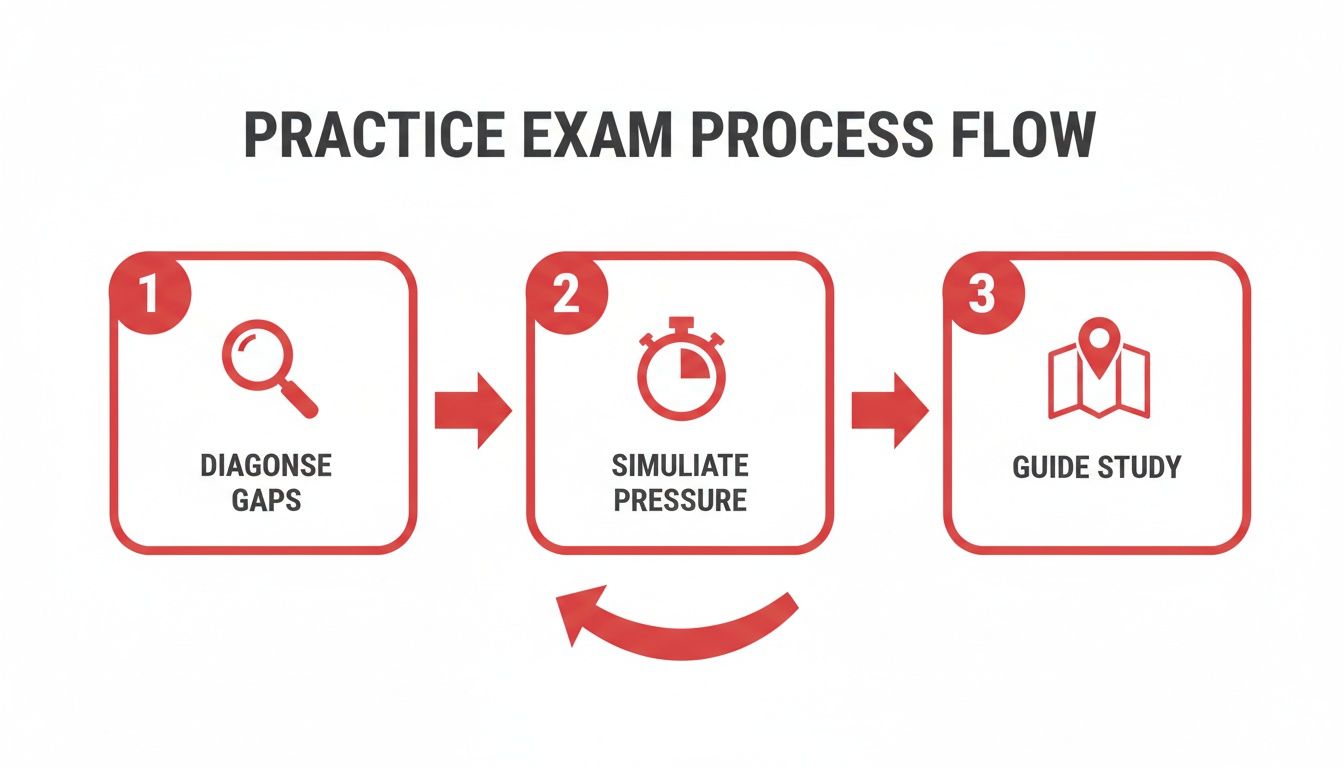
As you can see, each exam has a job to do, from the initial diagnosis to targeted remediation, all feeding into the next step.
A Battle-Tested Clerkship Timeline
So, how does this look in practice? The best approach is to space out your exams to measure your growth and give yourself time to adjust.
A great starting point is to take your first NBME form right around the midpoint of your clerkship. This isn't about getting a stellar score; it's about establishing an honest baseline. After a few weeks of clinical exposure, this test will shine a bright light on your true knowledge gaps.
After you've reviewed that first exam inside and out, spend the next one to two weeks hammering your weak areas. Then, take your second practice exam about 7-10 days before the real shelf. This one is huge. It shows you how much progress you've made and highlights any last-minute topics that need a final, high-yield push.
Don't just take the exam and look at the score. Your mid-clerkship score report is your new study guide. Use it to build targeted UWorld blocks and dive back into specific topics before you even think about that second practice test.
This two-exam strategy is a rock-solid foundation for most rotations. For the longer, tougher clerkships like surgery or internal medicine, you might want to throw in a third practice exam a few days before the real deal for one last confidence boost and stamina check.
Prioritizing the Right Forms
When it comes to picking which forms to use, always go with the newest ones first. The NBME is constantly updating its content and question style, so the most recent practice exams will give you the most accurate feel for what you'll face on test day.
Older forms are still goldmines for extra practice questions, but they shouldn't be your go-to for predicting your final score.
This whole process is designed to be adaptive. If your score jumps way up between the first and second exams, you know your study method is working. If it stays flat, you still have a week or more to pivot and change things up.
For more ideas on how to build this structure, check out our guide on creating a powerful study schedule for medical students. A well-timed practice exam strategy ensures you walk into that testing center prepared and confident, with no surprises.
Creating a Realistic Test Day Simulation
The data you get back from your NBME practice shelf exams is only as good as the conditions you take them in. If you want a score that actually predicts how you'll perform, you need to do more than just find a quiet corner in the library. A high-fidelity simulation is what trains your mind and body for the real pressure of test day.
This means you have to commit to the full time block. No interruptions. A standard 50-question practice form gives you 75 minutes, and you need to treat that time as sacred. No pausing the timer for a quick snack, no "just one second" Google search for a drug name you blanked on. No breaks. Period.
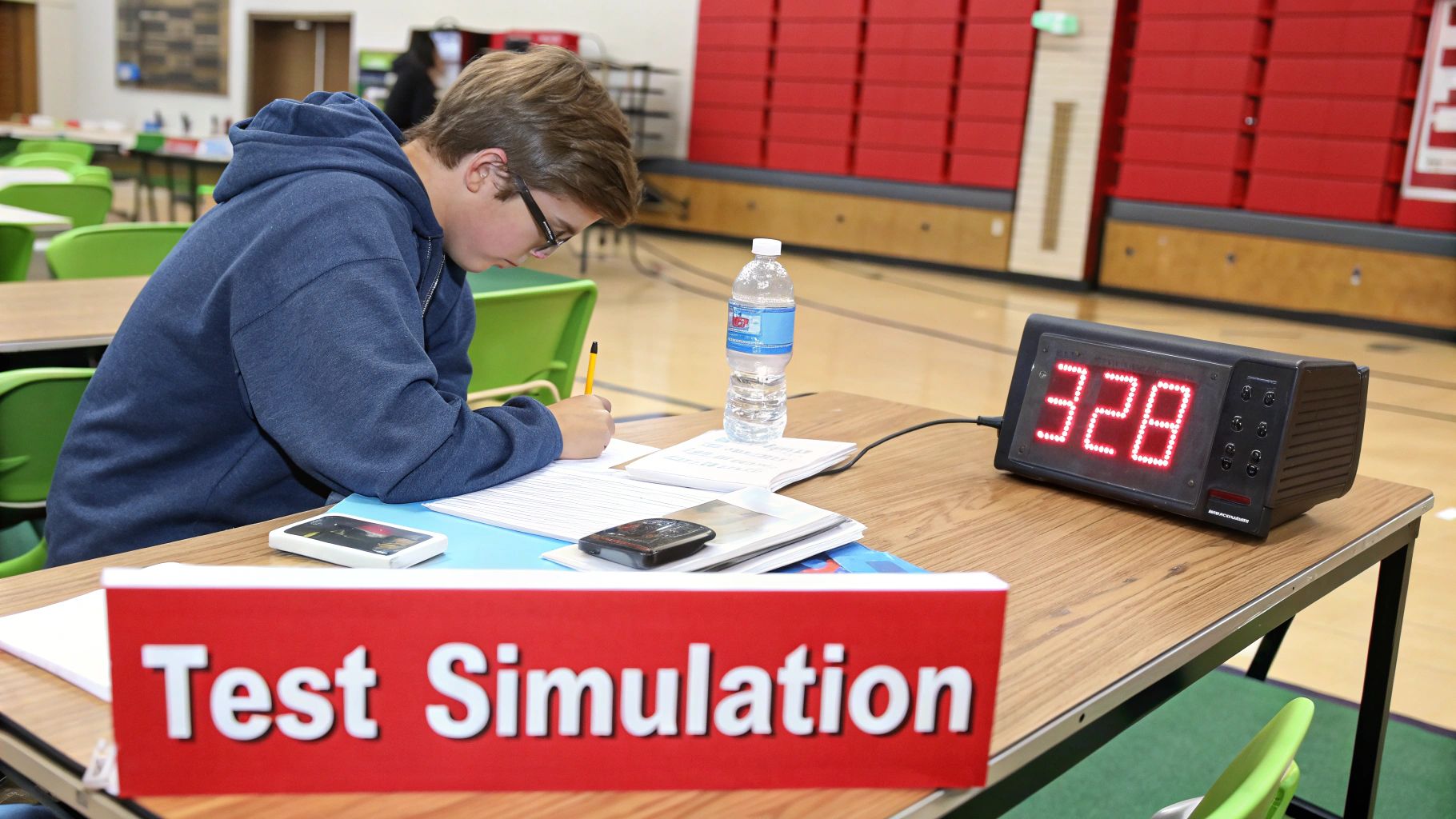
I know how strong the urge to pause is, especially when you hit a brutal question that makes your brain freeze. But resisting that urge is how you build mental stamina. The real shelf exam doesn't have a pause button, and learning to push through fatigue or uncertainty is a skill you absolutely must develop.
Building Your Test Day Ritual
A consistent pre-test routine does wonders for minimizing anxiety and getting you into performance mode. Don't just roll out of bed and fire up the exam.
- Mimic Your Morning: If your actual shelf exam is at 8 AM, take your practice tests at 8 AM. Go as far as eating the exact same breakfast you plan to have on the real day.
- Use the Same Tools: If you can, use the same type of computer, mouse, and even chair setup. The goal is to eliminate any little variables that could throw you off your game.
- Prepare Your Space: This is non-negotiable. Turn your phone off—not just on silent—and put it in another room. Let your roommates or family know you're off-limits for the next hour and a half.
This level of detail might seem a little obsessive, but it's all about making the unfamiliar feel routine. When the real test day comes around, your brain will recognize the pattern and shift into "go time" instead of "panic time."
A realistic simulation isn't just about getting an accurate score. It's a dress rehearsal for your focus, timing, and endurance. Every practice exam is a chance to train yourself to perform under pressure, so when it counts, it feels like just another session.
By treating every single practice test like it’s the real deal, you systematically desensitize yourself to test-day anxiety. This psychological conditioning is just as critical as reviewing renal physiology. You’re not just practicing medicine; you’re practicing the art of taking a high-stakes medical exam.
Turning Your Score Report Into a Study Blueprint
Once you’ve survived a grueling, high-fidelity practice exam, the real work begins. Your NBME practice shelf exams score report is so much more than just a number; it's a personalized roadmap showing you exactly where you need to go next. Learning how to read it is the key to turning a good score into a great one.
The first things you’ll see are your scaled score and corresponding percentile. It’s natural to fixate on these, but their main job is just to give you a rough GPS coordinate of where you stand. Remember, these practice exams are powerful predictors. In fact, multiple studies show a clear correlation between NBME subject exam scores and performance on bigger licensing exams like the USMLE. You can check out some of the predictive power of these exams in published research for yourself.
Decoding Your Performance Breakdown
The real gold is buried deeper in the performance breakdown. This section dissects your performance by subject, system, and even physician task (like diagnosis or management). This is where you put on your detective hat and hunt for patterns.
Don't just glance at the bars; interrogate them. Are you consistently below average in endocrinology, even on your surgery and pediatrics exams? Is pharmacology a weak point no matter the rotation? This data transforms vague feelings of "I'm not great at GI" into concrete, actionable targets.
The NBME provides sample score reports that show exactly how this data is visualized, giving you an immediate visual cue for where to focus.
Your score report isn't a judgment; it's a diagnostic tool. A "lower" performance bar in cardiology isn't a failure—it's a bright, flashing sign telling you exactly what to study tonight. Embrace this feedback.
By digging into these specifics, you can stop studying broadly and start studying smartly. You can discover more about how to study for shelf exams by using this kind of targeted data to guide your efforts.
Your score report provides a wealth of information beyond just the final number. Understanding these individual metrics helps you pinpoint exactly where things went wrong—and how to fix them.
Decoding Your NBME Performance Metrics
| Metric | What It Means | Actionable Step |
|---|---|---|
| Equated Percent Correct Score | This shows your raw percentage of correct answers, adjusted for exam difficulty. It’s a direct measure of your content mastery. | If this is low across the board, focus on foundational content review before diving deeper into question banks. |
| Performance Bands by Subject | These visual bars compare your performance in specific subjects (e.g., Cardiology, Pulmonology) to the average of a reference group. | Target subjects where your performance is consistently "Lower" or "Borderline." Create dedicated study blocks for these areas. |
| Physician Task Breakdown | This metric categorizes questions by the skill being tested, such as "Diagnosis," "Management," or "Scientific Principles." | If you're strong in Diagnosis but weak in Management, you may know the diseases but not the treatments. Focus your Qbank sessions on "next step" style questions. |
| Keyword/Topic Analysis | Some score reports provide a list of keywords from questions you answered incorrectly, offering granular insight into missed concepts. | Create flashcards or a study sheet for every keyword on this list. This is a direct, high-yield way to patch specific knowledge gaps. |
By systematically reviewing each part of your report, you move from a general sense of your performance to a specific, evidence-based study plan.
From Data Points to an Action Plan
Let’s walk through a real-world scenario. Imagine your surgery practice exam report shows you crushed trauma questions but tanked everything related to post-operative complications. Your next move is crystal clear.
- Isolate the Topic: Fire up UWorld or Amboss and create a custom block focused only on post-op complication questions.
- Shore Up the Foundation: Before hitting the questions, spend an hour reviewing the relevant First Aid or OnlineMedEd sections on that specific topic. Don't re-read the whole book.
- Perform an Autopsy on Your Errors: As you work through the Qbank, categorize your mistakes. Was it a knowledge gap (didn't know the most common bug for post-op pneumonia)? A misinterpretation (missed a key lab value in the vignette)? Or a classic test-taking error (changed a right answer to a wrong one)?
This methodical approach ensures you aren't just re-reading everything hoping something sticks. You're performing targeted interventions on your weakest areas, which is the fastest and most efficient path to a higher score. Your NBME report provides the diagnosis; it’s your job to create and execute the treatment plan.
Building Your Targeted Remediation Plan
A score report from your NBME practice shelf exams is useless if it just sits there collecting digital dust. The real magic happens when you turn that data into a focused, high-yield action plan. This is where you stop being a passive student and start actively hunting down your weaknesses.
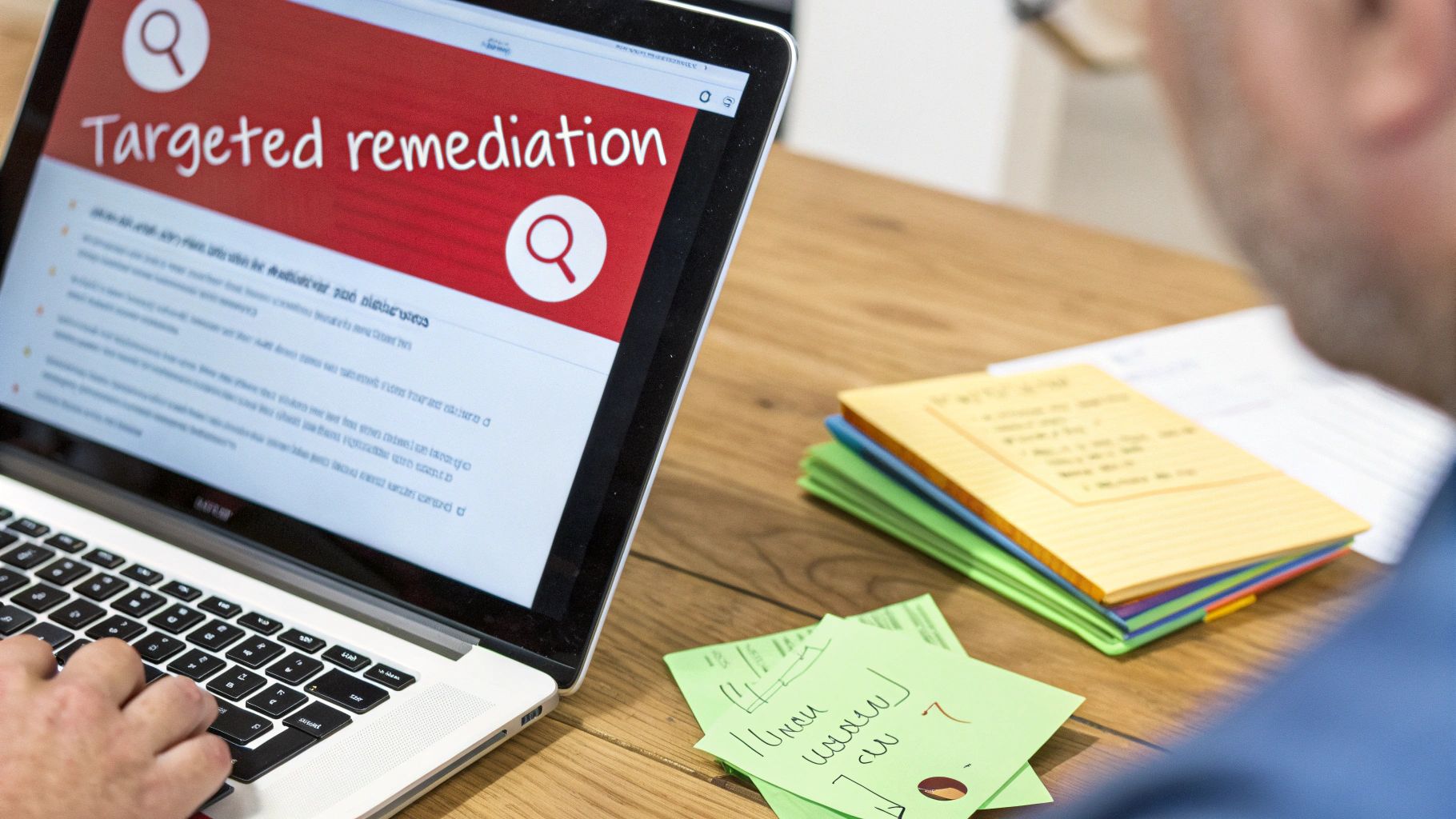
Your first move? A deep dive into every single question on the exam. Yes, even the ones you nailed. A correct answer from a lucky guess is just a knowledge gap in disguise. For each question, force yourself to explain why the right answer is correct and—just as critically—why the other options are dead wrong.
This is the only way to truly categorize your errors, which is the cornerstone of any remediation strategy that actually works.
Categorizing Your Errors for Maximum Impact
After reviewing a few exams, you'll notice that most of your incorrect answers fall into one of three buckets. Figuring out which bucket you fill up most often tells you exactly what kind of problem you need to solve.
- True Knowledge Gap: The most straightforward error. You just didn't know the information. Maybe you'd never heard of the specific antibiotic, or you couldn't recall the classic triad for a particular syndrome.
- Question Misinterpretation: This one is frustrating. You knew the material but completely misread the question stem. You might have skimmed past a critical word like "except" or overlooked a key detail like the patient's travel history.
- Test-Taking Mistake: The most painful of all. You knew the content, understood the question, but made an unforced error. This is where you changed a right answer to a wrong one, second-guessed yourself into oblivion, or just mismanaged your time.
Tracking these error types reveals powerful patterns. Are most of your misses true knowledge gaps? You need more content review. Are they clumsy test-taking errors? Then you need to work on strategy and confidence, not just facts.
Your goal isn't just to learn the fact you missed; it's to understand why you missed it. This meta-awareness is what separates students who improve dramatically from those who stay stuck at the same score.
From Analysis to Action with Qbanks
Once you’ve pinpointed your weakest areas—let's say it's post-op complications in Surgery or pediatric developmental milestones—it's time to build targeted workouts in your go-to Qbank like UWorld or Amboss.
This isn't random studying; it's a surgical strike. Instead of wading through mixed blocks hoping you'll stumble upon your weak topics, you're creating custom quizzes that force you to confront them head-on.
Here’s what that looks like in the real world:
- Identify Weakness: Your NBME report shows you bombed the "Gastrointestinal/Nutrition" section on your internal medicine exam.
- Drill Down: Your error log shows you're consistently missing questions about inflammatory bowel disease management.
- Create Custom Block: Fire up UWorld and generate a 20-question, timed block exclusively on "Inflammatory Bowel Disease" under the GI system.
- Analyze and Repeat: Review that block like it’s your job, focusing on the explanations. Tomorrow, do the same thing for another weak spot, like hepatobiliary disorders.
This approach transforms your studying from a passive review into an active intervention. You aren't just studying harder; you're studying smarter by aiming your effort exactly where it will do the most good. To round out your strategy, you can integrate some general efficient study techniques to make every hour count.
This kind of focused remediation is the key to turning a disappointing practice score into an excellent shelf exam performance.
Frequently Asked Questions About NBME Exams
It's completely normal to feel a bit lost when figuring out the best way to use NBME practice shelf exams. Let's cut through the confusion and tackle some of the most common questions I hear from students, so you can build a smarter study plan.
How Many Practice Exams Should I Take Per Clerkship?
For most clerkships, the sweet spot is 2-3 practice exams. This number is usually enough to establish a solid baseline, track your growth, and perform a final check-in without hitting total burnout.
Here’s a strategy that works well: schedule your first exam around the midpoint of the rotation. This serves as a reality check, giving you an honest look at where you stand while you still have plenty of time to shore up any weak areas.
Then, take a second exam about one to two weeks before the real shelf. This one is crucial. It shows you how much progress you’ve made and helps pinpoint any lingering topics that need a high-yield, last-minute review. If you're on a beast of a rotation like internal medicine, adding a third exam a few days out can be the perfect final dress rehearsal.
What Is a Good Score on an NBME Practice Exam?
Everyone wants to hit that 70% or higher mark, which often correlates well with passing the actual shelf. But honestly, a "good" score is any score you can learn from. The real gold isn't the number itself, but what it reveals about your preparation.
Pay more attention to your percentile rank and, more importantly, the jump between your first and second practice tests. Seeing your score go from a 65% to a 75% is a massive win. It’s hard proof that your targeted study plan is actually working.
Think of these exams as diagnostic tools, not final judgments. A score that’s lower than you hoped for isn't a failure—it's a gift. It's specific feedback telling you exactly where to focus your energy for the biggest possible score increase.
Are Newer NBME Forms Better Than Older Ones?
Yes, as a general rule, always prioritize the newest forms available. The NBME is constantly tweaking question styles and content to reflect the most current medical knowledge and testing standards.
The most recent forms will give you the most accurate feel for the real exam, from the user interface down to the types of clinical vignettes you'll face. This makes them, by far, the best predictors of how you'll actually perform on test day.
That doesn't mean the older forms are useless, though. They are fantastic resources for extra practice questions and content review. Just don't rely on them for your high-fidelity, timed simulations. Use the new ones for your dress rehearsals and the old ones for untimed, supplemental practice.
Should I Review Correct Answers Too?
Absolutely. One hundred percent. This is a critical step that so many students skip, and it's a huge missed opportunity.
Reviewing answers you got right is the only way to confirm you truly understood the concept and didn't just get lucky with a 50/50 guess.
This process reinforces your knowledge and solidifies the clinical reasoning behind the right diagnosis or management step. It can also show you a more efficient way to break down a question stem—a skill that's vital for managing your time when the clock is ticking. You're not just confirming what you know; you're actively sharpening your entire test-taking strategy.
Feeling stuck trying to turn your NBME score report into a concrete action plan? Ace Med Boards offers personalized, one-on-one tutoring to help you decode your performance and build a targeted study strategy for your shelf exams and USMLE. Get expert guidance by booking a free consultation.

