
Think of shelf exams as the "final boss" at the end of each clinical rotation level. They're officially called NBME Subject Examinations, and they are the standardized final exams for core clerkships like Internal Medicine, Surgery, and Pediatrics. Their whole purpose is to test the clinical knowledge you were supposed to pick up on the wards.
What Shelf Exams Are and Why They Define Your Third Year
The third year of medical school is a massive shift. You're yanked out of the classroom and thrown into hands-on clinical practice. As you jump between different specialties, you're not just learning how to care for patients—you're constantly studying for the next high-stakes test. These medical school shelf exams are the great equalizer, measuring what you know against a national standard.
So where do they come from? Imagine a massive library where the National Board of Medical Examiners (NBME) stores retired USMLE Step exam questions. They sort these questions by subject and "shelve" them for later. When you sit for your surgery shelf, you're basically taking a focused, surgery-only version of an old Step exam. This is exactly why they're such a powerful predictor of how you'll do on Step 2 CK.
The stakes are incredibly high. For most clerkships, your shelf exam score is the single biggest chunk of your final grade. It’s what separates an Honors from a High Pass or a Pass—a distinction that residency program directors definitely notice.
The Real Impact on Your Medical Career
It’s easy to get tunnel vision and just focus on passing the next test, but the long-term impact of these exams is huge. A string of strong shelf scores sends a clear signal to residency programs about your clinical knowledge and work ethic.
Here’s how they shape your future:
- Honors Grades: Nailing your shelf exam is the most direct way to earn "Honors." These grades pop on your transcript and get highlighted in your MSPE (Dean's Letter).
- MSPE (Dean's Letter): Your performance often gets a specific mention in the narrative part of your Medical Student Performance Evaluation. A comment like, "ranked in the top 10% of the class on the Internal Medicine shelf exam," carries serious weight.
- Residency Applications: Program directors look for patterns. Consistent excellence across multiple shelf exams proves you have a solid foundation, making you a much more competitive applicant. You can learn more about how clerkships fit into your medical journey in our dedicated guide: https://acemedboards.com/what-is-clerkship/
Core Rotations and Their Shelf Exam Focus
To succeed, you need to know what each exam is really testing. This table breaks down the core clerkships and what you should expect from their shelf exams.
| Clerkship Rotation | Primary Focus of Shelf Exam | Common High-Yield Topics |
|---|---|---|
| Internal Medicine | Diagnosis and management of common adult diseases | Cardiology (MI, CHF), Pulmonology (COPD, PE), GI (hepatitis, IBD), Endocrinology (diabetes), Renal (AKI, CKD) |
| Surgery | Pre-operative, intra-operative, and post-operative care | Abdominal pain (appendicitis, cholecystitis), Trauma (ABCDEs), Burns, Surgical oncology basics, Hernias |
| Pediatrics | Developmental milestones, common childhood illnesses, and vaccination schedules | Newborn care (jaundice, RDS), Febrile illnesses, Growth charts, Congenital heart defects, Asthma |
| OB/GYN | Full-spectrum women's health: obstetrics and gynecology | Prenatal care, Labor & delivery, Contraception, Abnormal uterine bleeding, STIs, Gynecologic cancers |
| Psychiatry | DSM-5 diagnostic criteria and first-line pharmacotherapy | Mood disorders (depression, bipolar), Psychotic disorders (schizophrenia), Anxiety disorders, Personality disorders |
| Family Medicine | Broad-spectrum outpatient care for all ages; preventive medicine | Health screenings (cancer, lipids), Hypertension, Diabetes management, Common musculoskeletal complaints, URI |
Think of this as your roadmap. Knowing the focus of each rotation helps you zero in on what truly matters when you're studying on the wards.
Understanding the Scoring System
Shelf exams are scored on a scale from 0 to 100%. This isn't a raw percentage of questions you got right; it's an equated score that's then converted to a national percentile. This percentile shows how you stacked up against every other medical student who took that same exam.
The pressure is real. A failing score can torpedo your clerkship grade. And while the raw number might not always show up on your transcript, it's a huge factor in the MSPE that residency programs read so carefully. For example, did you know that as of 2020, a remarkable 84% of U.S. medical schools require a neurology clerkship? For rotations like that, the shelf exam is often the make-or-break component of your final grade.
As you get ready for the grind of your third year, understanding how to study for exams effectively is the bedrock of success. This isn’t just about memorizing facts; it’s about building a system for learning that can actually hold up under the pressure of clinical rotations.
Designing Your High-Yield Shelf Exam Study System
Let's be honest: acing your shelf exams isn't about pulling a few all-nighters the week before the test. That strategy might have worked in college, but third year is a different beast entirely. Real success comes from building a smart, sustainable study system from day one of your rotation—one that fits into your already-packed clinical schedule without leading to burnout.
Think of it this way: you can't build a house with just a hammer. You need a full toolkit. The same goes for shelf prep. The most effective approach, often called the "Holy Trinity" by med students, combines three core components that work together.
The Core Components of Your Study Arsenal
Your entire system needs to be built around active, efficient learning that can squeeze into the unpredictable life of a third-year student on the wards. The magic happens when you blend different types of resources that reinforce each other.
- A Top-Tier Question Bank (Qbank): This is your bread and butter. It's where you'll do the heavy lifting of active recall and test your knowledge under pressure. Platforms like UWorld are the gold standard for a reason—they offer thousands of questions that perfectly mimic the style and difficulty of the real shelf exams.
- A Video Learning Platform: Think of this as your foundation. Resources like Boards & Beyond or OnlineMedEd are brilliant for breaking down incredibly complex topics into digestible video lectures. You can watch them on your commute, while eating lunch, or during any scrap of downtime you can find.
- A Spaced-Repetition Tool: Anki is a game-changer. It’s a powerful flashcard program that uses a smart algorithm to show you information right before you’re about to forget it. For memorizing the sheer volume of facts, drugs, and pathways for each rotation, this is non-negotiable.
The real power isn't in just using these tools, but in weaving them together. After watching a video on acute coronary syndrome, you immediately do a block of cardiology questions in your Qbank. Then, you unsuspend or create Anki cards for the concepts you got wrong or felt shaky on. This creates a powerful cycle: learn, test, reinforce. To really master this approach, check out these effective study methods for medical students.
Integrating Studying into Your Clinical Day
The biggest hurdle is figuring out when to study when you’re on the wards for 10-12 hours a day. The secret isn't finding huge blocks of time—it's about capturing the small, scattered pockets of "lost time" that litter your day.
This flowchart paints a clear picture of why this matters so much. Your shelf performance has a direct line to your grades and, ultimately, your residency options.
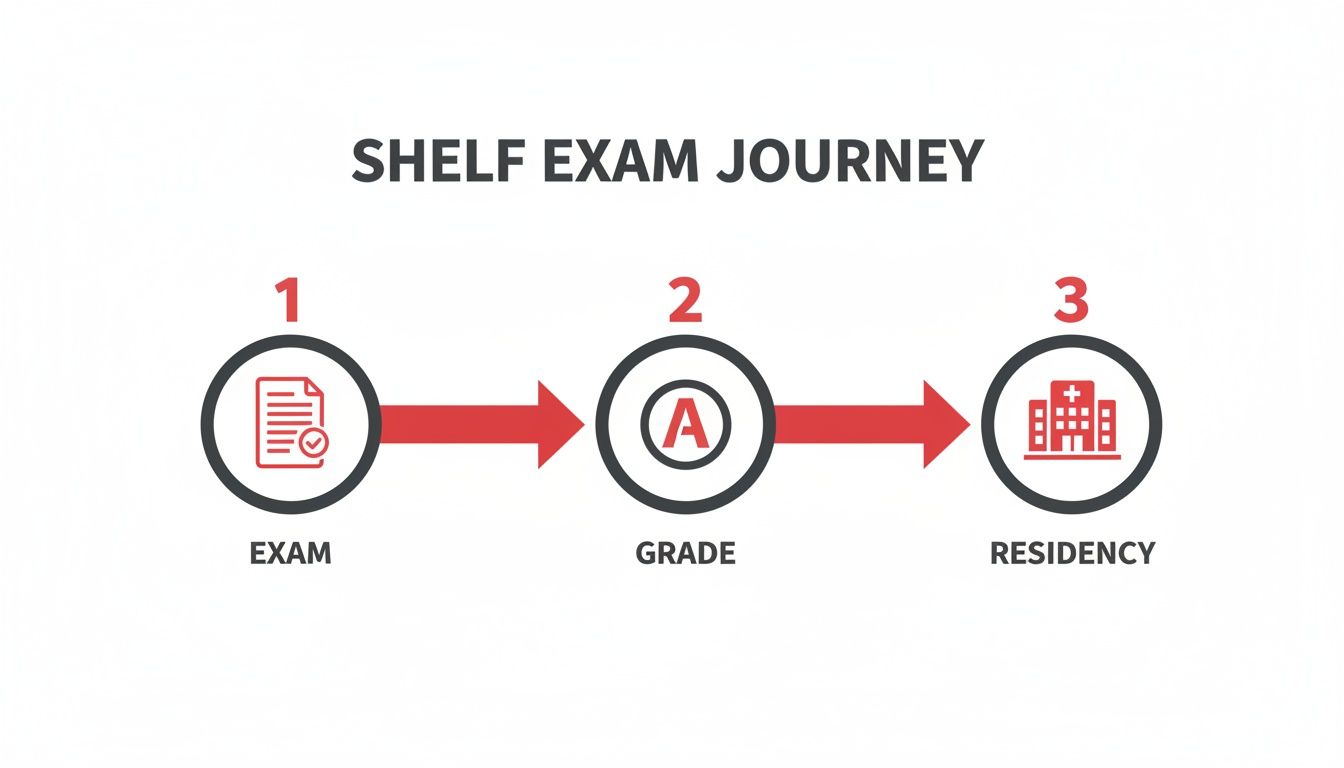
This simple flow highlights a critical truth: strong exam scores are a foundational step toward earning honors grades and securing a competitive residency position.
Think about your daily routine and where the gaps are:
- Morning Commute: Instead of music, put on a high-yield podcast or an audio lecture for the rotation you're on.
- Between Patients: Waiting for an attending? Walking to the lab? Pull out your phone and knock out 5-10 Anki cards. It adds up fast.
- Lunch Break: Even a 15-minute break is enough time to do a small, 10-question block from your Qbank. This keeps you in a testing mindset all day long.
By turning these tiny moments into productive study sessions, you can get through a shocking amount of material before you even get home. This consistent, low-intensity approach prevents the burnout that comes from trying to cram for hours at night and builds a much stronger knowledge base over the entire rotation. Our guide on creating a study schedule for medical students can help you put this into a concrete plan.
The data is clear: the right resources make a measurable difference. A systematic review found that an incredible 99.3% of students used UWorld for their board and shelf exam prep. Similarly, active recall tools like Anki have been shown to boost retention by 20-30% on average. Learn more about the data behind student resource choices to see why this approach works.
Mastering the Content for Core Shelf Exams
Every shelf exam has its own personality. The Surgery shelf feels worlds apart from the Pediatrics shelf, and the secret to crushing them is knowing where to focus your limited time and energy. Trying to learn everything is a surefgire recipe for burnout. The real key is to zero in on the highest-yield topics for each rotation.
This isn’t about just re-reading a textbook from cover to cover. It’s about building a smart, targeted game plan for the content most likely to pop up on test day, earning you the most points possible. Below, we'll break down the must-know concepts for the biggest shelf exams you'll face.
Internal Medicine Shelf High-Yield Topics
There's a reason everyone calls the Internal Medicine shelf the "mini-Step 2." It's a beast of an exam that covers the entire spectrum of adult medicine, making it one of the toughest shelves out there. Your focus here should be on nailing the most common presentations and the first few steps of management.
Think of it as building a solid mental framework for the "big three" systems:
- Cardiology: You absolutely have to be fluent in the workup for chest pain. That means confidently differentiating a myocardial infarction from a pulmonary embolism or an aortic dissection. Get ready for questions on managing heart failure (systolic vs. diastolic), the latest hypertension guidelines, and interpreting basic EKGs.
- Pulmonology: Know the difference between obstructive and restrictive lung diseases cold. This means you can walk through the presentation, diagnosis, and treatment of COPD and asthma in your sleep. You will 100% see questions on pneumonia (community-acquired vs. hospital-acquired) and pulmonary embolisms.
- Gastroenterology: The GI section hits liver diseases hard, especially cirrhosis and all its nasty complications (like ascites and hepatic encephalopathy). You should also be super comfortable with inflammatory bowel disease (Crohn's vs. ulcerative colitis) and the workup for GI bleeds.
Beyond these giants, endocrinology (especially diabetes and thyroid disorders) and renal (acute kidney injury) are also tested heavily. To really dig into a winning strategy, check out our complete internal medicine shelf review.
Surgery Shelf High-Yield Topics
The Surgery shelf is less about obscure surgical techniques and more about the "medicine of surgery." It’s designed to test your ability to manage patients before, during, and after an operation. Your number one priority should be recognizing surgical emergencies and knowing the immediate next steps like the back of your hand.
Key areas to lock down include:
- Pre-Op and Post-Op Care: This is your foundation. You need to understand pre-operative risk assessment (cardiac, pulmonary) and how to manage the most common post-op complications—think fever, atelectasis, wound infections, and DVTs.
- Acute Abdomen: This is arguably the highest-yield topic on the entire exam. You need to know the classic presentations for appendicitis, cholecystitis, diverticulitis, bowel obstructions, and pancreatitis. Focus on the diagnostic algorithm for each one.
- Trauma: The surgery shelf loves a good trauma scenario. Master the ABCDEs (Airway, Breathing, Circulation, Disability, Exposure) of trauma assessment. Know how to manage common injuries like pneumothorax, hemothorax, and splenic or liver lacerations.
Remember, the Surgery shelf is a test of clinical judgment, not just memorization. The best answer is often the safest and most immediate step in management. Don't jump to "laparotomy" if "IV fluids and abdominal CT" is a safer first move.
Pediatrics Shelf High-Yield Topics
The Peds shelf requires a total mental shift. Kids are not just tiny adults, and the exam hammers this point home. The content runs the gamut from newborn care all the way to adolescent medicine, with a heavy emphasis on developmental milestones and preventative care.
Your study plan must prioritize these areas:
- Developmental Milestones: You will absolutely be asked to identify a child's age based on their motor, social, and language skills. Make flashcards, use an app, do whatever it takes to drill these until they become second nature.
- Vaccine Schedules: This is pure memorization, but it's guaranteed points on the board. Know the standard immunization schedule and the common contraindications for live vaccines.
- Common Childhood Illnesses: Be ready for a barrage of questions on febrile seizures, bronchiolitis (RSV), croup, asthma attacks, and the classic childhood rashes (e.g., measles, roseola).
OB/GYN Shelf High-Yield Topics
The OB/GYN shelf is split into two distinct but deeply connected fields. For Obstetrics, the game is all about managing a healthy pregnancy and spotting complications early. For Gynecology, it’s about tackling common outpatient complaints and knowing your cancer screenings.
Focus your efforts here:
- Prenatal Care and Complications: Understand the routine prenatal screening tests for each trimester. Become an expert on complications like pre-eclampsia, gestational diabetes, and third-trimester bleeding (placenta previa vs. abruption).
- Labor and Delivery: Know the stages of labor and, crucially, how to interpret fetal heart tracings. This is a critical skill and a topic that shows up again and again on this shelf exam.
- Gynecology Essentials: You need to master the workup for abnormal uterine bleeding, amenorrhea, and common STIs. On top of that, you must know the current guidelines for Pap smears and HPV testing.
By strategically focusing on these high-yield zones for each core rotation, you can walk into your shelf exams feeling prepared and confident, ready to tackle the questions that truly matter.
Turning Practice Questions Into Guaranteed Points
It’s a classic med student trap: thinking that hammering through thousands of Qbank questions is the secret to success. But let’s be honest—that’s not a strategy, it’s just busywork. The real key to crushing your medical school shelf exams is learning how to turn every single practice question into a guaranteed point on exam day.
This means shifting your mindset entirely. Stop focusing on just getting the question right. Instead, your goal is to deeply understand why the correct answer is right and, just as crucially, why every other option is wrong. Think of each clinical vignette as a mini case file. Your job isn't just to solve the puzzle, but to see how every piece—the patient's story, the weird lab value, the subtle physical exam finding—fits together perfectly.
That analytical approach is what separates the students who just pass from the ones who consistently earn Honors.
The Art of Deconstructing a Question
If you want to convert practice into points, you need a system. Passively reading the explanations after you answer a question is a waste of your time. You have to actively break down each question, especially the ones you miss.
Here’s a simple but incredibly powerful process to use every time:
- Find the Real Question: Before you even glance at the answer choices, figure out what they're really asking. Is this a diagnosis question? A "next best step" in management? Or are they testing the underlying pathophysiology?
- Hunt for the Clues: Go back into the vignette with a metaphorical magnifying glass. Highlight the keywords, buzzwords, and critical lab values that scream the correct answer. Ask yourself, "What specific piece of data made this diagnosis more likely than the others?"
- Justify Every Single Option: This is non-negotiable. For every choice—A, B, C, D, and E—force yourself to explain in your own words why it's either the right answer or definitively wrong. This is what builds the strong neural connections you need for recall under pressure.
Yes, this kind of rigorous review takes more time. But the return on that time investment is massive. It trains your brain to spot clinical patterns, which is the exact skill these exams are built to test.
Timed Mode vs. Tutor Mode: A Strategic Choice
Your Qbank gives you two main ways to practice, and knowing when to use each is a game-changer. Both have their place in a smart study plan.
- Tutor Mode: This should be your go-to for the first half of any rotation. It gives you instant feedback after each question, creating a tight learning loop. This is where you do your deep deconstruction and build your foundational knowledge.
- Timed Mode: In the final 1-2 weeks leading up to your shelf, you need to switch almost exclusively to timed mode. This is about building mental stamina and practicing your pacing under exam-like pressure. It’s a dress rehearsal that helps kill test-day anxiety.
A common mistake is getting too comfortable in tutor mode and never leaving. You have to simulate exam pressure. The goal isn't just knowing the information, but being able to pull it out of your brain quickly and accurately when the clock is ticking.
How to Use NBME Practice Exams
The NBME Clinical Mastery Series (CMS) forms are your ultimate secret weapon. Think of them as official blueprints for the real exam because they’re made by the very same people. They are, without a doubt, the single most accurate predictor of how you'll perform.
You have to be strategic about when you take them. A great approach is to take one CMS form about halfway through your rotation to get a baseline and pinpoint your weak spots. Use that score report to laser-focus your studying for the next couple of weeks. Then, take a second one about a week out from the real exam to track your improvement and build confidence.
The intensity of these exams is designed to mirror the high stakes of boards. Consider that while 97% of first-time takers from US/Canadian schools passed Step 1 in 2022-2023, that number falls off a cliff for those who have to repeat it. This underscores just how critical strong preparation is from the start. Taking practice tests like the CMS forms has been proven to significantly boost final scores, making them an indispensable tool. You can find more insights in the recent USMLE performance data.
For a deeper dive into making the most of these invaluable resources, check out our complete guide on NBME practice shelf exams.
Avoiding the Most Common Study Traps

Knowing the high-yield topics is one thing. Mastering how to break down questions is another. But the real secret weapon for honoring your rotations is sidestepping the subtle but devastating study traps that sabotage countless third-year students.
Success with medical school shelf exams isn't just about what you do; it's about what you don't do. Even the sharpest students fall victim to bad habits under the immense pressure of clinicals. Let's break down the biggest pitfalls I see year after year and give you a clear, actionable plan to avoid them.
Trap 1: Procrastination and Last-Minute Cramming
This is the classic mistake. Treating a six-week rotation like a six-day study sprint is a recipe for disaster. The sheer volume of material for any shelf exam makes cramming physically impossible. If you wait until the final week to get serious, you're guaranteed to feel overwhelmed and miss huge chunks of critical information.
Your best defense is a structured, non-negotiable plan from day one.
- Solution: Commit to a daily minimum. It can be as simple as completing 10-15 Qbank questions and reviewing 20 Anki cards. This small, consistent effort compounds massively over a month or two, building a rock-solid knowledge base without the last-minute panic.
Trap 2: Passive Learning Instead of Active Recall
It feels productive to spend hours highlighting textbooks or re-watching video lectures. But this is passive learning, and it creates a dangerous illusion of competence. You might recognize a concept when you see it, but you won't be able to summon it under the pressure of the clock on exam day.
Active recall is the antidote. It forces your brain to actually retrieve information, which is what strengthens the neural pathways you need to perform.
The core principle of effective studying is this: if it doesn't feel like a mental workout, it probably isn't working. True learning happens when you force your brain to struggle a little to retrieve information.
- Solution: Make Qbanks and flashcards the foundation of your study plan. Instead of re-reading a chapter on heart failure, do questions on it. Instead of re-watching a video on antibiotics, test yourself with Anki. This is what turns fragile, temporary knowledge into durable understanding.
Trap 3: Neglecting Your Well-Being
Third year is a marathon, not a sprint. The pressure to honor every rotation can push students to sacrifice sleep, nutrition, and mental breaks, which is a critical error. Burnout doesn't just feel awful; it actively tanks your cognitive function, memory, and test performance.
You simply cannot pour from an empty cup. Scheduling breaks isn't a sign of weakness; it's a strategic necessity for peak performance.
- Solution: Schedule your downtime with the same seriousness as your study blocks. Block out at least one evening a week for something completely unrelated to medicine. Protect your sleep like it's a top priority, aiming for 7-8 hours a night. This self-care is a direct investment in your shelf exam scores.
When One-on-One Tutoring Makes a Difference
For most students, a solid study plan built on Qbanks and active recall is more than enough to crush the medical school shelf exams. But what happens when that tried-and-true approach just isn't cutting it? Sometimes, even the most dedicated students hit a wall or face a challenge that a standard study plan can't solve.
This is where one-on-one tutoring goes from being a simple fix to a powerful performance tool. It’s not just for students who are falling behind; it’s for high-achievers who are determined to reach their absolute peak potential.
Recognizing the Signs You Need More Support
Self-study is the backbone of medical education, but let's be honest—it has its limits. It’s incredibly difficult to accurately diagnose your own weaknesses or break out of bad habits you don't even know you have. In certain high-stakes situations, tutoring becomes a serious strategic advantage.
See if any of these scenarios sound familiar:
- That Disappointing Practice Score: You put in the hours, you did the work, but your NBME practice exam score felt like a punch to the gut. A tutor can help you tear that performance apart, piece by piece, to find the specific knowledge gaps or flawed test-taking habits you’re missing on your own.
- Feeling Drowned by a Tough Rotation: Rotations like Surgery or Internal Medicine are notoriously brutal. They can leave you with barely enough time or mental energy to study effectively. Personalized guidance gives you a clear, efficient roadmap so that every single study hour actually counts.
- Aiming for a Competitive Specialty: When you've got your sights set on dermatology or neurosurgery, every point on your transcript matters. An expert tutor can offer the nuanced strategies needed to turn a good score into an outstanding one, giving your residency application a critical edge.
The Tutoring Advantage Over Self-Study
So, what makes targeted support so different from just grinding through another block of UWorld questions? The real value is in the customized feedback and accountability. A good tutor does far more than just explain concepts; they get inside your head and analyze your thought process.
Tutoring isn't about someone giving you the answers. It's about learning a better way to find the answers yourself. An expert can spot the patterns in your mistakes and give you a whole new framework for tackling those complex clinical vignettes.
This kind of personalized feedback loop is something you simply can't get from studying alone. It provides a clear path forward, expert insights into how to dissect a question, and the accountability needed to stay on track. For students who want to be certain they are performing at their absolute best, exploring shelf exam tutoring services can be a game-changing decision.
Common Questions About Shelf Exams
Third year can feel like you're learning a whole new language, and all the talk around medical school shelf exams only adds to the confusion. Let's clear things up. Here are the straight answers to the questions I hear most often from students trying to crush their rotations.
What Is Considered a Good Shelf Exam Score?
This is probably the #1 question I get, and the answer isn't a single number. Shelf exams are scored from 0 to 100, but that raw score is then converted into a national percentile. So, what’s “good”?
Generally speaking, scoring above the 75th percentile nationally is solid. It shows you have a strong command of the material compared to other medical students across the country.
But if you're aiming for an "Honors" grade in the clerkship, the bar gets much higher. Most medical schools will require you to be in the top 10-20% of national test-takers to even be considered for that top-tier grade.
How Do Residency Programs See My Shelf Exam Scores?
Residency directors don't typically see your individual shelf exam scores on your transcript. What they do see is the grade that resulted from it: Honors, High Pass, Pass, or Fail. A transcript full of Honors grades speaks volumes about your clinical knowledge and work ethic.
More importantly, your performance often gets a direct shout-out in your Medical Student Performance Evaluation (MSPE), or the "Dean's Letter." A comment from a clerkship director like, "excelled on the standardized final exam, scoring in the 92nd percentile nationally," is concrete proof of your academic horsepower.
Think of your shelf exam performance as the hard data that backs up your clerkship grades. It gives residency directors an objective measure of your knowledge, which perfectly complements the subjective feedback from your clinical evaluations.
Are UWorld and Anki Enough for Every Shelf Exam?
UWorld and Anki are the undisputed champions of shelf prep. They are the foundation of any good study plan, but relying on them alone can leave you vulnerable, especially on certain rotations. They build a fantastic base, but you need to add specialty-specific resources to truly excel.
For instance, top students almost always supplement with targeted resources to get an edge:
- Surgery: A book like Pestana's Surgery Notes is practically required reading. It’s the perfect high-yield review for mastering pre- and post-op care.
- OB/GYN: You'll want a resource like Case Files or Blueprints to nail the specific algorithms and clinical vignettes that are unique to women's health.
- Pediatrics: Don't forget to add a resource specifically for developmental milestones and vaccine schedules. Those are guaranteed points you can't afford to miss.
UWorld and Anki are your engine, but think of these extra resources as the specialized tools you need to fine-tune your performance for each unique medical school shelf exam.
Ready to turn challenging shelf exams into top scores? Ace Med Boards provides expert one-on-one tutoring tailored to your specific needs, helping you master high-yield content and build unshakeable confidence. Visit our website to schedule your free consultation and take the next step toward honoring your clerkships.

