
To really get a handle on MCAT psychology practice questions, you first have to know what you're walking into. The exam hits you with a 95-minute section packing 59 questions. It's a mix of dense passages and standalone questions designed to test how you think, not just what you've memorized.
What to Expect from the MCAT Psych Soc Section
Before you even think about tackling your first practice question, you need to understand the battlefield. The MCAT’s Psychological, Social, and Biological Foundations of Behavior section—or Psych/Soc, as we all call it—isn't a simple vocabulary quiz. It's a test of your ability to think like a social scientist, pull meaning from data, and apply complex theories to situations you've never seen before.
A lot of students look at the Psych/Soc section and think it’s the "easy" one because there’s no heavy math like in Chem/Phys. That’s a huge mistake. The real challenge is in the details—the dense experimental passages and the need to recall the exact definition of a term under extreme pressure. It's built to catch you if you only have a surface-level grasp of the concepts.
Decoding the Section Structure
The Psych/Soc section is a 95-minute marathon made up of 59 multiple-choice questions. But they don't all look the same. The AAMC uses two different formats to keep you on your toes:
- Passage-Based Questions: Get ready for 10 passages, each with four to seven questions. These aren't light reading; they're often summaries of research studies or deep dives into theoretical models.
- Discrete Questions: You'll also face 15 standalone questions sprinkled throughout the section. These are direct, knowledge-based questions with no passage to give you clues.
This hybrid setup means you have to be mentally flexible. One minute you're dissecting a complicated study on cognitive dissonance, and the next you're asked for a textbook definition of a sociological concept with zero context.
To give you a quick snapshot of what you're up against, here's a simple breakdown of the section.
MCAT Psych Soc Section At a Glance
The table below summarizes the key components of this section, from timing and question count to the content breakdown. It’s a good reference to keep handy as you build your study plan.
| Component | Details |
|---|---|
| Total Time | 95 Minutes |
| Total Questions | 59 Multiple-Choice Questions |
| Passage-Based Questions | 10 Passages (with 4-7 questions each) |
| Discrete Questions | 15 Standalone Questions |
| Psychology Content | Approximately 65% |
| Sociology Content | Approximately 30% |
| Biology Content | Approximately 5% (as it relates to behavior) |
Understanding this structure is your first step toward building a strategy that works. You can't just study content; you have to prepare for the format itself.
The Content Breakdown
Knowing where the points come from is half the battle. The content isn't split evenly, and you need to plan your studying accordingly. Psychology concepts are the star of the show, making up about 65% of the questions (that’s around 38 questions). Sociology takes up another 30% (about 18 questions), and the last few questions will weave in some basic biology related to behavior.
If you want to dive deeper into how this plays out, you can check out the MCAT psychology question breakdown on Kaptest.com.
The heavy focus on psychology means you have to nail topics like cognition, learning, and psychological disorders. But if you blow off sociology, you’re basically guaranteeing a score plateau. Concepts like social stratification and demographics show up on every single test.
The Hidden Curriculum: Scientific Inquiry Skills
Here’s something most students miss: the MCAT isn’t just testing what you know, but how you think. The AAMC is very open about this, and they test four specific Scientific Inquiry and Reasoning Skills (SIRS) in every section, including Psych/Soc. Every single question maps to one of these skills.
Let's break them down:
- Knowledge of Scientific Concepts and Principles: This is your straightforward content recall. Can you define Erikson's stages of psychosocial development? This skill is tested most often in the discrete questions.
- Scientific Reasoning and Problem-Solving: This is about application. They'll give you a theory in a passage and ask you to predict how an experiment would turn out based on it.
- Reasoning about the Design and Execution of Research: This tests your understanding of how science is actually done. You’ll need to spot independent and dependent variables, find flaws in a study's design, and understand what a control group is for.
- Data-Based and Statistical Reasoning: This is a classic stumbling block. You absolutely must be comfortable reading charts, graphs, and tables. Understanding what a p-value means and drawing the right conclusions from data is a non-negotiable skill.
A Practical Strategy for MCAT Psychology Passages
Let’s be honest: MCAT Psych/Soc passages can feel like they’re written in another language. They are dense, full of research jargon you've likely never seen before, and they’re built to test your reasoning just as much as your content knowledge. The key isn't to read faster; it's to read with a clear purpose.
The biggest trap students fall into is getting lost in the weeds of a specific study. You don’t need to become a world-renowned expert on the experiment in the passage. Your real goal is to quickly pull out the essential components of the research so you can tackle questions about its design, findings, and what it all means.
This infographic breaks down what you’re up against, showing how the passage-based questions and discrete questions come together to make up the whole section.
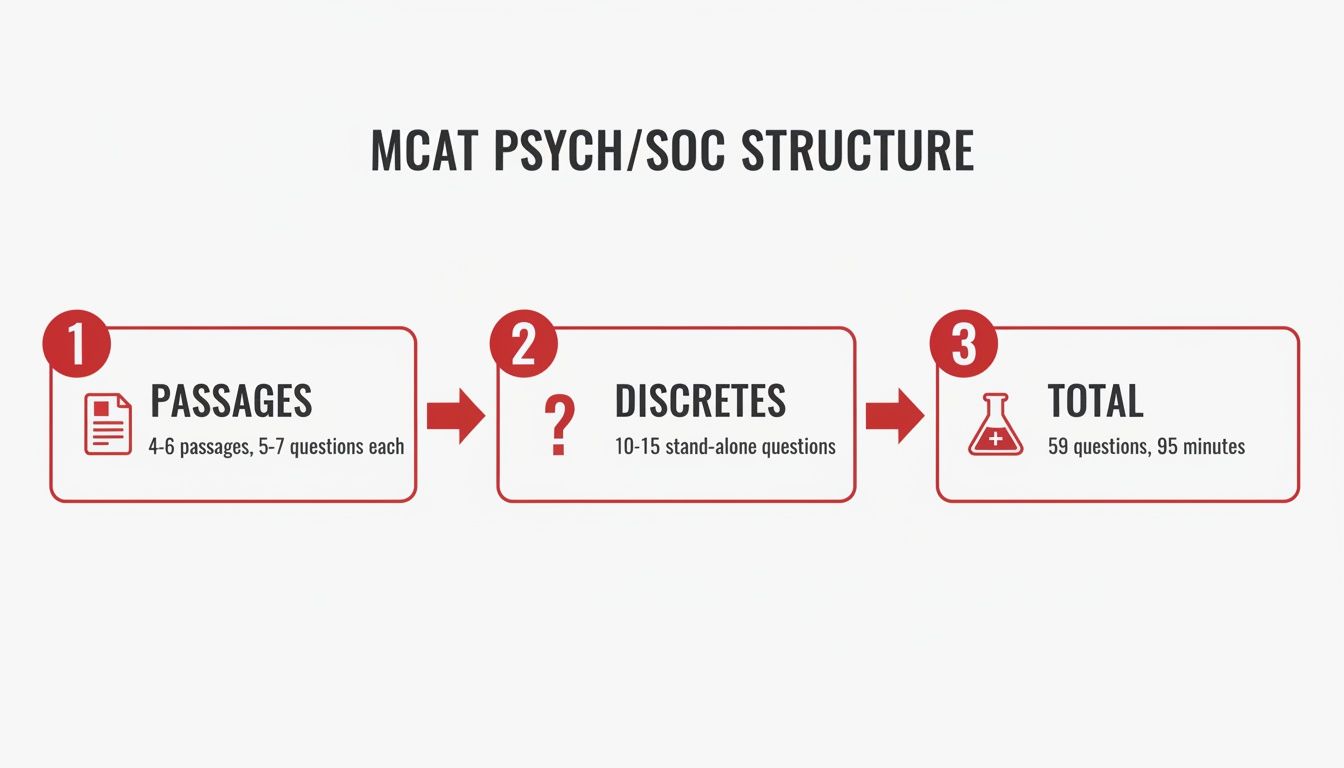
As you can see, you’ll spend most of your time wrestling with these complex passages, which makes having a reliable strategy absolutely critical.
Building a Mental Map of the Passage
Instead of just letting the words wash over you, you need to actively build a "mental map" of the experiment as you read. This means your internal monologue should be laser-focused on answering a few key questions. This approach transforms reading from a passive activity into an active hunt for information—a much more effective method when the clock is ticking.
Here’s a framework that top-scorers swear by:
- What’s the main question or hypothesis? Hunt for that one sentence that sums up what the researchers were trying to figure out.
- Who were the participants? Make a quick mental note of the sample size and any important demographics. This often comes up in questions about whether the results can be generalized.
- What’s the independent variable (IV)? What did the researchers actively change or manipulate between the groups?
- What’s the dependent variable (DV)? What did they measure to see the effect of that change?
- What were the results? Don't get bogged down in p-values and confidence intervals. Just find the big-picture takeaway—did their hypothesis pan out or not?
By zeroing in on these five things, you create a simplified blueprint of the study in your head. It’s your defense against getting distracted by complicated methods or statistical fluff that rarely becomes the focus of a question.
A huge mistake I see is students highlighting everything that looks important, which ends up meaning nothing is important. Try this instead: jot a single word in the margin next to each paragraph—like "Methods," "Results," or "Flaw." This creates a scannable outline you can reference in seconds when you’re answering the questions.
Timing Your Attack
You get roughly 9.5 minutes per passage and its associated questions. Pacing is everything. If you spend too much time on one dense passage, it can create a disastrous domino effect for the rest of the section. A disciplined approach to timing is non-negotiable.
Many students have success with a "three-pass" reading strategy. Your first pass is just a quick skim, no more than 60-90 seconds, to get the gist of the topic. The second pass is your deeper dive, where you actively pinpoint the IV, DV, and other core parts, which might take 2-3 minutes. The final "pass" happens as you work through each question, jumping back to the text to confirm your answer. This structured method stops you from aimlessly rereading.
Spotting Keywords and Distractors
The AAMC loves to write questions where two or three answer choices seem plausible. They are masters of nuance. The secret to beating these questions is to look for specific keywords in the passage and the question stem that let you eliminate the wrong options with confidence.
Common Signal Words to Watch For
- Causation vs. Correlation: Be on high alert for words like "causes," "leads to," or "results in." These imply a direct causal link, which is a very high standard to meet in research. Words like "associated with," "related to," or "linked to" only suggest a correlation and are often found in more accurate answer choices.
- Absolute vs. Nuanced Language: Be suspicious of extreme words like "always," "never," or "proves." In a science passage, the correct answer is almost always more cautious and qualified, using words like "suggests," "may," or "supports."
Getting good at this takes practice, but it's a game-changer for improving your accuracy on MCAT psychology practice questions. Broadening your toolkit with a range of learning strategies can also help you master complex material more effectively.
Ultimately, a winning passage strategy is a mix of structured reading and a sharp eye for detail. To take your approach to the next level, check out our guide on high-impact MCAT test-taking strategies, which offers powerful techniques that work across every section of the exam.
Analyzing High Yield MCAT Psychology Practice Questions
Knowing the theories and having a passage strategy is one thing. Applying it all under the pressure of the clock is a completely different ballgame. This is where we shift from theory to practice, and it’s where top scores are made.
By walking through a few high-yield MCAT psychology practice questions, we can start to think like the test-makers. We'll dissect the AAMC's logic, spot the common traps they lay, and build the quick mental reflexes you need to excel. The real goal isn't just getting the right answer—it's understanding the anatomy of a question. Let's break down both discrete and passage-based examples to see how the same concepts show up in different flavors.
Deconstructing a Discrete Question
First up, the discrete question. These are straightforward gut-checks of your content knowledge, with no passage to give you clues. Some students see them as "easy," but that directness means there's absolutely no room for error. You either know it, or you don't.
Example Discrete Question:
A student cramming for a final exam stays awake for 36 hours. This sleep deprivation is most likely to interfere with which cognitive process the following day?
A) The consolidation of long-term memories from the previous day's study session.
B) The ability to perform well-learned, automatic tasks like tying their shoes.
C) The retrieval of procedural memories related to riding a bicycle.
D) The function of the cerebellum in maintaining balance and coordination.
Thought Process Breakdown
The key here is homing in on the specific cognitive process that's most vulnerable to sleep deprivation. Sure, being exhausted affects just about everything, but the question wants to know what's most likely to take a hit.
- Pinpoint the core concept: The question is all about the link between sleep deprivation and cognition, with a clear focus on memory.
- Evaluate the options, one by one:
- (A) Memory consolidation is the brain's process of turning short-term memories into long-term ones. This happens in a big way during sleep, especially REM and slow-wave sleep. This option looks very strong.
- (B) Tying your shoes is a well-learned, automatic task. These procedural memories are incredibly tough and resistant to disruption. It's almost a reflex.
- (C) Just like option (B), riding a bike is a deeply ingrained procedural memory. Sleep deprivation might make you clumsy, but the fundamental memory of how to ride isn't the first thing to go.
- (D) The cerebellum handles motor control. While fatigue definitely impairs coordination, the question specifically asks about a cognitive process. Memory consolidation is a much more direct cognitive casualty of pulling an all-nighter.
- Select the best answer: Option (A) draws a direct line between a critical function of sleep and the student's situation. Sleep is absolutely essential for cementing what you've just learned, making this the most precise and accurate answer.
Navigating a Passage-Based Question
Passage-based questions are a whole different beast. They demand that you blend your content knowledge with information you've just read in a text, usually a research study abstract.
Let's break one down.
Passage Snippet:
Researchers investigated the bystander effect by staging an emergency in a controlled setting. In Condition 1, a single participant was in a room when smoke began to fill it. In Condition 2, a participant was in a room with two passive confederates who were instructed to ignore the smoke. Researchers measured the time it took for the participant to report the smoke. The results showed that participants in Condition 1 reported the smoke significantly faster (p < 0.01) than participants in Condition 2, where 75% of participants never reported the smoke at all.
Example Passage-Based Question:
The behavior of the participants in Condition 2 is best explained by:
A) Group polarization
B) Informational social influence
C) Cognitive dissonance
D) Fundamental attribution error
Thought Process Breakdown
Your job is to connect the experiment's findings to a specific social psychology term from your content review.
- First, understand the setup: What's the key difference between the two conditions? It's the presence of other people (the confederates). In Condition 2, the real participant sees two other people acting totally calm, and that influences their own reaction.
- Analyze the question and your options: The question asks for the best explanation for the behavior in Condition 2—why didn't they act? They were in a group where the social cue was "do nothing."
- (A) Group polarization is when a group's opinions become more extreme after a discussion. That's not happening here; there's no discussion at all.
- (B) Informational social influence happens when we conform because we see others as a source of information in an ambiguous situation. The participant sees the confederates ignoring the smoke and likely thinks, "They must know something I don't. Maybe this isn't a real emergency." This fits the scenario perfectly.
- (C) Cognitive dissonance is that uncomfortable feeling from holding two conflicting thoughts. A participant might feel dissonance ("There's smoke, but I'm not acting"), but that doesn't explain the root cause of their inaction. The group's influence is what's driving the decision.
- (D) The fundamental attribution error is our tendency to blame others' behavior on their personality instead of the situation. This is an error we make when judging other people, not an explanation for our own behavior.
- Lock in the best fit: Informational social influence (B) is the most precise term for what's happening. The participant is using the group's inaction as a guide in an uncertain scenario.
Key Takeaway: The best answer isn't just a term that's related; it's the one that most precisely and completely explains the phenomenon described in the passage. Always hunt for the 'best' fit, not just a 'good' one.
Uncovering High-Yield Content Patterns
The more MCAT psychology practice questions you do, the more you'll start to see that the AAMC has its favorite topics. They come up again and again.
When you look at the numbers, social psychology concepts like groupthink and conformity are tested heavily, showing up in about 20-25% of the Psych/Soc section's 10 passages. Overall, sociology accounts for roughly 30% of the section, which translates to about 18 questions. Psychology makes up the other 65%, or 39 out of 59 questions, with a heavy emphasis on things like perception and behavior change. For example, you’ll often see scenarios testing the elaboration likelihood model, where central route persuasion is shown to be 60-70% more effective than peripheral routes for high-involvement topics.
For a deeper dive into these numbers, detailed topic breakdowns from resources like UWorld can give you an even clearer picture.
Knowing this distribution is a huge strategic advantage. If a topic like social influence is a major player, it’s smart to dedicate extra time to mastering its subtleties—like the critical difference between informational and normative influence. That kind of deep knowledge is what pays off big on test day.
How to Interpret Data and Statistical Figures
Let's be honest: your heart probably sinks a little when you flip the page in the Psych/Soc section and see a dense chart or a complex graph. For many students, it feels like hitting a brick wall. But here's a secret from those who've been through it: mastering data interpretation is one of the fastest ways to bank easy points. The AAMC isn't trying to turn you into a statistician, but they absolutely expect you to think like a scientist and critically evaluate evidence.
The biggest mistake students make is getting lost in the numbers. The trick is to focus on the story the data is telling. Before you even glance at the questions, give yourself 30 seconds to get your bearings. What are the axes? What do the columns and rows in that table represent? A tiny investment of time upfront will save you from making a costly mistake under pressure.

Key Statistical Concepts You Must Know
You won't be asked to run your own statistical analyses, but a few core concepts show up on the MCAT over and over again. You can't just memorize definitions; you need to understand how these concepts function inside a research study. If you don't have a solid handle on these, you're just guessing.
Let's break down the most common stats you'll see in mcat psychology practice questions:
- P-values: This little number tells you the probability that the results you're seeing happened by pure random chance. A small p-value, typically p < 0.05, means the results are "statistically significant"—it's highly unlikely they're just a fluke.
- Confidence Intervals (CIs): A CI provides a range where the "true" value for the whole population probably lies. If a study reports a 95% CI of [2.5, 4.0] for a drug's effect, it means the researchers are 95% confident the real effect is somewhere in that range.
- Correlation Coefficients (r): This value, which always falls between -1 and +1, shows the strength and direction of a relationship between two variables. A value near +1 is a strong positive link, one near -1 is a strong negative link, and 0 means no relationship at all.
These concepts are absolutely foundational. For a quick tune-up on other quantitative skills, a good MCAT formula sheet can be a lifesaver for reinforcing the must-know equations and statistical principles.
Correlation Is Not Causation
If you remember one thing from this section, make it this: correlation does not equal causation. Just because two things happen together doesn't mean one causes the other. The test-makers absolutely love to prey on this logical fallacy, and it’s one of the most common traps on the entire exam.
Think about it this way: a study might find a strong positive correlation between ice cream sales and the number of drownings. A wrong answer choice would claim that eating ice cream causes people to drown. The real explanation? A third variable—hot weather—is causing both to increase.
Always be on high alert for causal language like "causes," "leads to," or "results in." Unless the passage explicitly describes a well-designed experiment with independent and dependent variables, you should be extremely skeptical of any answer choice that claims causation.
Attacking Data-Based Questions Systematically
When a question directs you to a figure, you need a game plan. Don't just stare at the chart and go with what "feels" right. A structured approach is faster, more accurate, and less stressful.
A Practical Approach to Data Figures:
- Read the Question First: Pinpoint exactly what the question is asking for. Is it a specific value? A trend over time? A comparison between two groups?
- Locate the Relevant Data: Go to the figure and find the exact part that holds the answer. Ignore the noise and focus only on the data points you need.
- Analyze and Conclude: Base your conclusion only on what the data shows. This isn't the time to bring in outside knowledge unless the question specifically asks for it. What relationship do the numbers reveal?
- Eliminate Wrong Answers: Now, compare your conclusion to the options. Get rid of anything that isn't directly supported by the data you just analyzed.
This simple process turns a potentially confusing task into a repeatable checklist, helping you navigate data-based questions with confidence. Remember, statistical reasoning is a huge part of this. Questions will often test your understanding of concepts like what happens when the significance level (alpha) becomes stricter, say dropping from 0.05 (a 95% CI) to 0.01 (a 99% CI). This sets a much higher bar for a result to be considered significant, and that's the kind of critical thinking the MCAT rewards.
Turning Your Mistakes into Score Increases
Doing thousands of MCAT psychology practice questions is a hollow victory if you aren't learning from what you get wrong. Every incorrect answer is a data point showing you exactly where you can get better. The art of effective error analysis is what separates students who improve slowly from those who see rapid score jumps.
This whole process starts with a detailed error log. This isn't just a list of wrong answers; it's an investigative tool. For every question you miss, you need to dig deeper than simply reading the correct answer explanation. Your real goal is to find the root cause of the mistake—that's the only way to stop it from happening again.

Categorize Your Errors
From what I've seen, most mistakes on the MCAT fall into one of three buckets. When you start categorizing each error, you'll quickly spot the patterns holding you back.
- Content Gap: This one's the most straightforward. You just didn't know the definition of a term or the details of a theory. Maybe you confused normative social influence with informational social influence. Simple fix: hit the books.
- Reasoning Error: This gets a bit more complex. You knew the content, but you couldn't apply it correctly to the passage or question. Perhaps you misunderstood the experiment's design or failed to connect the results to the right concept.
- Misreading/Careless Mistake: Easily the most frustrating category. You knew the material and the reasoning but blew past a keyword like "EXCEPT" or "NOT" in the question stem. This type of error points to issues with focus and pacing, not knowledge.
A huge part of turning these mistakes into points involves implementing proven ways to avoid careless mistakes across all sections of the test. Simple habits, like rereading the question right after you pick an answer, can make a massive difference.
When reviewing, don't just ask, "What is the right answer?" Instead, ask, "Why was my wrong answer so tempting to me?" This deeper question forces you to confront the flawed logic that led you astray, rewiring your brain for next time.
Track Your Progress with Metrics
Your error log is a goldmine of data. Over time, it will show you exactly where to focus your energy for the biggest return on your study investment.
Let's say after reviewing 50-100 questions, you notice that 60% of your errors are content gaps all related to sociology. That’s a crystal-clear signal to schedule a deep-dive review on that topic.
Tracking this stuff is essential. If you want to get serious about data-driven improvement, our guide on how to improve your MCAT score lays out a structured framework for using metrics to guide your prep. Don't just work hard; work smart by letting your mistakes show you the way to a higher score.
Answering Your Top MCAT Psych Soc Questions
As you get closer to test day, it's completely normal for a few nagging questions to pop up. Let's clear up the most common concerns students have about the Psych/Soc section so you can walk in feeling prepared and confident.
One of the biggest questions I get is about the sheer volume of practice questions. How many is enough? While there's no single magic number, the goal is quality, not just quantity.
Drilling 1,000 to 1,500 questions with a deep, thoughtful review process is infinitely more valuable than just blazing through 3,000 questions without learning from your mistakes. Focus on why you got something right or wrong, not just the final tally.
Which Study Resources Are Best
The market is flooded with prep materials, and it's easy to feel overwhelmed. To cut through the noise, you really only need to focus on a few key resources to build a rock-solid foundation.
- AAMC Official Prep Material: This is non-negotiable. The AAMC writes the exam, so their materials—practice questions, the section bank, and full-length tests—are the absolute gold standard for question style, logic, and difficulty.
- Third-Party Question Banks (QBanks): Tools like UWorld are fantastic for targeted practice. They help you get the reps you need on specific topics and their detailed explanations are second to none for patching up content gaps.
- Content Review Books: Books from companies like Kaplan or Princeton Review are great for building your initial knowledge base. Just be sure to pivot from passive reading to active practice as soon as you can.
Ultimately, the "best" resource is the one you actually use consistently and learn from.
A huge mistake I see students make is hoarding all the AAMC material until the last few weeks. Start sprinkling it in much earlier. Getting a feel for the AAMC's unique logic will make your third-party Qbank practice way more effective.
Managing Test Day Nerves
What happens if you hit a brutal passage and start to panic on test day? It happens to the best of us. The trick is having a game plan before it happens.
If you feel the anxiety creeping in, don't let it spiral. Just stop. Take 30 seconds. Close your eyes, take a few deep, slow breaths, and reset. Remind yourself that one tough passage won't tank your entire score.
The best way to combat nerves is to build mental endurance ahead of time. Take every single full-length practice exam under strict, simulated test conditions. That means a quiet room, exact timing, and the same break structure as the real deal. This makes the actual test day feel like just another practice run, which works wonders for keeping anxiety at bay. You've done the work—now go show them what you know.
Feeling ready to take your MCAT preparation to the next level? At Ace Med Boards, we provide personalized, one-on-one tutoring to help you master high-yield topics and build a winning test-day strategy. Learn more at https://acemedboards.com.

