Securing research experience is a rite of passage for any competitive residency applicant, but the process can feel like a black box. The good news? It doesn't have to be overwhelming.
The whole game boils down to a clear strategy: figuring out your interests, finding the right labs or clinical trials, polishing your application materials, and then making a strong impression when you reach out. This isn't about luck; it's about having a solid plan.
Your Strategic Roadmap to Medical Research Experience
Landing a meaningful research position is really your first research project. It takes some background reading, a methodical game plan, and a lot of persistence. A common fear is not being qualified enough, but you’d be surprised. Most Principal Investigators (PIs) are looking for enthusiasm, reliability, and a genuine curiosity about their work—often more than a long list of prior lab skills.
So, where do you even start? Your first goal is just to understand the landscape. Different types of research offer completely different day-to-day experiences and add unique strengths to your medical journey. For some great outside perspectives on this, you can explore blog insights from other experts in the field.

Understanding Your Role and Potential Impact
Before you fire off a single email, take a minute to picture where you fit in. Your role might be entering data for a major clinical trial, or it could be running gels in a basic science lab. Either way, every task builds real, transferable skills.
These experiences prove you can think critically, manage your time, and work as part of a team. Those are the exact qualities residency program directors are hunting for. For a deeper dive into how this all comes together, check out this guide on how to build a competitive residency application with research.
The key is to remember that you are not just filling a spot; you are learning the scientific process. This mindset shift helps you ask better questions, take ownership of your tasks, and turn a simple volunteer position into a powerful story for your application and interviews.
Let's break down the most common research opportunities out there. This quick overview will help you pinpoint which path clicks with your interests and long-term career goals.
At-a-Glance Guide to Medical Research Opportunities
This table gives you a quick snapshot of the main types of research, what you might actually be doing, and why it matters for your applications.
| Research Type | Your Potential Role | Key Benefit for Applications |
|---|---|---|
| Basic Science | Lab Assistant, Data Analyst | Demonstrates foundational scientific inquiry and technical skills (e.g., PCR, cell culture). |
| Clinical Research | Research Coordinator Asst., Patient Screener | Provides direct patient interaction and understanding of clinical trial protocols. |
| Translational | Hybrid Lab/Clinical Role | Shows ability to connect bench research with bedside applications, a highly valued skill. |
| Public Health | Survey Administrator, Data Entry | Highlights interest in community health, epidemiology, and health disparities. |
Each of these paths offers a unique way to contribute and learn. Think about what kind of story you want to tell on your residency application and let that guide your search.
Finding the Right Type of Medical Research for You
Picking a research area feels a lot like picking a specialty—the right fit ignites your passion and gives you incredible stories to share in residency interviews. Not all research is created equal, and knowing the core differences is the first step toward finding an experience that genuinely clicks with you.
The goal here isn't just to add another line to your CV. It's about finding a project that makes you excited to get to work. The world of medical research breaks down into a few key domains, each with its own vibe, skillset, and impact. Your day-to-day could be anything from pipetting solutions in a sterile lab to spotting health trends across entire cities.
Let's unpack what these paths actually look like.
Basic Science Research: The Molecular Deep Dive
This is the classic "bench" research that happens in a laboratory. Here, scientists dig into the fundamental mechanics of biology and disease at a cellular or molecular level. If you're fascinated by the "why" behind an illness—like which specific gene mutation kicks off a certain cancer—this is your world.
A typical day could involve:
- Running experiments: Think PCR to amplify DNA, Western blots to find proteins, or carefully maintaining cell cultures.
- Collecting data: This might mean peering through a microscope to see how cells have changed or running samples through sophisticated machinery.
- Lab meetings: You'll present your findings to the lab chief (the Principal Investigator or PI), troubleshoot experiments that went sideways, and map out what to do next.
This kind of work is a perfect match for students who love detail-oriented, hands-on tasks and want to build a rock-solid understanding of scientific principles. It shows you have patience, precision, and a firm grip on the scientific method.
Clinical Research: At the Patient's Bedside
Clinical research brings the science directly to human participants. It’s all about testing the safety and effectiveness of new drugs, medical devices, or diagnostic tools. If you’re motivated by direct patient interaction and seeing science translate into real health improvements, this is an amazing choice.
Your role will probably be more patient-facing. You might help a research coordinator explain a new drug trial to a patient and get their consent, making sure they fully understand the risks and benefits. Other tasks often include pulling patient data from charts, giving out surveys, or keeping track of follow-up appointments based on a strict protocol.
This experience is absolute gold for residency applications because it puts you right in the clinical mix. It proves you can talk to patients, navigate ethical issues like informed consent, and handle detailed clinical data—all non-negotiable skills for a doctor.
Translational Research: Bridging the Gap
Translational research is the critical link between the lab bench and the patient’s bedside. Its motto is literally "bench-to-bedside," as it focuses on taking discoveries from basic science and turning them into new therapies or medical procedures. It's a fast-paced field that demands a hybrid skillset.
Picture this: a basic science lab finds a compound that kills cancer cells in a petri dish. The translational researcher steps in to test that compound in animal models and, eventually, design a phase 1 clinical trial for humans. You might spend part of your week in the lab and the other part in the clinic, analyzing patient samples and connecting lab results with what you're seeing in people.
This path is ideal if you enjoy both the methodical grind of lab work and the human side of medicine. Aligning your research with a specialty you're eyeing can be a smart move; you can learn more about this by exploring how to choose a medical specialty.
Public Health and Epidemiological Research: The Big Picture
Does looking at population-level health, health disparities, or disease prevention get you fired up? If so, public health research is calling your name. This work zooms out from the individual to look at health patterns and risk factors across entire communities. Your primary tool here isn't a pipette; it's statistical software.
You might find yourself analyzing huge datasets to find risk factors for diabetes in a certain demographic, designing community health surveys, or seeing if a public health campaign actually worked. This research is less about one-on-one patient care and more about data analysis and understanding the social determinants of health. It’s a powerful way to show your commitment to improving community health on a massive scale.
Alright, you know what kind of research you want to do. That's a huge first step. Now comes the fun part: actually finding a spot in a lab or on a clinical team. The good news is that medical schools and their affiliated hospitals are buzzing with projects. You just need to know where to look.
This isn't about passively scrolling through job boards and hoping something perfect pops up. It's about being proactive, doing a bit of detective work, and making connections. Forget about having a flawless CV right now—the goal at this stage is to identify researchers and projects that genuinely get you excited.
Start on Your Home Turf: Your Own Institution
Your medical school's faculty directory is, without a doubt, the most powerful tool you have. Seriously. This is your home-field advantage. These professors are already invested in mentoring students from your school, which gives you a massive leg up.
Fire up the directory and start filtering by departments that pique your interest. Read through faculty profiles, check out their recent publications, and see whose work makes you stop and think, "I need to know more about that." Make a shortlist of 5-10 professors. This homework is critical because it lets you personalize your outreach later, which makes all the difference.
Not sure which path to prioritize? This flowchart can help you visualize the decision based on what you enjoy most.
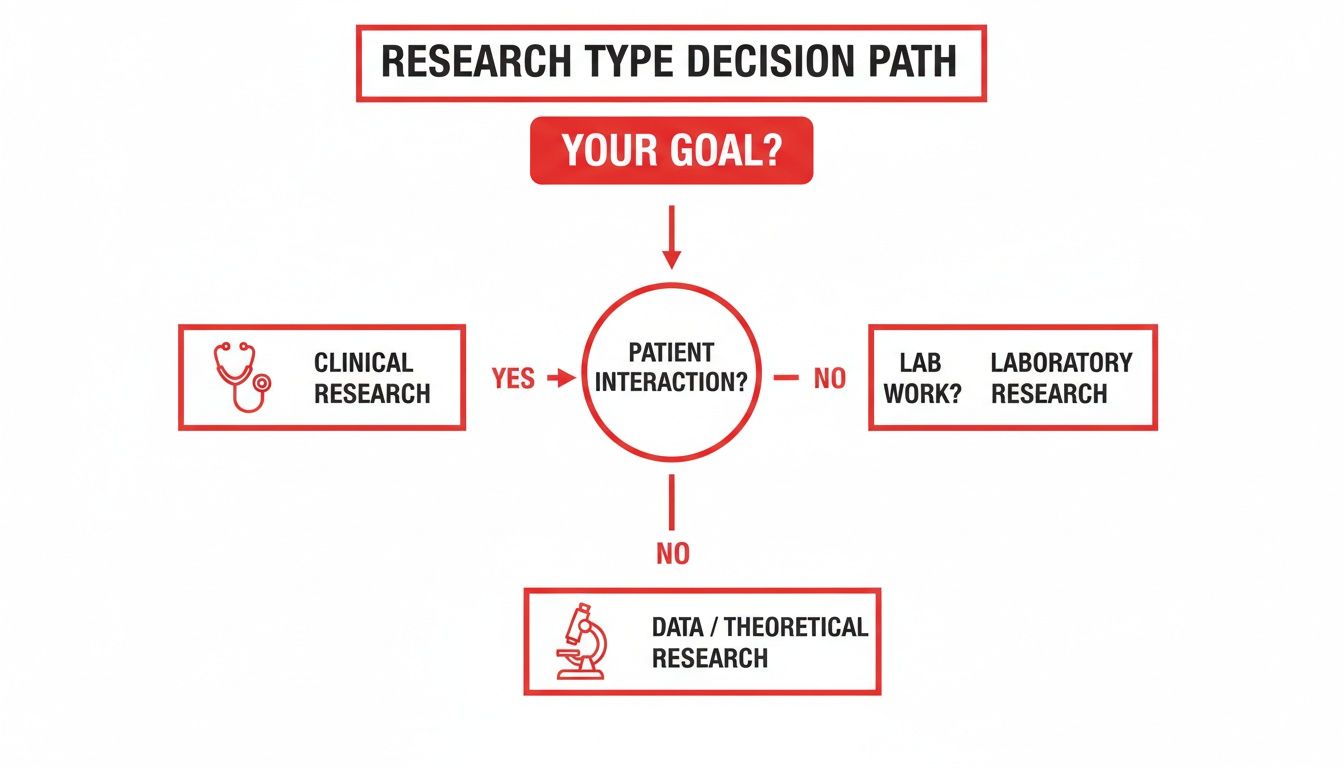
As you can see, the big question of whether you prefer patient interaction or benchwork is the key fork in the road, pointing you toward either clinical or basic science opportunities.
Go National: Tap Into Clinical Trial Databases
Looking beyond your local faculty opens up a whole new world of possibilities, especially if you're aiming for clinical research. Hands-on experience here is gold for residency applications, especially in competitive fields. One of the best places to start is ClinicalTrials.gov.
This government database lists a mind-boggling number of studies. For perspective, as of May 17, 2023, it listed 452,604 registered trials globally, with 64,838 actively recruiting participants. That's a massive pool of opportunity waiting for you.
Here’s a simple, effective way to use it:
- Search locally first. Use the advanced search to find studies happening right at your institution or nearby hospitals.
- Find the PI. Every single listing includes the name of the Principal Investigator (PI) and contact info for the research coordinator.
- Filter for "recruiting" studies. This ensures they're active and more likely to need an extra set of hands.
Finding a local trial and reaching out to the coordinator is one of the most direct ways to get your foot in the door of clinical research.
Comparing Different Research Search Strategies
There are several ways to hunt for a position, each with its own benefits and drawbacks. Understanding these can help you focus your energy where it's most likely to pay off.
| Strategy | Best For | Pros | Cons |
|---|---|---|---|
| Faculty Directory | Students wanting a close mentor relationship at their own institution. | Warm leads, established mentor-mentee culture, easier logistics. | Can be competitive; opportunities may not always be advertised. |
| ClinicalTrials.gov | Students specifically targeting clinical research experience. | Huge number of options, clear project details, direct contact info. | Can feel impersonal; outreach may go to busy coordinators. |
| Cold Emailing PIs | Proactive students with a very specific research interest. | Allows you to create your own opportunity and show initiative. | Low response rate, requires significant research and personalization. |
| Networking | Students who are comfortable building relationships over time. | Strong personal connection, opportunities shared via word-of-mouth. | Can be slow, depends on being in the right place at the right time. |
Ultimately, a blended approach often works best. Start with the "warmest" leads at your institution, but don't be afraid to broaden your search to national databases if you have a specific clinical interest.
Don’t Just Find a Lab, Vet the Mentor
Finding an open spot is one thing; finding the right one is a whole different ballgame. The quality of your mentor will shape your experience far more than the specific project ever will. A great PI can turn a simple data entry role into a life-changing experience. A disengaged one can make even the most groundbreaking project feel like a chore.
Before you say yes, do some digging. If you can, chat with current or former students in the lab. Ask about the PI’s mentorship style. What’s the lab culture like? Does the PI actively help students get posters or publications?
A great mentor is invested in your growth, not just in getting an extra pair of hands. They explain the "why" behind your tasks and help you see the bigger picture. That's the person who will write you a killer letter of recommendation down the line.
Embrace Volunteer and Remote Roles
Don't dismiss an opportunity just because it's unpaid or remote, especially when you're starting out. Volunteer roles are often the easiest way into a lab. It lowers the barrier for a PI to bring you on board and gives you a chance to prove you’re reliable and committed.
Many students start as volunteers and transition into a paid position or a more significant project once they've shown their value. Likewise, with the rise of computational biology and data science, remote roles are more common than ever. A position involving data entry, literature reviews, or statistical analysis can offer incredible flexibility for a packed med school schedule.
These experiences are just as legitimate as in-person lab work and demonstrate crucial skills. Remember, a mix of experiences builds a strong, well-rounded profile, much like other extracurricular activities for medical school that show your dedication and diverse interests.
Crafting Your CV and Nailing the First Email
Once you’ve got a shortlist of labs that genuinely excite you, the next hurdle is making a killer first impression. This is where a sharp CV and a thoughtful email can make all the difference, separating you from the dozen other hopefuls landing in a PI’s inbox.
Forget the myth that you need a long list of prior research projects. What you really need is to show your potential and a genuine, specific interest in their work.
Principal Investigators (PIs) are incredibly busy and have a sixth sense for spotting a generic, mass email. Your entire goal is to prove you've done your homework and aren't just looking for any old research credit to pad your application.
Building Your Research-Focused CV
Even if you have zero direct research experience, your CV can still be a powerful tool. The trick is to frame your existing experiences—from tough coursework to clinical shadowing—through a research lens. You're highlighting the transferable skills that every PI values.
Think about how you can showcase skills like:
- Attention to Detail: Did you ace that notoriously difficult organic chemistry lab? Mention it. Were your anatomy practicals flawless? Highlight that precision.
- Time Management: As a pre-med or med student, your life is a masterclass in juggling impossible schedules. Frame this as your ability to reliably commit to a project without flaking.
- Data Handling: Ever worked with patient charts during a clinical rotation or analyzed data for a class project? This proves you’re comfortable with the meticulous nature of data.
Major university labs and teaching hospitals are goldmines for opportunities, pumping out thousands of studies every year. To give you an idea, Brigham and Women's Hospital produced 117 papers on just one topic since 2003, racking up 59,257 citations. These research hubs, especially in the US (which led with 35% of global trial participants from 2015-2019), frequently offer summer programs or volunteer roles perfect for students. You can read more about the impact of institutional research output here.
For a complete breakdown of how to structure your CV from scratch, our detailed guide on creating a standout medical school CV provides a perfect template.
Writing an Email That Actually Gets a Response
Your first email is everything. It's your one shot to get your foot in the door, so it needs to be concise, professional, and—most importantly—personal. PIs get buried in emails, so yours has to immediately signal that you’re a serious, thoughtful candidate worth their time.
A winning email has three key parts: a clear subject line, a personalized hook that shows you know their work, and a direct (but respectful) ask. Keep the whole thing under 200 words. Seriously.
Pro Tip: Never, ever ask "Do you have any research opportunities?" This puts all the work on the PI. Instead, ask if they might have 15 minutes to talk about their research and how a motivated student could potentially contribute. It’s a much softer, more engaging approach.
Key Elements of a Winning Outreach Email
Here’s a blueprint for crafting an email that makes a connection, not just a request.
A Specific Subject Line: Use something direct like "Prospective Research Assistant Inquiry – [Your Name]" or "Interest in Glioblastoma Research – [Your University] Medical Student." This helps them triage their inbox instantly.
The Personalized Hook (1-2 sentences): Start by mentioning something specific. "I recently read your 2023 paper in Nature on CRISPR-Cas9 applications in glioblastoma and was fascinated by your findings on…" This immediately shows you've done your homework.
Your Introduction (1-2 sentences): Get straight to the point. "I am a second-year medical student at [Your University] with a strong interest in neuro-oncology."
The Connection (1-2 sentences): Bridge their work to your background. "My coursework in molecular biology has prepared me to quickly learn the PCR and cell culture techniques used in your lab."
The Ask and Logistics (1-2 sentences): Be clear about what you want and what you can offer. "I am looking for a long-term research experience and can commit 10-12 hours per week. I have attached my CV for your review and would be grateful for the opportunity to briefly discuss your work."
Always attach your CV. And for goodness' sake, proofread it twice. A clean, error-free email signals professionalism and the attention to detail that is non-negotiable in a lab. If you don’t hear back in a week or so, it’s perfectly fine to send a brief, polite follow-up.
How to Maximize Your Impact in the Lab
Getting the position is a huge win, but that's just the starting line. The real work—and the biggest opportunity—is turning that spot on the team into a powerful, application-boosting experience. You're aiming for more than just showing up; you want tangible outcomes like a stellar letter of recommendation, a poster presentation, or even your name on a published paper.
It all begins with a mindset shift. You're not just an extra set of hands; you're an apprentice scientist. Your goal is to become indispensable—the person known for reliability, intellectual curiosity, and initiative.
Master the Fundamentals First
Expect a steep learning curve in your first few weeks. Whether you're learning to pipette with precision, navigating the EMR for chart reviews, or running statistical analyses, your first job is to master the core tasks you're given.
Don't be afraid to ask questions. Seriously. It’s far better to ask for clarification on a protocol three times than to waste an entire afternoon (and expensive reagents) on a botched experiment. Keep a dedicated notebook, physical or digital, just for your research. Document every protocol, meeting note, and question. This simple act shows your mentor you're taking the role seriously and helps you internalize complex processes.
Understand the Bigger Picture
It’s easy to get lost in the day-to-day grind of running gels or entering survey data. The students who truly stand out, however, are the ones who make an effort to understand the "why" behind their work.
Take the initiative to read your Principal Investigator's (PI) past publications. This gives you context and shows you're invested. Then, ask questions that demonstrate you're thinking beyond your immediate task:
- How does this specific experiment fit into the project's main hypothesis?
- What are the next steps if we get the results we're expecting?
- What would it mean for the project if the results are completely unexpected?
This level of engagement is rare, and it signals to your PI that you have the intellectual curiosity of a future physician-scientist. It also prepares you to speak intelligently about your work, which is critical for residency interviews. If you want to get a better handle on interpreting research findings, our guide that breaks down concepts like what a p-value in research actually means is a great place to start.
Communicate Proactively and Professionally
Your PI and mentor are juggling a dozen other priorities. Clear, consistent communication is your best friend. Send regular, concise updates on your progress without waiting to be asked. A simple weekly email summarizing what you accomplished and what you plan to do next can work wonders.
This proactive approach builds trust and proves you're reliable. It shows you can manage your responsibilities independently while keeping the team in the loop.
The most valuable students are low-maintenance but high-impact. They solve small problems on their own but know when to ask for help on bigger ones. They don't disappear for weeks at a time or require constant hand-holding.
Seize Opportunities to Contribute More
Once you've nailed your core duties, start looking for ways to add more value. Is there a tedious data entry task that could be streamlined? Offer to build a better spreadsheet. Does the lab need a literature review on a new topic? Volunteer to pull the initial papers and write a summary.
This kind of initiative is how you transition from being a "student volunteer" to a "junior researcher." For example, a 2023 survey from CenterWatch highlighted that significant staff shortages at clinical research sites have created more openings for motivated students. You can step in, prove your worth, and quickly become a key player.
By actively seeking more responsibility, you not only learn more but also position yourself for bigger opportunities, like presenting a poster at a conference or contributing to a manuscript. This is how you build a research experience that tells a compelling story on your applications.
Answering Your Top Questions About Medical Research
Jumping into the world of medical research for the first time? It’s completely normal to have a ton of questions. How much time will it take? Will I get paid? What if I don't get published? These are the practical concerns that every student thinks about.
Let’s tackle some of the most common questions head-on. Getting these answers sorted out now will help you set the right expectations and walk into the process with confidence.
How Much Time Do I Actually Need to Commit?
This is probably the most common—and most important—question students ask. The reality is, it varies a lot. A summer project might be a full-time gig, while a semester-long position could be just a few hours a week.
Most labs are hoping for a consistent 8-12 hours per week during the school year.
But here’s the inside scoop: what a Principal Investigator (PI) really cares about is consistency. Showing up reliably for the hours you promised is far more valuable than overcommitting to 20 hours a week and then vanishing during finals. Be upfront and honest about your schedule from day one. PIs get it; they're used to the crazy schedules of pre-med and med students and are usually pretty flexible.
Try to commit for at least one full semester, but an entire academic year is even better. That gives you enough time to get through the initial training and start making a real contribution.
Can I Get Paid to Do Research as a Student?
Yes, you absolutely can! Paid research positions are out there, but they’re definitely more competitive than volunteer roles. The most common route to a paid gig is through a structured summer research program. These often come with a stipend but usually have a formal, competitive application process.
You might also find PIs who have grant money specifically set aside to hire student assistants on an hourly basis. Your best bet is to keep a close watch on your university’s student job board for these kinds of listings.
But don’t be discouraged if the perfect lab for your interests only offers a volunteer position to start. That’s how most people get their foot in the door.
Think of an unpaid role as your opportunity to prove your worth. Once you've spent a semester demonstrating your dedication and becoming a key part of the team, you're in a much better position to ask about paid opportunities that might open up with new grants or as other lab members graduate. The experience itself is the real prize.
What if My Research Doesn't End in a Publication?
This is a huge source of anxiety for students, but it's time for a reality check. A publication is an amazing outcome, but it’s not the only—or even the most important—result of your time in the lab.
Residency program directors know that the publication process is long and unpredictable. It can take years to get a paper out, which is often long after a student has moved on. What they really care about is what you did and what you learned.
Here are other wins that are just as valuable:
- Poster Presentations: Getting to present your work at a university symposium or a local conference is a big deal and looks fantastic on an application.
- Abstracts: Even if the full paper isn't out, having your name on a submitted abstract is a solid CV-builder.
- A Killer Letter of Recommendation: A glowing, detailed letter from a PI who can speak to your critical thinking, work ethic, and passion is arguably more powerful than being the fifth author on a paper you can barely explain.
When you get to your interviews, being able to talk intelligently about the project—the research question, the methods, your specific role, and how you navigated challenges—is way more impressive than a publication you can't discuss with confidence.
How Can International Medical Graduates (IMGs) Find Research in the US?
For International Medical Graduates, getting a research position in the U.S. is a game-changing move for strengthening a residency application. It provides that critical US-based clinical exposure (USCE) and, most importantly, opens the door to getting US-based letters of recommendation.
The strategy is pretty much the same: find PIs at big academic medical centers whose work you find interesting and start sending out highly personalized emails. In your outreach, make sure to highlight your medical degree and any clinical or research experience you already have.
Be prepared to start as a volunteer. This is the most common way for IMGs to get started, as it's a lower-risk way for a PI to bring someone new on board. This dedicated "research year" has become a well-known path for many successful IMGs. It shows an incredible commitment to matching in the US and helps you build a strong professional network before residency even starts. Focus your search on large, well-funded institutions; they’re more likely to have the infrastructure and experience to support international researchers.
Navigating the world of research can feel like a maze, but with the right strategy, it can become the launchpad for your entire medical career. At Ace Med Boards, we help students like you build standout residency applications, from acing your Shelf exams to strategically planning your research involvement. Book a free consultation today to see how our expert tutors can help you achieve your goals.

