
Choosing a medical specialty is one of the biggest decisions of your career, one that will define your professional life for decades to come. The best way to tackle it is with a clear-headed assessment of who you are—your personal traits, lifestyle goals, and clinical interests—weighed against the realities of different fields.
Building Your Framework for Choosing a Specialty
Deciding on a specialty feels monumental because, well, it is. This choice goes way beyond which clerkship you enjoyed the most; it's about aligning the core of who you are with the work you'll do day in and day out. Too many students feel rushed by deadlines and outside pressure, but a decision made in a hurry rarely leads to a fulfilling career.
There’s a better way forward. It involves building a strategic framework for your decision. This guide moves past simple checklists to give you a real-world roadmap based on what actually matters.
The Four Pillars of Specialty Selection
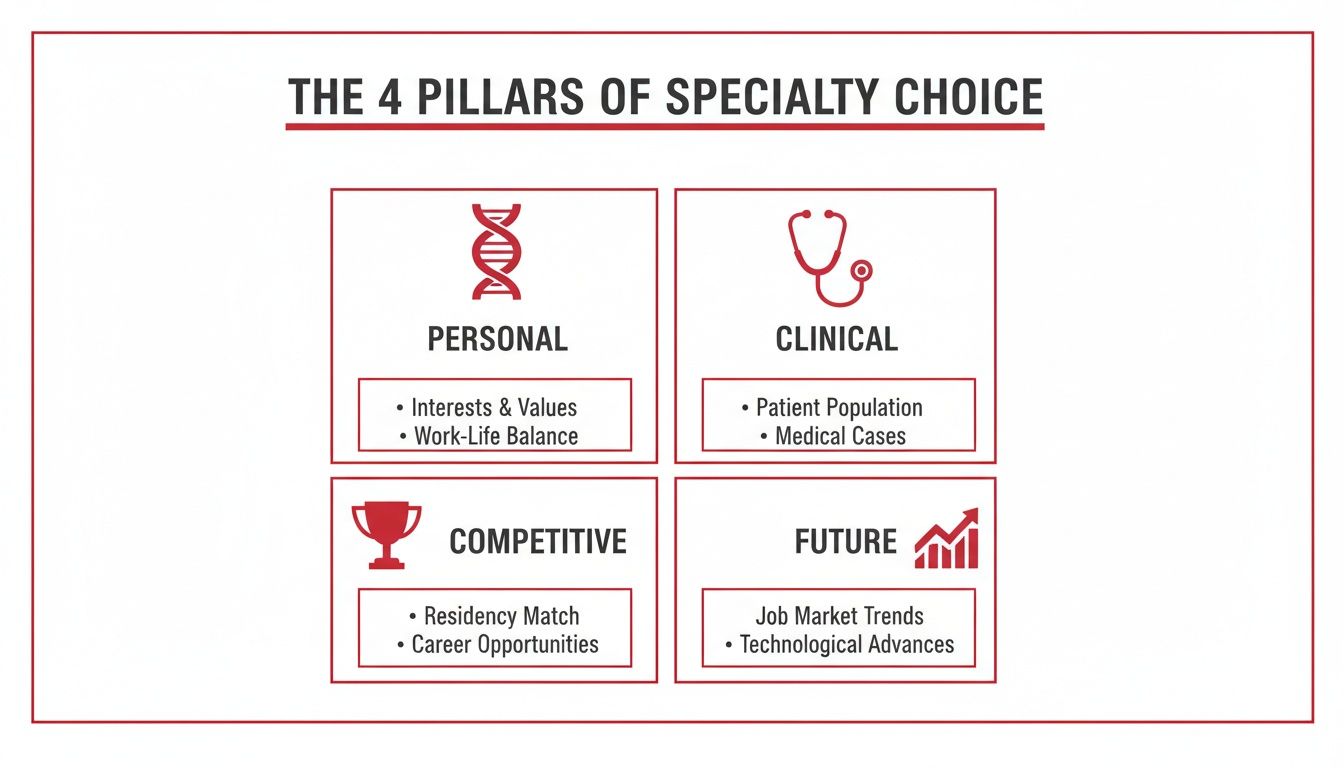
To bring some much-needed clarity to this process, we can break it down into four core areas, or "pillars," that should guide your thinking:
- Personal DNA: This is all about your innate personality, core values, and how you handle stress. Are you someone who thrives on high-stakes, quick decisions, or do you prefer methodical, long-term problem-solving?
- Clinical Reality: This covers the day-to-day grind—the patient interactions, the work environment, and the actual tasks of a specialty. It includes everything from the length of residency training to the specific procedures you'll be doing.
- Competitive Landscape: Time for an objective look at the data. This means digging into average board scores, research expectations, and the real match rates for the fields you're considering.
- Future Viability: Think long-term. What's the outlook for a specialty, considering workforce trends, new technology, and the inevitable shifts in how healthcare is delivered?
The infographic below helps visualize how these four pillars—Personal, Clinical, Competitive, and Future—create a balanced structure for making your choice.
This table offers a quick summary to help you start thinking through each pillar.
The Four Pillars of Choosing Your Medical Specialty
| Pillar | Key Questions to Ask Yourself | Actionable Steps |
|---|---|---|
| Personal DNA | What energizes me vs. drains me? What are my non-negotiable values? How do I handle pressure and uncertainty? | Take a personality assessment (like Myers-Briggs or DISC), journal about your clerkship experiences, list your core values. |
| Clinical Reality | What does a typical day/week look like? What are the best and worst parts of this specialty? How long is the training? | Shadow physicians, conduct informational interviews with residents and attendings, research residency program details. |
| Competitive Landscape | What are the average Step/COMLEX scores for matched applicants? How much research is typically expected? | Review the latest NRMP "Charting Outcomes in the Match" data, talk to your school's specialty advisors. |
| Future Viability | How might technology change this field? Are there workforce shortages or surpluses projected? What's the reimbursement outlook? | Read specialty-specific journals and industry reports, talk to mentors about the future of their field. |
By thoughtfully working through each of these areas, you build a complete picture that respects both your passion and the practical side of a medical career.
Understanding the training timeline is a huge part of this. To get a better handle on the commitment each path requires, check out our guide on how long is residency. For a wider view on career planning, you can also explore further career guidance and insights.
Discovering Your Personal and Professional DNA

Forget the match statistics and residency competitiveness data for a minute. The single most important factor in choosing a medical specialty is you. It's about finding a field that feels less like a job and more like a natural extension of your personality, values, and intellectual curiosity.
This first step is all about self-assessment—mapping your internal wiring to a career that energizes you instead of draining you.
Think about it: Are you someone who thrives on the adrenaline of making high-stakes decisions in a chaotic ER? Or do you prefer the meticulous, long-term detective work of piecing together a complex diagnosis over weeks? The answer points you in very different directions. This process requires an honest look at what drives you, free from the expectations of family or faculty.
Decoding Your Core Values
Your core values are the non-negotiables that guide your life. Ignoring them when choosing a career is a fast track to burnout. A physician who deeply values autonomy might feel completely stifled in a highly protocol-driven specialty, while someone who prioritizes teamwork would excel in a field like PM&R.
To figure this out, ask yourself some pointed questions:
- Autonomy: How much control do I really need over my schedule and clinical decisions to be happy?
- Teamwork: Do I get my energy from being part of a large, collaborative team, or do I prefer working as an independent consultant?
- Work-Life Integration: How important is protected time for my family, hobbies, and personal well-being? Be honest.
- Innovation: Am I driven to be on the cutting edge of research and new technologies?
- Patient Relationships: Do I want brief, problem-focused interactions, or do I crave the continuity of care that builds over many years?
This isn’t about finding a specialty that perfectly checks every box. It’s about finding the one whose daily reality honors what you value most. For instance, if you have a passion for building a strong foundation in research, that's a huge clue that can steer your choices and even how you build your CV. Check out our guide on how to enhance a competitive residency application for more on that.
A critical step in how to choose a medical specialty is recognizing that the "best" parts of a job are often subjective. One person's thrilling, life-saving procedure is another's source of intense anxiety. Your personal definition of a "good day" is your most reliable compass.
Matching Personality Traits to Medical Fields
While these aren't rigid rules, certain personality types naturally gravitate toward specific fields. Thinking about these archetypes can provide a useful framework for where you might fit best.
See if any of these sound like you:
- The Problem-Solver: You love diagnostic puzzles and complex physiology. Specialties like nephrology, infectious disease, or cardiology will offer endless intellectual challenges to sink your teeth into.
- The Artisan: You have excellent manual dexterity and find deep satisfaction in performing intricate, hands-on work. Surgery, interventional radiology, or anesthesiology could be your calling.
- The Communicator: You excel at empathy, building rapport, and navigating difficult conversations. Fields like psychiatry, pediatrics, or family medicine will give you the chance to form profound patient connections.
- The Sprinter: You prefer acute problems with clear resolutions and enjoy a fast-paced, high-energy environment. Emergency medicine or critical care might be a perfect match for your temperament.
This isn't a one-and-done exercise. It's an ongoing process. During your clerkships, keep a journal and make a quick note of which activities left you feeling energized versus which ones left you feeling completely drained. These patterns are invaluable clues pointing you toward a specialty that truly aligns with your personal and professional DNA.
Turning Clinical Rotations Into Real-World Insights

Your clinical clerkships are the test kitchen for your future career. Reading about a specialty is one thing, but living it for weeks on end is another beast entirely. This is your prime opportunity to move beyond textbook knowledge and gather the real-world intel you need to make this massive decision.
But here’s the thing: just showing up and going through the motions isn’t going to cut it. You have to actively transform these rotations from passive learning experiences into a full-blown investigation of your potential future.
Going Beyond Textbook Questions
Every student knows to ask about pathophysiology or the latest treatment algorithms. That’s table stakes. To get a true feel for a specialty, you have to ask the questions that reveal the culture, the daily grind, and the long-term satisfaction of the people living it.
Get personal with your residents and attendings. These conversations, often snatched in the call room at 3 a.m. or on the walk to the cafeteria, can be more illuminating than any grand rounds lecture.
Here are some questions that get to the heart of it:
- "What's the most emotionally draining part of your job, and how do you cope with it?"
- "If you could go back, what’s one thing you wish you knew before choosing this field?"
- "What does a 'bad day' actually look like in this specialty, versus a 'good day'?"
- "Outside of seeing patients, how much of your time is eaten up by admin tasks, research, or teaching?"
These questions uncover the specialty’s unwritten curriculum—the true pace, personality, and pressures that define the work day in and day out. For more strategies on making the most of this critical time, check out our complete guide to the clerkship years for medical students.
Uncovering the Hidden Culture of a Specialty
Every medical field has its own vibe. The controlled chaos of the emergency department is a world away from a psychiatry clinic. A surgical OR operates on different principles than a bustling primary care office. Your job during rotations is to be an anthropologist, observing these subtle but powerful differences.
Pay attention to how the team interacts. Is communication formal and hierarchical, or is it more collaborative and relaxed? How do physicians handle stress when a case goes sideways? The answers reveal whether you’d thrive or feel completely stifled in that environment.
The best way to know if you fit is to ask yourself, "Do I see myself in the residents who are a few years ahead of me?" If you admire their work ethic, their communication style, and how they carry themselves, that’s a very strong signal.
To gain these kinds of insights even before med school, many students explore support roles. A helpful guide on medical scribe vs. medical assistant roles breaks down how these positions offer a ground-level view of different medical environments.
The Value of Varied Clinical Settings
Experiencing a specialty in a single setting gives you an incomplete picture. The life of a pediatrician in a huge urban academic center is vastly different from that of a pediatrician in a small rural hospital.
Whenever you have the choice, try to get exposure in diverse environments:
- Academic vs. Community: See the difference between a research-heavy, sub-specialized setting and a broader, more generalist practice.
- Inpatient vs. Outpatient: Feel the contrast between managing acute, complex cases in the hospital and providing long-term, continuity of care in a clinic.
This dual exposure helps you pinpoint what aspects of a specialty truly appeal to you. You might love the intellectual rigor of academic internal medicine but find you prefer the patient relationships you can build in a community clinic. Without seeing both, you’d never know.
Navigating Specialty Competitiveness and Career Demand

While your passion is the engine driving your career choice, let's be real: objective data is the map that makes sure you actually get there. Understanding the competitive landscape of different specialties and their long-term career demand is a crucial reality check. It’s about balancing your dream with a smart strategy to make sure your years of grinding lead to a successful match and a secure career.
Ignoring this data doesn't make you a purist; it just makes you unprepared. Let's break down how to use these numbers to your advantage without losing sight of what truly inspires you.
Decoding the Data Behind the Match
The National Resident Matching Program (NRMP) publishes "Charting Outcomes in the Match," and you need to treat this as your holy grail. It’s an incredibly transparent look at the stats of applicants who successfully matched into every specialty. This isn't about scaring you away from competitive fields; it's about giving you a clear benchmark of what it takes to get in.
This data gives you a statistical profile of matched applicants, including:
- Average USMLE/COMLEX Scores: See the score ranges for matched U.S. seniors and IMGs in fields from family medicine to plastic surgery. It’s a reality check.
- Research Experiences: Get a feel for the number of abstracts, presentations, and publications that successful applicants in your target specialty typically have.
- Volunteer and Work Experiences: Understand how different types of experiences factor into a competitive application.
This is where you get brutally honest with yourself. If your heart is set on dermatology but your board scores are below the average for matched applicants, you know you need to blow them away in other areas—like having a killer research portfolio or absolutely glowing letters of recommendation—to have a fighting chance. To see a detailed breakdown, check out the data on Step 2 scores by specialty to really understand the expectations.
Assessing Long-Term Career Viability
The Match is a huge hurdle, but you also have to think about the next 30 to 40 years. The demand for certain types of physicians is always shifting because of population changes, new technology, and healthcare policy. Looking at workforce projections can uncover some amazing opportunities in high-need specialties that offer incredible job security and sometimes even significant loan forgiveness programs.
For example, the Health Resources and Services Administration's (HRSA) 2024 report projects a shortage of 87,150 full-time equivalent primary care physicians by 2037. Specifically, family medicine is expected to meet just 73% of demand. That creates a 27% shortfall, meaning we’ll need 35,910 more physicians in metro areas alone.
Choosing a high-need field isn't "settling." It's a strategic move that can lead to a deeply fulfilling career with high patient impact, professional autonomy, and excellent financial stability.
Balancing Passion with Pragmatism
So, how do you put all this together? You’re looking for the sweet spot where what you love, what you’re good at, and what the world actually needs all intersect. This isn't about giving up on your dream specialty if it's competitive. It's about building a smart, tiered application strategy.
Try creating a list with three categories:
- Reach Specialties: These are your dream fields, even if they're a long shot. You know exactly what it takes to match, and you're building your application to meet those sky-high standards.
- Target Specialties: These are fields where your current academic profile and extracurriculars align perfectly with the average matched applicant. You have a strong, realistic chance of matching here.
- Parallel Specialties: These are less competitive fields that you still find genuinely interesting. They serve as your intelligent backup plan, ensuring you match into a specialty where you can still build a happy and successful career.
For instance, a student who loves procedural work might have interventional cardiology as a "reach," diagnostic radiology as a "target," and anesthesiology as a "parallel" option. Each one offers hands-on work but with totally different competitive landscapes. This approach lets you chase your passion while having a data-driven safety net, setting you up for success no matter what happens on Match Day.
Building Your Application and Mastering the Match
Once you've narrowed down your top choices, the game shifts from exploration to execution. Now is the time to translate all that hard work and self-discovery into a residency application that truly pops. A great application isn't just a list of accomplishments; it tells a compelling story, connecting your experiences to your chosen specialty in a way that resonates with program directors.
This is all about strategic storytelling. Every single piece of your application—from the personal statement to your letters of recommendation—needs to weave together into a powerful narrative that shows exactly why you're the perfect candidate for their program.
Crafting a Narrative That Resonates
Think of your personal statement as the heart of your entire ERAS application. It’s your one real chance to speak directly to the admissions committee and give a voice to your CV. This isn't the place to just re-list what you've done; it's where you explain the why behind it all.
For example, don't just state that you did cardiology research. Instead, describe how analyzing echocardiograms ignited your fascination with the elegant complexity of cardiovascular hemodynamics. That small shift transforms a dry bullet point into a genuine story of intellectual curiosity.
A powerful personal statement should:
- Tell a Story: Kick things off with an engaging anecdote that shows, not just tells, your connection to the specialty.
- Show, Don't Just Tell: Instead of saying you're compassionate, describe a specific patient interaction that proves it.
- Connect to Your Future: Clearly explain why you're a fantastic fit for their specific program and what you hope to bring to their team.
A well-written statement is absolutely critical. For a much deeper dive, check out our guide on ERAS application strategy, which breaks down how to optimize every part of your application.
Securing Powerful Letters of Recommendation
Let's be clear: strong letters of recommendation (LoRs) come from mentors who know you well, not just from big names in the field. A detailed, personal letter from an assistant professor you worked with closely for a month is infinitely more valuable than a generic one from a department chair you met once.
When you ask for a letter, make it easy for them to say yes and write a great one. Give them your CV, your personal statement, and a quick summary of your shared experiences. Gently remind them of specific cases you worked on together or a contribution you made that you were particularly proud of. This helps them pack the letter with concrete examples that showcase your strengths.
Here's the bottom line when choosing your letter writers: "Select recommenders who can speak to your clinical skills, work ethic, and personality with specific, illustrative examples. A letter that says 'she was a great student' is forgettable. A letter that says 'her differential diagnosis on a complex case was better than the residents'' is memorable."
Making Your Audition Rotations Count
Audition rotations, or sub-internships, are basically month-long interviews. This is your chance to show a program who you are beyond the paper application. To make a killer impression, you can't just be competent—you have to be engaged, teachable, and a fantastic team player.
How to crush your audition rotation:
- Be Prepared: Know your patients inside and out. Read up on their conditions the night before so you can contribute intelligently during rounds.
- Be Helpful, Not a Hindrance: Look for ways to make the residents' lives easier. Offer to help with notes, call consults, or chase down lab results before they even have to ask.
- Show Genuine Interest: Ask thoughtful questions about the program, the city, and what the residents really think. You're interviewing them just as much as they're interviewing you.
Finalizing Your Rank Order List
After the interviews are over, you're left with one last monumental decision: creating your Rank Order List (ROL). This is a deeply personal process. Your list should be driven by your genuine feelings about each program, not by its reputation or what you think you "should" do.
Rank programs based on where you truly believe you'll be happiest and get the best training for your career goals.
Think about the overall fit. Did you click with the residents? Did the faculty seem supportive and invested in teaching? Does the program's culture match your personality? Trust your gut. That feeling you had on interview day is often a powerful and accurate indicator of where you belong. This is the final strategic step that turns all your hard work into a successful Match Day.
Common Questions About Choosing a Medical Specialty
You’ve done the deep dives, survived your rotations, and stared at spreadsheets until your eyes blurred. Yet, even in the final stretch, a few nagging questions can feel completely paralyzing. These are the real-world dilemmas that pop up in late-night study sessions and conversations with mentors.
Let's tackle the most common uncertainties head-on, so you can move forward and finalize your rank list with confidence.
What If I Am Torn Between Two Very Different Specialties?
First off, this is a great problem to have. It means you've found multiple areas of medicine that genuinely excite you. Instead of seeing it as a deadlock, think of it as the final round of your investigation. The goal now is to shift from abstract pros and cons to a tangible comparison of what your daily life would actually feel like.
Start by creating a brutally honest comparison chart. Go beyond "better lifestyle" or "more procedures." Get granular. For "Anesthesiology," you might list: "Real-time physiology, limited long-term patient follow-up, team-based OR environment." For "Family Medicine," it could be: "Building longitudinal relationships, managing a broad scope of practice, emphasis on preventative care, heavy administrative load."
Then, put them to the test. If you can, schedule back-to-back fourth-year electives or audition rotations in both. There is no substitute for this kind of immersive experience to compare the rhythm, the culture, and the day-to-day grind of each field. Watch the residents closely—can you see yourself in their shoes in two years?
Finally, ask mentors in both fields this killer question: "What does the absolute worst day in your specialty look like?"
The answer is incredibly revealing. One field's worst day (a tragic outcome in the OR) might be something you can process and handle. Another's (endless insurance paperwork and emotionally draining patient encounters) might be your personal version of hell. Often, the specialty whose worst day you can tolerate best is the one you’re built for.
How Much Do My Board Scores Really Limit My Options?
Let's be direct: board scores matter. They are a quantitative filter that residency programs, especially in hyper-competitive fields like dermatology or neurosurgery, use to manage a massive applicant pool. But they are just one data point in your entire application. They are not your identity.
If your scores are below the average for your dream specialty, the door isn't automatically slammed shut. It just means you have to be much more strategic and build an undeniable case for yourself in other areas.
Here's how you compensate:
- Crush Your Clerkships: Honors in your core clerkships, especially the one in your target specialty, proves you excel in a real-world clinical setting where it counts most.
- Produce Compelling Research: Meaningful, long-term research that results in publications or presentations demonstrates a deep commitment and intellectual horsepower.
- Secure Glowing Letters of Recommendation: Powerful letters that use specific examples to describe your clinical skills, work ethic, and personality can absolutely carry an application.
It's also essential to create a smart, parallel plan. This means applying to a wider range of programs, including those in less sought-after locations or those that are known to be more holistic in their review. And yes, you should have a genuine backup specialty that you also find engaging, where your stats align more closely with the average matched applicant.
Is It a Bad Idea to Choose a Specialty for Lifestyle or Income?
Let’s bust this myth right now. Ignoring lifestyle and income is one of the fastest routes to burnout. Thinking about your future well-being isn't selfish; it's a critical part of planning a sustainable, fulfilling career.
The goal isn't to choose a field only for these reasons, but to find a specialty you love that also supports the life you want to build outside of medicine.
Think of it as a two-step process:
- Filter by Passion: First, make a list of specialties that genuinely fascinate you based on your clinical experiences.
- Filter by Practicality: Now, within that pre-approved list, start comparing the real-world factors—call schedules, average work hours, compensation, and geographic flexibility.
It’s not about choosing money over medicine. It’s about acknowledging that financial stability and personal time are essential for your well-being. A happy, fulfilled doctor provides better patient care. Choosing a field you love that also offers a predictable schedule isn't a compromise; it's a strategic life decision.
What Is the Best Way to Find a Mentor?
Great mentors rarely just appear. You have to be proactive, professional, and seek them out. The best connections almost always spring from your time on the wards.
During your rotations, pay attention. When you find yourself admiring a particular resident or attending—their diagnostic skill, their bedside manner, their teaching style—that's your signal.
A simple, low-pressure ask is most effective. Try something like, "I've really enjoyed working with you and learning about your career. Would you have 15 minutes to grab a coffee sometime in the next few weeks? I'd love to hear more about why you chose this field." Most physicians are swamped, but they almost always make time to help an enthusiastic student.
Don't overlook your school's official resources, either. Tap into the alumni network and get involved with specialty interest groups. A well-crafted, professional email can open a lot of doors. Just be specific—instead of a vague "can you be my mentor?", ask for a brief informational interview. Look for someone who isn't just successful, but who seems genuinely invested in guiding the next generation. A great mentor can be the single most valuable guide in your journey of how to choose a medical specialty.
Navigating board exams, residency applications, and the Match process requires a solid strategy. Ace Med Boards offers personalized tutoring for USMLE, COMLEX, and Shelf exams to help you build a competitive application and match into the specialty of your dreams. Learn more and book a free consultation at https://acemedboards.com.

