
The 28,000-character field in MyERAS is a red herring. Treating that number as a target is one of the biggest mistakes an applicant can make—and it's why an otherwise strong statement may be skimmed instead of read. The ERAS personal statement length you should aim for is much shorter than the system's maximum.
Our editorial recommendation is based on practical criteria: whether a statement fits on one page in the MyERAS preview, whether its paragraphs remain clear after cuts, and whether the finished text has enough white space to read easily. This is editorial guidance, not a finding from a study of matched applicants. [Comment: Please confirm the methodology and criteria with the client.]
Your goal is a one-page statement that respects a reviewer's limited time and demonstrates the concise communication skills expected of a physician. Here's how to reach that target without sacrificing your strongest material.
Decoding the ERAS Character Count
The official allowance is a technical maximum set by the AAMC—letters, numbers, punctuation, and spaces all count toward the 28,000-character ceiling. It is not a recommendation from program directors. It's like a highway with a 100 mph speed limit; just because you can go that fast doesn't mean you should.
The practical gold standard is a compelling, single-page statement: roughly 600–800 words, or 3,500–4,500 characters with spaces. The full allowance could stretch to roughly 4,000–4,500 words—about 20 pages—and no program director has time for that. For more on this, OnlineMedEd offers useful context on why brevity matters.
Does the Character Count Include Spaces?
Yes, the 28,000-character limit includes all letters, numbers, punctuation, and spaces. This is the ERAS personal statement character limit; it describes the system's maximum, not a recommended essay length. If you're asking, “does eras character count include spaces,” the answer is yes.
Your practical target should be 3,500–4,500 characters including spaces, typically 600–800 words. That range fits comfortably on one page in the ERAS preview and leaves enough visual separation for a reviewer to process the story.
To put the technical limit and practical target in perspective, here's a quick summary.
ERAS Personal Statement Length At a Glance
This table breaks down the technical limits and our recommended targets to help you stay on track.
| Metric | Official ERAS Limit | Recommended Target |
|---|---|---|
| Characters | 28,000 (with spaces) | 3,500–4,500 |
| Words | Approx. 4,000–4,500 | 600–800 |
| Pages | 15-20 | 1 |
As you can see, the sweet spot is a small fraction of the maximum allowed. This isn't about filling space; it's about making every single word count.
The Technical Limit vs. The Practical Ideal
The gap between the allowed character count and the ideal length is massive. The contrast between the technical maximum and a focused one-page statement shows why the maximum should not be treated as a target.
Successful applicants don't need to approach the official limit. Your focus should always be on quality and impact, not quantity.
Viewing Your Statement in ERAS
Formatting issues can completely derail a great personal statement. The only way to know for sure how it will look to program directors is to use the preview function within the ERAS application itself.
Don't skip this step! It's your final quality check to catch any weird line breaks or formatting quirks before you hit submit. This is absolutely critical for ensuring your story comes across as clean, professional, and polished as you intended.
How We Determine ERAS Personal Statement Length
Our editorial recommendation uses three practical criteria. First, the statement should fit on one page in the MyERAS preview. Second, every paragraph should remain clear after substantial cuts without losing its central argument. Third, the finished text should include enough visual white space to be readable at application-review speed.
We compare these criteria with the ERAS system's stated counting and formatting rules. In practice, that means recommending 600–800 words: long enough to develop a meaningful story, short enough to earn a complete read. The recommendation is based on editorial judgment, not an analysis of matched applicant data. [Comment: Please confirm the methodology and criteria with the client.]
Why One Page Wins Over Program Directors

In our editorial view, one-page statements are easier for reviewers to recall because a focused narrative makes its central experiences and message easier to find. A statement that runs beyond one page may also include material that could be condensed; reviewing each paragraph for its purpose can help identify what to cut.
Picture the reviewer's reality: hundreds of files, an inbox that never empties, and real application fatigue. A statement spilling onto a second page can unintentionally signal that the applicant doesn't respect that limited time. Your statement is often the first genuine glimpse a committee gets of your personality, making it a critical first impression.
A powerful, concise one-page narrative does the opposite. It communicates professionalism and shows you can distill your medical journey into a clear, compelling story.
Communicating Confidence and Clarity
Sticking to one page is a strategic move. It tells the committee, "I know what's important, and I can deliver it efficiently." That skill is priceless in medicine, where clear, concise communication under pressure is a daily requirement.
A long, rambling statement doesn't just waste time; it dilutes your most powerful points, burying them in a sea of unnecessary detail. A focused essay ensures your key experiences pop off the page, making your application memorable for all the right reasons.
Think of it as presenting a patient to an attending. You wouldn't list every minor detail from the patient's history—you'd give a sharp, relevant summary that gets straight to the point. Your personal statement deserves that same clinical precision. We recommend applying that test yourself: if a paragraph can be summarized in one sentence without losing meaning, consider making it one sentence.
Crafting Your Story Within the One Page Limit
Our narrative recommendations use the same practical criteria as our length target: a one-page fit in the preview, paragraphs that can be trimmed without losing their central point, and enough white space to support readability. A one-page statement isn't merely short; it's deliberately constructed, with each paragraph earning its place.
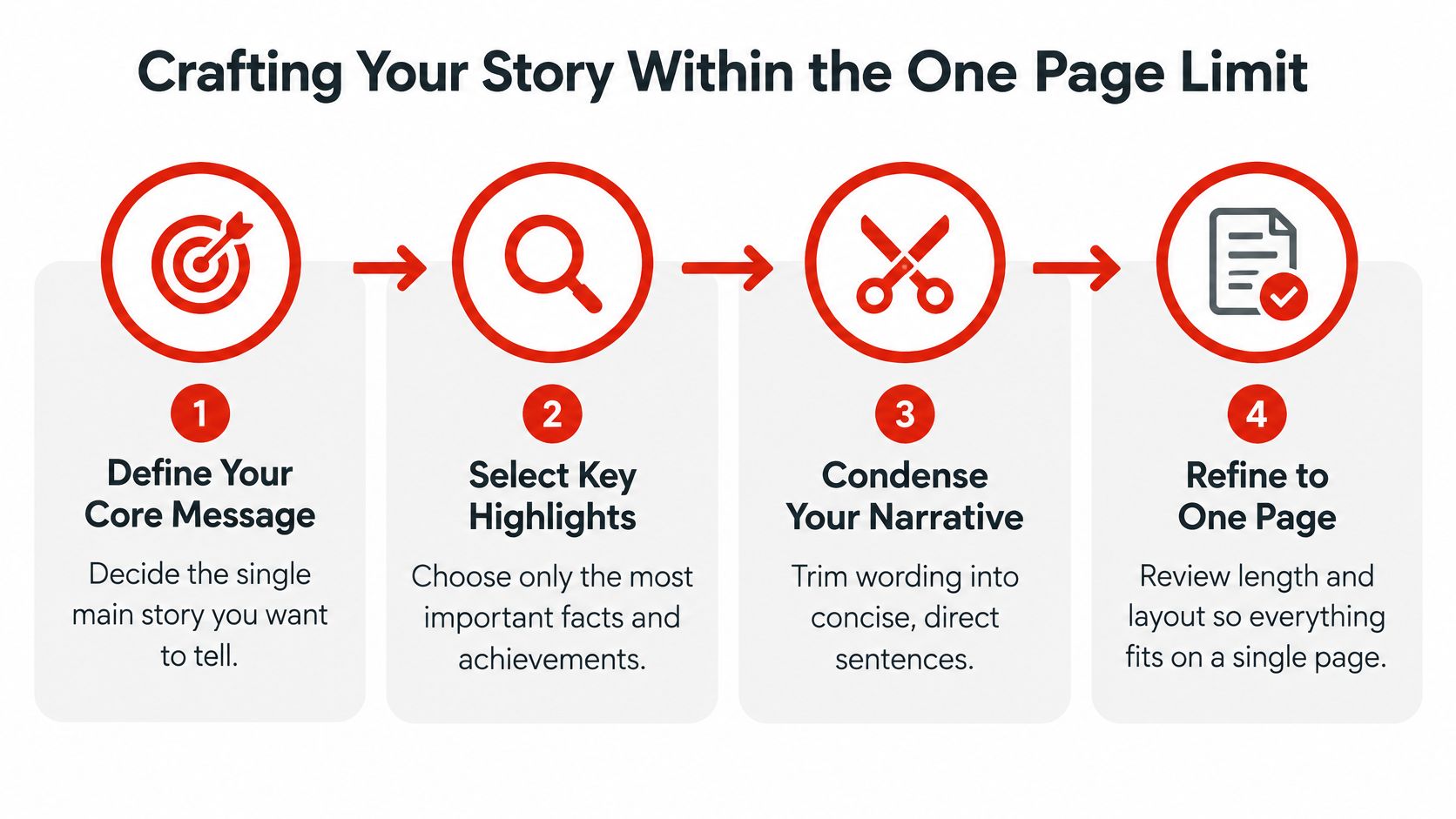
Your mission is to turn a simple list of accomplishments into a cohesive, memorable story. Every sentence needs to push the narrative forward and reinforce your central message. If you're staring at a blank page and feeling stuck, you might want to explore some techniques to spark creativity and ignite ideas to get the ball rolling.
The Proven Narrative Framework
The most successful personal statements almost always follow a clear, three-part structure. This simple framework gives your story a logical flow, making it easy for busy program directors to read, absorb, and remember.
- The Hook (Introduction): Your first paragraph should grab the reader’s attention. Begin with a compelling anecdote or defining moment that showcases your passion for your chosen specialty.
- The Growth (Body Paragraphs): Bring your journey to life in the body of your statement. Focus on 2-3 meaningful experiences. Rather than simply listing what you did, reflect on what you learned and how each experience shaped you as a future physician.
- The Vision (Conclusion): Connect your past journey with your future goals. Explain why you’re a strong fit for their program and what you hope to achieve there.
A well-structured statement does more than just list achievements; it reveals your thought process, resilience, and unique perspective. It's the difference between a resume and a story.
Sticking to this structure keeps you focused and ensures your statement is impactful from the first word to the last. To see this framework in action, reviewing a sample medical school personal statement can be helpful. By focusing on a clear beginning, middle, and end, you can craft a memorable story that fits within that one-page ideal.
Navigating ERAS Formatting and Technical Limits
The ERAS portal is infamous for its formatting quirks. Many applicants have learned the hard way that it can turn a beautifully written statement into an unreadable block of text in seconds.
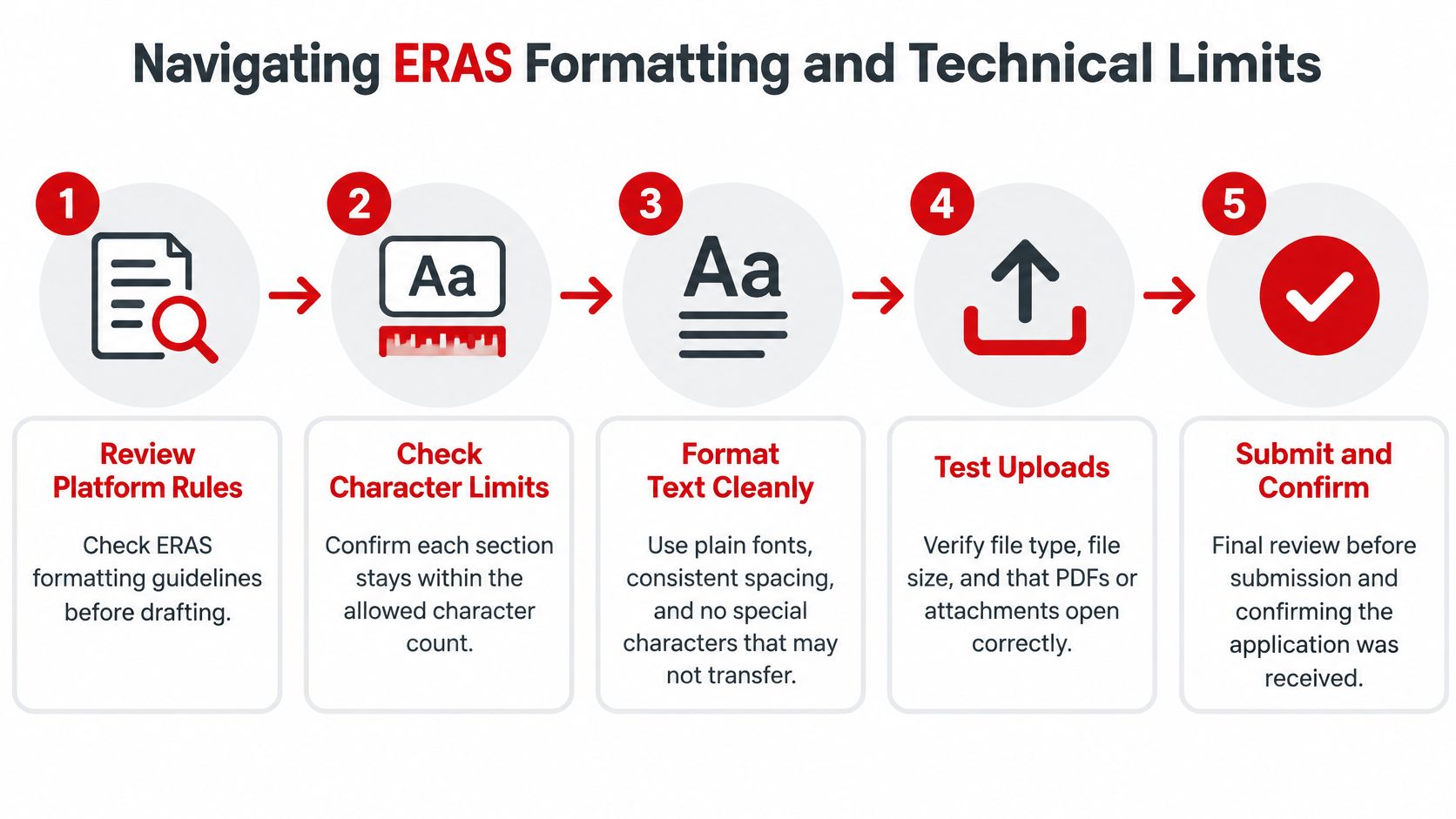
The most common mistake? Copying and pasting directly from a program like Microsoft Word or Google Docs. These programs sneak in hidden formatting code that ERAS doesn't understand, resulting in jumbled paragraphs and bizarre symbols appearing out of nowhere.
Think of it like trying to play a modern streaming file on an old VCR—the technologies are completely incompatible. The only way to win is to strip your statement of all formatting before it ever touches the application portal. This ensures your story shows up exactly as you want it to, without any technical glitches.
The Plain Text Editor Solution
Your best weapon against this formatting chaos is a simple plain text editor. Every computer comes with one: Notepad for Windows users and TextEdit for Mac users are perfect for this. These basic programs work only with raw, unformatted text. No bolding, no italics, no fancy fonts.
This limitation is your biggest advantage. By writing your final draft in a plain text editor, or pasting it there first, you scrub away all that invisible code. What's left is a clean version that is 100% compatible with the ERAS system.
Remember, the ERAS application is a great equalizer. It intentionally ignores rich text formatting to make sure every single application looks uniform to program directors. A plain text editor helps you work with the system, not against it.
Once your statement is clean in the plain text editor, you can confidently copy and paste it into the ERAS application. This one extra step is the single most effective way to avoid last-minute formatting nightmares and submit a clean, professional document.
Proven Techniques to Edit Your Statement Ruthlessly
Your first draft is almost guaranteed to run over the ideal one-page length—and that's a good thing. A powerful personal statement isn't written in a single sitting; it's carved out with precise, sometimes ruthless, editing. The goal is to trim the fat without losing your voice or diluting your core message.
Think of yourself as a sculptor who starts with a huge, raw block of marble. That's your first draft. Now, it's time to chip away everything that isn't part of the final masterpiece. This process is what transforms a good story into an unforgettable one.
The Art of Self-Editing
Effective editing requires you to step back and be objective, which isn't always easy with your own writing. One of the best ways to do this is to read your statement out loud. This trick immediately exposes awkward phrasing, sentences that drag on forever, and spots where your tone just feels off.
Another critical technique is what writers call "killing your darlings." This means you have to be willing to delete beautifully written sentences or touching anecdotes that, while eloquent, don't directly support the main narrative of why you're a perfect fit for this specialty.
Every single word in your statement should serve a purpose. If a sentence doesn't advance your story, showcase a key quality, or connect to your specialty, it has to go. No exceptions.
It can be tough, but this is how you ensure your final essay is focused, tight, and impactful. As you work on refining your statement, keep the deadlines in mind. You can get a full picture of the submission schedule by checking out our guide on the ERAS application timeline.
Your Tactical Editing Checklist
To make this less abstract, here's a tactical checklist to help you attack your draft. Challenge every word, every sentence, to justify its place on the page.
- Hunt Down the Passive Voice: Flip sentences like "The patient was seen by me" to the much stronger "I saw the patient." Active voice is more direct, confident, and almost always uses fewer words.
- Slash Weak Adverbs and Adjectives: Search for words like "very," "really," and "extremely." Strong verbs and nouns don't need these helpers. Let your actions and descriptions speak for themselves.
- Eliminate Cliché Phrases: Get rid of tired expressions like "I've always wanted to be a doctor" or a generic "passion for helping people." Instead of telling the committee, show them with specific, compelling examples from your experiences.
- Combine Short, Choppy Sentences: Look for places where you have several short sentences in a row covering related ideas. Merging them can create a more polished and readable flow.
ERAS Personal Statement Length: Frequently Asked Questions
Questions like “how long should eras personal statement be” and “how long is eras personal statement” come down to the same practical recommendation: aim for a focused one-page statement, about 600–800 words or 3,500–4,500 characters including spaces.
Is a 1,000-word personal statement too long?
Usually, yes. At typical spacing, 1,000 words lands near 6,000–6,500 characters and will almost certainly spill past one page in the ERAS preview. We advise reducing it to 600–800 words rather than risking the skim that often follows a two-page document.
Can I go over 4,000 characters?
Technically, yes: the hard ceiling is 28,000 characters, not 4,000. We advise against exceeding roughly 4,500 characters, including spaces, because that generally means exceeding one page. A statement doesn't earn extra credit for using every available character; it earns attention through focus.
Is 2 pages too long?
We consider it a clear misstep. A two-page statement can signal poor judgment to program directors—an inability to prioritize—and it invites a skim rather than a full read. If your draft runs long, cut a secondary anecdote rather than shrinking the font or margins.
Does my med school personal statement have to be 5,300 characters?
No—that 5,300-character figure belongs to the AMCAS application for medical school, not the ERAS personal-statement field. ERAS permits up to 28,000 characters with spaces, but our practical target remains one page: approximately 3,500–4,500 characters or 600–800 words.
Answering Your Top ERAS Personal Statement Questions
Most applicants do not need to rewrite dozens of essays. A polished statement focused on your chosen specialty is generally sufficient, with limited personalization for a small number of top-choice programs if appropriate.
How to Tailor a Statement for Your Dream Program
For that small handful of programs you'd be thrilled to match with, adding a touch of personalization is a fantastic strategy. This doesn't mean you need to rewrite the whole thing. Instead, just tweak the final paragraph.
- Get Specific: Mention a faculty member whose research excites you. Reference a unique clinical track or community outreach program that aligns with your career goals.
- Show You've Done Your Homework: This effort sends a signal. It tells the program director you aren't just bulk-applying; you have a sincere, informed interest in their specific community.
- Keep It Short and Sweet: You only need a sentence or two to make this connection. It can make an impact without disrupting the narrative you've already built.
Making Sense of Character Counts and Page Limits
The official ERAS limit is 28,000 characters, including every letter, space, and punctuation mark. That is a hard system limit, not a target. While a few extra lines in the preview may not automatically disqualify an application, a focused one-page statement is more likely to be read closely.
If you're having trouble cutting your story down to size, our guide on how to write a personal statement offers frameworks for writing with impact and brevity. The final check is simple: upload the clean text, preview it in ERAS, and make sure the story remains complete, readable, and within one page.
Conclusion
The right eras personal statement length is not the maximum number of characters MyERAS will accept. It is the shortest complete version of your story that still establishes your motivation, demonstrates the qualities that matter, and fits on one page. Aim for 3,500–4,500 characters including spaces, or roughly 600–800 words, then confirm the final presentation in the ERAS preview before submitting.