Your journey as a clerkship medical student starts now, marking the shift from memorizing diseases in textbooks to diagnosing them in actual patients, under careful supervision. Think of it this way: your preclinical years were spent learning the rules of a very complex game. Clerkships are where you finally get to play.
Your Transition From the Classroom to the Wards

The leap from the lecture hall to the hospital floor is one of the biggest moments in your medical training. That white coat suddenly feels a lot heavier when you're part of a real medical team, responsible for real patients. This phase, often called the clinical years, is all about immersing you in the core specialties of medicine through a series of rotations.
For most students, this is both thrilling and terrifying. All that theoretical knowledge you’ve spent years cramming now has to be applied to messy, unpredictable, real-life clinical problems. This is no longer about acing a multiple-choice question; it's about building a differential diagnosis for a patient with chest pain or figuring out the next best step for someone with a vague complaint of abdominal discomfort.
Understanding Core Rotations
Most medical schools build the third year around a set of required core clerkships. Each rotation is a unique window into a different field of medicine, designed to help you discover what you're passionate about and where your skills lie. While the exact order and length will vary, you can expect to rotate through:
- Internal Medicine: Often seen as the bedrock of clinical practice, this is where you'll tackle the diagnosis and management of complex adult diseases.
- Surgery: You’ll get your first real taste of the operating room, learn the ins and outs of pre- and post-operative care, and hopefully master basic skills like suturing.
- Pediatrics: This clerkship covers the entire spectrum of child health, from well-child checks in newborns to the unique challenges of adolescent medicine.
- Obstetrics & Gynecology (OB/GYN): You'll support patients through pregnancy, labor, and delivery, while also getting a deep dive into women's reproductive health.
- Psychiatry: A rotation that hones your ability to diagnose and treat mental health conditions, teaching you invaluable skills in communication and empathy that apply everywhere.
- Family Medicine: This is a broad, outpatient-focused rotation where you’ll gain experience providing primary care to patients of all ages.
The goal here isn't just to teach you more facts. It's about building your clinical instincts. You'll learn to move beyond simply collecting patient data to actually interpreting it—a skill that sits at the very heart of being a physician.
A New System of Evaluation
In your preclinical years, success was pretty much just your exam scores. As a clerkship student, the game completely changes. Your final grade on a rotation is now a mix of your clinical performance evaluations from residents and attendings, plus your score on a standardized final exam, known as the NBME Shelf Exam.
This dual system is designed to make sure you're developing both your practical skills and your knowledge base. To do well, you have to learn how to connect what you see in a patient to the underlying pathophysiology. Our guide on what is clinical reasoning is a great place to start building this essential skill. It will give you the framework you need to start building real clinical confidence and competence.
Navigating Daily Life on a Clinical Rotation
Get ready for a shock to the system. The predictable rhythm of lectures and labs is over, replaced by the dynamic, often chaotic, world of the hospital. Your daily life is about to look completely different, centered now on real patients, team dynamics, and learning on the fly. Feeling anxious on day one is totally normal, but having a blueprint for your new responsibilities will help you walk onto any service with confidence.
Your day will likely start before the sun comes up. This is pre-rounding time. You'll head in to see the patients you're following, checking their overnight vitals, reviewing any new lab results or imaging, and performing a quick, focused physical exam. This prep work is the bedrock of your day—it's what allows you to present a sharp, accurate picture to the rest of the team.
Mastering Your Daily Responsibilities
As a third-year student, you are the frontline data gatherer. Your most critical jobs revolve around documenting what you find and clearly communicating it to your team. The two skills you'll sharpen more than any others are writing effective notes and delivering solid oral presentations.
Your daily progress notes will almost certainly follow the S.O.A.P. note format. This structure is the universal language of clinical medicine, and mastering it ensures any provider can quickly grasp a patient's situation.
- Subjective: This is the patient's story in their own words. What's their chief complaint? What new symptoms or concerns have come up since yesterday?
- Objective: This is where you stick to the hard data. Think vital signs, physical exam findings, lab results, and imaging reports.
- Assessment: Here's where your brain really comes into play. You'll summarize the patient's main issues and offer a differential diagnosis for any new problems.
- Plan: This section outlines the game plan for each problem. What medications, tests, or consults are you ordering next?
Think of the S.O.A.P. note as a legal and medical document, not just a casual summary. It’s a permanent part of the patient’s record. Clarity and accuracy are non-negotiable.
The Art of the Oral Presentation
After you’ve finished pre-rounding, the whole team gathers for rounds. This is your moment to shine by presenting your patients. A great oral presentation is tight, organized, and gets straight to the point. You aren't just reading your note out loud; you're telling a compelling clinical story that highlights the most critical information and logically leads to a clear plan.
Kick things off with a one-sentence summary of the patient, then flow into your subjective and objective findings. The most important part is your assessment and plan—this is where you show everyone your thought process. It's your chance to prove you’re not just a bystander but an active, thinking member of the team.
This daily cycle of patient care, documentation, and teamwork is intense. Good time management isn't just a nice-to-have skill; it's a survival tool. Our guide offers some fantastic med student time management tips to help you juggle your clinical duties with your study schedule.
Understanding Your Role on the Team
Every clerkship student runs into tasks that can feel like "scut work"—tracking down old records, calling for consults, or running to grab supplies. Try to reframe that mindset. These tasks are actually a golden opportunity to learn how the hospital really works from the inside out. When you're helpful and reliable, you quickly become an indispensable part of the team.
Clinical clerkships are now a cornerstone of medical training globally. One study, for instance, showed that 84.3% of eligible students took part in general practice clerkships at outside facilities. Digging deeper, other research reveals that over 50% of the Class of 2025 did at least one away rotation, using the experience to lock in their specialty choice. You can read more about these findings on medical student clerkships to see just how important they've become.
Figuring out the team hierarchy is also crucial. Be proactive and enthusiastic, but always know your limits and stay within your scope. Your job is to learn, support your residents, and give your patients the best possible care. Do those three things well, and you'll earn trust and respect faster than anything else.
How to Master Your Evaluations and Shelf Exams
Your success in clerkships boils down to two things: how you perform on the wards and how you score on your exams. Think of them as two sides of the same coin. Your clinical evaluations are your real-time performance review, while your Shelf exams are the standardized test of your knowledge foundation.
This isn't about choosing between being a great team player or a great test-taker. The best students figure out how to merge these roles, turning every single patient encounter into a powerful, high-yield study session. Let's break down how to crush both.
Decoding Your Clinical Evaluations
Day in and day out, the residents and attendings you work with are assessing your performance. This feedback is the most direct measure of your hands-on skills, professionalism, and clinical reasoning, and it makes up a huge chunk of your final grade.
Evaluations can feel subjective and totally nerve-wracking, but you have way more control than you think. The trick is to be proactive and treat feedback like a gift, not a judgment.
- Seek Midpoint Feedback: Don't wait until the last day to find out where you stand. Politely ask a resident or attending you trust for five minutes of their time to chat about how you're doing. Ask pointed questions like, "What's one thing I could improve in my patient presentations?" or "Is there anything I can do to be more helpful to the team?"
- Implement Feedback Immediately: When someone gives you constructive criticism, thank them and make a visible effort to apply their advice. If an attending says your notes are too long, work on making them more concise that same day. This shows maturity and proves you're committed to learning.
Your clinical grade is often a reflection of your perceived trajectory. A student who starts off shaky but actively seeks and incorporates feedback is often evaluated more highly than a student who is competent but seems unteachable.
Conquering the NBME Shelf Exams
At the end of each core rotation, you'll face a standardized test called the NBME Shelf Exam. These multiple-choice exams are built by the same folks who make the USMLE, and they're designed to test your knowledge of that specific specialty. Your score is a major factor in your final grade, often deciding whether you pass, get a high pass, or earn honors.
These exams cover a massive range of topics, many of which you may not have seen firsthand on your rotation. You absolutely cannot rely on clinical experience alone to pass; you need a dedicated, strategic study plan. For a deep dive, our complete guide on how to study for shelf exams gives you an incredible framework for success.
Here's a quick look at the core clerkships you'll encounter and the exams that go with them.
Core Clerkships and Associated Shelf Exams
| Core Rotation | Typical Duration (Weeks) | NBME Shelf Exam Subject |
|---|---|---|
| Internal Medicine | 8-12 | Internal Medicine |
| Surgery | 8-12 | Surgery |
| Pediatrics | 6-8 | Pediatrics |
| Obstetrics & Gynecology | 6-8 | Obstetrics & Gynecology |
| Psychiatry | 4-6 | Psychiatry |
| Family Medicine | 4-6 | Family Medicine |
| Neurology | 4 | Neurology |
This table gives you a general idea, but remember that the length and order of your rotations are set by your medical school.
The chart below shows just how central these experiences are, with nearly universal participation and a huge number of students even taking on extra "away" rotations.
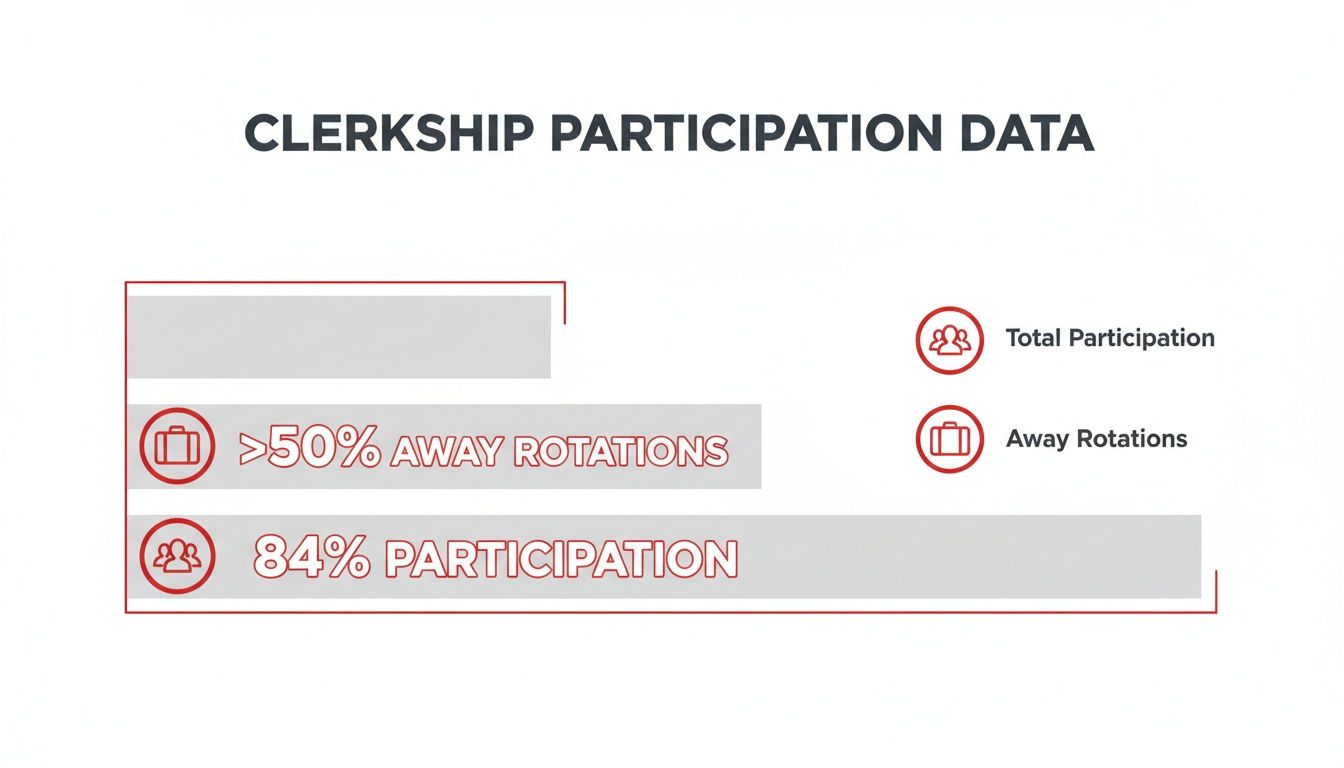
This data just reinforces that clerkships—and the exams that come with them—are a fundamental part of becoming a doctor.
Bridging Clinical Work and Exam Prep
The single most effective way to prep for Shelf exams is to connect your studying directly to the patients you see every day. This approach transforms passive learning into an active, unforgettable process.
When you admit a patient with pancreatitis, that's your study topic for the evening. You'll read about its causes, diagnosis, and management, then immediately hammer out practice questions on that topic.
This method does two things at once:
- It cements the knowledge for your exam by anchoring it to a real person and their story.
- It makes you look like a superstar on rounds the next day when you can intelligently discuss the patient's care plan.
For most students, the biggest hurdle is balancing the grueling hours on the wards with a rigorous study schedule. This is where targeted tutoring can be a game-changer. An expert tutor helps you create a high-yield study plan that cuts through the noise, focusing your limited time on the concepts most likely to show up on your Shelf and USMLE Step 2 CK exams. They help you turn every clinical question into a learning opportunity, making sure you're ready for both the wards and exam day.
Developing High-Yield Study Strategies for Rotations

Here’s the biggest academic mistake you can make in your clinical years: trying to study the same way you did in preclinical. It just won't work. The long hours, unpredictable schedules, and constant demand for clinical reasoning require a total overhaul of your approach. It’s no longer about studying harder; it’s about studying smarter.
The secret is to weave your learning directly into your clinical work. Your patients are no longer just patients—they are your most valuable, living textbooks. Every diagnosis, treatment plan, and clinical question is a high-yield learning opportunity waiting to be seized. Making that mental shift is the foundation of a study strategy that actually works for rotations.
Building Your Daily Study Routine
Forget blocking out entire days for the library. Your new study schedule is built from small, focused bursts of activity woven into the fabric of your day. The goal is active, efficient learning that actually sticks.
A realistic daily routine might look something like this:
- Morning (Pre-Rounds): As you check your patient's overnight labs or vitals, pinpoint one or two key learning points. Why was their potassium low? What are the side effects of that new medication?
- During Downtime: Waiting for a case to start in the OR or for an attending to arrive for rounds? Use that time to crush 5-10 practice questions on your phone related to your patients.
- Evening (Post-Shift): Carve out a focused 1-2 hours for question banks like UWorld or AMBOSS. Zero in on the topics you saw that day to cement what you learned in a real-world context.
This method transforms studying from a chore into a core part of your clinical development, making the information far more relevant and memorable. For medical students trying to stay afloat, this includes using a practical guide on how to improve focus while studying to make every minute count.
Think of your question bank less as an assessment tool and more as your primary learning resource. Run it in "tutor mode" and read the explanations for every single answer choice—right or wrong. This kind of active recall blows passively reading a textbook out of the water.
Choosing the Right Resources for Each Rotation
Feeling overwhelmed by the sheer volume of resources is a classic third-year trap. Trying to use everything is a fast track to burnout. The key is to be selective and stick to a handful of high-quality, trusted sources for each rotation.
Here’s a sample toolkit that will get you through most clerkships:
The Universal Essentials (For All Rotations):
- Primary Question Bank: UWorld is the undisputed gold standard for Shelf and USMLE Step 2 prep. Its questions and detailed explanations are simply unmatched.
- Secondary QBank/Reference: AMBOSS is a powerhouse, serving as both a fantastic question bank and a clinical encyclopedia perfect for quick lookups on the wards.
- Video-Based Learning: OnlineMedEd offers concise, high-yield videos that are excellent for building a solid foundation on core topics before you dive deeper.
- Spaced Repetition: Anki is non-negotiable for making information stick long-term. Use pre-made decks like AnKing or make your own cards based on practice questions you get wrong.
Mastering spaced repetition is a game-changer for long-term retention. You can learn all about spaced repetition and Anki for medical students in our detailed guide.
Leveraging Technology and Downtime
Your smartphone is your secret weapon. Load it up with apps like UWorld, AMBOSS, and Anki. These portable tools turn every spare moment—the ten minutes between patients, the bus ride home—into a potential study session.
This "micro-studying" strategy really adds up over the course of a rotation, making a huge difference in your knowledge base without needing huge blocks of dedicated library time. It lets you stay on top of your studies while still getting enough rest to be sharp and engaged on the wards—the ultimate balancing act for every clinical student.
How to Earn Honors and Strong Evaluations

Let's get one thing straight: crushing your clerkships is about way more than your Shelf exam score. It’s about mastering the "unspoken curriculum"—the soft skills, clinical judgment, and professionalism that separate a good student from a truly great one. This is where you build the reputation that earns honors and the kind of glowing letters of recommendation that open doors to residency.
The journey to honors starts with a huge mindset shift: take ownership of your patients. This doesn't just mean you're following them; it means you are their primary student doctor. Know their story backward and forward, be the first one to check their morning labs, and always be the one who follows up on imaging or consult recommendations.
When you're this proactive, you signal a genuine investment and reliability. The team starts to see that you’re on top of every detail, and with that trust comes more responsibility. It’s the difference between passively watching patient care and actively shaping it.
Cultivate Unshakeable Professionalism
Professionalism is the absolute bedrock of your clinical reputation. It’s not just about showing up on time; it's a mix of your attitude, your work ethic, and how you treat every single person in the hospital—from the head of surgery down to the transport staff.
- Be Punctual and Prepared: Get there early enough to pre-round without feeling rushed. When you’re prepared, you’re calm and confident, ready to actually contribute during rounds instead of just reciting data.
- Maintain a Positive Attitude: Rotations are a grind. Some days are just plain hard. But having a positive, can-do attitude, even when you're stuck with "scut work," makes you someone the team wants to have around.
- Show Respect to Everyone: How you interact with nurses, techs, and administrative staff is just as critical as how you talk to attendings. A student who is kind and respectful to the entire team gets noticed and appreciated.
A classic mistake is thinking you need to know everything to impress your evaluators. The truth is, they're looking for curiosity, humility, and a real desire to learn. Admitting you don't know something—and then immediately looking it up—is far more impressive than faking it.
Develop Your Clinical Reasoning
During your clerkship year, your thinking has to evolve. You need to move beyond just collecting data points, like a patient's history and physical, and start synthesizing that information into a coherent assessment and plan. This is the art of clinical reasoning.
Instead of just listing a patient's problems, start connecting the dots. Ask yourself why a patient has a certain symptom or lab value. Come up with a thoughtful differential diagnosis and be ready to defend your thinking with evidence from the patient's chart. Even if you’re wrong, it’s the thought process that counts.
This skill is what will set you apart. The competition is fierce—the medical school Class of 2025 alone had 22,666 students enrolled from a pool of over 62,000 applicants. These future doctors often prioritize goals like work-life balance (54.6%) and a secure future (51.8%), which all start with matching into a top-choice specialty. Building sharp clinical skills now is your ticket. You can dive deeper into the medical school Class of 2025 statistics to see what drives today's students.
Master Efficient Time Management
On the wards, time is your most valuable resource. Learning to manage it is a survival skill that will directly impact your performance and your sanity.
- Streamline Your Pre-Rounding: Get a system down. Chart review, see the patient, formulate your plan. Your goal is to be done with enough time left to organize your thoughts before rounds kick off.
- Prepare for Presentations the Night Before: Don’t try to wing your oral presentations in the hallway. Go over your patient’s case the night before and outline your presentation so it comes out concise and logical.
- Anticipate the Team’s Needs: Think one step ahead. If you know a patient needs a specific consult, have the phone number ready. If an admission is on the way, start grabbing the paperwork. This kind of initiative makes your residents’ lives easier and gets you noticed for all the right reasons.
Building Your Path to a Successful Residency Match
Think of your clerkship year as more than just a series of rotations. It's really a year-long audition for residency. Every single day, you're laying the bricks for your future application, and every interaction you have helps tell your story to program directors. The goal isn't just to get by—it's to build a rock-solid case for why you're the perfect person for their program.
This journey from a third-year med student to a competitive residency applicant is definitely a marathon, not a sprint. It all starts with recognizing that your evaluations and exam scores are the currency that will open doors. Performing consistently at a high level shows everyone you're ready for the real work of residency.
Securing Powerful Letters of Recommendation
Your letters of recommendation are one of the absolute cornerstones of your application. These aren't just formalities; they're personal endorsements of your skills, your grit, and your character from people who have seen you in action. Figuring out who to ask for a letter is a strategic game that you need to start playing early.
Keep an eye out for faculty members who genuinely know you and have watched you shine on the wards. This is usually an attending you worked with closely for several weeks, especially if the rotation was in the specialty you're aiming for. The perfect time to ask? Right near the end of the rotation, while your hard work and great performance are still fresh in their mind.
To make it easy for them to write a stellar letter, hand them a packet with:
- Your updated CV: This gives them a quick snapshot of everything you’ve done.
- A draft of your personal statement: This gives them crucial context about your career goals and what drives you.
- A clear deadline: This is just a professional courtesy that ensures you get your letters in on time.
For a detailed breakdown of all the key dates and deadlines, check out this comprehensive residency application timeline to keep yourself organized.
The Strategic Value of Away Rotations
As you roll into your fourth year, away rotations—often called "audition rotations"—become a huge deal, particularly if you're shooting for a competitive specialty. These rotations are your chance to test-drive a residency program and, just as importantly, for that program to see what you're made of. A strong performance can make all the difference in your chances of matching there.
Think of an away rotation as a month-long interview. It’s your opportunity to prove you are a dedicated, teachable, and collaborative future resident who would be a valuable addition to their team.
Your performance in your third-year clerkships is what makes these opportunities possible in the first place. Strong grades and glowing evaluations are your tickets to landing those coveted away rotation spots. This is how it all connects: excelling today directly creates the opportunities you’ll need tomorrow.
The residency match process gets more competitive every year. The 2025 Main Residency Match, for example, was the largest in history. Internal medicine alone offered over 11,750 positions and filled an incredible 96.8% of them. These numbers show that while opportunities are growing, so is the competition. Your entire application, from your photo to your letters, needs to be polished. To make a great first impression, it’s worth looking into professional headshots for doctors and medical professionals. By strategically building your application throughout your clinical years, you put yourself in the best possible position for a successful match.
Common Questions from Clerkship Students
Jumping into the clinical years feels like a whole new world, and it’s totally normal to have a ton of questions. Here are some straightforward answers to the things almost every third-year medical student wonders about.
How Do I Balance Studying for Shelf Exams With Long Ward Hours?
This is the million-dollar question of third year. The secret isn't about finding huge blocks of time to study—it's about learning to blend your clinical work with your exam prep.
Think in small pockets. Waiting for a surgical case to start? That's 15 minutes to knock out a few UWorld questions on your phone. Got a no-show patient in the clinic? Another 10 minutes. These moments add up fast.
Then, in the evening, aim for one to two hours of focused, high-quality studying. Forget passively rereading textbooks. Your time is better spent grinding through question banks. The best way to do this is to let your patients guide your studying. If you spent the day admitting someone with a COPD exacerbation, that's exactly what you should be studying tonight. This ties the textbook knowledge directly to a real person, making it stick so much better.
What Is the Best Way to Prepare for a New Rotation?
A little bit of prep work before you start a new rotation goes a long way and makes a killer first impression. A few days before day one, shoot an email to the clerkship coordinator or find a resident's contact info to confirm your start time, where you need to be, and what to expect.
Next, do a quick review of the absolute must-know, high-yield topics for that specialty. You're not trying to become an expert overnight, just building a solid foundation so you're not starting from zero.
- For Surgery: Quickly look over the anatomy for common procedures like cholecystectomies and appendectomies.
- For Pediatrics: Refresh your memory on developmental milestones and the standard vaccine schedule.
- For Internal Medicine: Get familiar with common admission orders for things like chest pain or community-acquired pneumonia.
Show up a few minutes early, dressed professionally, with your notebook, a couple of good pens, and your stethoscope. That’s it. You'll look prepared, professional, and ready to learn.
How Should I Respond to Negative Feedback?
First, take a deep breath. Feedback isn't a personal attack—it's a gift meant to help you grow. Your first job is to just listen. Don't get defensive, don't make excuses. Just listen, nod, and when they're done, thank them for taking the time to teach you. This shows incredible maturity.
If the feedback feels a little vague, it's okay to ask for specifics. A great way to phrase it is, "Thank you, I really appreciate that feedback. Could you show me an example of how I could make my assessment and plan more concise?"
The final step is the most important: make a visible effort to incorporate what they told you. When they see you trying to apply their advice, it shows you're humble and genuinely want to improve. That's exactly what attendings and residents want to see in a student.
How Early Do I Need to Choose a Medical Specialty?
While it’s great to keep an open mind, your third year is prime time for seriously exploring what you want your future to look like. Treat every single rotation like an experiment. Ask yourself honestly: "Could I see myself doing this every day for the next 30 years?"
By the end of your third year, you should have a pretty good idea of what specialty you're leaning toward. This is critical because it allows you to be strategic with your fourth-year schedule. You can line up the right away rotations, build relationships with faculty in that department, and secure strong letters of recommendation. A little focus now sets you up for a much stronger residency application.
Feeling the pressure of balancing clinical duties with crushing your exams? Ace Med Boards provides personalized, one-on-one tutoring built for the chaos of clerkship year. Our expert tutors help you turn your daily clinical experiences into high scores on your Shelf exams and USMLE Step 2. Visit us at https://acemedboards.com to book a free consultation and get a handle on your third year.

