

The share of students receiving Honors in emergency medicine ranged from 1% to 87% across 202 programs in earlier research summarized in a review of clerkship grading. Clerkship grades matter in residency selection, but programs need the school's grading context, the applicant's specialty interests, and supporting evaluations to interpret them fairly. An Honors label isn't a standardized measure of clinical readiness, and a lower grade isn't a verdict on an applicant's future.
By Ace Med Boards Editorial Team
What Clerkship Grades Tell Residency Programs
Clerkship grades are an influential screening signal, not a stand-alone assessment of residency potential. Programs can use them to identify applicants for closer review, while the meaning of an individual grade depends on the institution and the rest of the application.
A clerkship is a required clinical rotation, such as surgery or internal medicine, with performance evaluated by supervising faculty and other school-defined assessments. The Medical Student Performance Evaluation (MSPE) is the school's summary of a student's performance sent with the residency application. Narrative evaluations are the written comments describing performance during rotations.
How program directors rate selection criteria
A survey of 70 U.S. ophthalmology program directors reported these mean importance ratings for interview selection:
| Selection criterion | Mean importance (out of 5) | Survey population |
|---|---|---|
| Core clerkship grades | 4.26 | Ophthalmology program directors (n=70) |
| Letters of recommendation | 4.06 | Ophthalmology program directors (n=70) |
| USMLE Step 1 | 4.03 | Ophthalmology program directors (n=70) |
The United States Medical Licensing Examination (USMLE) Step 1 rating predates its move to pass/fail and should be read as historical context. These ratings describe what respondents considered important, not how much an additional Honors grade changes an applicant's chance of matching.
More broadly, an Academic Medicine discussion citing the 2021 National Resident Matching Program (NRMP) survey reported that 74.6% of program directors considered grades in required clerkships a key factor in interview decisions. That finding establishes relevance, not a universal cutoff or a formula for selection.
Key takeaways
- Context comes first. Reviewers need the school's grading rules to interpret a transcript.
- Comments add meaning. Written observations can explain strengths that a grade label doesn't capture.
- Specialty matters. Applicants should distinguish general advice from a program's published criteria.
- Historical surveys have limits. Applicants planning a 2026 application should check the latest NRMP materials rather than assume older rankings remain unchanged.
For broader application context, Ace Med Boards' explanation of what programs look at in ERAS places clinical grades alongside other application components. For applicants exploring longer-term specialty pathways, American Cardiology Group's resource on understanding the cardiologist training pipeline provides complementary career context, not evidence about residency selection criteria.
A useful first step is to list every required clerkship grade, mark rotations related to the intended specialty, and identify which documents will accompany those grades.
Why an Honors Grade Means Different Things
A 2019 analysis of Electronic Residency Application Service (ERAS) data from 137 of 140 U.S. MD-granting medical schools identified 19 grading schemes, with four-tier systems most common at 31% of schools; the median highest-grade share was 34%, ranging from 5% to 97%, and students at top-20 schools received the highest grade more often than those at lower-ranked schools, 40% versus 32%.
An Honors label works like a currency whose value depends on the issuing bank. Two transcripts can display the same word while describing very different levels of selectivity. Counting Honors across schools without checking who issued each grade produces misleading comparisons. The practical task for an applicant is translation: converting each label into the context a reviewer needs to read it accurately.

What the reported distributions show
The all-clerkship and emergency-medicine rows below summarize the analyses identified above. A separate analysis of medical-school grading distributions reported 2022 median Honors shares of 36.0% for surgery and 33.0% for internal medicine, with respective ranges of 10.0% to 82.0% and 6.7% to 80.0%.
| Clerkship or dataset | Median Honors share | Reported range |
|---|---|---|
| All clerkships, 137 U.S. MD schools, 2019 analysis | 34% | 5% to 97% |
| Surgery clerkship, 2022 | 36.0% | 10.0% to 82.0% |
| Internal medicine clerkship, 2022 | 33.0% | 6.7% to 80.0% |
| Emergency medicine clerkships, earlier research | Median not reported | 1% to 87% |
The emergency-medicine findings describe earlier grading practices, not a current national distribution.
The problem extends beyond the word Honors. A national analysis of internal-medicine MSPE information from 145 schools identified 64 grading systems; among 135 schools reporting distributions, the highest-tier share ranged from 2% to 66%. Two applicants can both hold top-tier grades while standing at very different positions within their own cohorts.
Interpretation rule: A grade distribution describes how frequently a school awarded a label. It doesn't establish that students at different schools had equivalent clinical responsibilities or were assessed against identical standards.
Finding the school-specific meaning
Translating a grade takes three documents: the transcript key, the clerkship grading policy, and the MSPE appendix. Together they show which tiers exist, how many students reach each one, and what components feed the final label. A final grade may combine clinical evaluations, an examination, assignments, or other requirements, and each component can carry its own minimum standard.
A hypothetical applicant might receive strong clinical comments but miss an examination threshold required for Honors. Another might earn the same final grade through a different combination of components. The labels match, but the educational questions differ: one record raises a question about examination preparation, the other about clinical performance.
For examination-specific interpretation, the separate Shelf exam percentile guide addresses percentile terminology without treating an examination percentile as interchangeable with a final clerkship grade. Individual grade definitions should come from the school's official grading key.
When distributions are available, applicants should record the percentage receiving each grade in each required rotation, using the cohort and grading policy that apply to their own record. That single line of context turns a bare label into information a reviewer can weigh: an Honors earned where the highest tier reaches a small share of the class reads differently than the same word at a school where it reaches most of the class.
Reading the MSPE, Narratives and Class Rank
A reviewer can interpret a transcript more carefully when the accompanying documents explain how the school assessed performance. Applicants can use the same reading sequence to understand what their application communicates, without trying to invent a new ranking system.
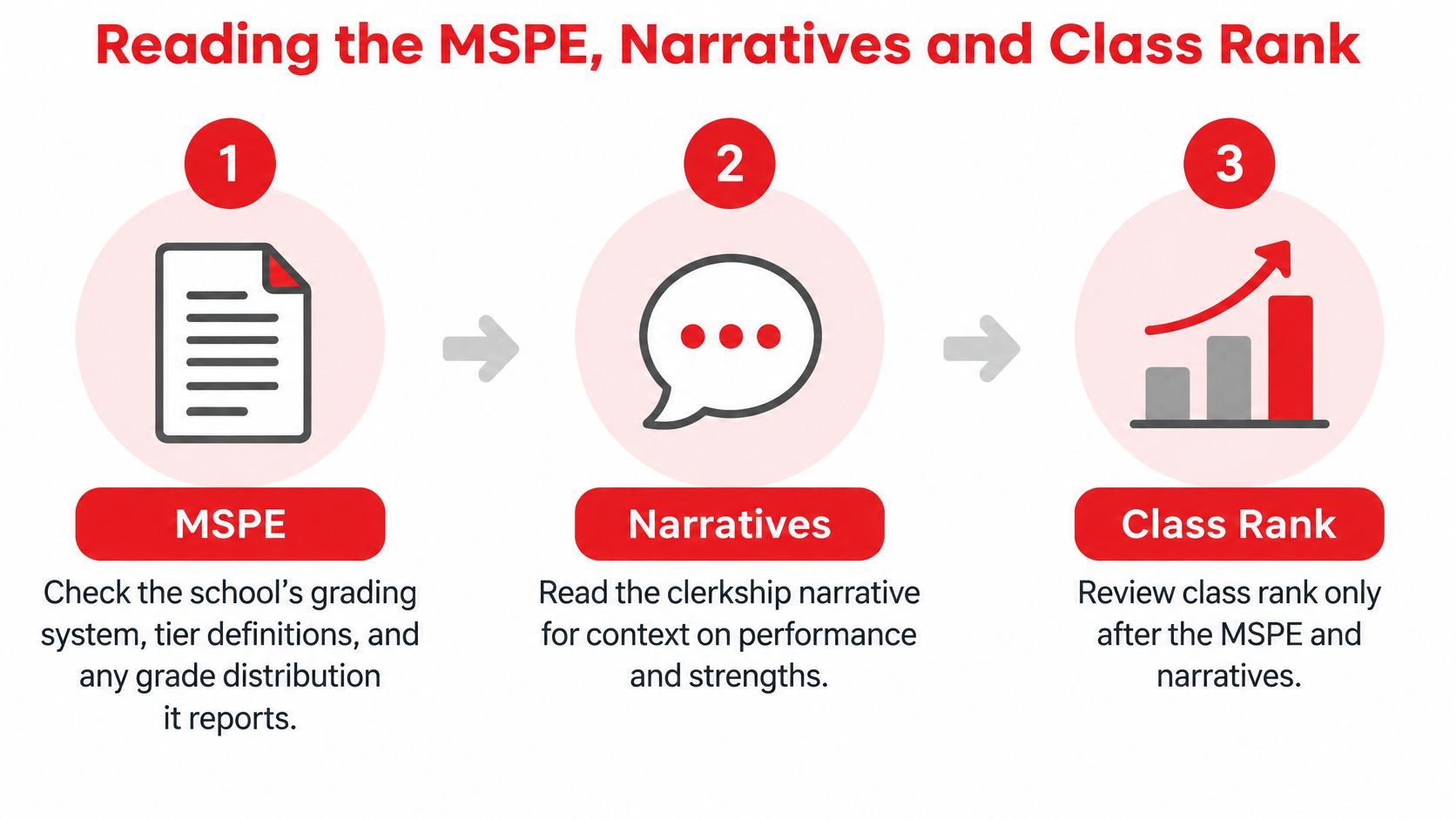
Reading the application packet
Establish the grading framework in the MSPE.
Read the tier definitions and any accompanying distribution before interpreting the grades themselves. The common slip is assuming that a familiar label means the same thing at every institution.Check whether rank or percentile information exists.
This establishes whether the school supplies an explicit comparison group. In a surgery-applicant analysis of school reporting practices, 34.7% of schools didn't report overall class rank. Missing rank is missing information, not evidence that the applicant performed poorly.Read the full narratives before drawing a comparative conclusion.
Look for specific observations about clinical reasoning, preparation, reliability, communication, and response to feedback. The common slip is allowing an isolated phrase to outweigh the rest of an evaluation or treating generic praise as equivalent to a detailed example.Identify faculty who directly observed the work.
A letter is most useful for interpretation when its author can describe what the student did. The common slip is prioritizing a faculty member's title over the depth of supervision; the residency recommendation letter guide can help applicants distinguish specific evidence from broad endorsement.Read the pattern in chronological order.
Rotation order helps separate an early learning need from an ongoing concern. The common slip is treating a later strong evaluation as if it erases an earlier difficulty, rather than showing how performance developed.
Specific observations carry more meaning
Consider a hypothetical student whose earlier narrative recommends more concise presentations, while later evaluations describe organized assessments and clear handoffs. The useful conclusion is that later supervisors documented improvement in a previously identified skill.
That conclusion should stay within the evidence. It doesn't establish a class percentile, prove that an earlier evaluator was wrong, or justify removing an unfavorable comment.
A school that doesn't publish rank hasn't assigned an applicant a hidden low rank.
For an osteopathic or international medical graduate, the same reading discipline applies: the school's own terminology and documentation should establish meaning. Applicants shouldn't independently convert unfamiliar grades into U.S. Honors equivalents.
A neutral packet summary might state that the record documents improving organization and communication, supported by later rotation evaluations and direct faculty observations.
How Specialty Changes the Weight of Clerkships
Specialty-specific surveys can help applicants identify questions worth asking, but they can't establish a single hierarchy for every residency program. The ophthalmology findings illustrate substantial reported attention to core clinical performance; they shouldn't be generalized automatically to family medicine, surgery, or an individual institution.
For applicants considering competitive fields, the practical implication is to treat required rotations as opportunities to demonstrate readiness, not merely complete graduation requirements. Preparation should still follow the rotation's educational objectives, rather than turn into an attempt to predict every evaluator's preferences.

Importance and consistency are different questions
A 2024 survey of family-medicine clerkship directors found that only 7% were completely confident that students of identical competence would receive the same clinical evaluation rating, while directors estimated that 38% of preceptors inaccurately rated student performance.
Those findings describe directors' confidence and estimates. They aren't a direct audit proving that a particular applicant's evaluation was inaccurate, and they don't establish that an unfavorable grade resulted from bias.
The sensible response is neither to dismiss grades nor accept every interpretation without question. Applicants can seek specific feedback, use established school review procedures when appropriate, and develop additional evidence through closely supervised work.
A specialty-specific check
For each intended field, applicants can complete a short review:
- Identify the relevant rotation. Determine which required clerkship or elective provides direct experience in the field.
- Identify the observers. List faculty who supervised meaningful work and could describe readiness with concrete examples.
- Identify published criteria. Record what each program's selection pages name, including any stated application requirements.
A program website may be incomplete, and the absence of a published grade requirement doesn't prove that grades receive no consideration. Unclear requirements are a reason to consult an advisor or the program's designated application contact, not a reason to invent a cutoff.
The separate guide to Step 2 scores by specialty addresses another application measure. Examination performance and clerkship evaluations answer different questions, so neither should be converted into an assumed replacement for the other.
The strongest specialty interpretation stays concrete: what the applicant did in the field, who observed that work, and which documented qualities relate to the program's stated priorities.
Pass/Fail and Mixed Grading Records
Pass/fail clerkships don't automatically disadvantage applicants. A study combining a survey of 1,578 residency program directors across 29 specialties with a meta-analysis of six studies involving 2,118 participants found no statistically significant director preference for tiered rather than pass/fail grading and no statistically significant differences in overall performance, learning ability, work habits, personal evaluations, residency selection, or educational evaluation between the systems.
That finding doesn't prove that every program treats both systems identically. It challenges the assumption that a transcript without Honors labels is automatically weaker.
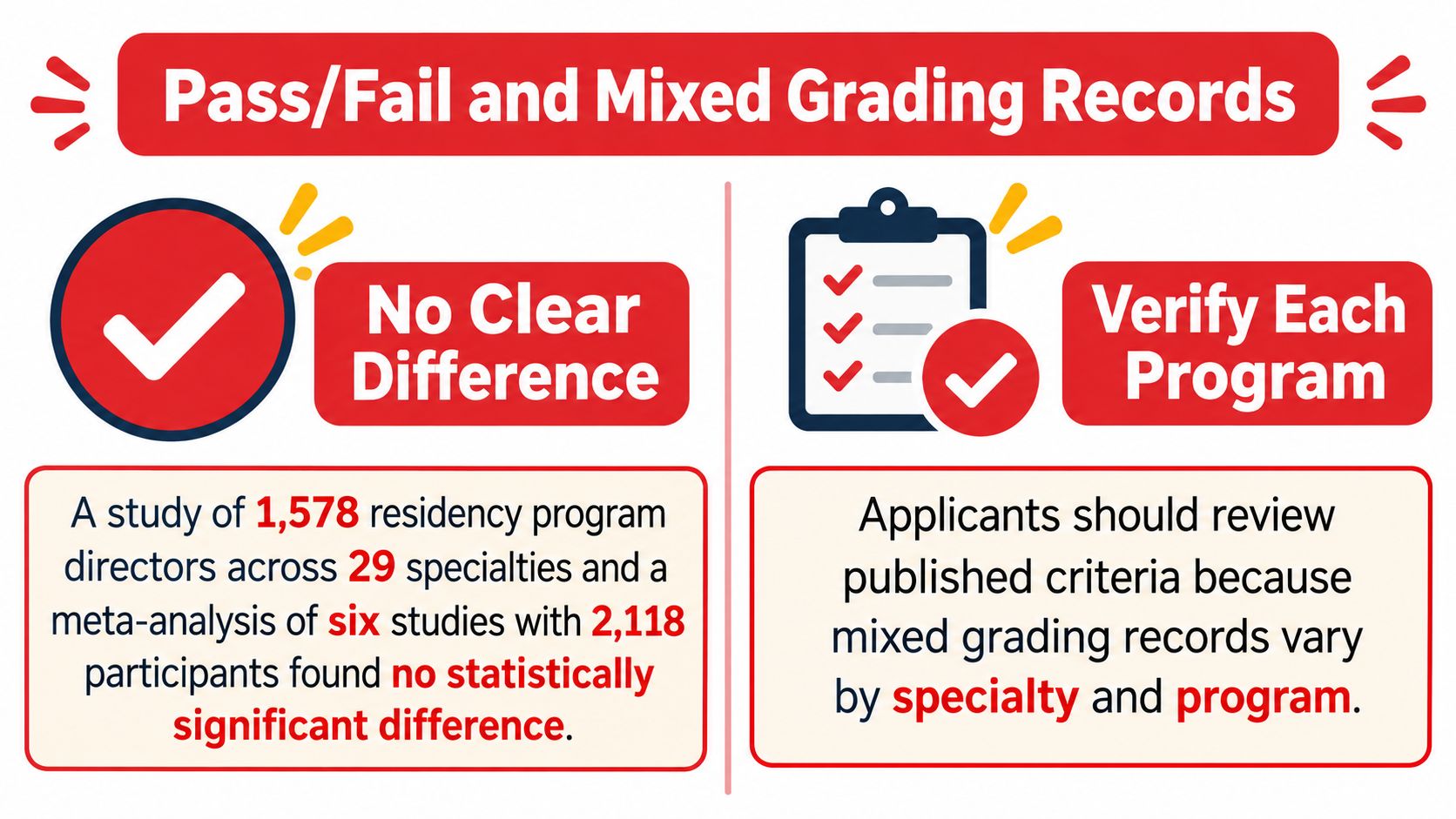
What each record makes visible
- Tiered grading: Reviewers can see distinctions assigned by the school, but need its definitions to interpret those distinctions.
- Pass/fail grading: Reviewers can see whether the school documented successful completion. Narratives and closely observed work provide detail beyond that outcome.
- Mixed grading: Reviewers need to know whether different labels reflect a policy change, different course systems, or different performance.
Applicants shouldn't treat pass/fail as permission to disregard feedback. Rotation comments can still document preparedness, strengths, and areas needing development.
Handling an uneven record calmly
A weaker rotation within an otherwise stronger record calls for a proportionate explanation, if one is needed. A hypothetical applicant could state that an early medicine evaluation identified presentation organization as a learning need, then describe the feedback used and the later documentation of improvement.
A failed, repeated, or remediated clerkship requires a more explicit account of what occurred and what was completed afterward. The explanation should match the official record and distinguish completed remediation from plans that remain unfinished.
When a grade appears inconsistent with the narrative, the applicant should first clarify the grading components through the school's permitted process. A positive narrative doesn't necessarily establish an administrative error.
A useful boundary: An application explanation should describe the record accurately, not argue a grade appeal before a residency reviewer.
Remediation, correction, and appeal policies differ by institution. The dean's office or advisor should confirm the applicable process before an applicant submits an explanation.
Auditing Your Clerkship Record and Next Steps
A focused audit can turn a collection of grades and comments into a practical application plan. Applicants can complete the review in one sitting with the transcript, available MSPE materials, rotation evaluations, school policies, and a tentative specialty list.
The purpose isn't to assign a homemade competitiveness score. It's to identify missing context, correctable documentation problems, and opportunities to demonstrate readiness through future work.
Clerkship record audit checklist
| Audit question | Where to find the answer | Action if the answer is weak |
|---|---|---|
| Is the school's grade distribution published? | MSPE or school website | Ask the dean's office how the MSPE reports distributions |
| Do core rotations match the intended specialty? | Transcript and rotation schedule | Seek letters from that specialty and consider an elective if school policy allows |
| Does narrative language support the assigned grade? | Narrative evaluations in the application | Ask for feedback from the supervising faculty member if the school permits |
| Does the school report class rank or percentile? | MSPE | If not reported, ask whether percentile data are available |
| Is there a failed, remediated or repeated clerkship? | Transcript and school policy | Consult an advisor on the explanation and the remediation steps taken |
| Do later rotations show growth? | Transcript and evaluations | Prepare a neutral sentence describing the trajectory for an interview or, when relevant, the personal statement |
Turn findings into specific actions
Each unresolved item should have an owner and a next step. A missing distribution is a question for the dean's office; an unclear evaluation calls for permitted faculty feedback; a decision about further specialty exposure belongs in an advising discussion.
Applicants with remaining clinical time might consider a relevant elective or subinternship if the school permits it and the academic plan supports it. The educational purpose should be clear: gaining experience, demonstrating readiness, or obtaining close supervision in a setting relevant to the intended specialty.
The guide to medical student clerkships provides related rotation-planning context. Additional research or service can strengthen a coherent specialty interest, but neither automatically cancels out a clinical concern.
An audit output can stay brief:
- Established strength: A documented ability supported by more than general praise.
- Unresolved question: A discrepancy or missing school-defined context.
- Next action: A named document request, advising conversation, or educational opportunity.
- Explanation needed: A concise, accurate account of a setback only where relevant or required.
Avoid application repairs that create new problems
The personal statement isn't the place to litigate an evaluation. It can describe meaningful growth when that growth helps explain the applicant's development, but a long defense of a grade can obscure the larger case for specialty interest and readiness.
Likewise, collecting letters from faculty who barely supervised the applicant doesn't solve a shortage of detailed clinical evidence. A carefully chosen observer can explain responsibilities and progress more credibly than an impressive name without direct knowledge of the work.
Applicants should save the audit alongside an application timeline and review it when MSPE materials and ERAS entries become available. For the 2026 application process, current dates should be confirmed through the Association of American Medical Colleges (AAMC) and ERAS official materials; no cycle-specific deadlines are assumed here.
Optional application support
Ace Med Boards offers Residency Match support covering the ERAS application, Personal Statement, MSPE Letter, Mock Interview, Letter of Recommendation, and Letter of Intent, plus other bonus support areas. Applicants considering outside assistance can review the current tutoring and residency-support options and discuss which part of the application needs attention.
The school remains responsible for its official evaluations, grading decisions, and MSPE. Official examination results, medical school admission, and residency match outcomes are not guaranteed.
Sources
The linked publications support different parts of interpretation and shouldn't be treated as interchangeable measures:
- NRMP survey discussion: Historical program-director responses supporting the relevance of required-clerkship grades to interview selection.
- National ERAS grading analysis: U.S. MD-school grading schemes and variation in highest-grade distributions.
- Grading-distribution analysis: Surgery and internal-medicine Honors distributions and changes over time.
- Ophthalmology director survey: Specialty-specific importance ratings, not causal estimates of matching probability.
- Family-medicine director survey: Reported confidence in evaluation consistency and perceived rating accuracy.
- Pass/fail study and meta-analysis: Director preferences and comparisons between grading systems.
- Internal-medicine MSPE analysis: Variation in grading structures and grade distributions.
- Surgery-applicant reporting analysis: Availability of class-rank information.
- Earlier clerkship-grading review: Historical emergency-medicine grading variation.
Historical findings provide context, not current program rules. Conflicting summaries shouldn't be combined into a single supposedly definitive Honors median.
Ace Med Boards offers residency-application support that can help applicants organize clerkship context, written materials, and interview explanations into a coherent presentation. Applicants seeking an outside review can visit Ace Med Boards to schedule a free consultation and discuss whether support fits their application needs.