There's no universal number of days between USMLE and COMLEX-USA because the exams use separate registration systems. The right gap depends on eligibility windows, booking lead times, school deadlines, recovery, osteopathic content gaps, and current readiness.
Why choose a gap based on another student's calendar when that student may have different requirements and preparation needs? For an osteopathic medical student taking both the United States Medical Licensing Examination (USMLE) and the Osteopathic Medical Licensing Examination of the United States (COMLEX-USA), the better approach is to identify the constraints first, then choose the interval.
By Ace Med Boards Editorial Team
The Rules That Set Your Testing Window
Separate systems create separate scheduling rules. The USMLE applying and scheduling guidance describes scheduling through Prometric, with appointments potentially available up to six months ahead. NBOME publishes advance-scheduling advice and a minimum-notice rule for COMLEX-USA, so those details should be checked directly before a student builds a calendar around a desired date.
Think of the testing window as two gates. The first gate is eligibility: does the examination system allow this student to book and test? The second gate is logistics: is there an acceptable appointment on a date that fits the student's school, study plan, and recovery needs? A student can clear the first gate and still need more time before crossing the second.
Official booking and eligibility rules by exam system
These are planning boundaries, not a prescription for how long preparation should take.
| Rule | USMLE (Step 1, Step 2 CK, Step 3) | COMLEX-USA (Level 1, Level 2-CE) |
|---|---|---|
| Booking lead time | Up to six months ahead through Prometric, within the eligibility period | Check NBOME scheduling guidance early when choosing a desired date |
| Minimum notice | Appointment availability and current scheduling rules govern booking | Check NBOME's minimum-notice rule before selecting a late date |
| Eligibility window | Assigned eligibility period; the appointment must fall inside it | Published testing windows, with candidate eligibility certified by the appropriate college or program |
| Exam order | Step 1 and Step 2 CK may be taken in either order when eligible; Step 3 requires passing both | Level 2-CE requires passing Level 1 and completing the second year |
The NBOME eligibility bulletin sets the Level 2-CE prerequisites shown above and describes college certification for Level 1. USMLE permits eligible candidates to take Step 1 and Step 2 Clinical Knowledge (CK) in either sequence, while Step 3 requires both passes.
Exam order and exam spacing are different decisions. Permission to take an examination doesn't establish that a student is ready, and passing one system's examination doesn't replace the other system's eligibility requirements. A calendar works best when each date has a reason behind it.
What the booking rules mean in practice
The COMLEX late-booking rule is an operational boundary. It doesn't mean that the same amount of time is enough to recover, review osteopathic material, or establish readiness after USMLE. A student might be able to reserve a date close to another examination and still need a longer study interval before feeling prepared.
NBOME's advance-scheduling guidance points to a practical issue: appointment availability deserves early attention. A student can reserve an appointment well ahead of testing while continuing to evaluate whether preparation supports keeping it. That approach keeps options open without forcing a rushed decision.
Planning rule: Reserve dates early enough to preserve options, but use readiness checkpoints to decide whether those dates remain appropriate.
A workable calendar should distinguish:
- Eligibility: Whether the examination organization permits the student to test.
- Availability: Whether an acceptable appointment exists.
- School approval: Whether institutional requirements have been satisfied.
- Readiness: Whether current preparation supports proceeding.
The COMLEX Level 1 test-date guide can help organize the calendar side of that decision without turning available dates into recommended study intervals.
For a 2026 planning reference, these policies should be treated as changeable, and the verification checklist under “Confirm Your Dates Before You Book” should govern the final booking decision.
Four Factors That Set Your Ideal Gap
The useful answer to “how many days between USMLE and COMLEX?” begins with identifying what the student needs to accomplish between appointments. A gap should have a purpose, not merely occupy space on a calendar.
School requirements and recovery
School or program requirements come first. A rotation start, graduation requirement, or documentation deadline can limit scheduling flexibility. The student should ask whether the institution needs an examination completed or an actual result received, because those are different deadlines.
An approaching deadline may favor a shorter, carefully planned gap, but it doesn't make an unready student ready. If preparation and institutional timing conflict, the next step is a discussion with the school rather than an automatic decision to compress both examinations.
Recovery deserves its own calendar entry. Full examination days require sustained concentration, and a student who remains exhausted after realistic practice should plan differently from a student who recovers quickly. Current exam-day duration and block structure should be checked before building a simulation, rather than assuming the formats remain unchanged.
Osteopathic content and current readiness
Osteopathic manipulative medicine (OMM) and osteopathic principles and practice (OPP) need deliberate attention when COMLEX is the next examination. A student with an organized osteopathic review and familiar question approach has a different transition task from someone who still needs substantial content work.
For USMLE preparation, National Board of Medical Examiners (NBME) practice assessments can inform the readiness discussion. For COMLEX, Osteopathic Medical Self-Assessment Examination (COMSAE) results can serve that planning role alongside school guidance, question review, and format familiarity.
The important feature is the pattern, not a universal score cutoff. Stable performance near the student's appropriate readiness goal supports a different decision from wide fluctuations, persistent timing problems, or unfinished foundational review.
How each factor pushes the gap shorter or longer
| Factor | Shorter gap fits when | Longer gap fits when |
|---|---|---|
| School or program deadline | A documentation or rotation deadline needs a score soon | The deadline is later and the second exam needs more preparation |
| Recovery after a full exam day | Recovery is quick and closely spaced testing hasn't caused lasting fatigue | Long practice sessions leave lasting fatigue |
| OMM and osteopathic content gap | Little osteopathic content remains and the COMLEX format is familiar | Substantial OMM review and COMLEX-format practice remain |
| Practice-test stability | Recent practice results are stable and near the readiness goal | Results are rising sharply or swing widely between assessments |
Each factor can be marked shorter, neutral, or longer. The student shouldn't count the marks, because an unmet eligibility requirement or substantial readiness concern outweighs convenience.
The USMLE timing and scheduling guide provides related calendar context. The final interval should follow the most consequential constraint, with the reason recorded before either appointment is finalized.
How Score Release Changes the Decision
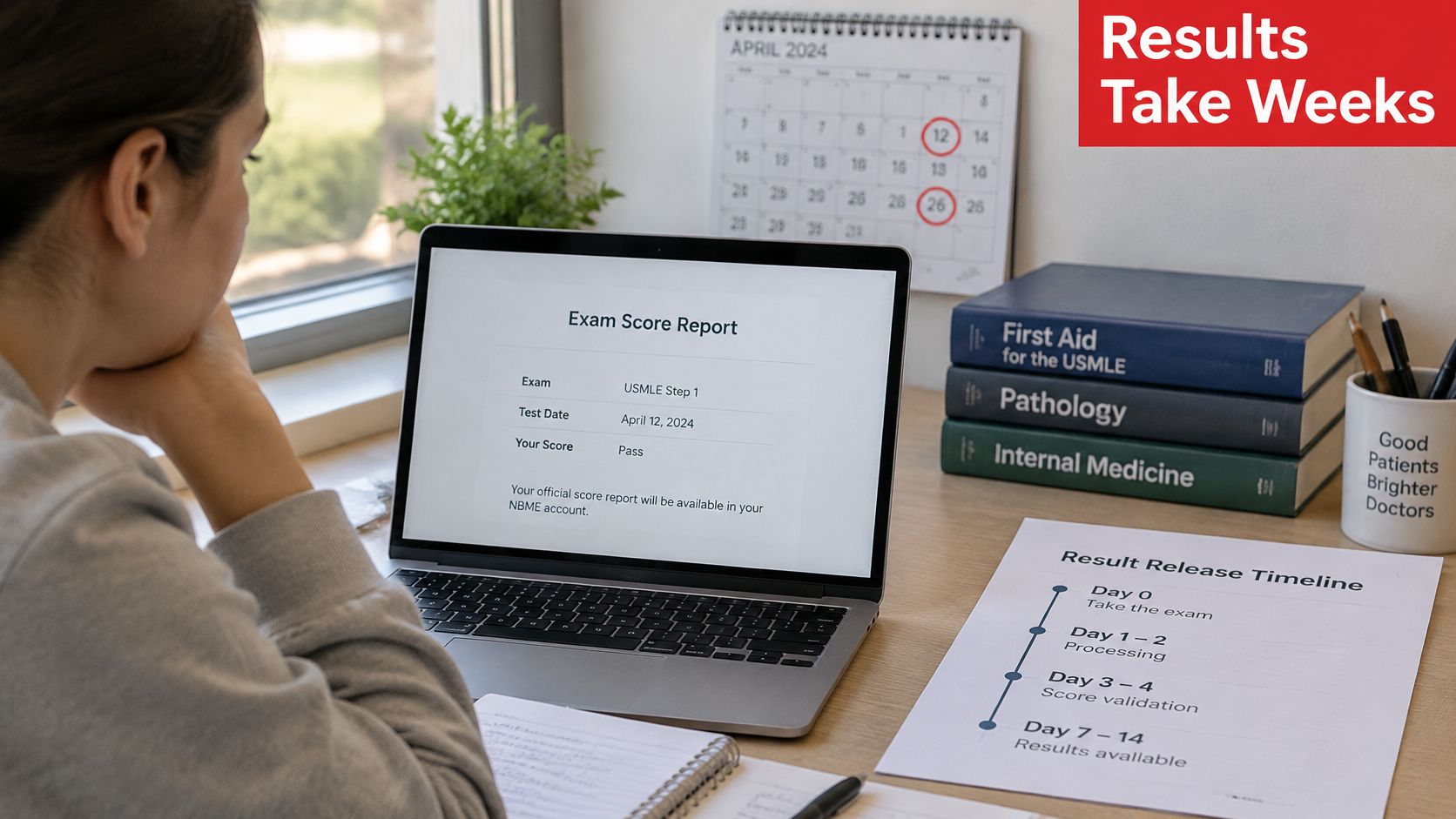
USMLE results are typically available two to four weeks after testing, but the USMLE scoring and score-reporting guidance advises allowing at least eight weeks for notification because delays can occur; it also distinguishes Step 1's pass/fail reporting from Step 2 CK's three-digit score.
An appointment date therefore isn't a documentation date. A student who needs a result for a fixed institutional deadline should work backward from the reporting contingency, not just from the day of testing.
A published calendar example
As a historical planning example, the NBOME 2026–2027 testing-window calendar lists a Level 1 window of May 7–31, 2026, with release on June 30, 2026, followed by June 1–13, 2026, with release on July 9, 2026.
Those windows span 25 and 13 calendar days, respectively, with approximately 30 and 26 days between each window's end and its published release date. The relevant lesson is that a student's position within a testing window affects the wait from the individual appointment to release.
The current NBOME calendar must replace this historical example before any booking decision. The COMLEX Level 1 score-release guide can help organize that check.
Waiting for a result versus proceeding
When a school or residency program needs documentation, the student should identify the required result and allow the appropriate reporting contingency. An earlier appointment is useful only if the expected reporting schedule also fits the deadline.
When no document is immediately required, proceeding without the first result may preserve study momentum. That choice also means making the second-exam decision from existing practice evidence rather than expecting the first result to arrive in time.
According to the NBOME Level 1 overview, COMLEX Level 1 is reported pass/fail with a formative performance profile, and results are generally released two to six weeks after the testing window ends.
A short planning note should record:
- Purpose: What each result will be used for.
- Deadline: When the receiving institution must have it.
- Decision date: When the student will choose whether to wait or proceed.
- Fallback: What changes if the result remains unavailable.
Illustrative Timelines for Three Common Paths
How should a student read a sample timeline without treating it as a rule? Use it as a model for matching constraints, then rebuild the plan around the student's own evidence.
The following timelines are illustrative examples, not official rules, recommended intervals, or outcome predictions. Their purpose is to show how different constraints can lead to different calendars.
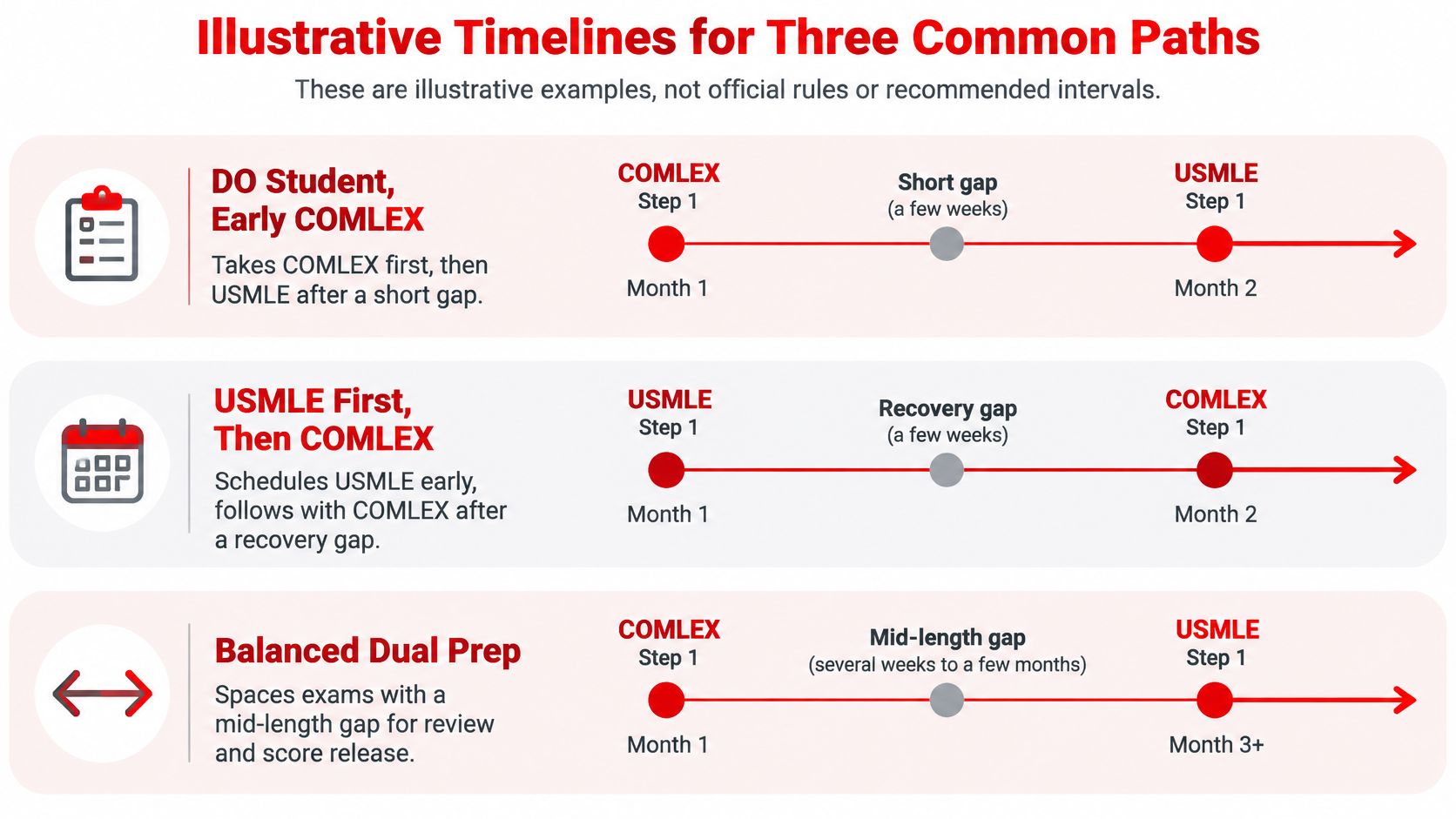
Illustrative timelines by scenario
Every gap and numerical checkpoint below is hypothetical. A timeline works like a route map, not a train schedule: it shows one possible path, but the traveler still checks current conditions. Each student's own practice evidence should determine whether the proposed appointment remains suitable.
| Scenario | Illustrative order | Illustrative gap | Checkpoint before the second exam |
|---|---|---|---|
| Osteopathic student who wants osteopathic content first | COMLEX Level 1, then USMLE Step 1 | About 4 to 6 weeks, illustrative | Stable personal NBME results, with OMM review completed before COMLEX |
| Student with a documentation deadline for both results | USMLE Step 1, then COMLEX Level 1 | About 3 weeks, illustrative | Published reporting dates checked against the deadline and personal COMLEX readiness established |
| Student rebuilding after a lower practice result | Either order | About 8 to 10 weeks, illustrative | Two consistent personal practice results in each format, an illustrative checkpoint rather than an official requirement |
Osteopathic content first
Consider an osteopathic medical student whose immediate priority is completing COMLEX preparation. The student finishes OMM review before COMLEX, then uses the illustrative transition period to address USMLE-style reasoning and shared biomedical weaknesses.
The additional time has a defined task. It is a bridge from one format to the other, so the student reviews what overlaps and practices what changes. It is not a reason to restart every subject or continue intensive OMM review after the examination that required it.
Checkpoint: The student's recent NBME performance and timed-question review support the USMLE appointment, without relying on familiarity with previously completed questions.
Both results needed for documentation
Another student has already prepared for both formats and faces a fixed documentation deadline. USMLE comes first, followed by a recovery period and focused COMLEX preparation. The order is chosen around reporting needs, with readiness checked separately.
The illustrative gap in the table falls within the typical USMLE reporting range, so the result may not have arrived before COMLEX. That student must establish a proceed-or-wait decision point before booking, rather than assuming feedback will be available. The calendar should answer two questions at once: when the appointment can happen, and whether the needed result can be reported in time.
Checkpoint: The school's actual documentation requirement, the published release calendar, and the student's own COMLEX preparation all support the plan.
Rebuilding readiness
A student with a lower practice result or a difficult previous attempt may choose the longer illustrative path. The interval can support targeted content repair, pacing practice, and repeated assessment under comparable conditions.
That longer gap has value only when it is structured. Random extra weeks can feel reassuring while leaving the same weaknesses untouched. A better approach is to identify the weak areas from practice evidence, adjust the study strategy, then repeat assessment under similar timing conditions.
A separate support conversation may be appropriate when stress or personal concerns affect preparation. For background on comparing EMDR and CBT for trauma, the linked resource can help frame that conversation with a qualified clinician. It is not an exam-readiness tool or a basis for choosing treatment.
Checkpoint: The student's own consistent practice evidence, rather than elapsed time alone, supports proceeding.
A timeline is a planning tool, not a promise. The same student may reasonably choose a different gap after reassessing preparation.
How to Use the Gap Between Two Exams
The interval should contain a small number of specific tasks. A student who finishes the first examination and then improvises the entire transition risks spending valuable time on familiar material while neglecting the next format.
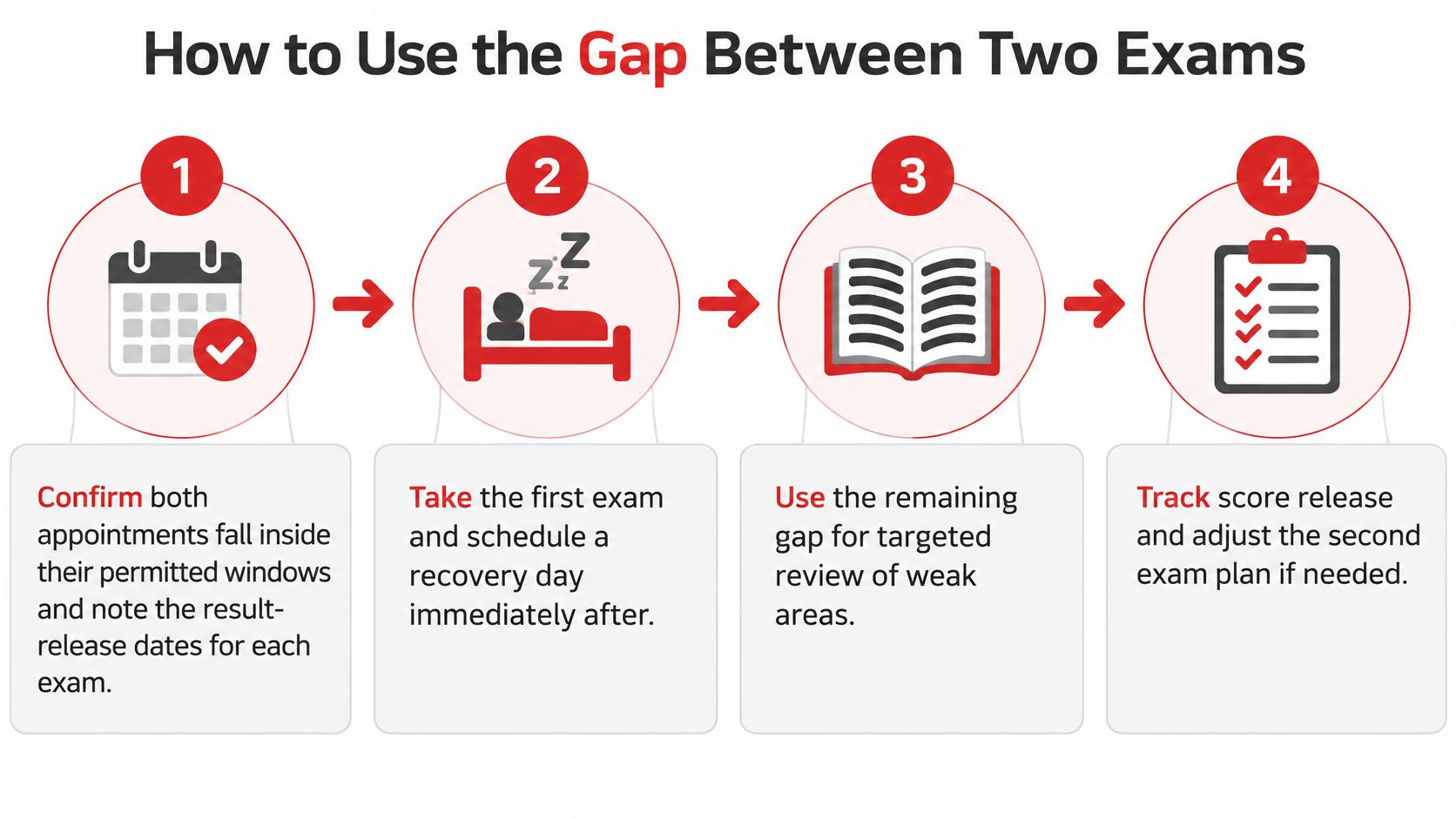
A practical transition workflow
The following sequence is an educational planning framework, not an examination-organization requirement.
Confirm the calendar before testing. Both appointments should fall inside their permitted windows, with expected reporting dates recorded separately. The common mistake is checking the examination dates but overlooking the documentation deadline.
Protect a recovery day immediately afterward. The suggested plan leaves that day free of scheduled studying so the student can rest without treating recovery as unfinished work. A common slip is replacing the break with anxious question-bank sessions.
Review existing learning records during the following days. Use practice-question logs and broad observations about pacing or stamina to identify priorities. Students shouldn't reconstruct, record, or share live examination questions, and post-exam impressions shouldn't replace established practice evidence.
Switch deliberately to the next examination's blueprint. COMLEX preparation should include OPP and OMM, while USMLE preparation should focus on the relevant biomedical or clinical blueprint and question approach. The common mistake is postponing format-specific work until the final stretch.
Include a full-length practice simulation before the next appointment. This suggested checkpoint tests pacing, breaks, and sustained concentration as well as knowledge. Students should use authorized materials and the current examination structure, not assume that a brief question set measures stamina.
Judge readiness from a pattern. Review recent comparable assessments alongside recurring errors and timing problems. The common slip is treating an isolated high result as more informative than the broader preparation record.
Protect the final week for lighter review and rest. This is a proposed planning buffer, not an official rule. If major content work remains at that point, the student should reconsider the appointment rather than relabel heavy studying as final review.
Keep the review log actionable
A useful log separates knowledge gaps, reasoning errors, misreading, and pacing problems. Each entry should identify the next action, such as reviewing a mechanism, practicing a question type, or rehearsing block timing.
The combined USMLE and COMLEX study-plan guide provides related planning support. The transition period itself should stay focused on what the next examination requires, with familiar content maintained through lighter review rather than a complete restart.
Handling Rescheduling and Setbacks
Keeping the original date isn't always the most responsible choice. A student can preserve the overall goal while changing an appointment that no longer fits preparation, reporting needs, or recovery.
When an appointment needs to move
The USMLE scheduling questions page describes a three-month eligibility period, requires rescheduled appointments to remain within that period, and notes that changes during the 45 calendar days before an appointment may incur a fee.
Before moving a date, the student should check the current fee schedule, the remaining eligibility period, and available replacement appointments. Canceling first and searching afterward can leave fewer workable options.
COMLEX planning also requires attention to the available testing window and seats. A preferred replacement date shouldn't be treated as secured until the scheduling system confirms it.
The COMLEX rescheduling guide can help organize those operational checks. If the issue is a delayed result rather than readiness, the purpose-and-deadline decision described under “How Score Release Changes the Decision” should govern the next action.
When preparation or an attempt falls short
A longer gap can be a risk-management choice, not a judgment about ability or career potential. A previous unsuccessful attempt, academic interruption, substantial OMM gap, or difficulty sustaining timed work may justify a more deliberate transition.
A plateau should prompt a closer look at the learning process. For example, a student who understands explanations afterward but struggles with unfamiliar questions may need more reasoning practice rather than another broad reading pass.
Similarly, persistent pacing problems call for timed practice and review of decision-making habits. Merely extending the calendar without changing the work may leave the underlying problem unaddressed.
A useful reset: Name the obstacle, choose a task that addresses it, and define the evidence that will support the next booking decision.
A concise contingency record should include:
- Rescheduling deadline: The current change or cancellation requirements for each appointment.
- Result-release date: The expected release and the institution's documentation deadline.
- Readiness checkpoint: The personal practice evidence required to keep the second appointment.
- Reassessment date: The planned date for reconsidering the gap before options narrow.
This record makes adjustment intentional. It also keeps a disappointing result from becoming the sole basis for a rushed scheduling decision.
Confirm Your Dates Before You Book
The final booking decision should rely on current official pages and written institutional requirements. A 2026 planning reference isn't a substitute for checking the live rules, particularly when eligibility, testing windows, or reporting schedules may change.
Final verification checklist
- USMLE rules: Confirm the assigned eligibility period, permit, appointment availability, and current change policy.
- COMLEX requirements: Confirm NBOME eligibility, college or program certification, the testing window, and the published release date.
- International graduate eligibility: International medical graduates should confirm applicable Educational Commission for Foreign Medical Graduates (ECFMG) requirements rather than assuming this dual-exam framework establishes COMLEX eligibility.
- Institutional documentation: Ask the school or residency program whether it requires examination completion or receipt of a result.
- Personal checkpoints: Record the recovery plan, remaining osteopathic work, practice-assessment evidence, and the date for reassessment.
Choose the order and gap that fit the deadline, recovery needs, OMM workload, and stable readiness. If those factors don't align, the calendar needs revision rather than a more optimistic interpretation.
Ace Med Boards' COMLEX-USA tutoring information describes support for Level 1, Level 2-CE, and Level 3, including preparation plateaus and return after an unsuccessful attempt; tutoring complements official practice materials rather than replacing them.
Sources
Primary references used for this 2026 planning discussion include:
- USMLE: Applying and Scheduling; Scoring and Score Reporting; Common Questions.
- NBOME: Eligibility Bulletin; Testing Windows and Score Release Dates; COMLEX-USA Level 1 overview.
These policies and calendars may change. Current official requirements should be checked before payment or rescheduling.
Ace Med Boards offers a free COMLEX consultation to discuss the student's examination level and timeline. Students considering the gap between USMLE and COMLEX can visit Ace Med Boards to discuss remaining preparation needs and a schedule built around their own readiness checkpoints.