

On most U.S. clerkship scales, High Pass sits just below Honors, Honors is the top tier, and neither label represents a national cutoff: one national surgery clerkship analysis found school-level Honors rates ranging from 5% to 67%. The useful comparison is therefore not High Pass vs Honors, but what each grade requires and how selectively the student's school awards it.
A student can make that comparison by separating three questions: what performance earns the grade, what can remove eligibility, and what the school reports to residency programs. A strong study plan starts with those answers, not with an assumed shelf-exam percentile.
By Ace Med Boards Editorial Team
High Pass vs Honors at a Glance
32.5% was the median share of students awarded Honors in a national analysis of surgery clerkship grades. The same study found wide differences among schools in the shares receiving each grade. A clerkship is a supervised clinical rotation in medical school; Honors and High Pass are labels within a school's grading system, not nationally interchangeable measures of clinical ability.
The national analysis of clerkship grading published in the Journal of Surgical Education reported these surgery-clerkship distributions:
Share of students receiving each clerkship grade across U.S. schools, surgery
| Grade | Share of students across schools | What it signals |
|---|---|---|
| Honors | Median 32.5%; range 5% to 67% | Top tier; cutoff set by each school |
| High Pass | Range 9% to 80% | Intermediate tier when Honors is available; criteria set locally |
| Pass | Range 2% to 84% | Meets the clerkship minimum |
These study findings show how much the award rates can vary. An Honors grade at one institution may be less selective than an Honors grade elsewhere.
What the labels can and can't establish
Within a school that offers both categories, Honors is a higher designation than High Pass. The label alone does not show whether the distinction depends on clinical evaluations, an examination threshold, a composite score, a distribution cap, or a combination of requirements.
A grade distribution also cannot describe an individual student's strengths. High Pass can coexist with excellent narrative comments, while an Honors grade does not identify which clinical behaviors or examination skills stood out.
Practical rule: The grade identifies the category earned. The rubric explains the requirements; the distribution indicates how selectively the school awards it.
Start by recording the school's grading scale and finding the distribution for the relevant clerkship and reporting period. A school-wide average may combine unlike assessments, so it can obscure the comparison that matters.
If the school does not publish a distribution, ask the clerkship office or registrar whether one appears in residency application materials. Without that context, do not infer a percentile from the grade alone.
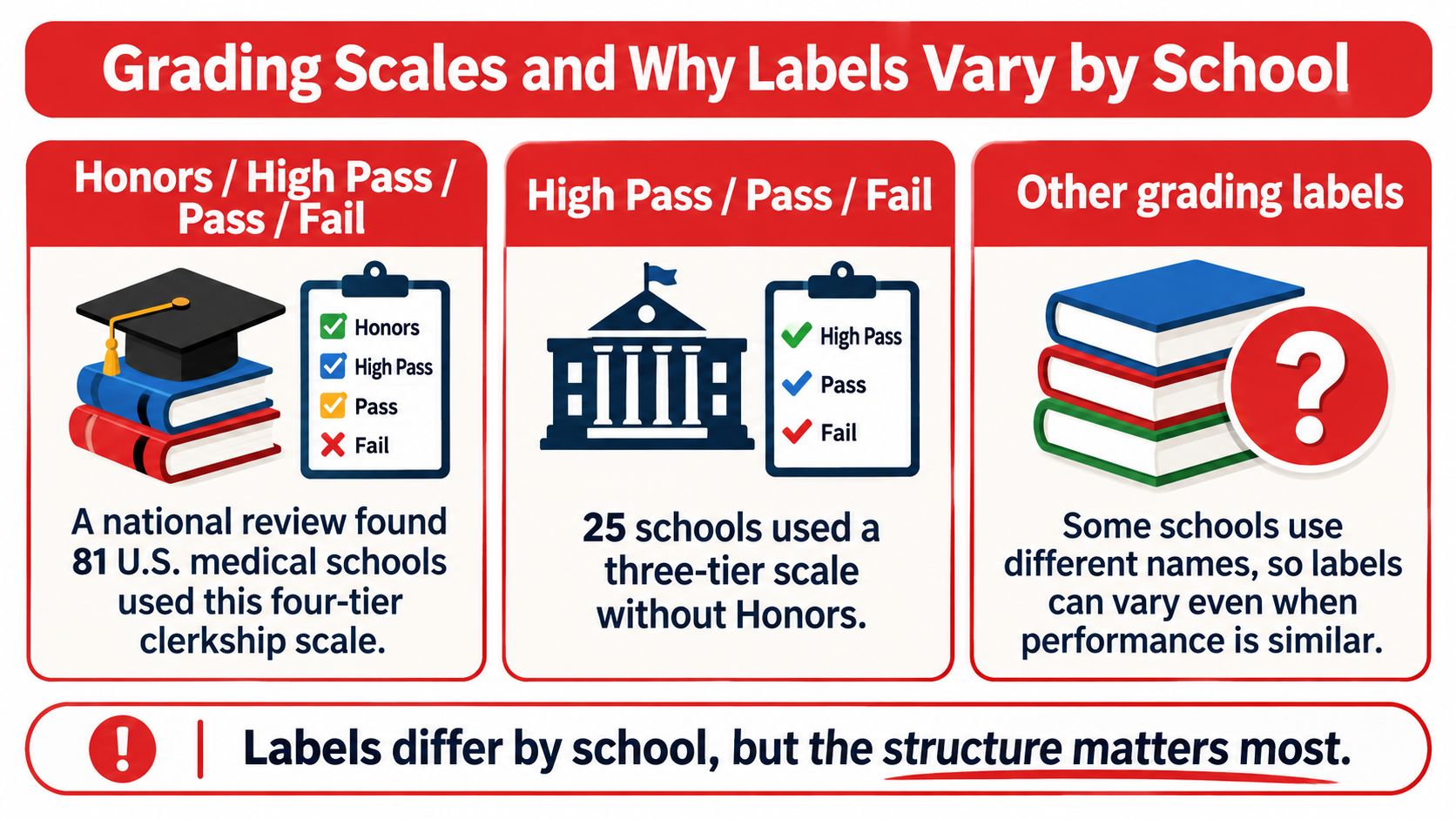
Grading Scales and Why Labels Vary by School
The first difference is structural. A student receiving High Pass on a scale without Honors occupies a different position within that scale from a student receiving High Pass where Honors is available.
A national review discussed in Academic Medicine identified 81 U.S. medical schools using Honors/High Pass/Pass/Fail, 25 using High Pass/Pass/Fail, and 24 using true Pass/Fail.
Clerkship grading scales used by U.S. medical schools
| Scale type | Categories shown | Schools in national review |
|---|---|---|
| Honors scale | Honors, High Pass, Pass, Fail | 81 |
| High Pass scale | High Pass, Pass, Fail | 25 |
| Pass/Fail scale | Pass, Fail | 24 |
These published counts describe the reviewed schools, not a verified current inventory of every medical school.
The same categories can conceal different standards
A multi-institutional study of clerkship grades reported that the median Honors share in 2022 was 36.0% in surgery, with school-level rates from 10% to 82%, and 33.0% in internal medicine, with rates from 6.7% to 80.0%. That analysis reported a surgery Honors rate 6.6 percentage points higher than in 2015, evidence of grade inflation, and substantial institutional differences.
Those findings don't establish that individual students performed less well or that any particular school's grades are undeserved. They establish that the category's statistical meaning isn't stable enough to support a national conversion chart.
Consider an illustrative policy comparison. One school might reserve Honors for a fixed upper share of students and award High Pass to the next band. Another might award Honors whenever students satisfy specified clinical and examination criteria, without reserving a fixed share.
Under the first approach, peers' performance can affect placement. Under the second, eligibility turns on meeting the stated requirements. Neither approach can be understood from the transcript label alone.
Percentiles need their own interpretation
A shelf-exam percentile isn't automatically a clerkship-grade percentile. Students interpreting shelf-exam percentiles should identify the examination benchmark separately from the clerkship's overall grading rule.
The relevant information is the student's rank, if reported; the grade distribution; the clerkship rubric; and the school's reporting practices. The multi-institutional study's caution against comparing grades without institutional context follows directly: the distribution describes selectivity, while the rubric describes qualification.
Comparison Worksheet for Your School's Grading Policy
The most useful grading worksheet fits the policy onto a single page. Its source documents are the clerkship syllabus, the school's grading policy, and a registrar sample or Medical Student Performance Evaluation (MSPE) template, the school's summary evaluation used in residency applications.
An Objective Structured Clinical Examination (OSCE) is a station-based performance assessment, often involving standardized patients. The National Board of Medical Examiners (NBME) subject examination, commonly called a shelf exam, assesses subject knowledge associated with a clerkship.
Clerkship grading policy comparison worksheet
| Policy question | Where to look | Why it changes the grade |
|---|---|---|
| Which scale and categories are used? | Grading policy page or clerkship syllabus | Determines whether High Pass exists as a category |
| Are there caps or percentile bands for each grade? | Grade-distribution or percentile policy | Determines how selective each grade is |
| Which components count, and with what weight? | Clerkship syllabus grading breakdown | Shows where effort changes the outcome most |
| Is the first attempt the one counted? | Attempt and retake policy | A retake may not count toward Honors or High Pass |
| Does a nonpassing or remediated component block Honors? | Remediation policy | Can disqualify a grade even when the total score is high |
| Do absences or professional-behavior points affect eligibility? | Professional-behavior section of the policy | Can remove eligibility independent of academic scores |
| Does the grade appear on the transcript and the MSPE? | Registrar sample or MSPE template | Determines what residency programs see |
The scale row prevents an incorrect comparison between unlike systems. The distribution row distinguishes a fixed performance standard from a grade awarded to a restricted share of students.
The components row should list every assessed element, not merely the examination and clinical evaluation. Assignments, observed encounters, professional behavior, and required learning activities may have separate consequences.
Eligibility deserves a separate column
The Keck School of Medicine of USC grading policy, considered here as of November 4, 2026, uses first-attempt scores and identifies Honors exclusions including an unexcused absence, a nonpassing first attempt on a graded element, fewer than four professional-accountability points, or unprofessional behavior.
That example explains why the attempt, remediation, and professional-behavior rows cannot be compressed into the numerical grading breakdown. A weighted score and eligibility for distinction are separate questions.
The final reporting row establishes whether residency readers receive only the recorded grade or additional narrative and distribution information. A general guide to medical student clerkships can help with rotation preparation, but the clerkship's own documents govern the worksheet.
Each answer should fit into a clear line before the rotation starts. Any unresolved entry should become a specific written question to the clerkship office, and the worksheet should be revisited after the first written evaluation.
When One Weak Component Overrides a Strong Total
A high composite score doesn't always preserve eligibility for a high final grade. Some schools use noncompensatory requirements, meaning strong performance elsewhere cannot offset a deficient required component.
Under Loma Linda's 2025–26 medical-student grading policy, discussed as of November 4, 2026, students must pass clerkship sections on the first attempt, including the NBME shelf, OSCE, clinical performance, quizzes, and assignments; remediation or below-standard performance can disqualify both Honors and High Pass despite an otherwise qualifying total.

A published example of a component ceiling
A published clerkship grading model in BMC Medical Education required examination performance above the fifth percentile to pass, the 50th–69th percentile for High Pass, and at least the 70th percentile for Honors, together with matching clinical distinctions. In that model, Honors-level clinical performance paired with a High Pass shelf result produced High Pass overall.
Those thresholds belong to that model, not to a national grading standard. The important mechanism is that a component can set the final grade's ceiling.
The first planning priority is to protect eligibility across required components, not simply maximize the largest weighted score.
For a strong test-taker with uneven clinical feedback, the next productive action may be clarification of presentation or documentation expectations rather than another question block. For international graduates adapting to unfamiliar evaluation norms, explicit examples of expected performance can make feedback more actionable.
A useful component tracker records:
- Minimum requirement: The standard that must be met independently.
- Current feedback: The most recent written or verbal assessment.
- Next action: A specific behavior to demonstrate.
- Policy consequence: Whether a deficiency affects points, eligibility, or both.
Preparation for medical-school shelf exams belongs within that wider plan. Students should also identify remediation and appeal procedures early, without assuming either procedure restores distinction eligibility.
How to Earn Honors Through Behaviors You Control
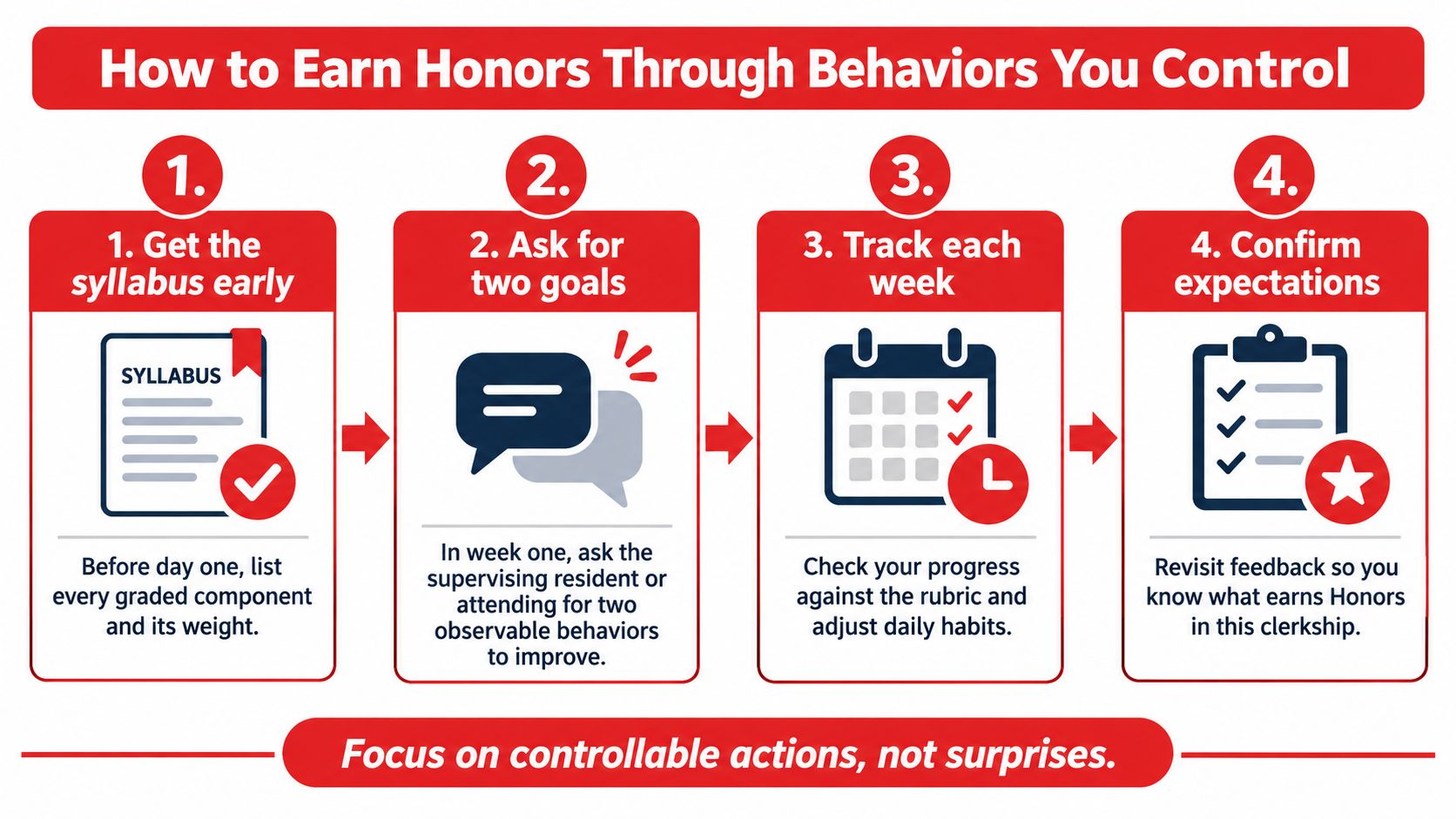
Honors cannot be promised through effort alone. Students can, however, make preparation more deliberate by translating the rubric into observable actions and responding to feedback while there's still time to adjust.
A rotation-length action plan
Obtain the syllabus before the rotation. The student should list every graded component, its weight, and any independent eligibility requirement. A separate flag for mandatory completion prevents a small assignment from disappearing behind a large examination weight.
Request concrete targets early. During the opening week, the supervising resident or attending can help identify observable goals, such as a more focused assessment, complete notes, or timely handoffs. Broad feedback becomes easier to use when the student asks what the evaluator would expect to see in the next observed encounter.
Maintain a brief feedback log. A spreadsheet can use columns for component, weight, feedback received, and next action. Each entry should describe a behavior rather than a judgment about the student's worth or ability.
Use a consistent shelf-review workflow. Assigned resources, timed practice questions, and careful review of missed items can form the study routine. Errors should be classified by cause, such as a knowledge gap, misread task, weak differential, or pacing problem, so the next study session addresses the actual difficulty.
Track required tasks and professional communication. A calendar should include assignment deadlines, attendance procedures, and required submissions. If a conflict arises, following the school's notification process is more useful than assuming an explanation can be supplied after the fact.
Compare midpoint feedback with the rubric. The student should ask which expectations are being met and which remain below target. A guide to ACGME core competencies can help organize professional-development language, but the local clerkship rubric remains the grading reference.
Use the closing portion of the rotation for targeted refinement. Presentation outlines and permitted documentation drafts can be checked against the same expectations used earlier. Patient-identifying material should remain within authorized institutional systems, not in a personal study tracker.
When additional support fits
If examination preparation is the limiting component, one-on-one tutoring can complement official practice materials, question banks, and independent study. Available tutoring services provide a place to review current options without assuming that tutoring replaces clinical feedback.
Ace Med Boards tutoring focuses on high-yield material, case-based work, and strategies for approaching and answering test questions. Shelf packages are selected according to preparation needs and available study time, with current prices listed on the pricing page.
Before applying any plan, students should confirm the current grading policy with the clerkship office. Improving the wrong component won't resolve a requirement that the student hasn't identified.
How Residency Programs Read the Grade and How Much Honors Matters
As of November 4, 2026, the Association of American Medical Colleges' Electronic Residency Application Service overview describes ERAS as the system used to transmit application materials, including medical-school transcripts and MSPEs. Programs therefore receive documents that can place the recorded clerkship grade alongside school-specific explanations and narrative evaluations.
That doesn't mean every school supplies identical context. Students should check the actual documents their school prepares rather than assume the grade key or distribution will appear automatically.
Where the clerkship grade appears in the residency application
| Document | What it shows about clerkship grades | What to check |
|---|---|---|
| Transcript | The grade label recorded for each clerkship | Whether the school's grade scale is explained elsewhere in the file |
| MSPE | The school's narrative and grading context for the student | Whether the school's grade key or distribution is included |
| ERAS application package | The documents transmitted to programs | Which documents the school releases to ERAS |
What the comparison supports
Published clerkship comparisons identify differences both across rotations and across institutions. Those findings support contextual interpretation, not a universal number of Honors grades required for residency.
The distinction matters because selectivity and individual performance are related but different questions. A distribution can show how unusual a grade was within a school; narrative evaluations can describe the work that led to it. Neither alone supplies a complete judgment of an applicant.
High Pass is a passing, respectable grade. One clerkship result shouldn't be treated as a verdict on a medical career, and a disappointing result calls for a specific review of requirements and feedback rather than a sweeping conclusion about future suitability.
A useful interpretation states what the student earned, what the school required, and what the evaluations actually document.
A decision framework for the next action
| Situation | Productive next action | Conclusion to avoid |
|---|---|---|
| The school publishes a distribution | Compare the grade with the relevant local distribution | Another school's label has identical selectivity |
| A required component limited the final grade | Identify the component and its policy consequence | More total points would necessarily have changed the result |
| The grade concerns a specialty advisor | Discuss the evaluation with that advisor or clerkship director | An online rule applies to every program |
| The record contains a possible error | Ask about the school's documented review process | An appeal is guaranteed to change the grade |
| Examination performance is the main concern | Review knowledge, reasoning, pacing, and anxiety-related barriers | The grade proves a fixed limit on ability |
For broader application decisions, the guide to what programs look at in ERAS addresses application strategy without reducing the process to clerkship labels.
Students with test-taking difficulties or anxiety may need a different preparation approach from students whose main challenge is clinical feedback. Ace Med Boards also serves students with those examination-related concerns and students preparing toward competitive specialty goals, without guaranteeing a particular grade or match result.
The immediate task is narrower than predicting residency outcomes: establish the correct interpretation of the grade, identify the actionable issue, and confirm current policy in writing.
Key Takeaways
- Interpret locally. High Pass and Honors have no national cutoff; the school's rubric and distribution establish their meaning.
- Separate points from eligibility. Component weights don't necessarily capture first-attempt, remediation, attendance, or professional-behavior requirements.
- Identify grade ceilings. A deficient required component can block Honors or High Pass despite a strong total.
- Track observable actions. A component log connects feedback with a concrete next step instead of a vague goal to perform better.
- Confirm the current rules. The clerkship office should resolve unclear requirements in writing before students rely on them for preparation decisions.
Sources
Publication findings are historical snapshots; policy discussion is dated November 4, 2026. Sources linked at their point of use include:
- Journal of Surgical Education: National analysis of clerkship-grade distributions.
- Academic Medicine: National grading-scale review and multi-institutional grade comparisons.
- BMC Medical Education: Published clinical and examination component grading model.
- Keck School of Medicine of USC: Required-clerkship grading and Honors eligibility policy.
- Loma Linda University School of Medicine: Medical-student grading policy, 2025–26.
- Association of American Medical Colleges: ERAS system and application-document overview.
Ace Med Boards offers individualized shelf-exam tutoring focused on high-yield material, cases, and question-answering strategies. Students whose grading worksheet identifies examination preparation as the main obstacle can visit Ace Med Boards to explore current options and schedule a free consultation about their preparation needs and available study time.