
No Shelf exam order is best for every student; the workable order fits the school calendar, builds overlapping clinical knowledge, and matches the student's main goal. Internal Medicine first can be useful, but it isn't a universal rule, and leaving a supposedly difficult Shelf until last isn't automatically a better strategy.
The popular advice overlooks a basic distinction: the best order for a single subject-exam score may not be the best order for specialty exploration or broader clinical preparation. A student choosing rotations needs a decision framework, not a difficulty ranking.
Which Shelf Exam Order Is Best by Goal
Ace Med Boards Editorial Team
Policy context as of 2026. Students should confirm current examination policies and local scheduling requirements before finalizing a clerkship calendar.
The school's calendar comes first. The National Board of Medical Examiners Subject Exam Program Guide describes Clinical Science Subject Exams as discipline-specific assessments typically administered at the end of traditional clinical clerkships and requires secure, proctored administration.
That means rotation order and exam order usually travel together. A student shouldn't assume that completing a rotation early creates permission to take its Shelf later. Separate exam timing requires explicit school approval.
Key Takeaways
- School rules outrank preferences. Prerequisites, available clinical sites, examination dates, and permitted swaps define the actual choices.
- Earlier exams can support later performance. Students should plan for cumulative learning rather than treating each subject as unrelated.
- Early Medicine is an option, not a requirement. Its breadth can support later rotations, but a student needs enough study capacity to benefit.
- High-stakes rotations deserve deliberate placement. When allowed, gaining exam experience before a personally important Shelf can be a reasonable precaution.
Shelf Order Decision Matrix by Student Goal
The sketches below are planning options, not validated prescriptions. Obstetrics and Gynecology is abbreviated OB/GYN, and United States Medical Licensing Examination Step 2 Clinical Knowledge is abbreviated USMLE Step 2 CK.
| Goal | Order sketch | Best fit | Main trade-off |
|---|---|---|---|
| Cumulative later-Shelf scores | Internal Medicine, then Surgery, Pediatrics, OB/GYN, Psychiatry, and Family Medicine as the calendar allows | Student who can give Medicine a full block early | Medicine may feel hardest before exam routines exist |
| Higher Internal Medicine Shelf | Surgery, Pediatrics, and Family Medicine before Internal Medicine | Student whose main target is the Medicine subject exam | Leaving Medicine last has been linked in an individual study to lower Step 2 CK scores |
| Specialty exploration | Sample the target field early enough for letters; delay that Shelf until after initial exam experience if allowed | Undecided student or competitive-specialty applicant | School lottery or prerequisite rules may block the ideal spot |
| Least study disruption | Keep the assigned order and standardize daily questions | Student with a fixed schedule or compressed block | Little room to optimize sequence itself |
| Step 2 CK readiness | Complete Medicine, Surgery, Pediatrics, and OB/GYN before comprehensive review; avoid placing Medicine last solely to chase its Shelf score | Student planning Step 2 CK after core clinical learning | Less freedom to put a preferred specialty first |
Choose the row whose constraint is binding. A student facing an inflexible lottery gains little from selecting an academically attractive order the school won't permit. A student still deciding between specialties may reasonably prioritize early exposure over a theoretical score advantage.
For residency-oriented planning, the discussion of Step 2 scores by specialty can help frame a separate conversation about application goals. Specialty interest shouldn't become a reason to sacrifice broad clinical learning.
Osteopathic students can use the same decision-making approach for scheduling discussions, but NBME Shelf exams and Osteopathic Medical Achievement Tests, or COMAT exams, aren't interchangeable. COMAT scheduling and eligibility rules require confirmation with the National Board of Osteopathic Medical Examiners and the student's school before applying these sketches.
The clinical examples below explain examination learning, not patient-care guidance.
Why Clerkship Order Changes Later Scores
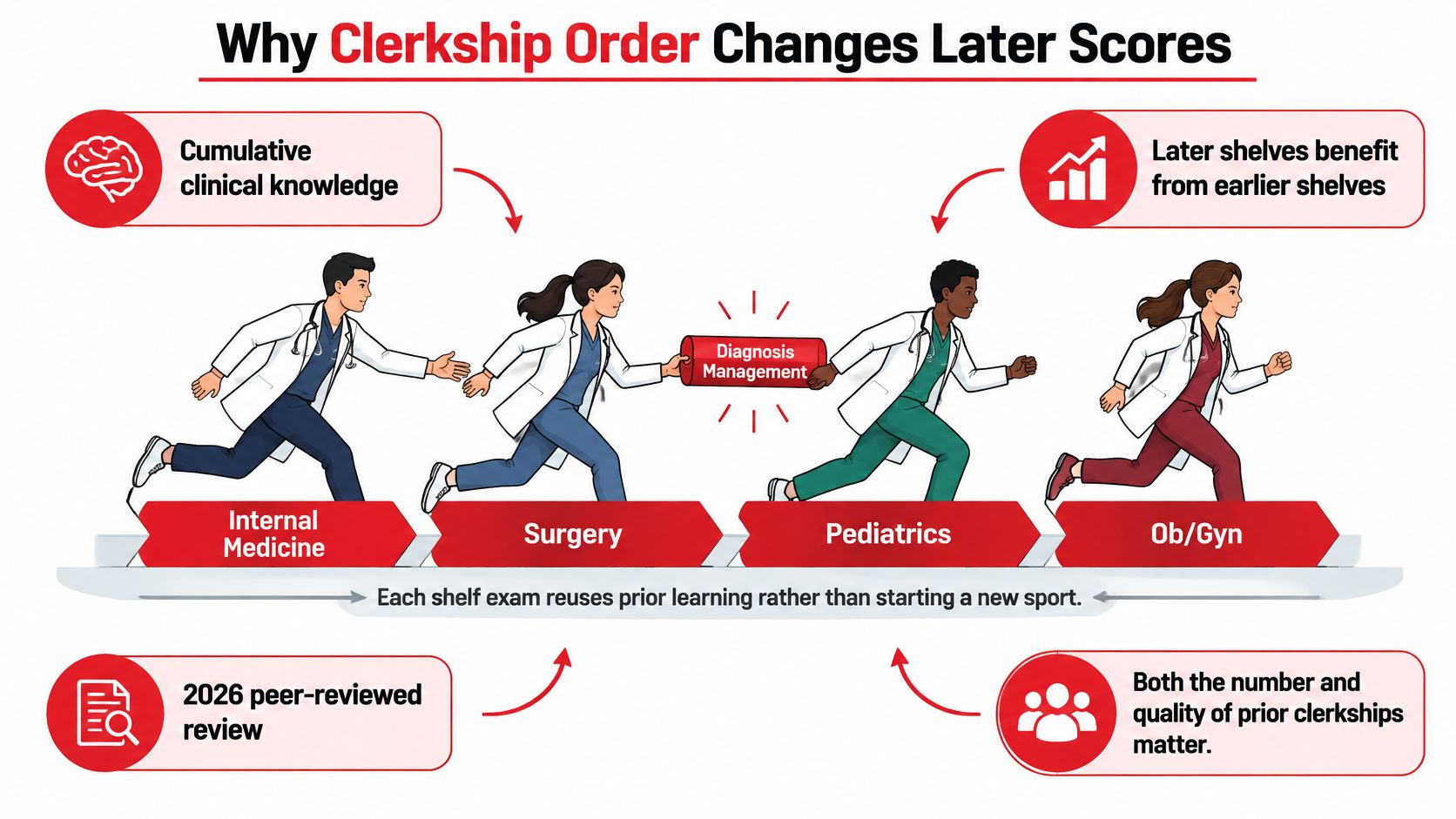
Clerkships resemble a relay more than a series of unrelated sports. Students carry diagnostic reasoning and management concepts into the next rotation, then learn how those concepts change with the patient population and clinical setting.
A 2026 peer-reviewed review of U.S. medical-student subject-exam performance reported that both the number and order of prior Shelf exams influence later scores, with more previously completed exams positively associated with performance; it also identified preclinical academic performance as an important predictor and found inconsistent score benefits across studies of clinical exposure, active learning, team-based learning, and peer-review sessions.
Sequence is therefore a contributor, not a substitute for preparation. A student can have an attractive rotation order and still need substantial help with knowledge gaps, question interpretation, or review habits.
Why Medicine Has So Much Carryover
Internal Medicine provides a useful example because its examination covers multiple systems, clinical tasks, and care settings. It isn't a cardiovascular examination with a few additional topics.
The NBME Medicine Subject Exam outline assigns cardiovascular, blood and lymphoreticular, and multisystem content 10%–15% each; respiratory, gastrointestinal, renal and urinary, and endocrine content 5%–10% each; diagnosis 45%–50%; management 25%–30%; foundational science application 15%–20%; and care settings 40%–45% inpatient, 35%–40% ambulatory, and 20%–25% emergency department.
Those categories explain the educational rationale for early or midyear Medicine. Students practice integrating information across systems rather than learning a narrowly bounded subject.
Consider an educational comparison involving shortness of breath. During Medicine, a student might organize possible explanations by organ system and acuity; during Surgery, that same reasoning framework becomes relevant to postoperative presentations. The later task isn't identical, but the student doesn't have to rebuild the entire approach.
Carryover Requires Deliberate Retrieval
A useful review habit connects each new topic to a previous decision:
- Recognition: Which findings distinguish the leading possibilities?
- Evaluation: What information would resolve the uncertainty in an examination vignette?
- Management: What feature changes the next step?
- Context: How does age, pregnancy, setting, or postoperative status alter the reasoning?
The student should retrieve those connections from memory before reading an explanation. Recognizing familiar terminology while rereading notes does not establish that the reasoning is accessible under timed conditions.
Practical rule: A favorable order creates opportunities to reuse knowledge. Students still have to practice retrieving it.
Early Medicine can also be overwhelming when the student is simultaneously learning documentation, rounds, clinical expectations, and exam preparation. Moving it somewhat later may be sensible when that permits a more sustainable start without postponing broad clinical learning until the end.
The relationship between Shelf exams and Step 2 performance deserves attention, but association shouldn't be mistaken for an individual score forecast. The defensible conclusion is strategic sequencing plus repeated testing, not a mandatory order for every school.
Constraints and Yes-or-No Checklist Before You Lock an Order
A feasible schedule starts with the least negotiable requirements. Students should ask the clerkship coordinator about prerequisites and lottery restrictions before discussing preferred specialties or perceived exam difficulty.
Site capacity comes next. An open calendar block doesn't necessarily mean an approved clinical placement is available. Students should distinguish a permissible sequence from a sequence the school can staff.
Protect the Licensing-Exam Timeline
As of 2026, USMLE examination-results and scoring guidance lists a Step 2 CK passing score of 218 for examinations administered on or after July 1, 2025; USMLE guidance also permits Step 1 and Step 2 CK in either order, requires both to be passed before Step 3, and describes fourth-year Step 2 testing as the conventional pattern for most students at Liaison Committee on Medical Education-accredited schools.
That conventional pattern isn't a personalized scheduling recommendation. The student's school requirements, readiness, and application plans still need to fit together.
Coordinator Checklist
Each item should receive a clear yes or no, with an action attached to every no.
- Allowed order: Does the sequence satisfy prerequisites and lottery rules?
- Manageable opening: Does the first block avoid combining the weakest subject with the highest personal stakes, unless no alternative exists?
- Medicine coverage: Does the available block allow adequate preparation, or is supplementary review planned?
- Career timing: Do potential letter requests and away-rotation deadlines remain workable?
- Known exam logistics: Are Shelf dates and proctored-testing arrangements confirmed?
- Established workflow: Has the student chosen a question-review method before starting?
- Remediation clarity: Has the school explained reassessment options and whether a setback could affect progression or require repeating the year?
A hypothetical OB/GYN-bound student offered early OB/GYN and end-of-year Medicine could ask about moving Medicine earlier while retaining early specialty exposure. Separating the OB/GYN examination from the rotation would be an additional request, not an assumed option.
The final planning note should name the chosen order, what cannot move, and the preferred swap if a seat opens.
A prior low score, failed attempt, academic gap, or test anxiety should prompt support planning, not a judgment about career potential. Practical medical-student time-management strategies can help translate the approved calendar into realistic study commitments.
Sample Orders for Score Specialty and Step 2
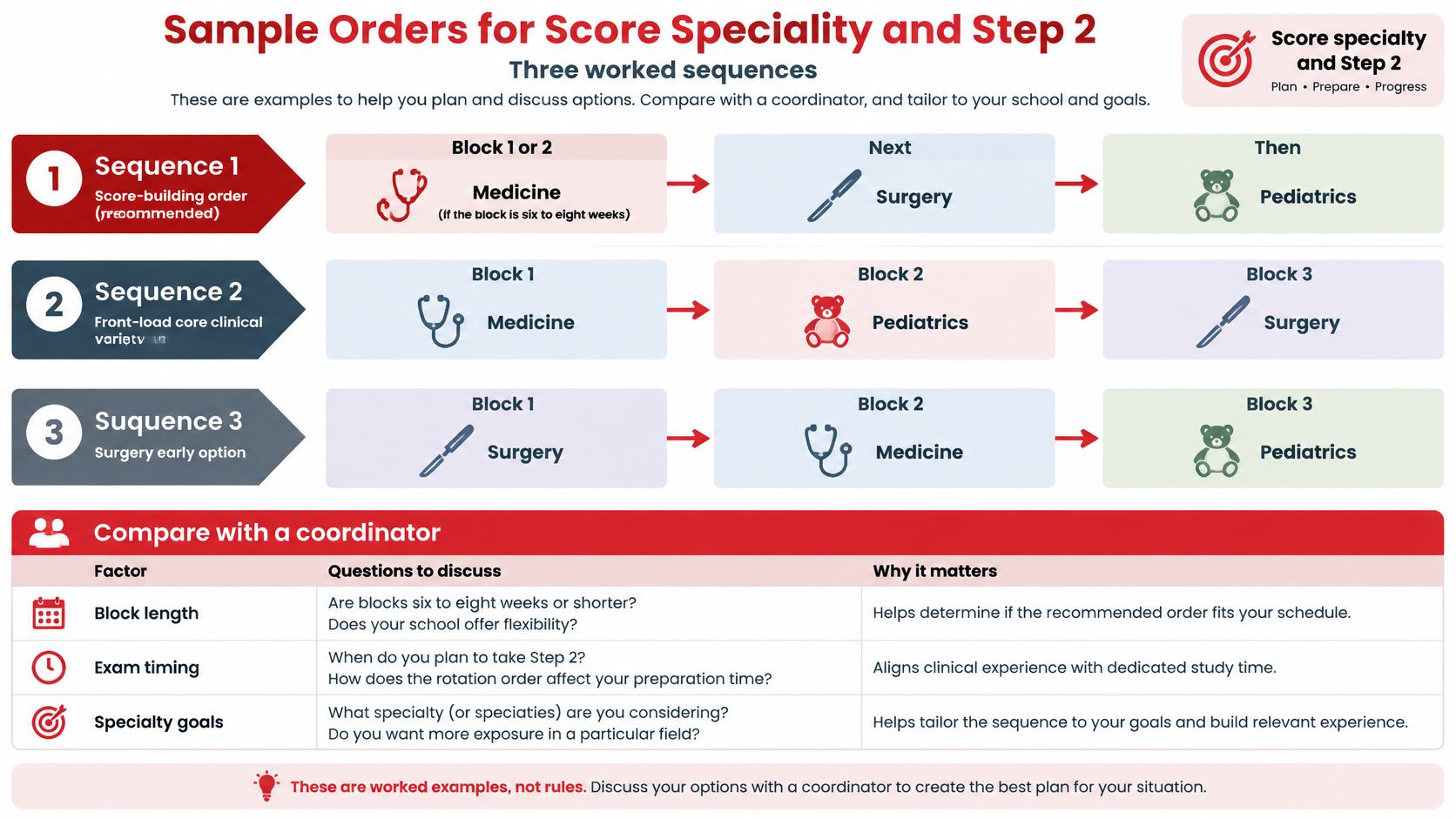
No rotation order wins on every goal. Each sequence below protects something different: a stronger early score, a clearer specialty decision, or fuller coverage before Step 2 review. Every plan also pays a price somewhere, often in the opening block, where clinical routine and exam technique are still forming. Treat these as starting points for a coordinator conversation, since the school controls which seats can move.
Score-Building Through Broad Foundations
Example: Internal Medicine, Surgery, Pediatrics, OB/GYN, Psychiatry, then Family Medicine.
Placing Medicine first builds the widest base of clinical reasoning before the other subjects narrow the focus. If the opening block feels too steep, Medicine can move to second position behind a more manageable rotation. A six-to-eight-week Medicine block gives room to establish a question routine, though the actual length is a school-level constraint rather than a requirement for the plan to work.
This order suits a student who wants broad reasoning practice early and can give Medicine sustained attention. A short weekend review of systems already covered keeps earlier material alive without turning every evening into board prep.
Downside: The Medicine Shelf arrives before the student has calibrated question volume, review depth, and exam-day pacing. A score-building label does not make the first score the highest one.
Specialty-First for Fit and Letters
Example: Pediatrics, OB/GYN as the target specialty, Internal Medicine, Surgery, Psychiatry, then Family Medicine.
The target field sits early enough for a real decision about fit, and Medicine follows so the student can reinterpret specialty encounters through a broader lens. When the intended specialty is also the student's weakest subject, starting elsewhere builds experience with clinical responsibilities and a first Shelf before the assessment that carries personal weight.
Downside: Early exposure does not guarantee a letter, and preferences can change after seeing the work up close. Evaluation and letter expectations belong in a conversation with local advisors rather than assumptions about what an early rotation delivers.
A broader guide to medical-student clerkships can help separate the educational purpose of each rotation from its examination demands.
Step 2-First for Integrated Review
Example: Internal Medicine, Surgery, Pediatrics, OB/GYN, followed by the remaining required clerkships and a protected review window.
The logic is finishing the major core experiences before reviewing across disciplines. Psychiatry, Family Medicine, and other required content still need deliberate coverage, since the broad cores leave gaps.
The NBME Comprehensive Clinical Science Examination outline, which reflects Step 2 content, assigns 40%–50% to diagnosis and 40%–50% to patient-care pharmacotherapy, intervention, and management. That weighting favors a review built on recognizing conditions and choosing the next step across specialties.
Downside: Less scheduling freedom remains for a preferred specialty or a desirable clinical site.
Why the Evidence Doesn't Produce a Winner
An older multi-institutional analysis involving more than 16,000 students at over 60 medical schools associated completing Surgery, Pediatrics, and Family Medicine before Medicine with higher Medicine Shelf performance, with Surgery showing the largest positive association.
That result supports one narrow tactic, a stronger Medicine Shelf, and says nothing about Step 2 CK, letters, or fit. Associations measured across thousands of students describe averages; they cannot promise an outcome for one schedule at one school. Flexible examination timing may add another local option where schools allow it, but a schedule should rest only on flexibility the school has approved.
The practical comparison still comes down to immediate subject performance, retained clinical knowledge, and career timing. Weigh those against the school's fixed constraints and the student's weakest subject, and the workable order usually names itself.
How to Prepare When the Order Is Fixed
Many students can't choose their order. The useful question then becomes how to support the opening rotations rather than whether the lottery produced an ideal sequence.
A medical-education article examining clerkship sequencing describes a 2025 study associating later placement with higher NBME scores, without lower performance in shortened clerkships, and reports first-to-last-sequence increases of 7.28 points in Family Medicine and 3.87 points in Surgery; it also describes a separate study of 314 students, in which 75% of failures below the 10th percentile occurred during the first three blocks and 45% during the first block.
Those patterns describe groups, not an individual student's destiny. They support treating early clerkships as a transition that may require additional structure.
A Fixed-Schedule Preparation Workflow
Establish the routine before clinical work starts. Choose a question bank, decide when questions will be completed, and reserve time to review explanations. A planned rest day can make the routine more sustainable than an uninterrupted schedule that repeatedly collapses after call.
During the opening week, use an appropriate diagnostic assessment or early practice set. List the three weakest systems as a planning exercise, then distinguish missing knowledge from difficulty choosing between plausible answers.
Front-load the actual weakness. A student struggling with renal reasoning should address that gap for the current Shelf rather than spending scarce time following a generic list of the hardest examinations. Review should respond to performance, not reputation.
Keep a brief longitudinal review of prior diagnoses. A compact error log can record the decisive clue, the mistaken assumption, and the rule that would improve the next answer.
Match outside support to the rotation. For a rotation lasting roughly four weeks, Ace Med Boards recommends meeting twice weekly until the exam. The session schedule should still account for clinical responsibilities, examination timing, and practice performance.
After a low result, audit the method before seeking an allegedly easier rotation. Determine whether the main problem was incomplete coverage, shallow explanation review, reasoning, pacing, fatigue, or anxiety, then choose a specific change.
What Support Should Address
One-to-one Shelf sessions can cover clinical reasoning, question analysis, pacing, and topics needing more attention. They can be useful when the student feels overwhelmed by the volume, uncertain about how to prepare, or concerned about low NBME practice results.
For example, a student who repeatedly narrows an item to plausible alternatives may need to explain the decisive feature aloud. A student who understands explanations afterward but runs out of time needs a different intervention from a student encountering unfamiliar content.
A low Shelf result should trigger a concrete review and a school-specific recovery plan, not a conclusion that a medical career has ended.
A failed Shelf can affect grades or progression, so the student should contact the clerkship office promptly about remediation requirements. It doesn't, by itself, end a residency path.
The detailed guide to studying for Shelf exams addresses preparation mechanics. Tutoring should complement official NBME materials and an independent question bank, not replace either.
Confirm the Order and Add Support
The final decision should become a written plan rather than a collection of preferences. The clerkship office should confirm prerequisites, examination dates, placement availability, and whether a swap is possible.
The strongest choice is the feasible matrix row that matches the student's binding goal. If the lottery produces another order, preparation should change to address the actual first rotation rather than an imagined better schedule.
Keep a Short Decision Record
- Fixed commitments: Record required placements, confirmed exam dates, and restrictions on moving rotations.
- Preferred change: Name the rotation to move and the specific educational or career reason.
- Support trigger: Identify the practice-performance concern or review difficulty that will prompt additional help.
- Recovery route: Keep the school's reassessment and academic-support instructions accessible.
Ace Med Boards offers individual study plans and focused online sessions for NBME subject examinations and selected COMAT examinations. Its Shelf tutoring plan takes account of the rotation schedule, exam date, available study time, and practice performance.
The tutoring-services page is the appropriate starting point for exploring relevant support. Current package prices belong on the provider's pricing page; students should consider preparation needs and available study time rather than assuming a larger package is automatically necessary.
Tutoring doesn't guarantee a Shelf score, Step 2 CK result, or residency match. Its role is to provide focused assistance with a preparation problem while the student continues independent work and follows school requirements.
Sources
The linked references include the NBME Subject Exam Program Guide, NBME Medicine and Clinical Science outlines, USMLE scoring guidance, a peer-reviewed subject-exam review, and clerkship-sequencing studies. Official organizations govern examination policies; observational studies inform scheduling trade-offs but don't establish an optimal order for an individual student.
Ace Med Boards offers a free Shelf exam consultation to discuss tutoring options before purchasing a package. Students overwhelmed by the material or concerned after low practice scores can visit Ace Med Boards to discuss support that fits their assigned rotation order, examination date, and available study time.