
Physicians and surgeons had a median annual wage of $275,930 in May 2025. That's a national occupational median, not a starting offer, a resident stipend, or take-home income.
A doctor salary number only becomes useful when it's read correctly. For medical students, residents, international medical graduates, and residency applicants, the key skill is understanding what the figure measures, what it leaves out, and how specialty choice, training stage, and contract terms change the number that matters.
Introduction
Salary literacy is part of professional literacy. A headline pay figure can look simple, but the meaning changes once the data year, population, and compensation model are clear. The BLS figure above describes physicians and surgeons as a broad occupation category, so it should be treated as a benchmark, not a promise of what one graduate will earn in a first job. This overview of doctor versus surgeon roles is a useful reminder that the title alone doesn't tell the whole compensation story.
That distinction matters for anyone trying to compare specialties, plan debt repayment, or decide whether a longer training path fits personal goals. A student who sees one big annual number may assume all doctor pay works the same way, but medical compensation is shaped by specialty, geography, employment model, call burden, benefits, and training length. None of those details are visible in a single headline figure.
Practical rule: Treat every salary post as a starting question, not a final answer.
The good news is that compensation data can be read carefully without needing a finance degree. Once a reader knows how to separate median from mean, current pay from projected growth, and survey averages from official occupational wages, most salary tables become much easier to interpret. A good comparison doesn't ask, “How much do doctors make?” It asks, “For which specialty, in what setting, with what obligations, and in which data year?”
For that reason, the most useful approach is step by step. Start with the published figure, identify what group it describes, compare it with a like-for-like source, then move to the contract and the budget. That's the kind of compensation literacy that helps medical learners make calmer, more informed decisions.
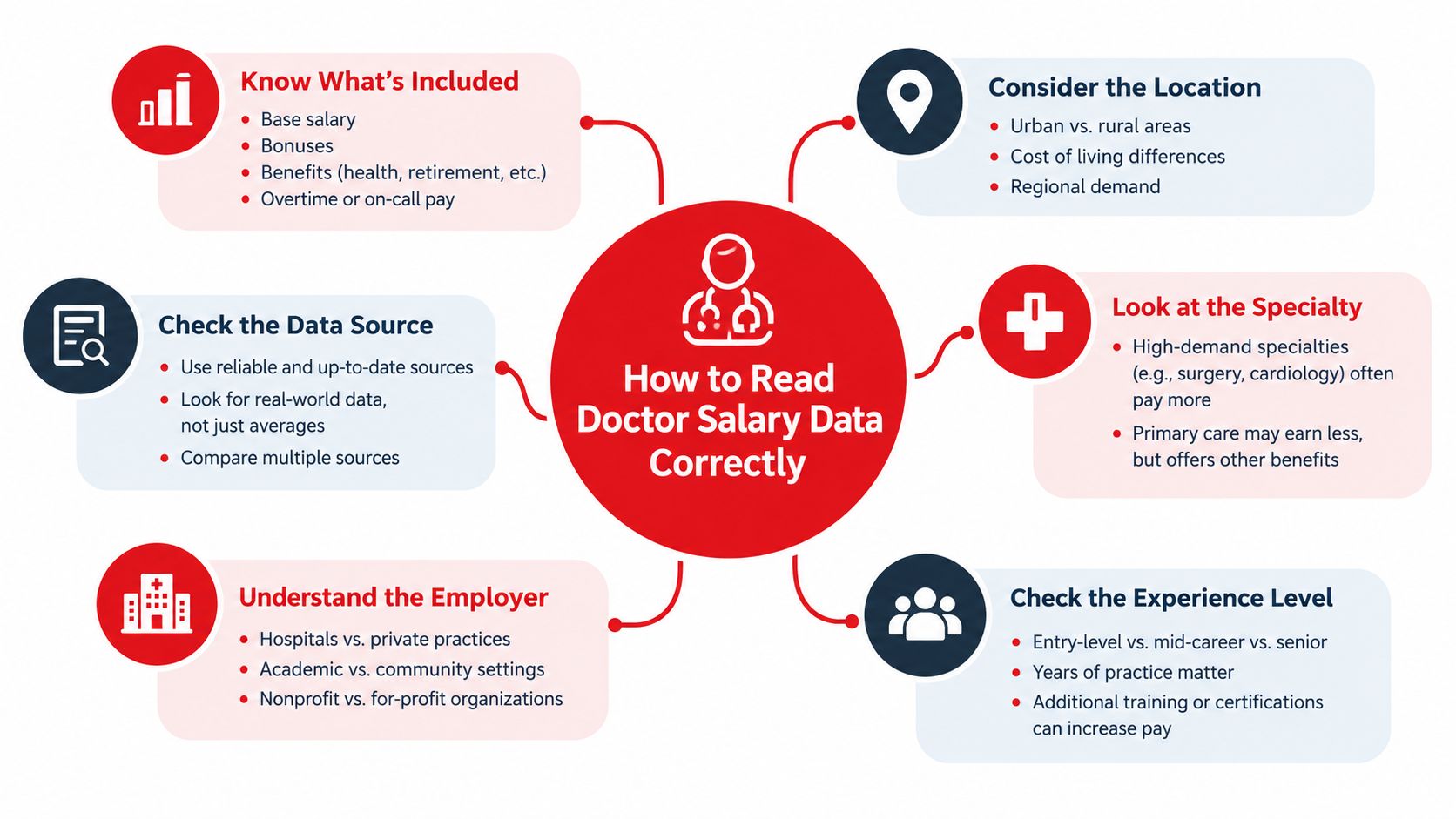
How to Read Doctor Salary Data Correctly
Median, mean, and why the distinction matters
The median is the middle value in a data set. If compensation is sorted from lowest to highest, the median sits in the center. The mean is the arithmetic average, and a small number of very high earners can pull it upward. That's why a median often gives a more stable sense of the “typical” pay point in a field with wide variation.
For physician compensation, that difference is especially important. The BLS reports a May 2025 median annual wage of $275,930 for physicians and surgeons, while other reports may show higher averages because they use survey data and different specialty mixes. A reader who doesn't check the statistic type can easily compare numbers that aren't measuring the same thing.
Data year, publication year, and population
A salary table can be current and still describe an earlier year. The BLS figure above is a May 2025 wage estimate, even if the webpage is checked later. That matters because calling it a “2026 salary” would blur the difference between the data year and the publication or access date.
The population matters just as much. Physicians and surgeons as a broad occupational category are not the same thing as family medicine physicians, radiologists, residents, or a survey of employed doctors in one compensation report. A number from one population should never be presented as if it describes another.
Reading rule: If the label changes, the number changes meaning.
A BLS occupational median, a survey average, and a starting-salary posting all answer different questions. If a residency applicant wants to understand the labor market, the useful habit is to ask, “Who was counted here, when was it measured, and what kind of compensation was included?” That skill makes any later comparison much more trustworthy. This hourly-pay guide can also help translate annual pay into a more practical frame.
The same caution applies to projections. The BLS projected that employment of physicians and surgeons would grow by 4% from 2025 through 2035 (BLS Occupational Outlook Handbook). That projection speaks to job outlook, not to immediate paychecks. Growth forecasts, current wages, and residency stipends are separate pieces of information.
Comparing Doctor Salary by Specialty
Salary comparisons become clearer when they come from the same table and the same year. For May 2025 BLS data, the contrast between family medicine, internal medicine, psychiatry, radiology, and pediatric surgery shows why “doctor salary” isn't one number.
| Specialty | Median Annual Wage (May 2025) |
|---|---|
| Family medicine | $244,180 |
| General internal medicine | $256,560 |
| Psychiatry | $281,870 |
| Radiology | $420,860 |
| Physicians and surgeons, overall | $275,930 |
| Pediatric surgeons | $559,030 |
The spread reflects real structural differences. Procedure-heavy specialties usually support higher compensation, training length can delay earnings, call burden can affect lifestyle value, and productivity-based pay can amplify differences inside the same field. That's why a comparison table is most helpful when it stays inside one source and one time period. A specialty-pay overview can be useful as a navigation aid, but it shouldn't replace source-level reading.
What the table does and doesn't tell a learner
The BLS table shows national median wages, not guaranteed offers. It also doesn't say what one doctor keeps after tax, debt payments, relocation, or benefits. A radiology median of $420,860 is informative, but it doesn't describe every practice model, every city, or every first job.
The same caution applies to family medicine and general internal medicine. Those numbers are still high relative to the broader labor market, but they're not identical to a contract offer in a specific region. A learner comparing specialties should therefore use the table to narrow questions, not to set expectations for one exact salary.
Useful habit: Compare only numbers built on the same definitions, then ask why they differ.
The practical reason for the gap is easy to grasp. Specialties with more procedures, higher facility revenue, or more intense call patterns often support higher compensation than fields that depend more on visits, panel management, or care coordination. But a student shouldn't confuse that structural pattern with a personal outcome, because individual contracts, geography, and hours can all change the result.
How Geography and Career Stage Change Physician Pay
Career stage matters because resident pay and attending pay are not on the same scale. The AMA reported weighted average resident salaries ranging from $74,994 for first-year residents to $107,287 for eighth-year residents in the Northeast, with corresponding ranges of $65,076 to $86,768 in the South, $68,580 to $91,134 in the Central region, and $77,649 to $107,587 in the West (AMA resident physician pay). Those figures show gradual yearly progression, but they also show that location affects training compensation.
Employment model and region change the benchmark
The setting matters after training, too. In a 2025 recruiting review, academic positions averaged $338,000 while non-academic settings averaged $425,000 (HealthLeaders review). The same review reported approximate regional averages around $385,000 in the Midwest and $363,000 in the Northeast. Those are market benchmarks, not guarantees, but they show why the same specialty can look different on paper once setting enters the picture.
The idea is similar to what financial writers call geographic arbitrage, where the same nominal income can feel very different depending on local costs and incentives. This explanation of geographic arbitrage helps frame why region changes practical value, even when the headline number looks strong.
For international and foreign medical graduates, the residency-to-attending path is especially important. A single attending figure can look impressive in isolation, but the transition from trainee pay to physician pay takes time, and geography can change both sides of the equation. Locum tenens opportunities are one example of how schedule and setting can affect income later, though they're a separate career choice rather than a universal path.
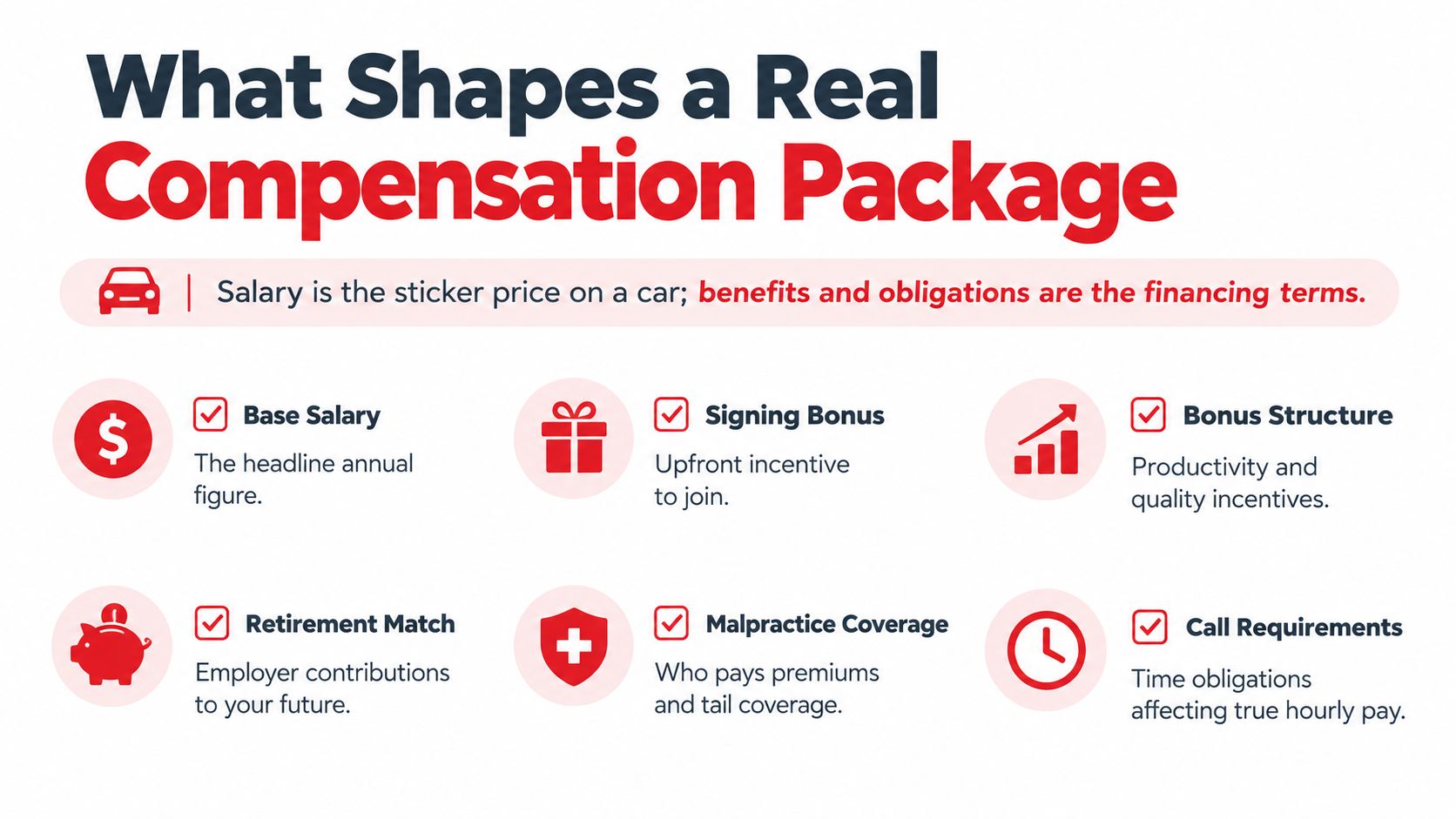
What Shapes a Real Compensation Package
A salary number is the sticker price on a car. The rest of the contract, benefits, and obligations are the financing terms. Two jobs with the same headline pay can leave a physician with very different real value once call, coverage, retirement contributions, and expenses are included.
The parts that change the real value
Base salary is the headline annual figure. Productivity or bonus incentives can raise pay if volume, collections, or performance targets are met. Retirement contributions matter because employer support changes the value of the package over time. Malpractice coverage is another major item, especially when the contract says who pays the premium and whether tail coverage is included.
Call requirements also matter because they affect time, fatigue, and practical hourly value. A higher annual number can still be less attractive if the schedule is heavy or if administrative work keeps the true workload high. The number alone doesn't reveal that.
Questions to ask before signing
Before any contract is signed, a learner should ask the employer or advisor:
- What benefits are included? Health insurance, retirement support, paid time off, and professional development can all change the package.
- Is malpractice coverage included, and does the contract specify tail obligations? If not, the missing detail can be expensive later.
- Which licensing, credentialing, and relocation costs are covered? Those items often vary by employer.
- How is bonus pay calculated? A bonus tied to productivity means something different from a guaranteed salary.
- What are the call expectations? Night, weekend, and backup call can quickly change actual workload.
Ace Med Boards does not provide contract negotiation or financial advice, and compensation questions are best brought to the employer, a mentor, or a qualified advisor. A careful reader is not looking for the best-sounding offer, only the offer that actually matches the person's life, obligations, and goals.
Budgeting After Residency Without Assumed Numbers
The biggest budgeting mistake is assuming every physician pays the same hidden costs. That isn't how employment works. Loan payments, relocation, licensing, and living expenses depend on the individual, the location, and the contract, so a written offer and a personal budget have to be reviewed together.
Questions that belong in a real budget
A practical budget starts with questions, not guesses:
- Which student-loan payments are due during the first year out of training?
- Which licensing, credentialing, DEA, and onboarding expenses does the employer cover?
- Are moving expenses reimbursed, or does the physician pay them personally?
- What are the local housing, transportation, and childcare costs in the offer's location?
- Does the package include benefits that reduce out-of-pocket spending?
Those questions matter because no two physicians pay the same items or amounts. A salary that looks lower on paper may be more workable if the employer covers key expenses, while a larger salary may shrink after relocation, loan service, or higher local costs.
The trend context also deserves caution. Medscape compensation data summarized in 2025 showed overall physician compensation rising by about 3% from 2024 to 2025, with movement that wasn't uniform across specialties (Fierce Healthcare summary). That kind of headline is useful for general orientation, but it doesn't build a decade-long plan by itself.
For readers who want a broader accounting framework, this guide to financial planning for high earners can be a helpful external reference point. Even then, the physician-specific rule stays the same, compare the contract, then compare the budget, then decide what the number really means. PhD and MD salary comparisons can also help keep educational pathways in perspective without treating one figure as a universal answer.
Key Takeaways and Your Specialty Planning Worksheet
The cleanest way to use salary data is to turn it into a comparison worksheet, not a prediction. A table can help a student ask better questions while still leaving room for clinical interest, day-to-day fit, and training demands.
| Worksheet row | What to record |
|---|---|
| Specialty interest | The field being considered |
| Training length | Residency and fellowship time |
| Work schedule and call | Expected weekly rhythm, nights, weekends, backup call |
| Target location | Region or city under consideration |
| Published compensation measure | Median or average, with data year and source |
| Sources of uncertainty | Survey type, employment model, benefits, hours, geography |
Three reminders matter most. First, median is not the same as mean. Second, the data year has to be checked before any number is reused. Third, a compensation package includes more than salary, especially when call, benefits, and malpractice coverage change the actual value.
A fourth reminder is just as important. Resident pay and attending pay live in very different parts of the timeline, so a trainee shouldn't judge a specialty only by its eventual headline number. The path to that number matters too.
A fifth reminder keeps the worksheet honest. No table predicts an individual offer. It only helps a learner ask sharper questions before choosing a specialty, a region, or a first job.
For board-exam support, residency preparation, and structured academic planning, a free consultation with Ace Med Boards can help a learner build a clearer study and application strategy without confusing that support with compensation or financial advice. Sources used here include the U.S. Bureau of Labor Statistics, the American Medical Association, the OECD, Doximity, Medscape, and related reporting cited inline.
If residency prep or board studying is still taking most of the mental bandwidth, Ace Med Boards can help with a focused academic plan that fits the stage a learner is in. It's a practical next step for anyone who wants clearer structure for exams and residency preparation while keeping salary decisions grounded in evidence, not hype.