You've set aside a full Saturday for your first MCAT practice test. By the end, the score feels discouraging, but the number doesn't tell you whether the problem was missing content, misreading a passage, rushing, or changing a correct answer. That uncertainty is common, and it's exactly why an MCAT practice test should be treated as a diagnostic instrument, not just a score checkpoint.
The most useful approach builds preparation around the four official sections, Chemical and Physical Foundations, Critical Analysis and Reasoning Skills (CARS), Biological and Biochemical Foundations, and Psychological, Social, and Biological Foundations of Behavior, while combining passage reasoning, retrieval practice, timed work, and official AAMC materials. Every missed question should lead to a specific repair task.
Building a Diagnostic MCAT Test Practice Test Strategy
The first practice test often creates an emotional problem before it creates an academic one. You may see unfamiliar passages, lose time in one section, or recognize concepts only after the answer is revealed. None of those experiences, by themselves, tells you that you're incapable of improving. They tell you that your current process needs to be observed under realistic conditions.
The MCAT has a testing history dating to 1928, and the modern exam has been computer-based since January 2007. That computer-based format made full-length simulations a central part of preparation, because students must practice not only recall but also sustained passage analysis in the same type of testing environment. The MCAT's history and format development provide useful context for why isolated textbook review can't fully reproduce the task.
Start with a baseline, not a verdict
Use an official-style diagnostic before making major changes to your study plan. Your first result is a snapshot of current performance across the four sections, not a prediction of your eventual application outcome. Record the score, section pattern, timing notes, confidence level, and the questions you answered correctly for uncertain reasons.
A useful diagnostic record includes:
- Section pattern: Identify whether difficulty is concentrated in CARS, Chemical and Physical Foundations, Biological and Biochemical Foundations, or Psychological, Social, and Biological Foundations of Behavior.
- Question behavior: Mark guesses, changed answers, skipped questions, and items completed with unusual hesitation.
- Timing behavior: Note where you began rushing and whether fatigue changed your reading or calculation habits.
- Review priority: Separate errors that require content study from errors that require a change in reasoning.
The Ace Med Boards MCAT preparation hub can sit alongside your independent use of AAMC materials as you organize this diagnostic process.
Practical rule: A practice score tells you what happened. Your review log should explain why it happened.
The AAMC reports that official practice materials are widely used. In the 2023 testing cycle, 89.6% of examinees used official MCAT practice exams, while 61.2% used official question packs and 58.5% used official section banks, according to an AAMC presentation. AAMC's official usage presentation also describes testing at hundreds of sites across the United States, Canada, and other locations, reinforcing the value of consistent, standardized practice for applicants preparing in different settings.
Your objective isn't to take tests endlessly. It's to create a repeatable loop: test, classify, repair, practice the repaired skill, and retest with unseen material. That loop turns anxiety into a set of manageable academic decisions.
Evaluating Official and Third-Party Practice Resources
The right resource depends on the job you need it to perform. A third-party question bank may be useful for building volume, practicing calculations, or finding content gaps. Official AAMC material deserves special attention when you're evaluating whether your passage interpretation, interface habits, and test-day decisions resemble the actual exam.
The AAMC provides four scored practice exams and one unscored practice exam as part of its official preparation ecosystem, and its current official preparation page describes two free full-length exams and five low-cost practice exams. Each practice exam includes explanations for every answer choice in every section, along with links to related Khan Academy lessons. Check the AAMC official practice-exam product page for current availability because products and policies can change.
Compare resources by function
| Resource Type | Best Use Case | Predictive Accuracy |
|---|---|---|
| Official AAMC full-length exam | Final simulation, interface familiarity, score benchmarking | Highest available representation of the official exam |
| Official AAMC question packs and section banks | Targeted passage work and review of official-style reasoning | Strong for learning the exam's wording and logic |
| Third-party full-length exam | Early endurance practice and broad scheduling flexibility | Useful for skill development, but not interchangeable with an AAMC score |
| Third-party question bank | Content drilling, repeated practice, and identifying recurring weaknesses | Valuable for learning, though style and difficulty may differ |
| Original science question sets | Focused retrieval and application after content review | Depends on question quality and alignment with the AAMC outline |
The AAMC's free Practice Exam 1 contains 230 questions and uses questions from previously administered MCAT exams. It's designed to match the actual test's look, functionality, scaled score, and percentile rank, making it especially useful when you need a realistic benchmark. AAMC's free planning and study resources explain the role of this official sample material.
Third-party resources are most helpful when you use them for a clearly defined purpose. Early in preparation, they can supply additional opportunities to practice a concept or build endurance without consuming every official form. Later, preserve official exams for conditions that resemble your intended test experience, and review them carefully rather than treating them as disposable assignments.
If you're writing your own study drills or helping a study group create original items, a resource on planning science test questions can help structure distractors and test objectives. Any self-created question should remain original and should not reproduce recalled or copyrighted MCAT content.
Read the score correctly
The MCAT uses a scaled score for each of its four sections. Those section scores combine into a total score ranging from 472 to 528, and the official score report doesn't display raw scores. AAMC's explanation of the scoring process explains why a raw-question count from one practice form shouldn't be treated as a universal conversion rule.
For a practical resource-selection framework, see this comparison of MCAT practice tests. Choose materials based on the problem you're solving, not on how many questions a package advertises.
Simulating Real Exam Conditions and Timing Rules
A practice test only measures stamina and pacing if you let it. Pausing the timer, checking messages, taking unscheduled breaks, or working in a noisy café changes the task. You may still learn from the questions, but the result won't tell you how you function during a continuous exam session.
Build the simulation deliberately
Use the AAMC's current exam materials and timing guidance when you set up the session. The MCAT test time and break breakdown can help you organize your workspace and break plan, but always check the current AAMC instructions for the authoritative format.
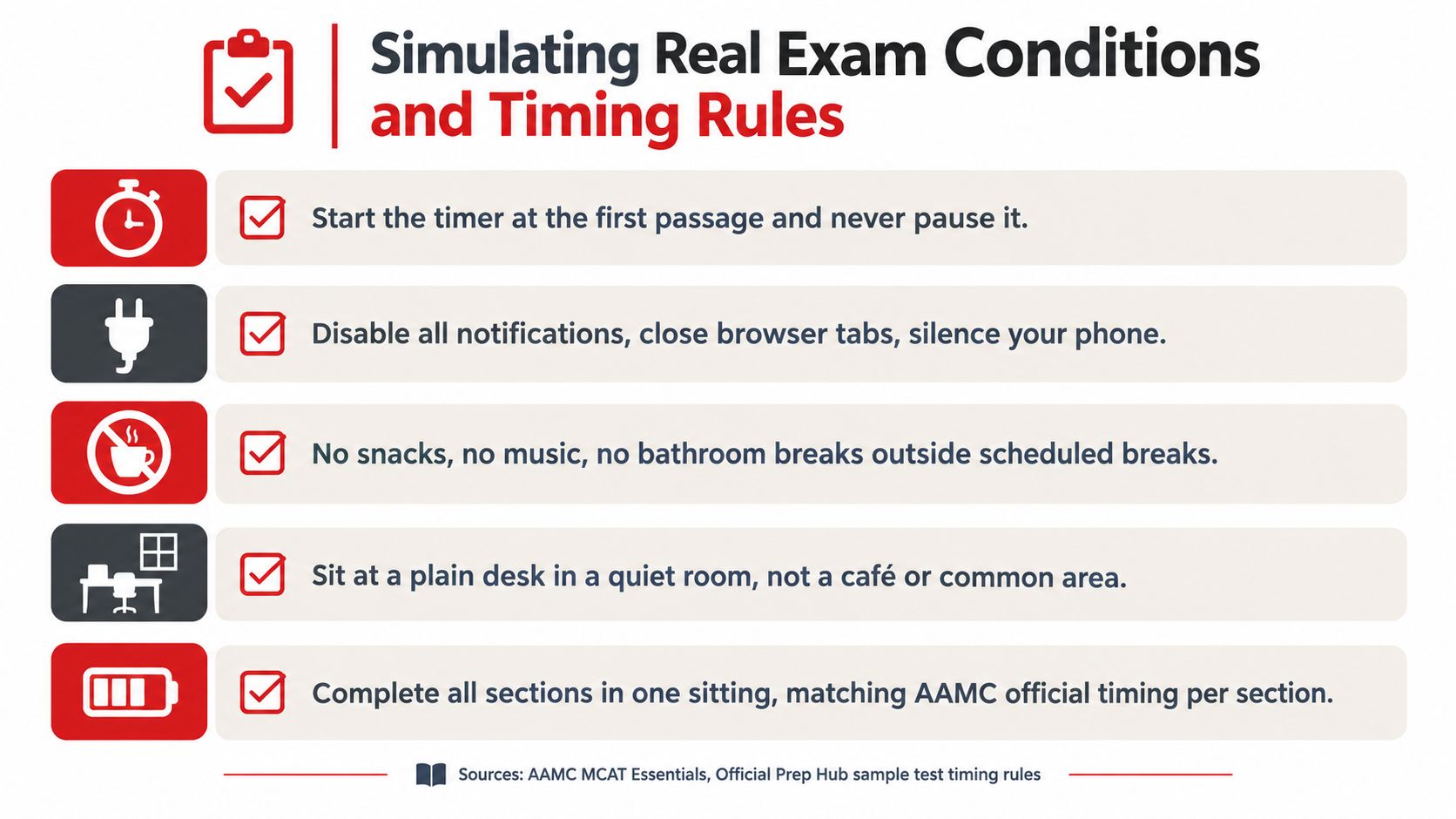
A reliable home simulation has a few nonnegotiable features:
- Use one start time. Begin the full-length at the time you plan to use for your real appointment, if that schedule is known.
- Keep the timer running. Don't pause because a passage feels unusually difficult or because you want to check an answer.
- Remove digital distractions. Silence your phone, close unrelated tabs, and disable notifications before starting.
- Use a plain workspace. A quiet room and a simple desk are better than a shared kitchen, café, or common area.
- Follow only scheduled breaks. Put water and permitted items where they won't become an excuse to leave the session.
- Complete the entire sequence. Fatigue is part of the skill being trained, so stopping after the section that feels hardest removes useful diagnostic information.
CARS deserves a flexible pacing approach. A Yale MCAT FAQ, included in the published literature discussed in this peer-reviewed MCAT practice exam study, warns against rigidly timing every passage at exactly ten minutes because that habit can encourage shortcutting and interfere with later score gains. Use timing as an awareness tool, not as a command to abandon careful reading at an arbitrary second.
Use an internal clock
During passage work, ask whether you're spending time because the question requires reasoning or because you're rereading without a plan. In science sections, identify the task before calculating. In CARS, connect each answer choice to the passage's argument rather than selecting the option that sounds the most polished.
A flexible pace is controlled reading, not slow reading.
Review your timing pattern after the test. If one section absorbs time, identify the exact trigger. It may be long calculations, excessive rereading, uncertainty between two choices, or a tendency to return to earlier questions. Each cause needs a different intervention.
Conducting a Deep Error Analysis After Every Exam
The score is produced during the test, but much of the learning happens afterward. Reading an explanation and thinking “that makes sense” is not enough, because recognition can feel like mastery without proving that you can reproduce the reasoning on a new passage.
Classify the root cause
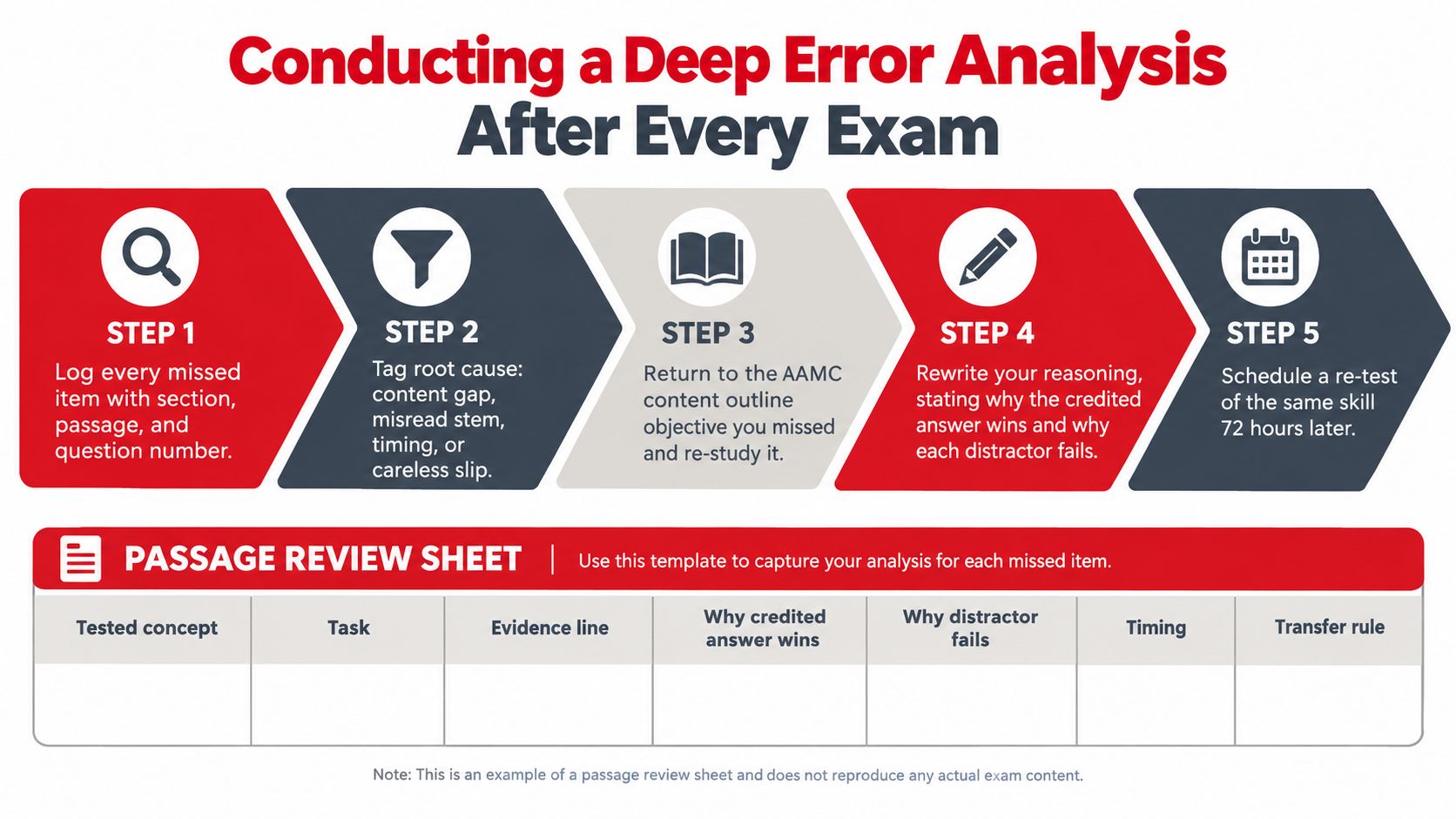
Review every missed question, every guessed question, and every correct answer that depended on weak reasoning. Tag each item with the primary cause:
- Content gap: You didn't know or couldn't retrieve the relevant concept.
- Reasoning error: You knew the concept but failed to connect the passage evidence to the task.
- Misread: You overlooked a qualifier, reversed the comparison, or answered a different question from the one asked.
- Pacing issue: You ran short on time, rushed the final choices, or spent too long on an earlier item.
The categories matter because the repair differs. A content gap may require retrieval practice and a concise return to the AAMC content outline. A reasoning error calls for passage reconstruction. A misread calls for deliberate stem annotation. A pacing issue requires timed practice with a specific decision rule.
Use a passage-review sheet
For each audited item, reproduce this structure in a spreadsheet or notebook:
| Field | What to record |
|---|---|
| Tested concept | The content objective or skill being assessed |
| Task | What the question required, such as inference, comparison, calculation, or experimental interpretation |
| Evidence line | The passage detail, figure feature, or stem wording that supports the decision |
| Why the credited answer wins | The logical connection between the evidence and the answer |
| Why each distractor fails | The exact mismatch, unsupported assumption, or overreach |
| Timing | Your approximate time and whether pacing affected the result |
| Transfer rule | One rule you can apply to an unseen passage |
For example, an original practice item might describe a fictional enzyme assay in which activity changes after a variable is altered. Your review shouldn't merely state the correct direction of change. It should identify the tested concept, explain what comparison the question asks for, point to the relevant result, and distinguish a tempting distractor that confuses correlation with the experiment's measured outcome. This kind of example is instructional only, not recalled exam content.
The AAMC states that official preparation materials are written by the test developers themselves, so the AAMC content outlines and explanations should anchor your interpretation of what the question is testing. AAMC's preparation guidance also emphasizes planning and practice as core preparation strategies.
Turn the audit into a repair plan
After logging the items, count patterns qualitatively or in your own spreadsheet. If several errors point to the same objective, return to that objective, retrieve it from memory, complete a small set of related passages, and schedule a retest. Don't reread an entire textbook chapter when the audit identifies one narrow weakness.
The distractor-analysis guide can support this process by keeping your attention on why wrong answers fail, not only on why the credited answer is correct.
A strong review ends with a scheduled action. Write the repair task beside each error, then retest the same skill using unseen material. The purpose isn't to memorize one explanation. It's to make the reasoning portable.
Designing a Weekly Practice Test and Review Schedule
A full-length exam should create work for the following days, not compete with them. A practical week separates testing, diagnosis, content repair, passage practice, and retesting so that each activity has a defined purpose.
The schedule below is a reusable framework, not a promise that one calendar fits every applicant. Adjust the workload to your available study time, academic responsibilities, health, and test date.
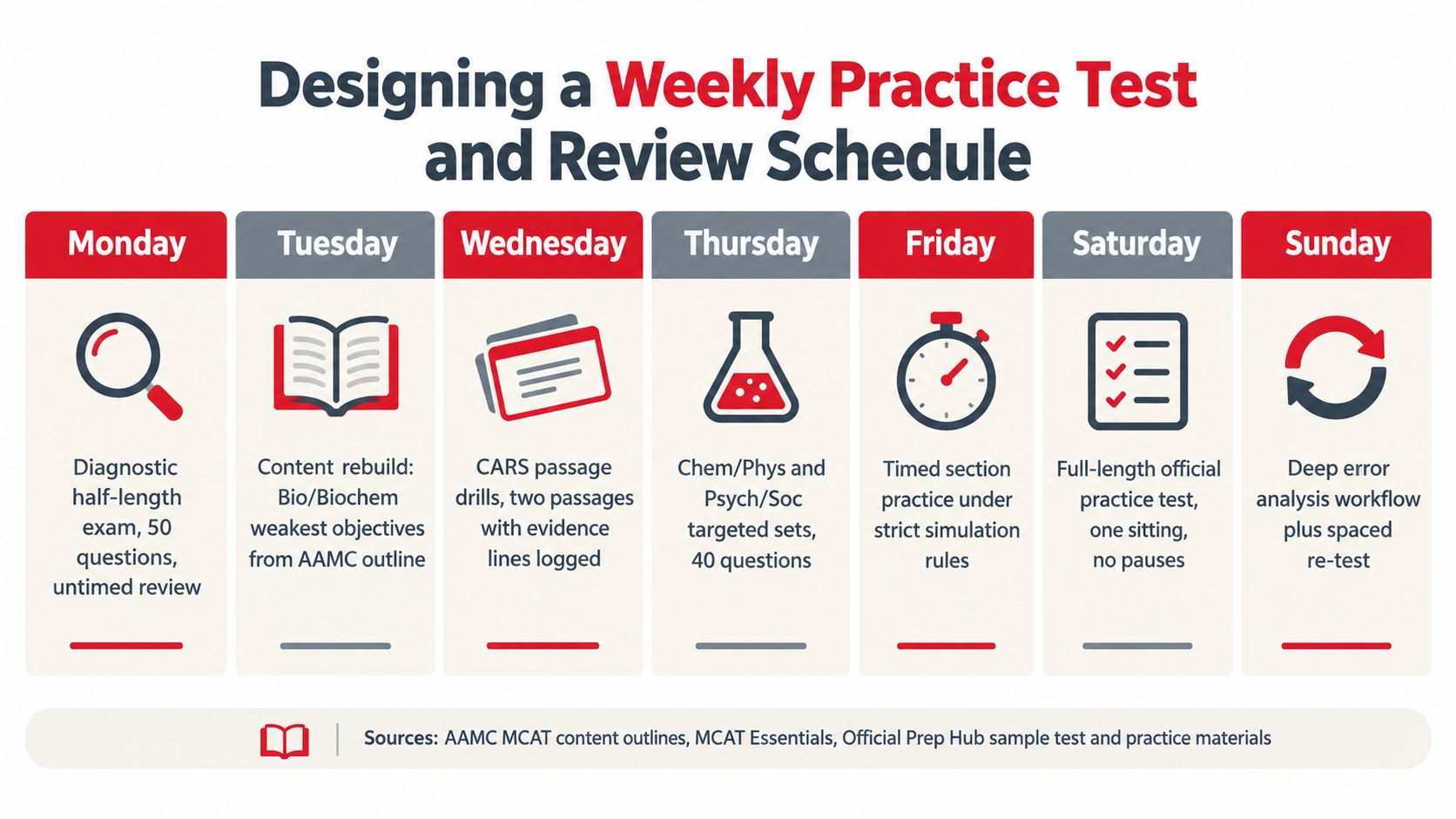
A diagnostic-to-repair week
| Day | Primary task | Output |
|---|---|---|
| Monday | Complete an official-style diagnostic or focused diagnostic block | Initial error map |
| Tuesday | Rebuild the weakest Chemical and Physical or Biological and Biochemical objectives | Retrieval notes and targeted practice |
| Wednesday | Practice CARS passages and log evidence lines | Passage-review entries |
| Thursday | Work targeted Psychological, Social, and Biological Foundations or science sets | Classified question errors |
| Friday | Complete timed section practice under simulation rules | Pacing observations |
| Saturday | Take an official full-length in one sitting | New benchmark and fatigue notes |
| Sunday | Conduct deep error analysis and schedule retests | Repair calendar |
The first diagnostic should be official-style and taken under realistic conditions, but it doesn't need to consume every official form immediately. Preserve some official material for later benchmarking, especially when you're close enough to your test date to benefit from interface and format realism.
Match the calendar to the error map
Suppose your audit shows frequent content gaps in Biological and Biochemical Foundations but mostly pacing issues in CARS. Tuesday should focus on the identified biology objectives, retrieval practice, and a limited set of application passages. Wednesday should emphasize evidence tracking and argument structure rather than another broad content review.
If the pattern is different, change the emphasis. A student with strong content knowledge but repeated misreads may gain more from careful stem analysis and distractor comparison than from another passive review block. A student who loses time in Chemical and Physical Foundations may need untimed calculation reconstruction first, followed by timed sets that preserve the same reasoning steps.
Retest the skill, not the memory
Use a new passage or an unseen full-length item when you retest. Repeating the same question too soon can measure recognition of the explanation rather than transfer of the underlying skill. Space the retest far enough from the original review that you must reconstruct the logic.
The MCAT six-month study schedule offers another planning framework for applicants with a longer runway. Regardless of calendar length, protect time for review. A practice exam without a meaningful audit is an expensive way to collect another number.
Schedule the repair before you schedule the next test. Otherwise, the next score may simply repeat the same causes.
Elevating Your Prep With Expert Tutoring Support
Independent practice materials can show you where a problem appears, but they may not reveal why the same pattern keeps returning. A tutor can review your error log, ask you to explain the evidence behind an answer, and distinguish a knowledge gap from a reasoning habit that looks like a knowledge gap.
Tutoring works best as a supplement to official AAMC practice, not as a replacement for it. You should bring a focused question set, passage-review sheet, timing record, or recurring error category to the session. That gives the meeting a concrete starting point and keeps the time centered on decisions you can apply later.
Use sessions for targeted feedback
A productive session might examine:
- CARS reasoning: Whether your selected answer follows the author's argument or adds an assumption.
- Science passages: Whether you identify the experimental question before interpreting every detail.
- Distractors: Whether you reject choices for evidence-based reasons or merely because they feel unfamiliar.
- Pacing: Whether your time loss comes from calculations, rereading, indecision, or late-section fatigue.
- Review habits: Whether your notes explain transferable rules or only summarize answer explanations.
Ask for a method you can perform without the tutor. The long-term value of feedback is not dependence on another person's explanation. It's learning to interrogate your own reasoning accurately.
Ace Med Boards offers one-on-one MCAT preparation alongside its broader medical education services. If you're considering support, compare the fit of tutoring with your current error-analysis records, official materials, schedule, and budget rather than assuming tutoring should replace independent work.
Key takeaways
- Treat the first practice test as a baseline. It identifies patterns, not your final ability.
- Use official AAMC material for benchmarking. Third-party resources can support early drilling and endurance work.
- Classify every meaningful error. Content gaps, reasoning errors, misreads, and pacing problems require different repairs.
- Keep a passage-review sheet. Record the tested concept, task, evidence line, answer logic, distractor failures, timing, and transfer rule.
- Retest repaired skills. Improvement depends on applying the reasoning to unseen material under realistic conditions.
The MCAT is an admissions exam, not a clinical diagnosis or a measure of your worth as a future physician. If test anxiety, academic disruption, or a low practice result is affecting your preparation, use the data to choose the next support step and consider appropriate academic or mental health resources.
Ace Med Boards can help you interpret MCAT practice-test patterns, organize passage-review logs, and build a targeted preparation plan around official AAMC materials. Visit Ace Med Boards to learn about the available support and decide whether a free consultation fits your goals.