Spacing works best when each card tests one retrievable idea and reviews are paired with question-bank practice. The evidence is unusually consistent: spacing beat cramming in 259 of 271 comparisons, and a medical-education meta-analysis found a strong overall benefit across 21,415 learners, with SMD = 0.78 (Growth Engineering's evidence summary; 2026 medical-education meta-analysis).
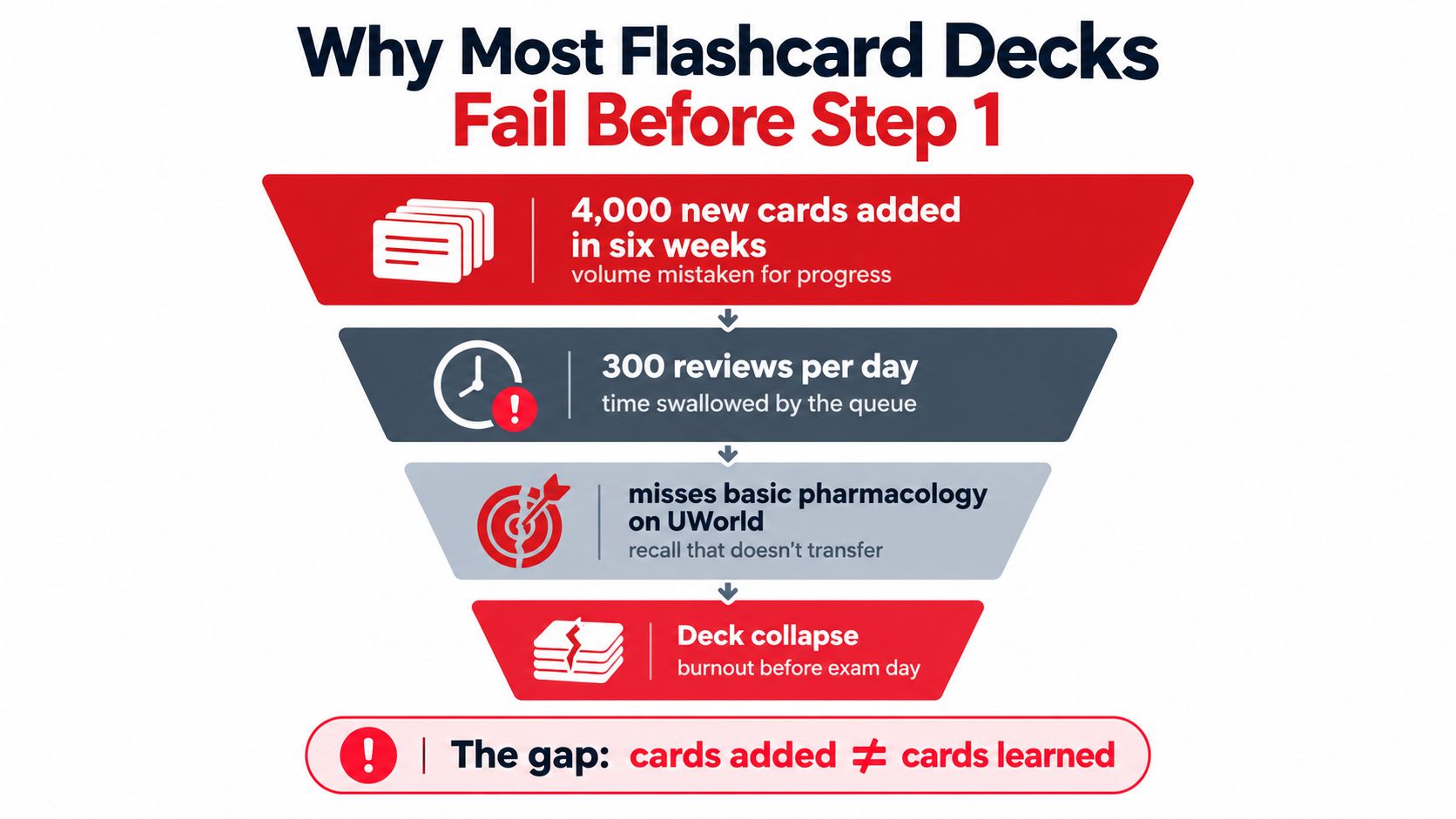
You have 4,000 new cards added in six weeks, a queue of 300 daily reviews, and you're still missing basic pharmacology questions in your question bank. The problem isn't necessarily effort. It's that card volume has replaced retrieval under exam conditions, error analysis, and clinical transfer.
Flashcard spaced repetition is a scheduling system, not a shortcut to understanding. It resurfaces information at expanding intervals, but it can only schedule the material you put into it. If one card hides six facts behind a vague prompt, the algorithm is efficiently repeating a poorly designed learning task.
This guide focuses on the decisions that affect board preparation: choosing a tool, writing atomic cards, setting a schedule around your exam date, tracking retention, and knowing when to stop adding cards. A concise flashcard workflow for medical students can help you organize those pieces, while study guides that improve comprehension can support understanding before memorization begins.
Why Most Flashcard Decks Fail Before Step 1
A student can complete hundreds of reviews and still miss basic pharmacology questions. The failure usually comes from treating card completion as exam preparation. Flashcard spaced repetition is a scheduling system, not a shortcut to understanding. It brings information back at expanding intervals, but it cannot repair a vague prompt, a weak explanation, or a failure to apply facts under time pressure.
Spaced repetition rests on sound learning principles. Hermann Ebbinghaus showed in 1885 that review frequency and spacing affect retention, and later systems such as SM-2 converted that principle into software scheduling (medical-education review). A correct retrieval usually sends a card farther into the future, while a failed retrieval brings it back sooner. That mechanism does not make every review useful.
A bloated deck produces three predictable failures:
- Compound prompts: One card asks for a mechanism, adverse effect, contraindication, and clinical use. You recall two details, mark the card correct, and miss the detail the exam tests.
- Recognition disguised as recall: Wording, an image, or familiar context supplies part of the answer. Familiarity feels like mastery, but you still cannot produce the answer independently.
- Queue displacement: Reviews take time away from timed questions, explanation review, and recording why you missed an item.
A “mature” card may have a long interval while your knowledge remains shallow. Scheduling maturity reflects review history, not your ability to apply the concept to an unfamiliar vignette.
The diagnostic question: Can you answer the card without visual cues, then use the concept in a new question?
Exam performance requires transfer
Medical exams test more than definitions. They require you to identify mechanisms, interpret findings, distinguish close alternatives, and recognize when a familiar fact does not apply. Flashcards preserve the memory layer. They do not replace question-based reasoning.
Use reviews for high-yield facts, then test transfer in a question bank. Create another card when a missed fact is reusable. If the error came from misreading the stem or following weak reasoning, log the corrective action instead of adding another fact card.
A practical flashcard workflow for medical students can organize review decisions, while resources that boost comprehension with study guides can support understanding before memorization. Build your system around retrieval, spacing, feedback, interleaving, and transfer. Choose representations that fit the material, adding a useful diagram when a mechanism or anatomy relationship is visual.
Choosing the Right Spaced Repetition Tool
The app matters less than the cards and the review behavior, but tool friction can still determine whether you maintain the system. Compare platforms using the same questions: Can you understand or adjust the scheduling logic? Does synchronization fit your devices? Can you customize cards without spending your entire evening configuring them? Does the cost match your study phase?
A practical comparison
| Tool | Algorithm | Cost | Sync | Customization |
|---|---|---|---|---|
| Anki | Configurable schedulers, including FSRS and traditional options | Desktop version is free; mobile costs may vary by platform and time | Strong cross-device workflow when configured correctly | Extensive card types, tags, media, and add-ons |
| AnKing | Curated medical deck built for use with Anki | Access and associated resources may vary | Depends largely on the Anki setup used | High after importing, though the source deck is curated |
| Quizlet | Proprietary scheduling logic with limited interval transparency | Free and paid features may vary | Straightforward across supported devices | Easier setup, less granular control |
| RemNote | Integrated notes and flashcards with proprietary scheduling options | Free and paid features may vary | Designed for multi-device note and card use | Strong note integration, with less traditional deck control |
Anki is the most defensible default for dedicated United States Medical Licensing Examination (USMLE) preparation when you want granular control, mature add-ons, and a large medical-study ecosystem. Its setup takes work, and that work is a real limitation. AnKing can reduce deck-building time through curated material, but you still need to edit, suspend, and align cards with your resources.
Quizlet and RemNote make more sense when setup friction is blocking consistency, especially during coursework. Their interval logic is less transparent, so they're less appealing when you need detailed workload control during board preparation.
Use this decision checklist:
- Choose Anki if you'll maintain tags, settings, and a structured medical deck.
- Choose a curated Anki deck if your bottleneck is card creation, not review discipline.
- Choose Quizlet or RemNote if fast setup and simple synchronization matter more than deep customization.
- Avoid switching tools mid-prep unless your current platform is actively preventing daily review.
For a closer look at settings and workflow, use this Anki and spaced-repetition guide. Don't select an app because its interface feels productive. Select the system you can operate consistently for the months ahead.
Writing Cards That Actually Stick
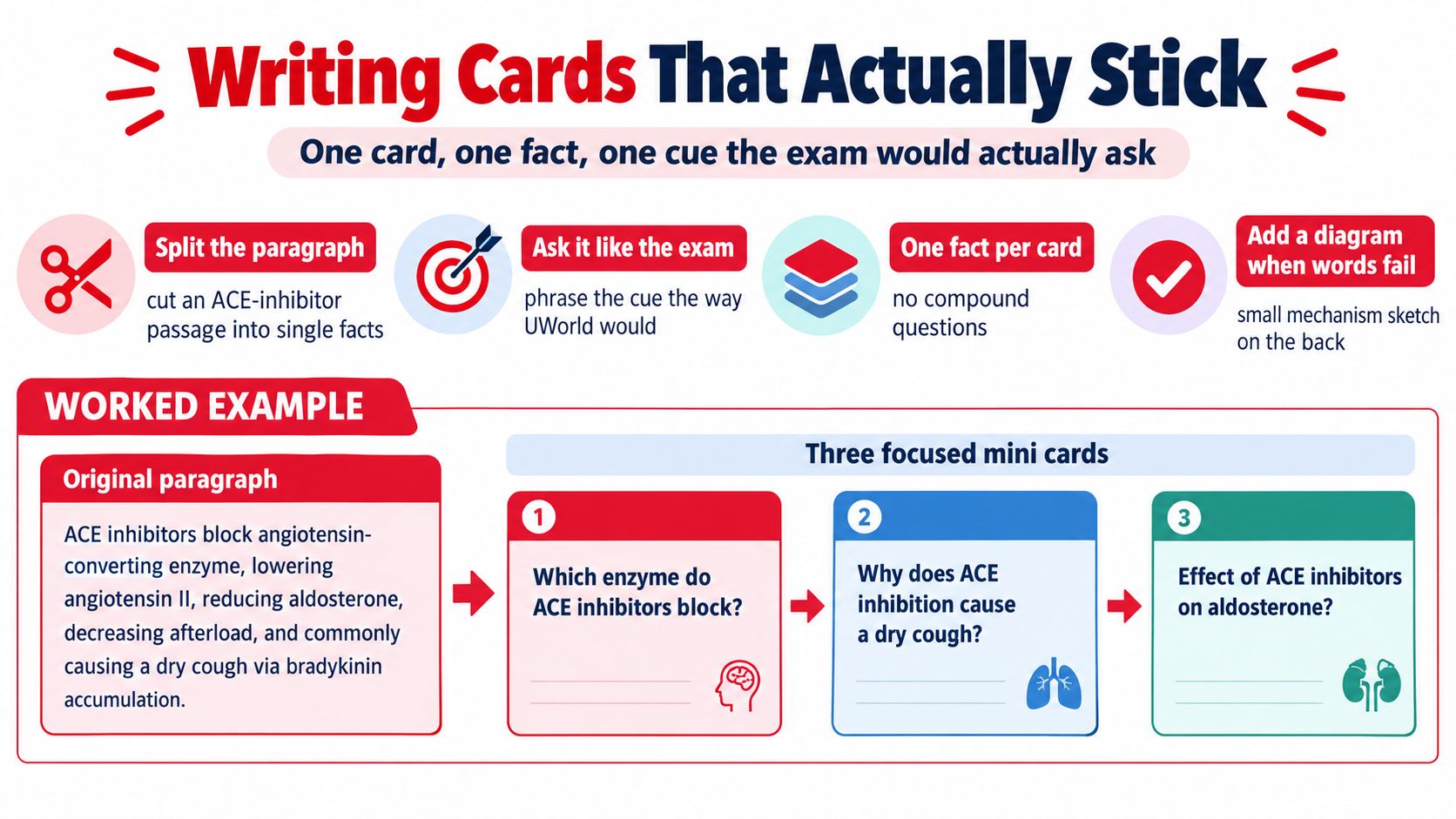
A card should force a small act of retrieval that resembles something you may need to do on an exam. The minimum-information principle is simple: one card, one fact, one clear cue. If the answer requires a paragraph, the prompt probably contains several cards.
A pharmacology example
Suppose your notes say that angiotensin-converting enzyme inhibitors reduce angiotensin II, lower aldosterone, reduce afterload, and can cause cough through bradykinin accumulation. Don't paste that paragraph onto the back of one card. Split it into separate retrieval targets:
- Mechanism: Which enzyme do angiotensin-converting enzyme inhibitors block?
- Hormonal effect: What happens to angiotensin II after enzyme inhibition?
- Aldosterone: What is the effect of angiotensin-converting enzyme inhibition on aldosterone?
- Adverse effect: Why can these drugs cause a dry cough?
- Clinical risk: Which potentially serious adverse reaction should you remember with this drug class?
The fifth card should contain the precise answer in your own words after you verify it against your study resource. The point isn't to create a complete pharmacology textbook inside the deck. It's to isolate facts that can be retrieved, corrected, and later applied.
Cloze deletion works well for definitions and rapid-fire relationships:
- “Angiotensin-converting enzyme inhibitors can cause cough through accumulation of {{c1::bradykinin}}.”
Question-and-answer cards work better when the cue must include a clinical condition:
- Front: A patient develops a persistent dry cough after starting an angiotensin-converting enzyme inhibitor. What mechanism explains the symptom?
- Back: Increased bradykinin activity.
That example is original and educational. It isn't an official or recalled exam item.
Four rules for every new card
- Split the prompt: Never ask for multiple independent facts in one response.
- Remove giveaways: The front shouldn't contain the answer or an obvious synonym.
- Rewrite source language: Copy-pasting a textbook or question explanation preserves recognition rather than demanding recall.
- Add useful visuals selectively: Use a small diagram for a pathway or spatial relationship, not as decoration.
Avoid cards that depend on seeing several images side by side, contain long sentences, or duplicate an explanation you already understand from a question bank. Before adding a card, ask whether it will help with retrieval or transfer. If it only records something you could look up instantly and will never confuse on an exam, leave it out.
The memory-retention guide is useful for reviewing the broader principles, but card quality remains your responsibility. An algorithm can't repair an ambiguous prompt.
Setting Up Schedules That Match Your Exam Date
A useful schedule creates expanding gaps between successful retrievals. Medical-education literature describes spacing material on the day of instruction and then revisiting it at progressively longer intervals. Expanding schedules such as 2, 7, 17, and 40 days have been reported to outperform contracting or fixed schedules in retention (medical-education spacing study).
Match settings to workload
Young cards need frequent exposure because the memory is still unstable. Mature cards have survived longer intervals, but they still need honest testing. A common Anki sequence described in medical education uses 1, 3, 7, 14, and 28 days, although your actual intervals depend on recall quality and scheduler settings (Anki scheduling study).
| Setting | Dedicated, 8 to 12 months out | Clerkship year | Final 4 weeks |
|---|---|---|---|
| New cards | Start conservatively, often 60 to 120 per day only if reviews remain manageable | Often 20 to 40 course-linked cards per day | 0 new cards |
| Review limit | Keep a high ceiling so due cards aren't hidden, then monitor workload | Cap the queue to protect clinical and question time | Prioritize due and failed cards, without adding backlog |
| Graduating interval | Use a short first interval that requires real retrieval | Keep early reviews close to instruction | Avoid experimenting with aggressive settings |
| Easy interval | Keep it long enough to prevent premature promotion | Use only when recall is immediate and stable | Don't use Easy to escape difficult material |
| Lapse steps | Return failed cards soon enough to diagnose the problem | Rewrite or suspend repeated failures | Relearn only high-yield misses |
Treat these ranges as starting points, not prescriptions. Your target is 85% to 90% true retention, not an attractive daily streak. The schedule should protect time for questions and review of explanations.
Use the deck options screen to adjust new cards per day, maximum reviews, graduating interval, easy interval, and lapse steps. Changing settings every few days creates noise. Make one deliberate adjustment, observe the workload and question performance, then keep or revise it.
An aggressive Easy button can create false confidence. A card may feel obvious because the answer is familiar, yet fail when the stem removes the original context. Your rating should reflect independent recall, not relief that the card is over.
For calendar-based planning, use the USMLE Step 1 study calendar as a planning reference, then adapt it to your test date, school schedule, and question-bank goals.
Sample Weekly Review Plan for USMLE and COMLEX
A schedule is useful only when it leaves room for unseen questions. The following plan is a default for a dedicated learner, not a promise that a particular number of cards will fit every student.
Dedicated USMLE version
| Day | New cards | Review window | Question-bank work |
|---|---|---|---|
| Monday | 80 | Morning due reviews, evening cleanup | Timed block, then error log |
| Tuesday | 80 | Morning due reviews, evening cleanup | Timed block and explanation review |
| Wednesday | 80 | Morning due reviews, evening cleanup | Mixed questions with interleaving |
| Thursday | 80 | Morning due reviews, evening cleanup | Targeted block from recurring errors |
| Friday | 80 | Morning due reviews, evening cleanup | Timed mixed block |
| Saturday | 80 | Longer review window | Questions plus weekly card audit |
| Sunday | 0 | Light due reviews | Full-length block or cumulative assessment, then error-log review |
The plan may produce 300 or more daily reviews for some learners as cards accumulate. That isn't automatically a problem, but it becomes a problem when reviews crowd out question analysis, sleep, or recovery. If an exam is two weeks away, set new cards to zero regardless of the calendar.
Shelf and COMLEX adaptations
During a Shelf-heavy week, pause new cards and prioritize due reviews alongside 40 timed question-bank items per day only if that workload is realistic for you. Tag missed concepts and convert the most reusable gaps into cards the following Monday.
For Osteopathic Medical Licensing Examination of the United States (COMLEX-USA) preparation, layer in osteopathic medicine content rather than mixing every fact into an undifferentiated deck. Reserve Friday for COMSAE-style practice and record whether a miss came from a knowledge gap, interpretation error, or weak application.
A card from a missed question should earn its place by passing this test: Will the fact help you answer a different question later? If yes, write one clean card. If no, keep the insight in the error log.
Copy this error-log structure:
| Date | Question task | Error type | Correction | Next review dates | Transfer test |
|---|---|---|---|---|---|
| Monday | Explain why a drug causes a symptom | Knowledge gap | Write one mechanism card | Tuesday, Friday, next week | Apply mechanism to a new drug class |
| Tuesday | Identify the next diagnostic step | Misread stem | Mark the decisive clue | Wednesday, Saturday | Solve a new vignette without cueing |
| Thursday | Distinguish similar diagnoses | Second-order reasoning | Add a comparison prompt | Friday, next week | Explain why each distractor is wrong |
The spaced-repetition study guide can complement this framework. Keep the central rule visible: cards preserve facts, while questions reveal whether you can use them.
When More Flashcards Start Hurting Your Score
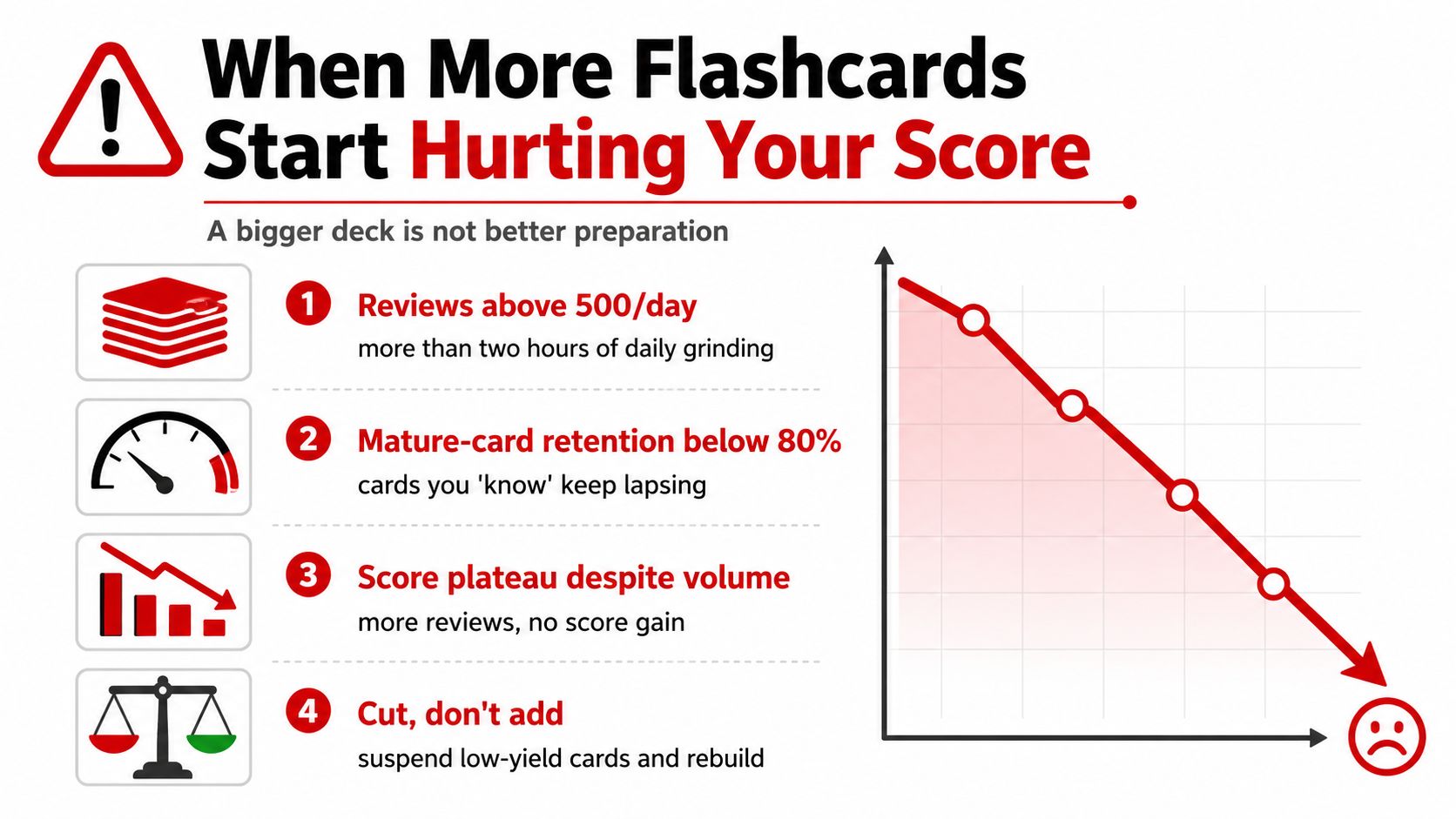
A larger deck can make preparation worse when it consumes the time required for application. Don't treat every due card as equally valuable. Low-yield repetition can crowd out high-yield reinforcement and the deliberate practice that exposes reasoning errors.
Audit the deck before adding more
Use these warning signs as prompts for an audit:
- A queue above 500 reviews: If it takes more than two hours and leaves no time for questions, reduce new cards and prune aggressively.
- Mature-card retention below 80%: Cards you thought were stable are repeatedly failing. Check wording, context dependence, and overconfident ratings.
- No transfer despite volume: You recognize cards but can't solve unfamiliar questions.
- Repeated lapses: A card that fails more than five times needs rewriting, splitting, suspension, or a return to the underlying concept.
The five-lapse rule is an editorial cutoff, not a scientific passing standard. It forces a decision instead of allowing one defective card to drain attention indefinitely.
Delete or suspend cards that test trivial lookup facts, duplicate a question-bank explanation without adding retrieval value, or contain long sentences with several independent claims. Replace them with a single-fact prompt, a compare-and-contrast card, or another practice question.
Cut before you customize. Most overloaded decks don't need more tags or a new theme. They need fewer, sharper prompts.
The 2026 medical-education meta-analysis found a substantial overall benefit for spaced repetition but also identified unanswered questions about optimal design, delivery, and long-term performance (medical-education meta-analysis). That limitation matters. Spacing works, but implementation determines whether the method supports learning or becomes a second job.
When reviews feel automatic and question-bank errors become the main source of new learning, shift your attention. The deck has done its job. More cards aren't a sign of seriousness.
Tracking Retention and Building Your Error Log
Your deck should produce evidence that it helps. Track three signals together: mature-card count, true retention from the statistics panel, and recurring error tags from your question-bank log. A high mature-card count with weak transfer means the deck is stable in its own environment but not preparing you for unseen tasks.
Use a lightweight audit
Record the source, concept, related cards, root cause, and fix action. Keep the question-bank source name accurate, whether that's UWorld, Amboss, or another licensed resource. Don't copy protected question text into your spreadsheet.
| Date | Source (UWorld/Amboss/AMBOSS) | Concept Tested | Related Anki Card(s) | Root Cause | Fix Action |
|---|---|---|---|---|---|
| Misread, content gap, or second-order reasoning | Rewrite, suspend, review concept, or complete a question drill | ||||
Cross-reference misses with card history. If you repeatedly miss pharmacology despite mature cards, inspect whether the cards test isolated mechanisms while the questions require adverse-effect recognition, contraindication selection, or comparison between drug classes. Add the missing transfer layer, not another copy of the same definition.
A monthly review should be short and decisive:
- Recalculate true retention and compare it with your target range of 85% to 90%.
- Count mature cards and identify subjects with repeated lapses.
- Prune cards below 70% accuracy after three mature lapses, then rewrite or suspend them.
- Review error-tag frequency, especially recurring misreads and second-order reasoning errors.
- Move only reusable gaps into fresh cards or a targeted question drill.
Don't add cards during the audit until you know what your current system is failing to capture. Spend one evening reviewing your statistics, card lapses, and question errors. The next card should solve a documented problem, not relieve anxiety about an incomplete deck.
Ace Med Boards provides one-on-one online tutoring for USMLE Steps, COMLEX-USA exams, and selected Shelf preparation, with study strategy and question-analysis support shaped to a learner's needs. If your flashcard workload is high but your question performance isn't translating, visit Ace Med Boards to learn about a free consultation and discuss whether targeted guidance fits your preparation.