No single school is best for every applicant. Harvard Medical School led a major 2026 global medical-school list with a score of 99.06, followed by Johns Hopkins at 98.13 and NYU Grossman at 96.75, but the strongest choice depends on whether you prioritize research, curriculum flexibility, clinical mission, financial aid, student experience, or geographic fit.
The seven MD programs below represent different answers to the question of what makes the best medical schools. Harvard and Johns Hopkins suit research-intensive applicants, Stanford favors self-directed innovation, UCSF emphasizes health equity and population health, NYU Grossman changes the tuition calculation, Mayo Clinic Alix offers a smaller high-touch environment, and Perelman combines broad academic pathways with deep clinical affiliations. Those distinctions matter more than a prestige label alone.
This comparison uses an as-of-2026 verification standard. Confirm each school's current admissions page, the Association of American Medical Colleges (AAMC) Medical School Admission Requirements database, or the American Medical College Application Service (AMCAS) guidance before applying. Requirements, tuition, financial-aid policies, admissions timelines, and residency rules can change. These are MD programs. Osteopathic medical students and applicants should make a separate comparison using the American Association of Colleges of Osteopathic Medicine (AACOM) and the American Association of Colleges of Osteopathic Medicine Application Service (AACOMAS).
Key takeaways
- Rankings are a starting point, not a decision rule. Different lists measure different missions.
- Admissions are exceptionally selective. One 2026 U.S. ranking reported a 1.96% average acceptance rate across its top 50 medical schools, with an average MCAT of 517. (College Evaluator)
- Fit requires verification. Check prerequisites, competencies, MCAT policy, letters, experiences, residency preferences, cost, aid, and deadlines for every school.
- Financial aid can outweigh small ranking differences. NYU Grossman's full-tuition scholarship is a meaningful example, but living costs and eligibility details still require review.
- A strong application list should include mission fits, not only famous names.
Reusable school-fit matrix
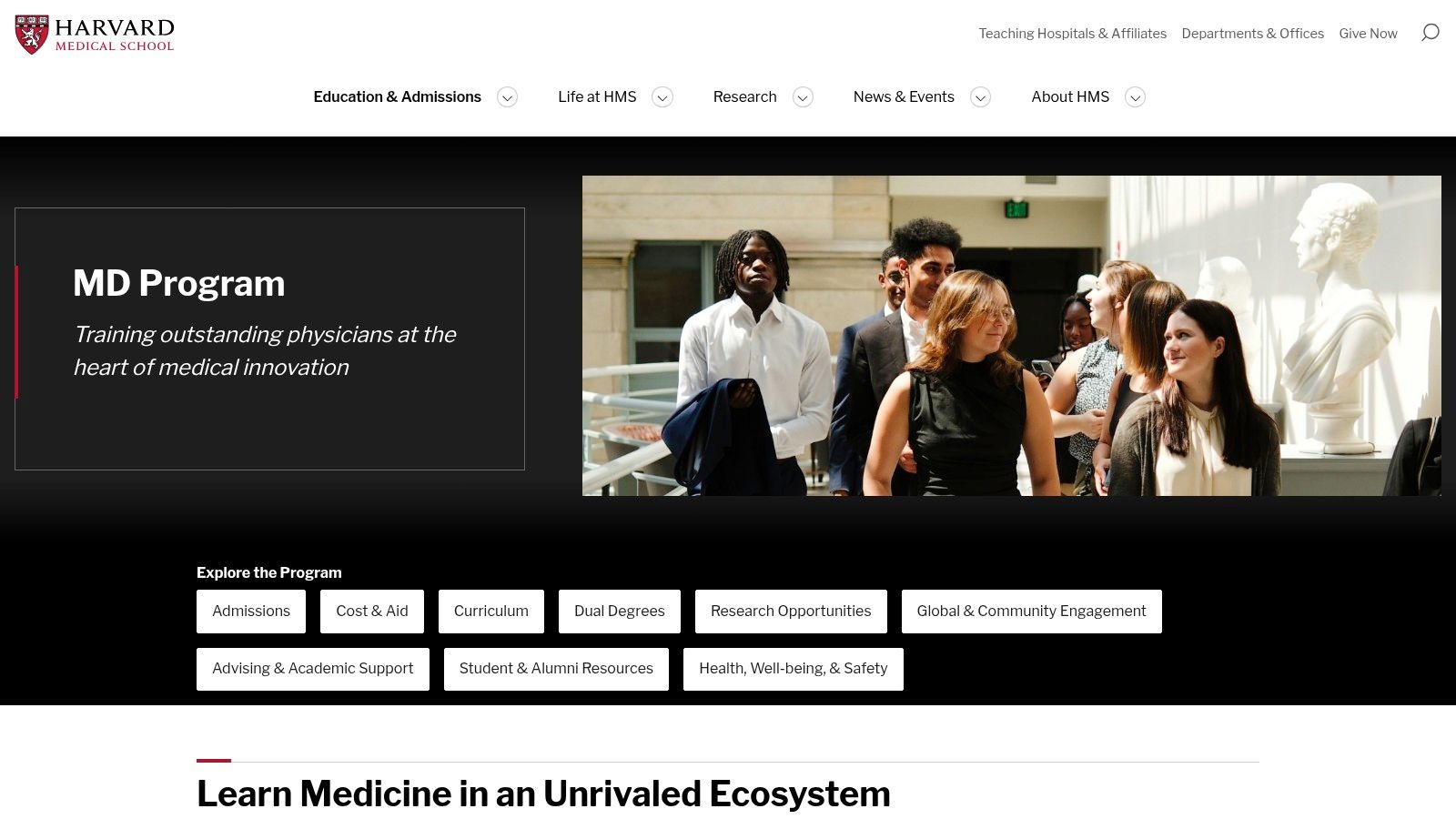
1. Harvard Medical School
Harvard Medical School is a strong fit for applicants who want research depth, early clinical learning, and access to multiple academic pathways. Its position as a global benchmark is supported by the 2026 ranking cited above, but the more useful question is whether HMS's structure matches the way you learn and the career you're building. (Harvard Medical School)
HMS offers two MD curricular tracks. Pathways uses case-based learning and introduces clinical exposure early, while Health Sciences and Technology, or HST, is a research-intensive program conducted jointly with the Massachusetts Institute of Technology. Both tracks connect biomedical science with patient care, but HST is especially relevant to applicants interested in engineering, translational science, or academic medicine.
Why HMS may fit
- Research ecosystem: Students can pursue opportunities across Harvard and MIT, with extensive options for research and dual degrees.
- Longitudinal clinical learning: Clinical education is integrated across curriculum phases rather than treated as a late standalone experience.
- Flexible enrichment: A fifth year can support research or other enrichment, subject to current school policies and tuition adjustments.
- Academic pathways: MD-PhD and other dual-degree options may suit applicants with clearly defined scholarly goals.
HMS also uses structured oversight across the pre-clerkship, Principal Clinical Experience, and post-clerkship phases. That organization can help students plan progression through a flexible curriculum, although flexibility doesn't remove the need for careful advising and time management.
Fit question: Do you want a broad research ecosystem and multiple academic options, or would a smaller, more standardized curriculum give you better support?
The primary trade-off is financial and environmental. Boston-based attendance requires careful planning, and a highly accomplished peer group may feel energizing to one student and overly competitive to another. Before adding HMS to your list, compare its current requirements with the medical school rankings and verify every prerequisite, letter policy, competency expectation, and deadline through HMS and MSAR.
2. Johns Hopkins University School of Medicine
Johns Hopkins University School of Medicine fits applicants who want intensive clinical training connected to major research and public-health infrastructure. Its 2026 placement in a major ranking remained near the top, but the strongest reason to consider Hopkins is the relationship between its curriculum, clinical environment, and research opportunities. (Johns Hopkins School of Medicine)
The Genes to Society curriculum links genetics, environment, social determinants, and clinical reasoning from the beginning of medical education. That design appeals to students who want to understand disease across biological and social levels rather than study basic science and clinical care as separate subjects.
What distinguishes the program
Hopkins builds early patient contact into the curriculum through clinical experiences that continue longitudinally. An ambulatory clerkship and transition courses help students prepare for inpatient wards and residency responsibilities. Those elements make the program relevant to applicants who value a deliberate bridge from classroom learning to clinical performance.
- Research access: Students can connect with opportunities across Hopkins Medicine.
- Mentorship: Early and continuing patient contact creates repeated opportunities to work with faculty.
- Clinical intensity: Urban clinical settings can expose learners to complex patient populations and demanding systems.
- Financial aid: Hopkins announced a financial-aid initiative beginning in Fall 2024 that covers full cost of attendance for families earning under $175,000. (Johns Hopkins financial aid information)
That financial-aid policy may materially change the comparison for eligible students, but applicants should verify current terms, household definitions, asset considerations, documentation, and renewal rules. A headline policy isn't the same as a personal aid estimate.
A school's financial-aid promise only helps after you confirm eligibility and understand what it covers.
The main limitation is that Hopkins is not a low-pressure option by default. Its urban clinical settings can be demanding, and private-school costs require a complete budget even when aid may be available. Review the school's current admissions requirements, then use the medical school acceptance rate guide as a planning resource without treating selectivity as a prediction of your individual outcome.
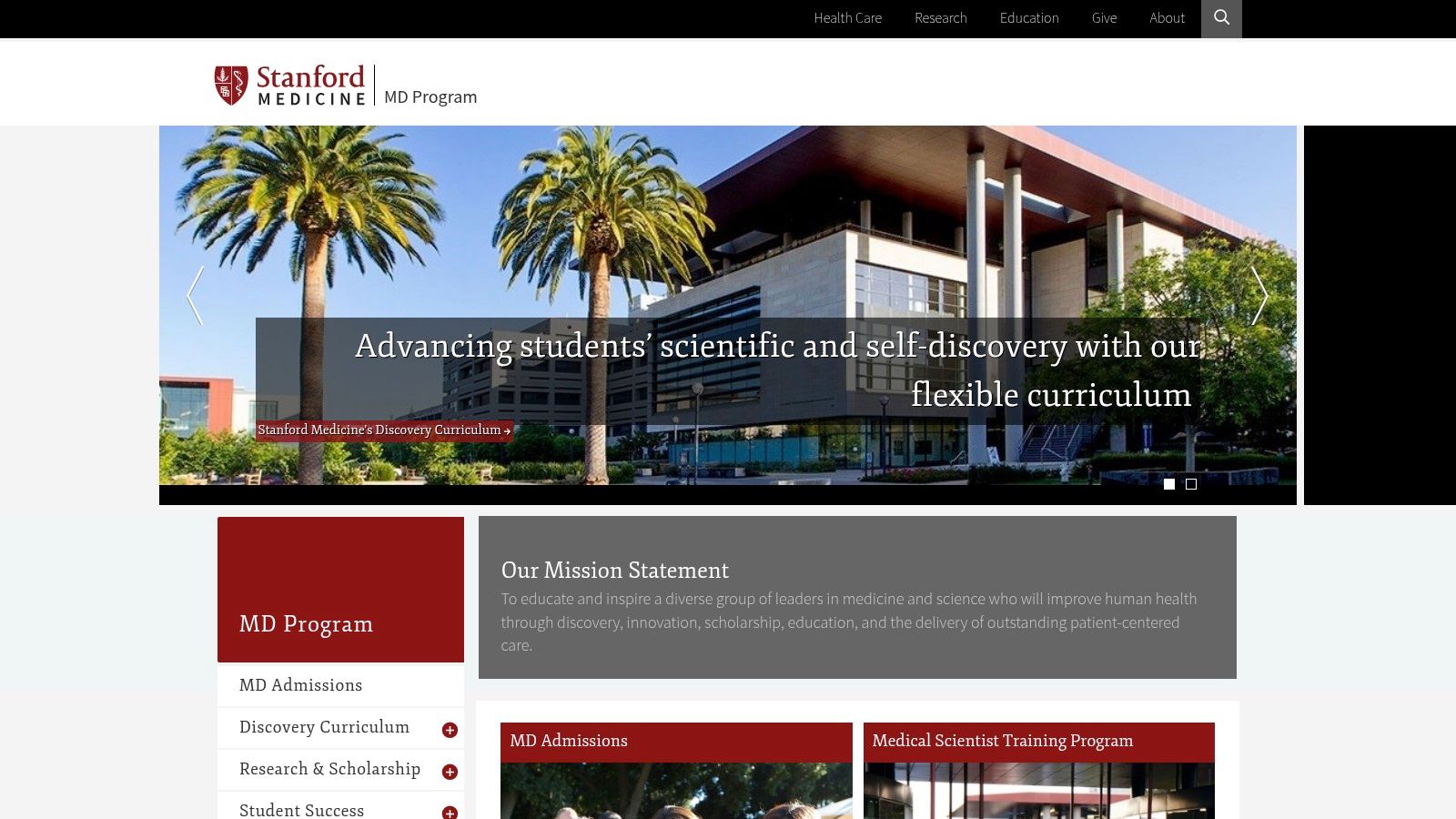
3. Stanford University School of Medicine
Stanford is a stronger fit for applicants who can define their academic direction and use substantial autonomy well. Its appeal rests on curriculum customization, protected scholarly time, and links to innovation, not on ranking position alone. Johns Hopkins and Stanford tied for second nationally in the United States-focused Times Higher Education 2026 medicine ranking, while both placed fifth globally, showing that rankings can group schools with similar broad strengths without resolving individual fit. (Times Higher Education context via Medical School Rankings)
The Discovery Curriculum lets students complete pre-clerkship education in two or three years while meeting the same competency outcomes. That choice can create room for research, entrepreneurship, dual degrees, or other academic work. It also shifts more responsibility to the student, who must plan timing, mentorship, and milestones carefully.
Stanford's model is easiest to assess through the questions an applicant would ask before committing:
- What can I build? Silicon Valley connections may support collaboration with biotechnology, engineering, and technology communities.
- How much time can I protect? Research quarters and dual-degree pathways provide structured routes for scholarly work.
- How will I measure progress? Stanford publishes curriculum schematics, competency frameworks, and graduation requirements, giving applicants material for comparing timelines.
- What support exists when plans change? Early clinical engagement and longitudinal mentorship through Educators-4-CARE matter because flexibility is useful only when advising and feedback keep pace.
The trade-off is straightforward. A student with a defined research question or interest in health technology may turn this freedom into meaningful academic time. Someone who prefers fixed sequencing and frequent external structure should examine advising access, required milestones, and academic support before applying.
Compare the learning model, not just the curriculum title. Ask how often students receive feedback, how mentors are selected, and how a flexible plan can be revised.
Cost and Bay Area living expenses also belong in the fit calculation. Use this medical school admissions guide to audit prerequisites and application narrative, then verify Stanford's current MCAT policy, letters, experiences, residency rules, deadlines, and financial-aid details through official MD admissions materials.
4. University of California, San Francisco School of Medicine
UCSF fits applicants who want medicine tied to health equity, population health, clinical inquiry, and service to diverse communities. Its appeal is not limited to research prestige. The school also emphasizes leadership, health-system improvement, and care across varied communities. U.S. News separates research and primary-care categories, and its 2026 primary-care methodology uses four tiers based on primary-care, faculty, and admissions metrics. (U.S. News primary-care methodology)
The Bridges Curriculum connects early clinical immersion with inquiry and health-systems science. Clinical microsystems clerkships introduce students to how care is organized and delivered. The inquiry curriculum then asks them to interpret evidence and develop work of their own, creating a useful test for applicants who want research to inform clinical practice.
A strong fit for systems-minded applicants
UCSF places leadership and health equity throughout the four-year experience instead of isolating them in standalone courses. Interprofessional learning and population-health projects may suit students who want to study patients within communities, institutions, and care systems.
Assess the program through these questions:
- Clinical range: Does exposure across primary care and subspecialties match your intended path?
- Community connection: Can your service interests develop into sustained clinical or research work?
- Scholarly preparation: Will the inquiry structure give you the practical research skills your goals require?
- Cost by residency: How would California residency or nonresident status affect tuition and aid?
The last question can change the ranking. A strong mission match may still be financially unrealistic after comparing resident and nonresident charges, aid eligibility, housing, transportation, and family obligations. Review current UCSF admissions and financial-aid pages because these policies can change.
Mission fit should be demonstrated, not merely declared. Your experiences, service choices, and written application should show why UCSF's priorities connect to your goals.
For an application audit, compare competencies, prerequisites, letters, and experiences with this current medical school admissions requirements resource, then verify every requirement through UCSF and MSAR. Applicants considering a DO program should create a separate AACOM and AACOMAS matrix, since MD and DO requirements should not be combined in one comparison.
A useful decision rule is simple: prioritize UCSF when systems improvement and community-oriented clinical work are central to your plans. If those aims are secondary, compare its curriculum structure, cost, and clinical opportunities against schools whose missions fit your intended practice more directly.
5. NYU Grossman School of Medicine
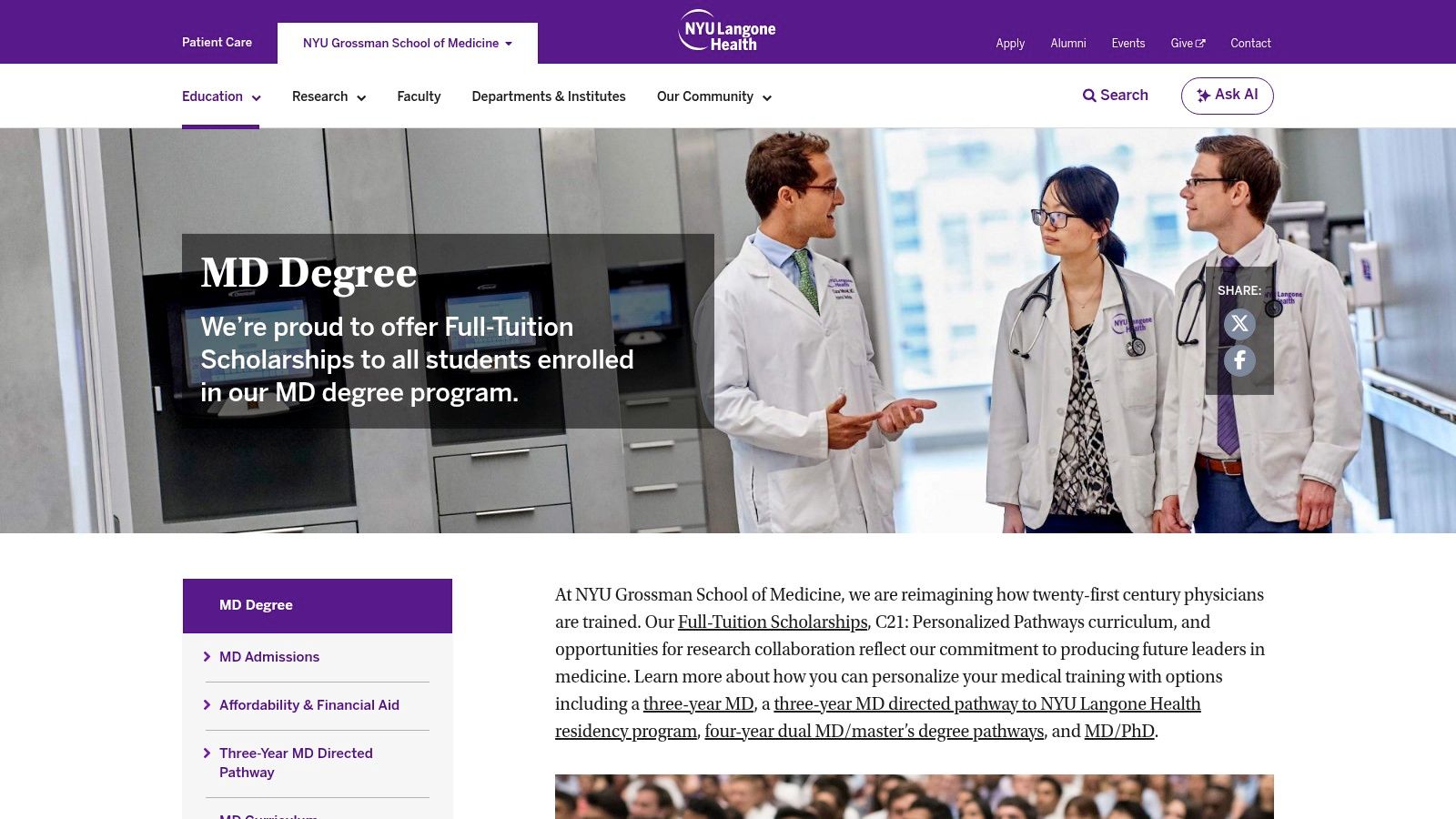
NYU Grossman School of Medicine belongs on a shortlist for a specific reason: financial aid can materially change school fit. A published ranking places NYU Grossman first among its listed U.S. medical schools, while reporting a small entering class, a highly selective admissions process, and very high median academic metrics. (College Evaluator) These figures are useful context, not a prediction of an individual applicant's chances. The small class makes the financial opportunity attractive and the admissions trade-off sharper.
NYU's financial model is unusually prominent. The school automatically awards a full-tuition scholarship to MD students, and additional need-based Debt-Free scholarships may address demonstrated need. Applicants should still distinguish tuition coverage from total cost. New York City living expenses, fees, insurance, transportation, and other personal costs remain part of the budget.
The program offers a four-year MD pathway and a three-year accelerated option. The accelerated route connects students with directed opportunities within NYU Langone Health and may suit someone with a well-defined plan for clinical training. Its shorter schedule also leaves less time for exploration, remediation, or a change in direction.
Use this comparison before treating the scholarship as the deciding factor:
- Net cost: Confirm what the scholarship covers and how need-based aid is assessed.
- Curriculum and clinical setting: Review training across NYU Langone Health and compare the available clinical exposure with your intended specialty or practice.
- Pace: Assess whether the accelerated pathway fits your academic preparation, personal responsibilities, and tolerance for an intensive schedule.
- Admissions strategy: Keep NYU in a balanced list that includes schools with different missions, regions, and aid structures.
The medical school scholarship guide can help organize questions about grants, living expenses, and borrowing. Verify NYU's current scholarship terms, eligibility rules, admissions requirements, and program details directly, since policies can change.
Ask for a net-cost estimate, not a tuition headline. Request a realistic budget that includes living expenses, fees, insurance, transportation, and the financial effect of program length.
NYU is a strong fit when substantial tuition support aligns with your goals and you can accept intense competition and a demanding pace. The scholarship alone should not determine an application list or enrollment decision.
6. Mayo Clinic Alix School of Medicine
Mayo Clinic Alix School of Medicine is a strong fit for applicants who value close mentorship, individualized advising, student wellness, and clinical training inside a major health system. Its multi-campus design creates a different student experience from schools centered in one urban academic setting. (Mayo Clinic Alix School of Medicine)
The program spans Rochester, Scottsdale, and Jacksonville. Training across these locations may expose students to different patient populations, specialties, and clinical settings. That flexibility comes with practical questions about campus placement, timing, relocation, and continuity of support.
Fit depends on how much flexibility you want
Mayo's small-cohort approach and advising model may suit students seeking frequent faculty interaction. Its connection to Mayo Clinic also supports clinical, procedural, subspecialty, and research interests within one health system. The value depends on whether those opportunities match your goals, rather than on the institution's reputation alone.
A useful evaluation should focus on the experience you would receive.
- Mentorship: Ask how advising works in practice and how accessible faculty are outside formal meetings.
- Clinical exposure: Compare each campus's specialties, patient populations, and opportunities related to your intended field.
- Student wellness: Review the services, advising structures, and scheduling practices that support student well-being.
- Research alignment: Identify projects and mentors connected to your interests before treating research access as a general advantage.
- Financial aid: Verify whether institutional scholarship review requires detailed financial information, including parental information, and confirm current eligibility rules.
Campus assignment is the clearest trade-off. Some applicants will welcome several Mayo settings. Others may prefer one city, one support network, and fewer logistical changes. Ask when assignments are made, how transitions are supported, and whether preferred specialty experiences are available at the assigned campus.
Use a consistent net-cost comparison. Include tuition, fees, living expenses, institutional scholarships, outside aid, and projected borrowing. A scholarship's eligibility rules may differ from those at other schools, so compare the terms rather than the headline amount.
A focused application should connect your experiences to individualized learning, service, research, or wellness. Before submitting, verify current prerequisites, letters, MCAT policy, application requirements, aid terms, and campus information through Mayo's official admissions resources.
7. Perelman School of Medicine at the University of Pennsylvania
Perelman School of Medicine at the University of Pennsylvania suits applicants seeking integrated science, broad research access, dual-degree options, and urban clinical training. Its IMPaCT curriculum links basic, clinical, translational, social, and health-systems sciences throughout medical school. (Perelman School of Medicine)
The fit depends on how those features serve your goals. Penn Medicine and Children's Hospital of Philadelphia, commonly known as CHOP, expose students to adult and pediatric care, varied patient populations, translational research, health systems, and interdisciplinary scholarship. Applicants should verify current curriculum details and clinical opportunities through official school materials.
Fit depends on purpose, not program count
Perelman offers MD-plus degrees and concentrations that can support careers combining medicine with research, policy, business, or another field. Their value depends on a defined objective. A combined degree adds time and academic demands, so compare its requirements with the work you intend to pursue.
Rather than repeating a standard checklist, assess the school through these trade-offs:
- Curriculum integration: Longitudinal threads connect scientific foundations, clinical care, and health systems.
- Clinical range: Penn Medicine and CHOP provide different patient populations and specialty settings.
- Research access: The wider academic medical community can support projects across disciplines, but applicants should identify relevant mentors and confirm how students join research.
- Financial planning: Review tuition, fees, living costs, scholarships, loans, and aid rules together. Combined-degree years may follow different funding policies.
- Learning environment: Urban rotations can offer high clinical volume and complex cases, while demanding schedules and resource-intensive settings may not suit every learner.
Published tuition does not equal total cost. Compare Perelman with other schools using the same assumptions, then model projected borrowing under each aid offer. Verify current figures, scholarship conditions, parental-information requirements, and financial-aid policies before making a decision.
A credible application would connect prior research, service, clinical exposure, or leadership to Perelman's integrated mission. “Top research school” is too general. Explain why its curriculum, clinical affiliations, or degree options match your intended work, and distinguish verified school information from your own interpretation.
The ranking context also deserves caution. The 2026 global list described earlier placed nine of its top ten schools in the United States, illustrating how prestige can cluster among a small group of institutions. That pattern may reflect visibility more than fit, so use the ranking as a starting point, not a final decision rule.
Top 7 Medical Schools Comparison
| School | Curriculum complexity & flexibility 🔄 | Resources & cost ⚡ | Expected outcomes ⭐📊 | Ideal use cases 💡 | Key advantages ⭐ |
|---|---|---|---|---|---|
| Harvard Medical School (HMS) | High 🔄: Two tracks (Pathways, HST); structured phases; optional 5th year | Very high resources; extensive Harvard/MIT research access; high cost | High research output and strong residency placement ⭐ | Research‑intensive training; early longitudinal clinical learning | Unmatched research ecosystem; early clinical exposure |
| Johns Hopkins University School of Medicine | High 🔄: Genes‑to‑Society integrated curriculum with early clinical exposure | Extensive research infrastructure; private‑school cost but new aid for families < $175k | Elite residency matches; strong clinical reasoning and mentorship ⭐📊 | Students seeking rigorous clinical training + research | Continuous patient contact; strong mentorship |
| Stanford University School of Medicine | High 🔄: Flexible pre‑clerkship pace (2–3 yrs); customizable pathways | Exceptional access to biotech/engineering; high Bay Area living costs | Strong opportunities for innovation, research, and entrepreneurship ⭐📊 | Learners wanting flexibility, protected research time, or startups | Silicon Valley collaborations; customizable MD experience |
| UCSF School of Medicine | Moderate–High 🔄: Bridges curriculum with early clinical microsystems and inquiry | Strong academic medical center resources; high SF cost and nonresident tuition | Graduates skilled in health‑systems science, leadership, and equity ⭐📊 | Students focused on population health, equity, and community engagement | Interprofessional focus; leadership and health‑equity emphasis |
| NYU Grossman School of Medicine | Moderate 🔄: 3‑yr accelerated and 4‑yr pathways; integrated clinical training | Unique: automatic full‑tuition scholarship for all MD students; NYC living costs remain | Reduced debt burden; faster route to residency for accelerated track ⭐📊 | Applicants prioritizing debt reduction or accelerated training | Full‑tuition award to all MD students; strong clinical integration |
| Mayo Clinic Alix School of Medicine | Moderate 🔄: Small cohorts, high‑touch advising across multi‑campus model | Strong clinical and research sites; centralized scholarships but detailed aid requirements | Personalized training with strong subspecialty and procedural exposure ⭐📊 | Students seeking close mentorship, wellness focus, and diverse clinical sites | World‑class clinical sites; individualized advising and wellness emphasis |
| Perelman (University of Pennsylvania) | High 🔄: IMPaCT integrated longitudinal curriculum with many concentrations | Broad MD+ combined‑degree options; private‑school tuition levels | Strong research network and diverse career pathways; ties to Penn Medicine/CHOP ⭐📊 | Those pursuing combined degrees, translational research, or pediatrics | Wide range of dual‑degree options; clear financial policies |
Turn the Ranking Into an Application Strategy
A prestigious program isn't automatically the best personal choice. The AAMC's 2024 Graduation Questionnaire found that 92% of graduates agreed or strongly agreed that they were satisfied with the overall quality of their medical education, suggesting that satisfaction is high across U.S. medical education and that applicants should compare execution, clinical exposure, curriculum support, and board preparation rather than assume prestige alone creates a better student experience. (AAMC Graduation Questionnaire summary)
The application process should begin with an audit, not a school list. Use the AAMC Premed Competencies to identify gaps in service, teamwork, communication, ethical responsibility, scientific inquiry, and other areas. Then compare each MD program's current admissions page or MSAR entry. For DO programs, use AACOM and AACOMAS separately. Coursework, MCAT policy, letters, clinical exposure, research, residency status, prerequisites, and deadlines vary by school.
Application timeline
- Prerequisite and competency audit: Review transcripts against every target school's current requirements. Record missing coursework, competency evidence, and explanations for academic gaps or unusual patterns.
- MCAT preparation: Build a realistic study plan around your baseline, test date, coursework, work, health, and retake considerations. Use official AAMC materials and verify the current testing calendar before registering.
- Clinical and service development: Build sustained experiences that help you understand patient care and the communities you hope to serve. Depth, reflection, and responsibility matter more than collecting disconnected activities.
- School-list construction: Use mission, prerequisites, MCAT and GPA context, geographic policy, clinical setting, research access, cost, aid, and student support. A school isn't a safety because its median looks lower.
- Letters and narrative: Ask recommenders early and give them concrete information about your work. Your personal statement and secondary essays should connect experiences to a credible motivation for medicine.
- Secondary applications: Track prompts, requirements, fees, and deadlines in one document. Tailor each response to the school's actual mission instead of recycling generic language.
- Verification and submission: Check transcript receipt, letters, coursework entries, and school designations before submitting. Apply early only when the application is accurate and ready, then date-stamp every deadline and policy in your tracker.
AAMC guidance and AMCAS instructions should anchor MD application logistics. MSAR can provide school-specific admissions context, but applicants still need to confirm changes on official school pages. This source plan is more reliable than copying a ranking page's assumptions.
A practical fit decision tree
- Do you want research to be central to your career? Compare Harvard, Johns Hopkins, Stanford, and Perelman for research access, mentorship, dual-degree options, and protected scholarly time.
- Do you prioritize health equity, primary care, or population health? Examine UCSF's mission and clinical model, then compare it with schools in the U.S. News primary-care tiers. (U.S. News primary-care rankings)
- Do you need to minimize tuition exposure? Model NYU Grossman's scholarship alongside living costs and eligibility. Compare net cost, not reputation.
- Do you prefer individualized advising and a smaller community? Investigate Mayo's cohort, campus assignment, mentoring, and wellness structure.
- Do you want maximum curriculum flexibility? Examine Stanford's pacing options and ask whether your learning habits support self-direction.
- Does geography or residency policy affect your list? Verify in-state preferences, nonresident tuition, and regional mission before assigning a school a realistic category.
- Are you applying internationally? Confirm eligibility, prerequisite equivalencies, transcript handling, English-language requirements, financial documentation, and whether the school accepts international applicants. Never assume that an MD school's policy matches another school's policy.
Final verification checklist
Before submitting an application, confirm each school's:
- Current admissions page: Record the page's review date and any update notice.
- MSAR entry: Compare the school's published context with the official page.
- MCAT policy: Check required, accepted, superscored, or expired-score rules.
- GPA reporting: Understand how AMCAS calculates and displays academic information.
- Letters: Verify committee-letter, individual-letter, and recommender requirements.
- Prerequisites: Check course content, laboratory expectations, online-course rules, and timing.
- Competencies and experiences: Map your evidence to the AAMC Premed Competencies.
- Residency status: Review state preference, nonresident rules, and supplemental tuition.
- Interview requirements: Confirm format, required activities, and applicant technology needs.
- Deadlines: Record primary, secondary, letters, transcripts, and financial-aid deadlines separately.
Frequently asked questions
How should I interpret MCAT and GPA context?
Use school-specific medians and ranges as context, not as admission cutoffs. One 2026 dataset reported a top-50 average MCAT of 517, while individual schools in that dataset reported median MCAT scores in the low 520s, including NYU Grossman at 523, Penn at 522, and Yale at 522. (College Evaluator) A lower score or GPA doesn't end an application, but it should prompt a careful review of mission fit, academic trends, experiences, narrative, and list balance.
Should match or research data determine my ranking?
They should inform your decision, not dictate it. Rankings often reward research infrastructure, while U.S. News separates research and primary-care categories. Choose the environment that supports your intended path, then verify residency and research information from current school materials rather than relying on a single composite ranking.
How should I compare cost and debt?
Calculate estimated total cost of attendance, including tuition, fees, living expenses, insurance, transportation, and program length. Review institutional aid terms, renewal requirements, family-information rules, and nonresident supplements. NYU Grossman's full-tuition scholarship is significant, but it doesn't automatically eliminate living costs or every form of borrowing.
Is there a lesser-known school I should consider?
Yes, if its mission and structure fit you better. Look for strong clinical affiliations, accessible mentorship, relevant community partnerships, research access, transparent aid, and outcomes that align with your goals. A school deserves a place on your list because of verified fit, not because it appears in a particular ranking tier.
How should international applicants compare schools?
Start with each school's official international-applicant policy. Confirm whether it accepts your applicant category, how it evaluates foreign coursework, what documentation it requires, whether English-language testing applies, how financial proof works, and whether prerequisites must be completed at an accredited U.S. or Canadian institution. Treat every school separately, and don't infer eligibility from another program's policy.
Applicants who want structured support can review Ace Med Boards' MCAT and medical-school admissions preparation, compare current program information, and use its medical school roadmap to organize prerequisite review, school fit, narrative development, and interview preparation. For questions about your specific application stage, use the free consultation page. Tutoring or admissions guidance can supplement official AAMC, AMCAS, AACOM, AACOMAS, MSAR, and school resources, but it can't replace them.
Before finalizing your list, revisit every policy and deadline directly on the responsible organization's website. Admission decisions depend on the complete application and institutional review, not on a ranking label or a single score.
Ace Med Boards offers one-on-one online support for MCAT preparation and medical-school admissions planning, including school-fit review, application organization, and interview preparation. Visit Ace Med Boards to explore whether a free consultation or Board Score Audit fits your current admissions preparation needs.