
The most popular flashcard advice is also the least reliable: more cards do not automatically produce better board scores. Flashcards help with USMLE, COMLEX-USA, and MCAT preparation when they force genuine retrieval, revisit material after useful intervals, and target knowledge gaps revealed by questions. They become much less valuable when you spend your study day collecting, flipping, and organizing cards instead of thinking through problems.
The practical standard is simple. A strong card asks for one answer, requires you to produce that answer before seeing it, and connects a high-yield fact to a mechanism or decision. Your deck should support question-bank work and practice exams, not replace them.
Why More Flashcards Doesn't Always Mean Better Scores
A large deck can create the appearance of progress. Card counts rise, review sessions feel familiar, and difficult topics seem organized. Yet completion is not the same as retrieval, and recognizing an answer after seeing it isn't the same as producing it under exam pressure.
The evidence supports a more careful conclusion. A 2026 meta-analysis involving 21,415 medical learners found a significant advantage for spaced repetition over standard study methods, with a standardized mean difference of 0.78, a 95% confidence interval of 0.56 to 0.99, and p < 0.0001 (PubMed summary of the meta-analysis). However, the broader literature doesn't show that every flashcard routine improves final exam performance. One study found that students considered flashcards helpful without finding an association with final exam scores, while another found a dose-dependent performance relationship (discussion of the conflicting evidence).
That difference matters for students preparing for Step 1, Step 2, Step 3, COMLEX Level 1, Level 2, Level 3, or the MCAT. The question isn't “How many cards can I get through?” It's “Which weak, testable ideas still fail when I have to retrieve them without cues?”
Quantity can hide a design problem
Cards often multiply for anxiety-driven reasons. A student misses a question, copies the entire explanation, adds several related facts, and repeats the process until the deck contains every detail from every resource. The resulting workload can crowd out the activities that develop exam performance, including timed questions, passage interpretation, distractor analysis, and review of incorrect reasoning.
Research on digital flashcards in physiology illustrates why volume should be interpreted carefully. For every 100 low-performing cards reviewed, exam grades were associated with an increase of 0.44 to 0.75 points on a 0 to 20 scale, while every 1,000 CP flashcards reviewed was associated with an increase of 0.81 to 1.08 points (2024 physiology study). These findings support a relationship between deliberate review and performance, but they don't establish that indiscriminately adding cards will keep producing equivalent gains.
Practical rule: Create a card when it addresses a recurring, high-yield weakness. Don't create one merely because a sentence appeared in a textbook.
Flashcards can strengthen factual retention, mechanisms, definitions, and compact clinical associations. They can't, by themselves, teach you to interpret a long MCAT passage, prioritize competing diagnoses, manage time, or recognize how a COMLEX or USMLE vignette is constructed. Those skills require questions and feedback.
A useful deck is therefore selective. It reflects your missed questions, unstable foundations, and high-yield facts that must remain accessible. It doesn't measure your worth, your intelligence, or your readiness by its size.
The Science Behind Spaced Repetition and Active Recall
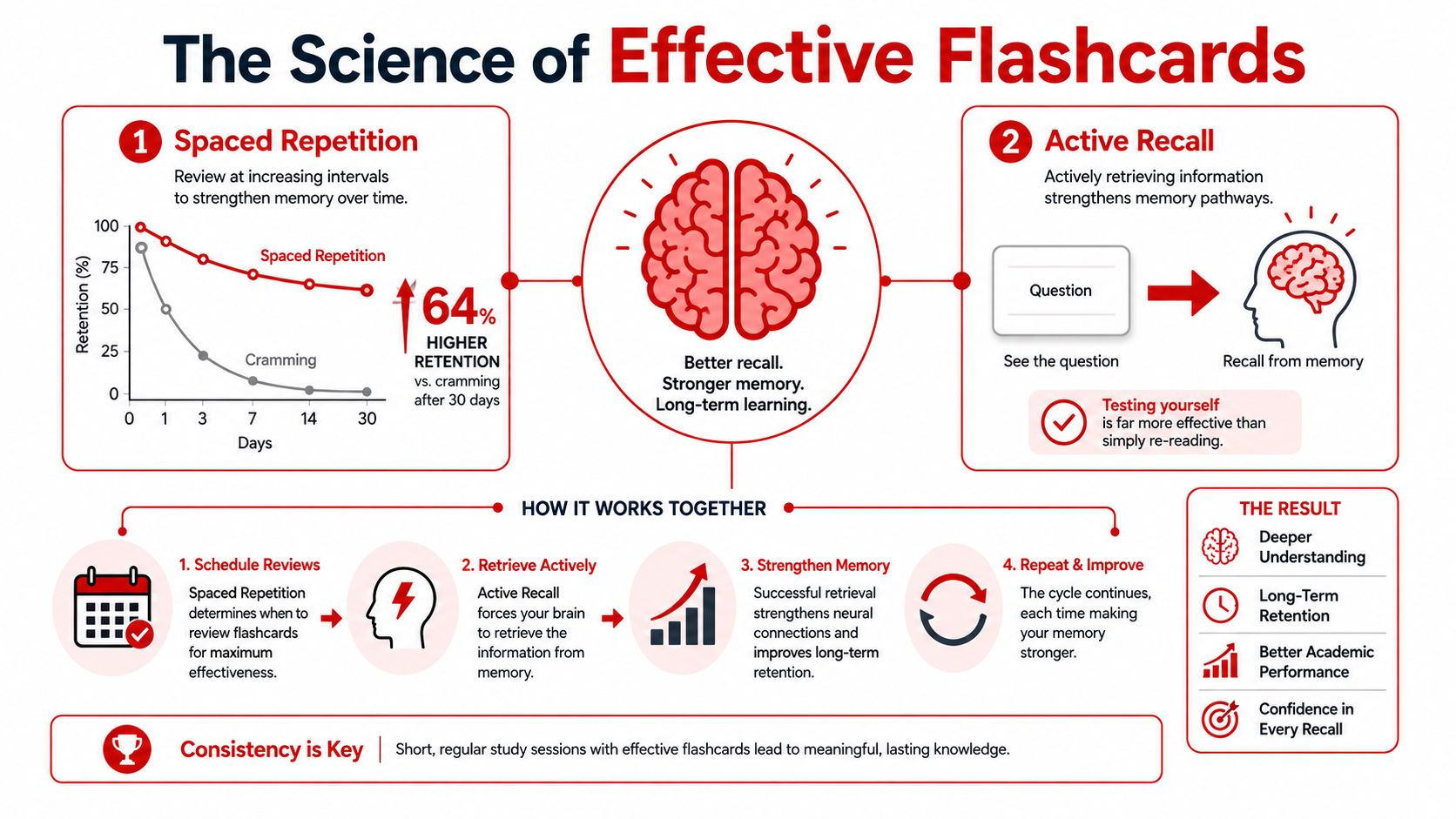
Flashcards work through two separate mechanisms: retrieval practice and spaced repetition. Retrieval practice requires producing an answer from memory before checking the explanation. Spaced repetition brings that idea back after an interval, rather than repeating it in one concentrated sitting. Together, they turn review into a test of memory instead of continued exposure to familiar words.
Rereading leaves the answer visible. A well-designed card temporarily removes that support, asking you to reconstruct a mechanism, term, or relationship and then compare your response with the explanation. That brief struggle is informative. It shows whether you can retrieve the idea independently or only recognize its wording on the page.
Why spacing beats concentrated review
A 2008 meta-analysis found that spaced practice can improve long-term retention by roughly 64% over massed practice when learners are tested after a delay (summary of the spaced-practice evidence). The difference was greatest over longer delays. Cramming and spacing may look equally effective when testing occurs within minutes or hours, but spacing performs better across days, weeks, and months, the time horizon relevant to board preparation.
Cramming feels productive because the material remains familiar. Recent wording and visual layout can support a correct response even when the underlying memory is weak. The learner experiences recognition, then mistakes that feeling for durable recall.
Spaced systems address part of the scheduling problem. Sebastian Leitner's 1972 five-box system sorted cards by mastery. The least-known cards were reviewed daily, the next box every two days, and later boxes at lengthening intervals as recall improved. This structure made flashcards a method for strengthening long-term memory rather than a simple memorization aid (educational research on spaced-repetition flashcards). For a deeper explanation of how to set review intervals, see this guide to spaced repetition.
What an algorithm can and can't do
Digital platforms can schedule cards according to recall performance, making large review sets easier to manage. They cannot repair a vague prompt, catch every medical error, or determine whether a card represents the concept you missed. Scheduling improves a well-written card. It does not make a poor card useful.
For medical learners, the review process matters more than the software brand:
- Attempt the answer before revealing it.
- Grade recall accurately, including partial or mechanism-free answers.
- Review difficult concepts at intervals that keep them accessible.
- Edit cards that repeatedly cause confusion.
- Return to practice questions to determine whether recall transfers to application.
The same principles apply across exams, while the emphasis changes. MCAT cards may target amino-acid properties, physics relationships, or biology mechanisms. USMLE and COMLEX cards often require a mechanism paired with a clinical association. Neither format replaces passages, patient-centered vignettes, or timed assessment. A card earns its place when successful retrieval supports later reasoning, not merely when it disappears from today's queue.
Card Quality Rubric and Common Design Mistakes
The most common design error is packing a paragraph, several facts, and a clinical exception into one recognition-heavy card. The student sees a familiar block of text, thinks “I know this,” and moves on without proving that they can retrieve the relevant idea.
A strong card is atomic, meaning it tests one meaningful idea. It should be concise enough to answer without rereading a miniature lecture, but specific enough to prevent guessing. The answer should use your own words and include a mechanism when the mechanism is what makes the fact memorable.
A practical quality test
Before keeping a card, ask:
- One idea: Is there one clear question rather than a cluster of facts?
- Retrieval: Can you answer without relying on multiple-choice recognition?
- Precision: Does the wording identify the exact relationship being tested?
- Mechanism: Does the answer explain why, when that explanation matters?
- Usefulness: Would missing this card affect your reasoning on a question?
- Ownership: Did you write the answer in language you understand?
| Quality Indicator | Poor Example | Effective Example |
|---|---|---|
| One testable idea | “What are the causes, findings, complications, and treatment of aortic regurgitation?” | “What hemodynamic change most directly explains the widened pulse pressure in aortic regurgitation?” |
| Retrieval rather than recognition | “Aortic regurgitation causes widened pulse pressure because of increased stroke volume and diastolic runoff.” | Front: “Why does aortic regurgitation widen pulse pressure?” Back: “Increased stroke volume raises systolic pressure, while diastolic runoff into the left ventricle lowers diastolic pressure.” |
| Concise answer | A full paragraph copied from a review resource | Two sentences that state the mechanism and its pressure effects |
| Clinical connection | “What is nephrotic syndrome?” | “Which glomerular injury pattern causes heavy protein loss with relatively preserved red-cell passage?” |
| Meaningful visual encoding | Red, blue, and green text applied randomly | A pressure arrow or simple flow diagram that distinguishes systolic ejection from diastolic runoff |
The aortic-regurgitation example is original and illustrates the right level of specificity. Color can help if it encodes meaning, such as using one color consistently for increased pressure and another for decreased pressure. Decorative color, elaborate formatting, and unrelated images add workload without improving retrieval.
Fix the card instead of blaming your memory
If a card repeatedly feels impossible, inspect the prompt first. It may ask for too much, use an unfamiliar phrase, hide the target concept, or combine facts that should be separate. Split a multi-part card into prompts such as “What causes the widened pulse pressure?” and “How does diastolic runoff affect diastolic pressure?”
For detailed guidance on building and scheduling digital cards, use spaced-repetition and Anki study methods. The goal isn't to produce beautiful cards. The goal is to create prompts that make the correct mental operation unavoidable.
Converting Missed Questions into High-Yield Cards
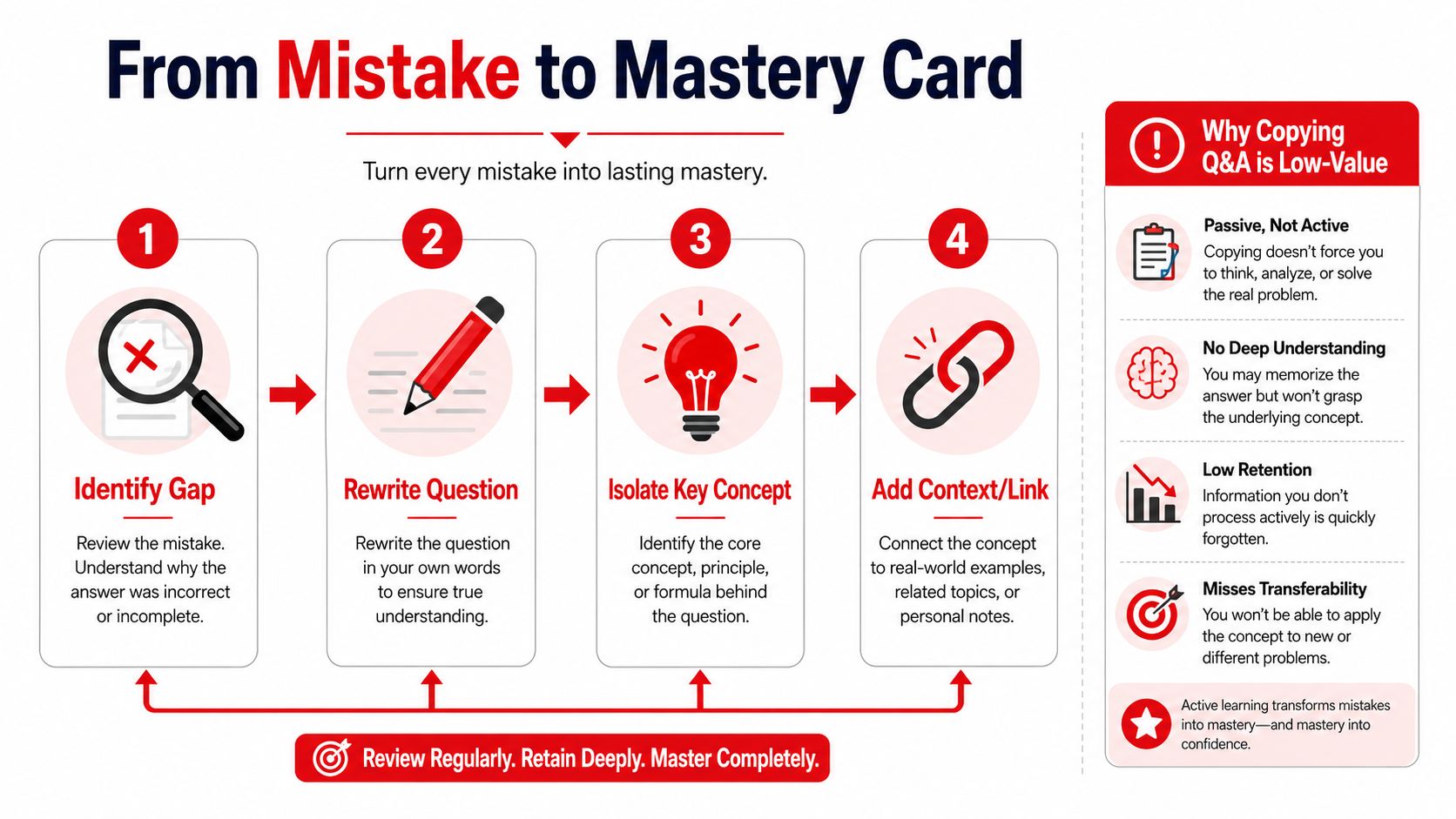
A missed question is raw material, not automatically a flashcard. Copying the stem and explanation usually creates a card that tests whether you remember the original page, not whether you understand the underlying concept.
Start by separating knowledge gaps from reasoning errors. If you didn't know that a specific enzyme deficiency causes a characteristic metabolic pattern, a focused fact-and-mechanism card may help. If you knew the fact but chose the wrong option because you ignored the timeline, your card should target the reasoning rule, not repeat the diagnosis.
A four-step mistake-to-card workflow
Identify the gap. Write one sentence describing why your answer failed. “I confused decreased renal perfusion with intrinsic tubular injury” is more useful than “I missed a kidney question.”
Rewrite the question. Remove distinctive wording from the original item and create a fresh prompt. For example: “What finding best separates prerenal azotemia from acute tubular injury?” This tests the transferable distinction rather than recognition of a particular vignette.
Isolate the concept. Put the essential relationship on the back. Add a short mechanism or contrast, such as how preserved tubular function affects urine concentration in a prerenal state. Keep the explanation compact enough to retrieve.
Add context or a link. Record the source topic, lecture, or question-bank category so you can revisit the broader material when needed. Don't reproduce copyrighted question-bank content or recalled exam material.
A useful card might look like this:
- Front: “A patient has reduced effective circulating volume. Which renal response supports a prerenal pattern?”
- Back: “The kidneys conserve sodium and water through intact tubular function, producing concentrated urine and low sodium excretion.”
The exact details should match the concept you missed and your curriculum. If the error came from misreading a distractor, create a card about the discriminating clue. Distractor analysis for medical questions can complement this process by helping you identify why an attractive wrong answer won.
Create selectively
Create a card when the concept is high-yield, likely to recur, and not already represented effectively in your deck. Edit an existing card when the topic is covered but the prompt is weak. Add a note to your question-review record when the problem was timing, careless reading, or an isolated reasoning slip that doesn't need repeated memorization.
You can use UWorld, NBME materials, COMQUEST, TrueLearn, lecture questions, and other resources as sources of learning opportunities, but don't copy their protected content into a deck. Extract the principle in your own words, then return to original practice questions to determine whether the card improved application.
When to Review, Edit, Suspend, or Delete Cards
Deck management is a learning decision, not an administrative chore. A card deserves review when it tests a fundamental, high-yield idea and remains difficult despite clear wording. Difficulty alone isn't a reason to delete it, especially when the concept appears repeatedly in questions.
Use this decision tree during review:
- Can you answer the card accurately and explain the mechanism?
- Yes, keep it scheduled.
- No, continue below.
- Is the concept fundamental and relevant to your exam?
- Yes, review it and check the underlying content.
- No, consider suspending it.
- Is the prompt confusing, overloaded, or ambiguous?
- Edit it into one atomic retrieval question.
- Does another card test the same idea more clearly?
- Suspend or delete the redundant card.
- Is the fact outdated, incorrect, or inconsistent with your current curriculum?
- Verify it against an authoritative resource, then correct or remove it.
Compare the four actions
Review a card when the knowledge matters and the card is sound. A difficult fundamental card may indicate that you need a short content review before trying retrieval again.
Edit when the concept is useful but the wording causes failure. Split long answers, remove unnecessary details, and add the missing mechanism.
Suspend when the card is temporarily irrelevant, overly advanced for your current phase, or repeatedly creates confusion while a prerequisite remains weak. Suspension isn't failure. It protects review time until the foundation is ready.
Delete when the card is redundant, inaccurate, trivial, or so poorly designed that rebuilding it is more efficient. Deleting a card doesn't erase the time you spent learning from it. It removes noise from future decisions.
Cards that are consistently effortless may also deserve review. If a prompt has become automatic but no longer supports meaningful discrimination, combine it with a related mechanism only if the resulting card remains atomic. Otherwise, leave it alone and spend your attention on unstable material.
A progress system can help you see whether your review workload is crowding out questions and practice assessments. If you use a dashboard, track study progress and weak areas rather than celebrating raw card totals.
A lean deck isn't evidence that you studied less. It often shows that you curated more carefully.
Integrating Flashcards into Your Complete Study Plan
Flashcards work best as one layer of a broader plan. Content review builds the initial framework, flashcards stabilize high-yield facts and mechanisms, question banks develop application, and practice exams reveal whether those skills transfer under realistic conditions.
During initial learning, make only the cards that clarify essential relationships or capture repeated errors. During consolidation, let scheduled reviews expose weak retrieval while questions test whether you can use the information in context. During final review, prioritize unstable, high-yield concepts and avoid expanding the deck with low-value details.
A digital format is useful when you need scalable scheduling, searchable notes, and automatic review intervals. Handwritten cards may help some learners encode material deliberately because writing forces selection and compression. Neither format is universally best. The effective format supports active recall, concise prompts, consistent review, and correction of missed concepts.
Protect time for questions. If reviews consume the entire day, reduce new-card creation, suspend low-value material, and reserve a defined study block for practice. For students building broader resources, guidance on how to make effective study guides can help organize content before you convert only the most testable pieces into cards.
A 2026 systematic review of 11 studies on Anki use in undergraduate medical education found that regular use was associated with higher academic performance, particularly on standardized licensing exams such as USMLE Step 1, with benefits appearing dose-dependent (systematic review of Anki use). That finding supports consistency, not unlimited volume.
For a balanced approach to medical-school studying, see this guide to how to study as a medical student. Personalized study planning and question-analysis coaching can help you decide which missed concepts deserve cards, which require deeper review, and when flashcards are taking time away from the skills your exam measures.
Ace Med Boards offers personalized tutoring and test-preparation support for USMLE, COMLEX-USA, MCAT, and selected medical-school exams, including help with study planning, high-yield review, and question analysis. If your flashcard workload feels disconnected from your practice-question performance, visit Ace Med Boards to explore a free consultation and discuss a focused plan.