

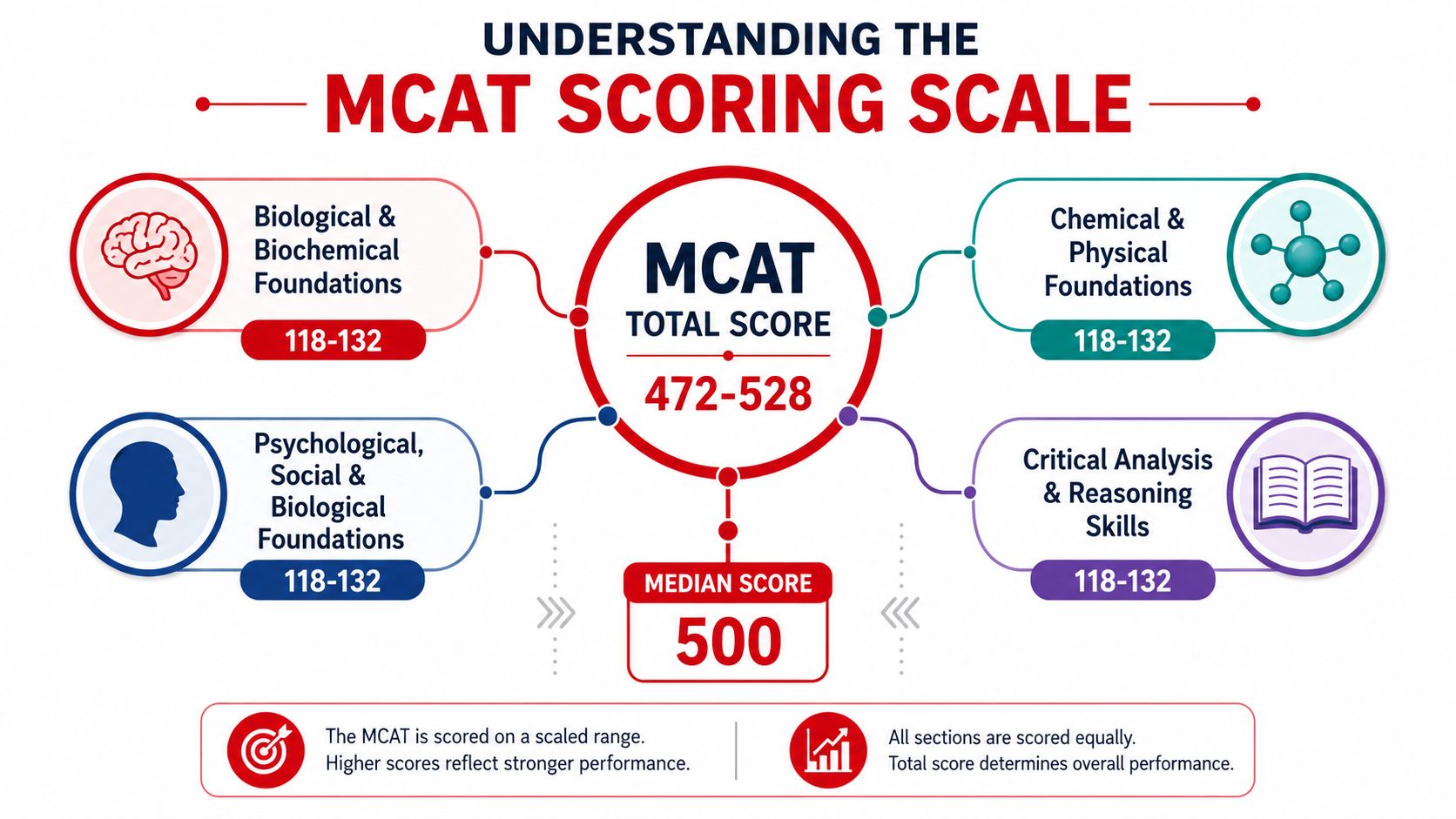
The MCAT total score range is 472 to 528, and each of the four sections is scored from 118 to 132. The midpoint is 500 overall, with 125 per section, so the exam spans 56 points from floor to ceiling.
If you're staring at a practice score and wondering whether it means “good,” “average,” or “competitive,” you're not alone. The MCAT can feel opaque until you see how the scale works, and once the numbers make sense, planning gets a lot calmer.
Understanding the MCAT Scoring Scale
A student can finish a full-length practice exam and still feel unsure about what the number means. The mcat range of scores is meant to turn that confusion into a clearer reading of performance, as long as you know how the scale is built.
The MCAT total score runs from 472 to 528, and that total comes from adding four section scores, each of which ranges from 118 to 132. The midpoint is 500 overall and 125 per section, which is why a score near 500 sits near the center of the scale, even though percentile ranks shift as the testing pool changes from one reporting cycle to the next. That yearly update also means a 500 is a midpoint on the score scale, not a promise of the same percentile position every time. AAMC score scale overview
A four-part instrument panel gives you a reading for each section, and the total score shows admissions readers how the whole performance came together. For a fuller breakdown of how the score is built, see the official MCAT score breakdown guide.
Practical rule: do not read a practice score as a judgment of your future. Read it as a map of where your prep is balanced and where it is not.
The scale also helps with admissions strategy. A score is not just a number on a page, it is a signal that schools use alongside GPA, coursework, and the rest of the application. If you know where your score sits on the scale, you can start asking the right question, whether you are meeting the level needed for the schools you want or whether one section is holding the total back.
The MCAT is not graded like a classroom exam where points are tallied from a checklist of right answers. It is standardized, so the number reflects your performance relative to the broader testing population, not just how many questions you happened to answer correctly that day.
A score near the middle can still mean very different things depending on the school list you are building. That is why understanding the scale is useful before you start comparing practice results, because the same total can point to different next steps for different applicants.
How the Four MCAT Sections Build Your Total Score
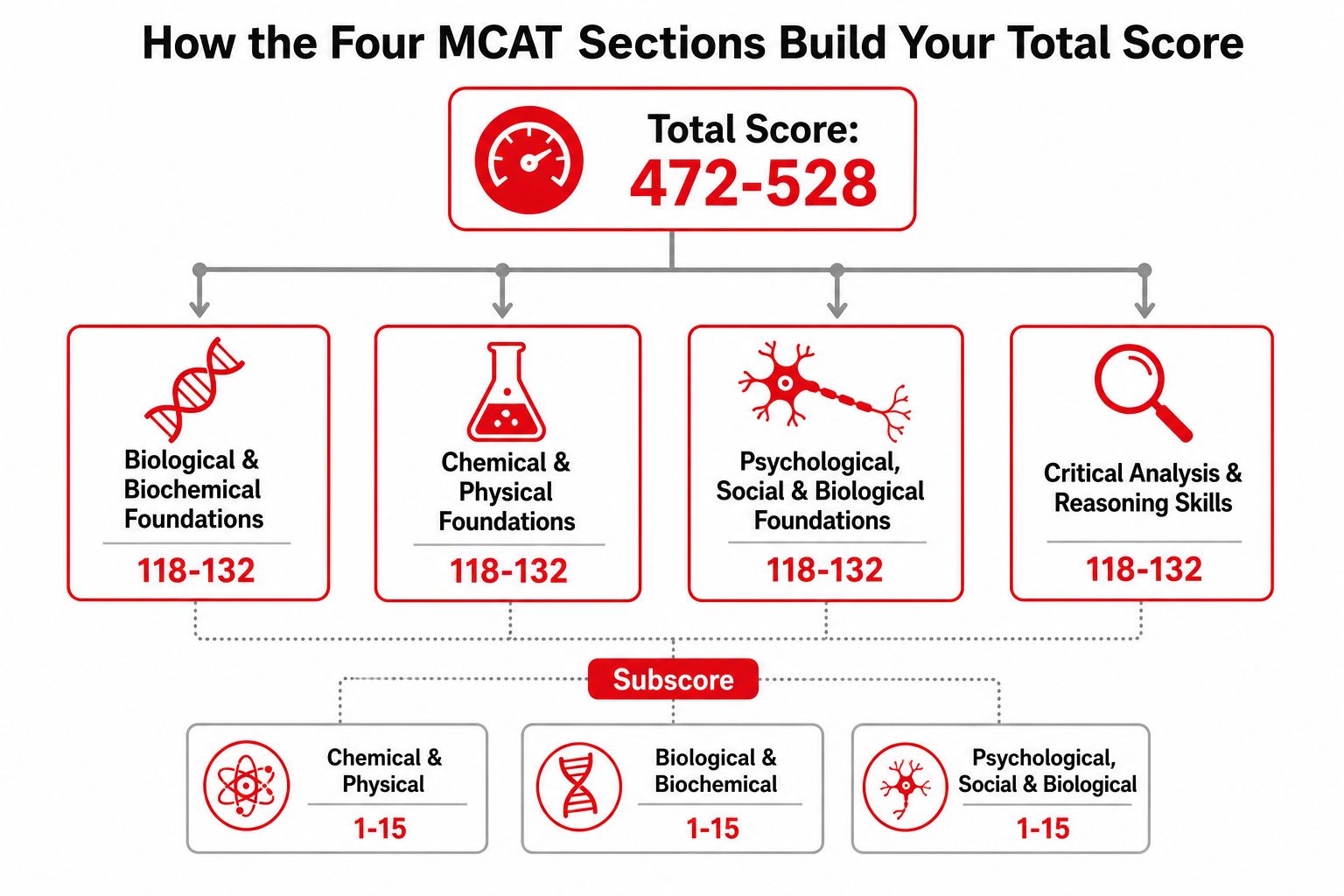
A strong MCAT result is built section by section. That matters because admissions committees do not read the total score as a stand-alone number. They look at whether your performance is balanced enough to suggest you can handle the full range of medical school demands, or whether one section suggests a gap that needs a closer look.
The four sections are Biological and Biochemical Foundations of Living Systems, Chemical and Physical Foundations of Biological Systems, Psychological, Social, and Biological Foundations of Behavior, and Critical Analysis and Reasoning Skills. As outlined in the AAMC score scale overview, each section contributes equally to the total. That equal weighting is useful to remember, because it means one section cannot be ignored because another section is strong.
Why balance matters
A total score can look competitive on paper and still leave questions if the section pattern is uneven. Admissions readers often use the section breakdown as a quick check on preparation depth, not just overall test-day performance.
If one section sits noticeably below the others, the issue is not only the lower number itself. It can suggest a content weakness, a pacing problem, or a gap in reading stamina that may matter later in the curriculum. A slightly uneven profile is common. A large gap is harder to dismiss.
A simple way to read the score
The MCAT works a little like a four-part dashboard. One gauge can run high and still not hide a weak reading in another part of the panel. That is why students should review the section pattern before deciding what the total really says about admissions competitiveness.
A balanced score often carries more weight than a lopsided one with the same total. Two applicants can land near the same headline number, yet the one with steadier section performance usually looks more reliable to schools that want evidence of all-around readiness. If you want a plain-language overview of how timing and section structure fit together, this MCAT test time breakdown guide is a useful reference.
For a quick orientation on the sections, the embedded overview below can help you picture the flow.
A high total score with one weak section can still leave work to do. Review the section pattern, not just the headline number.
Mapping Scaled Scores to Percentile Ranks
A 498–501 cluster can look modest on paper, yet the AAMC's 2026 data guide shows that a large share of test takers sits right there. That matters because the MCAT does not work like a raw-point quiz. A scaled score only becomes meaningful once you place it against the current testing pool, which is why percentile ranks are updated using recent testing history.
The 2026 data guide also shows another dense pocket in 494–497 (N = 9,011), while 498–501 (N = 9,123) remains one of the biggest score clusters in the referenced data set. The distribution materials note that 71% of total scores were at or below 508 across exams administered in 2019–2021, which helps explain why the low 500s include so many examinees. Those figures do not tell an applicant whether a score is good or bad by themselves, but they do show where the center of the pack sits. AAMC 2026 data guide
| MCAT Score Distribution Snapshot | Approximate Percentile Context | What This Means for Applicants |
|---|---|---|
| 494–497 | Around the dense middle of the score distribution | Many test takers land here, so this range usually means more work is needed for broader competitiveness. |
| 498–501 | Near the center of the scale | This is the zone where many students hover before targeted improvement begins to matter. |
| At or below 508 | Includes a large share of recent scores | A score in this neighborhood can be solid, but school list context still matters. |
Percentiles shift over time, so the same scaled score can carry a slightly different meaning from one cycle to the next. A score like 508 can still be respectable without being rare, while a score a few points higher may place you in a much smaller part of the pool. That is why admissions readers often treat the number as a position marker, not a finish line.
For a cleaner benchmark discussion, see the average MCAT score guide. The practical lesson is simple. Small score gains can change how your application sits in the distribution, which can matter a great deal when you are deciding how ambitious your school list should be.
Competitive MCAT Benchmarks for Medical School Admissions
What counts as a competitive score depends on where you're applying. The mcat range of scores doesn't mean the same thing for every school type, because applicant pools and admissions priorities vary by program.
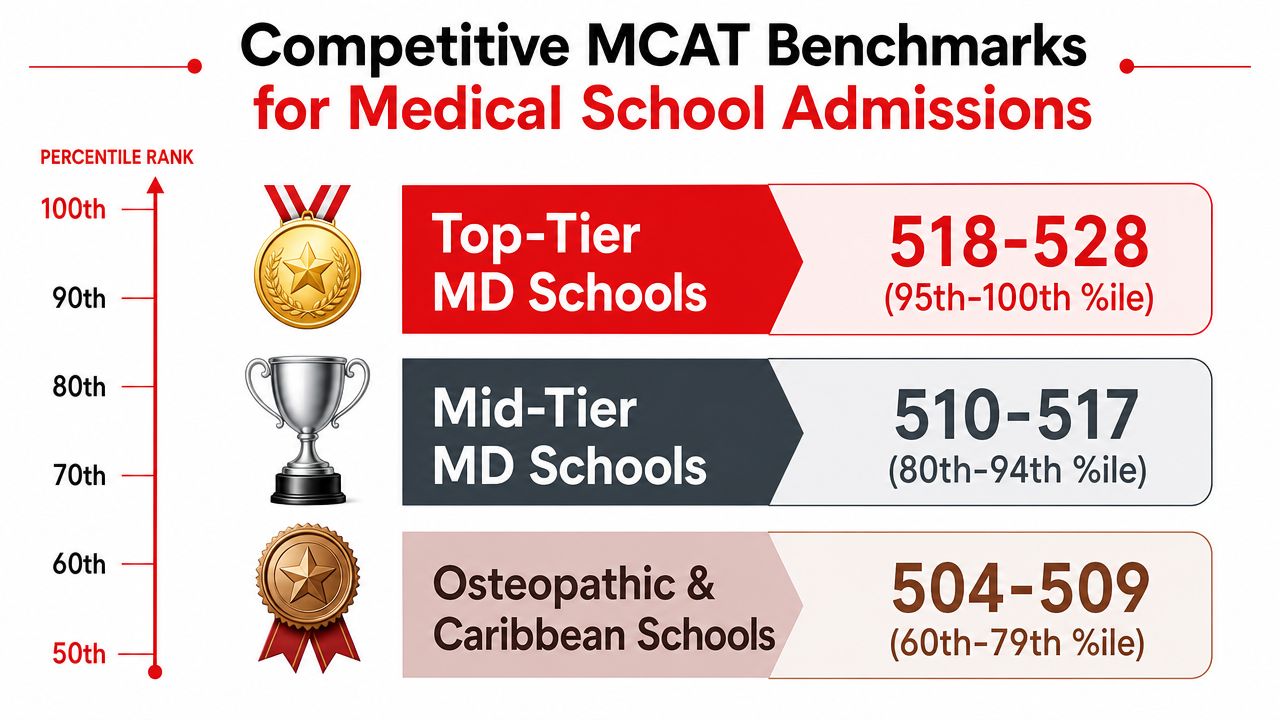
Reading the target range
For many applicants, top-tier MD schools usually sit at the highest end of the competitive conversation, while mid-tier MD schools often remain selective but somewhat broader in profile review. DO programs have their own admissions context, and international applicants may also need to think ahead about future U.S. residency expectations if they plan to train in the United States.
A practical way to choose your target is to build a school list first, then work backward from the middle of that list. If your schools are a mix of highly selective and moderately selective programs, your target should reflect the stronger half of that list rather than the most forgiving option.
| School Type | Competitive Framing | How to Think About It |
|---|---|---|
| Top-tier MD schools | Highest-end applicants | Strong totals matter, but academic depth, experiences, and fit matter too. |
| Mid-tier MD schools | Competitive and realistic for many applicants | A score here can still be very strong when paired with balanced academics and experiences. |
| DO programs | Competitive in a different admissions context | Applicants should compare themselves with the programs they actually plan to attend. |
Keep the goal personal
A score is only “good” if it fits the schools on your list. That's why a single universal cutoff never tells the whole story.
If you want a plain-language benchmark to compare with your own plan, the good MCAT score guide can help frame the conversation. The question isn't whether your score sounds impressive, it's whether it matches your application strategy.
Practical rule: build your target around the schools you'd realistically attend, not the schools that sound most impressive to name.
How Medical Schools Evaluate MCAT Scores Alongside the Full Application
Medical schools rarely treat the MCAT as a stand-alone gatekeeper. They read it together with GPA, clinical experience, research, letters of recommendation, and your personal statement, because one number cannot show the whole applicant.
A score often works like the first page of a file. If it clears a school's screen, the rest of the application gets a fairer look. If it falls below that line, the committee may spend less time on the file, even when other parts are strong. Once the application moves past that first pass, the review becomes much broader, and that broader reading can matter more than a small score difference.
A score does not speak for itself, the admissions committee places it in context.
Some programs pay closer attention to specific sections, especially when the curriculum depends heavily on reading, analysis, or science integration. A stronger section profile can support your application even when the total score is only moderate. A weak section can also signal that a retake deserves serious thought, especially if the rest of the file already looks solid.
The key is to read the score the way an admissions officer might. If the total clears a screening line, the next question becomes whether the rest of the application shows readiness, consistency, and fit for the program. If the total is below that line, the number can narrow the review before your experiences even get their full chance to speak.
If you want to see how outside test-prep support is organized, a directory like Tutorbase's test-prep center listings can help you compare available options. For a focused plan on improving your result, this MCAT score improvement guide can help you connect the number on the page to the next step in your study strategy.
A Practical Score-Audit and Improvement Framework
A lower practice score can feel discouraging, especially when you've already invested a lot of time. The useful move is not to panic, it's to audit the score like a diagnostic report and decide what kind of fix you need.
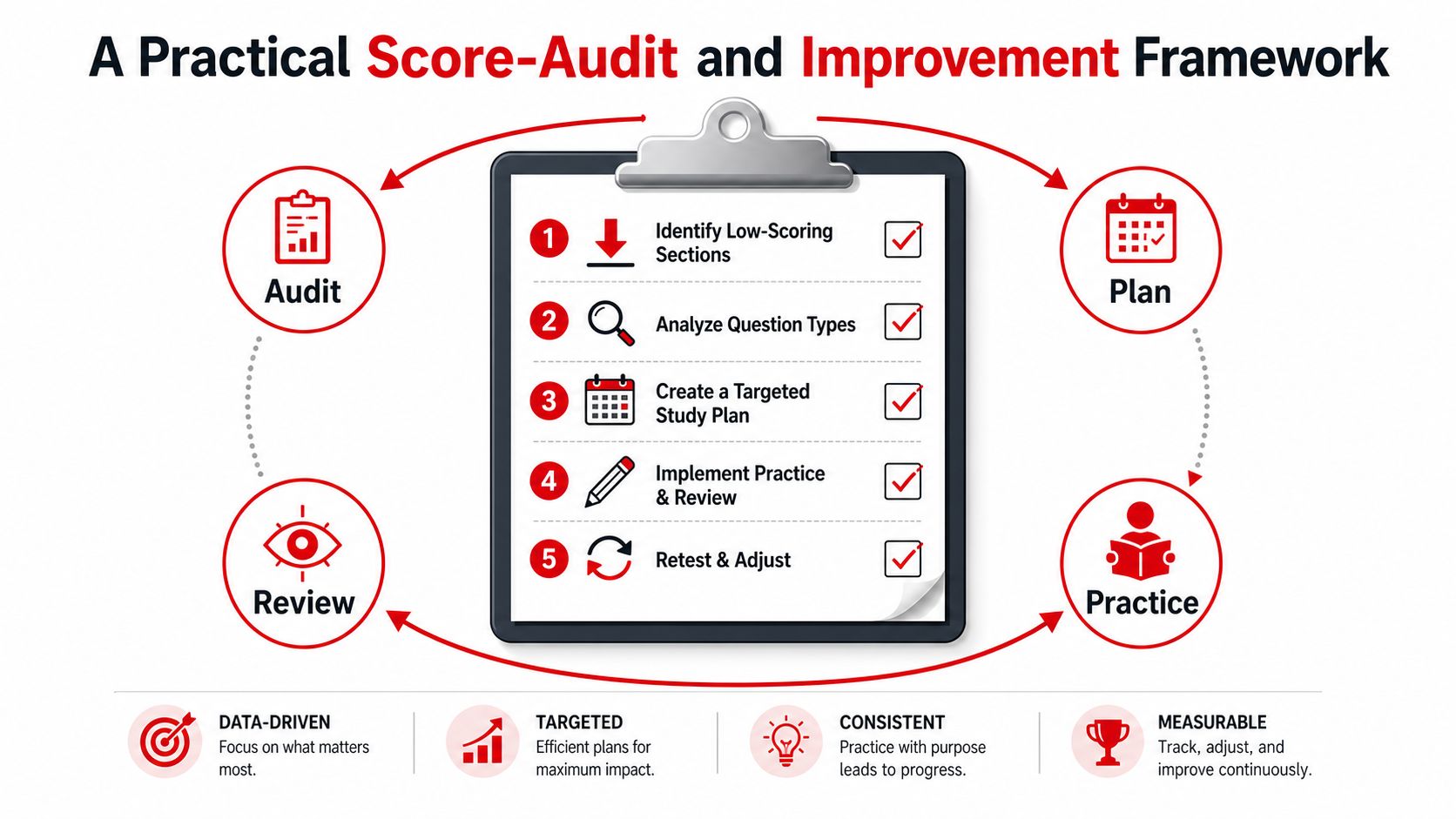
A simple audit process
- Identify the weakest section. Look for the score that is pulling down the total instead of guessing.
- Sort the misses. Separate content gaps from timing errors, careless reads, and passage strategy problems.
- Build a targeted plan. Put more time where the misses are repeatable, not where the work merely feels familiar.
- Practice with review. Use question sets, then spend real time on why the wrong answer looked tempting.
- Reassess. If the same issue keeps showing up, the plan needs adjustment, not more of the same work.
A weekly structure you can adapt
- Monday: one weak science topic, then a short question set.
- Tuesday: CARS passages and detailed error review.
- Wednesday: another weak content area, followed by timed practice.
- Thursday: mixed passage work to test stamina and retention.
- Friday: review missed questions, rewrite notes, and fix recurring errors.
- Weekend: one longer practice block, then a calm debrief.
Full-length exams help most when you're ready to test endurance and decision-making, while targeted question banks help most when the problem is specific and repeatable. If you're unsure how to organize that balance, the MCAT improvement guide can help you compare options.
When the same score pattern repeats across several exams, outside support can save time. One-on-one tutoring, self-study, and structured review each have a role, and Ace Med Boards is one option that offers individualized MCAT preparation guidance alongside broader admissions support.
Key Takeaways and Next Steps for Your MCAT Journey
The MCAT range of scores is a planning tool, not a verdict on your potential. Once you understand the 472 to 528 scale, the four section scores, and the way percentile context changes over time, the whole exam becomes easier to interpret.
A few points matter most. 500 sits at the midpoint of the scale, large clusters of scores sit in the low 500s, and competitive meaning shifts by school type and applicant pool. A structured audit of your weak sections is usually more useful than chasing a random number.
If you want help translating your score into a realistic study plan or school strategy, a personalized review can make the next step clearer.
Ace Med Boards helps pre-med students make sense of MCAT scoring, section balance, and retake decisions with individualized guidance. If you want a clearer read on where your current score stands and what to work on next, visit Ace Med Boards to explore options for a free consultation or Board Score Audit.