
Medical-school enrollment in the United States reached 100,723 students in 2025, the first time it crossed the 100,000 mark, while the incoming class reached 23,440 matriculants and applications climbed to 54,699 (AAMC enrollment report). That growth matters, but it also exposes the central question behind diversity in medicine. If the pipeline is expanding, why do representation gaps still persist, and which parts of the system are responsible?
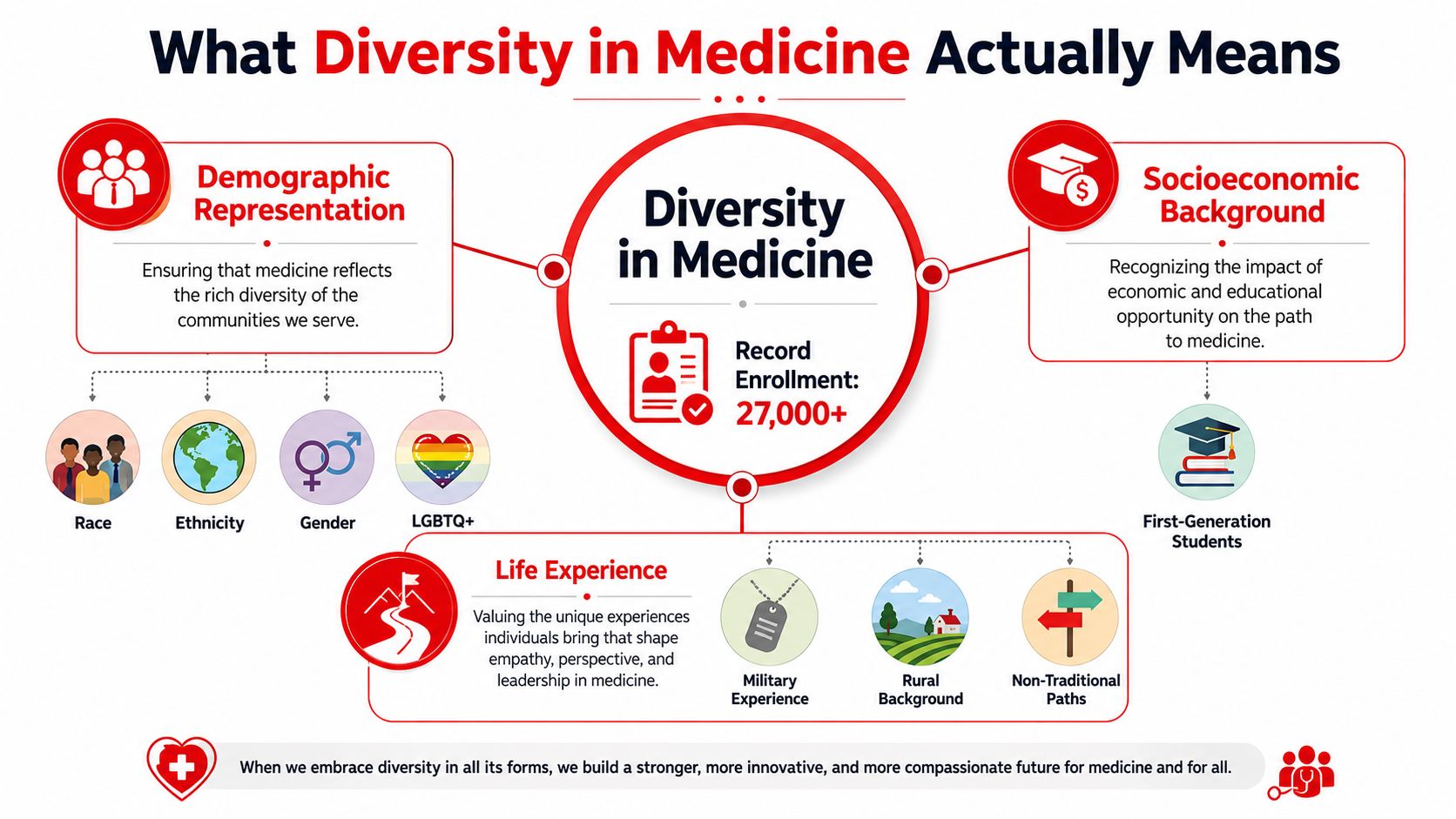
What Diversity in Medicine Actually Means
Diversity in medicine is more than race alone. It includes racial and ethnic representation, gender, disability, sexual orientation, socioeconomic background, and the lived experience people bring into training and practice. If institutions collapse those differences into a single category, they miss how selection, climate, and retention work in practice.
Representation and inclusion are different problems
Representation asks who gets in, who gets hired, and who becomes visible. Inclusion asks who stays, who advances, and who feels safe enough to contribute fully. Those questions are related, but they are not interchangeable, and treating them as if they were often turns optics into a substitute for progress.
Practical rule: A school can look diverse on paper and still fall short on inclusion if trainees from underrepresented groups leave, stall, or avoid leadership tracks.
Analysts at KFF found that Hispanic people made up 20% of the U.S. population but only 7% of the physician workforce, the widest underrepresentation gap among the major racial and ethnic groups measured (KFF physician workforce analysis). That is not just a recruitment issue. It points to selection, climate, and advancement as separate places where institutions need to be accountable.
Diversity also shows up in ways that admissions brochures often miss. A student who is the first in their family to go to college, a trainee with a disability, or someone who has overcome rural access barriers may bring a perspective that changes how they learn, collaborate, and serve patients. For a practical lens on how institutions frame this work, see cultural competency in healthcare.
A useful definition is simple. Diversity in medicine is the range of identities and experiences that shape who enters the field, who stays, and whose knowledge counts once they get there.
Where the Workforce Gaps Are Largest
The largest gaps are not spread evenly across groups or health systems. They cluster where institutions have filtered people out at several points, from admissions to specialty training to promotion. The headline numbers identify pressure points, but the pattern matters more than any single figure.
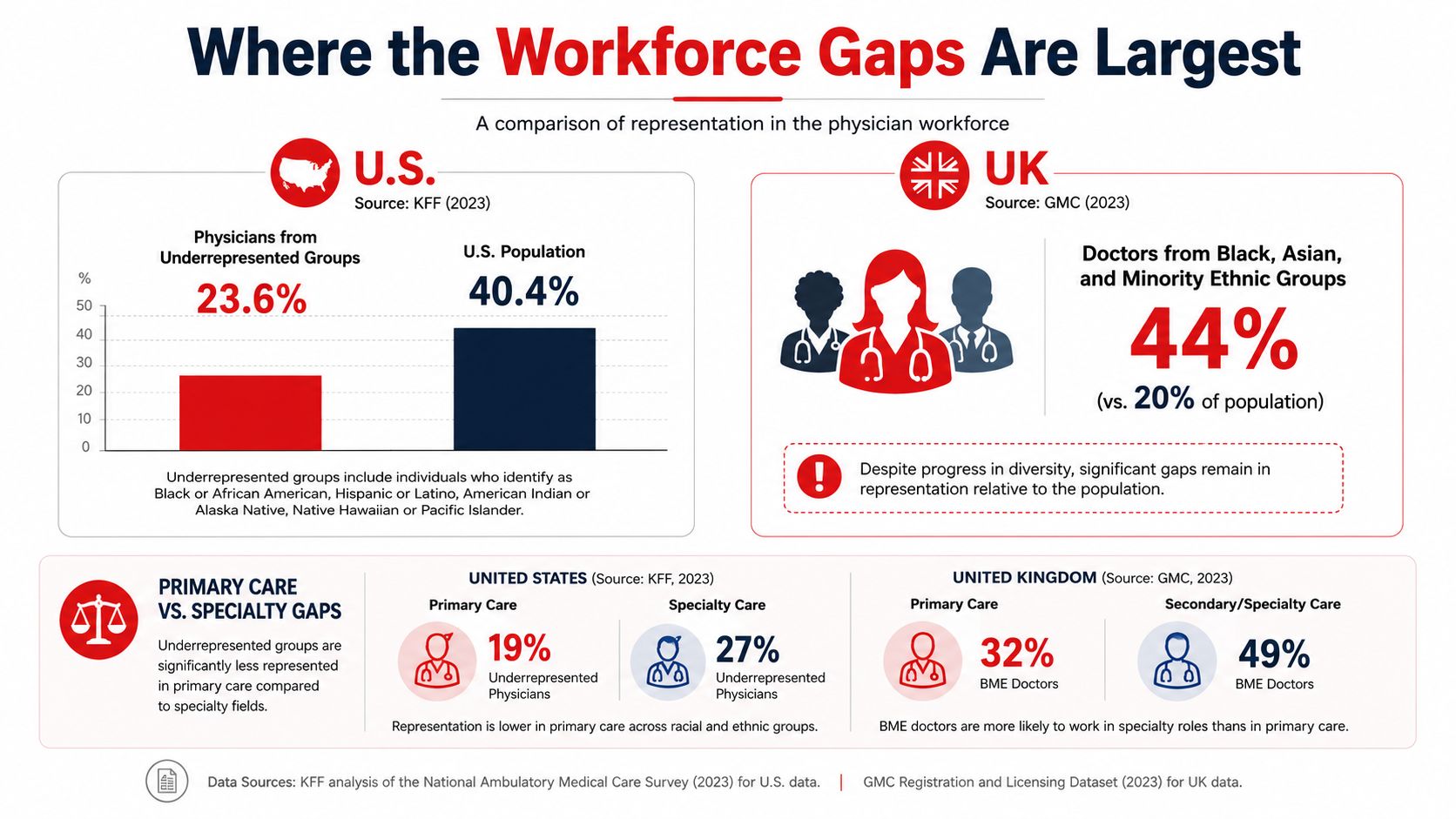
The U.S. gap is broad, but not evenly distributed
In the U.S., KFF's workforce analysis shows the sharpest measured underrepresentation among Hispanic physicians, with workforce share far below population share. That gap matters because it is not only about seeing more faces in white coats. It affects language access, trust, and who is available to serve communities that have been underserved for years.
The longitudinal specialty data sharpen the point. A 16-specialty study found that Black and Hispanic physicians were more underrepresented by 2016 than in 1990 across all ranks and specialties studied, with the only exception being Black females in obstetrics and gynecology (PubMed study). The system can produce more medical graduates without producing proportional specialty representation.
The UK shows that demographic change is possible, but uneven
The UK reached a milestone in 2025 when women became a slight majority of licensed doctors, with 164,440 female doctors (50.04%) and 164,195 male doctors (49.96%). The same source reports that doctors from ethnic minority backgrounds grew 78% between 2016 and 2023, compared with a 10% rise among white doctors. That growth is real, but it does not erase disparities in advancement or specialty mix.
The right way to read these numbers is as diagnostics, not trophies. A growing pipeline can coexist with a stubborn hierarchy.
For first-generation applicants who want to understand how these gaps appear from the other side of the admissions desk, this guide is a useful companion. The larger lesson is that representation data show where the imbalance sits, but they do not identify which part of the institution is causing it.
Why Pipeline Numbers Are Not Enough
Headcounts can rise while access stays uneven. That is the core problem with treating diversity in medicine as a pipeline issue alone. The applicant-deficit framing suggests underrepresentation exists because too few qualified people from underrepresented groups apply, which is convenient because it puts responsibility outside the institution. The harder reading is a system-deficit framing, where admissions, mentoring, promotion, pay, and climate all shape who enters, who stays, and who advances.
The gap is structural, not just numerical
If supply were the main constraint, then bigger medical-school classes would have produced proportionate representation across training and specialty pathways by now. As noted earlier, the longitudinal specialty evidence points in the opposite direction, with Black and Hispanic physicians remaining more underrepresented over time across the specialties studied. Pipeline growth alone does not correct the parts of the system that sort people differently after admission.
Four structural barriers explain that gap more convincingly than applicant shortage does.
Selection effects in admissions. Schools may say they value diversity, yet still give the most weight to narrow metrics, opaque interview impressions, or informal prestige signals. That leaves the door open, but keeps the same profile at the center of decision-making.
Mentoring gaps. Students without well-connected mentors often receive less help with specialty choice, research positioning, and recovery after setbacks. The absence of sponsorship matters because many opportunities are distributed through relationships, not posted criteria.
Promotion and pay inequities. Once trainees enter the system, advancement can slow if institutions do not monitor outcomes by demographic group. Without that accounting, disparities can hide inside apparently neutral processes.
Hostile climate. If students, residents, or faculty expect bias, they may self-censor, disengage, or leave. That is a retention problem, not a recruitment problem.
The real diagnostic question is where the leak occurs
Admissions reform by itself is too narrow if the institution does not track what happens after matriculation. A school can enroll a more diverse class and still lose people later if the culture punishes difference or the promotion structure rewards only one background type. The pipeline metaphor is useful only to a point, because real institutions are full of valves, choke points, and side exits.
Useful test: If your institution can name who was admitted, but not who was retained, promoted, and paid fairly, it is measuring the front door and ignoring the hallways.
That shift in focus changes the accountability standard. Schools should publish whether students from different backgrounds are graduating at similar rates, whether they are matching into comparable specialties, and whether they are receiving equivalent access to scholarships and support, including medical school scholarship resources. It also means institutions need to examine climate, because facilitating respectful interactions is part of retention, not a side activity.
The conversation changes once the question becomes where the institution failed to keep and advance people. That is the standard a serious diversity strategy has to meet.
Evidence-Based Strategies That Actually Work
The interventions with the strongest support are process changes that reduce bias, make decisions more transparent, and force institutions to test whether their programs are doing anything useful. The National Academies' review emphasizes that there is little consistent empirical evidence that cultural competence training or increasing minority physician numbers directly improves health outcomes, but it does support practical recruitment and retention levers such as thorough review, inclusive interviewing, and institutional prioritization of diversity (NCBI review).
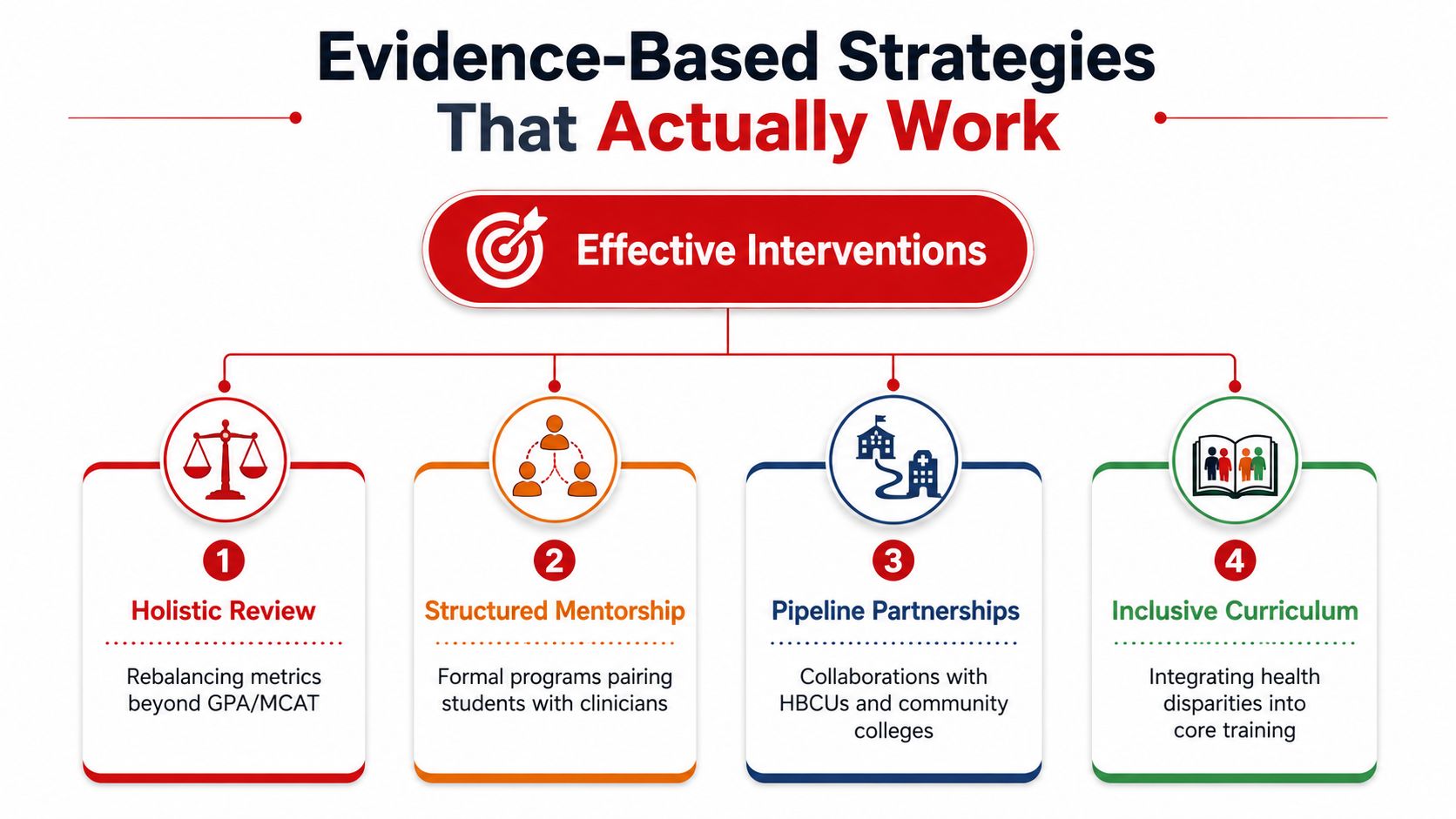
Start with holistic review
Holistic review is not code for lowering standards. It means rebalancing the admission file so that academic metrics sit alongside context, persistence, leadership, service, and lived experience. The point is to avoid treating one score as destiny.
Admissions committees control this lever. They need shared rubrics, documented criteria, and reviewer training that explains what counts as evidence of readiness beyond test performance. The practical gain is not only broader representation, but also a more defensible process when applicants ask how decisions are made.
Use structured, bias-aware interviews
Unstructured interviews are a bias magnet. Structured interviews force every candidate through the same core questions and scoring rules, which makes comparisons more credible. That does not eliminate bias, but it does make favoritism harder to hide.
For institutions trying to create safer interview and learning environments, facilitating respectful interactions is a useful complement, especially when programs are trying to reduce climate-related attrition. The relevant owners here are admissions directors, faculty interviewers, and residency selection committees.
Standardize pipeline programs and evaluate them
The NEJM perspective on pipeline reform is explicit, pipeline programs need standard design and evaluation, not just good intentions (NEJM perspective). That separates a program that generates photographs for a brochure from one that changes outcomes. A school that cannot say who participated, what support they received, and what happened after participation is running symbolism, not infrastructure.
If you want a concrete planning resource for students and schools, this scholarship guide can help frame financial support as part of access, not as a side topic. Financial pressure often determines whether a student can accept research opportunities, away rotations, or test-prep time.
Audit climate, not just admissions
Climate audits ask whether people feel able to speak, belong, and persist. The NCBI guidance on diversity and inclusion also emphasizes public reporting and continuous measurement, which means climate data should not sit in a drawer after one survey cycle (NCBI guidance). Faculty leaders own this lever, but students and residents should expect to see the results.
The strongest institutions do not just announce commitments. They publish process, outcomes, and follow-up.
What Students Can Actually Do
A first-generation student often hears the same advice from every direction, work hard, find mentors, and keep going. That advice is not wrong, but it is incomplete. The students who handle admissions and boards most effectively usually build a strategy around information, not just effort.
Build a mentorship map instead of waiting for one mentor
A realistic mentorship map includes different people for different needs. One person can help with applications, another with exam strategy, another with research, and another with emotional grounding. That structure matters because no single mentor can cover every problem, and waiting for a perfect match wastes time.
For residency applicants and pre-meds, asking for specific help works better than asking broadly for guidance. “Can you review my personal statement?” is easier to answer than “Will you mentor me?” A student who knows that difference is already using the system more effectively.
Choose programs that reveal how they work
Applicants should look for schools and residencies that publish demographic data, retention information, and climate findings. If a program only markets values but will not show outcomes, that is a warning sign. Transparent institutions make comparison possible, and comparison is what gives applicants an advantage.
A representative first-generation applicant might be balancing MCAT prep, family obligations, and the fear of saying the wrong thing in interviews. The practical move is to use those constraints as a planning variable, not a personal flaw. That means choosing resources that fit the schedule, requesting structured interviews when possible, and documenting which programs support students like them.
A helpful rule for applicants: Do not ask only, “Can I get in?” Ask, “Will I be able to stay, learn, and match where I want to go?”
Ace Med Boards' audience knows that board prep is not just about one score. It can shape specialty choice, away rotations, and confidence in competitive environments. Students preparing for the MCAT, USMLE, or COMLEX should treat exam performance as one of the practical levers that expands, rather than narrows, opportunity.
If you are writing a diversity statement or trying to clarify how your background fits into an application, this guide can help you frame the narrative without sounding generic. The best applications do not perform identity, they explain readiness, context, and contribution.
Contested Evidence and Honest Limits
A serious analysis has to say what the evidence does not prove. The most common overstatement in this space is that diversity training automatically improves patient outcomes. The strongest reviews do not support that claim, and stretching it further weakens the case for diversity rather than strengthening it.
Cultural competence helps, but it is not magic
The National Academies review is clear that there is little consistent empirical evidence proving that cultural competence training or increasing minority physician numbers directly improves health outcomes. That does not mean the work is pointless. It means the claim has to be narrower and more honest.
What is more defensible is that diversity can improve diagnostic reasoning, widen research agendas, and make institutions more responsive to underserved communities. Those are important effects, but they are not the same as a guaranteed outcome bump on every quality metric.
Intersectionality and disability access belong in the core frame
Coverage often stops at race and gender, but that is too narrow. Major guidance also says inequities persist across race, ethnicity, gender, sexual orientation, and disability, and that progress stalls when institutions treat diversity as optional (NCBI guidance). That matters because a disabled trainee may face barriers that a standard diversity dashboard never captures.
Accessibility has to be built in. Universal design, accessible curricula, confidential mental-health support, and representation on committees are not nice extras, they are conditions for equal participation. If those pieces are missing, the institution is asking people to succeed while working around its design flaws.
Denial is part of the problem
One of the clearest themes in the guidance is that institutions make less progress when they deny discrimination or frame inclusion as a side project. That is the system-deficit view in plain language. The problem is not that qualified people do not exist, it is that the institution often has not built conditions where they can thrive.
For readers who want to sharpen their evidence-reading habits before making policy claims, this critical appraisal guide is a useful tool. It is a good reminder that good intentions and strong evidence are not the same thing.
Measuring Progress With Real Metrics
A school or hospital system that wants credibility has to publish numbers that show whether change is happening. The metrics do not need to be exotic, but they do need to be tracked the same way over time and shared openly. Without that discipline, diversity becomes a statement instead of a system.
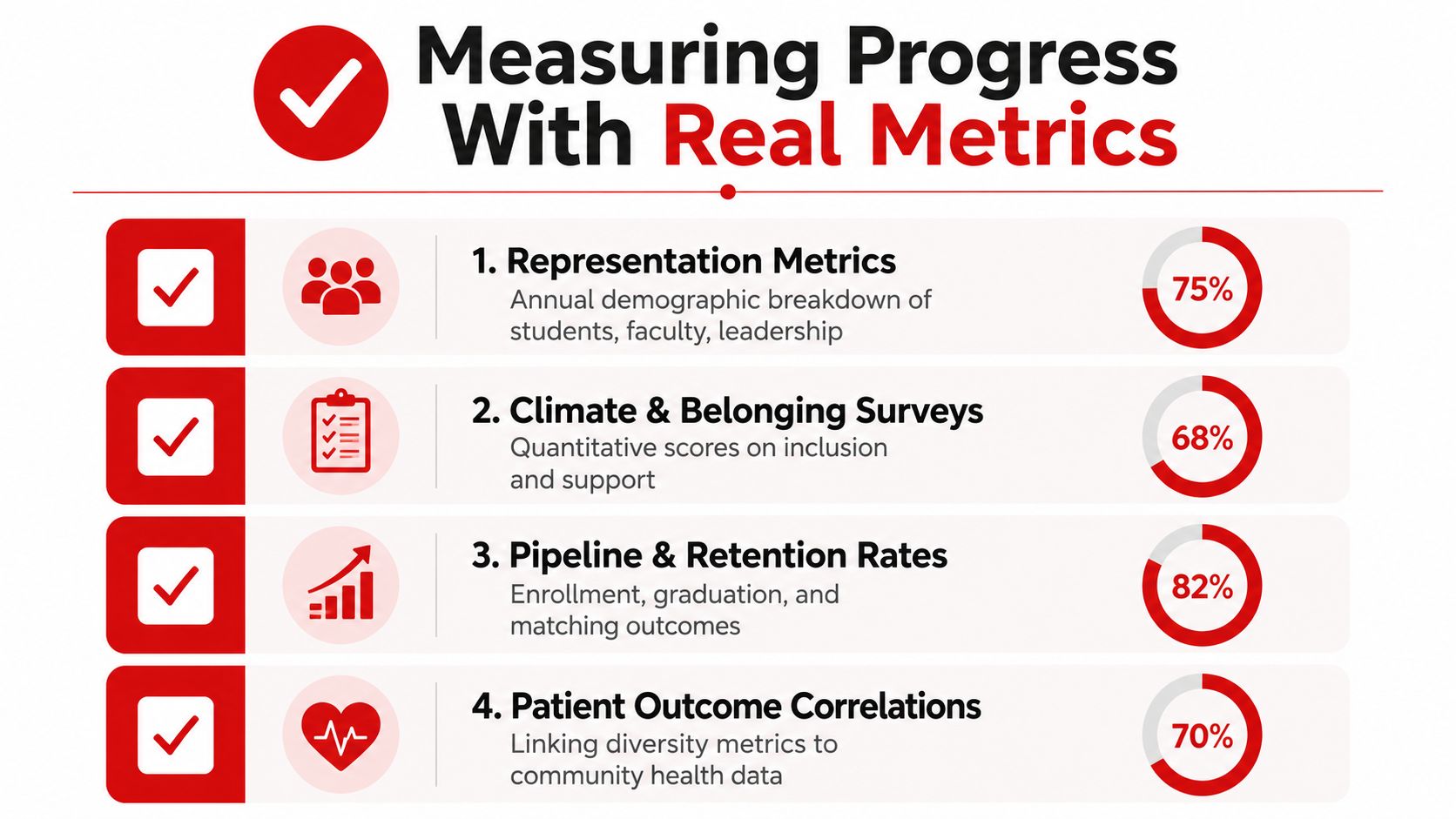
The four metric categories that matter
- Representation metrics. Publish annual demographic breakdowns of students, faculty, and leadership, not just applicants.
- Climate and belonging surveys. Report quantitative inclusion and support scores, along with response rates and follow-up actions.
- Pipeline and retention rates. Track enrollment, graduation, specialty matching, promotion, and departure patterns.
- Patient outcome correlations. Where feasible, connect diversity metrics to community health data and service access.
Make the data comparable, not decorative
A single diversity report is easy to produce and easy to ignore. Dashboards are more useful when they let people compare cohorts over time, identify drop-offs, and see whether one subgroup is consistently losing ground. That matters because pipeline gains do not automatically become workforce gains.
Accountability rule: If a school will not publish retention, promotion, and pay-equity data, it is probably measuring appearance, not equity.
Institutions should stop hiding behind vague language. A program can say it is “committed to belonging,” but until it publishes climate results, interview structure, and demographic outcomes, the claim is untested. The same logic applies to faculty hiring and leadership development.
The useful shift is from aspiration to auditability. Institutions should be able to answer a simple question in public, not just in internal meetings, what changed, for whom, and by how much?
Questions Pre-Meds and Educators Actually Ask
Are diversity quotas legal after SFFA? Schools need legal review before making admissions policy claims, but they can still use holistic review, structured interviews, pipeline outreach, and transparent evaluation of process and outcomes. The safer public posture is to focus on lawful, documented selection criteria and measurable educational access.
How can I tell whether a school has a healthy diversity climate? Look for public data on retention, faculty advancement, belonging surveys, and whether the school names the actions it took after survey findings. If you only see glossy language and no numbers, the climate story is probably incomplete.
Do USMLE, COMLEX, and MCAT prep resources matter for diversity? Yes, because test performance affects specialty choice and opportunity. Resources that fit the learner's style, schedule, and financial reality can reduce one of the biggest avoidable barriers in the pipeline.
How should international medical graduates talk about diversity in residency applications? Keep it concrete. Describe the perspectives you bring, the populations you have served, and how your training has prepared you to work across systems and cultures, without trying to force a generic diversity statement.
For students trying to turn all of this into practical next steps, Ace Med Boards supports exam prep, admissions strategy, and residency planning with one-on-one guidance built around real performance goals. If you want a place to strengthen your boards preparation while you think seriously about access and opportunity in medicine, visit Ace Med Boards.