You're staring at a question stem with a missed period, a single FSH value, and two answer choices that look painfully similar. One points to the hypothalamus, the other to the ovary, and if you mix them up, the whole vignette falls apart. That's why reproductive endocrinology basics show up everywhere on Step exams and shelves, the topic rewards students who can connect physiology, labs, and clinical reasoning without getting lost in memorization.
The fastest way to think clearly is to anchor everything to the hypothalamic-pituitary-gonadal axis, then layer in cycle timing, hormone patterns, and the practical reasons patients sometimes never reach treatment. That broader view matters because this specialty is not just about female hormones. It also includes male-factor evaluation, genetic and anatomic causes, and access barriers that shape who gets care in the first place.
Why Reproductive Endocrinology Dominates Board Exams
Understanding why this topic is tested so heavily helps you prioritize your study time effectively. A lot of students first run into reproductive endocrinology in the middle of a practice block, right after a question on amenorrhea or infertility. The stem looks straightforward until the test writer asks you to separate functional hypothalamic amenorrhea from primary ovarian insufficiency with one lab pattern. If you cannot localize the defect, you are guessing instead of reasoning.
Why the test writers love this topic
This area appears so often because it sits at the intersection of physiology, pharmacology, and clinical workup logic. You need to know how the hypothalamus, pituitary, and gonads communicate, what happens when the signal is disrupted, and how hormones change over the menstrual cycle. That same framework also shows up in ovulation disorders, infertility, amenorrhea, pregnancy-related endocrinology, and the broader reproductive evaluation that includes male-factor testing, structural causes, and access barriers that shape who reaches care.
A good study strategy is to build in layers. Start with the normal axis, then sort what happens when the signal is too low, too high, or out of sync. After that, practice pattern recognition so you can turn a vignette into a diagnosis without getting pulled into unnecessary detail.
Practical rule: If a stem gives you an irregular cycle, ask whether the problem is signal generation, signal transmission, or end-organ response.
Board exams also favor this topic because beginner guides often narrow it to menstrual cycles alone. That misses male-factor workup, structural and genetic causes, and the barriers that change how reproductive care is delivered. If you want a compact companion while you review endocrine physiology, a structured resource like Ace Med Boards' endocrine system study guide can help you organize the same material into exam-ready chunks.
The Hypothalamic-Pituitary-Gonadal Axis Explained
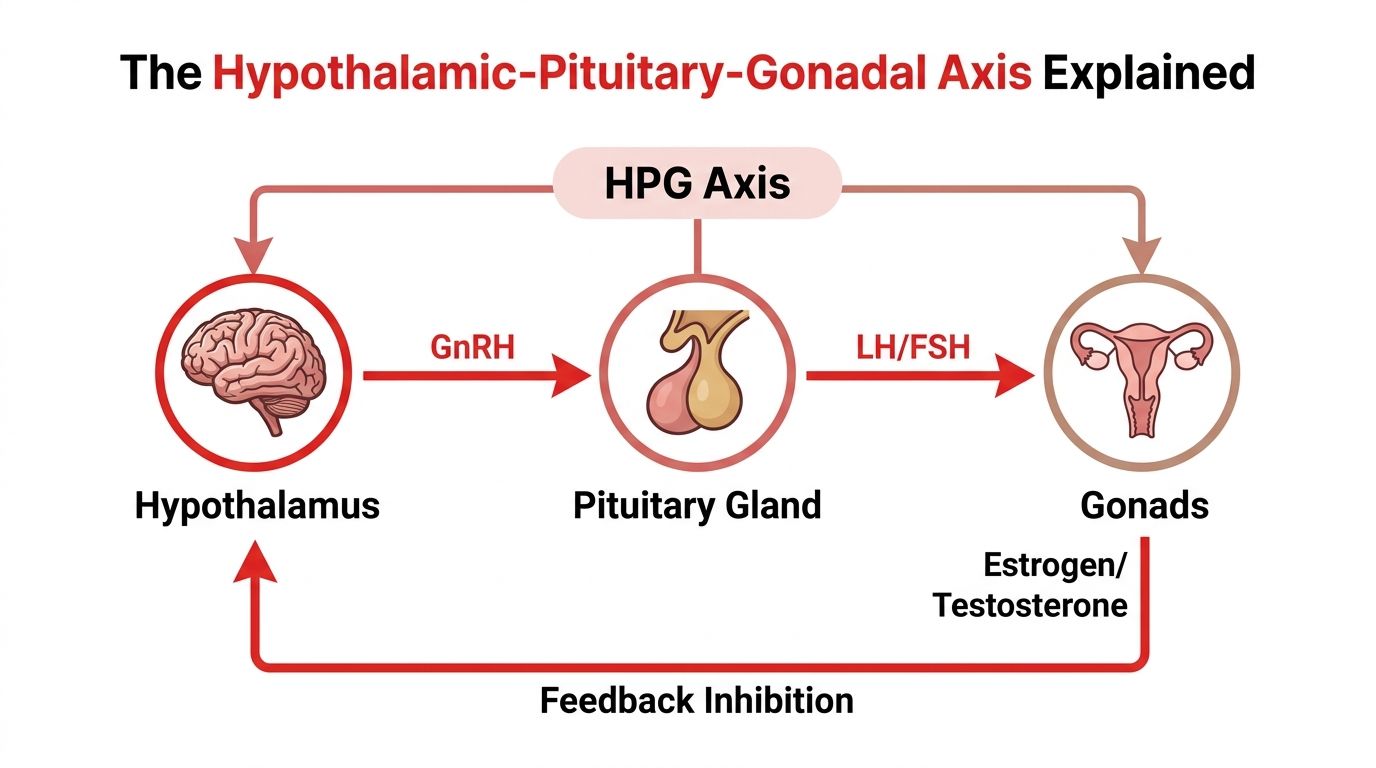
A patient has irregular cycles, low libido, or infertility, and the first question is often whether the problem starts in the brain, the pituitary, or the gonads. The hypothalamic-pituitary-gonadal axis is the feedback loop that links those three sites through hormones. The hypothalamus releases the signal, the pituitary relays it, and the gonads answer by producing sex steroids and gametes.
Start with GnRH, then follow the signal
The hypothalamus releases gonadotropin-releasing hormone, GnRH, which drives anterior pituitary secretion of luteinizing hormone, LH, and follicle-stimulating hormone, FSH. These hormones are released in pulses every 1 to 4 hours, and that rhythm is what keeps the system working normally (Merck Manual Professional).
In women, LH and FSH regulate ovulation and stimulate ovarian production of estradiol and progesterone (Merck Manual Professional). A simple way to keep the sequence straight is to follow the signal from top to bottom. If GnRH release is disturbed, the downstream hormones often become abnormal, and the clinical result can be anovulation, irregular menses, or infertility. Exams like to test that hormones are dynamic, not fixed values sitting still on a page.
Why pulsatility matters more than simple hormone levels
Board questions often hide the diagnosis in timing and feedback. A reference in Yen and Jaffe's Reproductive Endocrinology reports LH and GnRH pulse frequency of about one pulse every 90 minutes in the early follicular phase, rising to roughly one pulse per hour by the late follicular phase (Yen and Jaffe's Reproductive Endocrinology). That shift changes the balance of LH and FSH, which then shapes follicular recruitment and the pre-ovulatory surge.
The exam takeaway is straightforward. Pulsatile GnRH supports normal reproductive function. Continuous or disrupted signaling does not behave the same way, and that is why the same patient can move from regular cycling to amenorrhea when the axis is suppressed. The symptoms of luteal phase defect can also make more sense once you see how tightly the luteal phase depends on coordinated hypothalamic and pituitary signaling.
Reproductive endocrinology also reaches beyond the hormone axis itself. A student who learns only the loop in women can miss male-factor evaluation, anatomic or genetic causes of infertility, and the access barriers that shape who gets worked up and treated. For a structured review of endocrine physiology, Ace Med Boards' endocrine system study guide can help organize the same material into exam-ready chunks.
Menstrual Cycle Phases and Hormone Curves
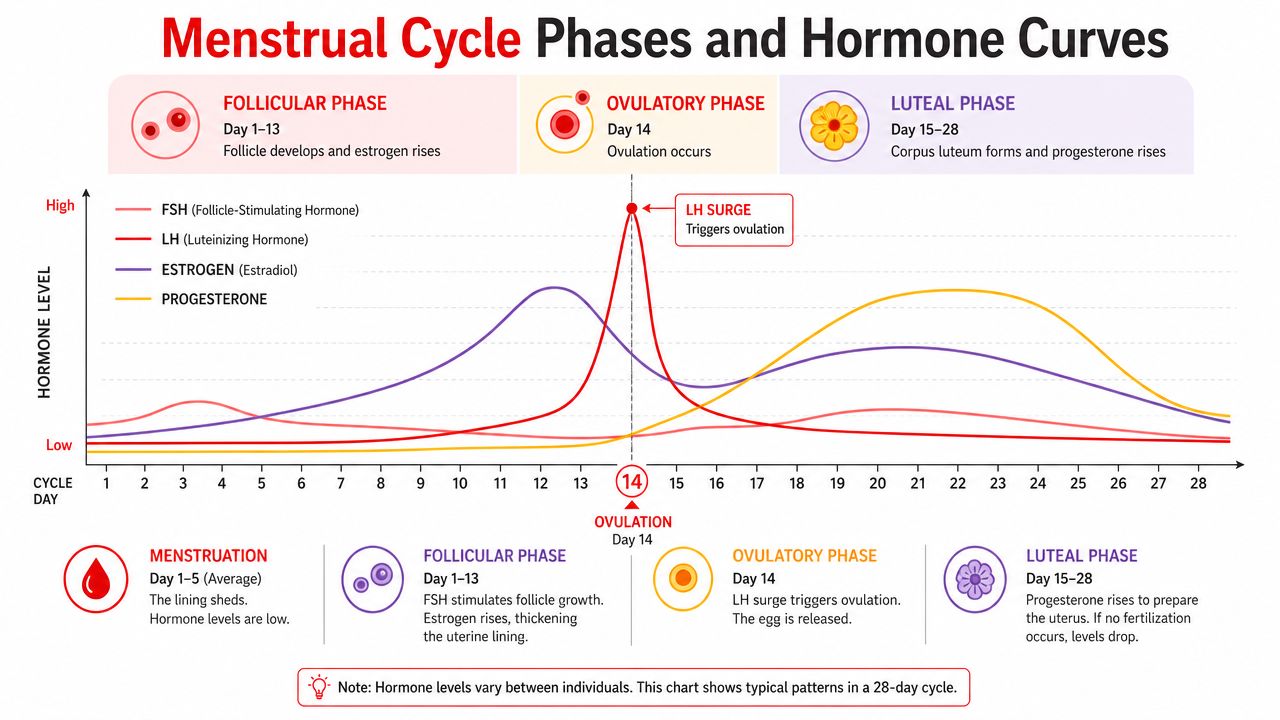
A normal cycle is easier to understand if you stop memorizing hormones in isolation and start reading the curve. The median menstrual cycle length is 28 days, and most cycles fall between 25 and 30 days, which is the practical baseline used when clinicians assess ovulation timing and cycle irregularity (NCBI Bookshelf). That baseline matters because many board stems are really asking whether the timing fits physiology.
Follicular, ovulatory, and luteal phases
In the follicular phase, FSH supports follicle growth, while estradiol gradually rises as the dominant follicle matures. Once estradiol stays high enough, feedback flips from inhibitory to stimulatory, which helps trigger the LH surge and ovulation. After ovulation, the luteal phase is progesterone-dominant, and that progesterone prepares the endometrium for implantation.
The clean exam pattern is this. FSH helps recruit. LH helps trigger. Progesterone helps maintain. If you remember that sequence, many lab curves become much easier to read.
For a visual refresher on the hormone classes involved, the distinction between peptide and steroid signaling is worth reviewing in a separate resource like Ace Med Boards' peptide hormones vs steroid hormones guide. That kind of comparison helps because reproductive hormones don't all behave the same way at the receptor level.
Early pregnancy and luteal support
Another detail that shows up in physiology questions is the luteal-placental shift. Corpus luteum progesterone support naturally transitions to placental support at about 6 to 10 weeks of gestation (NCBI Bookshelf). That's a useful anchor when a question asks why early pregnancy depends on ovarian progesterone at first, then shifts to the placenta.
If a patient has mid-cycle spotting or short luteal support, some people read up on symptoms of luteal phase defect to understand the clinical picture. On exams, though, the key is less about naming the syndrome and more about recognizing the hormone pattern that drives it.
Common Reproductive Disorders and Their Hormone Profiles
This is the section where pattern recognition pays off. Most exam questions don't want a long essay, they want you to identify whether the problem sits in the hypothalamus, pituitary, ovary, or a broader reproductive system issue. The fastest way to do that is to compare disorders side by side and look for the hormone signature.
Hormone patterns that keep appearing
Polycystic ovary syndrome, PCOS, usually shows chronic ovulatory dysfunction with androgen excess and a hormonal pattern that often points toward relatively higher LH signaling than FSH signaling. Functional hypothalamic amenorrhea trends the other way, with reduced gonadotropin drive because the brain is not sending normal reproductive signals. Primary ovarian insufficiency gives you ovarian failure physiology, so gonadotropins rise as the pituitary tries to stimulate a struggling ovary.
Two common traps show up repeatedly. One is mixing up amenorrhea from stress or low energy availability with ovarian failure. The other is forgetting that amenorrhea workups still need a pregnancy test, prolactin, and TSH before you settle on a final diagnosis.
Reproductive Disorder Hormone Profiles at a Glance
| Disorder | FSH | LH | Estradiol | Key Clinical Feature | First-Line Treatment |
|---|---|---|---|---|---|
| PCOS | Often normal or variable | Often relatively higher than FSH | Variable | Irregular cycles, anovulation, androgen excess | Depends on goal, cycle regulation or ovulation induction |
| Functional hypothalamic amenorrhea | Low | Low | Low | Stress, weight loss, heavy exercise, missed periods | Restore energy balance and address the trigger |
| Primary ovarian insufficiency | High | High | Low | Amenorrhea at a young age, ovarian failure pattern | Hormone replacement and fertility counseling |
| Menopause | High | High | Low | Age-related cessation of menses | Symptom management and preventive care |
| Hyperprolactinemia-related amenorrhea | Low or normal | Low or normal | Low | Galactorrhea, menstrual disruption | Treat the cause of elevated prolactin |
If you want a patient-friendly overview of hormone symptoms and support options, a resource like hormone imbalance symptoms solutions can help frame the symptom language. For boards, just keep your attention on the source of the disruption and whether the gonads are being under-stimulated or failing to respond.
The exam traps to watch
Primary ovarian insufficiency and menopause can look similar on labs, but they are not the same clinical problem. One happens earlier than expected, the other is the normal end of reproductive function. Another common mistake is skipping the thyroid-prolactin connection, which can send you down the wrong path if you jump straight to PCOS or ovarian failure.
The safest habit is to pattern-match from the axis outward. Low gonadotropins usually point upstream. High gonadotropins usually point to the ovary. Abnormal androgens, prolactin, or thyroid studies tell you whether the reproductive abnormality is part of a larger endocrine picture.
Interpreting Reproductive Labs and Imaging
Good reproductive workups follow a sequence, not a hunch. Start with the question of whether pregnancy is present, then use labs to localize the defect, then add imaging only when it changes the diagnosis. That structure keeps you from ordering random tests without a purpose.
A repeatable order for lab interpretation
The first step is always the same, pregnancy testing. After that, FSH and LH help localize the problem to the hypothalamus, pituitary, or gonads. Estradiol, prolactin, TSH, and androgens come next depending on the presentation.
Clinical shortcut: Low gonadotropins suggest upstream suppression. High gonadotropins suggest ovarian dysfunction.
Imaging follows the same logic. Pelvic ultrasound helps assess uterine anatomy and ovarian structure. Brain MRI becomes relevant when pituitary pathology is suspected, especially if prolactin is high or other pituitary signs show up. That's why a lab-first mindset is more efficient than jumping straight to imaging.
What the timing of labs can tell you
A day-3 FSH can help with ovarian reserve assessment, while a mid-luteal progesterone helps confirm ovulation. If a cycle question gives you a progesterone value drawn at the wrong time, the result can mislead you, so always ask whether the lab was drawn at the right point in the cycle.
For a tidy refresher on thyroid testing in this context, Ace Med Boards' guide to thyroid function tests is a practical companion. Thyroid disease shows up often enough in amenorrhea and infertility workups that students really do need it in the same mental folder.
When a question points to luteal support problems, some students also read a focused overview like Venus Health Co.’s guide to low progesterone for fertility to understand the symptom pattern in plain language. On exams, just remember that progesterone interpretation only makes sense when you know where you are in the cycle.
The Broader Scope of Reproductive Endocrinology
A narrow view of this specialty only covers the axis and menstrual cycles. That misses a lot. Reproductive endocrinology and infertility, REI, includes endocrine, genetic, anatomic, structural, and molecular causes of reproductive disorders, and subspecialists are trained in minimally invasive surgery as well as advanced reproductive technologies (ASRM).
Why a normal hormone panel is not the end of the story
A patient can have hormone labs that look unremarkable and still need more evaluation. Male-factor infertility, genetic conditions, and Müllerian anomalies can all change the workup, and they don't fit neatly into a “female hormone” story. That's why the best students think in systems, not just in isolated labs.
The same broader lens matters for exam questions on counseling and referral. If the problem is structural, endocrine testing alone won't solve it. If the problem is genetic, the answer may involve testing and specialist input. If the problem is on the male side, the female lab panel may never explain the infertility at all.
Access is part of the specialty
There's also a real systems issue that beginner summaries often ignore. In a U.S. survey of REI practices tied to OB-GYN residency programs, only 56% reported at least one initiative to improve access for underserved or unaffordable-care patients, and the most common solutions were discounted treatment, low-cost IVF, or resident/fellow-staffed clinics (PMC). That finding matters because treatment pathways aren't just about diagnosis, they're about whether patients can reach care.
Bottom line: Reproductive endocrinology is not only a hormone specialty, it's also a triage and access specialty.
For a broader patient-education perspective on the field, Ace Med Boards' sexual health education page sits in the same general area of reproductive medicine and can be useful when you're thinking beyond a single lab pattern.
High-Yield Clinical Pearls and Practice Questions
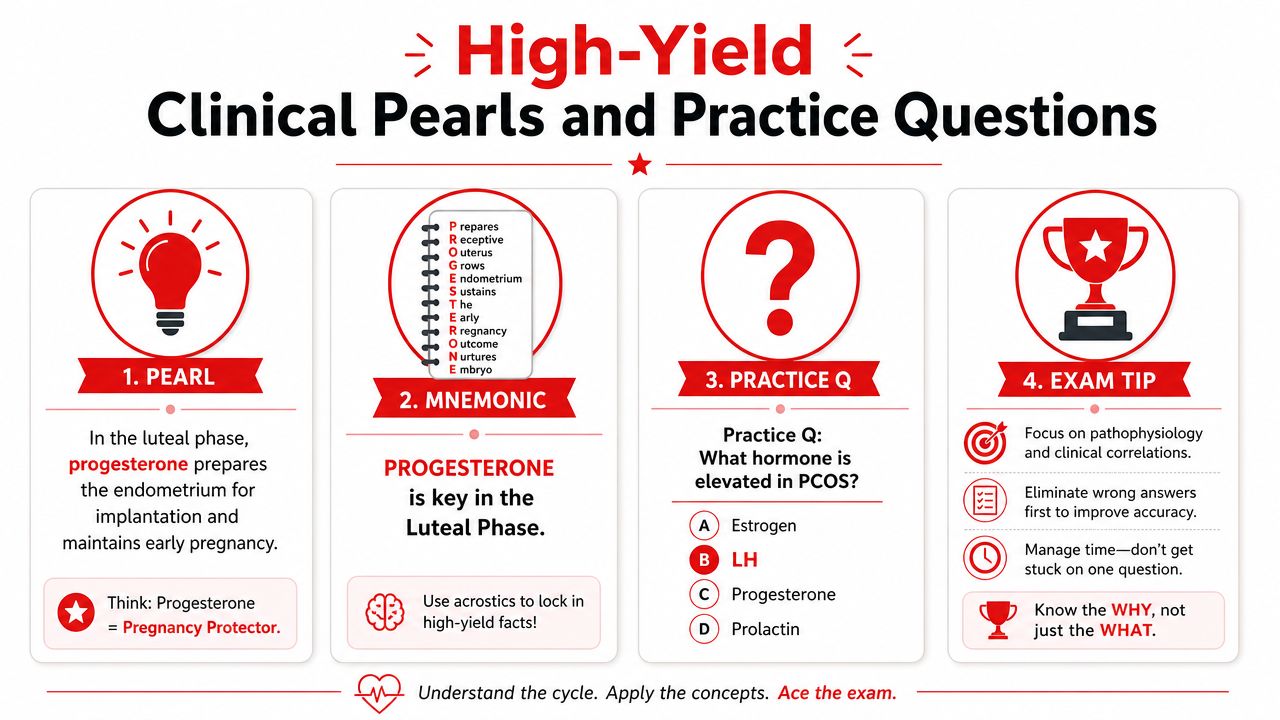
When you're down to the last pass before an exam, the goal is fast recall, not new theory. Keep the axis, the cycle, and the workup sequence together in your head. If one of those pieces is missing, your answer choices start to blur.
Three pearls that show up again and again
- Pulsatile GnRH matters: Continuous signaling doesn't behave like normal reproductive physiology, and altered pulsatility can reduce fertility (Yen and Jaffe's Reproductive Endocrinology).
- Cycle timing matters: A 28-day cycle is the practical reference point, but most normal cycles sit in a broader range (NCBI Bookshelf).
- Localize before you label: Low gonadotropins point upstream, high gonadotropins point downstream, and the rest of the endocrine panel helps fill in the cause.
For a concise review format, a board-style resource like Ace Med Boards' endocrinology board review can be a useful final-pass tool if you're drilling mixed physiology questions.
Practice question one
A patient has irregular menses, acne, and signs of chronic anovulation. Which pattern best fits the diagnosis?
The best answer is the one consistent with ovulatory dysfunction plus androgen excess, which points toward PCOS. The distractors usually try to tempt you toward ovarian failure or hypothalamic suppression, but those patterns don't match the androgen picture.
Practice question two
A patient with weight loss and intense exercise has absent periods and low gonadotropins. Where is the problem?
The problem is upstream suppression at the hypothalamic level. The pituitary and ovaries are being under-stimulated, so the low hormone pattern fits functional hypothalamic amenorrhea better than primary ovarian insufficiency.
Practice question three
A patient with secondary amenorrhea and galactorrhea needs a workup. What comes first?
Start with pregnancy testing, then move to prolactin and TSH if pregnancy is excluded. That sequence matters because the fastest diagnosis is still the one you don't miss at the beginning.
If you want a tighter way to study reproductive endocrinology basics without bouncing between scattered notes, use Ace Med Boards for focused, exam-style review and question strategy. Visit Ace Med Boards to work through the endocrine framework, tighten up your lab interpretation, and turn this topic into points on test day.