You've probably had this experience this week. You crushed a set of microbiology flashcards, then blanked on the details the next day. But when you walked into clinic, your hands knew how to set up the blood pressure cuff, log into the chart, and move through the room almost automatically.
That split matters.
Medical training depends on two different memory systems. One helps you recall facts on demand. The other helps you perform skills without consciously narrating every step. If you don't know which system you're training, it's easy to use the wrong study method for the wrong job and wonder why progress feels uneven.
Introduction to Implicit and Explicit Memory
A lot of students think memory is one big bucket. It isn't. When you memorize the causes of nephrotic syndrome, you're using one kind of memory. When you get smoother at suturing, presenting, or recognizing a familiar chest X-ray pattern without fully explaining why, you're leaning on another.
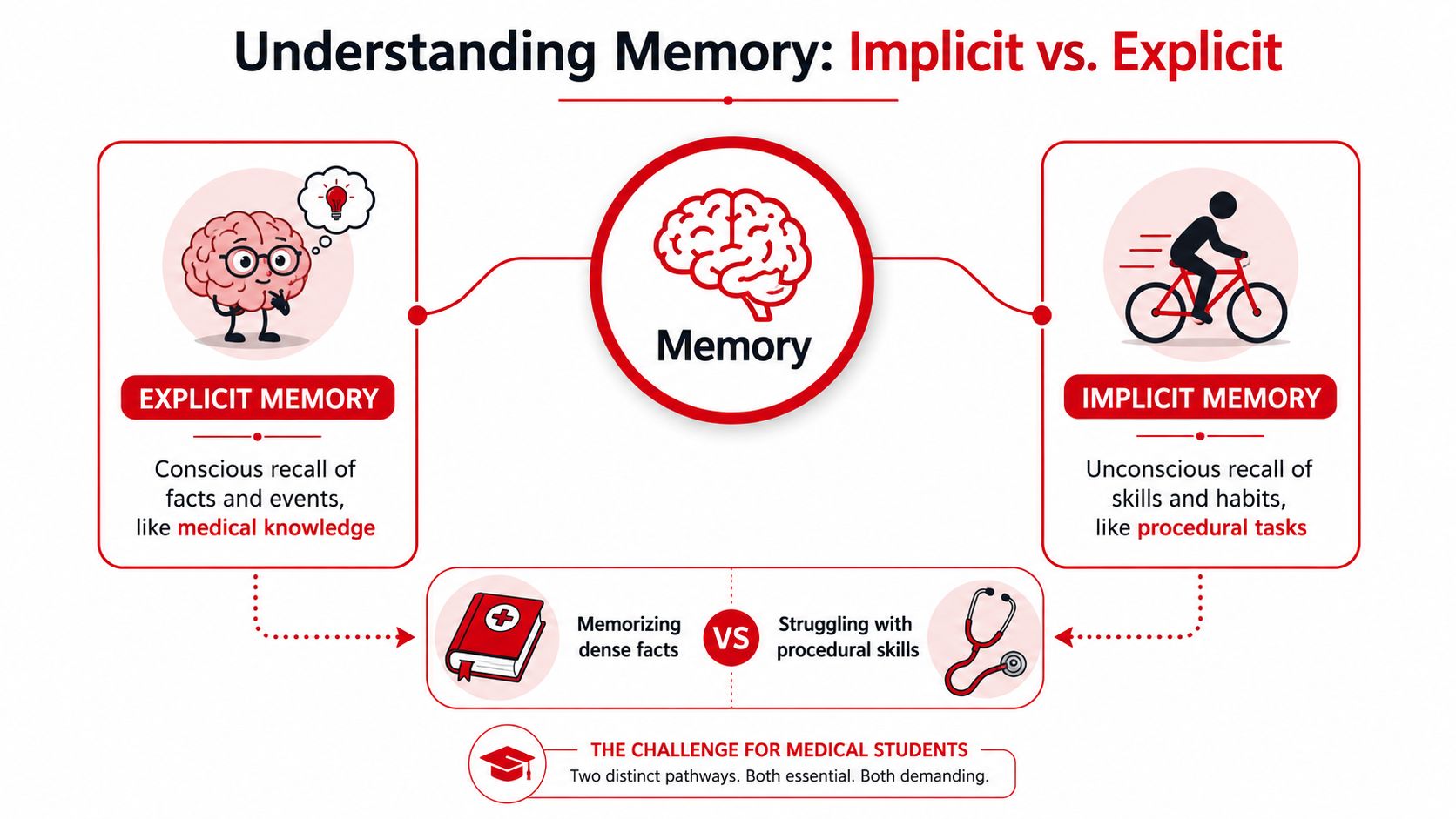
The high-yield distinction is this: explicit memory is conscious and verbalizable. Implicit memory is expressed through performance, habits, and automatic responses. For med students, that means board prep and clinical training aren't really the same cognitive task, even when they happen in the same week.
A nuance that gets missed in many review resources is that the hippocampus isn't only an “explicit memory center.” Neuroimaging work has shown it's also critical for both direct and indirect relational memory tasks, which complicates the oversimplified classroom version many students learn first (hippocampal involvement in direct and indirect relational memory). If your study plan treats memory as only facts versus not-facts, you'll miss how these systems overlap.
If you've been wondering why passive exposure helps some things but not others, this short guide to active and passive learning in med school pairs well with what follows.
| Feature | Explicit memory | Implicit memory |
|---|---|---|
| Main experience | Conscious recall | Unconscious expression |
| Typical med school example | Recalling side effects of a drug | Smoothly performing a physical exam routine |
| Best seen through | Free recall, recognition, explanation | Priming, habits, procedural performance |
| Student feeling | “I know that” | “I just do it” |
Understanding Key Memory Concepts
Students often confuse implicit vs explicit memory because both can improve with practice, yet they don't feel the same during learning.
What explicit memory actually is
Explicit memory is the kind you can deliberately bring to mind. It includes facts, concepts, lists, and events. If I ask you for the mechanism of action of a loop diuretic, and you can say it out loud, that's explicit memory.
It's the memory system most board-style questions target. You read a stem, retrieve a fact or a chain of facts, then choose the answer. Flashcards, question banks, oral quizzing, and sketching pathways from memory all lean heavily on this system.
Common examples in med school include:
- Fact recall: Naming the branches of the external carotid artery.
- Concept explanation: Explaining why respiratory alkalosis shifts calcium binding.
- Recognition under pressure: Identifying a classic presentation after seeing key clues in a vignette.
What implicit memory actually is
Implicit memory shows up in performance rather than conscious explanation. You may not be able to describe every tiny step, but your behavior improves anyway. This includes procedural learning, priming, and automatic routines.
A simple example is typing. You probably can't name the exact finger movement pattern for each key, but you still type fluently. In medicine, the same thing happens when your oral presentations become smoother, your hand placement during an exam gets more natural, or your eye starts spotting recurring imaging patterns faster.
Students often think, “If I can't explain it, I must not know it.” That's false for skills. Performance can improve before verbal explanation catches up.
Where students get tripped up
The biggest confusion comes from mixed tasks. Many study activities recruit both systems at once. A surgery clerkship student may consciously remember sterile sequence steps, then gradually perform them with less mental effort over time. A pathology student may memorize criteria explicitly, then begin to recognize slides more automatically after repeated exposure.
Interference makes this harder. When old and new facts compete, explicit recall gets messy. If that's been a problem for you, a focused review of proactive and retroactive interference can help you see why some topics keep crowding each other out.
A practical way to classify a task is to ask one question: Do I need conscious recall to succeed, or does success show up mainly through smoother performance? If the answer is recall, you're mostly training explicit memory. If the answer is performance, you're leaning toward implicit memory.
Neural Bases of Implicit and Explicit Memory
The brain doesn't process all memory in one location. That's why a student can lose confidence in factual recall after a long week yet still perform a learned routine fairly well in clinic.
Explicit memory networks
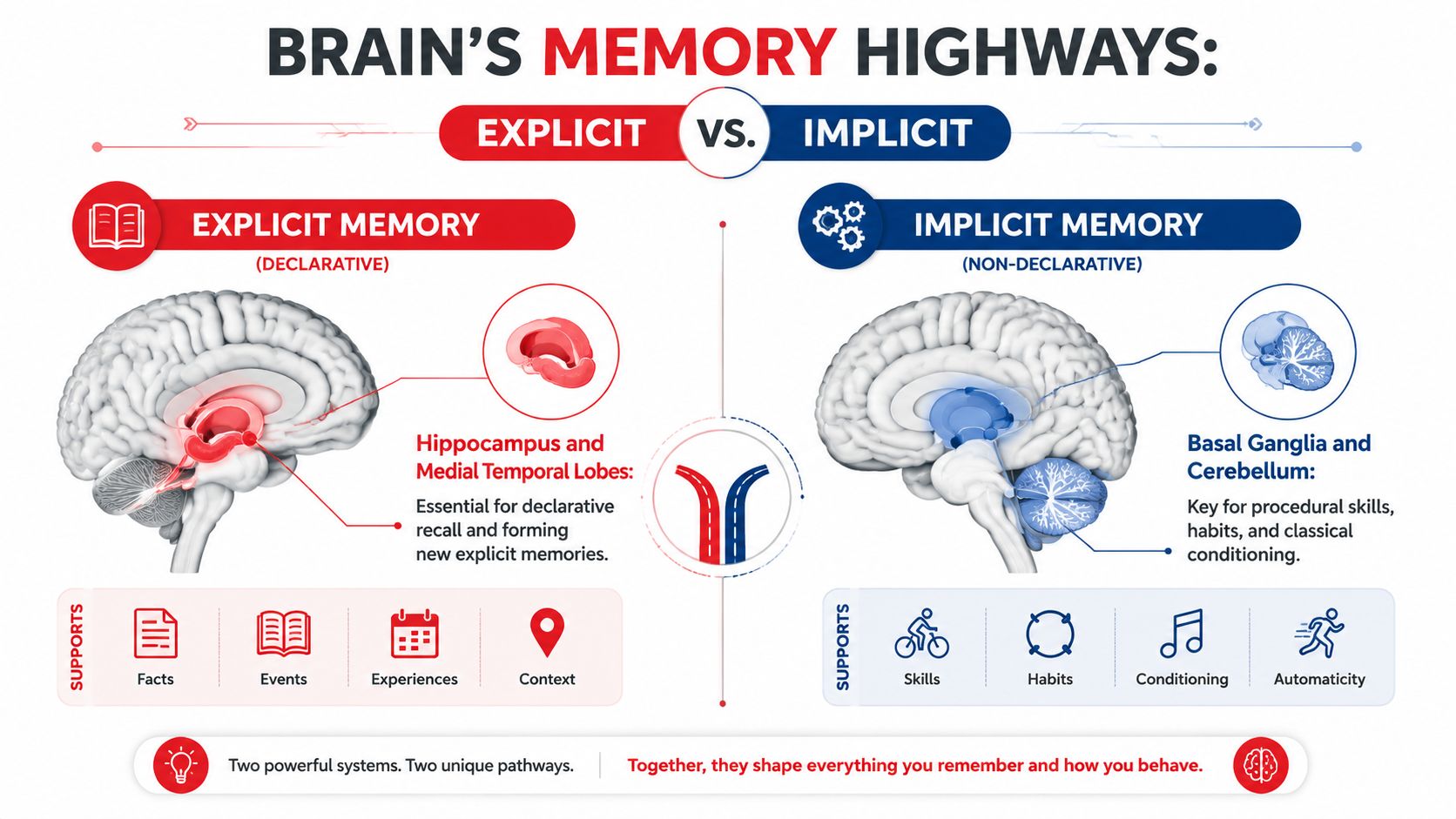
When students learn explicit memory for boards, they usually start with the hippocampus and medial temporal lobe idea. That's useful, but incomplete. Explicit retrieval has been associated with increased hemodynamic activity in bilateral parietal, temporal, and left frontal regions, showing that conscious retrieval is distributed rather than isolated to one structure (functional neuroanatomy of implicit and explicit retrieval).
That fits what you feel during hard studying. Recalling an answer from a blank screen often involves search, selection, language, and attention. It's not just storage. It's controlled retrieval.
For medical students, that matters because board questions rarely ask for a naked fact. They ask for a fact embedded in context. You don't just retrieve “anti-dsDNA.” You retrieve it, discriminate it from nearby distractors, and apply it to the stem.
Implicit memory networks
Implicit memory relies on a different profile. The classic teaching model emphasizes systems involved in procedural learning and habit formation, especially the basal ganglia and cerebellum. That's why repeated movement, perceptual exposure, and patterned performance can become more automatic over time.
The same neuroimaging review found that implicit memory, especially priming, was associated with hemodynamic decreases in the left fusiform gyrus and bilateral frontal and occipital regions, supporting the idea that implicit and explicit retrieval rely on different functional neuroanatomies (distinct brain activity in priming and conscious retrieval).
That “decrease” language confuses students. It doesn't mean implicit memory is weaker. It means the brain can process familiar material more efficiently in certain contexts. In plain terms, repeated exposure can make some kinds of processing easier and less effortful.
The hippocampus isn't a simple one-line answer
On exams, students are often taught a neat split: hippocampus for explicit memory, basal ganglia and cerebellum for implicit memory. That's a good first pass, but it's too tidy. As noted earlier, the hippocampus also contributes to some indirect relational memory tasks. So if a question stem tries to force a simplistic “hippocampus equals only declarative memory” interpretation, slow down and read carefully.
Clinical reasoning shortcut: If the question is about conscious recall of facts or events, think explicit systems first. If it's about habits, skills, priming, or automatic performance, think implicit systems first. Then look for nuance before locking in your answer.
Why this matters for exam prep
Different neural systems reward different training. Fact-heavy courses need retrieval, self-testing, and explanation. Skill-heavy growth needs repetition, pattern exposure, and time for automaticity to develop.
If you're trying to build stronger recall, memory retention strategies for med school are most useful when they match the kind of memory the task requires. Students waste time when they treat every weakness as a flashcard problem.
Behavioral Tasks Demonstrating Memory Types
Lab tasks make these differences easier to see because they strip memory down to behavior.
Tasks that reveal explicit memory
Explicit memory is usually measured with free recall or recognition. In free recall, you study material and later try to produce it without cues. In recognition, you identify the correct answer from options. That should sound familiar because it maps closely onto oral quizzing and board questions.
A med school example is straightforward. If you review causes of hypercalcemia, close your notes, and write down everything you remember, that's an explicit memory task. If you answer a multiple-choice item about hyperparathyroidism, that's explicit too.
What matters is conscious access. You know you're trying to remember, and you can usually describe what you're retrieving.
Tasks that reveal implicit memory
Implicit memory is often demonstrated with priming or procedural learning. In priming, earlier exposure changes later performance even if you aren't intentionally trying to remember. In procedural tasks, practice improves execution without requiring conscious verbal recall of each step.
A simple medical analogy is repeated exposure to classic rash images. After enough practice, a student may identify a pattern faster without consciously listing every visual feature. Another example is becoming more fluid at tying knots or setting up an OSCE station.
The student often experiences this as “I didn't memorize a script, but I'm better at this.”
A practical comparison
Here's a compact way to organize the common task types.
| Task | Memory Type | Description |
|---|---|---|
| Free recall | Explicit | Producing information from memory without prompts |
| Recognition test | Explicit | Selecting previously learned information from choices |
| Word-stem or perceptual priming | Implicit | Earlier exposure changes later response without conscious recall |
| Procedural practice | Implicit | Repeated performance improves skill and automaticity |
What the consolidation data means for students
A controlled study of 60 healthy adults found that over a 24-hour period, implicit and explicit memory traces followed different consolidation paths. Implicit knowledge of statistical structure strengthened, while precise explicit representations tended to decay without reinforcement. The same study found that repeated testing strengthened explicit retention but had no measurable influence on implicit statistical learning (divergent consolidation of implicit and explicit memory over 24 hours).
That has a direct board-prep implication.
If you're trying to remember enzyme deficiencies, drug toxicities, or lesion localizations, repeated retrieval helps. If you're trying to build faster pattern pickup or smoother procedural flow, testing alone may not be the main driver. Exposure, repetition, and time matter.
Don't expect a question bank to train every kind of learning equally. It's excellent for explicit recall. It's less complete for procedural automaticity and some forms of pattern learning.
Memory in Clinical Disorders
Clinical vignettes make implicit vs explicit memory feel much more real than definitions do.
When explicit memory breaks down first
A patient with hippocampal injury may have severe trouble forming or consciously recalling new declarative memories. They may not remember the conversation they had earlier in the day. They may fail to learn a new list of words. In conditions such as Alzheimer's disease, explicit memory is often impaired early enough that families notice repeated questions, lost details, and failure to retain recent events.
That's the classic exam setup. The patient can't tell you what they learned, when they learned it, or sometimes whether they learned it at all.
When implicit memory still shows up
Implicit memory is more resilient in aging and certain neurological conditions. It operates unconsciously and doesn't require the hippocampus for retrieval in the same way explicit declarative memory does. Research summaries note that while explicit memory can fade without regular recall and can be severely compromised by hippocampal damage or Alzheimer's disease, implicit memory often remains largely intact and may persist for a lifetime (overview of implicit memory and its resistance to some impairments).
That's why a patient might deny remembering a task but still perform it better after practice. The behavior improves even when conscious recall doesn't.
How this appears in question stems
Board writers often test this through contrast.
- Recent-event failure with preserved skill learning: Think impaired explicit memory with relatively spared implicit memory.
- Can't describe the lesson but performs more efficiently: Think procedural or implicit learning.
- Knows facts but can't execute a motor sequence smoothly: Think beyond pure declarative memory and examine procedural circuits.
A useful clinical image is the patient who doesn't remember meeting the therapist but becomes more capable at the task each day. The memory is present in performance, not narration.
Why this matters beyond test-taking
This distinction helps with bedside reasoning. It changes how you interpret “memory loss.” Not all memory complaints are the same. A student who only thinks in terms of “the patient remembers” versus “the patient forgets” misses a lot of neuropsychology.
It also helps with patient teaching. Some patients won't reliably retain explicit instructions after one conversation, but they may still benefit from repeated routines, environmental cues, and hands-on repetition. In other words, when explicit memory is fragile, structured practice can still do useful work through other pathways.
In clinic, ask two separate questions. Can the patient tell you what was learned? Can the patient show you improved performance? Those answers may differ.
Study Strategies and High-Yield Mnemonics
Most students overtrain one memory system and neglect the other. The usual pattern is heavy explicit studying. Endless Anki, long review sheets, repeated explanation. That's useful, but it won't fully build the kind of automaticity you need for clinical work, image recognition, and efficient exam performance.
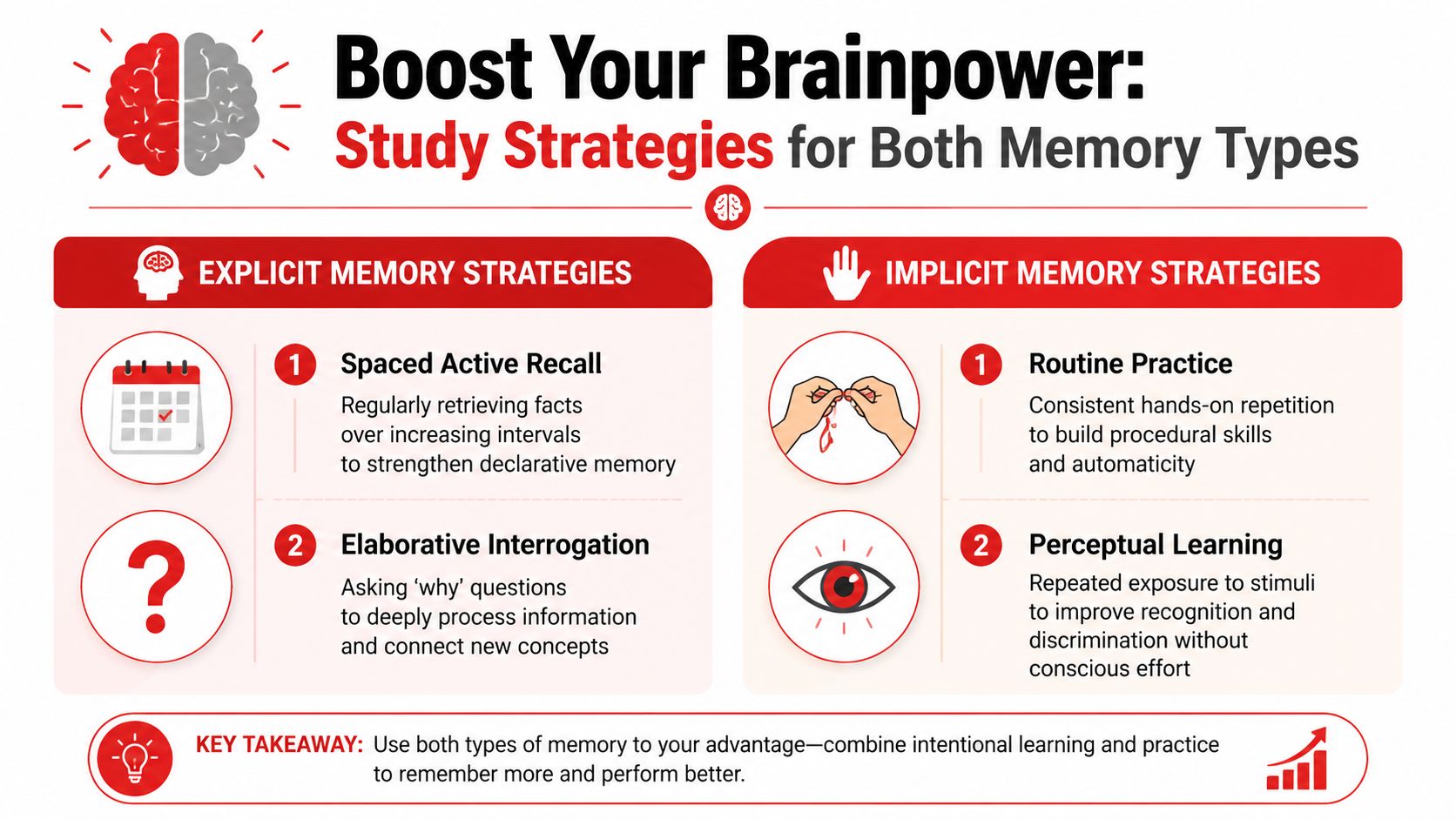
Train explicit memory on purpose
For explicit memory, use methods that force retrieval.
- Spaced recall: Review facts after increasing intervals rather than rereading notes.
- Question-first studying: Start with a prompt, then reconstruct the answer before looking.
- Teach-back: Explain a concept out loud as if you're tutoring a classmate.
- Blank-page drills: Write a pathway, table, or differential from memory before checking accuracy.
These work because explicit memory improves when you actively pull information back into consciousness. That's one reason many students do well pairing flashcards with timed question blocks. If you use Anki, this guide on acing your boards with spaced repetition fits nicely with an explicit-memory-heavy phase of studying.
Train implicit memory differently
For implicit memory, think less about “Do I remember the sentence?” and more about “Can I perform the pattern?”
Try these:
- Routine practice: Run the same physical exam flow in the same order until it feels natural.
- Perceptual repetition: Review many examples of murmurs, rashes, pathology slides, ECGs, or imaging findings.
- Simulation: Rehearse oral presentations, counseling, and procedural setup under realistic constraints.
- Low-friction repetition: Keep your setup consistent so the skill gets practiced, not renegotiated.
This isn't passive in the lazy sense. It's structured exposure and repetition. Some learners also benefit from broader reflection on how to improve retention, especially when they're trying to pair deliberate recall with consistent learning habits.
A mnemonic you can actually use
Use SPACE for explicit memory sessions:
- S, Separate sessions. Don't cram all retrieval into one sitting.
- P, Pull from memory first. Start with recall before notes.
- A, Ask why. Connect the fact to mechanism or pathology.
- C, Check errors fast. Correct the exact miss, not the whole chapter.
- E, Expand intervals. Revisit later, not immediately.
For implicit skill building, use RIDE:
- R, Repeat the same flow.
- I, Increase realism.
- D, Drop unnecessary prompts.
- E, Expose yourself to many examples.
Why students misjudge their progress
One tricky point from the research literature is measurement. Implicit memory can be harder to measure cleanly. Work on indirect tasks such as fame and preference judgments has found significantly lower reliability coefficients for implicit measures than for explicit measures, suggesting the two types of memory reflect distinct cognitive representations and that indirect assessment is less precise in some designs (reliability differences between implicit and explicit memory measures).
That's part of why students sometimes say, “I'm getting better, but I can't prove it yet.” For procedural smoothness, pattern recognition, and automaticity, improvement may show up subtly before it feels testable.
A practical weekly split
If you're preparing for USMLE or COMLEX, a balanced week often looks better than an all-recall week:
- Use question banks and flashcards for pharm, micro, pathology associations, and lesion-based neuro.
- Use repeated visual exposure for imaging, derm, histology, and murmurs.
- Use spoken rehearsal for oral presentations and counseling language.
- Use routine drills for physical exam sequences and procedural setup.
A strong plan asks two things of every session. What fact am I trying to retrieve? What skill or pattern am I trying to make automatic?
Sample Practice Questions and Explanations
These are the kinds of distinctions students miss when they read too fast.
Question 1
A student can accurately list the side effects of lithium during a study session. Which memory type is being used most directly?
Answer: Explicit memory.
Why: The task requires conscious recall of verbalizable facts. When you can intentionally retrieve and state information, you're in explicit memory territory.
Question 2
A patient with severe anterograde amnesia denies ever having practiced a motor task, yet performance improves across sessions. What best explains this finding?
Answer: Preserved implicit memory.
Why: The clue is the mismatch between poor conscious recall and improved performance. The patient can't describe the learning experience, but learning still appears in behavior.
Question 3
A student keeps rereading nephritic and nephrotic syndromes but still mixes them up on exams. Which study change best targets the weaker memory system for this task?
Answer: Active retrieval, such as self-testing from a blank sheet.
Why: This is a fact-discrimination problem, so explicit memory needs stronger retrieval practice. Rereading can create familiarity without dependable recall.
Question 4
A learner becomes faster at recognizing a classic facial droop pattern on neuro images after repeated exposure, even when they can't fully articulate every visual cue. Which memory process is most involved?
Answer: Implicit memory.
Why: Performance improves through exposure and pattern pickup rather than fully conscious rule-based explanation. That's a common setup for priming or perceptual learning.
Question 5
A board-style stem describes a patient who struggles with recent declarative learning but retains some ability to improve on practiced tasks. What's the best first distinction to make?
Answer: Separate explicit memory impairment from relatively preserved implicit memory.
Why: The stem is testing whether you can split “memory” into multiple systems instead of treating it as one function.
How to reason through these fast
Use this quick decision path:
- Ask whether the person must consciously recall information. If yes, think explicit.
- Ask whether the person improves mainly through performance. If yes, think implicit.
- Check whether the stem contrasts narration with behavior. That usually signals dissociation.
- Match the study tool to the memory demand. Flashcards for facts. Repetition and exposure for skills and patterns.
If you want more board-style reps, working through a Step 1 sample question can help you practice spotting the exact cue that separates a memory concept from a distractor.
If you want help turning concepts like implicit and explicit memory into a study system that improves your scores, Ace Med Boards offers personalized tutoring for USMLE, COMLEX, Shelf exams, and more. Their tutors can help you choose the right method for the right memory task, build a realistic study schedule, and sharpen both recall and clinical reasoning under exam pressure.