You're probably dealing with this at the worst possible time. Your exam schedule is packed, your ERAS tasks are piling up, and somewhere in the portal or email chain there's a vague instruction telling you to submit documents for credential verification. It sounds administrative. It isn't.
For medical students, graduates, and especially IMGs, credential verification is one of the few parts of the process that can unexpectedly impede the entire process. A strong score won't fix a missing transcript. A polished personal statement won't overcome an unresponsive registrar. If your records can't be confirmed, your timeline can stall without much warning.
That's why it helps to treat this process for what it is. Not paperwork. Not a formality. It's the gate that decides whether your education, exams, and qualifications are accepted as real, current, and usable by the institutions reviewing you.
Your Medical Career's Most Important Gatekeeper
Residency applicants often assume programs mainly care about scores, letters, and clinical performance. They do. But first, the system has to trust that your underlying record is valid.
That's what credential verification does. It confirms that the person applying is who they claim to be, that the school issued the diploma or transcript, and that the training history matches the official record. In medicine, this matters because every later step depends on it. Residency. Licensure. Hospital privileges. Employment.
If you've been trying to understand how programs weigh your application overall, what residency programs look at in ERAS is useful context. Verification sits underneath all of those review factors. It's less visible, but just as decisive.
Why applicants underestimate it
Most applicants only notice credential verification when something goes wrong. A document gets rejected. A school doesn't reply. A name mismatch creates a discrepancy. A licensing body asks for direct confirmation instead of a scanned copy.
By then, you're no longer planning. You're reacting.
Practical rule: Start treating verification as a parallel track, not a final administrative step after your application is ready.
That mindset shift matters most for IMGs. If your school is outside the U.S., uses paper archives, or doesn't respond quickly to outside requests, your delay won't look dramatic at first. It will look like silence. Then deadlines get closer. Then every day matters.
What's at stake
A verification problem can delay review, postpone eligibility decisions, and create avoidable stress during an already high-pressure cycle. In some cases, the issue isn't that your credentials are weak. It's that they can't be confirmed in the format or through the channel the receiving organization requires.
The good news is that most verification problems are manageable when you identify them early and work them systematically. The rest of this guide focuses on the practical side. What credential verification means, which pathways apply to you, what documents usually trigger problems, and how to deal with the dead ends most general guides skip.
What Credential Verification Actually Means
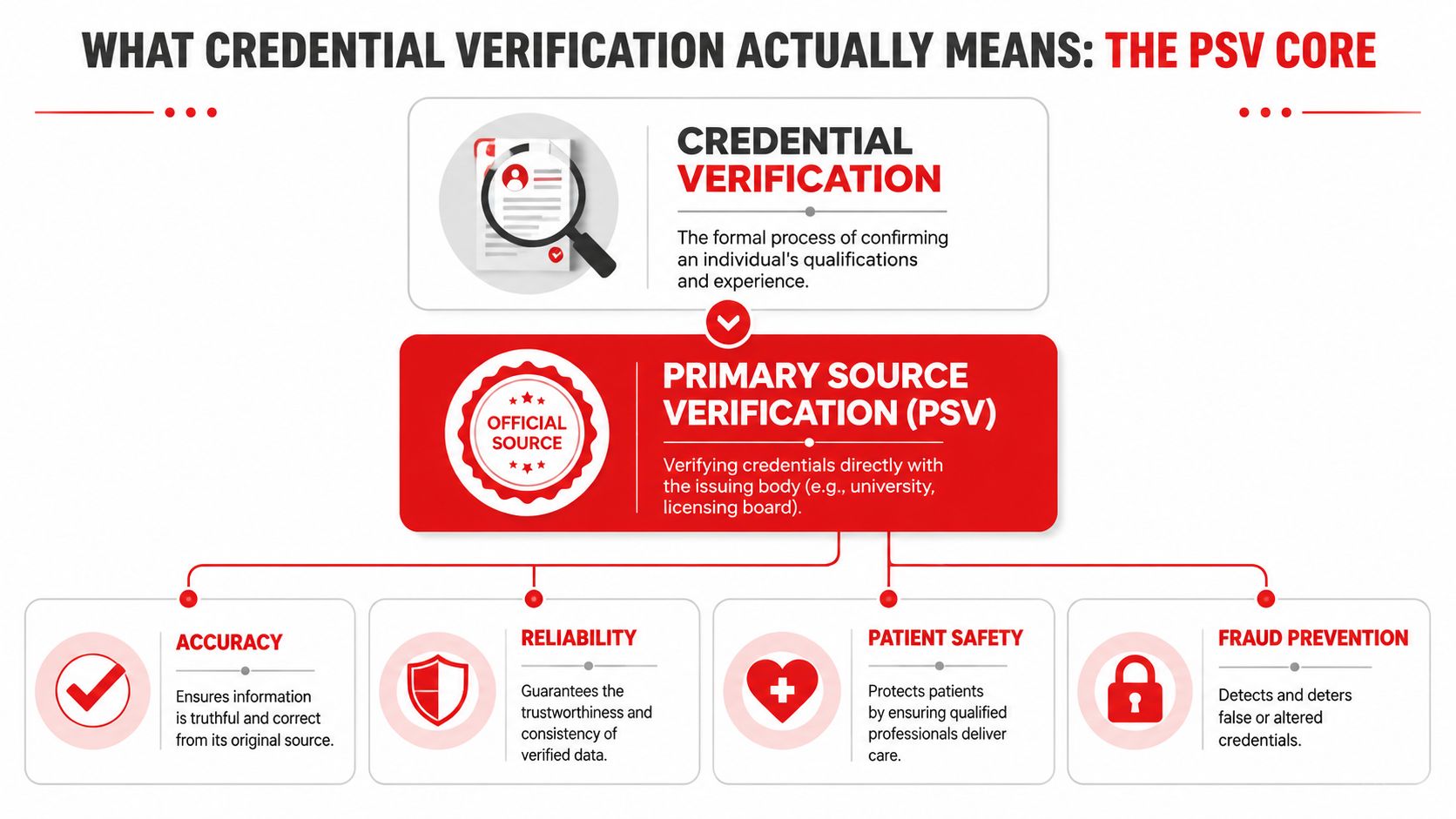
Credential verification is the formal process of confirming that your education, identity, training, and professional records are authentic. In medicine, the key concept is Primary Source Verification, usually shortened to PSV.
Think of PSV like a detective checking the original file, not the photocopy you handed over. If you submit a diploma, the verifier may still need the medical school itself to confirm that the diploma was issued, to whom, and when. If you submit a license, the verifier may need the licensing authority's direct confirmation that it's active and in good standing.
Why scanned documents aren't enough
Applicants often ask a fair question. “If I already uploaded the diploma, why do they need anything else?”
Because a document alone doesn't prove origin. It proves possession.
That distinction matters more now than it did a few years ago. In the first quarter of 2026, approximately 11% of all documents submitted to verification platforms, including diplomas, transcripts, professional certificates, and government IDs, were flagged as forgeries or unverifiable according to TuringCerts' 2026 document fraud statistics. In medical education and licensing, that level of risk forces institutions to verify more aggressively, not less.
What gets checked in practice
A verification process may include some or all of the following:
- Education records: Medical school attendance, graduation status, transcript details, and degree issuance
- Identity records: Name consistency, date of birth, passport or government ID details
- Licensure history: State or national licenses, status, sanctions, and expiration
- Training history: Internship, residency, fellowship, or clinical placement records
- Professional standing: Disciplinary actions, restrictions, or unresolved adverse findings
Some systems now rely on cryptographic verification instead of repeated manual outreach. W3C Verifiable Credentials 2.0 uses an issuer, holder, and verifier model so a verifier can confirm authenticity through trusted public keys instead of contacting the issuer every time. It also supports selective disclosure, which means a holder can reveal only the claim needed for a given use case, not the entire record. If you want a practical primer on the mechanics behind that, learn about digital signatures with FaxZen.
Verification is stricter than document collection. Collection gathers files. Verification confirms facts.
What works and what doesn't
What works is assuming every important claim in your application may need to be confirmed independently.
What doesn't work is relying on screenshots, unofficial translations, cropped scans, or documents with inconsistent names and dates. Those may be enough for your own records. They usually aren't enough for a formal medical credentialing workflow.
The Key Verification Pathways for Medical Professionals
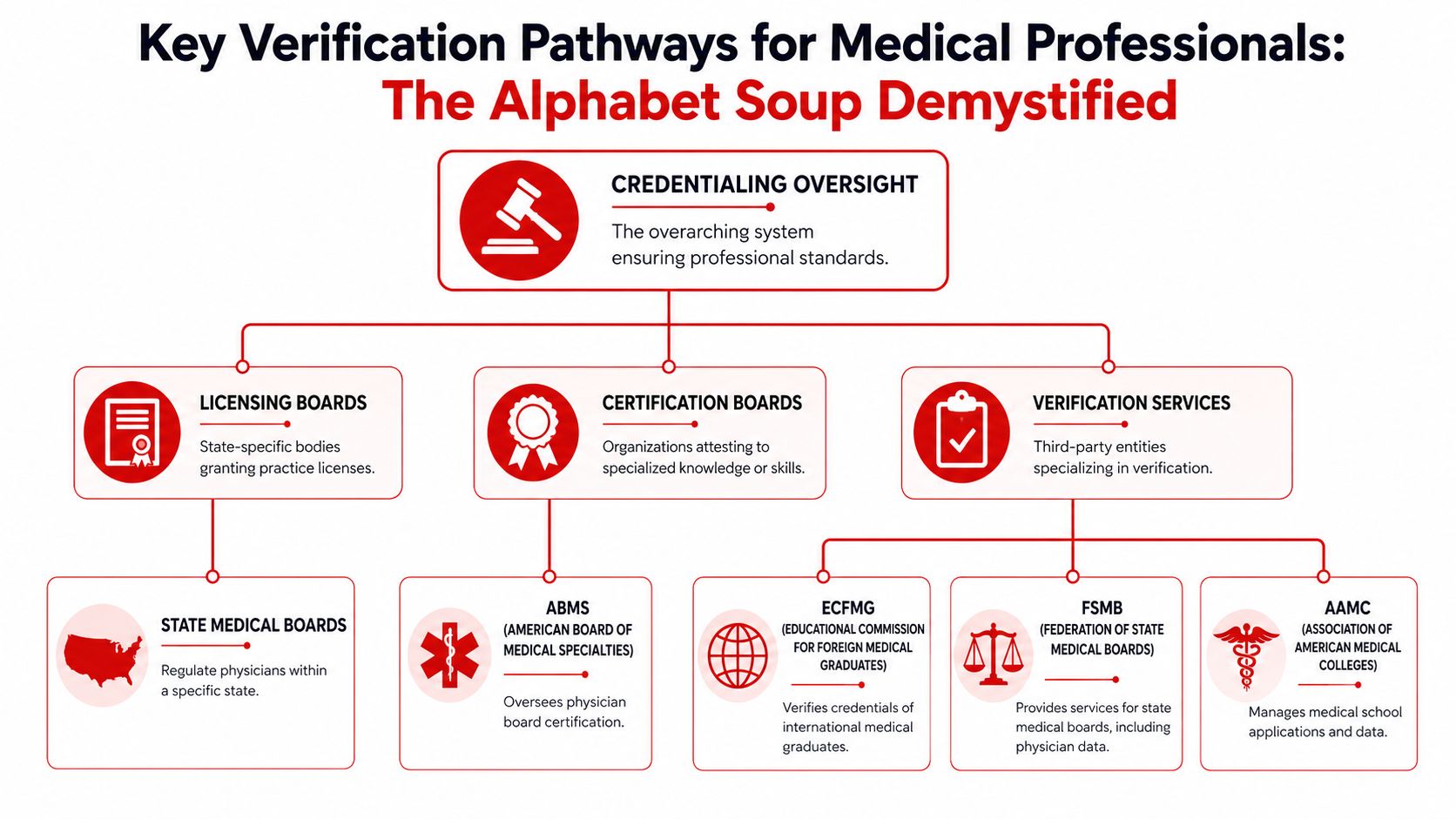
Medical credential verification feels confusing because several organizations handle different parts of it. Applicants often lump them together, then miss the one that determines their next step.
The easiest way to think about it is by purpose. One pathway verifies international education. Another helps organize records for licensure. Another moves residency application materials through the system. They overlap, but they aren't interchangeable.
ECFMG for international graduates
If you're an IMG, ECFMG is usually the most consequential checkpoint early in the process. It exists to verify that your international medical education meets the standards required for U.S. training and progression.
This is also where many applicants encounter the first real administrative bottleneck. If your school is slow, uses manual records, or handles outside requests inconsistently, ECFMG-related verification can drag. That's why it helps to review the ECFMG certification requirements for IMGs before a deadline is close enough to hurt you.
FSMB and FCVS for licensure-related record management
The Federation of State Medical Boards matters more as you move toward licensure. Its services can help physicians maintain a centralized professional profile used by state boards during licensing applications.
That doesn't replace primary source verification by every receiving body, but it can reduce repeated scrambling when multiple jurisdictions ask for similar materials. For applicants who expect to move through residency into state licensure and credentialing, having a structured record repository becomes more useful over time.
ERAS for residency application transmission
ERAS is not the same thing as a credentialing body, but it becomes the operational center of your residency application. It organizes and transmits application materials, and those materials still depend on valid upstream verification.
That's the distinction many applicants miss. ERAS can move your file. It can't fix a school that never confirmed your transcript or a source record that doesn't match your submitted name.
Why the system is this strict
The medical system doesn't build these checks just to create bureaucracy. It does so because downstream institutions carry legal and patient safety risk if they accept unsupported credentials.
Federal law raises the standard even higher in provider credentialing. Under 38 U.S.C. §1703F, credential verification organizations must conduct initial verification of provider history and license sanctions across all U.S. states and territories, and recredentialing must occur at least every three years as outlined in the statutory text on 38 U.S.C. §1703F. That law is aimed at provider credentialing, but it shows the larger culture of verification you're entering. Medicine assumes records must be checked, rechecked, and monitored.
A simple way to know which pathway matters most
Use this mental shortcut:
| Situation | Main pathway you'll feel first | Why it matters |
|---|---|---|
| IMG applying to U.S. residency | ECFMG | Your education record must be accepted before later steps move cleanly |
| U.S. or IMG physician pursuing state licensure | FSMB and state boards | Licensure requires structured verification of training, identity, and standing |
| Residency applicant assembling application | ERAS | Your file transmission depends on complete, usable supporting records |
The mistake isn't failing to know every acronym. The mistake is assuming one organization handles all verification for all purposes.
If you know which lane you're in, your preparation gets much easier.
A Step-by-Step Verification Timeline and Document Guide
Applicants get into trouble when they treat verification like a one-week errand. It's rarely that simple. Even when everything goes right, there are handoffs between you, your school, third-party systems, and receiving institutions. If one part moves slowly, the whole sequence stretches.
For most applicants, the right timeline starts earlier than feels necessary. Build your file before anyone asks for it. Confirm your school's registrar contact details before you need a rush response. Check whether your transcript, diploma, and identification documents all show the same name format.
If you're planning around residency deadlines, keep your broader ERAS application timeline in view while you work on verification tasks. The applicants who stay calm in late summer are usually the ones who handled these details months earlier.
A practical timeline that works
Here's a no-nonsense sequence:
Start with identity consistency
Compare your passport, school records, exam registrations, and any prior licenses. If your name differs across them, gather the legal paperwork now.Request core academic records early
Don't assume your school can turn around a clean transcript or degree confirmation quickly, especially if archives are manual.Ask how documents must be sent Some bodies accept uploads. Others require direct transmission from the institution. Applicants frequently waste time preparing the wrong format.
Create submission-ready files
Use clear, complete PDFs. If you only have image files from scans or mobile photos, a clean conversion tool can help. For applicants organizing document packets, File Studio's PNG to PDF tool is a practical reference.Track every request in one place
Use a spreadsheet or simple tracker with date sent, recipient, method, follow-up date, and current status.
Field note: A missing follow-up date causes more delays than a missing file. Applicants often send one request, assume it's in process, and lose two weeks.
Essential Credential Verification Document Checklist
| Document | Typical Source | Pro Tip for Verification |
|---|---|---|
| Medical school diploma | Medical school registrar or records office | Make sure the full degree name matches the official institutional record exactly |
| Official transcript | Medical school registrar | Verify whether the receiving organization requires direct transmission rather than applicant upload |
| MSPE or dean's letter | Medical school dean's office | Confirm letterhead, signature, and issue date are complete before release |
| Letters of recommendation | Faculty member or supervising physician | Ask writers early and confirm whether they must upload directly through a designated platform |
| Passport or government ID | Government issuing authority | Use a clean, uncropped scan with all edges visible |
| Name change document | Civil registry or court record | Keep it with your core packet if any academic or identity record uses a prior name |
| Exam score reports | Exam body or official reporting platform | Check whether the recipient pulls scores directly or expects you to authorize release |
| Internship or training confirmation | Hospital GME office or training program | Request exact start and end dates, not general attendance language |
| License or certificate records | Licensing board or certifying body | Verify current status and whether sanctions history is checked separately |
What applicants forget most often
The most common issue isn't a dramatic missing diploma. It's small inconsistency.
- Name format drift: Middle names appear on one record but not another
- Date mismatches: Graduation month or training dates differ between records
- Unofficial files: Applicants upload a useful reference copy that isn't acceptable for formal review
- Poor scan quality: Seals, signatures, or margins are cut off
Clean records move faster. Messy records invite questions.
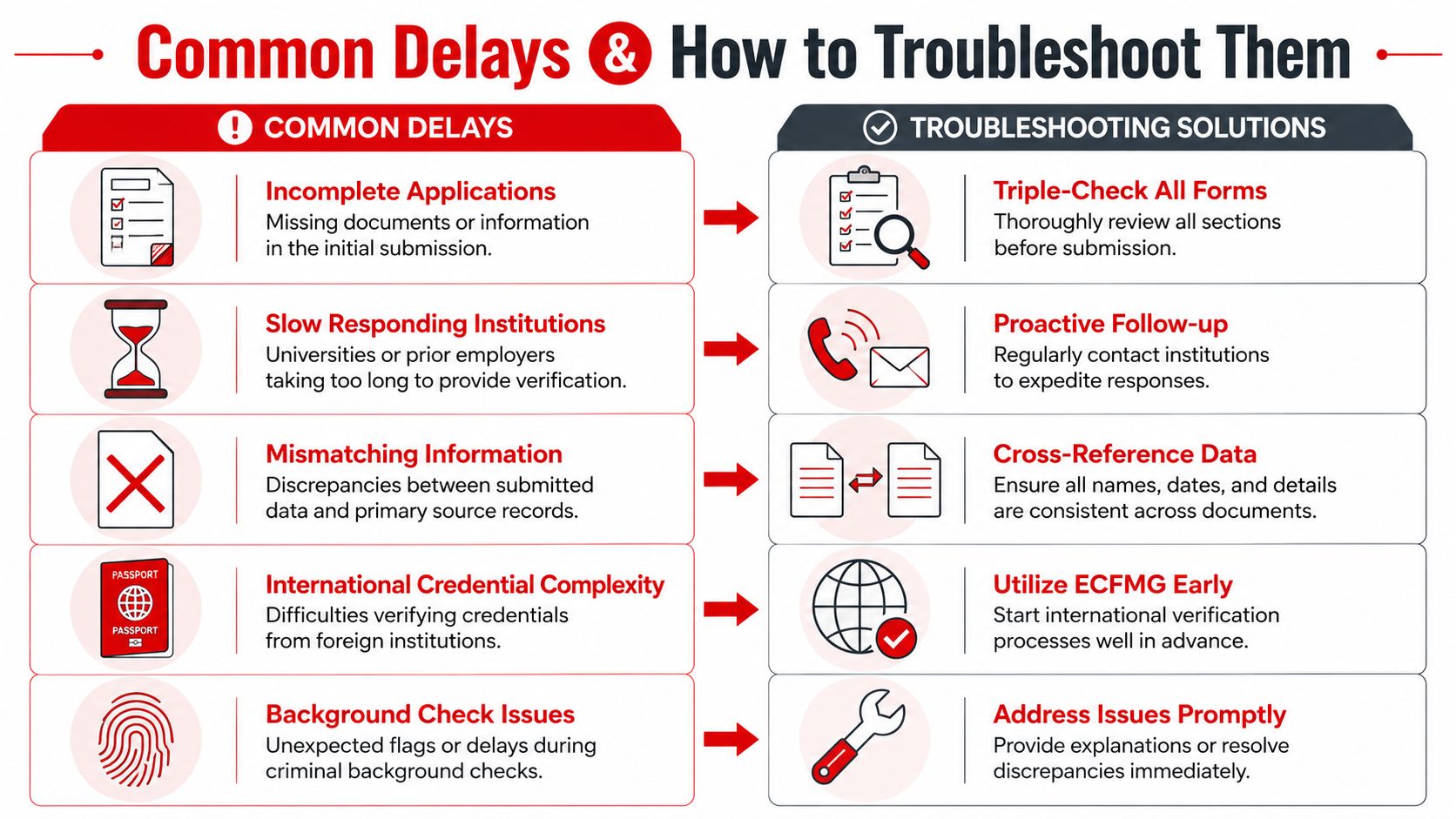
Common Delays and How to Troubleshoot Them
The hardest part of credential verification isn't knowing the rule. It's knowing what to do when the rule runs into real life. A school doesn't answer. A registrar office wants in-person pickup. A name discrepancy triggers a hold. A re-applicant discovers that a gap year created a monitoring problem nobody warned them about.
Many guides falter here, as they explain the ideal process, not the failure points.
When the school won't respond
For IMGs, this is the dead-end that causes the most panic. A major failure point is the verification gap, where a non-digitized or international school fails to respond to standard verification requests, as discussed in this analysis of real-world medical credentialing problems.
If your school is non-responsive, don't keep sending the same email and hoping. Escalate methodically.
- Use multiple contact routes: Registrar, dean's office, records office, and official institutional email addresses
- Get local help if possible: A former classmate, family member, or authorized contact near the school may help identify the right office
- Request exact requirements: Ask what format, stamp, language, or payment the school needs to release or confirm records
- Document every attempt: Save emails, call logs, courier receipts, and portal screenshots
Sometimes the issue isn't refusal. It's process mismatch. The institution may only respond to a mailed request, only issue paper confirmation, or require an internal form before it will verify anything.
If your school is slow, vague, or paper-based, assume delay and build around it. Don't wait for proof that it's a problem.
When the information doesn't match
A discrepancy hold can start with one small detail. A maiden name on the diploma. A missing middle name on the transcript. A different birth date format. An internship listed with slightly different dates on two documents.
Fix these issues by creating a reconciliation packet.
What to include in a reconciliation packet
| Problem | Best response |
|---|---|
| Different names across records | Include passport, legal name change document, and a short explanation |
| Different training dates | Ask the training office for corrected confirmation on letterhead |
| Different degree wording | Request official clarification from the school rather than informal explanation |
| Translation differences | Use a consistent certified translation approach and keep source copies attached |
Later in your application, even recommendation materials can create avoidable friction if details don't align with the rest of your file. Reviewing a sample residency letter of recommendation can help you spot date, title, and institutional naming issues before they become one more mismatch.
Here's a helpful overview for applicants trying to understand how delays build and how verification workflows operate in practice:
The overlooked risk for re-applicants
Another problem getting more attention is post-application monitoring. The same LinkedIn analysis notes that the newer 2025 JCAHO expectation for monthly monitoring creates vulnerabilities for residency re-applicants with gaps in activity or documentation continuity.
That matters if you didn't match, changed roles, moved countries, or spent time in research, observerships, or non-clinical work without keeping your records organized. A gap isn't automatically disqualifying. An undocumented gap is what causes trouble.
What actually solves delays
The most effective troubleshooting is usually boring:
- Follow up on a schedule: Every request needs a next contact date
- Keep one master file: Don't scatter explanations across emails
- Answer questions fast: Institutions often move on if you don't respond promptly
- Escalate politely, not emotionally: Specific requests get better results than frustrated messages
Credential verification rewards persistence more than perfection. When a process stalls, your job is to turn a vague problem into a trackable one.
How Ace Med Boards Ensures Tutor Credibility
Students trust tutors with high-stakes decisions, so “experienced” can't just be a marketing adjective. It has to be backed by a real verification process.
That standard matters even more because credential verification itself is becoming a more formalized industry. The Credentials Verification Organization services market is projected to reach $14.74 billion in 2025, growing at a 13.9% CAGR, according to this market analysis on CVO services. The bigger point isn't the market size alone. It's that organizations across healthcare are moving toward more systematic trust checks.
What rigorous screening looks like
For a medical education company, credibility should rest on records that can be checked, not anecdotes. That means verifying a tutor's academic background, exam history where applicable, teaching qualifications, and professional consistency before presenting that person as an expert resource.
It's the same logic used in other sensitive sectors. When organizations need to confirm backgrounds, relationships, or risk exposure outside a routine workflow, they sometimes rely on specialist due diligence resources such as corporate investigations. In education and advising, the equivalent principle is simple. Verify first, then ask students to trust.
Why this matters to students
A tutor isn't just explaining content. That person may shape your study plan, your shelf strategy, your USMLE timing, and your residency application decisions. If their own record is vague, the guidance can become vague too.
Students looking for medical student tutors should expect transparent standards around who is teaching them and why they're qualified. In a field built on licensure, documentation, and accountability, loose verification sends the wrong signal.
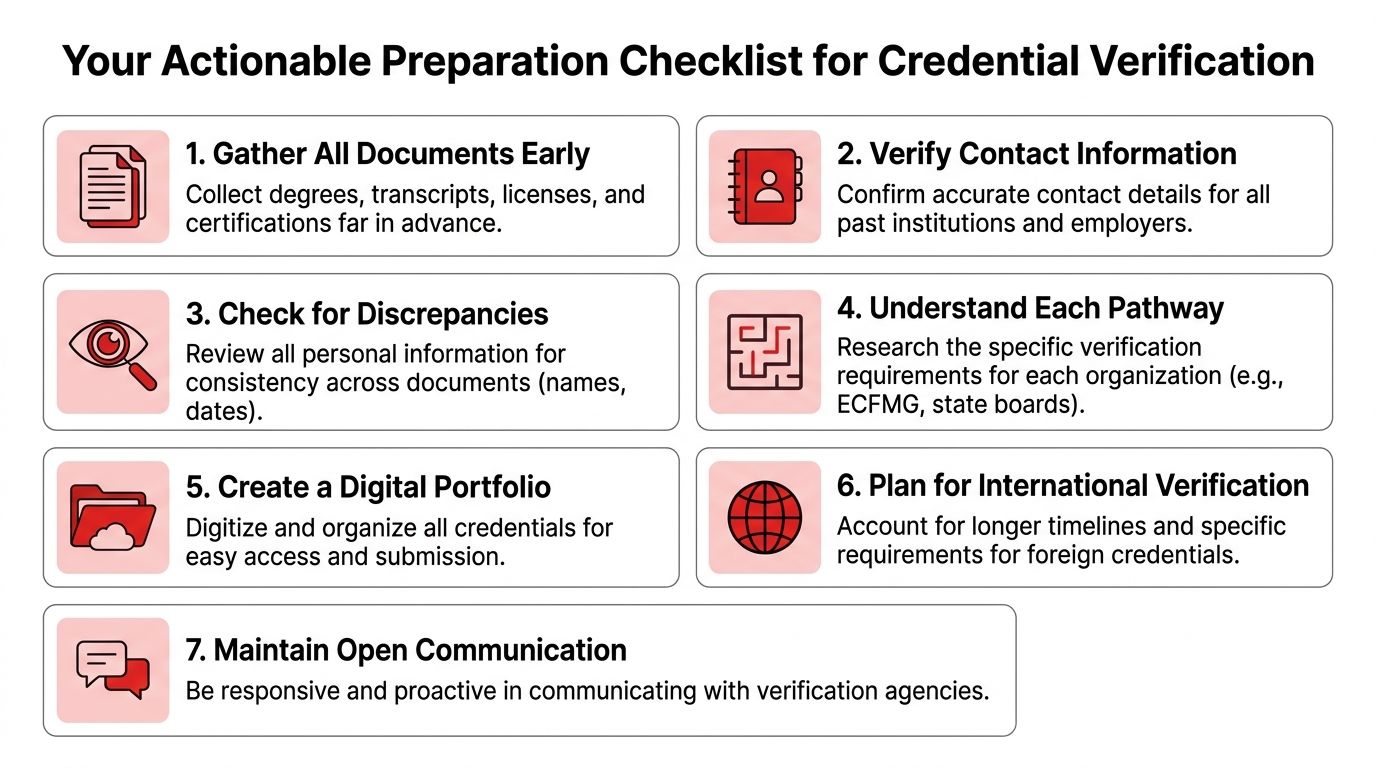
Your Actionable Preparation Checklist
By the time a verification problem appears in a portal, you've already lost some control. The best move is to prepare before any agency, school, or program asks for documents.
That preparation doesn't have to be complicated. It just has to be deliberate.
The checklist that saves time later
- Build a master credential folder: Keep diploma, transcript, ID, exam records, training letters, and legal documents in one organized place
- Confirm registrar contact details now: Don't wait until a deadline week to discover an office changed its email or process
- Check every name and date: Review all documents for consistency before you submit anything
- Learn your pathway early: IMG, U.S. senior, re-applicant, and licensure-track physicians run into different verification demands
- Prepare for paper-based institutions: If your school is slow or manual, gather alternate contacts and start earlier than feels necessary
- Keep a follow-up log: Track requests, responses, resend dates, and unresolved issues in one file
- Document transitions carefully: If you have a gap year, role change, research period, or name change, collect proof before someone asks for it
Strong applicants don't avoid bureaucracy. They out-organize it.
Credential verification can feel opaque because most of the process happens behind the scenes. But the applicant's side is still manageable. Clean records, early outreach, and persistent follow-up solve more problems than last-minute scrambling ever will.
If you want expert support for exams, applications, and the parts of the medical path that become high-stakes fast, Ace Med Boards helps students and graduates prepare with experienced tutoring and advising adapted for USMLE, COMLEX, shelf exams, and residency planning.