The USMLE Step 3 First Aid book is the go-to, high-yield review guide for any resident gearing up to pass the final board exam. Think of it less like a textbook and more like a strategic battle plan for the test, condensing essential clinical knowledge, biostats, and patient management into one focused resource. It’s a powerful tool, especially when you use it hand-in-hand with a question bank like UWorld.
Understanding Your Core Study Tool
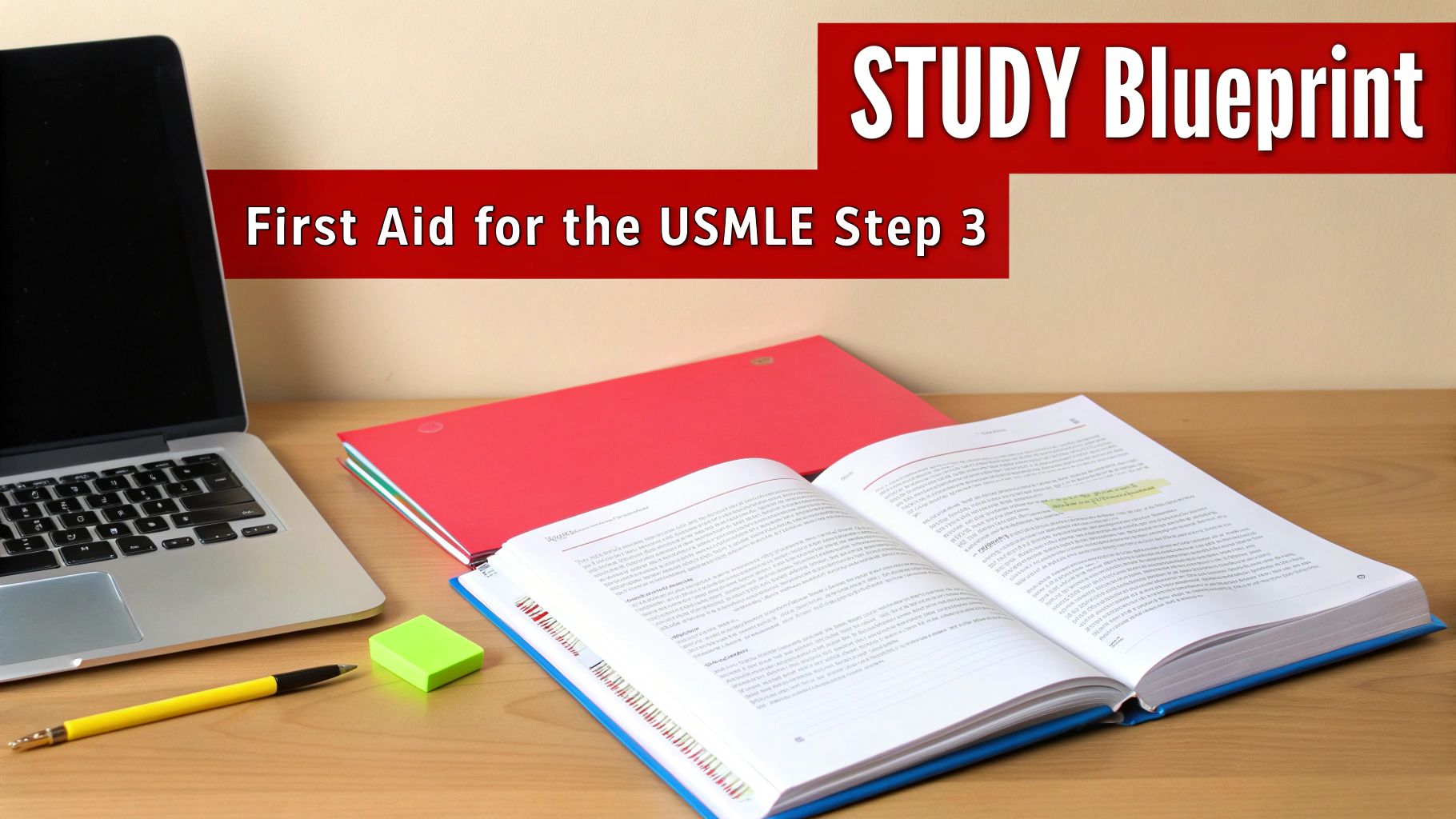
Getting over the final hurdle of medical licensure—the USMLE Step 3—demands a whole new game plan. You’re not just a med student memorizing pathways anymore. You're a practicing physician, and the exam expects you to make critical management decisions. This is exactly where the First Aid for the USMLE Step 3 book becomes your anchor.
Unlike the encyclopedic textbooks from medical school, this guide is built for pure efficiency. Its main job is to cut through the fluff and serve up only the concepts that show up on the exam again and again. It’s essentially a high-yield filter, making sure every minute of your precious study time is spent on what actually moves the needle on your score.
The Anatomy of First Aid for Step 3
At its core, the book is structured to tackle the unique two-day format of the Step 3 exam. It meticulously breaks down the material you'll need for both Day 1, Foundations of Independent Practice (FIP), and Day 2, Advanced Clinical Medicine (ACM). This is a big deal because each day tests a different, yet overlapping, set of skills.
- Day 1 (FIP) Content: You'll find sections zeroed in on biostatistics, ethics, patient safety, and the foundational sciences. These are often the topics where residents feel the rustiest, and First Aid provides that much-needed refresher.
- Day 2 (ACM) Content: The majority of the book is dedicated to clinical management across the major specialties—internal medicine, pediatrics, surgery, and more. This preps you not only for the multiple-choice questions but also gives you a solid framework for the computer-based case simulations (CCS).
The information is laid out in an incredibly digestible way, with concise text, smart mnemonics, and full-color diagrams. This design makes thorny topics, like remembering antibiotic coverage or complex management algorithms, much easier to lock into your brain, especially under exam day pressure. To see how to build a complete study plan around these concepts, check out our in-depth guide on how to study for USMLE Step 3.
This book isn’t just a collection of facts; it’s a strategic framework. It teaches you how the exam thinks by emphasizing next-best-step clinical reasoning, a skill that is paramount for success on both the multiple-choice questions and the CCS cases.
More Than Just a Book
The best way to use the USMLE Step 3 First Aid book is as the central hub for your entire study plan. It’s the home base where you consolidate everything you learn from other resources. While it's an amazing guide, it truly comes alive when you pair it with active learning. For example, after grinding through a block of UWorld questions, you should be annotating the key takeaways directly into the corresponding pages of your First Aid book.
Doing this transforms it from a passive reading tool into a dynamic, personalized study guide that’s perfectly molded to your specific strengths and weaknesses. And while this book should be the backbone of your prep, it’s always smart to have access to other materials for deeper dives. For getting digital access to a huge library of academic texts, a Perlego student discount can be really helpful. By weaving these resources together, you build a comprehensive understanding that goes way beyond rote memorization, setting you up to confidently handle the nuanced clinical scenarios you'll face on the real exam.
Decoding the High-Yield Content
To really get the most out of the USMLE Step 3 First Aid book, you have to see it for what it is: an exam blueprint in book form. It's not just a collection of facts thrown together. It’s a strategically designed guide that mirrors the actual Step 3 exam, pointing you directly toward the topics most likely to show up.
This is a huge deal because Step 3 covers a massive amount of clinical medicine. Without a solid guide, it's incredibly easy to get bogged down in obscure details and completely miss the core concepts that rack up points. First Aid keeps you on track by dedicating the most space to the heaviest-weighted subjects, making sure your study time is spent where it counts.
Prioritizing Chapters for Maximum Impact
Not every chapter in First Aid for Step 3 deserves equal attention, simply because not all topics are weighted equally on the exam. Your main focus needs to be on the sections that make up the biggest chunks of the test. Internal Medicine, for instance, is the undisputed heavyweight, both in the book and on the actual exam.
Likewise, you need to live in the Ambulatory Medicine and Emergency Medicine chapters. These sections are gold because they directly reflect the real-world scenarios you’ll encounter in the Computer-based Case Simulations (CCS). You'll notice the book is packed with diagnostic algorithms and management flowcharts in these areas, which are perfect for building the clinical reasoning skills you need for both the CCS cases and the multiple-choice questions.
Here's a practical way to break down your study priorities:
- Tier 1 (Highest Priority): Internal Medicine, Ambulatory Medicine, Biostatistics, and Ethics. This is the foundation of the exam. Master it.
- Tier 2 (High Priority): Pediatrics, Surgery, Emergency Medicine, and Obstetrics & Gynecology. These are essential and show up frequently.
- Tier 3 (Moderate Priority): Psychiatry and other subspecialties. They're still important, but they make up a smaller slice of the exam pie.
To help you visualize this, here’s a table comparing where First Aid places its emphasis against the official exam weightings. Use this to fine-tune your study plan and avoid spending too much time on lower-yield topics.
First Aid Content Focus vs USMLE Step 3 Exam Weightage
| Medical Specialty or Topic | Approximate Focus in First Aid | Official USMLE Step 3 Content Weighting |
|---|---|---|
| Internal Medicine | Very High | 20-30% |
| Ambulatory Medicine | High | 20-30% |
| Emergency Medicine | High | 10-15% |
| Pediatrics | Moderate-High | 8-12% |
| Surgery | Moderate-High | 8-12% |
| Obstetrics & Gynecology | Moderate | 8-12% |
| Psychiatry | Moderate | 5-7% |
| Biostatistics & Ethics | High | 10-15% |
This comparison makes it clear: aligning your study time with the high-yield topics covered extensively in First Aid is the smartest path to a higher score.
The Power of Mnemonics and Visuals
One of the things that makes the USMLE Step 3 First Aid guide so effective is its brilliant use of memory aids. It takes complex topics and boils them down into catchy mnemonics and clear, full-color illustrations that make tough concepts click. This isn’t just for looks; it’s a proven method for improving how well you remember information under pressure.
For example, trying to memorize all the antiarrhythmic drugs can be a nightmare. But First Aid uses clean visual charts and simple mnemonics to make the Vaughan-Williams classification system feel intuitive. Instead of just cramming drug names, you learn to see their mechanisms, making it way easier to apply that knowledge to a vignette about a patient in A-fib.
Another classic is acid-base disorders. The book lays out simple, step-by-step diagrams for interpreting arterial blood gases, complete with the compensation formulas you need to know. This visual approach turns a confusing topic into a logical process. To see how these ideas play out in an exam setting, it’s a great idea to work through some sample USMLE Step 3 questions.
The whole point of these tools isn't just to help you cram facts. It's to build a solid mental framework you can pull from quickly and accurately when the exam clock is ticking.
This resource has become a staple for residents for a good reason. The fifth edition, for instance, packs 512 pages with thousands of high-yield facts, mnemonics, and visual aids all tailored for the two-day exam. You can explore more details about this edition's comprehensive content. By zeroing in on these high-yield elements, you're not just studying harder—you're studying smarter.
Integrating First Aid with UWorld and AMBOSS
Let’s be clear: the USMLE Step 3 First Aid is a fantastic high-yield resource, but treating it like a standalone textbook is one of the most common mistakes residents make. To really get your money's worth, you have to pair it with active learning tools.
Think of your study resources like a clinical team working together on a complex case. First Aid is your evidence-based textbook, UWorld is your demanding clinical rotation where you apply that knowledge, and AMBOSS is your on-call subspecialty consult for when you get stuck.
When you use them together, you create a powerful system. You’re not just passively reading—you’re actively diagnosing your own knowledge gaps, treating them with targeted review, and locking in those concepts for good. This integrated approach turns your study time into a highly efficient cycle of learning, doing, and reinforcing.
Building Your Integrated Study Workflow
The key here is creating a feedback loop between your question bank and your book. Don't just read one and then do the other; make them talk to each other.
Start by picking a topic in First Aid, say, Cardiology. Spend a focused session reading through the chapter to get a solid foundation on the high-yield stuff, like heart failure management or the arrhythmia algorithms.
Then, immediately fire up a block of UWorld questions dedicated to Cardiology. This is where the magic really happens. As you grind through the questions, you'll see in real-time which concepts you actually understand and which ones are still a bit fuzzy.
The goal isn’t just to get questions right. It's to understand why you got them right or wrong. Every incorrect answer is a gift—it’s a bright, flashing arrow pointing directly at a specific weakness you need to fix.
After finishing the UWorld block comes the most critical step: annotation. Go back to your First Aid book. In the margins of that Cardiology chapter, jot down concise notes from the UWorld explanations. For instance, if you missed a question on the unique side effects of a new diabetes drug, add a quick, bolded note right next to that drug in the book. This process transforms First Aid from a generic text into your personalized, battle-tested guide. To really nail this process, check out our expert guide on how to use UWorld for Step 3.
Using AMBOSS for Deep Dives
While UWorld is your workhorse for practice, AMBOSS shines as a rapid-fire clinical encyclopedia. It’s perfect for those moments when a UWorld explanation doesn't quite click, or you hit a complex topic in First Aid that needs a bit more context.
Think of it as your digital consult. If you're struggling to tell the various vasculitides apart, a quick search in AMBOSS will pull up concise tables, images, and diagnostic criteria that clear things up in seconds. This prevents you from getting bogged down in the weeds and helps you keep your study momentum going.
This simple infographic breaks down the cyclical learning process: prioritize a topic, study it actively, and then master it through application and review.
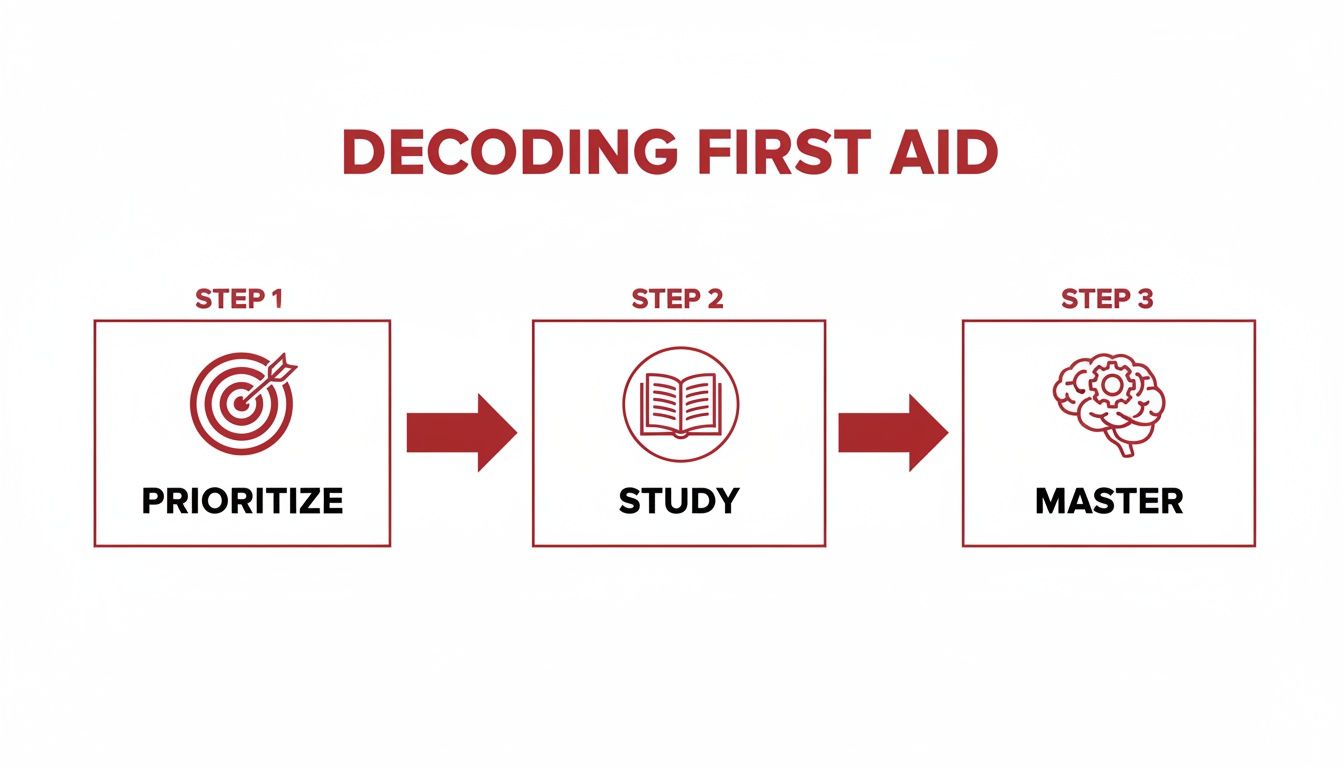
This workflow shows how each resource builds on the others, creating a powerful, self-correcting study system that leads to genuine clinical mastery.
Using First Aid to Master CCS Cases
Let's be honest: the Computer-based Case Simulations (CCS) are probably the part of Step 3 that keeps you up at night. It’s a totally different beast from the multiple-choice questions we've all grown used to. CCS throws you into the deep end, demanding real-time clinical decisions.
This is exactly where USMLE Step 3 First Aid transforms from a review book into an essential training manual. It’s no longer just about facts; it’s about your clinical playbook.
Think of those mini-cases and management algorithms you see throughout First Aid as your scripts for the CCS. They lay out the fundamental approach for common clinical scenarios, giving you a clear roadmap for initial orders, diagnostic workups, and immediate treatments. The real challenge, of course, is taking that static knowledge off the page and applying it in a dynamic, ticking-clock simulation.
From Book Knowledge to Clinical Instinct
The secret to crushing the CCS portion is developing a systematic approach that becomes second nature. You need to be able to apply it to any case that pops up, no matter the chief complaint. First Aid is your partner in building this clinical reflex by drilling the patterns of management over and over again.
Your mission is to internalize these patterns so deeply that you can act with confidence on exam day without hesitation. For instance, when a chest pain case appears, your brain should immediately flash to the "Chest Pain" algorithm in First Aid. This gives you a mental checklist for your opening move: EKG, cardiac enzymes, chest X-ray, and getting the patient on a monitor with IV access and O2.
Having that solid foundation lets you place your initial orders confidently and then, crucially, advance the clock to see what happens next.
The real magic of First Aid for CCS prep is how it trains your brain to think in algorithms. It helps you spot the clinical cues, order the right tests in the right sequence, and anticipate the next move before the simulation even updates.
The fifth edition of First Aid for the USMLE Step 3 is particularly strong here, packed with resident-tested tips for these simulations. Remember, the CCS section includes 13 cases and accounts for a massive 25% of your final score on Day 2. Historically, poor performance on CCS is a major reason people fail Step 3, making this part of your prep absolutely non-negotiable.
Building a Practical CCS Workflow with First Aid
Just reading the mini-cases won't cut it. You have to actively practice them. One of the most effective ways to do this is by using First Aid as your pre-game playbook right before you jump into a practice case on a simulator like UWorld's CCS.
Here’s a step-by-step breakdown of how to weave First Aid into your CCS practice:
- Pick a Case in First Aid: Flip to a mini-case, like Diabetic Ketoacidosis (DKA). Before you read the answer, cover up the management steps.
- Simulate Your Initial Orders: Grab a blank piece of paper and write down the very first orders you would place based on the vignette. Ask yourself: what are the five most critical things I need to do for this patient right now?
- Compare and Analyze: Now, uncover the management section in First Aid and compare it to your list. Did you remember to order a BMP and check the anion gap? Did you include IV fluids and an insulin drip? This simple comparison instantly shines a light on what you missed.
- Practice on a Simulator: With the First Aid algorithm fresh in your mind, launch a DKA case on your CCS software. Go through the steps you just reviewed. This active repetition is what forges the muscle memory you’ll rely on during the real exam.
This process turns passive reading into an active, hands-on drill. It closes the gap between knowing what to do and knowing how and when to do it inside the tricky CCS interface. For a deeper dive into winning strategies, check out our dedicated guide on how to approach Step 3 CCS cases. This kind of systematic practice is what builds the clinical instincts you need to manage cases efficiently, advance the clock with confidence, and provide timely, life-saving care.
When to Consider Personalized Tutoring
While self-study with USMLE Step 3 First Aid and UWorld is the classic combo for most residents, sometimes that well-worn path just doesn't lead to the score you need. Hitting a plateau with your practice scores, feeling crushed by a brutal residency schedule, or just plain struggling with certain concepts—these are all signs that you might need a more personalized approach.
Think of a good tutor as the attending physician for your exam prep. You're the resident in the trenches, seeing the "patients" (practice questions) and making the calls. The tutor provides that expert oversight, helping you sharpen your clinical reasoning, spot the diagnostic errors you keep making, and ensure your study plan is both effective and efficient.
Identifying Your Unique Study Challenges
Every resident's path to Step 3 is different. One person might crush multiple-choice questions but completely freeze up on CCS cases. Another might have rock-solid clinical knowledge but get tripped up by every biostats and ethics question. A great tutor’s first job is to run a "diagnostic workup" on your study habits and knowledge base.
This process often uncovers weaknesses you didn't even know you had. For instance, maybe you’re consistently missing questions on renal physiology. It might not be because you don’t know the facts in First Aid—it could be that you’re struggling to apply those facts to complex clinical vignettes. A tutor can spot that pattern and give you a real strategy to fix it.
A personalized tutor takes you way beyond just memorizing high-yield facts. They teach you the art of clinical application, showing you exactly how to connect the dots between a patient's presentation, lab values, and the next best step in management. That’s the core skill for both Day 1 and Day 2 of the exam.
Crafting a Targeted Action Plan
Once your specific challenges are laid bare, a tutor helps you build a customized study plan. This isn't some generic schedule pulled off the internet; it's a plan designed to integrate First Aid and other resources in a way that directly attacks your weak points.
Here’s what that targeted approach looks like in practice:
- For the Overwhelmed Resident: A tutor cuts through the noise. They'll help you focus only on the highest-yield topics in First Aid that will get you the most points, making sure every precious minute of study time counts.
- For the Plateaued Scorer: If your practice exam scores are stuck in a rut, a tutor can dig into your performance, pinpointing the specific reasoning errors or knowledge gaps that are holding you back.
- For the CCS Struggler: Tutors give you real-time, one-on-one feedback on your simulated cases. They can teach you the nuances of timing, order sets, and patient management that are almost impossible to master from a book alone.
This kind of individualized support does more than just boost your score—it builds real confidence. The journey through medical training is a marathon, and it's critical to have strategies for dealing with burnout in the medical profession. A tutor can be a source of both academic and motivational support.
To see how this kind of expert guidance can transform your prep, learn more about our dedicated USMLE Step 3 tutors and find out how they can help you conquer this exam.
Common Questions About Using First Aid for Step 3
When you're deep in the trenches of residency, staring down yet another high-stakes exam, it's natural to have questions. USMLE Step 3 First Aid is a cornerstone for most study plans, but the difference between passing comfortably and just scraping by often comes down to how you use it.
Let's clear up some of the most common uncertainties residents have. Getting these answers straight will help you build a smarter, more targeted study plan and walk into exam day with confidence.
Is First Aid for Step 3 Enough to Pass on Its Own?
This is the big one, and the answer is a hard no. While First Aid is an absolutely fantastic high-yield review book, it was never designed to be your only study tool. Relying on it alone is like having a detailed city map but never actually getting in the car to drive the streets.
Think of First Aid as the architectural blueprint for your study period. It gives you the essential structure and points out all the most important landmarks. But to truly learn the terrain—and handle the unexpected detours the USMLE loves to throw at you—you have to pair it with a top-tier question bank like UWorld.
First Aid provides the map, but question banks are how you learn to navigate the territory. There's simply no substitute for the active practice that builds the clinical reasoning and pattern recognition skills you need for Step 3.
This is even more critical for the CCS portion of the exam. First Aid has excellent mini-cases and algorithms, but you absolutely must get hands-on practice with dedicated CCS software to get a feel for the unique interface and the clock ticking down.
Which Edition of First Aid for Step 3 Should I Use?
Simple answer: always get the newest edition you can. Medicine changes constantly. Guidelines get updated, new drugs come out, and patient safety protocols evolve—and the USMLE keeps pace with all of it.
Each new edition of First Aid for the USMLE Step 3 is painstakingly updated by residents and faculty to reflect these changes. This ensures the information you're spending hours memorizing is actually current and relevant for your exam.
Trying to save a few bucks by using an old edition is a classic high-risk, low-reward move. You might be learning outdated treatment algorithms or completely missing newly emphasized concepts. The investment in the latest version is a small price to pay for the peace of mind that your study material is aligned with the current test.
What Is the Best Way to Annotate My Book?
This is where the magic happens. Effective annotation transforms your First Aid from a generic book into a personalized study guide laser-focused on your knowledge gaps. The goal isn't to color every page, but to create a single, consolidated resource that brings all your learning together.
The most powerful way to do this is to let your question bank performance guide you. Here’s a simple, effective workflow:
- Do a Block of UWorld: Knock out a set of questions on a topic, like Cardiology.
- Analyze Your Mistakes: For every question you get wrong, really dig into the UWorld explanation to pinpoint the exact concept you missed.
- Annotate in First Aid: Find the relevant section in your book and jot down a concise note in the margin. Don't copy the whole explanation—just the key pearl that will jog your memory later.
For instance, if you missed a question on managing hypertensive emergencies, you might add a quick note like, "IV labetalol preferred, AVOID hydralazine in aortic dissection" right next to the hypertension section. Some people find that using different colored pens for different categories (e.g., blue for diagnosis, red for treatment, green for pharmacology) helps with visual recall during that final cram week.
Can I Use This Book to Study for COMLEX Level 3?
Yes, absolutely. The First Aid for the USMLE Step 3 is an incredibly valuable tool for anyone prepping for COMLEX Level 3. The core clinical medicine content—all the internal medicine, peds, surgery, and ob/gyn—has a massive overlap between the two exams.
However, it is not enough on its own. The COMLEX has a unique and heavy focus on osteopathic principles that you won't find in the USMLE-focused First Aid.
To be fully prepared for COMLEX, you have to supplement First Aid with a resource dedicated to:
- Osteopathic Manipulative Treatment (OMT): This is a huge part of the exam.
- Chapman's Points: You have to know these reflex points cold.
- Viscerosomatic Reflexes: Understanding these connections is non-negotiable.
Use First Aid as the strong foundation for the vast majority of your clinical review, but make sure you layer in a COMLEX-specific resource to master the osteopathic components. That hybrid approach is the key to walking in fully prepared.
Feeling overwhelmed by the sheer volume of material for Step 3? You don't have to navigate it alone. Ace Med Boards offers personalized tutoring to help you create a targeted study plan that integrates First Aid, UWorld, and CCS practice to maximize your score. Schedule a free consultation today and see how expert guidance can make all the difference.