To really nail your USMLE exams, you need a smart, structured schedule that gets you doing practice questions right from the start. This isn't about randomly taking tests whenever you feel like it. It's about building a calendar that balances learning new material with the constant, active recall that question banks like UWorld or Amboss demand. The best way to kick things off? Take an NBME self-assessment early to get a baseline—it will shape your entire prep strategy.
Crafting Your High-Yield USMLE Practice Schedule
Jumping headfirst into thousands of practice questions without a plan is one of the most common mistakes I see. A well-thought-out schedule is the bedrock of solid USMLE prep. It’s what turns scattered effort into focused, measurable progress. This isn't about clocking more hours; it's about making every single hour work for you.
The real goal is to weave practice into your daily routine long before your dedicated study period even starts. Doing this builds up both your knowledge base and your mental stamina over time, helping you sidestep the burnout that hits so many students hard. Think of your schedule as a living document—one that you can tweak based on your progress as you uncover and attack your weaknesses.
Establishing Your Baseline Early
One of the single most powerful things you can do is take a National Board of Medical Examiners (NBME) self-assessment exam early in your prep. I’m talking months before dedicated even begins. So many students hoard these exams for the last few weeks, just using them to predict their score. That's a huge missed opportunity.
Taking an NBME early serves a much more strategic purpose: it gives you an honest, data-driven snapshot of your strengths and weaknesses across every subject. This first test isn't about getting a great score; it's about gathering intel. The results will tell you exactly which areas are crying out for attention, letting you focus your content review where it matters most, right from day one.
Key Takeaway: Think of an early baseline NBME not as a test of your readiness, but as a roadmap for your entire study journey. It helps you stop guessing about your knowledge gaps and start working with concrete data to build a truly targeted and effective plan.
Building Your Weekly Practice Routine
Once you have that baseline, you can start putting together a weekly schedule that mixes up your study methods. A rigid, jam-packed schedule is just setting yourself up for failure. Instead, plan your week in flexible blocks that you can shift around depending on your energy levels and classwork.
Here’s what a typical week might look like during your pre-dedicated or early dedicated period:
- Morning Blocks (High-Focus Time): Save your mornings for the heavy lifting—your UWorld or Amboss question blocks. Start with one 40-question, timed block a day. As your endurance builds, you can ramp it up to two.
- Afternoon Blocks (Review and Reinforcement): Use this time to meticulously review the morning's questions. This part is non-negotiable. You should spend at least as much time reviewing (both right and wrong answers) as you did answering the questions in the first place. After that, dive into content review focused on the weak spots you just identified.
- Evenings (Lighter Tasks): Evenings are perfect for lower-intensity work. This is a great time to watch review videos like Pathoma or Boards and Beyond, or to run through your Anki flashcards for that crucial spaced repetition.
- Dedicated Rest: Seriously, schedule it in. Take at least one full day or two half-days off every week. Real rest is productive. It prevents your brain from turning to mush and actually helps solidify what you've learned.
Beyond just the schedule, finding ways to optimize your workflow can make a huge difference. If you're an iPad user, checking out some of the best productivity apps for iPad can really help streamline how you study. Creating a personalized schedule is a critical first step, and our detailed guide on building a https://acemedboards.com/study-schedule-for-medical-students/ offers even more templates and strategies to get you started. This methodical approach ensures you're not just passively reading but actively grappling with the material every single day.
Choosing and Sequencing Your Practice Exams
With a dizzying number of practice exams out there, figuring out which ones to take—and just as importantly, when to take them—is a huge part of your study strategy. This isn't about collecting resources. It's about using them smartly to push your score as high as possible. When you get the sequence right, practice tests become more than just checkpoints; they become your most powerful diagnostic and predictive tools.
Your journey through these assessments should feel like a logical ramp-up, building your knowledge, stamina, and confidence along the way. Think of it in phases: establishing your baseline, diving into dedicated practice, and making time for essential rest before the big day.
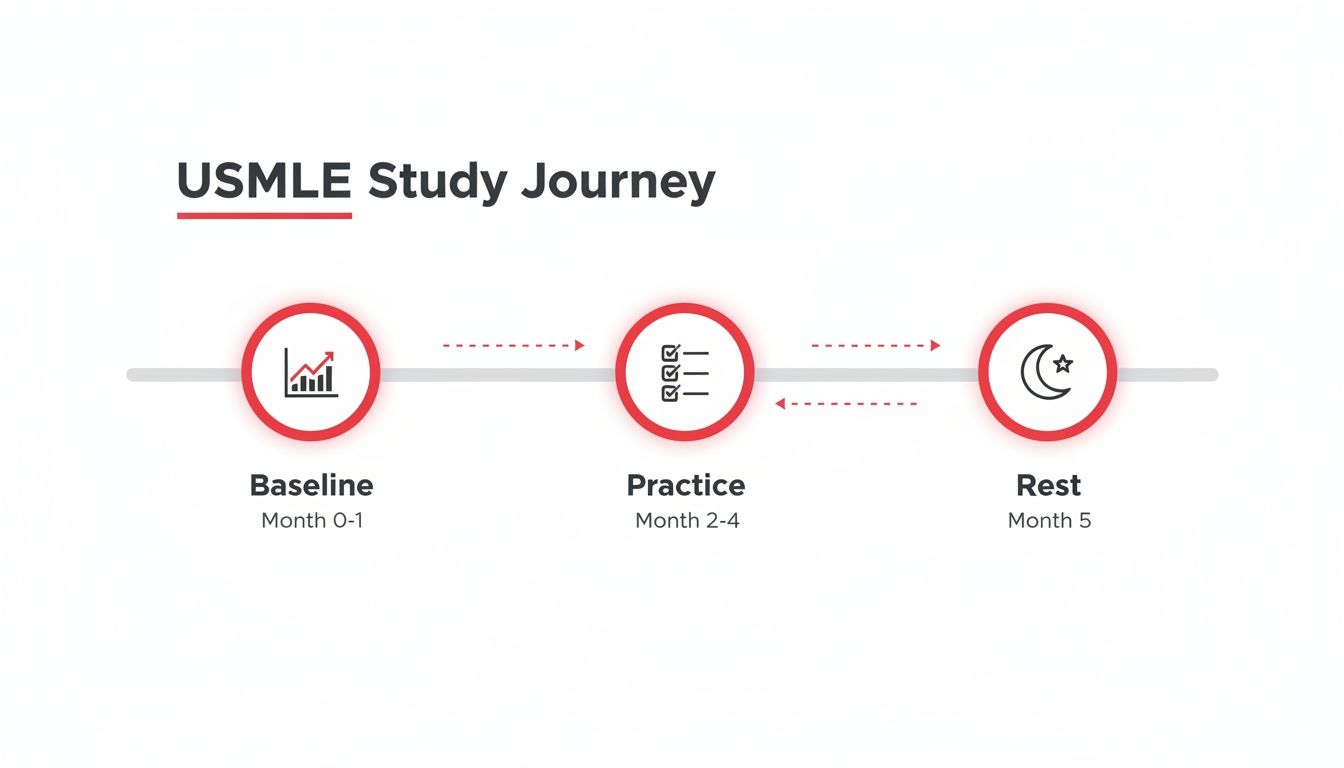
Breaking up your prep like this lets you focus on what matters most at each stage. You build a solid foundation first, then you turn up the intensity.
To help you visualize the flow, here's a typical sequence for practice exams during a dedicated study period. This isn't set in stone, but it's a battle-tested framework that works for thousands of students.
Recommended Practice Exam Sequence by Test Type
| Study Phase | Recommended Practice Exam (USMLE) | Recommended Practice Exam (COMLEX) | Purpose |
|---|---|---|---|
| Beginning | NBME Diagnostic (an older form) | COMSAE Diagnostic | Establish a baseline score and identify major content gaps from the start. |
| Mid-Point | NBME Mid-Point Check | COMSAE Mid-Point Check | Track progress, re-evaluate weak areas, and ensure your study plan is working. |
| Late-Mid | UWSA 1 | N/A (or another COMSAE) | Deep dive into content mastery and expose more nuanced knowledge gaps. |
| Final Stretch | Recent NBME Forms | Recent COMSAE Forms | Get an accurate score prediction using the most up-to-date materials. |
| Final Week | Free 120 / UWSA 2 | N/A (Free 120 is still key) | Final confidence boost, pacing practice, and exposure to real exam-style questions. |
This table provides a roadmap, but remember to be flexible. If a particular subject is consistently dragging your score down, you might need to adjust your plan to tackle it head-on.
The Gold Standard: NBME Self-Assessments
Let's be clear: the practice exams from the National Board of Medical Examiners (NBME) are the most important ones you will take. Period. These are the Comprehensive Basic Science Self-Assessments (CBSSAs) for Step 1 and the Comprehensive Clinical Science Self-Assessments (CCSSAs) for Step 2.
Why are they so critical? Because they're made by the same organization that writes the real USMLE. That means the question style, the interface, and the way topics are distributed are as close as you can get to test day. Their predictive power is legendary for a reason. Plan on taking several NBMEs throughout your dedicated study period, typically one every 1-2 weeks, to track your progress and fine-tune your focus.
For those gearing up for Step 2, our in-depth guide to NBME Step 2 CK practice exams breaks down how to choose and analyze these crucial assessments.
Understanding the Role of UWSAs
The UWorld Self-Assessments (UWSAs) are another pillar of a solid prep plan. While NBMEs are king for mimicking the test and predicting your score, many students find the UWSAs to be a more powerful learning tool. They have a reputation for testing concepts in excruciating detail, which is great for uncovering blind spots other exams might miss.
You'll typically have two UWSAs for each Step. A classic strategy is to take UWSA 1 about halfway through your dedicated period to see where your content mastery stands. Then, save UWSA 2 for the final one or two weeks. Just be aware—UWSAs can feel a bit harder and sometimes over-predict scores, but their explanations are second to none.
Integrating the Free 120
The Free 120 isn't just another practice resource; it's your final dress rehearsal. This is a set of 120 questions released by the USMLE organization itself, often containing retired questions from past exams. It's an incredibly accurate preview of what you're about to face.
You absolutely must do the Free 120 in the last few days before your exam. Take it under timed, simulated conditions to get a final feel for the pacing. It’s not uncommon for students to see a handful of nearly identical questions on their actual test.
Pro Tip: Don't just do the Free 120—master it. Go over every single question and explanation, even for the ones you got right. Understanding the logic behind each answer choice is one of the highest-yield things you can do in your last week.
How Sequencing Changes for Each Exam
While the core principles are the same, the strategy needs some tweaking depending on which exam you're facing.
Step 1 (Pass/Fail): The game here is to comfortably clear the passing threshold. But don't get complacent. In 2022, the first pass/fail year, the pass rate for MD and DO students was 91%. By 2024, those rates had dropped to 89% and 86%, respectively. The pass rate for International Medical Graduates fell to just 70%. You want to see consistent scores above 65-70% on your final NBMEs and the Free 120 to walk in with confidence.
Step 2 CK (Scored): Here, every point matters for residency applications. Your sequencing should be geared toward peaking at the right time. Most students save the most predictive NBMEs and UWSA 2 for the last two weeks to get the most accurate snapshot of their potential score.
Step 3 (Two-Day Exam): This exam is a different beast, mixing foundational science and clinical knowledge with Computer-based Case Simulations (CCS). Your practice plan has to include dedicated time for CCS cases (like those from UWorld CCS) in addition to your usual question blocks and full-length exams.
For osteopathic students taking the COMLEX, the pattern is similar. Use the official COMSAEs as your main score predictors, just as you would with NBMEs, while using UWorld and other qbanks for broad content review and question practice.
Simulating Test Day Conditions for Peak Performance
Thinking of your practice USMLE exams as just another Q&A session is a massive strategic mistake. These aren't just knowledge checks; they're your chance to stress-test your endurance, timing, and mental game for the grueling 8-hour marathon of the real deal. A true simulation is a dress rehearsal in every sense of the word.

This means you have to replicate test day as closely as humanly possible. If you don't, you're leaving yourself wide open to predictable pitfalls—decision fatigue setting in by the final blocks, disastrous pacing, and the kind of anxiety that can torpedo a rock-solid knowledge base. Each simulated exam is a golden opportunity to condition your mind and body to perform when it counts.
Creating a Distraction-Free Environment
Your first job is to transform your study space into a mini Prometric center. This isn't about comfort; it's about focus. Find a quiet spot where you absolutely will not be interrupted for the entire 8-hour stretch.
Let your family or roommates know you're off-limits. Put your phone in another room—not just on silent, but physically out of reach. This removes the temptation for that "quick check" during a break that would never happen on test day. The goal here is to train your brain to operate under strict, isolated conditions.
This process itself can be a huge source of stress for many students. If you find the pressure is creating more problems than it's solving, it's a good idea to explore our guidance on how to overcome test anxiety to build healthier coping skills.
Mastering the Clock and Pacing
On test day, the clock is your biggest opponent. Every simulation is a chance to sharpen your internal timer. The standard guideline is 90 seconds per question, but you have to build in a buffer for those questions that make you stop and think.
Here are a couple of practical timing strategies to drill into your routine:
- The "Mark and Move On" Rule: If a question has you stumped for more than a minute, make your best educated guess, mark it for review, and get out of there. Burning five minutes on one question is a recipe for disaster.
- Block Time Management: Try to finish each 40-question block with 5-10 minutes to spare. This is your time to go back to those marked questions. Don't second-guess every answer, but do give a fresh look to the ones that genuinely puzzled you.
This strict time management is your best weapon against decision fatigue, which gets progressively worse in the later blocks. By making your pacing automatic, you save precious mental energy for the actual medicine.
Expert Insight: Remember, the USMLE is a marathon, not a sprint. Your goal in the early blocks is to be efficient and accurate, banking both time and mental energy. This is what allows you to stay sharp and focused during blocks 6 and 7, which is where so many otherwise well-prepared students start to fall apart from sheer exhaustion.
Structuring Your Breaks Like a Pro
How you use your 60 minutes of total break time is just as crucial as how you answer the questions. Don't just take breaks when you feel like it; simulate the official schedule. You can split your break time between blocks however you want, so use your practice exams to figure out your ideal rhythm.
Here’s a sample break strategy you can try out and tweak:
- After Blocks 1 & 2: Take a quick 5-minute break. Get up, stretch, and use the restroom.
- After Block 3: Now take a longer 20-minute break. Have a pre-packed lunch or a substantial snack.
- After Blocks 4 & 5: Another quick 5-minute stretch break.
- After Block 6: Use your remaining 15-20 minutes for a final boost. A quick snack, splash some water on your face, and take a moment to reset before the final push.
Practice everything, including what you'll eat and drink. Skip the heavy, carb-loaded meals that lead to a post-lunch slump. Stick with light proteins, nuts, and plenty of water. By rehearsing every little detail, you eliminate variables and build the confident, automatic routine you need to perform at your absolute best.
Turning Performance Analysis into Actionable Insights
Finishing a full-length simulated exam is a huge milestone, but the real work begins the moment you click "submit." That score report is so much more than just a number; it’s a detailed roadmap pointing directly to your weaknesses. This is where you have to shift from being a test-taker to a detective, hunting for clues that reveal exactly why you’re leaving points on the table.

Simply glancing at your percentage correct and moving on is one of the biggest wastes of a valuable practice opportunity. A deep, systematic review of every single question—both the ones you got right and the ones you got wrong—is what separates students who plateau from those who see consistent score growth. It turns a source of anxiety into your most powerful tool for improvement.
Building Your Error Log
To really dig into your performance, you need a system. This is where an error log comes in, and it doesn't need to be fancy. A simple spreadsheet is perfect. The goal is to categorize your mistakes so you can spot the patterns you’d otherwise miss completely.
Set up columns for the question number, the general topic (like Cardiology or Pulmonology), the specific concept being tested, and—most importantly—the reason you got it wrong. This last column is where the magic happens.
Most errors fall into a few key buckets:
- Content Deficit: Plain and simple, you just didn't know the information.
- Misread the Question: You blew past a critical word like "not" or "except," or you missed a key patient detail in the vignette.
- Overthinking: You knew the right answer but convinced yourself it was wrong.
- Test-Taking Error: This covers things like running out of time or changing a correct answer at the last second.
Methodically tracking your mistakes gives you concrete evidence of your recurring issues. You might discover you're not weak in "Cardiology" as a whole, but specifically in interpreting EKGs or understanding heart murmurs. That level of detail is exactly what you need for targeted studying.
Key Insight: Your error log's primary job is to make your weaknesses impossible to ignore. After a few practice USMLE exams, you'll have undeniable proof of your most common error types, forcing you to address the root cause of your missed questions instead of just re-reading broad topics.
From Data to a Dynamic Study Plan
Once you’ve logged the data from a practice exam, it's time to put it to work. Look for trends. Are most of your errors from simple content gaps? That’s a clear sign you need to hit the books or find review videos for those specific topics. But if your log shows you’re constantly misreading questions, the solution isn't more content review—it's practicing a more deliberate, methodical approach to question dissection.
Let’s walk through a real-world scenario. A student keeps missing questions on renal physiology. After starting an error log, she realizes it isn’t a broad knowledge gap at all. Her log shows she gets 75% of questions about acid-base disturbances wrong, specifically because she mixes up the formulas for anion gap and Winter's formula under pressure.
Instead of re-reading the entire renal chapter, she can now focus her energy on drilling just those concepts with flashcards and targeted practice questions. This transforms her study plan from a passive review into an active, surgical strike on her weakest points. If you're looking for more ways to analyze your performance, especially for Step 2, our guide on NBME USMLE Step 2 practice tests provides additional strategies.
Analyzing Correct Answers
It sounds counterintuitive, but it’s just as important to review the questions you answered correctly. Why? Because sometimes you just get lucky. You need to be brutally honest with yourself and confirm you got the question right for the right reasons.
When looking at a correct answer, ask yourself:
- Did I know this answer cold, or was it a 50/50 guess that went my way?
- Could I explain to someone else exactly why the other answer choices were wrong?
- Was my reasoning sound, or did I stumble into the right answer through flawed logic?
This honest self-assessment helps solidify your knowledge and ensures your score truly reflects your understanding, not just a string of good guesses. The USMLE is a critical benchmark, and as of 2024, examinees from non-US and non-Canadian medical schools achieved a 73% pass rate on their first Step 1 attempt—a notable gap compared to their US and Canadian counterparts. Meticulous performance analysis is one of the most effective ways to close that gap. You can find more about these performance statistics directly from the source. This disciplined review process is how you build a stable foundation of knowledge that holds up under pressure.
Using Expert Tutoring to Break Through Score Plateaus
While dedicated self-study and meticulous performance analysis are the backbone of any solid USMLE prep, there often comes a point where your score just… stops moving. You’re putting in the hours, grinding through questions, and reviewing your exams, but your NBME scores have hit a frustrating wall.
This is a score plateau, and it's one of the clearest signals that it might be time to bring in an expert.
One-on-one tutoring isn’t about admitting defeat; it’s a strategic move to get an objective, experienced perspective on your performance. A great tutor does so much more than just re-teach content. They act as a diagnostic expert, digging into your thought processes to find the hidden patterns and blind spots that are holding you back.
When a Tutor Provides Maximum Value
So, how do you know when you’ve hit the point where a tutor is a smart investment? Certain scenarios are classic indicators that an expert's guidance can unlock serious progress. If any of these sound familiar, it's a strong sign that self-study alone might not be enough to get you to your goal score.
It's time to consider getting help when you're facing:
- Persistent Score Stagnation: You’ve taken two or three practice exams in a row with little to no improvement, even though you’re studying diligently.
- Can't Pinpoint Your Weaknesses: You’ve analyzed your error logs, but you can’t find a clear, actionable reason for your mistakes. The errors seem scattered and random.
- Overwhelming Test Anxiety: The pressure is getting to you. You find yourself second-guessing and making poor decisions on practice tests in a way you don't during regular study.
- Trouble with Question Interpretation: You consistently fall for trap answers or misread what a complex clinical vignette is actually asking.
In these situations, a tutor can provide the targeted intervention needed to get you back on an upward trajectory.
Deconstructing Your Performance Together
The single most valuable thing you can do with a tutor is a joint review of a recently completed practice exam. Sure, you can review an exam on your own, but a tutor sees things you simply can't.
They’ll ask you to walk them through your thought process on specific questions—not just the ones you got wrong, but also the ones you guessed correctly. This process uncovers flawed reasoning you might not even realize you have.
For example, a tutor might spot that you consistently over-value a single lab finding while ignoring more critical clinical signs in the vignette. They can then teach you a systematic approach to breaking down question stems, helping you prioritize information like a seasoned clinician. It’s all about refining your test-taking strategy, a skill that pays dividends on every single question you'll face.
Expert Takeaway: A tutor's real job isn't to give you the right answers. It's to teach you the process of arriving at the right answer, every single time. They help you build a reliable framework for thinking through high-pressure clinical scenarios.
Building a Hyper-Personalized Study Plan
After digging into your performance data and thought patterns, a tutor can help you build a study plan that is truly customized to your specific needs. This goes way beyond a generic weekly schedule you could make yourself. They can recommend specific high-yield resources or question sets that directly target the weaknesses they've identified.
If your issue is retaining pharmacology details, for instance, they might build a custom Anki deck for you or suggest a video series that excels at explaining mechanisms of action. This level of personalization ensures every hour you study is focused on the areas that will give you the biggest score jump.
For many students, this expert guidance is a critical part of their success, especially when facing unique challenges. You can read more about how a tutor for USMLE Step 1 can make a substantial difference.
It's also worth noting how targeted support influences outcomes globally. Pass rates for the USMLE vary widely, with students from Palestine achieving a 94.67% Step 1 pass rate, followed by Jordan at 90.96% and Lebanon at 90.91%. These high success rates often reflect strong foundational education and robust preparation resources. Tutoring can help bridge preparation gaps, giving students everywhere the strategies they need to excel.
Your Top USMLE Practice Exam Questions, Answered
Working through the logistics of practice USMLE exams can sometimes feel as complex as the material itself. You’ve got a schedule, you’re grinding through questions, but those nagging, specific questions always pop up. Let's clear the air and tackle some of the most common things students ask.
Think of this as a quick-reference guide to sharpen your strategy, build your confidence, and make sure you walk into test day ready for anything.
How Many Practice USMLE Exams Should I Take?
This is a classic "quality over quantity" scenario. There’s a sweet spot between taking too few to see a real trend and taking so many you burn out.
For a standard 6-8 week dedicated study period, aiming for 4-6 full-length assessments is a solid goal. This gives you enough data to track your progress without eating up valuable time that should be spent on targeted review.
A schedule that works for most students looks something like this:
- A baseline NBME right at the start to see where you stand.
- 2-3 exams mid-prep (a mix of NBMEs or UWSAs) to see if your study plan is actually working and to make adjustments.
- The Free 120 and a final NBME in the last week or two for a final score prediction and to lock down your pacing.
Remember, one practice exam that you review inside and out is worth more than three that you just glance over. Every test is a learning opportunity, not just another task to check off your list.
What Is a Good Score on an NBME Practice Exam?
"Good" is a moving target that really depends on the exam you're taking and what you're trying to achieve. There's no single magic number, but there are definitely reliable benchmarks to keep in mind.
For the pass/fail USMLE Step 1, it’s all about consistency. Most advisors agree that scoring above 65% on the newer NBME forms puts you in a relatively safe position to pass. If you want to walk in feeling extra confident, consistently hitting above 70% in your final weeks is a great target.
For the scored Step 2 CK, "good" is directly tied to the specialty you’re aiming for.
- A score above 240 is widely considered competitive for a broad range of specialties.
- If you're shooting for highly competitive fields like dermatology or plastic surgery, you should be targeting scores of 250+ or even 260+.
Pro Tip: While chasing a specific number is a decent goal, the most important thing to watch is your score trend. A steady upward climb shows that your study methods are working and your knowledge is solidifying.
Should I Simulate Breaks During My Practice Exams?
Yes. One hundred percent, absolutely. This is probably the most critical—and most overlooked—part of a true exam simulation. How you manage that 60 minutes of break time on test day can be the difference between finishing strong and crashing in the final blocks.
The USMLE isn't just a test of your medical knowledge; it's an eight-hour marathon of mental endurance. If you haven’t practiced your break strategy, you're risking serious fatigue and mismanaging your energy.
Use your practice exams to experiment. Figure out what you need. Do you need a quick snack after block 2? A moment of quiet focus before the last section? Rehearsing how you’ll use that precious time—down to the minute—builds a routine that cuts down on decision fatigue when it matters most.
My Practice Scores Are Not Improving. What Should I Do?
Hitting a plateau is incredibly frustrating, but it happens to almost everyone. First things first: don’t panic. Instead, it's time to get forensic with your performance analysis. Go back to your error log and look for the subtle patterns.
Are your mistakes always in one subject? Is there a type of error you keep making, like changing right answers to wrong ones or misreading the last line of the question stem? A deep, honest analysis will often point you to the root cause.
But what if you've done all that and are still stuck? That’s the perfect time to get an objective, expert opinion. This is exactly where targeted help can be a game-changer. An experienced tutor can comb through your performance data with you, spot the hidden weaknesses you’ve missed, and give you concrete, actionable strategies to break through that plateau and get your score moving up again.
If you've hit a wall or just want to make sure you're getting the most out of your hard work, the expert tutors at Ace Med Boards can provide the personalized guidance you need. We'll help you turn that effort into a score that truly reflects your ability. Learn more about our customized USMLE and COMLEX tutoring programs.